The northern Seoul suburb of Uijongbu has long been just a sleepy farming village north of Seoul of little consequence in Korean history.
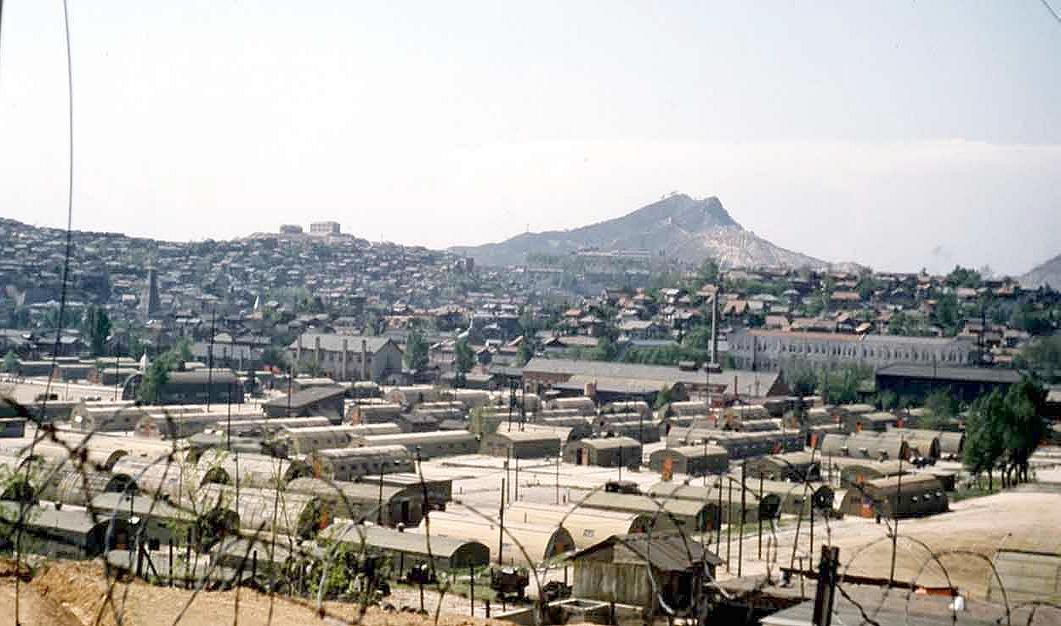
However all this would change in 1950 when it became a pivotal battlefield during the Korean War. The terrain around Uijongbu provided the last natural defensive positions before the North Korean army could reach Seoul. After the ROK Army forces lost the Battle of Uijongbu the gates to Seoul were open and the city would eventually fall only days after the North Korean invasion. Below is a picture of Uijongbu in 1950:
In the picture you can see Highway 3 which is the north-south highway running in the center of the picture and Highway43 which is on the right of the picture that is a northeast-southwest running highway. These two highways converge in Uijongbu and are the two routes the North Koreans used to capture the city during the Korean War. Interestingly enough the famous TV series M*A*S*H was based on the “4077th Mobile Army Surgical Hospital” that was stationed in Uijongbu during the Korean War.
Here is a picture that shows a US tank driving through Uijongbu during the Korean War:
After the war the city became known as a US military camp town called a “gijichon” in Korea when a large contingent of US soldiers were stationed in the city after the Korean War. Even though the town is host to US soldiers today, I don’t think anyone can claim with a straight face that Uijongbu is still a camp town considering its explosive growth that has made the city a thriving metropolitan center for Korea’s northern Gyeongi-do province. Here is a modern day Google Earth image of Uijongbu that shows how much it has grown as well as identifying the major US military installations in the city:
Read more about the US military installation in Uijongbu at the below link:
These following photographs should give everyone an indication of the explosive growth of this town. This below picture is taken from Cheonbo-san mountain that shows the US military base Camp Kyle in the foreground and Uijongbu in the distance tucked into the slopes of beautiful Dobong-san mountain in 1965:
Notice how Camp Kyle is on the outskirts of the city and is surrounded by farm land. I have had people in Korea now a days ask me why the US military built their bases within Korean cities? However what these people don’t understand is the bases were originally built outside of the Korean cities, but Korea’s explosive growth over the past few decades has completely swallowed these bases.
Here is a picture I took from the same vantage point back in 2005 that shows how Camp Kyle has been completely surrounded by the city:
Camp Kyle’s front gate at this time was very dangerous because you had large slow moving military trucks trying to turn on to a fast moving highway 43 that saw heavy traffic. So it should be no surprise that Camp Kyle was one of the US military bases in Uijongbu that was shutdown in 2005.
Here is a picture from the same vantage point in 2011:
In the picture it can be seen that Camp Kyle has been completely leveled as the land is prepared for redevelopment. Here is how Camp Kyle looked when it was still open in 2005:
Camp Kyle isn’t the only place being redeveloped, just down the road from Camp Kyle is Camp Sears which was also closed out in 2005. Here is how the camp looked when it was open in 2005:
Here is how it looks in 2011 after being leveled for redevelopment:
If you look closely in the earlier 2011 picture of Uijongbu you can see that the old Camp Essayons has been leveled as well in order to construct a university hospital. Here is what the camp looked like back in 2005 when it was open:
Another USFK base Camp La Guardia has also been leveled and can be seen in the center of the below photograph also when it was open in 2005:
Camp La Guardia was really a base that needed to be closed because it was an old airfield that had been completely surrounded by the growing Uijongbu. Not all the camps in Uijongbu have been closed though. Below is a picture of Camp Red Cloud that can be seen lying at the slopes of the hills to the west of town:
Camp Stanley is the other US military base still open in Uijongbu that lies right next to the Uijongbu Prison that is the building pictured below with the blue roof:
The land where these US military camps is located is not the only place in Uijongbu being redeveloped. In the past 10 years this entire city feels like it has been redeveloped. The heart of the city is without a doubt the area around the Uijongbu Train Station. The train station used to be this old brick building that Seoul Subway Line 1 ended and passengers could transfer to the KORAIL train system to travel to locations north of Uijongbu:
Below is a picture of this location at night where Uijongbu Station is infamous to GI’s as being a place where many of the cab drivers will try to charge you hugely overpriced fees to bring you back to you camp, especially when 2ID had a curfew because they knew soldiers had no choice, but to pay the extortion:
Today commuters don’t need to change on to the KORAIL line at Uijongbu Station since Seoul Subway Line 1 has been extended all the way to Dongducheon. Additionally the station has been torn down and being redeveloped into a massive shopping center/train station:
In addition to the train station the entire downtown area is being redeveloped as well. Here is a picture of downtown directly across from the east side of the train station:
The entire area has seen a number of new buildings go up that has really added to the city’s skyline:
Further into downtown away from the new buildings around the train station, the older Uijongbu of older buildings, street ajummas selling goods, crazy traffic, oblivious pedestrians, the blackmarket area, etc. can still be seen:
Here are a few pictures of the area of downtown Uijongbu to the west of the train station that was taken back in 2005. The first picture is of a wedding hall:
Just for comparison’s sake here is what a wedding hall in Uijongbu looked like in 1965:
Here is the main thoroughfare in this part of town in 2005 looking east towards Uijongbu Station:
Here is the view looking west towards the city hall complex at the end of the road, which by the way is a really nice structure:
I thought the big open road and the new construction made this area of Uijongbu look really nice, but in recent years it has been spoiled by the construction of a light rail transit (LRT) system known as the U-Line:
All over Uijongbu the concrete pillars from the U-Line are a major eye sore in my opinion:
The U-Line is supposed to help relieve the major traffic congestion that plagues the city. The traffic congestion has actually gotten much better in recent years. I can remember when it took an hour to drive from Camp Stanley to Camp Red Cloud. Now it can be done in half that time during even peak traffic times. A long time friend I have in Uijongbu told me he felt the U-Line had less to do with traffic congestion and more to do with being a big public works hand out to the companies involved in its construction. I guess time will tell how popular the U-Line will be with the locals in Uijongbu. I think the biggest demographic that will use the U-Line will be students.
Finally here is a view from a hill in the neighborhood of Geumo-dong looking towards downtown Uijongbu:
This picture of downtown Uijongbu 1965 only further shows how much the city has changed since then:
To the northwest of downtown is where Camp Red Cloud pictured earlier in this posting is located. Behind Camp Red Cloud a newer neighborhood of high rise apartments has been constructed in recent years along with a very nice sports stadium:
Besides the stadium a ice rink was constructed as well:
Across the street in front of Camp Red Cloud is where older buildings remain and is the location of a small ville for US servicemembers stationed at the camp:
The previously mentioned neighborhood of Geumo-dong is one of the fastest growing areas of the city. This is an area of the city that I know very well since I lived in this neighborhood for two years. Here is a picture of Geumo-dong viewed from the summit of Cheonbo-san mountain:
I can remember 10 years ago when Geumo-dong still had farms and small businesses and since then it has all been turned into apartments and a major shopping area:
Here is a picture of Geumo-dong’s main shopping district with the city’s only Home Plus at night:
Like much of Uijongbu, Geumo-dong also has a sea of apartments:
For those that have never lived in one of these high rise Korean apartments, they are actually quite nice. My apartment was a spacious three bedroom and two bathroom apartment on the 14th floor. I really enjoyed the view from being that high up and occasionally would run up the stairs for PT instead of taking the elevator. If you are wondering how Koreans move things to the higher floors they don’t use the stairs of elevators, they instead use these lift systems that quickly move furniture and other large items into the apartments:
The Geumo-dong neighborhood is also home to St. Mary’s Hospital:
This facility really is a good hospital with a foreigner friendly staff. They have an agreement with USFK to provide medical services for US military servicemembers and their families. The wife of one my soldiers gave birth to their daughter at this hospital.
Like the rest of Uijongbu, Geumo-dong also has some areas affected by the U-Line eyesore:
Overall though the U-Line isn’t as bad as a eyesore in Geumo-dong as it is downtown. Pictured below in Geumo-dong was one of my favorite places to eat Uijongbu’s most famous dish budaejigae:
Budaejjigae is Korean for “soldier’s stew” due to the spam and other ingredients added to the dish that was introduced to the local Koreans by US GI’s:
The restaurant can be found adjacent to the old Camp Kyle. My favorite place to grab a drink was a place in Geumo-dong called Beer School:
This place had a wide selection of foreign beer and would actually issue out merit badges and diplomas to repeat customers. The owners of the establishment were very friendly to GI’s that would stop by here. Unfortunately when I went to stop by Beer School recently it was closed and was turned into a Chinese restaurant.
In Geumo-dong behind the Northern Gyeongi-do government office is a trail up a hill that provides some nice views of Uijongbu. I used to go run up the trail up this hill for PT occasionally in the morning. Here is a picture of the sunrise from this hill on one of those mornings:
Here is an example of another spectacular sunrise I was able to get a picture of in the morning:
Here are some views of the other areas of Uijongbu once again as viewed from the hill in Geumo-dong. First is a picture of the southeastern are of Uijongbu, which is where Camp Stanley is located at:
The mountain that towers over this area of the city is Suraksan mountain. Adjacent to Camp Stanley Suraksan mountain has some very nice streams that are a good place to hang out at in the summer. This section of the city is one of the most lightly populated areas where rice fields still take up just as much land as houses:
All in front of Camp Stanley are fields of rice that are worked by prisoners from the Uijongbu Prison. Also just down the road from Camp Stanley is this large Buddhist temple:
Here is a view looking towards the southwest portion of Uijongbu which is backdropped by Dobongsan mountain:
The southwestern portion of Uijongbu is sandwiched between not only Dobongsan, but Suraksan mountain as well:
The stream that runs through this area is a very popular spot for fishing:
I have never tried to go fishing in this stream because I once saw a sewage truck dumping raw waste right into this stream before:
Despite becoming a dense urban city, a nice thing about Uijongbu is how easy it is to escape the city. All around the city is wilderness areas with Dobongsan mountain which is part of Bukhansan National Park being the primary spot for people to escape the city:
Dobongsan is an extremely scenic mountain with a variety of Buddhist temples, hiking trails, and creeks to play in the water that are popular with locals.
Another popular location for locals is Cheonbosan mountain located adjacent to the Geumo-dong neighborhood:
Cheonbosan is not as tall as Dobongsan, but despite this it provides better views of Uijongbu and the surrounding region than its more well known neighbor across town.
Notice that in 1965 the lack of trees on the mountain as well as the absence of the twin radio towers. Another place to escape the city is the mountains behind Camp Read Cloud. This is another area I used to go running at for PT. The winding road behind the camp leads to this nice lake where I have seen plenty of locals fishing at:
There are plenty of other hills around the city that I would go hiking at and exploring no matter the weather:
Occasionally I would run into random shrines like this one pictured below:
Or even find something unusual like a deer farm on the city’s outskirts:
All in all I really enjoyed my time living in Uijongbu and always stop by and visit friends in the city whenever I am in Korea. Every time I visit it is always interesting to see how much the city has changed. It is definitely no longer a camp town and quickly becoming one of the nicest commuter suburbs of Seoul in my opinion.
If anyone has any stories to share of their time in Uijongbu please share it with everyone in the comments section.
Those weren’t bran muffins, Brainiac…
11:13 am on July 25th, 2011 1
Great photos and analysis…
This statement: “I have had people in Korea now a days ask me why the US military built their bases within Korean cities? However what these people don’t understand is the bases were originally built outside of the Korean cities, but Korea’s explosive growth over the past few decades has completely swallowed these bases.” shows a great deal about the education and the mindset of the people asking the questions…
This page deserves repeated viewings and was a real gold mine for me since I’m trying to wrap my brain around the changes that have occurred there since my tour of duty in 1983. I still cant quite get over the general amount of development. I really had no idea before I found this ROK Drop site.
I’m wondering of all that signage on the outside of the buildings ever draws complaints from Koreans? It looks just crazy to me but I’m not sure if that’s just a cultural difference or what?
I lived in Uijongbu for 3 years in the late 90′s. I was a world class Soju drinker. My bar was the World Hof. I left in ’97 and have never been back. I enjoyed everything about Korea.
When I was at Hovey in the 80′s there was only one flashing light between Red Cloud and Casey. I will probably be going back within the next 2 years. hope I can handle it; it sure looks crowded now.
When I was there in 94, they where building a tunnel through the ridge line that runs behind Camp Kyle. Just to the east of Camp Sears. There was a road over the mountain which was a narrow winding one. One weekend a few of us where bored and decided to ride bikes over the mountain for something to do. The tunnel construction looked like they where putting in a 6 lane highway in place of the small 2 lane over the top. I didn’t understand the need for it at first, but the traffic picked up and I understood it – a constant stream of slow moving trucks and cars – even on a weekend day. I also remember on the other side of the ridge, we discovered what seemed to be a farm raising dogs. It had a big Purina sign on the fence. It didn’t seem like the where raising them as purebred puppies to sell — looked more like meat production to a farm boy like me….
I also remeber the rapid construction everywhere in general. Korea obviuosly didnt have the safety standards involved in construction they way we do in the US. I remember highways with buildings sticking out into lanes and utility poles in the middle of roadways with nothing more than yellow lines painted around them. Other places where they opened sections of new highways with no merge / speedup / decelaration areas — 2 or 3 lanes just go full speed to the end onto the old 1 lane (or worse, gravel) road….every trip to Yongsan was allways an adventure….
I’ve lived here in Uijeongbu since 2007 and I really liked this article. The 1950s pictures are great. Currently they are building a Shinseghe mall around Uijeongbu station that is supposed to be the largest in Korea. Bigger than the Seoul malls. Also they are adding another subway line. I think they have big plans for Uijeongbu.
Wow. Seeing Camp Sears flattened was a bit sad, but I suppose that was going to happen sooner or later. I was there from 80-81. What a great year that was. I had a really memorable time there. I couldn’t wait to leave, but I didn’t want to go so soon if that makes any sense.
I recently found an author named Martin Limon that has written a good series of books about two US Army CID guys in Seoul set in the early to mid 70′s. I think anyone that was stationed over there would enjoy reading them. I did.
I was station in the Uijeonbu area 1959-1960, 13 Trans Co (Lt Hel), H-21C Helicopter. All these pictures are a marvel…I cant recognize the area any more. Wonderful progress!
Glad I found your site. I will be traveling to Korea in late June and didn’t know what to expect, having been there in 1953. You prepared me to not expect a village (Ouijonbu) or rubble (Seoul)
My name is Ronda Cavel, my husband served at 59th AVN at Camp Red Cloud from March 1966 thru April 1967. He now has stage 4 lung cancer in both lungs. I am trying to find out about any chemical spraying, just before these dates and during these dates. Also would like to find any of his buddies that served during this same time period.
What time will do to a place. Uijongbu was a small village in 1968-69. Maybe I just saw it from the base of the moutain, where our CommCenter was set up. We were north of the city, but it’s really changed.
I was stationed at camp Essayon in 1954. The highest building in town was a 2 story bank. mostly surrounded by rice paddies and a river going through, right in front of camp essayon’s we used to was our trucks in it
Hi, has anyone heard of Camp Indian in Uijongbu. This was an army base surrounded by cinder blocks. Very small camp surrounded by creek and homes. This camp is closed and overgrown with weeds now. It is near Camp Stanly set off the main road. I don’t know when it was erected but was opened at least until 1961.
Hello Friends:
Reference my comment #19. When I was stationed at Camp Stanley there was a young Korean boy named “Johnny”. He stayed in the ROK barracks, I think. He was “adopted” by us soldiers. A man that was in my section Al Doucette. He wrote”As for Johnny, yes, I do remember him. I have quite a few pictures of him. He was a
nice young kid. Do you remember a Quackenbush? He was married to a Korean woman and had a little daughter. If, I’m not mistaken, he was trying to adopt Johnny. I don’t know if he did”…
Question: Does anyone remember Johnny? I pray that he is OK and maybe a citizen of the USA.
Good memories of the 13th Trans Co (H-21). God Bless, Donald R. Fox, retired, CSM
Just took a rushed 1/2 day trip from OSAN to see this city…my dad served somewhere here during the Korean War and I wanted to at least set foot in the same town since this is my first trip to Korea (2-weeks of USAFR training). I took several pictures of the blocks surrounding the train station and mall…I am really bummed that I didn’t have chance to do this research on the city before I went…your site provides a great overview and would have made my trip much more productive…since I had no idea what to expect when I got there. Let me know if you’d like pictures I took…would be happy to email them to you.
I’m trying to help my boyfriend’s daughter (Angela) find her mother’s family when I came across this website. The photos of the area around Uijongbu are beautiful! Angela’s dad was stationed in Camp Stanley and her parents were married there about 1980-81. Her mother was Korean. Does anyone know how to go about getting a marriage record from that time and place?
I’m trying to help my boyfriend’s daughter (Angela) find her mother’s family when I came across this website. The photos of the area around Uijongbu are beautiful! Angela’s dad was stationed in Camp Stanley and her parents were married there about 1980-81. Her mother was Korean. Does anyone know how to go about getting a marriage record from that time and place?
Thanks for any help anyone can give.
Dolores.
– See more at: http://rokdrop.com/2011/07/25/a-profile-of-uijongbu-south-korea/#comment-509526
Wonderful site. I’ve been stationed at Red Cloud almost a year. This past labor day weekend, I made my way through the trails that start behind Uijeongbu City Hall that lead to a trench system and a hiking trail. Went all the way to the top of a mountain. Not sure what part of what mountain, but it’s East by South east from Uijeongbu. Love the city and the Korean Culture.
Unbelievable!! When I was in Korea in 1953 Uijongbu was just an intersection of dusty dirt roads on the way from Seoul to Chorwon. drove through the place many times and it is hard to conceive of the progress that has been made. Guess that is why the North Korean government won’t allow their citizens to visit the South.
Co. L, 15th Regt. 3rd Div. went into reserve just north of Uijeonbu. We desperately needed replacements. It was just a sandy plain with some wrecked homes. I can’t believe how this city evolved.
I’m so glad I found this website. I was abandoned as a baby in 1966 and recently discovered that I was found in Uijeongbu. Seeing the photos from around that time was a real eyeopener for me. The only details the adoption agency can give me is the address of the house where I was found at the age of one month. Unfortunately all other records are now lost. Luckily for me I was adopted, not by Americans, but my dad was in the British army stationed in Hong Kong. Seeing these photos and reading the comments of people who were there at the time is quite emotional for me. Thanks for the images!
One thing I would be interested if someone could tell me if Korea was still recovering from the war by then (1966) as the adoption agency told me so and that a lot of families still abandoned their babies around that time?
I was there in 1965 and 1966. Yes, Korea was still recovering from the war, though I didn’t see any war-damaged buildings. That part of recovery was pretty well over. But modernization was around the corner. Farmers typically plowed with oxen, and ox carts were a common part of daily traffic along with bicycles. Riding a streetcar in Seoul I noticed that it was American and had a patent date of 1897 on the control panel. By today’s standards many people were poor, and there were a few beggars in the streets. I took a lot of pictures, and one of these years, if I live long enough, I’ll put them on my website.
Friends:
Reference # 19 and 29.
My tour was 1959-1960. Camp Stanley, 13th Trans Co (H-21). The road from Camp Stanley to Seoul was all dirt/rock. Women washed their clothes in rivers/creeks. Farmers used oxen. I never observed any tractors, etc. We had no showers/bath area for the first six months of my tour. I continue to marvel at the great improvements. It is beyond my understanding the progress in Korea and military installations also. God Bless You All,
CSM (Retired) Donald R. Fox
Does anyone have any information about the 60th transportation company at uijeongbu. I was stationed there from 1964 to 1965. I cannot remember the name of the camp. I cannot find any information about it. It’s like it never existed. It was a small camp not far from camp Red Cloud . Would like to hear from anyone who has any information and would like to share stories.
Larry, we’re in the same boat. I don’t remember the name of the camp where I was stationed either. I was over there just after you, 1965-1966, in the 5760h Signal Company attached to a missile battery. I guess I need to dig up a picture and post it to see if anybody can ID the place.
Wonderful site! So happy to find it.
I was there from 62 till 67 as a defense contractor, and have visited a couple of times since. But last time was in the 70s. What changes!
Do you happen to know anything about the 696th Ammunition
Supply Point just south of CRC. I think it was called ToBongSan ASP. I would like to know if it still exists. I heard there were some terrible floods in the area, but know no more.
In 62 it was the location for the 9th Ord Detachment (Direct Support) HAWK. The 9th later became a part of the 2/71st ADA Artillery.
Any leads about the area would be very much appreciated.
Thanks. and compliments on the wonderful work.
uijeongbu ,60-62 co.c 51st signal bn.I corp. most compounds were co. size,like 55th M.P.s , 3rd L.A.S, camp red cloud was 3-4 miles away. outside our co.wire the houses [houches]were mud with thach roofs.the people were very poor,hard workers.my heart broke for the children life was hard , winter deadly for them.
i’m glad things have improved so much over there.
thank you for this great site.
rance
just browsing thru,,shocked at the improvements,was at 128th aviation co uijong-bu 73-74. nothing there then except hangers and barracks,had a good time but lost and found some very good friends,changed my life forever, skoshi-man
– See more at: http://webcache.googleusercontent.com/search?q=cache:ILamordv0HsJ:rokdrop.com/2011/07/25/a-profile-of-uijongbu-south-korea/+&cd=1&hl=en&ct=clnk&gl=us#sthash.Rb200M7G.dpuf
The Korean Demilitarized Zone (DMZ) was established with the signing of the armistice agreement that ended the Korean War on July 27, 1953. It was agreed upon that the DMZ would separated the two Koreas by creating a buffer zone four kilometers wide across the width of the 151 mile wide Korean peninsula. This buffer zone would be created in roughly the same positions that the warring parties had ended the conflict at. The Military Demarcation Line (MDL) would be the official border between the two countries while the two kilometers of the buffer zone to the north of the MDL would be monitored by North Korea while the two kilometers of the buffer zone of the south of the MDL would be monitored by South Korea. It was further agreed upon that no opposing force would enter the territory, air space, or contiguous waters under the control of the other country.
The United States military used to monitor the area of the DMZ north of the Imjim River with the 2nd Infantry Division as well as along the Chorwon corridor with the 7th Infantry Division. The 7th Infantry Division with redeployed in Korea in the 1970’s leaving the 2nd Infantry Division to continue their monitoring of the DMZ north of the Imjim River. The 2nd Infantry Division ultimately gave up the sole responsibility of monitoring the DMZ north of the Imjim River in the 1980’s and has now handed over all responsibilities for monitoring the demilitarized zone to the Korean Army. Besides the monitoring of the DMZ by the ROK Army a small contingent of civil police authorized by the armistice man 114 guard posts that monitor activity on the DMZ. The DMZ Civil Police also man two guard posts that overlook the Neutral Nations Supervisory Commission (NNSC) housed at the Swiss/Swedish Camp, the Joint Security Area (JSA), and Tae Song Dong.
Military Armistice Commission
The Military Armistice Commission (MAC) was formed to be a body that would have the responsibility to negotiate any violations of the Armistice Agreement. This job was increasingly important over the years as the North Koreans have repeatedly violated the Armistice. From 1953 to 1994 the MAC was composed of a UNC component and a North Korean/Chinese component. Each component is comprised of five senior officers. Three of the officers must be the rank of general or a flag officer of some kind. The two remaining officers must be at least a colonel. During an official MAC meeting only the senior officer on each side can speak. The meetings are held inside one of the blue UN buildings situated on the MDL at the Joint Security Area at Panmunjom.
Anything spoken during these MAC meetings must be read in three languages, English, Korean and Chinese. The meetings also follow very strict guidelines, which further makes the meetings proceed at an extremely slow pace. The last official MAC meeting was held in 1991. Since then the North Koreans have refused to participate in an official MAC meeting because a South Korean general was appointed as the senior member of the UNC component. In 1994 in violation of the Armistice the North Koreans withdrew from the MAC altogether.
The United Nations Command Military Advisory Committee (UNCMAC) Secretariat is responsible for ensuring that United Nations Command (UNC) units comply with the 1953 armistice. The UNCMAC is responsible for investigating and reporting on any violation of the armistice on either side of the DMZ. Military personnel from either side of the border are not authorized to cross the MDL. Only the NNSC and a small number UNCMAC personnel are authorized to cross the MDL on certain occasions. The UNCMAC is also responsible for providing translators as well as scheduling official MAC meetings.
However, with the withdrawal of the North Koreans from the MAC in 1994 the UNCMAC has shifted from its primary administrative role to being the main channel of communication between the two sides. The UNCMAC Secretariat meetings held between the two sides which is supposed to be for administrative reasons has now turn into quasi MAC meetings with the secretariats now discussing things such as Armistice violations, the transfer of detained personnel, as well as the return of remains of deceased personnel on each side.
Neutral Nations Supervisory Commission
The Neutral Nations Supervisory Commission (NNSC) was established by the Armistice Agreement as an independent, fact-finding body outside of the MAC, but responsible for reporting to the MAC. The NNSC is composed of four senior officers from four nations that did not participate in the Korean War. Each side chooses two of the officers that will compose the NNSC. Historically officers from Switzerland and Sweden composed the UNC side while officers from Poland and Czechoslovakia formed the North Korean side.
The NNSC was originally formed to investigate Armistice violations outside of the DMZ. This was intended to ensure both sides maintain a military status quo which existed when the ceasefire was signed. However, North Korea regularly prohibited NNSC teams from investigating in North Korea. Due to pressure from North Korea Czechoslovakia withdrew from the NNSC in 1993 and Poland withdrew in 1995. The Swiss and Swedish team remains and they continue to meet weekly to discuss reports from the UNC side in regards to Armistice issues. Despite this, the NNSC’s role on the DMZ is largely ceremonial.
Joint Security Area (JSA)
With the creation of the various bodies to manage the Armistice Agreement an area was needed to conduct the every day business of these bodies. Thus it was agreed upon that a Joint Security Area (JSA) at the village of Panmunjom where the Armistice negotiations took place, would be created.
The JSA is roughly 800 meters wide and is roughly circular in shape and bisected by the Military Demarcation Line. The MAC buildings where negotiations and meetings are held in are painted blue and divided down the middle by the MDL.
The JSA also has a building on each side of the MDL that serves as the Joint Duty Office. Since the senior officers that compose each component of the MAC are based in Seoul for the UNC and in Kaesong for the North Koreans they leave liason officers at all times at the JSA that work out of the Joint Duty Offices. These JDOs pass messages from the MAC to the secretaries on the other side of the JSA. Military policemen only are used to guard the JSA. Each side may only have 35 military policemen on duty in the JSA at one time. These policemen are also allowed to maintain an administrative area in the JSA. The NNSC is also allowed to keep an administrative area at the JSA to conduct meetings in as well.
Camp Bonifas
The most forward deployed base in all of United States Forces Korea is Camp Bonifas:
The camp was established after the Korean War to support operations at the Joint Security Area. Camp Bonifas is located approximately 400 meters south of the JSA and was originally called Camp Kitty Hawk. The name of the camp was changed after two American officers, Captain Arthur G. Bonifas and First Lieutenant Mark T. Barrett were murdered by North Korean soldiers in the infamous “Axe Murder Incident”. After the attack the camp was renamed in honor of CPT Bonifas.
The camp is home to the soldiers of the United Nations Command Security Force. The Korean and American soldiers that compose this battalion-sized element are responsible for the 24-hour security of the United Nations Command personnel and their guests that are working at or visiting the JSA.
The unit is also responsible for controlling the entry and exit of all vehicle and personnel into the area along with providing security for the Korean civilians that live within the Tae Song Dong farming village (Freedom Village) that lies within the DMZ. Finally the soldiers are also responsible for conducting tours of the JSA for both civilians and military personnel. The tours are available in English, Japanese, Chinese, and Korean. Roughly 100,000 people conduct a tour of the JSA annually. If you live in Korea and have not done one of these tours I highly recommend you do so. Probably the most unusual aspect of Camp Bonifas is that it is home to what is called the “world’s most dangerous golf course” by Sports Illustrated since the one hole course has minefields around it.
Today US and Korean soldiers continue to serve “In Front of Them All” as the battalion’s motto goes. Even though tensions continue between the two countries, major incidents on the DMZ have greatly diminished in recent years.
The base with the main combat power to support DMZ operations is Camp Greaves located just to the south of Camp Bonifas on the north side of the Imjim River:
The camp is named after Corporal Clinton Greaves of Company C, 9th U.S. Cavalry, who fought off a band of Apaches in 1879 to save fellow cavalrymen. Camp Greaves was founded by the 1st Marine Division during the Korean War in 1953. After the war the Marines used the camp as a patrol base to monitor the DMZ from. After Marines left they were replaced by various units over the years to include the 1st Amphibious Tractor Battalion; the 3rd Battalion, 19th Infantry Regiment, 24th Infantry Division; the 1st Squadron, 9th Cavalry, 1st Cavalry Division; and various 2nd Infantry Division battalions. The last 2ID unit stationed on Camp Greaves was the 1-506 Infantry Regiment. The 1-506th had been stationed on Camp Greaves since 1987 and their unit motto was “Stands Alone”, which I always found funny considering the thousands of ROK soldiers stationed nearby. With that said when the 1-506th was stationed in Korea I always found them to be a very high speed and motivated unit whenever I worked with them. Camp Greaves was closed in 2004 as part of the USFK transformation plan. After its closure half the camp was handed over to the ROK Army’s 1st Infantry Division and the other half is slated to become a $40 million DMZ theme park that is scheduled to open in 2018.
After its closure Camp Greaves like other Western Corridor camps has been the subject of protests though the protests around Camp Greaves is different from the left wing environmentalists that have been protesting other camps. The Camp Greaves protesters are from the Paju area who want the land the camp sits on to be given to the local government for development and not given to the ROK Army.
Warrior Base
Warrior Base is located near the Unification Bridge on the northern side of the DMZ. The base is used to house range control for the various firing ranges located around the DMZ area in the Western Corridor as well providing tent and barracks housing for units training in the area.
Here is a picture of Warrior Base which I have fond memories of spending nights in the tents there while training on the DMZ:
The DMZ includes two villages authorized by a subsequent agreement to the Armistice that ended the war. One village is Tae Song Dong (Freedom Village) on the South Korean side and the second village is Kichong-dong (Propaganda Village) on the North Korean side of the DMZ. Tae Song Dong is located about half a kilometer southwest of the JSA while Kichong is located about a half kilometer northwest of the JSA. Here is a Google Earth image of Tae Song Dong:
Residency in Tae Song Dong is strictly controlled. Only original inhabitants of the village or their direct descendants may live in the village. Kichong-dong on the other hand appears to be a normal village by day with North Koreans working in the fields but at night the workers are bussed to where they live in the nearby city of Kaesong. Only a small custodial staff actually lives in the village. Kichong-dong is referred to by UNC soldiers as “Propaganda Village” due to the loud broadcasts of propaganda blasted from speakers in the village over the years. Here is a Google Earth image of the Propaganda Village:
Here is a a picture of the “Propaganda Village” as seen from the South Korean side of the DMZ:
Located in the Joint Security Area is the Bridge of No Return. This bridge received this name because in 1953 prisoners of war from the allied nations, the Koreas, and China were given the one time option of returning to their home countries. When one walked across the bridge they could not return thus giving the bridge its name The Bridge of No Return.
Image of the Bridge of No Return via the DMZ webpage.
Besides being the setting for the swapping of POWs the bridge was also the scene of the Axe Murder Incident on August 18, 1976 that saw two American officers brutally killed by North Korean soldiers while trying to trim a tree. The murder of these two officers nearly led to war on the peninsula as the US brought in extra ground, air, and naval power to the peninsula to cut down the tree.
Freedom Bridge
Before the Korean War two side by side railway bridges extended across the Imjim River that were used for rail traffic between the then South Korean city of Kaesong and the capitol city of Seoul. However during the surprise North Korean attack against the Republic of Korea launched on June 25, 1950 the South Korean military failed to destroy the bridges. The explosives on the bridges had failed to explode and the North Korean military quickly captured the bridges, which greatly aided the speed of their assault south on Seoul. One of the bridges was destroyed in 1951 as the allies marched north against both the North Koreans and the Chinese forces that had entered the war. The allies were able to successfully capture the last remaining bridge across the Imjim in late 1951.
Freedom Bridge which crossed the Imjim River during the Korean War via Defense Media.
This bridge took on increased importance as peace talks began at the village of Panmunjom just north of the Imjim River. The bridge was refurbished to handle the increased amount of traffic that flowed back and forth from Panmujom every day. On February 16, 1952 the refurbishing was complete and the bridge officially became known as Freedom Bridge. The bridge lived up to its moniker when allied POWs were returned to South Korea after the signing of the Armistice Agreement and they crossed this bridge by ambulance on their return to a reception station set up at Munsan. This route from Panmunjom across the bridge became known as Liberty Lane afterwards.
Freedom Bridge today.
On June 15, 1998 a four-lane bridge dubbed the Tongil (Unification) Bridge was opened across the Imjim River in response to increased traffic to the north side of the Imjim River. The opening of the Tongil Bridge has caused Freedom Bridge to be largely unused today, but it still stands as a testament to the days of the Korean War.
Tongil Bridge
Illegal North Korean Tunnels
In the 1970’s North Korean dictator Kim Il-sung ordered his divisions along the Demilitarized Zone to each dig and maintain two tunnels that infiltrated into South Korea. Evidence of this plan became evident until 1974. On the morning of November 15, 1974, a ROK Army patrol in the west-central sector of the DMZ noted steam rising from the ground. They thought they had found evidence of a hot spring and began digging to see if they had indeed found one.
Instead of a hot spring they found a tunnel that was a mere 18 inches below the surface. While excavating the site the South Korean patrol began to take fire from a North Korean guard post. The patrol began to return fire back at the North Koreans to cover their retreat away from the area. Fortunately no one was injured in the exchange of fire. The South Koreans returned with a larger force to further excavate the site and discovered that the tunnel ran from North Korea and extended one kilometer into South Korea before it was discovered by the patrol. The tunnel was reinforced with concrete slabs, had electric power, weapons storage, sleeping areas, and even a narrow gauge rail line with carts. It was believed that the tunnel was big enough to hold one regiment of soldiers at a time which would have allowed the North Koreans to infiltrate an entire division into South Korea in a matter of hours.
On November 20th as a United Nations MAC team investigated the site, an investigation that the North Korean UNCMAC members refused to participate in, a North Korean explosive booby trap went off killing two MAC investigators, US Navy Commander Robert M. Ballinger and ROK Marine Corps Major Kim Hah Chul. Five more US soldiers and one ROK Army soldier were injured in the blast. Commander Ballinger was the first US casualty on the DMZ since 1969. Just a few months later on March 19, 1975 another tunnel was discovered approximately eight miles northeast of Chorwon. Excavation of the tunnel found that the tunnel was two meters high, less then two meters wide, and about 2,300 meters in length with 1000 meters of the tunnel extending into South Korea. The North Koreans denied digging the tunnel and claimed the South Koreans dug it themselves.
On October 17, 1978 another tunnel was discovered under the DMZ. The prior two tunnels had been in relatively isolated locations however this tunnel was different because it was dug only four kilometers from Panmunjom along the main invasion route into South Korea. Similar to the prior tunnels this tunnel was created with a two by two interior and could have been used to infiltrate thousands of soldiers into South Korea. Of course the North Koreans denied any knowledge of constructing the tunnel. The fourth North Korean tunnel was discovered on March 3, 1990 northeast of the small city of Yanggu in the remote Punchbowl area of Gangwon province. Surprisingly a week later the North Koreans actually admitted to constructing the tunnel in order to “facilitate peaceful reunification”.
Picture of entrance to the 4th entrance tunnel via Wikipedia.
Conclusion
I hope everyone enjoyed this profile of the Western section of the Korean Demilitarized Zone. If you haven’t visited Panmunjom while in South Korea I highly recommend you do so. It is a fascinating place to see that many US military servicemembers and their ROK counterparts over the years have kept safe for visitors. Likewise these same servicemembers have helped keep the ROK safe from North Korean provocations and invasions with their service on freedom’s frontier on the Western Korean Demilitarized Zone.
Note:You can read more from the ROK Drop featured series “A Profile of USFK Bases” at the below link:
Besides several typos (minor issue), I noticed that the description of Camp Bonifas states that the camp is “located approximately 400 meters south of the JSA”. The camp is actually approximately 100 meters from the southern boundary of the DMZ, which since the JSA is in the middle of the 4km wide DMZ, would mean the camp is approximately 2000m from the JSA.
A small correction, but one I’ve been making comments on ever since the Axe Murder Incident, when the official US Army report stated that the (QRF) “Rescue SQuad” (actually a platoon), was over a mile away from the DMZ at the time of the incident, when the Camp wasn’t even a mile away from the DMZ, and at the time of the incident, the QRF Platoon was at the QRF site about 300m away, and then sat at CP#2 (the entrance to the JSA) while the 3rd Plt. leader waited for orders from Capt. Bonifas (who was already dead) to enter the JSA. Finally LTC Vierra arrived at CP#2 from Camp Kitty Hawk and ordered the 3rd Plt. into the JSA, so at no time was anybody ever “over a mile away from the DMZ”.
Thanks for this very thorough overview, I really enjoyed reading it.
I am a 1.5 gen and while growing up in Korea, I distinctly remember that axe incident and the odd feeling of uneasiness that fell on our household. I was too young to fully comprehend what exactly occurred but just remember the elders being really cautious…much more than usual.
I was at Osan AB for two years. Arrived after the murder of the two officers but there was still a lot of uneasiness, the Air Base was still on alert. I was also there during the discovery of the third tunnel. This was a big dill in Korea at the time, but made very little news in the US.
[…] versa. I’ll spare you the history lesson about Korea’s DeMilitarized Zone – but ROK Drop’s post is detailed, accurate, and full of win. Suffice it to say that the sites you’ll see are […]
I had heard many of these terms, places, incidence mentioned when I was there in ’83 at Camp Pelham (later named Gary Owen) but I can appreciate much of this information in a clearer context after reading your post. You have a way of making information entertaining to read while not diminishing the seriousness of some of these events.
Very good perspective of the Korean DMZ. Some facts presented are disputable, but otherwise great source of information and good pictures. Congratulations to the one who put this together and best wishes for you in the future.
With the passing of the NK president Kim Jong-Il this week, it will be most interesting to see how things develop under the rule of Kim-Un, the expected new leader of the North.
Bill is correct in his remarks, above–and he should know, since he was there at the time.
Another small correction: the Google Earth “pin” for Camp Bonifas is actually on the edge of the helipad between it and Camp Liberty Bell. Camp Bonifas (formerly Advance Camp) is south of the road–unless all the new buildings just to the west of the pin have been incorporated into the compound since 1976. Thanks for posting.
HALF of Camp Bonifas is created from the old Camp Kitty Hawk, the other half is from Camp Liberty Bell, which of course sat diagonally across the road from Kitty Hawk and was the Advance Camp for the Forward Most Deployed Infantry Company (Co A) in the forward most deployed Inafantry Battalion in the US Army (1st Bn 9th Inf Manchu) in my day 79-81. LOL We were the Po’ COuntry Cousins that everyone forgets about right across the road. We wasnt fancy, we were just the ones that kept everyone else on the Z from getting thier asses flattenned by the entire KPA before help could arrive from the REMF’s.
I wish I had spent more time touring these historic monuments during my time in the ROK. The two incidents that stick out in my mind were the 9/11 lockdown and the two school girls who were accidentally run over.
I was stationed at Camp Casey 1978-1979 and we were constantly on alert, they were finding tunnels then.I always felt the ground shaking. I have alot of bad memories from the 13 months I spent there.It’s a SHAME…..
I was stationed at PanMumJom as a military policeman from 1964 to 1965. I loved my duty there even though at times it was scary. I can’t remember a night that we didn’t hear gun fire or those damn speakers. We got a lot of respect from Korean’s wherever we went. They respected that United Nations patch and the men who wore it.
I was stationed at Panmunjom during the USS Pueblo incident march 1968.My MOS is 11B10 and by April I remember getting paid a combat pay.The damn speakers are still there.I was awarded with a bayonet badge, for crossing the demarcation line.
Is there anyone there who was stationed in the same place and time range? please I want to hear from you.
[…] spare you the history lesson about Korea’s DMZ – but ROK Drop’s post is detailed, accurate, and full of win. Suffice it to say that the sites you’ll see are […]
Thanks for posting this–It brought back memories of my day at the DMZ while participating in Team Spirit in the late 1980s as a MSgt. with the Army Reserve’s 302nd Public Affairs Unit from Los Alamitos, L.A. Co., CA.
There was an incident in 1977 2chinooks on a training excersise collided in the Z several we’re killed and one survived. NK returned them to us a couple of weeks later.
Would have liked to see a little love for Fire Base 4P3. Everyone stationed from JSA to Freedom Bridge knew that we had their back. Was stationed at Camp Pelham from 90-91 during the first Gulf War and did 3-4 rotations up there. Remember celebrating Cristmas and New Years (no booze of course)shadowing the grunt patrols with our 155mm towed howitzers. GUNS OF THE DMZ!!!
[…] spare you the history lesson about Korea’s DMZ – but ROK Drop’s post is detailed, accurate, and full of win. Suffice it to say that the sites you’ll see are […]
ALL OVER DMZ 70 71 LOTS OF PATROLS OUT OF GP MARTIN.NOT TOO MUCH HEARD ABOUT PEOPLE WHO WERE ON GUARD POSTS.REMEMBER SEEING MDL SIGN AND BACKING UP REAL SLOW.IMJIN SCOUT FROM ACTA E5.ANYONE WITH PICS PLEASE SEND mkikasdmz@att.net
I was stationed at Camp Stanley and the “First to Fire” 1st 15th FA from Oct 1979 – Jun 1980. I was a Forward observer and went to the DMZ three times and was involved in an international incedent on the DMZ when two 105′s were laid 1400 mils out of safe and we shot four rounds into North korea. What an experience it was!! 24 hours later I was in the air going home. Travis AB never looked better!! I was awarded the ARMY Accomidation medal for my actions as a PFC Gen Kingston looked surprised when he was pinning the medal on my chest and said “Damn Soldier, You are the yougest I have ever given this medal to” I am a proud Disabled Veteran and I want to thank you for your service……thnx me
I am researching the DMZ and trying to get clarity on the current status of the UNC-JSA force. Are there US Soldiers currently assigned to this unit conducting patrols along the DMZ?
Will try again had loss first attempt, had arrived at Casey 22 Jun 77 did the turtle farm thing then went I got to Hovey the 1/9th was getting ready to go to the DMZ so I was restricted to post and didn’t see Toko-ri until over a month later. Don’t know to today what part of the DMZ that we went to, one of the first patrols that I was getting ready to go on a 5.56 round whizzed by my head while still inside the compound, a Pfc who wasn’t supposed to even have the magazine in the well had sighted in on me with his starlight scope and squeezed off the round missing my head by inches, could hear the buzz sound as it went by.The PLT SGT come running and chewed his ass, saying son I will stick my foot so far up your ass I will have shit stained knee caps, I know that the SOP was that everybody inserted the magazine as you walked out the compound gate and only the point man and Squad leader actually chambered a round keeping the safety on, this is a true story and I know that it doesn’t even compare to combat but if that round would of been slightly to the right most likely it would of been said that dumb hillbilly from Kentucky done went and got himself killed the first month in country. Goes to show what that can happen.
A man is a man etc, not going to make this a hometown topic. When something happens that sticks in your mind like yesterday that was 35 plus years ago you tell it like it was and what was said. Don’t really care about your hip text u this u that. Never sucked and never will friend.
Unknown to a lot of people was a small unit based out of Yongsan. It was basically an engineer unit that did nothing but search for tunnels on the DMZ. This was in 78 when I was there. I was tasked to take my bulldozer to the DMZ to help look for the tunnel later discovered. However I was short and they sent someone else. When he came back about a week later he walked up and punched me. They sent him out into a area to dig trenches where they thought a tunnel might be. He kept hearing noises in front of his blade. He started to get off the dozer to inspect to see if something was wrong. Everybody started hollering and waving at him so he backed out of the area. They told him what he was hearing were landmines exploding and not to worry about it, but to keep a blade of dirt in front of the dozer at all times to be safe. He said it was the longest week of his life.
Camp Mujuk was established in 1980 to assist the III Marine Expeditionary Force (MEF) with training deployments to the Korean peninsula. Mujuk means invincible in Korean and is an 84 acre facility located approximately 400 kilometers southeast of Seoul and 6 kilometers south of the port city of Pohang. The camp used to be owned by the ROK Marine Corps, but as part of the camp close outs and consolidations that began back in 2004, Camp Mujuk became the responsibility of the US Marine Corps to maintain:
When viewed on Google Earth the small size of this facility is quite evident:
Camp Mujuk’s location in Pohang is important because it is only about a mile from the home base of the 1st ROK Marine Corps Division. The camp is used as a base to house Marines that rotate to the peninsula for various exercises such as Foal Eagle, Key Resolve, and Ulchi Focus Lens (UFL), which is where US Marines train with their ROK Marine Corps counterparts. Though US Marines only come on the peninsula to train with their ROK Marine counterparts they are still subject to anti-US protests at training exercises they conduct on the peninsula to include even this year’s 2010 Key Resolve exercise:
In past protests, demonstrators actually were jailed when they assaulted US Marines during amphibious landing exercises.
In preparation for these regular training exercises a small detachment of Marines man the camp full time. According to Global Security.com the camp is manned with 32 Marines full time who usually rotate out after 6 months. With such a small full time troop presence at Camp Mujuk this means the camp has limited facilities such as a mini-PX and barber shop:
The camp does have the ROK Hard Cafe, which I suspect visiting troops probably share chuckles about when they see the cafe’s name:
Besides being a camp for visiting Marines to house themselves at during training exercises, the camp also serves to maintain pre-positioned aviation and ground ordinance facilities in the area. Here is a look at the facilities that Camp Mujuk has for visiting Marines:
Here is Camp Mujuk’s headquarters area with the American and ROK flags flying overhead:
You can see the camp’s gym on the right of this picture that Im sure gets plenty of use when visiting Marines are on the base:
00309-N-9573A-002 CAMP MUJUK, Republic of Korea (March 9, 2010) Marines from 3D Marine Logistics Battalion and Republic of Korean (ROK) Marines warm up with a set of jumping jacks before conducting training at the ROK Mountain Warfare Training Center. The 3D Marine Logistics Battalion is stationed in Okinawa, Japan, and is in Korea to participate in Key Resolve/Foal Eagle 2010. Exercise Freedom Banner involves the movement of U.S. Marine Corps equipment on Maritime Propositioning Force ships and is part of Exercise Foal Eagle. Key Resolve is primarily a command-post exercise with computer-based simulations. (U.S. Navy photo by Mass Communication Specialist 1st Class Bobbie G. Attaway)
When Marines are not training they are also trying to make a positive impact within the Korean community by conducting Good Neighbor activities such as sponsoring orphanages.
Like other US camps in Korea, Camp Mujuk also has markers commemorating Heroes of the Korean War such as Marine Corporal Joseph Vittori who was awarded the Congressional Medal of Honor for actions during the Korean War:
Corporal Vittori was killed in action against the Chinese on September 16, 1951. Here is his Medal of Honor citation:
For conspicuous gallantry and intrepidity at the risk of his life above and beyond the call of duty while serving as an Automatic Rifleman in Company F, Second Battalion, First Marines, First Marine Division (Reinforced), in actions against enemy aggressor forces in Korea on 15 and 16 September 1951. With a forward platoon suffering heavy casualties and forced to withdraw under a vicious enemy counterattack as his company assaulted strong hostile forces entrenched on Hill 749, Corporal Vittori boldly rushed through the withdrawing troops with two other volunteers from his reserve platoon and plunged directly into the midst of the enemy. Overwhelming them in a fierce hand-to-hand struggle, he enabled his company to consolidate its positions to meet further imminent on slaughts. Quick to respond to an urgent call for a rifleman to defend a heavy machine gun positioned on the extreme point of the northern flank and virtually isolated from the remainder of the unit when the enemy again struck in force during the night, he assumed position under the devastating barrage and, fighting a singlehanded battle, leaped from one flank to the other, covering each foxhole in turn as casualties continued to mount, manning a machine gun when the gunner was struck down and making repeated trips through the heaviest shellfire to replenish ammunition. With the situation becoming extremely critical, reinforcing units to the rear pinned down under the blistering attack and foxholes left practically void by dead and wounded for a distance of 100 yards (91 m), Corporal Vittori continued his valiant stand, refusing to give ground as the enemy penetrated to within feet of his position, simulating strength in the line and denying the foe physical occupation of the ground. Mortally wounded by enemy machine-gun and rifle bullets while persisting in his magnificent defense of the sector where approximately 200 enemy dead were found the following morning, Corporal Vittori, by his fortitude, stouthearted courage and great personal valor, had kept the point position intact despite the tremendous odds and undoubtedly prevented the entire battalion position from collapsing. His extraordinary heroism throughout the furious night-long battle reflects the highest credit upon himself and the United States Naval Service. He gallantly gave his life for his country.
Here is another Marine hero commemorated at Camp Mujuk, Lieutenant Colonel Alfred Gordon:
Lieutenant Colonel Gordon was a veteran of World War II before seeing service in the Korean War. During the war he was the pilot of a AD-2 Skyraider or Marine Attack Squadron 121. On November 18, 1951, while on a combat mission over North Korea, his aircraft was struck by anti-aircraft fire and caught fire. LTC Gordon tried to bail out at a low altitude, but was killed during the attempt. Lieutenant Colonel Gordon was posthumously awarded the Purple Heart, the Combat Action Ribbon, the Korean Service Medal, the United Nations Service Medal, the National Defense Service Medal, the Korean Presidential Unit Citation, the Republic of Korea War Service Medal and the World War II Victory Medal.
Conclusion
That concludes my Camp Mujuk history lesson, which as readers can see isn’t much considering it is a small camp that has a small permanent troop presence, but that doesn’t mean the camp isn’t important. It is the premier site to host training between two important allied forces; the US Marines and the ROK Marine Corps. The importance of this camp will ensure that it will continue to play an important part of the US-ROK alliance long after many other camps of similar size are closed on the peninsula.
For most GI’s serving in Korea right now the term the Western Corridor is probably something they have never even heard of before since the camps in the Western Corridor all closed down back in 2005. However, for those who served on these installations the memories of these camps will never die. The Western Corridor refers to the western sector of military camps in the 2nd Infantry Division area of operations just to the north of Seoul. The Western Corridor camps are located to the west of the main US military hubs in Dongducheon and Uijongbu near the Demilitarized Zone (DMZ) that separates North from South Korea.
Camp Garry Owen
These camps in the Western Corridor housed the first line of American units that were tasked with slowing down any North Korean attack. The main unit tasked with this responsibility was the 4-7 Cavalry Regiment located at the now closed Camp Garry Owen:
Camp Garry Owen is named after an old Irish dance song that General George Custer liked after hearing some of his Irish troops singing it and he made it the official song of the 7th Cavalry Regiment. You can read more about the history of Garry Owen at the 7th Cavalry Regiment website. This camp wasn’t always called Garry Owen and in fact has gone through three name changes. It was first called Camp Rice at the time the camp was first established in 1951 during the Korean War. The land where the camp was built was originally an apple orchard. After the camp was built it was used as the headquarters for the United Nations Command (UNC) Military Armistice Conference Delegation. The UNC at the time was conducting armistice negotiations with the North Koreans and Chinese in the Pamunjom area. Two years later on July 27, 1953 UNC Commander General Mark W. Clark signed the Armistice Agreement ending the war in the Camp Rice theater. The theater was demolished in the 1970′s along with the camp changing its name to Camp Pelham in honor of a prominent Civil War artilleryman. It wasn’t until the 1980′s that the name Garry Owen would become the third and final name for the camp.
Here are the names of some of the units that have called Camp Garry Owen home: the 69th Field Artillery Battalion, 1st Marine Division (which became 49th Field Artillery Battalion, 7th Infantry Division); 13th Field Artillery, 24th Infantry Division; 2nd Battalion, 19th Field Artillery Regiment; and 5th Battalion, 82nd Field Artillery Regiment; 1st Battalion, 4th Artillery Regiment; E Company, 2nd Engineers Battalion; and 5th Squadron, 17th Cavalry Regiment, which became the 4-7 Cavalry Regiment. The 4-7 Cav was the last unit to call Camp Garry Owen home before closing down the camp in 2004 and relocating to Camp Hovey.
The ville right adjacent to Camp Garry Owen is the small town of Seonyu-ri:
However, the ville was known to the soldiers as Yonjugol. Many of the shops of Yonjugol used to be oriented towards the tastes of the US military, but are now today converted to more conventional businesses:
However, some signs of the former US military presence in the town are still visible:
I have never spent any time in the Camp Garry Owen ville, but from what I have heard the Paradise Club was one of the big places to take newcomers. The challenge was for the new comer to make it to the back door of the club without getting tackled by one of the girls that worked there.
Finally here is a video posted on YouTube showing all the posts buildings and the ville area before the camp closed in 2004 and I especially recommend reading all the comments from people sharing their memories about the camp:
If you have any memories about your time at Camp Garry Owen feel free to share them in the comments section as well.
Camp Stanton
The military base where the 4-7 Cavs helicopters were stationed was at the small Camp Stanton. The camp was one of the smallest in South Korea with it only being home to about 160 soldiers. Camp Stanton was divided in two by the main road through the area. One side of the camp the actual base camp and the other side is where helicopters are parked:
The camp is named after 1st Lieutenant John B. Stanton. In March 1952, during the Korean War, 1st Lt. Stanton of the 15th Aviation Company, 24th Infantry Division was killed in action after crashing his aircraft for the third time during the Korean War. His final crash was a midair collision between his Ryan Avian observation airplane and a P-51 Mustang fighter.Besides being the home of aviation units the camp was also once the home of the 2/61st Air Defense Artillery Battalion. When the camp closed in 2004 it was home to 16 Kiowa helicopters that flew in support of the 4-7 Cav.
There isn’t much left of Camp Stanton today other than the walkway bridge used to cross from the main camp over to airfield:
As you can see, today the camp has been completely leveled after it was turned over to the South Korean government:
Just down the road from Camp Garry Owen is Camp Giant:
Camp Giant was supposedly named in 1969 by Korean civilian engineers in honor of a popular American movie at the time in Korea called “Giant“. Here is an image of the camp back in 1971:
Camp Giant is very small and can house only about one company of soldiers. The last unit to occupy the camp before it closed in 2004 was A Company 1-506 Infantry Regiment that was part of the 2nd Infantry Division 2nd Brigade Combat Team that deployed to Iraq that year. Here are pictures of what the now closed out front gate of the camp looks like today:
Here is an overview of what the camp looks like today:
Here is a picture of the barracks on the camp:
As can be seen in the below picture, many of the quonset huts from the 1971 photograph are still existent today on the camp:
Here is a picture of the post’s small gym:
As far as a ville the soldiers at the camp could walk over to Yonjugol since it is located so close to Camp Garry Owen.
Camp Howze
The next major camp in the Western Corridor is Camp Howze:
The scenic little valley where Camp Howze is located was once a farm owned by the Cho family. In 1953 the family was relocated when the US Marines made the farm their headquarters:
After the Marines left Korea the camp was taken over by the 24th Infantry Division from 1955-1957. It was during this time period that the quonset huts were first built on the camp. Many of these quonset huts would continue to be used by tenets units on the camp until the day Camp Howze closed. In 1957 the camp was transferred over to the 1st Cavalry Division who named the camp after the unit’s first division commander and Medal of Honor recipient Major General Robert L. Howze. The 1st Cav used the camp as its division headquarters. In 1965 the 1st Cavalry Division units in South Korea were redesignated the 2nd Infantry Division, which continued to use the camp as a division headquarters.
Here is a 1971 aerial image of Camp Howze:
The 2nd Infantry Division headquarters would move to Camp Casey in 1971 and Engineer units would then occupy the camp instead. The camp would remain an Engineer post until its closing in 2004. The last units to call the camp home was the 44th Engineer Battalion which deployed to Iraq and the headquarters for the 2nd Engineer Brigade which would deactivate in 2005. On a side note the last Engineer Brigade Commander to command the camp was Colonel “Rock” Donahue who was quite the character for those of us who knew him.
Anyway here is a 2004 picture of the Camp Howze Chapel before closing that year:
Here is an image of the now closed out Camp Howze front gate today;
I have never been to the Camp Howze ville so I really don’t know anything about the place, however judging by these photographs the economic effect of the base closing is quite evident:
Camp Edwards is just up the road from Camp Howze and is named after the Korean War Medal of Honor awardee Sergeant First Class Junior Edwards.
Like its larger camp down the road Camp Edwards was home over the year to Engineer units. Here is a 1971 image of the front gate of Camp Edwards:
From the same website comes this aerial view of Camp Edwards as well:
Here is the view of the now closed out front gate of the camp today:
The last unit to call Camp Edwards home was the 82nd Engineer Company, which redeployed off the peninsula to Hawaii. Interestingly enough after arriving in Hawaii an accident involving the unit led to the largest traffic back up in Hawaiian history known as “Black Tuesday”.
Camp Beard
The final camp profiled is Camp Beard, which is also known as RC #1:
Camp Beard is located in a valley halfway between Camp Garry Owen and Camp Stanton. I mention Camp Beard simply because it is an example of many of the camps in the Western Corridor that were closed out long before the 2004 close out of all the camps in the Western Corridor. Here is a 1968 image of the front gate of Camp Beard which was then home to the 2-72 Armor Regiment:
I could not locate the exact date when Camp Beard closed, but I think it was in the 1970′s. Here is what remains of the camp today:
Conclusion
When driving around the 2ID area, many old camps, which are now mostly ROK Army compounds can still be seen. It would be an interesting project to identify and take photographs of all these old camps. For now though this and all my prior postings on USFK camps will have to do. If any one has any pictures of the old camps they want to share feel free to post them in the ROK Drop Forums.
I’ve been to a few USFK bases, and most of the buildings were barracks for soldiers and other facilities for those who work and live on base. They should let some of these anti-Americans on base. I imagine a few would become disillusioned with the movement given the chance to have the underwhelming experience of peeking behind the walls.
I don’t think that would help in the slightest. Ive dealt with these sorts of people over the years and there is no reasoning with them. If you let them tour a post, they would still swear there was polluted land in areas they were denied access (even if they were not denied access). They just hate America. Simple as that…
I don’t know when the ADA battalion was re-flagged, but I do know that in 1992 Camp Stanton had HQ/A 5-5 ADA and D/5-5 ADA (Avenger), and that pedestrian overpass wasn’t there. My battery commander on Hovey hated having to go to the Western Corridor for weekly command & staff call.
HHB/5-5 ADA moved to Camp Sears a few years later and D/5-5 ADA moved to Stanley. I believe that was in 1996. At the same time, C/5-5 ADA (BSFV) on Casey was re-designated A/5-5 ADA.
Yes, great memories! I find all this bittersweet. Its sad to see mt old stomping grounds fading into history but at the same time this is evidence showing Korea is ready to hold its own. That is a good thing.
I’m not going to pretend that I know even half as much as you do in this area, but it does seem to me that there is some merit to the claim that there has been environmental damage in the military bases. According to this article (Link), a meter-thick layer of diesel was covering the groundwater underneath Camp Edward. This is not some crackpot reporting — it is the most reputable newspaper in Korea reporting a site visit from the National Assembly.
I think part of the history is a little messed up,
The apple orchard is what became Camp Pelham and Camp Beard (RC 1) outside of Munsan, (Sonjuri was the ville next to the camps) with Pelham later changed its name to Garry Owen, and closed with that being its last naming.
Camp Rice, next to the ville of Yongugol, which was outside the town of Paju, became Garry Owen when the Cav added a second ground troop there, and the Air Cav troops moved from Camp Stanley up to Camp Mobile.
Before the Cav moved to Pelham and renamed it, there was an MP platoon there, which mainly patrolled the clubs in the local villes outside the camps in the western corridor
The American media is not much better, but Korea has NO “reputable” media outlets. The crazy cow bullshit just proves it.
With the billions and billions of dollars korea has made because of the stability offered by the presence of USFK, korea should clean it up.
American families and soldiers (consdired to be nothing more than “tripwires” to koreans) and the US taxpayers have suffered enough for ungrateful koreans like Tom to live in freedom.
Enough Americans have spilled their blood, enough American families have been torn apart and enough taxpayer’s money has been spent on korea. In general korea thwhich of course those who are anti-American for no reason, just aren’t worth it.
korea has to learn for once that you can’t have your cake and eat it too.
Oh come on! Yeah Korean media outlets are biased, but most Koreans aren’t like Tom and these protesters. Just because they would prefer we weren’t there and get bent out of shape when some Joe gets drunk and does something stupid doesn’t mean they are unappreciative. From my own experience I’ve probably gotten about three Korean “thank you”s for every one Korean “Yankee go home!”.
Which Korean media outlets did you read during the mad cow protest? The three largest newspapers in Korea were all staunchly opposed to the mad cow protest, often calling it “hysteria”.
RC1 wasn’t closed until the rest of Western Corridor in 2000 or so.
When I was at Camp Page there were a lot of pollution stories in the 90s. So we took the media onto the base and showed them the HazMat collection areas and how the water flows through post, same as Yongsan, and the Army did not let anything get into the creek. Whatever was in the creek came from the other side of post. But, of course it didn’t help. Those that hated the U.S. would just find another reason.
I was also in Area 1 on the baseops side when we discovered a leak at Camp Howze. You wouldn’t believe the expense we went to for cleanup. We had to take all of the soil out and have it treated/disposed of, and not just the wet soil, and soil that ‘might’ have been contaminated.
All in all, from my experience, the U.S. does a better job of keeping the area clean than the Koreans themselves. Just go to any garage in Seoul and watch the mechanics let the oil and radiator fluid flow right into the street drain.
And why no pictures of Camp Greaves? Liberty Bell? Camp Kitty Hawk/Bonifas? You left out some significant locations and their units: The JSA Battalion, 1-9INF/1-506thINF
One of my friends served in Korea before around the late 1970’s-early 80’s and I specifically asked him about pollution. He said at that time it was really bad. Again, that’s 30 years ago now though.
I drove past Greaves about 5 months ago on a USO DMZ tour. Probably no pics because it is so hard to get pictures of it. You can’t just drive your car up to the gate. When I drove past it on the bus it looked like nothing had been torn down, it was overgrown with weeds though. I hear most of the other bases in the Western Corridor will turn into satellite campuses for some of the universities in Korea.
You have totally missed my point. My point is if we pollute we clean it up. How did you not read that?
The other point about the U.S. keeping it cleaner than Koreans isn’t that it’s ok to pollute, it’s that politics cloud the issue whether we keep it clean or not and there is a clear double standard.
Yeah! *giggle* I mean, er, *cough* Yeah!… Korea is ready to hold their own… I guess if you are referring to their ability to bribe the norK’s, then yeah, they can hold their own.they can
The camp pollution issue is much like the Yongsan water dumping incident. A few gallons of formaldehyde is dumped down the drain and processed through two water treatment plants before entering the Han River is twisted to wear Koreans are going to come down with cancer and responsible for causing a mutant to kill Korean civilians in a popular monster movie. While all this hysteria is going on the fact that Korean companies continue to dump far more dangerous chemicals and pollutants into the country’s rivers are ignored. I can remember in Uijongbu riding my bike along the river running through the city that flows to the Han and seeing ajushi with septic truck dumping raw sewage straight into the river. http://rokdrop.com/2008/03/18/gi-myths-the-2000-y…
This same phenomenon has happened with the camp pollution issue. These camps have been there since the Korean War and home to large military equipment and of course things like fuel leaks from underground storage tanks will happen. However, USFK long before any camp close outs has spent a lot of money on dealing with HAZMAT issues. HAZMAT has long been an area checked by command inspection programs. A lot of work not only in USFK but around the Army in general is put into HAZMAT. People in the Army realize this. However, the anti-US groups make absurd claims like people needing radiation suits to enter these camps while ignoring the what is going on right outside the gates of the camp. As mentioned before these environmental groups were trying to hold USFK responsible for pollution in canals running through the camps that are polluted long before they even enter the camp. I have long said the ROK government should release the environmental report. Lets see what their complaints are?
I will fully agree that the formaldehyde issue and the HAZMAT suit issue are bullshit. But seems to me that the fuel leak contamination issue is still real. I’m glad to hear that it is cleaned up though.
I think we’re missing the main point here about the pollution problem. It is irrelevant whether it exists or not as it is controlled by the SOFA agreement. The ORIGINAL agreement stated that the lands would be returned “as is” when returned to the ROK. When the first major revision was done 1990-1992, they started up “working groups” to work with the ROK government and environmental agencies on the pollution problem, but they never changed the wording in the SOFA agreement. They continued the eye-wash “working groups” until present, but the wording remains the same. The camps will be returned “as is.” The USFK — as a goodwill gesture (snark) — only cleans up environmental hazards that are immediate risks.
This is the crux. Even if the camps are screwed up to hell, the US LEGALLY does not have any responsibility. Yeah, the USFK looks like the bad guy in the ROK’s eyes, but the document that was signed in 1963 and lasted till the present gives the USFK the out.
BTW when I visited my cousin up at Camp Gary Owens many years ago the first thing I noticed (and smelled) was the pig farms right across the fence from the camp. The other side of the camp was a Korean garage with oil-soaked earth. The point is the ROK community surrounding the base had just as much fault for polluting the ground water over the years as Camp Gary Owens seemed to be in a sump-hole when compared to the surrounding community. Though the camp would have the majority of the blame, it is still irrelevant because of the SOFA wording. This is why the USFK simply walked away from the camps in the end because they knew the ROK could not take them to any international court and win.
Irrespective of SOFA, isn’t there value in having a moral high ground, leading by example, and not pissing off an ally? OJ Simpson was found LEGALLY not guilty, but he hardly came out looking like a saint in the process.
The big problem is the ROK environmental groups wanted to turn the project in Super-fund base cleanup programs that would have cost the US government BILLIONS of dollars — possibly into a trillion — because the ground water tables are not only on the camp but extend far outward into the communities. That towns grew up surrounding the camps (Yongsan is a prime example) the real estate costs to effect a Super-fund type operation would be astronomically high.
This pollution problem is NOT a USFK problem but a problem of international treaties and intergovernment actions. This is at the Presidential level and Congressional/National Assembly level discussion. The “moral high ground” is irrelevant when we start talking in terms of billions of dollars being thrown at a problem WHEN THE US IS NOT LEGALLY RESPONSIBLE IN THE FIRST PLACE.
My personal experience of how messy this gets comes from being an EMS Maintenance Supervisor at George AFB, CA (a superfund base) many decades ago as the pollution leeched its way down to the Belen River many miles away from the base. The cleanup in the ROK would be a bloody nightmare as cities grew up to surround the bases. If the US even hinted at accepting fiscal responsibility, the costs would sky-rocket immediately into BILLIONS of dollars.
The pollution problems do not have any simplistic solution. Remember that the ROK is one of the worst polluters themselves for dumping industrial toxic waste into rivers, green belts and rice fields. This is a massive problem that even Korea continues to stick its head in the ground and pretend it doesn’t exist.
Agreed that there is no simple solution. It’s just that one thing about this issue keep on nagging at me:
Insisting upon legal rights is not the best PR strategy — especially when the treaty was entered into when Korea had hardly any leverage and a dictator was running the country. I recently argued here that the Basic Treaty between Korea and Japan is of dubious legality because, among other things, it was entered into by a dictator who did not properly represent the country. I find SOFA to be much, much more valuable than the Basic Treaty so I don’t want to make the same argument with equal vigor, but it still nags at me.
Basically, if we (America) want to keep our billions (and I agree that billions could be at stake, although trillion sounds like a stretch,) we have to accept that we are going to piss off Koreans. In fact, I’m not sure if we have any right to tell Koreans not to get mad if we insist upon our legal rights.
I agree with you totally that the PR from the way that the US has been forced to handle the problem sucks. From the Korean point of view, it is totally abhorrent. I can sympathize with their outlook.
However, the reality is the ROK doesn’t want to pick up the tab — and the US refuses to pick up the tab. It is a no-win situation.
This is an on-going problem with noise pollution being the latest stick-in-the-eye for all ROKAF and USAF bases.
The ROK government killed their national level EPA in about 1995 and shuttled the responsibility to the provinces who in turn rammed it down the city level throats. The environmental protection in Korea is very weak. But here at Osan AB, the Pyeongtaek City government is constantly taking samples outside of the base of the water. The noise pollution levels are well-lit on a board near the railroad tracks.
The USFK will ALWAYS end up on the short end of the stick in the PR battle with the ROK over pollution. It’s not going away and there simply is nothing the USFK can do to improve their environmental image. The projects that worked in Europe and the states on DoD property will NOT work in Korea. SIGH…more bad news for the USFK.
I have noticed some mistakes in the text of your review of the old camps in the western corridor. I would be more than happy to provide you with the corrections if you’ll contact me.
Was that Camp Edwards (west) gate ? as I was working or playing Gate guard back in 71-72…lots of free overnight passes! lol curious! lots of fun riding bikes to turkey farm!
CP Stanton was HQ for the corridor ADA throughout the 70s and early 90s. Nice to see they finally got around to finding a safe way for the troopers to get down to the lower compound safely. We lost one, and had numerous close calls with the speeding traffic. If I may be so bold, seems to me the cleanest places in the ROK were the camps!! Eventhough I love Korea, and It’s culture, they have a long way to go regarding the environmental issues. Forgot how many times I saw the mixer trucks dumping raw sewage into the paddys.
I remember stepping outside the airport terminal in Seattle, WA to have a smoke after flying home from my tour in Korea. One of my first thoughts was that I could not believe how clean everything looked. I really think that the Korean protesters on the pollution issue need to come to the USA and have a look at how we live then compare that to the way their streets look, perhaps it might convince them to worry more about cleaning up their own lifestyles and to just be thankful UN and US forces put a stop to that nutcase up North.
Nice tour of memory lane. Was at Pelham. We had no MPs so one duty was to go to all the bars in town and stop fights on weekends. Remember the first day there and my visit to Paradise Club. Also there was a bar called Club USA or something. Had an American woman that owned it. If you have seen her, you remember her.
About the South Korean activists protesting about pollution on US bases in ROK, you have to remember who was in power in ROK when the protests started. Yes DJ (aka closet communist, or rather servant of Kim of North Korea) was in power. Casual observers of Korean affairs may not know but DJ didn’t have much love for US. It’s pretty apparent that he and his underlings were busy looking for mud to throw on US and USFK.
But you ask how could DJ and his underlings be so effective in rousing up the anti-US sentiment among ROK citizens? It’s called 9 PM news. Not too long ago in ROK, the 9PM TV news on the 3 channels (KBS1, KBS2, MBC which are all owned and operated by ROK govt) were the all powerful information outlet in ROK. They were the authoritative source of news in ROK and most people pretty much believed what they saw/heard. No internet and no cable TV as alternative. Some newspapers were more independent but not influential enough to overcome the power of TV news.
There were some stark changes in the 9PM News when Chun Doo-Hwan (gained power through military coup) was in power and when DJ became president. When Chun was president, the 9PM news ALWAYS started with what HE did that day. EVERYDAY. Many stuff were really trivial stuff.
However when DJ became president few years later, all 9PM news ended with clips of some kind of bad behavior by USFK. One I remember is when supposedly used medical equipment including used needles were dumped near an old, unused US radar installation. Another was when a neighborhood was repeatedly flooded in monsoon season because a US military camp nearby wouldn’t cooperate with requests for digging a deeper flood channel. The list went on and on. It’s possible that the ROK people were simply heady with the newly found freedom after the military dictatorship of Chun ended. But IMO, they happened because someone or some group coordinated to rouse people’s anger against USFK. When a populace keeps hearing same thing again and again, they will eventually believe it.
Even the mad cow disease was a hoax. It was found out later that the translation of one of the interviews was altered by the producer of the segment. One of the translator who translated an interview of an American came out and said what he translated was altered when it was actually aired. Had it not been altered, it wouldn’t have supported the argument of the ROK TV producers.
And you still ask how can that be? Well, it can happen because the ROK president appoints the heads of KBS1, KBS2 and MBC as they are govt entities. The previous head of one of the TV stations (not sure which one) appointed by President Roh (another US hater), practically had to be dragged out of his post. Not 100% sure but the heads of the TV stations report directly to the president of ROK.
And a response to 4/7 Medic, your perception of how clean/dirty ROK could be skewed depending on where you spent most of your time in ROK. Obviously the villes won’t be as clean as a major US airport. But when did you leave ROK? When I visited ROK recently, Seoul was pretty clean considering it was a city of 10 million. If you went back now, you’d be surprised.
I was at Camp Edwards (east) from 74-75 and I believe the ville was called Yong te ri, with the Tree Frog club which we frequented often. Lots of great memories:
– taking my platoon through a minefield of ‘bouncing betties’in the DMZ
-almost seeing my commission disappear as a flaming white phosphorus mortar round narrowly missed men and equipment after an exceptionally energetic EOD attempt
-hunting pheasant and deer in the DMZ
-getting knocked out for a half hour at the ‘combat basketball game’
Had a great time with best engineer company in the Army-Bravo Company, 2nd Engineers-Gunfighter’s Engineers
Was stationed at Greaves, Liberty Bell and Howze during my three years of duty in Korea from Nov. 86 to Nov. 89. You’ve mixed up the names of some of the villes, but other than that, a great read. Thanks.
Club Paradise was in Sonyuri, which sat between the gates of Camp Pelham and RC#4. Yongjugol was the ville outside the gates of Camp Gary Owen. Bongilcheon was outside the gates of Camp Howze (actually, up MSR 1 toward Edwards East and West was the real village of Bongilcheon, but we called the ville outside Howze’s gates Bongilcheon. That’s how it was in the late 80’s any way.
I used to live just down the alley and to the right of the 77 Club in your picture. Our first room we rented was in the basement of the landlord’s house and in the winter the only way to heat water for a “shower” was on the ondol heater.
I bought a camcorder when I was at Cp Howze back in 88-89. I uploaded a bunch of pics and began uploading Vids on the Cp Howze Facebook group, I also have lots of footage of JSA/Liberty Bell and even a little Greaves, Warrior Base and Freedom Bridge area. I also have footage of MSR-1 and the front of Edwards
nice….been awhile, I was there..assigned to 1/4 Fa Camp Pellam, and attached to maneuver unit 1/5 INF camp howze but spent most of my time with B company 1/5 inf at edwards east…alwayways wondered what came of these places as I heard we no longer had them…
I WAS IN CAMP PELHAM IN 1968 AND 1969 IT WAS CAMP PELHAM THEN I HAVE MOVIES OF THE FRONT GATE. WOW WHAT MEMORIES HARD TO BELIEVE HOW THINGS HAVE SINCE THEN THE PICTURES FROM 2004 LOOK ULTRA MODERN FROM WHEN I WAS THERE.
Duke of Yongugal is right. There are a couple errors. It was still called Camp Pelham when I was there in ’92. The MP Platoon was 3rd Plt, 2nd MP. They were moved to Camp Howze shortly before my arrival.Camp Howze was the headquarters of the 3rd Brigade (Inf). I still have pics of the 3rd brigade “spade” posted there in late ’92. 44th Engineer took over thru the summer/fall of that year. Awesome postings.
Was at Camp Garry Owen in Jan. ’82 for a few months, (A troop) anyone remember “calculator man”? Then to Camp Howze to be Colonel’s driver (HHC 3rd Brigade, what a gig that was!!!), then my last few months back at Gary Owen (got caught “slickying” an overnight pass). What a trip those 13 months were. The first three didn’t even seem like reality.
Ditto on Yong-ti-dae, I have a picture I can look for that should have the correctly spelled name of the place. Not much there in the 90s, I only recall a small convenience store and a fried chicken place.
I was at Camp Edwards from 97-98. The town 10 minutes away is Kumchon in case anyone is wondering.
i was stationed at camp garry owen mid 70’s your post bring back a lot of memories. there was a club in yonjugol called the oasis. the club was most frequented by non-com’s. i sorded in s-4 the camp wasnot dirty by anyones image.the ville and roads leading into it were beyond words as being filthy.i was one of the nco’s who had the unpleasant duty of serving under gen brady. what a prud!!!! nco’s were not allowed to assoiate with known bussiness women. but hey guys sure appreciated the memories.
i have seen some off the pictures submitted.it saddensme to see what has become of some of the campswe called home. when i was there it was not near as modern looking as some of the pictures indicate.iwonder what became maj cameron s4 officer when i was there. he was a good officer and a person charater he was the type you could look up to.
’64-’65 I was stationed at Camp Rice (outside Yonjugol)- Hq. Co. 27th/702nd Maint. Bn. I’m really confused about Camp Gary Owen. When I was at Camp Rice, I’m fairly sure that Gary Owen was in our Bn., up near the DMZ. Did the original Camp Gary Owen close, and then was Camp Rice renamed to Camp Gary Owen?
I was driver for the Adjatant, and wouldn’t trade a minute of my Camp Rice experiences. I have many slides that I hope to get uploaded soon. I would love to hear from anyone stationed @ Camp Rice during that time.
it was my understanding that camp rice became camp garry owen .it seems to me that there was a small sign still there in 76 that indicated camp rice,before it was removed shortly after i was there.which reminds me that all the roads in the camp (which were few) were to be named after MOH soldiers. this was assigned to a young lt of which i cannot remember his name.i must say he seemed to be a decent sort. i like some of you don’t remember all of the things from 35years ago.i would like to see more post from those stationed there during the mid 70’s may jog my memory a little.
Sgt. Wing- Thanks for your info. In the ’60s, Camp rice was across the bridge from yonjugol to Tajepol, through the village approx. a half mile, and Camp Rice was on the right. It was small- less than 100 personnel, and backed up against a hill. The pictures that I have seen on the web of Camp Gary Owen, do not look like the old Camp Rice. I believe 1Lt Ken Leighty has put up some Camp Rice pictures that do look like the Camp Rice that I remember. Perhaps there are some others that have memories of Camp Rice in the ’60s.
Is anyone the least bit concerned about the possible Agent Orange exposure to everyone who served at these camps(GI and KATUSA) AFTER 1971 ??? The half life of dioxin is 9-15 years in ground soil. We drank the water in the compound and in the ville. I remember vehicles with trailer drawn “foggers” spraying periodically on RC4 (circa 1979-80). Who knows what else we were exposed to ??? Wake up Warriors !!!! Dont let the VA sweep this issue under the rug.
I was stationed at Cp. Greaves (1st/9th Inf. Bn.)”Keep up the Fire!”
from Jan 84-Jan 85. Was placed in S-4 as they needed drivers when I arrived. Sweet gig, as a deuce 1/2 driver in HHC no humping and no BS, plus we had ongoing offpost driver’s pass…..so we could cruise or trucks through Sonyuri or Yongjugol at a whim. We always went down range to Yongjugol in a group and always to same hooch area and club for overnight pass.The Niagara club!!! There was the Honeybee club and Happy Club. In Sonyuri you had the paradise and Blue Angel club. All the girls in the seedy Blue Angel would put on Breakfast stage shows of ping ping ball and lesbo activity, you always stood the risk, high risk of getting burnt (vd) if you had one of them blue angel girls, but the guys said the vd was worth it. Highlite of your was Russian Student who defected from the north at JSA on my birthday 24 Nov 1984. The north korean soldiers chased him into the south and we killed about 3 of them with our Qrf.
bones what year were you there? i can remember most of the clubs that you mention i just needed my memory jogged a little.when i was there i worked for a maj cameron and a cpt white which were the s-4 officers in charge.i must say they each were good and fair men. look forward to hearing more post in the future.thanks for the memories.
I was at Garry Owen from 75-77 and Hovey from 86-87, did some time at Warrior Base with the 1-503rd. The photos sure don’t look like anything that I remember except maybe the barber shop, it was just outside the rec center and was air conditioned. Got a haircut once a week. Remember Yong Ju Gol well, I think I paid for a building or two. Spent most of my time at the Niagara Club, but did manage to get some time in the Happy, Oasis, 7-Club and Queen Bee. I think there was a new club opened called the Paradise. Also spent some time in some “tea houses” drinking some dark brown liquid. The Turkey Farm was open for awhile, it was off-limits when I went back in 86. Oscar, OB beer, kimchi and Crest toothpaste. Falstaff beer for $2 a case and no ration, did have to go buy a can opener for it tho. Also managed to do a little soldiering while I was there and it was good.
I spent 15 glorious months on Camp Pelham and will never forget the experience. The true test of new comers was definitely a visit to the parasite i mean paradise club. the girls were super aggressive and intimidating to a guy just in from the states. I was there from Apr 90 thru July 91 during the first gulf war hence the extended stay of three extra months. Sonjuri was the paradise club on the surface but those of us who were stationed there knew of the back alley clubs where anything and everything goes. If you remember this was still during the ration years so cigarettes and booze went for a pretty price if you knew who to deal with. i brought a leather jacket and a wool suit for a bottle of Chevas Regal! insane! love the site keep up the good work and a great post about the western corridor. PEACE
Hey all, just wanted to let you know that basically everyone who served in Korea is eligible for the Korea Defense Serice Medal (KDSM). Not that it matters all that much, but for those of us who served in that strange land under that strange armistice, it’s cool to see our service recognized. Veterans can apply to have their DD214 updated and the ribbon sent. I’ve already done it but am still waiting for the paperwork.
Anyways, I thought that was pretty cool and wanted to let you all know if you didn’t already.
I was stationed at Camp Pelham (later renamed Gary Owen) in 1983 and am looking to re-unite with Army members and also I’m hoping to get any photos from that time. Please feel free to e-mail me at hiler8@gmail.com with any info or just a hello..thanks.
This site really helped me piece together the area on a satellite map (google earth). The strip of Sunjuri outside of Camp Pelham (later Garry Own) is now dwarfed by huge construction works behind the north side of the strip. I can send a file through e-mail if you want to see what I’ve been looking at.
daniel would like the information on getting the service medal.i aslo have a couple of awards that did not get on my dd-214 any info on the procedure to get it done or addded sould be helpful . thank you and all the others that have brought back the memmories for me.
The layout for the request page has changed a bit so you won’t find the same icons, but the instructions are the same. I can also confirm that this Saturday I received my updated DD214 in the mail, with a letter stating that all of my previous (and new) medals will be sent to me within a couple weeks.
Good luck Sgt, I’m looking forward to seeing my ribbon and medal first-hand in a couple weeks!
You are correct, I was station at Camp Howze in the winter of ’71. I was attached to B Troop, 4th Sqdn 7th Cav. Before being relocated to Camp Rice. We were given the task to deploy to Dragons Mouth if and when the north made an attempt to move into Seoul. That is were 8th Army was assigned. I guess things have changed since then, in the 13 month of being there not once did I hear for our removal. Had a great time with some wonderful folks, drinking Oscar and trekking through the back country. Some hard working, poor yet proud peoples. We had them on an agricultural type of program back them. Then again it was 1971-1972 and they really hated the North. Pollution was not a big issue, however, that motor pool and diesel heater did leave a mess. Thanks for the info, I was not aware they had close the western corridor. I must say coming across this web sight has made me pull out those long ago picture I stashed away. I met some great guys, some a little crazy, some of I wouldn’t turn my back to and those I would give my right arm for. Good times I must admit especially the Moon Tea room in Seoul. Thanks for helping me recall those wonderful memories of my army days in that freezer call the Republic of South Korea….”Chav”
Help me with this issue…I have had a very difficult time with my health since I ets from Ft. Hood Texas in 1974. My face was swelling up and now I am trying to recover from nerve damage to my legs and hands. They are telling me it is neuropathy, it crippled me in 13 years ago!
Gary Owen, 81-82, A Troop 4/7th….. watching the video, did not recognize anything about gary owen….. all i know they had great living quarters…. we had the old quansin (sp?) huts, turtle ditches, maybe hot water 4 days a week…… what a time…. driving the tanks through the towns….. trying to stop 50+ tons on ice and the main gun going through a wall of one of the bars…… blowing a 9 ft hole with a HEP round in the bridge we drove across to get to the Korean tank range…… what a time…..
I just wish i could remember more of my buddies over there…. 30 years ago, where does the time go……
Sgt. Houlette (702 MSB / 296 FSB)
9:56 am on July 1st, 2011 83
I spent 45 consecutive months in Korea from April 89 to January 93 and I miss it to this day. From April 89 to Aug 92 I was stationed at Camp Edwards West and the last part, due to our unit deactivation (296th FSB) was at Camp Casey with the 702nd MSB. Not only was the Army experience there less hassle and more mission driven than the state side duty stations but it was just down right fun. It is on my bucket list to go back soon just to see the country and the changes that have occured. I appreciate the write ups and such as it allows for some insight as to what has transpired since I left. As a note I saw something in the right up about the Paradise and it being in Yongjugol but I recall it being outside Pelham in Sonyuri.(Spelling) I guess they did some juggling of bases as Gary Owen was Pelham and the original Gary Owen was more south than the maps show here and at one time (during my stint there) there was Cp Howze, Cp Edwards West/East, Cp Stanton, Cp Giant, Cp Pelham and Cp Bonifas all in that area. 1/4 FA (M198 Howitzers) was at Pelham with some ADA (Avengers/Stingers/Vulcans) and the Tankers were at Gary Owen. FA at Sonyuri and Tankers in Yongjugol. But it seems they consolidated?
I was at North Camp Custer in Paju-ri with the 545th MP Co., 1st Cav. Div, from May,1964-June, 1965. Our MP station was in Yongu-gol, across from RC#1. Most of my off duty time was spent in Yongu-gol. The 21 Club, Oasis, 7up Club and the Queen Bee are the only ones I can remember. Of course none of us will ever forget the Turkey Farm.
#83, SGT Houlette. Why haven’t you gone back?? Based on what
you said, you have a strong yearning to do that. Go man!
I will bet you .25 cents hard cold cash there is no other
place you would rather visit on planet earth, what say you! If you have any trepidations about a visit there, contact me. jfisher1946@gmail.com
Pelham was later renamed Garry Owen so there is some confusion as to the two adjacent villes. I was at Pelham in 1983 and I’m wondering if you were there and is so at what time? I’m hoping to get photos of that ville Sonyuri from the 90s. I have a good set of photos from about 1970 onwards but the 90s remains a blank. I have some further details you may want to know about or if your looking for photos let me know at hiler8@gmail.com and I’ll send some to you.
Sgt. Houlette (702 MSB / 296 FSB)
2:13 pm on July 11th, 2011 87
Chris Hiler
As to the time and the lack of pocket digital cameras I will admit I do not have as many as I wish. I would have been there right int he time you wanted when the “parasite” club with “Peggy” and the girls were all there. I was at Edwards from April 89 to Sept 92 and supported both the battalion of artillery at Pelham (1/4th FA) and also the guns that rotated out of 4P3 monthly from the rest of the Division for break/fix.
Of the Pelham area the ones i have found are of the field trainging area at the end of the ville at the fork where the M198′s used to setup. I found a few I snapped there when I was on the way to Camp Casey one day from the corridor with some guns which were laid for exercises and maybe the main gate. Do not think I have any others in Pelham…. carrying cameras then was not as simple and not a priority which I kick myself in the backside for all the time. I will admit the “Gun Bunnies” (13B’s) loved to party and were a bunch of great guys to know.
For the ville outside of the old Gary Owen I have some pics of the inside of the one club that looked like a cave inside with the white walls and had the “for your protection where prophylactic” in both english and korean suspending from the ceiling. yeah too funny I know.. I think at the time it was called the “Nabi club”. I will look and see what I have.
Gary Owen was originally adjacent to the town of Yon Ji Gol before it moved to the former Camp Pelham, which is adjacent to SonYuRi. I was stationed at Camp Pelham in 81 82 as an MP and I know every nook and cranny in Paju Ri, which is the County within the western corridor. Some people don’t know about the original Camp Gary Owen and that Pelham was a separate camp with the 2/17 FA Bn, E Co, 2nd Eng, 4th Plt of the 2nd MP’s. RC4, which was right down the street from Pelham at the west end of the ville housed 2/61st ADA (Vulcan/Chapparel).
Yeah I have seen a lot of comfsuion on blog sites about the two Villes by the original location of Garry Owen (Yon Ji Gol) and Pelham (SonYuRi). I was at Pelham and have been assembling photos and reading blog sites in an attempt to get a good sense of how the area of SonYuRi has changed over time.
Chris, that’s a great website you have there. Brings back a ton of memories to me. I remember the Blue Angel, Kiss Me Club, Paradise Club (Kiss Me close and bought the Paradise) at that point we started calling it the parasite club. I had a great time there. Hope to go back and visit in the near future.
Hey Guys,
Was stationed in ROK in ’73. Arrived two weeks before Christmas at Camp Rice, B Trp, 4th Sqdn, 7th Cav, next to village we called Yon-gu-gol. In summer of ’73, B Trp packed up and moved south to Camp Pelham, I believe, which had a name change to Gerry Owen. Air field, helicoptors, was right across the road. Used to beg rides occasionaly. Had no crossover walkway when I was there. Flyboys were a crazy bunch, but we loved to party with them , especially “Crazy Charlie.”
Sorry, Camp Pelham was north and housed a friend of mine who belonged to an MP, or UP unit. Not sure what the name of the base we moved to was before called Gerry Owen. Will try to look it up in some of my pictures.
Hi Earl, good to hear from an “old timer” like you. Stanton ended up as the Air Cav camp. It was down the road from Gary Owen. I remember that place like it was yesterday. I went back in 91-93 as a civilian at casey, visited pelham and the area. Things really changed. I plan on heading back that way in the near future. I ended up getting out of the Army and joined the Marine Corps, went to language school and learned Korean….need to brush up a little.
Wow Scotty,You are bringing back memories of our days stationed on Pelham in 1980. We were secluded from the troops because of our Military Police Mission. 217FA. ” If I were the cane I would go insane”. Living ,sleeping and eatong with Katusas. Teaching them american slang and all our bad 22yo habits. Living out with the locals in a hooch with my Korean wife and 2yo son. Honey Pots, Bug sprayers at night. Us out during curfew delivering the blotter From the DMZ to Camp Howze. Drinking the water pumped out of the ground next to a rice paddy. Travelling to Seoul on the red train from Munson. We all stuck together like real brothers. I got to go back to our old haunts soon and I will be coming next time.
I was at Camp Stanton in from late 72 and 73 and moved to Camp Garry Owen 74, Camp Stanton Was called Stanton Amry airfield and change to Camp Stanton and Camp Rice Became Camp Garry Owen Spent the best 2 years of my life there even thou I didn’t know it then, The camps were not dirty but they were polluited with old oil and deisel fuel, JP-4 and we did spray Agent Orange along the fence line with a garden sprayer that we filled from a 55 gallon drum that was stored in the back of the motor pool at stanton I was a PFC back then and you can guess who got detailed to spray the weeds along the fence I remember that we would pour used motor oil in back of the motor pool on the ground it look like asphalt pavement when it was dry and nothing grew back there not even wild pot plants one of the men tried I remember him using a pick-ax to try loosen the dirt it just chipped up in large chunks
@ 87 & 88, the club you guys are talking about, was the New Seoul club.
@ 84 were you there from 86 to 87? Sgt. Houlette nobody seems to remember 4P3, I do.
The Happy club had the blondes, until a GI brought his wife into the club,
(she was a natural blonde) after that the girls went to their natural hair color. The Happy club girls were the wildest (they would have you on the defensive).
The 3rd photo down from the top..an areal shot of Garry Owen (was Pelham in ’83 when I was there) and the Ville Seonju-ri. I can still make out the rout we used for PT runs.
I was at Pelham from 93-94. I was still a turtle when I celebrated a birthday there. My “friends” dropped me off at the parasite club after some heavy drinking. The next memory I have is waking up the next morning in my room, late for PT and the 1st Sgt screaming for me because my wallet was turned it at the front gate. Of course the wallet was empty. The good ole days!
I was stationed at Edwards (West)1987-88. I was ETSed in 3/88. The camp had the Forward Area Support Team (FAST), a medical company (or detachment)with helipad, some supply outfit, and my unit- C/702nd. Also, small px store, barber, nco (really for everyone) club, and a small commissary.
After a few months there I served as a vehicle inspector for vehicles being brought for repairs- good duty. Also, as CCI- case contact interviewer. Stange additional duty for a 63W. CCI had to notify club girls that a solder, uh well let’s say had too much fun with the wrong one. lol
Interesting link way above- my my office was feet away from those gas pumps. I recall a Senator (Ohio?) coming in a convoy on the way to DMZ stopping to fill up. He was kind of an ass.
I served at Camp Edwards West as a medic from Feb 89-90, went through the name change from D Co 2nd Med to C Co 296 FSB. I have lots of good memories of my time there, some day I’ll get all my pics scanned in and some might be worth posting. Kum Chon was a few miles south of Camp Edwards, our Med co would run through their market every Friday on a PT run yelling our heads off. I remember the Tree Club, generally the lower enlisted went there the 7Up Club was usually the NCOs. Worked at the med clinic and saw the VD rates of the “working girls” across the Corrior. The Parasite Club was always above 90% positive.
Hey Bill W. (or anyone else), since it’s been a few years for me and I left before any closures, I suppose I fogot a lot about the planned closures. One thing that I’m not sure of as I google the Western Corridor closures is was Edwards (west) simply taken over by Edwards (east) and then simly became “Edwards”? I see some articles describe the Edwards closed in 2004 (?) and that that base had a px, commissary, etc. My memory is that West had those facilities and East did not. And, what year did West close (or at least get the change over from East)?
The picture in the link below shows “Camp Edwards” with 82nd Engineers, but it looks like Edwards (west) with the FAST being the first 2-story building and the second building being where my company had formation. http://www.globalsecurity.org/military/facility/camp-edwards-pics.htm
And Scott- a reunion for the 3rd Brigade/Western Corridor would be kind of cool. In Korea!! Some of you may know that the Korean government has sponsored/payed for Kaorean War vets to re-visit- all expenses paid. Maybe they would help with some in-county costs for us non-wartime guys to have a reunion.
Erik when I was there 89-90 FAST 3 was there along with an S&T Co. a Maint Co. and our Med Co. we were changed to a Foward Support Bn and continued the old FAST duties in Oct. 89. The first building became Bn. HQ and the second bldg was my Med Co. HQ. Camp Edwards East was across MSR 1 and had a co. of Mech Infantry. All amenties were at Edwards West. The FSB was deactivated in Sep 1992, and I guess the Engineers moved in until the camp was closed in 2004.
Lober- I found Camp Howze on FB, but there is nothing but a cut ‘n paste from wikipedia on it. About 40 ‘likes’, including me.
Bill- your link goes to FB, but reads ‘The page you requested was not found.’
As side note- I wonder if this would be more viewed if it were a “Western Corridor, Korea’ page? (dont mean to be greedy, just an idea).
Also, are there any Western Corridor specific veterans organizations? I see lots of wartime, infantry, etc. but not for the soon to be lost WC camp folks.
Thanks for all the info guys. I haven’t thought this much about Korea since I left 23 years ago! I especially enjoy the pics.
@Erik: That’s (sounds like) the Camp Howze page you found. Here’s a link (below) to the group I’m talking about, if it doesn’t work try searching Camp Howze, Korea on facebook.
I remember you… as a matter of fact I looked and you were in the 296th FSB annual when they started the unit back up. If you bought one and still have it check it out…lol I was there from April 89 (C CO 702nd) to Sept 92 (296 FSB) when they deactivated the unit and sent me to Camp Casey (702nd MSB). At the time you were there I was in the Armament Section in the old Firehouse by the barber shop and drove for the Battalion Commander for a bit.
I was at Camp Edwards from ’97-’98. Assigned as a 62B working up in the shop on the construction equipment. There were fighting positions when I got there which were then completely disassembled on orders of our new incoming CO who remarked (honestly) that we weren’t fighters and our main mission would be joining the garrison down in Yongsan if the balloon went up. He also added, with a bit of dark humor, that Yongsan would be gone and the charges on the overpass/tank block on the road outside would have already been blown. Pretty cool stuff
Anyone of you older guys have any specific questions about Edwards circa 97-98? The movie theatre was closed, fyi. Not sure when it was last open.
Was at Camp Pelham in 67-68. Sonyuri was the village adjacent to it and was the only place we could go w/out a more official pass, which would get you as far as Munsani, Yonjugol, maybe. Saturday was the only day we could go there and we had to be back by 11 pm. Hq batallion of the 6/37 Arty was there, along with another Arty unit. We had 3 155 batteries and one 8″ battery scattered out by the Imjin and into the no man’s land between the Imjin and the DMZ. We also had nukes.
Ah Camp Edwards. For guys like myself who were stationed at Pelham from 90-91, Camp Edwards was the place to go to use your ration card at the class six and was as far as i know the closest place to Pelham where you could meet American chicks. A couple of nights at the parasite club was enough to get you to try and meet someone else! Great time in country, we were there during the first gulf war so it was 15 months for us. I did’nt complain though. PS soon discovered Casey and other points south and Edwards was soon forgotten as far as american chicks go!
Edwards had a movie theatre!? During my 87-88 stay in the C/702nd Inspection Section (next door to Katusa snack bar) we had:
-Barber Shop
-PX (mini-mart would be an exaggeration)
-Commissary
-Katusa snack bar
-Stage-type room (mini auditorium), maybe that became the theatre?
-a gym (closed the entire I was there for remodel)
– a pool (I think?)
-the officer/NCO/enlisted club (forgot it’s name was Parasite), not too bad
-and a woodshop- hobbyshop
Had to go to Howze for movie theatre and bowling(?)Howze was the big city for us, and Casey was the camps of all camps since our world didnt have anything larger.
It’s cool hearing from Edwards’ folks (and all Western Corridor guys as well).
Alex’s reference was to the Paradise Club in Sonyuri. The theater @ Edwards (which was closed by 89-90) was across the street from the Katusa snack bar, downhill from the all ranks club on the side opposite of the pool. In the time I was there, we used it once for the annual all bases alert to give instructions out to the battalion. There was also a Clothing Sales Store as well, tucked away behind the Commissary. To Sgt. Houlette, once I put a face to the name I remember you as well, although I was much younger and thinner than now! lol
Haha Erik yeah the movie theatre was the stage-type thing too, they must have dolled it up at some point then pulled the plug, so to speak.
We had the same stuff you mention, though I don’t recall any sort of working hobbyshop. The club had slot machines, don’t know if you remember that? We also had beer vending machines in the barracks, but those were soon removed after some people got stupid.
The gym was open when I was there. We also had a USO building on camp, small little place but cool for ping-ping, darts, snacks and movie nights.
Yep, there was a pool but I only remember it being open once. We had a dog with a bad hip named MRE that used to chase all the Korean Nationals on base, he never failed to chase them. Golden Retriever as I recall.
We had a library right up near the front gate where we could check out dvds. The place even had a computer w/ internet access, that’s where I created my first email address through a strange little website called ‘hotmail’. Lol, I still have my very first email saved.
You’re right about Howze and Casey. Howze had a lot more action, and Casey, whoosh…the camp of all camps indeed. Had to wait for the bus to arrive, then take a nap for the 1.5 hour ride with my ID openly displayed for the guard check. And Casey was the only place guys could get any guaranteed mama-san action, to be polite about things. In retrospect, those trips amounted to $40 spent terribly…terribly.
One thing for certain when I was there, our chow hall was stellar. We had Soul Food day once a week (or it might have been every two weeks). People came from other camps just to get a taste. BBQ ribs, cornbread, fried chicken, collared greens, man that stuff was tasty.
Any of you guys ever head out into the little town outside Edwards? I think it was called Yong-ti-rae or something, I hesitate even calling it a town. There was absolutely nothing of importance for me there. The only thing I saw even remotely interesting was a fried chicken shop, but it was never open. Had to head into Kumchon for anything resembling real life.
Man what a time. Hated it while I was there but now I remember it fondly and am very sad to see it closed down.
Dan (#123) Were the clubs across the street gone by then? No “tree club”? the second I am sure was gfone as the business was low compared to the “Tree Club”.
Also during my time the theatre was opened for a period (less than a year) by a few of the troops working with the chaplain. (between 89-93 probably around 91ish)
As for the drive to Casey we used to race from Edwards to Casey and back for the best time. I think our Sgt Wessenberg had the best time probably at damn near 30 mins. USed to love to hear those Hmmer tires bark around the corners and dodge the RPAV’s (Rice Pattie Assault Vehicles)
Dan and Sgt. Houlette- things sure did change in a short time after I left! The chow was not something to brag about. It wasn’t terrible, but the chow hall was so hot that cooks were constantly sweating on the grills and it was obvious to us the same happened throughout the kitchen. Kind of dampens your appetite. lol. When it wss the Forward Area Support Team, the FAST commander was a major. I don’t remember why, but my buddy (Sgt. Ron Johnson) and I ended up drinking with the major across the street. We didn’t have overnight passes and when midnight came (isn’t that the expiration time for passes?) Ron and I said, ‘we better get back’. The major said abruptly ‘why, are you forgetting that i’m the FAST commander?’ so Ron and I looked at each other, smiled and ordered another beer. There was no USO, internet, or beer machines for us. The wood shop/hobby shop was first building on the left when you came on base. I do remeber the slots and the club (what was the name?) and was it Mr. Kim who managed it? I thought it was a pretty nice club.
Bill Beatty started the Camp Howze Facebook page (nice job), but I wonder if a Western Corridor page would allow a button for each camp? I dont know much about the technical parts, but it would be cool to have camp-specific deicussions and pictures, contact info, etc. Any thoughts? This duscussion tread has given me more information on Edwards than i’ve found anywhere in the past 23 years because of you folks. Thanks.
Hey Sgt Houlette, yep there were no clubs at all across the street, at least nothing I ever heard about Americans going to.. I think I walked across there probably three or four times my whole year there, just to see if I was missing what was actually in the town. I wasn’t missing anything because there was nothing to be missed.
Erik, that is bizarre. I actually write under the pseudonym ‘Ron Johnson’. Whoa.
Love the Edwards history guys, I’ve been meaning to get pictures up for a long time so this might finally get me up off my ass.
To Erik (#125) – Yeah as FAST3 we had a major and when we transitioned to the 296th FSB I beleive he simply transitioned to the XO of the 296th (Major Dempsey was the last I remember of the FAST Side) and he was very into the Korean Culture. Good guy though.
To Dan (#127) – Yeah I assume that when we left in late 92 (when the 296 was deactivated) the one real club left was the “Tree Club” but it had taken a beating due to people going to other villages or Seoul/Camp Casey. Does not surprise me that it was gone as the two main women that ran it (we called them First Seargent and Seargent Major affectionetly) were older and such.
I am looking for a place to post the Annual they had created in the first year of the 296th being reactivated as I placed it into a PDF files scanned into the PC. Includes the people and the units and such much like a school annual. Once I find a place to post it I will link it here for some of you to check out if you want.
I believe their were two clubs across the street, neither were anything to brag about, but a place to get off base for a bit and have a few beers. As I walked across MSR 1 into the village, first business on the right was a dry goods store. The first corner on the left was a food (?) store and i recall fish being layed on the ground outside to dry. Wonderful smell! If you make that left there was a restaurant that was the only place to get food (I had Ramon one time) after hours. In the rear portion of the village were apartments. Sgt. Ron Johnson’s wife and three kids lived there, unsponosored of course. 1SGT wasn’t happy, but sort of accommodating – Ron got overnight passes a bit more often. I spent the nights when I was able to get the pass. BTW Sgt Houllete- was MJR Dempsey an African American? Could be the same guy. And Dan- I would love to have any pics of Edwards. Would you be willing to e-mail them to me?
Erik… You got the stores right… first left corner was a food store of sorts much like a convenient store I guess… the one thing that sticks in my mind is the fact that that when I got there in 89 there were no street lights or traffic lights or even cross walks for the people to cross MSR1. As there was no AC in the barracks and my room faced the MSR you could count the auto/pedestrian accidents every month as you heard every one. Over the next three years as the country got more and more used to automobiles, as it struck me that after the 88 olympics they realized they had to, we recevied crosswalks then warning lights and finally a red light. Those damn taxi cabs and “Orange Crush” (The dump trucks which were orange) used to run those Rock Drops coming from the south and never see you walking across till it was too late… lol We called it “Frogger”. I lived in the Village in 91-92 and stayed in two locations… one was the “Strawberry House” as the owner had strawberry bushes.. and the second hooch was out back on the second story of an individuals house they made into an apartment. Better place as it had oil heating and not Charcoal Major Dempsey was Caucasion.
BTW Dan- before I was assigned to the inspection section I worked in the shop that you descibe working in. As you walk past the Katusa snack bar and gas pumps (cant remember what side of the gate the pumps were on), through the ‘maintenance yard’ gate, inspection section is a few feet on immediate left, ‘shop’ is all the way to the right, maybe a couple hundred feet. I believe the shop was built a few years before I got there. The the other/older buildings in the yard where welding shop, recovery (M88 tank tow truck basically), and machine shop.
I was stationed at Camp Edwards 74-75, worked at the East camp but lived at the BOQ at the West side. Since we were Engineers on the East side we made our own theatre and headquarters shack, had our own NCO club and ammo dump, not bad for a company sized unit and a lot better than what the West side offered. Although we had some legendary ‘hail and farewell’ parties at the BOQ on the West side. The camp commander would designate an LT to procure several women from the Tree Frog Club who then brought them in under cover with the band.
Yeah dude whenever i get down to scanning them in i’ll post up in here again (i’ve been sitting on an Edwards blog for awhile now so i’ll put the pics up there and you can just copy them straight off).
Ah yeah man that’s the shop I was in on the right side of the hill. The center shop was the wheeled vehicles bay. Petrol shack was way off on the left w/ the pumps.
The Katusa Snack Bar…ahh, memories of ordering Ramyun and Yakimandu while hammered on cheap beer on Friday nights in the barracks. They used to deliver to our rooms. Relatively tame in comparison to some of the stories here, but it really is cool that so many of us have awesome memories of ROK, even through different periods of time.
ALL – I have to ask if anyone here knew “Hank” the House Boy on Edwards West. The man was old enough to be my Father in 1989-1992 but he was a hard worker and busted is backside for all of us. It was my understanding that he was there for years and some of the older soldiers from the area (earlier 80′s) or even after (93 and on) from the Engineers that took over Edwards West might have known him. Always wondered what he did when the 29th FSB Deactivated. Any pics?
DAN #133 – Can you drop the link to the Edwards Blog you have?
I don’t recall the name of our house’boy’ (much older than I), but your description fits him. $30 per month for excellent services. I wish I could get the same here!
Erik & Sgt. H I was at Camp Edwards (89-90) the barracks on the left as you come on post on the rear. I don’t remember a name either. My memory though was leaving my unit coin in my pants. I went and asked him if he had seen it. He proceeds to pull out a 3 lb. coffee can full of unit coins! He said he always found them in the laundry and put them in the can until someone claimed them. I wonder whatever happened to that can…
Funny Bill. I recall my ahjussi being honest. NEVER one problem with his service, honesty, or anything. I slipped him a bottle of something rationed (Jack Daniels?)during Christmas. He was very happy with that.
Here’s another funny; aa a CPL I was on the CQ duty roster instead of CQ runner. For some reason I only pulled it one time during the year, although I didn’t make a stink over it :). We were to walk the camp every hour, I believe starting at midnight. My first round started off as a nice walk- nice weather, quiet, etc- but it was pitch black. I started from the orderly room (I believe that became the engineers orderely room) toward the gate and followed the road on around past the barber shop and eventually to the commissary and back up past the Katusa snack bar. Anyway, when I came close to the first gaurd tower i’m thinking, he’ll be saying ‘HALT, WHO GOES THERE’, etc. But he says nothing and i’m sure he could have heard me, especially as I got closer and closer. Duriing my tour the Korean gaurds in these towers were packing shot guns and they were civilian, and not known for being the best of the best. SO now i’m getting a bit worried (shot gun + trigger happy + language barrier) and I yell ‘HELLO, CQ HERE”. I then hear a little movement, but no voice. Now i’m more worried. Does this guy think i’m someone he needs to have a strategy with? Is he trigger happy? So I yell again, “HELLO, CQ HERE”. I then hear in very broken english, “WHO THERE”. “THIS IS THE CQ, CPL ANDAL”. After a long pause I hear “OK”. So not fealing real confident in this guy I say “CAN I PASS”. Another long pause and “OK”. And I was on my way. As I left that postion I had three thoughts; 1. I hope the other gaurds that I approach are more on top of things, 2 I’m glad I didn’t get to experience friendly fire first hand, and 3. i’m glad I don’t get this duty very often.
Erik… too funny.. they went on strike during the time I was there and we manned those little shacks for a time. Some of us also learned how to be “fireman” as they also turned our old armament shop near the barber shop back into the firehouse and they were going to strike also. By that time the Armament shop was down in the motorpool on the lower compound.
Just leaving a request that anyone serving at Camp Pelham during the year 1983 contact me. I have really enjoyed gathering people and stories from those times and I don’t expect to stop now!
Talk about a long and interesting read…I was assigned to Camp Howze from 1985-1986…Retired from the Army and lived at camp howze in the red brick apartments by the MSR until 1993…All these posts brought back many Great memories of the Villes outside most bases in the DMZ area…Those places gave a real meaning to the word Party…As a First Sergeant I had to go down range to insure my Soldiers were treating the Local working girls with respect…At least that is what the Brigade Commander Col Stack said…Col Leach was a whole different Ball Game…Division Commander Gary Luck was also a Village Monger and loved to tip a few with his men down-range…My 2 Won Worth…
Let’s see…we lose 58,000 lives preserving freedom for at least half of Korea…thousands more have sacrificed since the war. I have spent over 6 years in ROK military and civilian; I love Korea but they need to pick up the tab on this issue OR we need to pull out and let them handle their own problems from here on…
Scott M. Conn
8:48 pm on October 13th, 2011 141 Times have changed…..”lived in the red brick apartments”…in my day we had a hootch down in the ville.
Yes Times did change, Watched it being built, paid 13,000,000 won at that time it was about $15,000 usd 3 bedroom…Sold it prior to the base being closed and moved to Seoul (Yongsan area)…
Man,you guys brought back some memories! I was at Howze, 1/31 Inf Feb 84-85. I thought I was crazy when I read the confusion about Sonjuri and Yongjugul, but we cleared that up. I was 11b and recall my summer in the DMZ/Warrior Base.
Those 10 man, 24/48 hour patrols in the DMZ were some of my best memories. We shot the place up one night in summer ’84. Had to sit thru an interrogation by some brass and others afterwards, but Lt.Col Reid, our Bn CO backed us up totally. Great Commanding Officer. Anyone remember the long, steep hill getting into GP Collier? And GP Oullette was like being in the Twilight Zone. Hell, the DMZ was the Twilight Zone back then, with all the music blaring.
My back still hurts from jumping over the the fence at Howze after midnight curfew. MRI (years later) revealed a compressed disc from that little night of adventure, but no big deal, that’s my battle injury I guess!
I’d love to be part of a Western Corridor vets group, great stories!.
Check out the Camp Howze group on Facebook, there’s lots of pics and even some vids there. Also, anybody here stationed at Ft Campbell in the mid 80s to early 90s? I know a lot of guys came to the ROK from Campbell or (like me) PCS’d to Campbell from the ROK.
The 101st was my first permanent duty in 1985. 801st combat support bn. We went to NTC, West Point, and International Task Force 11 (Universal Trek) in Honduras. The big thing that sticks in my mind was how much of a running fool our bn. commander was. We didn’t look forward to those runs. What unit were you in Lourn? And, does everyone still head south (TN) to drink because of the stict laws and law enforcement in KY?
I was with 1/502 from 89-91, our previous BN Commander died from a heart attack during a run just before I got there. I saw a lot of guy’s from (1/5 INF) Camp Howze around Ft Campbell. Yeah, we started at the 101 Club on post then the Red Carpet on Tiny Town Road, then from there we usually went to the go-go clubs (Mona’s Log Cabin, Why Not?, Joann’s Back Door, The Pink Lady) working our way down 41A. The Pink Lady had the best dancers, we’ed usually start there then make a circut and finish where we started. There was another club you may remember called “The Penthouse” that burned down before I got there.
Hey guys, I haven’t forgotten about the pics I have from my time at Camp Edwards (97’98). Just been very very busy w/ work and writing. Once I get them scanned and on a computer I’ll post back, never fear.
Lourn- not much has changed at Ft. Campbell. as I was finishing a 10-mile air assualt run I saw a CSM collapse. It was a heart attack, but he survived.
Erik – I did that run too, I think it was in July too and hot as a MF. A female Captain kept passing me until we got to that long steady (incline) hill. I took it easy up the hill and and let her take the lead and she even got out of my sight, when I finally reached the top of the hill and it leveled out I saw a croud around her as she was laying flat on her back, they were fanning her with towels and splashing water on her. I kept chugging away and finished the run I think at 1:13 hrs, not too bad for a 200+ pounder in that heat.
Lourn: I knew a SSgt Leib, guy with red hair, believe his first name was Randall. He was my squad leader in ROK (Camp Edwards), and I know he was previously stationed at Ft Campbell. Sound familiar?
Erik – So you must left Ft Campbell for Korea in 87? Did you spend much time at any of the go-go clubs on 41A? Hey could you reply through either facebook or my email suflex@hotmail.com
Anyone from Pelham or Gary Owen (after the name change in 96) may want to join the following group on Facebook. The membership and activity on this group is increasing.
@ Bill Beatty; You know there’s already a Camp Howze group on facebook with lots of pics and even some videos, nothing wrong with having a page also except for some reason facebook won’t let me like anything anymore. I do like the pic on that page, that’s my old barracks in the foreground and I took a similar pic from our rooftop.
As an FYI I asked and now see that Joseph Helou now updated the Camp Edwards Facebook page so I will be posting some of my pics there and such. I have a few of Pelham and such and will try to get on those groups also as since I was a 45L I supported the M198′s and 4P3 from Edwards… would be cool to see some of the “Gun Bunnies” I knew….
Hi Everyone.
On a personal perspective, I like the Camp Howze FB page as that was my division HQ and a place I visited for various reasons- dental, edcucation counselor, etc. But, I also like the Camp Edwards FB page. Being such a small camp it is important for me to see conversations and pics that are specific to that camp because I would likely otherwise never see or hear anything significant about the small chunk of land that I spent a year on. I have enjoyed both pages very much and I’d sure like to see a link between the two pages. In fact, what about a link between the Howze page and other small camp’s pages? Just a few thoughts. And, thanks to all who have given me back memories that I haven’t thought about for years (mostly good )
Also, thanks to ROK Drop as well. I believe this too is an important page as it covers all of Korea’s issues/past. I certainly didn’t mean to downsize the great work here. I suppose I see the comparison between all the pages like an old high school web page (very cool), but also smaller and more focused groups like the ‘class of 1978′ would be valued as well since it focused on just those interests. Thank you all for this website, the Howze FB, and the Edwards FB.
I was stationed at Camp Edwards in 1989-1990 when it’s mission was DMZ Support (Med, Maint, S&T) we were re-designated 296th FSB while I was stationed there. Thank you to ROK Drop for keeping these bases alive, if only in the memory of us old soldiers. Thank you Erik for reminding me I have a box of photos somewhere that others stationed in the Western Corridor might find familiar. For what it’s worth, I recently saw online that the 3rd Bde of the 2ID is headed to Afghanistan. I don’t know all the units in 3rd Bde, but I do know that 3rd Bde HQ was at Camp Howze, and our FSB fell under their command, although we were still a part of DISCOM. Never quite figured that out, but I was a PFC then. I will dig out those pictures and start posting them on the Facebook page, or here on ROK Drop.
Bill
Was there a Lt. Cole there when you were there? African American, shop officer for the C/702nd maintenance activities and XO of our company. You may recall the shop office was next door to the Katusa Snack Bar. Good guy. He may have left not too long after me (March, 1988), but I just don’t recall when his tour started/ended compared to mine.
Erik
I don’t recall a Lt. Cole, my tour started in February of 89 so he may have been gone by then. I do remember the Shop Office as most of my tour I was assigned to the new MTF (Medical Treatment Facility) that was probably under construction or dedicated during your tour. It was just downhill from the Katusa snack bar.
A couple of people pointed out a simple mistake regarding 4-7 Cav and Camp Garry Owen in particular. I was in 4-7 Cav in 76-77, both HHT and C Trp. LTC Hahn was Sqdn Cmdr at the time. There was a MAJ Mcmanamay and MAJ Machioroli as XO and S-3, 1LT Philip K Duchin was the CE officer. SFC Paul Hogan was the PSNCO. SGT Walker was the Sqdn Courier, CPT Jack Ellertson commanded C Troop. The motor pool was on the left as you entered the gate, HHT barracks on right. Sqdn HQs on top of the small hill next to some Korean graves. The large dirt field shown on current photos was the baseball field and the Rec Center stood at the north end of it. The old NCO Club is still visible on google maps
Everywhere the 4-7 Cav is stationed, they call Camp Garry Owen. There was even an FOB Garry Owen in Iraq. When I got to Camp Garry Owen in 76, it was right outside YongjulGol. Supposedly it had been called Camp Rice before the Cav moved in.
Delta Troop, the Air Cav Troop was down the road at Camp Stanton.
They had one Platoon of Infantry called the Delta Blues which was the Div Cdr’s personal pet platoon, allowed special uniforms etc. Soldiers had to go thru a special training course to be in the Delta Blues. The culmination of which was a helocast where the chopped would “accidently dunk them in a local lake. That process was stopped by the Div Surgeon because every time a soldier went in the local water he had to be given shots for a bunch of diseases (cholera/hepatitis) if he had any open cuts or ingested the water.
Supposedly, across the street from Garry Owen was what had been called RC #4 which had been given to the ROK Army. RC = Recreation Center and there was what remained of a large swimming pool that the ROK had allowed to become filled with garbage. TaejuPol was the small village before you crossed the river/bridge into Yongjulgol. Also called the “Turkey Farm”, most well known place was the “Blue Door” which was famous for cheap oral thrills.
The gate to Garry Owen circa 1976-77 is located at 37.824963, 126.844049
I might try posting a map/annotated photo when I get the chance.
We lost our telephone communications for two days once. We were on the Giant telephone exchange. You picked up the phone and told the Korean Operator what unit you wanted and they connected you. Two Sergeants First Class stood up the Korea gals who worked as operators on a date and they responded by not not allowiing any of our calls to go through except on the line line we had to Casey which was direct dial. The CSM had to tell them to go and apologize so we could get phone communications back.
Do you remember the 1SG (s) Walton and Belardo? How about commissary mom, who
was married to a Korean and sold pictures at the entrance. I was on the Contact team with SSG Christian, SGT Reilly, SPC Legg and SPC Cole. There was guy who could out drink the Koreans (Soju)he ended up in track 3 treatment, What do you know about a guy name Mosher. LOL….SFC Deramus was the 3rd shop NCOIC and CW3 Peters was the OIC. Do you remember when GEN Luck called an ALERT while we were in the chow line? LOL I could go on and on about the comical crap that went on.
I agree… When I was in the Western Corridor from 89 to 93 the Garry Owen I knew was one in the same with yours to include the Air Cav down the road at Camp Stanton. Your Coordinates nailed it. The U.S. Army played name games later when the armor moved to Camp Pelham (where 1/4 FA was) closer to Munsan and the newer RC4 (from what you knew) and closed the Garry Owen you and I knew.
greg you nailed it. camp garry owen as you described it was as i remember it. i was stationed in the s-4 shop during that time i worked for a maj cameron and later cpt/maj white. the ncoic was sfc rodell which i replaced for a short time until a replacement came in. the 1st sgt was named hawke.the ones i remember most were sgt felix sfc white ist hawke maj cameron etc. we usually frequently went to the oasis club the momason there looked out for us,we were alerted when gen brady was in the area if you remember nco’s were not allowed to associate with known business women.funny i never saw any women in the clubs that were not bussiness women ha!
Hi Bones- I believe my first 1st Sgt was Belardo. He was an ass and had something wrong with his trigger finger that made it extend always, like he was pointing. He bragged when he got orders for Leavenworth and talked abouot how he wouldn’t mind making the prisoners lives more uncomfortable. We were SO glad when his replacement arrived. My second 1st Sgt. was a big dude, black, and commanded respect just from his posture. In reality, we all respected him because of him. Good guy (if you didn’t screw up). I can’t remember his name. I was only in the commissary a few times and so I don’t remember many of the regulars/staff. Mosher does not ring a bell, but my memory sucks anyway. Wher’d he work? And, our Shop OIC was 1st Lt. Cole (good guy, I wish I could locate him), 3rd shop office was CW3 Woods (another good guy i’d like to locate), and Cpt Virgilio was our CO for most of my 2007/08 tour. When were you there, what did you do?
Greg,
Thats the Garry Owen that I spent 75-77 on in HHT. Funny that mentioned Philip Duchin, I worked for him at Ft Huachuca in the early 80′s, he was the CO of the 505th Sig Co. I remember that we called him Disco Duck when he was in the 4/7 CAV. He was quite the character.
Erik,
I’ll get you his email address when I go back to work on Tuesday. He works for a contractor on Ft. Bliss as the PM for the DOL. I met him in the early 90s when he was the BDE Maint Officer and I was a BN Maint Officer. Good guy!
He was the 11th Air Defense Artillery Brigade Maintenance Officer. It is a small world and even smaller in the automotive Warrant Officer field. I’ll get his email to you tomorrow.
Camp Stanton, 95-96 F-troop 4/7 I was just leaving when they finished that overpass. Before you had to take your chances with the light and the terminator trucks.
I didn’t know that all the camps were closed. To bad no Camp Howze drink girls.
I was in seonyu-ri 62&63 CC4 is the only name I recogonize also MUNSON. I was in 77th field artillery 1st cav. HD battery. Could some one help me out with name of camp? There was a little creek dividing Seonyu-ri and camp. Was station there during Cuban crisis.
#179, I was an at north Camp Custer in Paju-ri from 64-65. You were definitely at Camp Pelham. Traveling north from Sonyu-ri you came to slicky boy corner. Stay to the left and Camp Pelham was a short distance up the road to the right. They changed the names after we left so it will be confusing but I assure you that you were at Camp Pelham. 15th S&T was also there.
Thomas,Paradise club and pictures of fish alley bring back memorys of seonyu-ri in 62. Every thing was dirt roads only hard surfaced rd was to Soel. We were country boys. All field exrecise’s was in Jan or Feb. Did all the girls want to go steady in the 80′s?
#179 I forgot to mention that slicky boy corner was in Munsan-ni. You probably remember that. Cuban Crisis found me at the Automotive School at Ft. Knox.
#182 – back in the 80′s, the girls were still all Koreans and yes, many did want to get married.
The ’88 Olympics are really what changed Korea from what it was, to what it is today. I look to the ’88 Olympics as the point in time that Korea truly emerged from their Hermit Kingdom.
I drove all those roads on a regular basis. I was a truck driver in the 17th Trans Bn at Casey and hauled to and from all the camps north of Uijongbu in 60-61. The MSR was blacktop to gate 2 at Casey, and the one from Seoul to Munson Ni was blacktop to the check point. Dirt roads with some gravel
Robert Johnson: I was a Instructor at the Automotive School at Knox 62-63 in the Chassis Section. Remember we had a Master Sgt Maxwell with a glass eye, SFC Merradith, Msgt Abshire,a Staff Sgt with a huge mustach. I was a buck sgt. I was also a platoon sgt for one of the wooded barracks. I let one of the students paint some hot rodded pictures of armt trucks and jeeps on the walls in the barracks, 1st sgt had a fit.
#185 Most of our NCO’s were shipped out during the Cuban Crisis. Only one I remember was Staff Sgt. Hershel Taylor. He came to Korea in 1965 as our new motor Sgt. I recognized him immediately and introduced myself in frontof the CO. He asked the Co if I was any good? The CO told him I was the best. Later, Taylor must have gotten a dear john because he became a vegetable. He got a compassionate reassignment back t the States. I drove him to Kimpo. The only other NCO I remember who as a black dude who could call cadence like nobody on this earth. If we weren’t in class, we had dismounted drill all the time. A pain in the butt except when he was in charge. We actually looked forward to it. I lived in an old wooden barracks that was actually at the corner of Wilson Rd. and 7th Avenue.
185 Yep, that is where I learned to march troops. I looked every where for photos from there, nothing. If you have any, I sure would love a scaned copy of ant of the school area or barracks.
I was a gear head back then, and still am. Here is my weekend play car.
185 I never had any pictures from the school or anywhere at Ft. Knox. I was a car nut long before I joined the Army. I had a 55 Chevy parked in a private lot on Wilson Rd.. The last night there, we were all going home for a couple of weeks for Christmas. They told us that we weren’t allowed to travel by POV during hours of darkness. About midnight I went to the orderly room for something and the CQ asked me why I was still there? I told him what we had been told and he laughed and told me to hit the road! Five of us with all our duffle bags and other stuff made for an interesting drive to Cincinnati. No Interstate highway, just US 42
1985 TO 1986 Camp Pelham 2/17th FA looking back on the first night we landed in South Korea and stayed in Seoul Hotel , I was fortunate and will always pride my self for that tour of duty, I have lost touch with most of my army buddies Mario Lavlenet, Art Carter , Roberto Jones, I would give anything to meet them today over a cup of coffee and reflect, some how life throws us around and we neglect to keep the best times close, I was just browsing my Face book time line change and found the Life Event page and started a post to my military time I served in South Korea which brought me to search the web and found the ROK site the pleasure to find the postings brought back vivid reflections and a smile to my face to see that although time has passed and the future is always bright , we can connect with people and a time that can improve our understanding of life and the reasons why we do the things we do, I think I shall update my life events in face book since my child hood days as see what happens,P.S. keep in touch .
Make sure to look up Camp Pelham on Facebook if you have not already as there is a Facebook page for Pelham and also Camp Edwards… not sure about the others but those two I am aware of and participate on. Never know… there might be some people there ya know of the 100 or so members.
Mr. Houlette- room dog. I was your “room-mate”, even though you lived in Yong Tae Ri.> sp. I was at Camp Edwards from ’90 to 91. 18 months, involuntarily extended. I remember a dog named JP4. Mama san at the club across the street, hung out there a lot and drank a lot of Jungle Juice??(what’s in that stuff anyway?) Did our CO’s girlfriend get killed trying to cross MSR1? Loved hanging out at the NCO Club and pool. Thank god for the NCO club. Someday I will try to post my photos too. We went to the field quite a few times supporting the artillery guys from Camp Pelham. Our 1SGT had a dog (a shepherd mix)that got kidnapped and someone shaved it’s head, hilarious. The 1st SGT also bragged that he was related to Brian Setzer?? Korea was a long strange trip.
I was stationed at Camp Stanton 1984-1985. HHB 2/61st ADA. Learned a lot about myself and the Korean culture. Kind of crazy seeing the walkway across the road to the airfield which was not there when I was. I found working with the ROK soldiers to be very enlightening and would love to see some of them again to catch up. I have some photos of the base from the top of the mountain behind the base. Does anyone know if the tank traps are still there?
I had to stop reading about the alleged pollution issue because I remember the area did not have any real sewage system. Raw sewage all over the place. I hope the new leader to the north has more sense than his predecessors?
I also remember finding all kinds of propoganda literature which was said to be dropped by the North using balloons. I have few copies of that as well.
I would give anything to live those times over again. 77-78. I was assigned to HHT at Camp Garryowen. Anyone remember SP4 Maggio? CSM Dimitri? Cpt Couch? SP4 Watson? I just remember being so young and crazy and full of life. This is a great forum and really rejuvenates me. I want to go back someday. Here; http://www.youtube.com/watch?v=RRdftI18E2k&feature=related you can see the camp as Camp Rice before it became Camp Garry Owen. The helo pad was still a helo pad but it was also the rec center’s open space. The Quanset huts were updated to more rectangular one floor barracks when I was there. What a time warp it was.
SGT STERK-thanks for the youtube video, I sure remember all of those buildings well. I was a mechanic in Troop Maintenance back in 75-77 and spent many hours in the old barn that we called a motor pool. Its fun to remember old memories but more fun to make new ones.
Thanks for the video. I believe Rice was renamed Pelham then later Gary Owen. There are a couple groups on Facebook dedicated to this camp and I would like to post this video in one of them. Please confirm my info above is you see this, Thanks
Camp Beard;
The pin locating Camp Beard is in the wrong place. That is Recreation Center #1. Camp Beard is across the road (top center) going up the narrow valley.
Camp Giant;
Prior to it assuming the name ‘Giant’, the compound was simply know as Post Engineers. However, a map dated July 1 1968 does refer to it as Giant. I arrived in country Oct 67 (2nd BN 72nd Armor, Camp Beard)and knew it as the PE compound. http://koreaatourofduty.us/Installations68.html
Camps that temporarily used the name Gary Owens;
Camp McGovern, Camp Rice (Yongjugol), Camp Pelham
This name Gary Owen is associated with the 7th Cav and units of it could use the name if they desired to. http://news.webshots.com/photo/1079038943027034894fOvVhc
For those following this thread that haven’t seen this already, the below link takes you to a complete list of my “Profile” series of postings of different USFK related areas in Korea:
Chris Hiler, Use the link of Camp Rice and the same Camp Pelhem if you like. I found it on YouTube. HANABMF you are correct. Making new memories is great but lately I have gone back in time to conjure up old times. I am almost 60 years old so I’m looking back these days. I’ll get over it soon enough I suppose. I’m still trying to find SP4 Maggio who worked with me at HHT. Anybody have a 1978 HHT yearbook that would give me a first name? Thanks. By the way, this website has some great fast turn around comments.
Thank you for your post…brings back a lot of memories. I arrived at Greaves in August 1971, serving with 1/17th(MECH) Infantry, and after some months, we pingponged south of the Imjin to a Camp McKenzie. Thus far, I’ve been unable to find any info on the latter, although I found the remnants of Greaves on Google Maps. I suppose 40 years has wrought too much change. I’m interested if anyone remembers McKenzie and/or its location. I still have the same camera I used all those years ago to take a good many photos of Greaves, the DMZ, McKenzie, etc.
I was there from June 86 to June 87, I was on the Contact team. Your right about
about 1SG Belardo with the finger, but he was cool for the time I was there. He retired at Ft. Riley and got a job selling insurance.
@189
You guys had issues with 4/7 CAV lol, there were a group of guys who called themselves “The Family” from HHB.
I was stationed with HHB, 5/5 ADA at Camp Stanton in 1992 and 1993. D Btry, 5/5 ADA was also on the camp. A and B Btry’s were at Tong du Chon. i never understood why an avenger battery and a HHB would be that close to the DMZ, but we were. If anyone was there during that time, feel free to contact me.
I was stationed at Camp Edwards in 1981-1982(Armament), 1984-1985(Armament NCOIC), 1987-1989(Armament NCOIC). I have a ton of pictures and some videos. Not only pictures that I took but also from 5 different year books. I’ve always thought about scanning the yearbook pics and putting everything up on one of my websites. I actually have a video where I mounted a Sony betamax camera in the back of a jeep and filmed the entire drive (through the front window) from the front of the Armament Shop all the way across Freedom Bridge to 4P1 on the DMZ to fix an M102 howitzer. Nice to see people from that time still around and hello to everyone that was stationed there that I don’t know. Sgt. Houlette? You remember Mike Kelly? Believe it or not, we both work here on APG in Maryland. Hope to hear from you some time!
Sgt. Houlette (702 MSB / 296 FSB)
12:09 pm on May 9th, 2012 205
LOL at SGT Stotts… glad to see ya and touch base… you need to tell Mike that I have tried to track him down and been unsuccessful..
I was stationed with S2, HHT 4/7 Cav at (old) Camp Garry Owen 1979-80. What a great bunch of guys. We were all so miserable together it was actually fun. At that time HHT and A Troop (Armored Cav) were at Camp Garry Owen, B and C Troop (Air Cav) were just a few clicks south at Camp Stanton by Changman-yi, and D Troop (Air Cav) was at Camp Stanley outside Uijong-bu with 2ID DivArty. The Romance Club and the Giant Tea Room were next to the police box at the East side of Yongju-Gol on the road to Beobwon-Ri(pronounced “Pobwonyi”). There were a few Hawk Missile ADA Batteries up on the mountains around Beobwon-Ri. YongJu-Gol was like the wild west back then. Damn near anything went. We worked hard and partied hard. I was a punk-ass 19-year old buck private when I got there and left a well-trained Spec4 in need a of rest from all the hard work and partying. When I came home in May 1980 I remember getting on the plane at Osan to fly back to Travis. I was so happy it was over and I was “going back to the world”. I swore I’d never go back to Korea again. Little did I know that I’d end up spending 8 more years in Seoul after the Olympics 88-95 and TDY throughout the Korea as a soldier and 3 more 96-99 as an Army Civilian at Yongsan. I learned to love the place. Life is a trip, no?
DRIVING AROUND DIVISION AREA
4:51 pm on May 24th, 2012 207
As the NCOIC for the 2ID carrier service, I went to every camp in the division area from Che judo to Cp Howez. Not one accident.
Thanks for the memories, guys! RC#4 89-91 “Attack Battery”, 5/5 ADA
My, how things have changed, especially the names of the camps.
Dave Daggett, 1SG, USA Retired
10:20 pm on July 22nd, 2012 210
I had a little guy named Paschall that I put thru BT in 1983. Then when I got off status and went to Germany, there he was. Is that possibly you, Pashall?
I was stationed there at camp pelham back in 1990 to 1991. I think it was the perfect place to train for our artillery exercices that we went out to the field for to prepare for any battle to come our way.
I was at C 702 86-87 I worked in 3rd shop with Sgt.D. I remember playing softball with spc Legg,sgt Holmes,sgt D,sgt Ericson, Mosher was from one of the great lake states, he was my room mate but iI don’t know anymore about him. He was a kick in the pants. I do remeber 1st sgt’s walton, and Belardo. they were both cool with me. as well as cpt.Davis. The office clerk was Balisha Jefferies.we partyed a little when she got back to the world. lost track of her. One of the most vived memerys was of sgt Riely grabbing some jackass’ junk and pulling him through one of the clubs, can’t remember the name of it but it was a cave.
Ed- I was in 702nd Co C from 87-88. I was first assigned to 3rd shop, then assigned to inspection section. I remember Balardo, but it seemed he wasn’t regarded as the nice guy. I recall him being excited to PCS to Leavenworth. We didn’t have use of the pool or old gym as they were closed for upgrades my entire tour. Was Lt. Cole there during your stay?
Erik- Was Lt Cole the shop officer. I think my chief officer was CW4 Peters. I also remiber a Sgt. Dove. For some reasone your name seems familar cant spell worth a crap sorry. I left in late May 87. I also worked with Sgt. Thorp.
You guys bring back memories. Peters was CW3 SFC was Deramis, Belardo replaced 1SG Walton, Jefferies was Company Clerk, Belardo Retired at Riley ended up selling Insurance. Legg PCS along with Kidd, Rielly was a Biker, Christian went to Carson, Mosher,you are right, if he was in jeans he was cool,if he was in a suit,look out. Garner, Commissary Mom, Katusa Snack Bar. Tree Club If you guys were to see me, you say Ohh Hail No.
#215 – Bones I was there in October of this year to see what all had changed after 20 years of being gone. the “tree club” as we knew it was demolished and a new building built in its place. the “Spring water” was done the same… seems the community was simply wanting to move on. Not to mention the entire post is demolished… no buildings at all. Have some pics and will need to simply post them up.
Bones- yea I Rembimber Mosher, he came back to post with his head bashed with a bottle, after the meds patched him up he pulled a cptQ out, put his kill a commy for mommy T on, then waited for the gate to open. He was dead set on getting who ever smacked the shit out of him. Commissary mom was Sherrie she moved to the ft Lewis area. Sg.Houlette did you do a lot of weight working.
#217 – Ed Harris I was not a big weight lifter… was more interested in lifting the OB bottles Spent a lot of time in the tree club or on bus 32 heading to Yong Ju Gol / Taking Cabs to Son Yu Ri outside of Pelham. Well…. when I was not keeping the M198′s firing for the 1/4th or supporting 4P3
Hey! Is there any way to have this website correct the order of camps up the MSR from Camp Howze? They skip over Camp Edwards West and go straight to Camp Edwards East. No mention of Camp Edwards West. Anyone else notice that? Maybe they moved the camps around and got rid of the original East Edwards during this posting of the camps, IDK. But the pictures and description clearly only show East Edwards and no West Edwards.
Sgt Stotts…. the entry they discuss is Edwards West (main Edwards by the gate and aerial view due to Commissary and such) the engineers took it from us when we disbanded 296th FSB in 1992. The Edwards East (across and down the MSR north of the ville) was our Med Company during the 296th FSB days I beleive. At one point there was an infantry company there I think when you were there in the mid 80′s? I think the confusing part is that Edwards had Engineers way back (prior to FAST3 and 296th and the Engineers of the 1992 and later era) the black and white pics of east you see… 1970 or so.
Hi Chuck, thanks for posting. Actually this website has some mistakes regarding this. Looks like they are referring to both east and west as a whole making no mention of the units that were the core of Camp Edwards West for many many years. That third picture is what was at Edwards East during the years I was at Edwards West. B Co 2nd Engineer Bn. I have a letter of appreciation for repairing their CEV (combat engineer vehicle) In 1982. The same vehicle that was used to block the North Koreans from coming across the bridge of no return during operation Paul Bunyan in the 70′s following the tree cutting incident. The last picture shows the front gate of Edwards West with the caption below it saying “the last unit to call it home was 82nd Engineers”. So I guess they took over Edwards West after your unit left? What I’m confused about is if the med unit went to Edwards East, where did the Engineer unit go that was there? At this website http://rickinbham.tripod.com/KoreaPhotos.htm scroll down to the picture of Mr. Cho and Miss Ko. They were at the NCO club at Edwards West when I was there. And you’ll also see 1971 pictures of the same 2nd Engineer Bn at Edwards East sign that was there when I was there. I don’t know exactly when C Co 702nd Mt Bn became active at Camp Edwards West but according to Ricks website it was there in 1971 and I’ve seen post on other websites indicating it was there as far back as 1968. So I can only assume that this website is only referring to the last days of the camps. But even still, they got it wrong in the fact that the last unit to call Edwards East home must have been the Med unit. So my main point is they seem to only refer to Edwards east and west as a whole and infer that the only units ever there were the Engineers.
Hello everyone I was a medic with D Co 2nd Med which became C Co 296th in Oct. 1989. We were at Camp Edwards West, there was a company of infantry at Camp Edwards East from 1989-1990 1/5 Mech I believe, do not recall the company. Our orderly room was the 2nd building on the right, just past FAST 3/ FSB HQ Bldg. The housekeeper we had said the post belonged to the engineers in the 1970s, at some point they moved the S&T Co.& Med Co. in and we became the 296th. Once the 296th was deactivated in Sep 1992, the Engineers moved back in until it’s closure in 2004. http://www.stripes.com/news/camp-edwards-closure-contiues-with-move-of-vehicles-to-camp-casey-1.25862
As stated in Post 222 the FAST 3 to 296th transformation changed the units on both WEST and EAST. one by designation and the other by rotation. Engineers did not return until Sept 1992 (Being gone since some time in early 80′s). As 2ID Doc stated, when Fast 3 was in place the Med was on WEST due to the Infantry at EAST. (1/5th sounds correct) During the 296th run the MED company of 296th moved to East until our deactivation in Sept 92 and I was sent to Casey (C Co 702nd AGAIN) for the last few months before leaving country in Jan 92.
I got a bit confused from the posts above. From my memory, during my 87-88 tour in C702nd; D Co Meds, C 702nd, and FAST 3 were on Edwards West. Engineers were on Edwards East. I do not recall infantry on East during my time.
Erik, When I arrived in Feb 1989, the infantry was across MSR1 and as you said FAST 3, 2nd S&T, 2nd Med, & 702nd Maint were all on West Edwards. In October 1989 we were all reorganized and renamed 296th Foward Support Battalion. According to the war plan the infantry was supposed to cover our evacuation south to our first position to provide brigade support. Sgt. Houlette spent several years at Camp Edwards & in 2ID so he may be more familiar with the timing of the Engineers at Edwards East. I know it was infantry at East when I was there, I stitched more than a few up after fights. Spc Bill Weedman
After the division moved out of the area it becomes very difficult to keep track of what units were moving to were as information is not as widely published.
I knew that some infantry had occupied Camp Howze over the years but never knew they also were at Edwards. It’s one of those camps you just don’t hear much about.
I was at Howze early 84 into 85, in 1/31 Inf (Mech). We would go to Younju gol all the time. Loved that place. What Camp was the one at Young ju gol?? I was at Edwards for 1 month, around Christmas time, helping with the mail (even though I was a grunt). The only Edwards I recall was a bit north of Howze, on the opposite side of the MSR. Not sure if that would be east or west. But west would be logical. They had a rail road line going thru it, where we (infantry) would put our APC tracks on (along with ourselves) to go down south for Team Spirit in March. I just don’t remember another Edwards, but it was a long time ago, as we all know.
Ok. Maybe you guys can help me out. I am confused. Pelham was the Son Yur-i Camp? What Camp was the Yung-ju-gol Camp? (In 1984, when I was there). Spent time in both ville’s, but really was never exactly sober while in them. The Son-yur-i girls were by far the scariest bunch. Yong-ju-gul was better. And how did some of you guys spend 3 or more years there, consecutively? They let us do that? If I had only known. Although I was crazy homesick as a 19-20 year old there. But all in all, Korea, western corridor was way better than any stateside duty. Stateside was just mundane and boring, 24/7. Western Corridor was The Twilight Zone, but it was one heck of a ride.
When I came down on levy and got my orders for Korea, everyone was laughing and telling me how screwed I was. They were telling me, “Worst place ever, bro, it’s all over for you, you will freeze to death, Frozen Chosen/Chosin”…etc etc. I was at Ft Bragg at the time, 82nd Abn.
Finally one Sgt came up to me and said, “you are going to have the time of your life there, kid.” He was right, although I didn’t believe him at the time.
Erik, ok, thanx. I should know, since I lived there for a month, temporary mail helper during Xmas time. But I just can’t recall an Edwards east. I do recall the small ville though, Yong te ri or something like that, a couple of clubs.
to Mike in #229 – YOu are correct on the Cp. Pelham situation as it was in Sonyuri(with the utopia and paradise clubs).. YongJuGol (Aju club and the like) was next to Cp.Gary Owen and Cp Stanton(air field) down the road.. Now before people on here start freaking out I want to highlight that this is the way it was between 89 and 93… at some point after that some cav commander decided to rename Cp. Pelham in Sonyuri to Cp Gary Owen all because they moved the cav to that location from Gary Own in YongJuGol. It has been discussed on a number of occasions that this “ranking officer” did not follow the proper process and the documentation around the change is missing or confusing to say the least. All i know is what was there when I was there from 89-93 and I supported M198 Howitzers at Pelham in Sonyuri and Cav M60′s and Bradleys at Gary Owen.
@Sgt Houlette;
A letter dated 22 Jan 1999 states ….
“Camp Pelham was re-designated to Camp Garry Owen in 1996. The Cav CMDR there did so on his own initiative. Subsequently, on the official records the camp is still known as Pelham. We tried to tell him how to do it by the book, but he would not listen”
‘R. Miller, EUSA Command Historian’
I’m still trying to get a conclusive answer as to whether or not the former Camp Rice (Yongjugol) was renamed or just re-designated Garry Owen. The name was also used at Camp Coursen and Camp McGovern when the 7th Cav occupied those locations back in the 60′s.
Ah. That clears things up a bit for me, as I thought I remembered Pelham at Sonuri, and I was kind of sure I also remembered Garry Owen at Youn ju gol, in 1984.
How some commander can just switch a camp name like that is bizarre.
It’s like switching Ft Hood to Ft Bragg, by the stroke of a pen. Of course, 30 years later it’s going to be nothing but confusion for guys trying to recall it all. And the Soju and OB beer probably doesn’t help trying to recall. Good times.
I was positive that Camp Garryowen was not in Yongu-gol in 1964-65. I worked at the MP station across from CC-1 and Camp Beard was right next to our station. Never could understand why the change in names over the years. Pelham was definitely at Sonyu-ri in my day. My home was at North Camp Custer at the base of Charlie Block. God only knows what it may have been called in later years.
The only camps that went through temporary name chances were Camp Rice (Yongjugol) to Gary Owen and Camp Pelham (Sonyuri) to Gary Owen. In both cases the change took place after the 7th Cav moved into them.
Prior to 1964/65, Camp Coursen was temporarily called Gary Owen (again, occupied by the 7th Cav) and Camp McGovern carried both names on it’s sign. Camp McGovern, written on the left side of the arc, and Gary Owen, written on the right side.
There were other camps were the 7th Cav was stationed over the years, but there was no name change at these locations(Camp MacKenzie and Camp Jeb Stuart, to name two of them.)
I might also mention that in order for a camp to be renamed, it must follow 8th Army guidelines.
Otherwise, the name change is simply a re-designation.
Camp Pelham was re-designated Camp Gary Owen.
I was stationed at Gary Owen back from 80-82 (end of 79 to Jan 82) with A Trp 4/7 Cav. as a mechanic working on 48a5′s, 113′s, duece n a halfs, goats..etc.., etc.., etc.. went through the ROK ranger course, qualified a 48a5 during gunnery (we were short on a crew for one of the tanks so SFC Williams (motor sergeant at the time) volunteered a couple of us wrenches to shoot the tank).., I used to hang out at the Chin-ju club (interior was designed like a cave).., majority of the mechanics hung out there. I had a hootch in tagibole or however you spell it (ville right out the gate before you crossed the bridge to yongjugol).., good times there, havent been back since I left but I will return there someday.
Some of the mechanics that I remember., Doobie, Tompson, Baker, Audie, T, Valaeo, Lindy, Allen, many others that I can remember their faces, but their names slip my mind.
Thanks for the site! Brings back some really kick-ass memories!!
I remember reporting to the turtle farm in nov 1989. from there went to 1st Battalion 4th Field Artillery Regiment at Camp Pelham. Seonyu-ri was the ville outside the camp’s walls. There was this store to the left outside the gate where the koreans store keepers made custom sweat suits and sold other items. there was this pretty korean girl working there. A lot of my soldier friends tried to talk to her but she wasn’t having it. One day I went into the store and asked her brother why did she act the way she did towards us soldiers. He responded, look over the counter and look at her leg. I did as he asked and noticed that she had only one leg, also that there was a prostetic leg sitting in the corner where she was working at. He then went on to tell me that a soldier had something to do with her injury. I was astounded. He never got into detail, and I never asked for any more info. I had some good times up there, especially at 4P3 for those soldiers who know what that is. I will return one day to see how the western corridor has changed, if they allow us up there anymore.
Erik- Mosier worked in third shop when he was not on the gate. He was my room dog. I can recall one time he came back from the vil. he was shitfaced, he remberd that he had tossed a sandwich out the window earler that day he went out and retrieved it and ate ants and all.
I remember while in a drunken stupor one night having our cook at the EM Club fry me a whole chicken that was frozen solid. After several minutes of bickering, he decided to do it. Looked good! Bagged it up and headed for the hooch. Discovered the thing was still frozen and just left it on my footlocker. Woke up later and found my buddy, Haines was cooking it on top of our oil heater. It worked! 545th MP. Co., Camp Custer, 1964-65.
I am writing in response to some comments about the 4/7 CAV. I was there July 1973- July 1974, this being my 2nd tour in Korea in 10 years. I was Platoon Sergeant of 3rd platoon C Troop. When I arrived the name of the compound was Camp Rice and was changed to Camp Garry Owen about September that year suggested by our new CSM Hood and Squadron CO. Not only that,but they also removed an 8th Army heli pad which used to be just behind the Aid building and in back of our supply room. In 1963 I was in Aco, 2nd Bn. 15th armor which was located across the Imjim supporting the 8th and 9th CAVs with our tanks in case anything happened. The rest of our Bn. was in Yon ju gol across the road from the RC. at the same time. up the road across from the compound I was at later in 73-74, was another US compound, an artillery unit. I was there with one of our platoon sgts. visiting his brother who at the time was operating the NCO club. In 73 when I got there, that compound was ROK army and our old Bn. compound was also ROK army. In 76-77 I was back again at Casey, Platoon sergeant 2nd Plt. 1/72nd armor. We made one run across the river at night and past my old area from 1963-64 and from what I could tell all of the quanson huts were gone and the area empty. I sure hated to see all those thing sgone. Now after being retired from the army for 26 years after 24 1/2 years service, I see how life has changed over the years. Vic Pitts, 1SG, USA RET
Well what Ican give thanks to you for the geografic history
so well gather and presented.That wouldbe very apreciated memory of the camp that i expend time during the flower of our youth on the defense of Korea.
My family we have 3generations of doing the Samuel sotomayor 1952 Company D 65th infantry myself, Federico Sotomayor 1976 1977.Co B 2nd Engr Batallion.My Son Ricky T.Sotomayor served 20010 on aviation unit here by we only have a fallen cousin in Korea. well thanks for a job well done.and best regards( Federico Sotomayor)Senior
One thing wrong with the timeline is when the name changed from Pelham to G. Owen. I was at Pelham from 1993 to 1994 as part of the 5-17 Cav. So, it changed after that. I would like to see about the other camps not mentioned as well. FYI…Liberty Bell was handed over to the ROK’s the same year I arrived in 93, but was home to Ranger and LRRP’s units before it closed.
@ JW
You would be correct as only the 7th Cav has the right to use the name Garry Owen. Other compounds that temporarily used the name Garry Owen were, Camp Rice (Yongjugol) Camp McGovern and Camp Coursen. All compounds at the time the name was used were occupied by units of the 7th Cav.
I might also mention that Pelham was not renamed but only re-designated, as a renaming can only be done following 8th Army guidelines for it to be official. And the commander of the 7th Cav at Pelham did not follow the proper procedure and guidelines. Thus, when the camp closed, it closed as Camp Pelham in the 8th Army books.
Was at Garry Owen 84/85, A troop 4/7 Cav. The CO was William Shatuck. I recall the names of Glen Pelkey, Rae Howery, David Foster, Eric Leon, Lewy Grebin. Had a great time there in my youth, it was like another life. Like most, I have experienced some of the worst times as well as the best times while there, and to this day, damn near 30 years latter, I recall only the good times. I only spent 1 tour in the army but it allowed me to further my education upon my ETS. I’m close to 50 yrs old and often think back on my time in Korea and the great guys I met. What wonderful memories.
I was station at camp Pelham A Btry 2nd bn 19th FA,MAR 1962 April 1963. I liked the Soldiers also the South Korean people, really wouldn’t blame any of them for whatever they done.
I was stationed at Camp Edwards West in 1974. I was in Charlie Co. 702nd Maint Bat., 3rd shop and had some crazy times. Some of the people on base were Sgt Tripp ” Don’t let that biscuit ring Sparks, Sanutti, Staples, Brashears,Wortham, Spann,Evans and many others . The Tae Kwon Do instructor was Choi Song Sik, 8th degree black belt and truly a great master. We spent a lot of time in Yon Te Ri, the Tree Club and also at the “turkey farm”. We were rousted one night and told the North Koreans had come across Freedom Bridge and that this was the real deal. We had a Deuce and 1/2, a generator and 12 guys and we drove to Freedom Bridge that night with the top down, M60 at the ready and lots of rain. The North Koreans had driven a tank around a little and then went back. We also had some great party’s up near the helipad. One memorable band was the ” Nobody Like A Lizard Band”. This site brings back a LOT of memories.
I was in the 4/7 Cav at Camp Stanton in 78-79. Flew AH-1G Cobras during that tour. The little village that was basically just outside the gate of Stanton was called “Pie Won Knee”(Obviously not the correct spelling, but that’s how it was pronounced). One of the highlights of my tour at Stanton was the infamous naked march out of the officer’s club and through the village outside the gate. I was not a participant during this march (was in Seoul at the time), but there were some pilots that got in some real trouble over this midnight march which also included some very loud cadence that obviously woke the local residence out of bed … I wish I could have been there to see it! We also had the annual “Chicken Drop”. Aircrews would buy live chickens down in the village and do everything from rigging parachutes on them to placing them in cushioned boxes. We would then fly over the airfield at 1,000 ft in a UH-1 Huey, and the participants would drop there individual chicken … Closest chicken to the target on the airfield (the chicken had to survive the fall) would win the prize money. Anyway, we had some pretty good times at Stanton … Had some miserable times too.
I was at Camp Stanton from Jan 86 to Jan 87 when it was the ADA HHB. I worked in S-1 as a legal clerk and then as the distribution clerk. I would go to Kwang-tan to drink with the Koreans and get laid at the Korean whore houses. I did not live a “good” life while there, but I sure had some fun. Met a Korean named Jimmy who could speak English as well as any American. My friends’ name was Frank Alvarez & would like to be get in contact with him sometime as well as Paul Hansen.
KOREA IS THE ARMY’S BEST KEPT SECRET!!!!!!!!!!!!!!!
The Agent Orange Review, Vol 26 No.1 Winter 2012; Expands dates of agent orange from 1968-1969 to 1968-1971.I received a copy Mar 21,2013, I served in A Btry 2nd Bn 19th FA 1st CAV Div Camp Pelham, Mar 1962- 1963, I hopes this helps for somebody.
The info on Camp Garry Owen is incorrect. The camp name changed from Camp Rice to Camp Garry Owen in 1974. I was there when that happened. Camp Pelham is a different camp.
Ken Leighty asked: “I’m still trying to get a conclusive answer as to whether or not the former Camp Rice (Yongjugol) was renamed or just re-designated Garry Owen.”
Yes, the renaming was official. I was the squadron adjutant and did the paperwork to get the name changed. It was all done by the book.
Charles you are correct about the renaming of Camp Rice to Garry Owen for I to was there then. Not only was the name changed but the 8th Army helipad was removed if you remember and if I remember right a ball field or something else was put in its’ place. The CSM was CSM Hood and had not been there too long. I was the platoon sergeant for 3rd platoon in “C” Troop and was there from late June 73- July 74. Sure do miss those old days. I went to Fort Riley Ks. from there and in 76 volunteered to go back to Korea for my 3rd tour. I had orders for “A” troop, but when I got to the replacement station at Casey, the CSM from 1/72nd armor was told I was there and was told I was an E7 19E40 so he high jacked me and had my orders recut for “C” company 1/72. At first I was sort of ticked off, but at least I wound up with a great company of tankers and the tour turned out great. I did 3 tours there, January 1963- January 1964, 1 half with 7th ID, 40th Armor, then my company was moved across the Imjim and redesignated “A” company 1/15 Armor, of which I liked it better being on the “Z” for the duty was better and had more meaning. I retired 1 January 1987 after 24 1/2 years, and today 26 years later, I still miss those days. and the army life.
For several years, I have been trying to identify the post- referred to as “Camp Rice”. From ’64-’65, I was stationed at “Camp Rice”, which was about 1/4 mile over the bridge from Yogjugol to Taejepo. At that time, it was HQ and A Co., 27th (later 702nd) Maint. Bn. Most references- and video- do not seem to be the same Camp Rice- rather, the camp across from RC #1 in Yonjugol.
One of Ken Leighty’s pictures of Yonjugol, looking across the bridge into Taejepo, shows the original Camp Rice in the distance. Can anyone confirm that this is the camp that is being discussed here? Thanks for any help in clearing my confusion.
@ Jerry Schrag. Camp Rice was just as you described it. I was with the 545th MP’s in Yongu-gol from May, 1964 until June, 1965. 27th Maint was there when I was. Over the years I have become greatly confused with the Camp names because the names were shuffled around. My hootch was at Camp Custer at the base of Charlie block. I thought the compound across from CC-1 was known as Camp Beard but other’s have told me that Beard was actually the name of the compound that CC-1 was located.
I was stationed at camp pelham, Mar 1962-1963 A Btry 2nd bn 19th FA Bn 1ST cav Div Arty. I am 72 years old and old enough to be your great grand pa’s, and camp Pelham was called Camp rice before that, and the Village was named songju-ri and thats that.
William Mitchell…. I believe the army has tried their best to confuse us over the years. I remember a huge POL storage area in Sonyu-ri. I also remember that 15th S&T was not far away but at what we knew as Camp Pellam. You had to go through Slicky Boy corner in Munsan-ni and Pellam was on the right. Railroad track ran to it.
I was stationed at Garry Owen from 90 to 91, actually spent a few extra months in country because of stop loss for the Gulf War. Reading these posts bring back some great memories. From going downtown and falling in a turtle ditch because i was slightly intoxicated to trading MREs in the field for a hot cheesy ramen and a coke.I remember being amazed that we had beer in the soda machines in the barracks. We spent alot of time in the field freezing and dodging slicky boy, remember watching Cobra helicopters at a live fire and Koreans were beneath the birds with open trash bags catching the falling brass. Great Times Bros!
Beer in the Coke machines in the barracks. I remember that in ’84. You can bet your life that never happens these days. It truly was a different Army. Being a grunt up in the Z, I was always like “what the hell am I doing here”? But I look back with nothing but fond memories of a lot of crazy guys.
@Sam Leonard. They camp was Camp Beard. 2nd Bn. 15th Armor, 1st Cav. Div. I worked out of the MP Station that was next door to Beard 1964-65. The camp changed names later but I’m not sure what it became. I believe the camp was closed around 1970.
I remember CPT Shatuck. He gave me my first Article 15 (LOL) for black marketing. My RCP card got me. 1SG was Palomino (hoped I spelled it right). I was at Gary Owens from July 83 to Dec 84. I extended for 6 months as I did not want to leave as it was so fun. I remember Zettler from Arizona, Smith (Smitty) from NY, Ramos from Chicago and Stafford (?). Zettler was 3rd PLT in the quonset huts while the rest and I were in the barracks in 1st PLT. Talking about fun.
I was stationed at RC#4 which was right in the middle of these camps. We were a Vulcan Stinger Btry, 1988-1989, A btry 5/5/ ada 2nd inf.
There was also Camp Pellam which was field arty.
I consider that one year in nine years of service to be my favorite!
I just found this website and it brings back many memories. I spent two years 1977-79 on a mountaintop communications relay site just above Yongugol. I was part of 1st Signal Brigade. My recollection is that Camp Beard was the ROK Ranger training base at the base of the mountain where the site I worked was located. The pictures here look so different. A lot of time has passed. I spent a great deal of my time at Mr.Won’s gym studying Tae Kwon Do. He had many US students and also taught on Camp Stanton. In the 70′s the area had a rice field right in the middle of town. The communications site I was on deactivated in 79 after the link was reengineered to a new path. I’m planning a trip to Korea in the next couple years and hope to visit this area.
I served as an 11 Delta for C/4/7 at Camp Rice/Garry Owen from March ’74/May ’75. I turned 18 there. I drove a scout gun jeep for SSgt. Johnny Brannon from Tennessee. I remeber Pvt. Miller, Sgt. Quinata from Guam, ‘wee wet willie’ Willy Williams from Bloomington, Ill., and another tall, lanky, dark-haired fellow from Mansfield, Ohio with glasses – can’t remember your name. My Top was 1st Sergeant Rheinhart and CO was Capt. Miller, I believe. It’s been awhile. Anyone that served there during that time frame please contact me. I miss you guys!
Hi guys, I was at camp Howze ( Ville ) Dongducheon the end of 1971: with the combat engineers unit. 3 months later we moved to John C Pelham (ville) Seonyu-Ri. Then I became a (UP) unit police for the duration of my time. I had a bad industrial accident, I was hit by the bucket 2 1-2 cubic yard. That was 23 yrs. ago. I have a closed head injury. The only guy I remember was Billy Batson from Mo. Other then that if anybody remembers me please contact me at wildmanrd@yahoo.com Thanks guys.
Hi Rob, I was at Howze in ’84, but the Ville outside of it was not Dongduchong. It was Bong-Il-Chon. Although the truly correct name for the area is Paj, I think. Maybe I misread your post. Sorry you got hurt over there. All the best.
A place soldiers in the 2nd Infantry Division become very familiar with during a tour in Korea is the Korea Training Center (KTC). The KTC is where gunneries for Bradley and tank crews is often held along with live fire exercises for both aerial and rotary wing platforms.
The KTC has additional ranges and land for just about any other type of training exercise needed for Second Infantry Division units. The range is located about 16 kilometers northeast of the Second Infantry Division installation of Camp Casey as the crow flies, but due to the rugged terrain the drive to the KTC takes about an hour to complete from the camp by a military vehicle:
The KTC is bordered by the small farming community of Yeongpyeong-ri which is considered part of the larger Pocheon city municipality:
Driving through Yeongpyeong-ri no one would have any idea that in the valley just to north of town is Korea’s premier range training complex if it wasn’t for the one sign indicating which direction to turn to reach the range. The small village is totally unlike other villages and cities bordering US military installations because there are no clubs and absolutely no signs of a US military presence in the area due to regulations restricting soldiers from leaving the range complex.
Local Concerns
However, just like we have seen with other USFK range locations, the local residents are demanding compensation for having to live next to the range:
Pocheon city officials are asking the South Korean government for millions of dollars worth of funding to make up for the continued presence of U.S. Forces Korea’s largest live-fire range.
Although USFK plans to relocate its northernmost bases south of Seoul by 2012, it will continue to use the 22 ranges within the Rodriguez Range complex in Pocheon.
Kim Hong-jin, chief of Pocheon’s Policy Development Division, said that local residents put up with noise, property damage and disruptions to daily life that call for governmental compensation. [Stars & Stripes]
As of 2008 no agreement has been reached on paying any compensation to residents living near the range complex. (Update: As of 2016 still no agreement has been reached.) I have always found it interesting how it seems that residents only complain about USFK tanks, bombs, and airplanes making noise while the Korean military’s noise does not draw the same complaints.
For troops stationed in the 2nd Infantry Division the noise at the Korea Training Center means they are receiving the best live fire training available in South Korea:
Tanks doing gunnery at the KTC. Image via VOA News.
The multipurpose range complex (MPRC) at the KTC is primarily used to support Abrams and Bradley gunnery exercises on the main Rodriguez Range (Called Rod Range for short by GIs) as well as on the adjacent Warrior Valley range. The range is a bit unusual to most gunnery ranges in the United States because units literally fire into the side of a mountain:
On the other side of the mountain there are actually a number of South Korean villages:
With the threat of civilian damage maintaining range fans is extremely important when firing at the KTC compared to firing at ranges located in the United States. Watching night fires at the range can be extremely impressive when viewing ricochets hit off the side of the mountain and put on a mini fireworks show.
The US armored crews are not the only ones that use the range, the Republic of Korea (ROK) Army units use the range as well:
US and ROK soldiers train together at the KTC. Image via Army.mil.
Having fired Bradley Table VIII gunnery on Rodriguez Range more times then I can remember, I have found it to be one of the most difficult ranges to fire on during the summer months because of vegetation and that obscures the green pop up targets. Guys that fire well on Rod Range earn it. However, I have also fired on the Warrior Valley range and have found that one to be quite an easy range to fire on thus causing most units to want their crews to fire on Rodriguez Range if possible to get the maximum training value out of the gunnery exercise.
Other Training Ranges
The KTC is also able to support Artillery, Mortar, Close Air Support, and Apache gunneries as well. The range is also used for aerial gunnery from Blackhawk and Chinook helicopters. The range is also being increasingly used by Stryker units that have been rotating to the peninsula in recent years for training. The KTC also has a number of small arms and grenade ranges as well for soldiers to train on. The range is also being increasingly used for convoy live fires by logistical units as well:
Something soldiers stationed in Korea appreciate about the KTC is that the range has a small support area with open bay barracks, showers, a KATUSA snack bar, and even a small pizza shack.
However, for those of us who have under gone Bradley Table VIII gunnery at Rodriguez Range there is little time to enjoy these facilities because firers spend the vast majority of their time out on the range mostly waiting in line to fire and simply sleep in their vehicles. However, the soldiers out there to support the gunnery live quite well in one of the best support facilities I have seen at a US gunnery range.
Conclusion
Overall the Korea Training Center is a good facility to keep USFK soldiers properly trained and certified on their respective weapon systems. The range continues to improve with more technological updates and innovations being installed at the range. There is probably not a more important training area for USFK in all of Korea then the KTC. This means that the Korea Training Center will continue to play a major role in the training of USFK forces now and well into the future.
Note:You can read more from the ROK Drop featured series “A Profile of USFK Bases” at the below link:
Small update… there is no longer a small pizza shack, as well as a Shopette trailer. Right next to the haircut place, they now have a somewhat bigger shopetter and an american snack bar that serves anthony’s pizza as well. Hell they even now have an internet cafe in there. And as a bonus for shits and giggles they have an ajosshi with a table right outside selling his little wares and every now and then the brand new car salesman are there with a car on display.
Dont know about how well the support facilities compare to others as I havent been to JRTC and NTC in awhile, but YTC (Yakima Training Center near FT Lewis) has pretty good facilities.
Thanks for the update. It appears the support facilities at KTC continue to improve.
Last time I was at NTC just the big shoppette behind where units put their tents up was allowed to be used by trainees. YTC has the small camp area but when I did gunnery there we were not allowed to use it. We stayed out in the field in tents the whole time and fired gunnery and went back to Lewis.
[…] in South Korea were messages to his comrades on top secret military targets. Sometimes he was just too blatant about it. His little “Korea Finder” games he played where readers had to guess the […]
I was stationed in this area on 2 of my tours. I spent several months just north of this at Camp Kaiser, nex to Uncheon City. Back in 1960 it was called Unchon-ni. I drove a truck, and used the back road that went just to the west of Rod Range, up through what was called Greek Valley, then into the rear gate of Cp Kaiser.
The other place was at Camp St Barbara, which was just about 2 miles west of Rod Range, where old highway 37 crossed the Hantan river. There is a air strip there that is still used by some of the aviation units while at Rod. It is R228 or G228.
If any of you guys use 228, please get some pictures. I was there in 1970.
The village there is Baekui-ri. Had some GREAT Times there.
[…] http://www.qsl.net/wd4ngb/ckaiser.htm • Found on Google, Windows Live, Yahoo! Search, Ask.com A Profile of the Korea Training Center Pocheon city officials are asking the South Korean government for …. I spent several months just […]
I was at K-2, Taegu, June 1952 to May 1953. I am looking for the site of the Naktong Gunnery Range so I can post a brass plaque in commemoration of the site. It was on the Naktong River 5 hours in a 6by or 83 miles along the river to the North. No one living today seems to know where it was including 3 who were there. If you know please contact me at 44-208 Malae Place, Kaneohe, Hawaii 808 254-1221. I will give you photos. I have returned to Korea 4 times, 5th at the end of August 2010 on a revisit program sponsered by the Korean Government. I wish to return to the site and leave a commemoration plaque. Please help if you know. aloha, Harry
Bruce,
Here’s a google map shot of Baekui-ri today. If you zoom in you can see the airstrip you spoke of just north of Highway 37. Doesn’t seem like much is happening there that would qualify as GREAT Times. Would love to hear your war stories from back in the day! My first tour there was in 90 and my last in 2011. Trying to get hired as a contractor up at KTC and if I do, I’ll get you some street shots of Baekui-ri when i do.
Matt
Harry,
If you’d like, shoot me any info (local landmarks, etc.) you have near the Naktong Gunnery Range and I’ll do what I can to help. Is it up by Andong? If so, it’s likely a ROKAF range now or overgrown, but I’ve lived in Daegu on and off for six years (my dad was stationed at K2 for a year in 69) and I also do alot of hiking. Wish me luck!
Matt
Matt,
Between some of the readers here, and GI Korea, I have added some recent photos of the southern part of Camp St Barbara and Baekui-ri (called Peggy Lee back in the day). It was a small village, but had at least 8 clubs back in the 60s and early 70s when the camp was occupied full time by US troops.
Bruce,
Looking at those pictures gives a great idea of what St. Barbara was like (I’m assuming the camp is now the ROK military camp that abuts the airfield)? The range facilities look like they’re kept up (I noticed range towers near some of them), but I’ll bet most units just roll down to Rod Range to shoot small arms vs. trying to coordinate with the ROKs. Cool! My offer is still on for the street shots if I get that job!
Matt
Matt,
Would love to see anything you can get from the area. The big thing about Cp St Barbara was the 8 inch and 175 mm Arty units that were there, a Battalion of each, plus the St Barbara Artillery Range that was at the north end of the camp. All the 1st Cav, 7th Inf, and 2nd Inf div, and I Corp Artillery units did all there firing there.
The small village was like a large Recreation Center, since the locals treated the GIs very well. I had 4 tours in Korea, and the time at St Barbara was the best of them. I walked the road from there, up past Rod Range, on the back road to Uncheon, called Unchon-ni back then. Nice scenery
i spent three or four days out at G228 in early 2009 for crew drills. it was pretty overgrown at the time. google maps shows some development on the parking apron and nearby that wasn’t there four years ago. sorry no landmark photos, but we took a group picture.
Robert A. Headlee (1SG, USA Ret.)
3:04 am on July 9th, 2014 14
Wow, this brought back a few memories! I was there serving as Apache Troop 1SG Dec 96-Dec 97. Not sure if this is the right forum for a question, however here goes. I Squadron photo was taken at the Korean Training Center during one of our Gunneries. I believe it was mid summer / early fall and was shot between the snack bar and ready line. The photo included the 4/7 Command Group standing in frount of and on top of an M1A1. I would love to have a copy for my collection. I PCSed before I could get a copy. Thanks for listening and loved the site. ‘GARRY OWEN’
The heart of United States Forces Korea is without a doubt Yongsan Garrison, which is appropriately located in the middle of the city that is at the heart of the entire nation of South Korea, Seoul.
Seoul is a vibrant and massive city with a population of over 10 million people. In the middle of this megalopolis is the expansive USFK camp Yongsan Garrison. To put the location of Yongsan Garrison into perspective imagine a 630 acre foreign military base in the middle of Manhattan in New York. That is what Yongsan Garrison is like.
The camp wasn’t always surrounded by such dense urban sprawl. It was originally constructed as an Army garrison during the Imperial Japanese colonial period of Korea between 1904-1945. In fact some of the older buildings that remain on Yongsan can be dated back to the Japanese colonial period. When the Japanese built the Garrison is was located south of Seoul which was mostly farmland at the time and close to the Han River. The Han River was where boats from the Yellow Sea would travel up to deliver goods to Seoul. This was also convenient for transporting military supplies and personnel as well to the garrison.
Old Japanese brick prison administration building picture via Army-Technology.com.
Interestingly enough the Yongsan area was actually used even prior to the arrival of the Japanese colonial forces as a military area for foreign armies due to its closeness to the Han River. In the 13th century the area was used as a garrison for the occupying Mongolian Army as well as in the 16th century by the invading Japanese samurai as part of the Hideyoshi invasion of Korea. Prior to the Japanese colonization of Korea in the 20th century the area had been used by the Chinese military as well who set up a headquarters in the Yongsan area in 1882. Due to its foreign military history it is easy to see why many Koreans have mixed feelings about the location of US troops at Yongsan Garrison.
Regimental Bachelor Officers’ Quarters; later Imperial Japanese Army Hospital; now JUSMAG-K Headquarters.
During the colonial period, Yongsan Garrison would remain under Japanese control until it was handed over to the United States military with the surrender of the Japanese Imperial Army at the end of World War II. The garrison was used by US military occupying forces until 1948 and after the withdrawal of the occupying force, the garrison was used by the US military’s Korean Military Advisory Group (KMAG) soldiers that advised and helped train the Republic of Korea (ROK) Army.
In June 1950 with the start of the Korean War, Yongsan Garrison was captured in less then a week by the invading North Korean forces. With the September 1950 Incheon Landing Operation led by General Douglas MacArthur, Yongsan would be recaptured by the US military to only be lost yet again a few months later with the Chinese entry into the war. By March 1951 the US military and their allies had recaptured Seoul and Yongsan Garrison once again from the Chinese. Considering the amount of warfare the garrison saw during the Korean War it is amazing how many of the old Imperial Japanese buildings actually survived the conflict.
Today most of the brick buildings seen on Yongsan Garrison date from the Japanese colonial period.
After the Korean War, Yongsan Garrison went on to become the home of United States Forces Korea (USFK), the United Nations Command (UNC), the Combined Forces Command (CFC), as well as the home of Eighth United States Army (EUSA). With such commands that are important both militarily as well as diplomatically, Yongsan Garrison is of extreme importance to both the United States and Korea.
Yongsan Garrison Today
Yongsan Garrison is currently home to over 25,000 US military servicemembers, DOD civilian contractors, and their families. In addition approximately 1,000 Korean Augmentees to the US Army (KATUSAs) serve on the compound along with 3,000 Korean civilian employees. Some of the major units stationed on Yongsan or its satellite camps are the USFK headquarters, 8th US Army headquarters, 18th Medical Command, 121 General Hospital, 175th Finance, Armed Forces Network Korea, Corps of Engineers Far East District, 1st Signal Brigade, and the 501st Military Intelligence to name a few.
8th Army Headquarters on Yongsan Garrison.
Combined Forces Command Headquarters on Yongsan Garrison.
Yongsan Garrison is currently considered one of the top installations in the entire US Army by recently receiving third place in the Army Communities of Excellence competition. The recognition is well deserved considering the excellent facilities on the post. The post is divided into North and South Posts which are divided by a wide Korean public road. In recent years an overpass was constructed over this road to allow vehicles to drive from each side of the garrison without having to exit on to the Korean road.
As I said before the facilities on the post are excellent. Yongsan has a very big Post Exchange (PX) and a massive commissary stocked with every type of American food you can think of. The post has most of the popular fast food restaurants as well as fine dining at restaurants located at the four star hotel the Dragon Hill Lodge on south post. The post’s Navy Club also continues to be a popular attraction on the compound. (Update: Navy Club closed in 2015.)
The Post Exchange (PX) on Yongsan Garrison.
An important difference between Yongsan Garrison and most other USFK facilities in Korea is the amount of families that live on Yongsan. Due to the number of families living on the post the installation operates a number of schools and community programs to create a good family environment on the compound. For soldiers stationed in the 2nd Infantry Division without their families it is a strange experience to go to Yongsan and see junior NCOs driving privately owned vehicles and taking their families shopping at the commissary.
Yongsan Apartment Housing.
The majority of the command sponsored families live on South Post or over at Hannam Village. The majority of housing on South Post is in individual homes while Hannam Village is composed of a highrise apartment complex of 1162 apartments that vary between 2, 3, & 4 bedrooms that are a 20 minute walk from Yongsan Garrison. I have heard nothing but good things about the housing on South Post where the majority of senior leadership lives; however I have heard nothing, but bad things about the Hannam Village where mostly junior soldiers live. Not only have I heard and read bad things about the apartments from people who live there, but the Stars & Stripes has reported on it as well. (Update: Hannam Village was closed in 2014.)
Those that are not housed on South Post or over at Hannam Village are authorized to live in an off post apartment. Off post apartments can be very hit and miss in quality and are notorious for landlord sharks defrauding the military and servicemembers out of money.
Dragon Hill Lodge
One of the key attractions of USFK is without a doubt the Dragon Hill Lodge hotel located on the south post of Yongsan Garrison. This massive hotel opened in May 1990 and was constructed using Morale Welfare & Recreation (MWR) funds raised through soldier programs such as the slot machines in operation on USFK camps in Korea. No Congressional funding was used to construct the hotel and to this day the hotel operates through an MWR program called the Armed Forces Recreational Centers. The Dragon Hill Lodge is one of four AFRC hotels across the globe with the others being in Hawaii, Germany, and Florida.
The hotel has 394 rooms and suites that come with queen size beds, sofas, private bathrooms, DVD players, etc. The hotel also has a number of western style restaurants to include fast food such as Subway and Pizza Hut. My personal favourite is the Oasis Mexican Restaurant that I believe serves the best Mexican food in Korea. The hotel also has a massive exercise and swimming facility for its guests. It is also popular for weddings and other large catered functions.
The Dragon Hill Lodge is rated as a four star hotel and for those staying there it definitely deserves its rating. I have only stayed at the Dragon Hill Lodge on TDY orders and have enjoyed every time I have stayed there. However, the one downside of the hotel is its price. Prices for rooms are based on rank and duty status and the average cost for a room is over $200. There are various reasons for the high prices at the hotel, but for soldiers on leave most can get a hotel room for less then a $100.
The Dragon Hill Lodge on Yongsan Garrison.
Even with the projected closing of Yongsan Garrison by 2012 the Dragon Hill Lodge is scheduled to remain a US military property which will mean that US servicemembers will be able to continue to use this great facility even after it closes.
Camp Kim
Located literally across the street from the main post of Yongsan Garrison is Camp Kim. Camp Kim is known to most GIs stationed in Korea as where the Seoul United Service Organization (USO) is located. Going to the USO is the only reason I have ever personally visited Camp Kim. The USO actually runs an excellent facility at Camp Kim and the best I have seen in USFK. Definitely worth checking out if you are a soldier stationed in Korea.
However, there is more to Camp Kim then just the USO. The camp is also home to the Special Operations Command – Korea (SOCKOR) which is the lone US special forces unit assigned to the Korean theatre of operations. The 1st Signal Brigade Project Support Directorate is also located at the camp. This directorate provides a number of technical and communications support capabilities for USFK.
Camp Kim also houses the Vehicle Processing Center for USFK which provides customer service for privately owned vehicles (POVs) of USFK servicemembers and their families. Finally the Korean Service Corps (KSC) is based out of Camp Kim which is a large organization of Korean civilian workers that provide direct peace time and combat support services to the US military in Korea.
Camp Coiner
On the northern part of the land that encompasses Yongsan Garrison is the small USFK installation of Camp Coiner. This camp was named after 2nd Lieutenant Randall Coiner assigned to the 3rd Battalion, 31st Infantry Regiment of the 7th Infantry Division who was posthumously awarded the Silver Star for actions taken in 1953 during the Korean War near the village of Sokkagae.
Quonset huts on Camp Coiner. Picture from the Stars & Stripes.
Prior to the US military taking control of the camp from the Imperial Japanese Army, Camp Coiner was used as a garrison for a horse drawn artillery unit. Currently the camp is home to elements of 8th PERSCOM, the 8th MP Brigade, 17th Aviation Brigade, and the 1st Signal Brigade. The camp is relatively small and only encompasses a total of 55 acres. (Update: In the future Camp Coiner will be tore down and become the location of a new US embassy compound.
Far East District Compound
The US Army’s Corps of Engineers Far East District has been based out of the extremely small Far East District Compound a block from Seoul’s massive Dongdaemun shopping district. The land that the compound was constructed on was originally owned by Seoul National University, but with the outbreak of the Korean War the South Korean government seized the land in order for the Corps of Engineers to start operations from the camp in 1951.
Since then with the economic development of Seoul, the surrounding community has swallowed up the small camp which some citizens of Seoul view as a eye sore. It also has been targeted by anti-US protesters from Hanchongryun that burned a hole in the US flag on the post. Recently the camp has been targeted by protesters angered by not being paid for services rendered while working on the project to expand Camp Humphreys.
The Far East District Compound is scheduled to be handed over back to the Korean government as part of the USFK transformation plan which has led to internal Korean fight between the ROK Ministry of Defense and Seoul National University over who really owns the land. Currently the compound is scheduled to close by 2012 and the land will be sold by the Ministry of Defense to the Korean National Housing Corporation. The camp is 142,000 square feet in size and is estimated that each 10.8 square feet in the compound is worth $85,000. The property is worth hundreds of millions of dollars thus making it quite clear why Seoul National University and the Ministry Defense are fighting over who controls the property.
Camp Jackson
Located in the far northern Dobong-gu suburb of Seoul is the small US military installation Camp Jackson. The camp was named after Private First Class George W. Jackson who was awarded the Silver Star during the Korean War. The camp is one of the smallest in Korea but probably has the prettiest back drop of any camp with the massive granite spires of beautiful Mt. Dobong soaring over the camp.
Camp Jackson used to be home to a field artillery Target Acquisition Battery that was assigned about 100 soldiers on the camp. In 1968 on the slopes of Mt. Dobong outside of the camp a continuing gun fight with Korean soldiers against North Korean infiltrators sent to kill Korean President Park Chung-hee erupted and could be heard from the camp.
Today there is no field artillery unit stationed on the installation and instead Camp Jackson is home to the Wightmen Non-commissioned Officer Academy that trains newly promoted US Army E-5 sergeants in basic NCO skills. Camp Jackson is also home to the very unique Korean Augmentee to the United States Army (KATUSA) training academy. Korea is the one US ally that has a sizable number of soldiers that serve side by side in US units. These Korean Army soldiers are called KATUSAs. The KATUSA program was first initiated in the early years of the Korean War to provide US units with translators and local cultural knowledge. KATUSAs continue to provide these important capabilities along with conducting clerical, driving, maintenance, etc. work within their respective units.
All ROK Army draftees that are selected for the KATUSA program after passing rigorous English language tests must attend the KATUSA academy at Camp Jackson. For all KATUSAs this is their first initiation into serving with US soldiers. The NCOs that train both the NCOs and KATUSAs at the academy are of high quality but unfortunately a sexual assault against a KATUSA trainee mired the school’s image a few years ago. Since then the academy has had a clean record and continues to produce great young NCOs and KATUSA soldiers for the United States Forces Korea.
The K-16 airbase is located just south of the Han River in the Seoul suburb of Soengnam. The airbase was actually the old Seoul City Airport which during the Korean War was converted into a full time military base. It received the name K-16 because airfields during the war were given code names. The original name of the base was Seoul Airbase but its codename of K-16 is what stuck and it continues to be identified as K-16 Airbase to this day.
The airbase today is 86 acres in size and controlled by the Korean Air Force 15th Composite Wing who plays host to the US Army’s 2-2 Aviation Battalion and its support units such as the 595th Maintenance Company. The 2-2 Aviation Battalion is equipped with Blackhawk helicopters and only moved to the base in 2005 from their former home at Camp Stanley in Uijongbu. The battalion was moved from Camp Stanley as part of the USFK transformation plan. K-16 also hosts a small security force that is responsible for defending Camp Post Tango located on the base. CP Tango is the primary warfighting center where any contingency on the Korean peninsula would be commanded and controlled from.
The airbase is also the entry and departure point for many VIPs flying to and from Seoul to include the South Korean president and American government officials. However, the thing that K-16 is probably most known for to USFK servicemembers is the nearby Sungnam golf course. The Sungnam golf course is not only popular with US servicemembers but with Koreans as well.
It is important to note that there are no plans to close the airfield as part of the USFK transformation plan to consolidate units around the hubs of Camp Humphreys and Osan Airbase. In fact money is actually flowing into K-16 now with major upgrades to the facilities taking place including brand new apartments for the servicemembers to be housed in.
Camp Market
Camp Market is yet another military installation that was originally constructed by the Imperial Japanese army in the 1930’s as a logistics base for supplies coming through the port of Incheon. Like with Yongsan Garrison, the Camp Market area was handed over to the US occupation troops after World War II. The area was captured by the North Koreans in the opening week of the Korean War and was recaptured in September 1950 with the Incheon Landing Operation. After the landing General McArthur used the area as a logistical base. The camp was lost again in December 1950 with the entry of the Chinese into the war. The camp was recaptured from the Chinese in March 1951.
After the Korean War the area became known as a logistical base for the US Marine Corps and in 1963 the area was given to the US Army which established the Army Support Command (ASCOM) in the area. ASCOM became the main logistical hub for the US military until most of the land and facilities for ASCOM was closed and turned over to the Korean government in 1973. Only the Camp Market area was not turned over and remains a small logistical base for USFK in Incheon.
Today Camp Market is composed of 34 warehouses that has a combined total of 852,495 square feet of storage space to store goods and supplies for USFK facilities. The Defense Reutilization and Marketing Office as well as the Army Air Force Exchange Service (AAFES) distribution and bakery is based out of Camp Market to provides products and baked goods to PXs and commissaries across USFK. Approximately 600 civilians work at Camp Market with the vast majority of them being Korean contract workers.
The Future of USFK Facilities in Seoul
As the decades passed in Seoul and the Korean economic miracle took hold of the city, it began to grow at a remarkable rate to where today Yongsan Garrison has been totally engulfed and surrounded by the city. A dense urban environment surrounds the garrison on all sides instead of the farmland that surrounded the garrison when it was first constructed by the Japanese.
This urban development has caused many problems for the US military in Korea because the 630 acres that composes the garrison causes both development and traffic problems for the city of Seoul. The location of the garrison also allows activists groups to easily use the garrison to conduct their anti-US protests at any time.
Recognizing the problems of the current location of Yongsan Garrison the United States military has tried for years to get the base relocated outside of Seoul and has been continually met with South Korean governmental delays to any proposed move. The first proposal to move the garrison was actually initiated back in 1987 with then Korean President Roh Tae-woo. By 1990 a Memorandum of Understanding was signed to relocate Yongsan Garrison.
However, in 1993 a new Korean president had come to power, Kim Young-sam who that year canceled the plan move, deeming it to expensive because Seoul was to pay for the cost of moving the garrison. However, it was probably no coincidence that the Korean government also killed the Yongsan move the same year the North Korean nuclear crisis was happening and the nation was on the brink of war with the North Koreans. After war was avoided with the signing of the Agreed Framework talks about relocating the garrison were effectively delayed even further with the onset of the Asian Financial Crisis in 1997.
Talks to relocate Yongsan did not seriously heat up again until 2003 when US President George Bush and Defense Secretary Donald Rumsfeld pushed the Korean government to relocate the garrison. On January 17, 2004 during the Sixth Future of the Alliance talks, an agreement was struck to relocate Yongsan Garrison to Camp Humphreys which is located about 50 kilometers south of Seoul. A small area of land would remain controlled by the US military at Yongsan to serve as the home for a new US embassy as well as keeping the Dragon Hill Lodge for the use of US servicemembers. The remainder of Yongsan was supposed to be turned into Seoul’s very own Central Park, but business interests and politics may sink this idea.
In my opinion the 2012 move date will never happen. Years ago I believed all the misinformation being put out by leadership about a 2008 move – not anymore!
Great work GI Korea, nicely written. And thanks for including the FED Compound. Most folks don’t even know we’re here.
Just one correction. The Google Earth image for Dragon Hill incorrectly identifies the building. The push pin identifies the First Replacement Company’s facility, Bldg. 4034 which is across the parking lot from DHL. DHL is actually the large “X” shaped gray roof at the bottom of the image (under the copyrights).
And I think you’re right on the final point, Yongsan will likely be a USFK base for the foreseeable future. Any ROK politico with half a brain knows that soon after the U.S. is gone from Seoul and then Korea, either the Chinese or the Japanese will want to establish a foothold. Stability in northeast Asia hinges on stability on the Korean peninsula.
Who can Korea depend upon to be the Hidden Dragon behind her Crouching Tiger? Someday that will be necessary, and I will say, Hell Yes!
These long posts like this one I actually type up as a Word file and leave it saved on my desktop and just slowly add to it over time. Once it is done I just cut and paste it into my blogging program. I have been slowly typing up this Yongsan post for probably about three months.
[…] main logistical support hub at the time and the only remnants of it that remains today is Camp Market. The story initially develops by following Mike’s interactions with fellow soldiers in the […]
[…] … metacomm.co.kr/forum/USAG%20Humphreys%20Relocation… • Found on Google A Profile of USFK Camps in Seoul May 13, 2008 … The US Army?s Corps of Engineers Far East District has been based …. Camp […]
[…] expect to live in back in the states. Even families that are command sponsored find themselves in Yongsan for example living in the Hanam Apartments which I have often heard referred to as “The Ghetto”. This is a […]
I was in the 135th FST and i served in Korea from 1996 to 1997, i will never forget the team of people i met there, if anyone can read this please email me any jobs that can help our soldiers in the duty. I am a US Army Vet, and i am so proud of the work we did there, we took over Mash, i designed the coin for the 135th FST, I would love to hear from anyone there, it really brings back so many good memories. To all those in 121 GH i miss you all…….
Great stuff. I have a picture of Camp Coiner in my collection that will show how the area looked in 1960. I am sure you can not see any of that big hill now, since the area is all high rises now.
I spent 61-62 at Camp Coiner and going to all signal corps sites to set up our carrier communications deuce and a half. any pics of TV hill Uijongbu, Pyontec
I was with MILPERCEN-K at Coiner in 80-81 and USAGY in 84-85 (and even Camp Stanley in 73-74). If anyone has any photos of these locations during these periods, I’d appreciate the memories.
in 1973 K-16 was little more than the small Air Base and maybe 10 farm houses across the road does CXamp Long still exist where I set up communications van on a duce and a half with generator
I was station at Camp Market. It seems surreal that I spent two years there. I was only required one year, but within the first 6 months I extend my tour for the rest of my enlistment. What a weird place. You could run around the installation in less than half an hour and it was surrounded by large apartment buildings. At times it was a lonely place when everyone left home for the weekend. Once you step outside, it was a diffrent world. It seemed I was the only foreigner walking around on that part of the city. I use to get stared at all the time. Alot of shady deals went down at the commisary and at the “club” or casino. Korean women who were married to officers showed up in their BMWs and load their vehicles with beer and other items they would sell of post. The casino was closed for GI’s at 10pm during the weekend, but oddly you could see the Korean national patrons playing the slot machines with the doors locked. The club manager always kicked me out when I showed up with my camcorder!
Greatest time of my life spent @ Seoul American High School,,71-74..Those who hated Korea, never really “saw” Korea, the culture shock of the far east and the pre concieved ideas blind some people.
I’m wondering why it never occurred to me to extend my stay in Korea at Camp Pelham in 1983. Had I known how boring stateside duty was (at least at Fort Ord)I would have spent my whole enlistment time in Korea. I clearly remember that moment on the runway..leaving the country..we all cheered when we heard and felt the rubber wheel lift off that runway when we departed. But deep down I felt sad..feeling like I had just scratched the surface of the experience and yet was leaving and would probably never be there again. I’m so grateful for sites such as this where I can check out the scene there a little bit and see the same sort of sentiments from others who served there. If ESL teaching paid a bit more..I’d probably be heading back now.
I think there is a small error about Ascom City in your history. Ascom was indeed a Marine supply point during and for a short time (no pun intended) after the Korean War, but I think it became property of the US Army in early 1954. I went to Korea on my first tour in 1956 on the USS Freeman and we processed through Ascom and boarded unheated trains for Uijongbu. I spent a month in the 121 Evac hospital in 1961 on my second tour and it was indeed at Ascom and I didn’t see a Marine. The Marines withdrew from Korea in either 1954 or ’55 and the 24th Infantry Division took their place. I served with the 7th Div just south of Kumwha.
Richard Sullivan has it right. I went thru there in Feb 1960 also was assigned there July 1962 thru August 1964. It became ASCOM when the seven technical services were combined and consolidated I believe early 1963 to form a depot. I worked on the eventual movement of supplies to Waegwan Camp Carroll before I went to Japan.
Ascom was a supply depot before the Korean War as I was surprised to read on page 509 of Roy Appleman’s “From the Naktong to the Yalu” nearly 50 years ago in his account of the Inchon landing and subsequent liberation of Seoul.
“…During the night of 16-17 September, the 2d Battalion, 5th Marines, occupied a forward defensive position commanding the Seoul highway just west of Ascom City. Behind it the 1st Battalion held a high hill…”
Anyone as rabid about military history as me or someone with just a little curiosity of what happened where they were assigned would find the Army’s official history very interesting.
Ascom was a supply depot before the Korean War thats very true I believe the 24th Infantry Division had it prior to the war but not sure. I actually found a picture showing the Marines moving thru Bupyong Dong about three days ago sent it to my son who was a marine and a avid Korean War junkie. Him and his brother actually lived for a year on that same street while I was in Vietnam.
1st time was 1965 at the Inventory Control Center down by the docks in Saigon. Then I was at Hq,USARV Long Binh 1968,1969. I was pretty lucky tour wise. Also spent two tours on Okinawa, Panama,Hawaii,Korea (two times) and one year at the Pentagon before I retired.
My 1st tour in Korea was 1960 7th Cav Camp Custer. I recall the 1st meal in Korea while at ASCOM was always a steak. Anytime of the day. Beat that junk on the ship.
I arrived in Korea on 5 January 1965 at Incheon aboard the USS Breckinridge bound for 7th Inf Div at Camp Casey. On Aug. 15, 1965, was transferred to Yongsan Garrison for assignment with the 199th Personnel Services Company. Separated from the US Army as SP5, at the 38th Replacement Co., then stationed at ASCOM/Camp Market on 23 Feb. 1966. Was hired as a temp GS3, Clerk-Typist with the ACofS, G5, Civil Affairs, 8th US Army on May 1, 1966. Thus began my civil service career. With the exception of nearly 3 years (Oct ’81-April ’82 and May 2007 – May 2009) I have lived in Korea and worked as a Public Affairs Specialist or Officer for about 35 years. Retired on 30 Sep 2008 at my last Public Affairs Officer position with the US Army Corps of Engineers, Sacramento District, California with 41 years of service (included 2 years of active duty). Worked on Yongsan Garrison for most of my life and living in numerous places in Seoul and now living in Yongin, near the Korean Folk Village.
I enjoy living in Korea and probably know more about this nation than I do about the US. I’ve traveled to almost all of the US military installations in Korea in the ’60s and ’70s and less travel in the ’80s, 90s and later.
Enjoy reading the comments and seeing the photos on the web related to our US military presence in the Republic of Korea. Appreciate the efforts of people like you who post these items of history.
I was never a military brat but I lived with my father in Seoul for many years. My dad worked for Dunham and Smith who supplied the military with food stuffs, electrical goods and you name it. So I was familiar with many of the bases. Especially Osan. I am looking forward to going back to Yongsan where I spent many of fond memories.
Quiet possibly the most common complaint from Koreans about being host to thousands of American servicemembers is that they commit an inordinate amount of crime and then get away with it because of the “unfair” Status of Forces Agreement (SOFA). This belief is widespread and believed by many in the country with no one stopping to ask themselves is it true?
I have even heard from KATUSAs (Korean Augmentees to the US Army) that GIs commit crimes and get away with it because of the SOFA. When I challenge them and others that have made these statements to provide an example of a soldier committing a crime and getting away with it because of the SOFA, they always bring up the 2002 Armoured Vehicle Accident as evidence. I always appreciate them bring up that tragic accident because it is so easy to debunk and makes a great teaching point. The accident in question happened while the soldiers were on duty which clearly states in the US-ROK SOFA that it falls under the jurisdiction of the US military just like the SOFAs the Korean government has signed with nations that host Korean troops.
The American SOFA with Korea is actually better than the SOFAs that Korea has signed with other countries because it allows US soldiers to stand trial in Korean civilian courts for crimes committed while off duty while the Korean SOFAs do not. Some examples of the Korean SOFAs being activated to clear Korean soldiers from being tried in foreign courts include the 2005 shooting of an Iraqi soldier by a Korean servicemeber[i] as well as a 2006 traffic accident that killed a Kurdish political official in Irbil, Iraq[ii]. Each of these incidents were handled by Korean military courts because of the SOFA Korea signed with Iraq. Even more telling is that ROK military servicemembers in Korea do not stand trial for crimes committed while on or even off duty. This just begs the question of if Korean civilian courts are not good enough for their own servicemembers who speak Korean and understand the system, than why should Korean civilian courts be good enough to try US servicemembers who do not understand the system much less even speak the language?
Let me make clear before I move on that I am not advocating for any revision of the current SOFA to exempt American servicemembers from Korean courts. I am only pointing out the sheer hypocrisy of those in Korean society who do want to change the SOFA to be able to try US servicemembers for incidents that happen while on duty when it is something their own military will never agree to, even for crimes committed while off duty.
Despite Korean conventional wisdom that the SOFA allows GIs to literally get away with murder and fly back to America, the truth of the matter is that there is not one reason to blame for why GI incidents occur; GI incidents are a product of simple statistics, the environment in Korea, and leadership. Statistics of criminal activity show that the usual troublemakers are immature, young, male, junior enlisted soldiers. Guess what USFK is primarily filled with, young, male, junior enlisted soldiers. Then these soldiers are thrown into a sleazy “ville” (entertainment areas outside US camps) filled with alcohol and prostitutes; is it any wonder why these soldiers commit the most crimes in United States Force Korea (USFK)? Trouble from this pool of soldiers has happened long before now and will continue to happen in the future. It is a statistical certainty. What is important to determine is the measures taken by USFK to limit incidents from happening and how the USFK crime rate compares to the local population.
When looking at GI crime rates, people need to take a historical perspective on incidents in Korea. Just a decade ago the ville was a much more misbehaved place than what it is now. Back then I was appalled by the conditions in the entertainment districts located outside US military bases. I could not walk through the Dongducheon ville north of Seoul without being approached by multiple prostitutes or seeing a fight break out somewhere. Some of the older soldiers in my unit were stationed in Korea in the 80’s and they told me the ville was tame compared to what I saw then. With the environment that soldiers were thrown into in the ville it should come as no surprise that in prior decades there was much more serious crime occurring involving USFK servicemembers than there are now.
A Historical Look at GI Crime
The USinKorea website maintains an archive of GI Crimes in Korea through published American newspaper reports such as the New York Times and the Washington Post[iii]. The newspaper articles show that there were a number of violent incidents involving US servicemembers over the decades that are truly a disgrace to anyone wearing the uniform, however they also show that since the US-ROK SOFA was first signed in 1966 that US servicemembers have been regularly tried in Korean courts to include even receiving the death penalty. For example the first documented rape that was handled by Korean courts was in 1967, the first murder was handled by the Korean courts in 1968, and the first reported taxi cab related incident was in 1969. The rapes and murders continue through the years and this list is just what the site’s webmaster was able to dig up through published US newspaper reports, imagine how many more incidents happened that were never published. As appalling as all these incidents may be it is also instructive because it shows that the argument that US soldiers can literally get away with murder in Korea and fly home because of the SOFA is totally untrue and has been untrue for decades because all these American criminals that were tried and convicted in Korean courts.
Part of the reason that feeds this perception of GIs getting away with crimes is that in the past the Korean media which was controlled by authoritarian governments would not publish stories about GI crimes fearing that it would harm the alliance between the two countries. As democracy came to the country and the media received increased freedoms, stories about GI crimes began to appear in the news such as the 1992 murder of a Dongducheon bar worker Yoon Geu-mi by Private Kenneth Markle[iv]. Markle had brutally murdered the woman after he found out that she had been with another man the night before. Markle bashed her and then sexually assaulted her with an umbrella and Coke bottle before pouring laundry detergent over the body. The scene was horrific and photographs of the murder spread across Korea and the conventional wisdom soon became that US troops have been doing these types of crimes for a long time and had been getting away with it. However, as I have already demonstrated yes, horrible crimes have happened over the years involving USFK servicemembers, but they were tried and convicted in Korean courts for those crimes; it was just that the Korean public never heard about them. Markle went on to be tried and convicted in Korean court and sentenced to fifteen years in prison, just like the GIs criminals that came before him starting way back in 1967. The only thing that made his case different was that it was widely published.
Reporting GI Crime Today
In the past the Korean media may not have reported incidents of GI crime, but today the exact opposite has happened. Now the media reports the smallest incidents involving GIs. For example just last year a Korean newspaper ran an article about how an American GI brushed a Korean woman with the mirror of his car[v]. Would such an article have ever been published if the woman was brushed by the mirror of a vehicle driven by a Korean? Of course not, but the Korean media will report any incident involving a GI which further feeds the conventional wisdom of out of control GI crime.
Additionally, the proliferation of the Internet has only further added to the perception of surging GI crime. Often times the Internet will be the catalyst to publicize a perceived injustice by a USFK servicemember. For example the 2000 Yongsan Water Dumping Incident and the 2002 Armored Vehicle Accident were greatly amplified with an incredible amount of disinformation and outright lies on the Internet before the media picked up the story and reported the same disinformation to further inflame the Korean public.
To further add to the perception of out of control GI crime is the sensationalism that the Korean media often adds to the reporting to inflame public anger. The best example of this is the 1995 Seoul Subway Brawl involving four USFK soldiers[vi]. One of the soldiers on the subway patted the behind of a Korean woman with him. A group of Korean males than confronted the American soldier about patting the woman’s behind. The woman explained to the male Koreans that she was in fact the soldier’s wife. After hearing this, the Korean males began to spat on and slap the woman for being married to the soldier. Needless to say the husband and friends intervened to prevent the Koreans from beating the soldier’s wife. However, the story that was published in the Korean media was one of drunk, American GIs sexually assaulting a Korean woman on the subway until confronted by concerned local citizens.
Here is how the Korea Times reported the case[vii]:
“The four went on the rampage in the subway station in May and beat Cho who tried to stop them, causing him injuries requiring three weeks of treatment, the prosecution claimed. They were indicted without physical detention on May 19.”
With a dishonest media narrative such as this, the incident quickly became one that inflamed anti-US sentiment in the country. This belief was only reinforced when the four GIs and the Korean wife were arrested and convicted of assault. Three of the GIs received monetary fines while the GI husband was sentenced to six months in jail while his wife, the one spat on and slapped, received a fine. The Koreans that started the fight in the first place were never even indicted. This is justice in Korea, that I show later in the essay, continues to be practiced to this day.
A year later the GI husband was able to successfully appeal his case and quietly his jail term was reduced to a fine just like the others involved. If the US-ROK SOFA had not been in place at the time he would have been imprisoned in Korean jail the entire time his case was awaiting appeal for an obvious travesty of justice. This case is one of many examples of why the US needs a SOFA with a country like South Korea where a sensational media and rampant xenophobic nationalism often makes any fair trial of an alleged crime by a USFK servicemember difficult.
Another more recent example of an outrageous arrest of USFK servicemembers was in 2002 when three American GIs were assaulted and then kidnapped off a Seoul subway by known anti-US activists.[viii] One of the kidnapped soldiers was taken to a packed college sports stadium and forced to make a coerced statement to the crowd condemning USFK that was broadcast on national television. Then the soldiers were taken to a hospital and forced to apologize to the anti-US activist who attacked them on the subway in the first place. Despite being assaulted on the subway, kidnapped, and then forced to make coerced statements on national TV, the soldiers were then booked by the police for assault.
A travesty of justice doesn’t begin to describe how despicable this case is. Could you imagine what the Korean reaction would be if a mob of US soldiers assaulted three Koreans, kidnapped them on to a US military installation, and then forced them to make coerced anti-Korean statements on the Armed Forces Network? There would be nation wide outrage in Korea, yet when it happens to US soldiers they are the ones charged with a crime. It truly boggles the mind.
As evidence that the railroading of American soldiers in Korean courts continues to this day look no further than the case of PFC Mark Feldman. Feldman was convicted of attempted rape of an off duty Korean policewoman, along with another USFK servicemember SGT Anthony Basel. Basel confessed and was convicted for the crime, but Feldman told police that he was outside trying to catch a taxi while Basel was using the restroom where the attack occurred. The victim did not see Feldman in the bathroom and initially the restaurant owner that broke up the attack did not see Feldman either in his initial sworn statement to police. However, later the police were able to get the restaurant owner to change his statement and were able to arrest and convict Feldman. Additionally the police pressured Basel to write a statement implicating Feldman in order to reduce his own jail time. During Feldman’s trial he was not even given an adequate interpreter to understand what was going on.
When Feldman was convicted the senior judge presiding over the case encouraged Feldman to appeal the conviction because it was so dubious, which he did. After sitting in Korean jail for 113 days PFC Feldman’s conviction was reversed because of lack of evidence and changing witness statements[ix]. Under the pre-2001 US-ROK SOFA, Feldman would have never been in jail to begin with because the old SOFA only sent USFK servicemembers to Korean jail after their appeals process was complete. Since the 2001 revision soldiers are now handed over to Korean authorities before the completion of their appeals process. Yes the SOFA is unfair; it is unfair towards American soldiers not Koreans.
The Statistics of GI Crime
The Korean media and politicians like to play with statistics as well in order to feed the conventional wisdom of out of control GI crime. Often statistics will be released that shows a high USFK crime rate, however the media will inflate the statistics by including such minor offenses as parking tickets to support their claim of out of control GI crime. Left wing Korean politician Lee Young-soon in 2005 released statistics from the Seoul police department that USFK soldiers committed 780 criminal acts over a six-year period and were not held for trial[x]. To sensationalize this statistic even further, the newspaper headline read, “NoUS Soldiers Held in Hundreds of Crimes”. Of course this statistic was inflated with unpaid parking tickets but the article also made no distinction of whether the soldiers not tried in Korean court were found to have no involvement in the crime by the police or were handed over to the US military for trial for minor crimes. From personal experience I have seen Korean police hand over soldiers for minor crimes such as urinating on a building to be handled by the military justice system so they do not have to prepare all the necessary paperwork to handle a US servicemember case in the Korean justice system. It should come as no surprise that this politician was later linked to a North Korean spy scandal[xi].
So what do the real criminal statistics say about GI crimes in Korea? For example let’s start with the statistics for SOFA status persons convicted of crimes in Korean court in 2007. These statistics are compiled from the ROK criminal court records involving USFK members published every month on the USFK website:
Crime Soldier Dependent Contractor
Rape 2
Sexual Assault 1
Assault 11 2 1
Bodily Injury 5
Larceny 3
Robbery 1
Drugs 2
DUI 10
Prostitution 1
T.M. Violation 2
Totals: 36 4 1
USFK currently has approximately 27,500 soldiers stationed in Korea. This means that .00131% of the population of USFK servicemembers in Korea are the ones causing trouble while the other 27,464 soldiers are minding their own business and respecting Korean law. Further more if the number of USFK servicemembers is divided by the number of incidents the ratio comes out to 1 criminal incident for every 764 soldiers.
This ratio is even further improved when just serious crimes are considered. The Korean National Policy Agency considers Murder, Robbery, Rape, Violence, & Larceny as major crimes when compiling Korean crime statistics. Of these five major categories USFK soldiers committed 23 cases of serious crime. When the USFK population is divided by this number, the ratio comes out to 1 serious crime for 1196 soldiers.
So how does this compare to Korean crime rates? The Korean National Police Agency has 2007 statistics for serious crimes committed by Koreans on their website. The KNPA has arrested 385,704 Koreans for serious crimes out of a population of 49 million Koreans[xii]. Here is how the statistics break down:
Crime Number
Murder – 1,062
Burglary – 3,731
Rape – 7,795
Theft – 102,688
Assault – 270,428
Total – 385,704
Korea has a conviction rate of 99% which means that of the 385,704 people arrested that comes out to roughly 381,847 people convicted. If the total Korean population of 49 million is divided by the number of serious criminal convictions, the ratio comes out to 1 serious crime for every 128 Koreans. As I have just demonstrated the USFK crime rate isn’t just lower than the Korean crime rate, but is significantly lower.
These statistics are even more interesting when compared by individual crime. For example by using the same equation as above, for assaults 1 in every 183 Koreans are arrested for assault compared to 1 in every 1,718 USFK servicemembers. The Korean statistic for rape is much high then the USFK number with 1 in every 6,350 Koreans are arrested for rape compared to 1 in every 9,166 USFK servicemembers. For combined burglary and theft 1 person is arrested for every 181 Koreans compared to 1 person arrested for every 6875 USFK servicemembers. Finally, for murder 1 in every 45,623 Koreans are arrested for murder compared to zero arrests for murder for USFK servicemembers.
These numbers are truly stunning and show how hard USFK has worked in recent years to lower what was already a low crime rate to begin with. The most stunning statistic the last few years has been that no USFK servicemember has been involved with murdering a Korean.
If you look at murders from 1990-2000 there was the infamous 1993 Kenneth Markle murder[xiii] of a Korean prostitute in Dongducheon, followed by another murder in Dongducheon in 1996 of another prostitute by Steven Munique[xiv], then a 1998 murder by Jerome Henrix[xv] of a prostitute in Itaewon, and then the 2000 murder of yet another Itaewon prostitute by Christopher McCarthy[xvi]. Additionally a USFK dependent murdered a Korean man at the Itaewon Burger King in 1997[xvii].
Now compare these murders to the time period between 2001 through 2008 where not one murder of a Korean civilian was perpetrated by a USFK servicemember. In fact a USFK servicemember was more recently murdered by a Korean than vice versa when in 2000 Major David Berry was murdered in broad daylight in Itaewon by a deranged Korean man[xviii].
The Spread of Disinformation
What else is interesting is that the most notorious Korean anti-US group USA Crime has launched a campaign claiming that USFK is releasing mentally deranged soldiers into Korea due to their service in the wars in Iraq and Afghanistan and that they are committing increasing crime in Korea[xix]. The statistics above prove that this is nonsense especially the murder statistics. How does USA Crime explain that during the peace time military before 9/11 that USFK servicemembers were responsible for murdering four Korean civilians, but after 9/11 not one Korean civilian has been murdered by these so called mentally deranged soldiers? They can’t explain it and they won’t explain it either because their sole purpose is to spread anti-US disinformation to the Korean public, which they are very effective at doing. They could care less about the actual truth of USFK crime rates.
It is because of the blatant smears, disinformation campaigns, and subsequent publicity that the Korean public continues to believe that USFK is responsible for an inordinate amount of crime in Korea. This perception problem has caused a command environment within USFK where commanders are trying to prevent every incident when preventing all incidents is statistically impossible. There is approximately 40,000 USFK servicemembers, contractors, and family members in Korea. Is there a town of 40,000 people in either the US or Korea with no crime?
Conclusion
The USFK attempt to create a crime free utopia is statistically impossible. In order to create this utopia, a curfew is implemented, the battle buddy policy exists, the loss of driving privileges for most of USFK service members was enacted, blood alcohol content (BAC) regulations in the 2nd Infantry Division were implemented, certain areas of Korean cities are put off limits, along with a host of other regulations to limit the amount of incidents involving USFK servicemembers.
All these regulations greatly effect soldier life in Korea which effects morale and has the side effect of creating a negative perception of Koreans because everyone knows these restrictions are enacted on them because of a general Korean public that believes GIs are out of control criminals. This perception will not change until the Korean media stops reporting every Korean brushed by a USFK servicemember’s car mirror as well as the media stopping the sensationalizing of major USFK crimes without providing context of how the USFK crime rate is significantly lower then the Korean crime rate.
The Korean media is only going to change the way they report when USFK and the American government begins to vigorously defend the rights and reputations of American servicemembers stationed in Korea. Korea has a long pattern of arrests of GIs, such as the 1995 subway incident that are driven solely by xenophobic nationalism. When these incidents happen why are American politicians and media silent while US soldiers are being railroaded through Korean courts? As long as America’s political leaders and media continues to be ignorant of the treatment of USFK servicemembers on the peninsula, cases of nationalistic xenophobic prosecutions will continue for little regard of whether the soldier is guilty or not simply to appease the masses in Korea that desperately want to believe GIs are out of control criminals despite all evidence that says otherwise. Just because Korean authorities are more concerned with appeasing the masses instead of rendering justice doesn’t mean our political leaders should be as well. USFK servicemembers deserve better than this.
________________________________________________
Note #1: I would appreciate if everyone DIGG this story by clicking here and if you have a blog to link to this posting. The internet is filled with disinformation about USFK GI crimes and I want to get this posting pushed up the Google page rankings as much as possible to combat the high level lies and propaganda on the Internet that only continues to feed the perception of out of control GI crime in Korea. Thanks.
Note #2: This posting has been updated with the latest 2007 KNPA criminal statistics and adjusted to reflect a 99% ROK criminal conviction rate.
A myth in Korea that is persistently held by many in Korean society no matter how discredited it is, is the belief that Korea has signed an unfair Status of Forces Agreement (SOFA) with the United States. A SOFA is a document signed between the US and the host country of US military personnel in order to clarify each side’s rights and responsibilities in regards to a variety of issues that arise with the stationing of US troops in a foreign country.
A SOFA between different nations is never the same because each nation has different legal and political systems that influence the way in which a SOFA is written. For example in the United States people expect that someone accused of a crime should have the right to remain silent and have access to lawyer. It is important to realize with Status of Forces Agreements, that unlike civilians, troops are ordered to go overseas. Since troops are under orders they are owed the legal protections they would find in the United States. Ambassador Thomas Hubbard summarizes this best, “we sent them under our system, and we owe them those protections.”[i]
Not all countries the United States has troops in respect these rights. For example the SOFA between the US and Japan allows the military to hold servicemembers accused of crimes until they are indicted by a Japanese court, to which then they are handed over to Japanese authorities[ii]. The holding of a servicemember prior to indictment is to protect their rights to remain silent, not to have coercive interrogation tactics used against them[iii], and have access to a proper lawyer, which is not something readily available to them if held by local Japanese authorities[iv]. It is legal differences such as this that make detailed status of forces agreements necessary.
The US-ROK SOFA
Like all other nations that hosts US troops, Korea has its own SOFA in regards to the stationing of United States Force Korea (USFK) personnel in the country[v]. Here is how USFK summarizes it responsibilities under the US-ROK Status of Forces Agreement:
The SOFA sets forth each nation’s responsibilities with respect to many subjects, including facilities and areas used by U.S. forces, entry and exit of U.S. personnel, customs, taxation, criminal jurisdiction, claims procedures, health and sanitation, use of utilities and USFK’s employment of Korean citizens.
The SOFA applies to members of the U.S. armed forces, civilian employees, invited contractors, technical representatives and their dependents. Civilian and military personnel of the U.S. Embassy and JUSMAG-K enjoy privileges under the SOFA, but are covered by separate agreements with the ROK government.
SOFA-status personnel are obliged to respect the laws of the ROK and abstain from any activity inconsistent with the spirit of the agreement and, in particular, from any political activity. In some cases the SOFA supersedes or abridges Korean law. For example, active-duty military personnel are exempt from passport and visa requirements and SOFA-status personnel are exempt from Korean taxes on wages and salaries paid by the U.S. government. […]
The SOFA also fully acknowledges the ROK government’s right to exercise criminal jurisdiction over USFK personnel accused of violating Korean laws. Accused military personnel may be placed in ROK custody upon indictment in serious cases, and the ROK may retain custody upon arrest in some of the most serious murder or rape cases. Civilians may be placed into ROK custody if the charges are serious and their presence for trial cannot be guaranteed.[vi]
The original SOFA was established in 1966 and has numerous revisions over the years with the most recent revision coming in 2001 that take into account the maturation of the Korean legal and political systems, which leads to the transfer of more rights and responsibilities to the Korean government.
However in Korea the SOFA has become a very convenient issue for the anti-US movement in the country to demagogue in order to create anti-US sentiment within the general Korean population. Like many of their other misinformation operations in Korea, the anti-US groups have succeeded in creating a widely held belief in the country that US servicembers can literally get away with murder and there is nothing the Korean government can do to stop them.
The 2000 Yongsan Water Dumping Scandal
One of the more recent and well known attempts to pass off this disinformation to the general Korea public was with the 2000 Yongsan Water Dumping Scandal where a USFK mortician ordered 20 gallons of formaldehyde to be disposed of down a sink in the mortuary. The formaldehyde was of no threat to the public because it was diluted with water and passed through two different water treatment plants before the wastewater was discharged into the Han River[vii]. Despite these facts the anti-US groups in coordination with their media allies were able to launch ferocious anti-US protests over this issue claiming that USFK was intentionally poisoning the Seoul city water supply and exposing everyone in the city to cancer. These groups distorted the amount of chemicals poured as well as the fact that they could not cause any cancer because they passed through two different water treatment plants.
Korean activists protest the dumping of formaldehyde by a USFK mortician.
These were inconvenient facts that were simply ignored. The anti-US groups also demanded that the USFK mortician be tried in a Korean court even though under the SOFA he was legally not eligible to fall under Korean jurisdiction since his alleged crime happened on duty. According to the US-ROK SOFA, all crimes committed on post or while on duty anywhere in the peninsula fall under USFK jurisdiction. Any crimes committed off a US military facility while the servicemember was off duty falls under Korean jurisdiction. The case of the mortician did not meet either criteria. Despite this the mortician was tried in absentee in a Korean court and fined. USFK actually paid the fine, but the anti-US groups were not happy with the fine and demanded a re-trial. Thus the Korean courts re-tried the case even though they had already reached a verdict. In the re-trial the mortician was sentenced to six months in jail, which was a longer sentence than what a child molester in Korea would receive[viii]. This was all because of the Korean court’s attempt to appease public sentiment instead of holding a fair trial to render justice.
This issue gave the anti-US groups a platform to bash the US-ROK SOFA, but if anything this issue only demonstrated to the United States why the nation needs a SOFA with Korea in the first place, to protect US servicemembers from politically charged trials. Even more telling is that Korean logging companies that were caught dumping 271 tons of lethal chemicals directly into the Han River without passing through any water treatment plant were simply fined with no one receiving jail time yet the USFK mortician is sentenced to jail[ix]. Such hypocrisy in the Korean courts and subsequent bashing of the US-ROK SOFA is not uncommon in Korea and the greatest example of this is the aftermath of the 2002 armoured vehicle accident.
2002 Armoured Vehicle Accident
On June 13, 2002 a USFK armoured vehicle struck and killed two thirteen-year-old Korean schoolgirls walking to a friend’s birthday party. The incident was clearly a tragic accident that led to apologies from every commanding general in USFK, the US Ambassador to Korea, and even President George Bush himself. In accordance with Korean law USFK payed over $150,000 to each of the effected families in compensation for their loss. Additionally $22,000 was raised for the two families through a candle light vigil fundraiser held by US soldiers after the accident and another $30,000 was eventually raised by US soldiers to fund a memorial for the two girls.[x]
Despite all of this, the anti-US groups were able to very successfully portray this accident as an act intentionally committed by US soldiers and that they were exempt from Korean justice because of an unfair SOFA. This perception only grew when the two soldiers were acquitted of negligent homicide charge after the conclusion of a military court martial. The USFK Commanding General Leon LaPorte felt that a military court martial could be used to disclose all the facts in an open setting to show the Korean public that this was simply a tragic accident. General LaPorte however unintentionally fed the frenzy because the perception of a court trial in Korea is very different from what Americans perceive trials to be in the US.
In the US defendants are presumed innocent and trials are held to have an open debate about the facts of the case with a verdict rendered by either an impartial judge or jury. In Korea when someone goes to trial, they are already presumed guilty; the only question to be found out during the trial is how guilty that person is. So when the two soldiers were acquitted, the Korean public took it to mean a cover up by the US military because if they were not guilty to begin with than why put them on trial? This belief of a cover up by USFK validated many people’s feelings of why the SOFA with the US must be changed so Korean courts can try soldiers who commit crimes while on duty.
After the not guilty verdict, anti-US groups and their media allies were able to feed this perception of a cover up and injustice by making claims that US soldiers regularly avoid Korean courts by claiming on duty status. Others even claimed US soldiers were never tried in Korean courts at all because of the unfair SOFA. However, US soldiers have actually been regularly tried in Korea courts since the 1960’s with some even receiving the death penalty[xi]. With such information easily available to those willing to look for it, it was incredible to see how the Korean media would simply avoid such inconvenient facts in their reporting.
Legal Status of ROK Military Servicemembers
The most hypocritical aspects of the anti-US groups and the Korean media’s claims of an unfair SOFA is that servicemembers in the Korean military are not subject to civilian courts whether they commit a crime on or off duty. For example, four young Korean males attacked and stole two K2 assault rifles from two on duty Korean soldiers. The gang was not able to get any ammunition for the rifles until one member of the gang stole ammunition from his ROK Army unit while conducting his annual reserve training. The gang used the weapons to execute a bank robbery in 2002 where they stole over $11,000[xii]. When the gang was apprehended by authorities, all four of the gang not just the reserve soldier who committed a crime while on duty were tried in a ROK Army court martial.
Another more recent example is when in 2007 a South Korean man struck two patrolling South Korean Marines with his truck and then assaulted them with a knife, killing one of them and then fleeing with their weapons and grenades. A manhunt ensured for the killer and he was eventually apprehended a week later. However, even though he was a civilian he was handed over to the Korean military to be tried by a military court martial[xiii]. The fact that ROK military personnel never stand trial in Korean courts and the fact that civilians can be forced to stand trial in a military court martial is an inconvenient fact that many Koreans would rather not acknowledge. A USFK servicemember on the other hand is subject to Korean civilian court for any crime committed while off duty. With the differences in jurisdiction between the Korean and American militaries, it makes you wonder if the Korean civilian judicial system is not good enough for the Korean military than why should it be good enough to try American soldiers in? This is an inconvenient fact that is left unaddressed by the anti-US groups and their media allies
Korean Media Disinformation
This avoidance of inconvenient facts would continue long after the 2002 accident. A year after the tragic 2002 accident, a USFK servicemember was involved in a DUI hit and run that killed a Korean woman. The servicemember was handed over to Korean authorities and put on trial in Korean court. A Korea Times headline about the trial of the USFK servicemember read, “First US Soldier to be Tried in Korean Court”[xiv]. What is quite ironic about this article is that the first GIs tried in Korean court was in 1967 when an airman was tried for arson and assault [xv]. In the article covering the rape convictions the newspaper said, “This is the first case which the Republic of Korea has exercised criminal jurisdiction over an American serviceman”. Nearly 40 years later and the media is making the same claims.
Later on other incidents that happened between GIs and Koreans that were ultimately handled by Korean courts would be covered in the Korean media with passages that would say, “However, many U.S. soldiers have evaded the South Korean jurisdiction by citing their exemption from the SOFA clause by claiming on-duty status.”[xvi] This claim in the years after the 2002 accident was made repeatedly in Korean newspapers in regards to incidents with GIs. I e-mailed the newspapers that made these proclamations to substantiate their claim by providing one example of when a soldier was off duty and claimed to be on duty to avoid prosecution in Korean court, I did not receive one reply back.
Probably the most stunning hypocrisy of the SOFA criticism is the fact that the Korean military has status of forces agreements with every nation that is host to South Korean military personnel. In every one of these SOFAs, the ROK Army has primary jurisdiction of crimes committed by their soldiers both on and off duty. A couple of recent examples of when the ROK military’s SOFA was activated were both in Iraq and involved the deployment of the ROK Army’s Zaytun Division outside the Kurdish capitol city of Irbil. In the first case a South Korean soldier was playing with his rifle when an accidental discharge killed a nearby Kurdish soldier[xvii].
The SOFA was activated and the Korean soldier was handled by a ROK military court martial. In 2006 a Korean soldier driving a military truck was involved in a traffic accident where he caused the death of a 53 year old Kurdish politician. Once again the South Korean military activated their SOFA. This is what Colonel Ha Du-cheol told reporters after the accident,“The traffic accident occurred in the line of duty, so we are seeking ways to compensate the victim’s family.”[xviii] Sound familiar? It should because it is the same thing the US military did after the 2002 armored vehicle accident, which everyone demanded SOFA revisions for, however when a nearly identical situation happens with a Korean soldier it receives a small passage in the newspaper and no righteous indignation from anyone complaining about an unequal SOFA between Korea and Iraq.
The Korean military has never allowed one of their soldiers to be tried in a foreign host nation’s civilian courts, which shouldn’t be surprising considering that Korean soldiers do not even stand trial in civilian courts in their own country. Despite all of these inconvenient facts the anti-US groups and their media allies have the nerve to condemn USFK for an unfair status of forces agreement. The hypocrisy is really quite stunning.
US Camp Pollution Claims
In recent years the claims of GIs getting away with crimes in Korea because of the SOFA have become more muted probably because of the sheer hypocrisy of it has become too evident as I noted. Instead the anti-US groups and their media allies have decided to shift their focus back on to so called USFK environmental crimes. This logic is a recycle of the anti-US tactic used in 2000 in regards to the Yongsan Water Dumping Scandal. However, this time the anti-US groups were not making claims that USFK is poisoning the Seoul water supply, but rather that the bases USFK was closing down and handing back to the Korean government were grossly polluted and a threat to their surrounding communities. USFK was handing back the bases as part of a USFK transformation plan made between the United States and the Republic of Korea that would see all 2nd Infantry Division bases in the north of the country and Yongsan Garrison in Seoul closed down and consolidated on an expanded Camp Humphreys base south of Seoul.
This agreement was made in compliance with the SOFA, and the ROK government stated that the Korean government would receive all the USFK land “as is”.[xix] This is because in the SOFA it states that USFK is “not obliged … to restore the facilities and areas to the condition they were at the time they became available to the U.S. armed forces, or to compensate the government of the ROK in lieu of such restoration.”[xx] The reason for this is because the ROK government is receiving 33,000 acres of prime real estate with many modern buildings and amenities already constructed on them. For example when Yongsan Garrison in the heart of Seoul is closed out, the Korean government will be receiving 615 acres of land, nearly the size of New York City’s Central Park, right in the middle of a city with some of the world’s highest real estate prices. Plus the Korean government will be receiving at no costs modern facilities on the camps such as the brand newly refurbished hospital on Yongsan Garrison[xxi]. Any costs in regards to cleaning any pollution on handed over USFK camps can easily be covered with the profits the Korean government is sure to make from the sale of the acquired USFK land.
Korean activists protest the expansion of Camp Humphreys.
Once again the claims that the environmental clauses in the US-ROK SOFA are unequal compared to SOFAs the US has with Japan and Germany are totally unfounded as well. For example when the US closed camps in Germany the US was responsible for cleaning any environmental damage on the closed camps. This is a fact that the anti-US groups like to trumpet to claim that the US-ROK SOFA is unfair, however what they don’t tell people is that the German government was responsible for buying back all the facilities built on the camps. The money the US government received from the German government to buy back the facilities was more than enough to cover the environmental clean up associated with closing the camps[xxii]. In the US-ROK SOFA the Korean government receives all the facilities on the camp free of charge. For example the renovation and added wing to the Yongsan 121 General Hospital that the Korean government will receive free of charge cost USFK $39 million dollars. The cost savings the Korean government will receive from conducting an environmental clean up compared to paying to receive all the USFK facilities will be enormous.
Likewise the anti-US groups will also not mention the environmental provision in the US-Japan SOFA. In this SOFA the US has no responsibility to clean any environmental damage when handing over closed out bases. The Japanese government bears all the costs in cleaning the returned land[xxiii].
Unequal SOFA Claims
Finally another common claim is that Korea has an unequal SOFA with the United States compared to the one the US currently has with Japan or Germany. As I have already shown in regards to environmental regulations, this claim is totally bogus, however the rhetoric does have a grain of truth to it, but the vast majority of the people making the claims have no idea what they are talking about[xxiv]. Both SOFAs with Japan and Germany are reciprocal meaning that German and Japanese servicemembers have the same rights granted to them while in the United States as American servicemembers have while stationed in their respective countries.
The US-ROK SOFA however is not reciprocal and this is because Korea does not have permanently stationed troops in the United States while Japan and Germany do. The Germans and the Japanese have air defense soldiers stationed on Ft. Bliss, Texas for example. The Germans even have their Luftwaffe flight-training center located just outside of Alamogordo, New Mexico. South Korea on the other hand does not have permanently stationed units in the US and ROK military soldiers that do travel to the United States are usually soldiers there to attend training. International soldiers who attend US military training schools fall under a separate status of forces agreement.
This is the only reason how the SOFAs between these nations are unequal, but the common people who make the unequal SOFA claims think that Japan and Germany have greater rights over American servicemembers than Korea does when in fact the opposite is true. The latest SOFA revision in 2001, before the armored vehicle accident, gave Korean authorities the right to hold US servicemembers before their trials. In comparison to the US-Japan SOFA there is nothing written that says that the US has to hand over servicemembers to Japanese authorities before being indicted. However, the perception in Korea exists that the agreement does allow Japan to take custody of US servicemembers before a trial because the US military often hands over servicemembers suspected of serious crimes to the Japanese authorities as part of a gentleman’s agreement. When one views the US-ROK SOFA without an agenda, it is quite clear that it is not unfair compared to the over 80 other SOFAs the US has signed with other nations that host US troops[xxv].
Conclusions
If people in Korea want to complain about unfair status of forces agreements they can start with the agreements their own military has signed with foreign nations. As I have clearly demonstrated the US-ROK status of forces agreement is much more fair than agreements Korea has with other nations that host Korean troops. I have also demonstrated that the US-ROK SOFA is just as, if not more fair to the Republic of Korea than similar agreements signed between the US and with Japan and Germany.
The fact of the matter is that the anti-US groups and their media allies could care less about how fair the US-ROK SOFA really is. The anti-US groups find an issue that will appeal to the wider Korean public and then the groups demagogue the issue by only presenting facts that support their side of the story while ignoring all the other evidence that says otherwise. Their media allies than spread this disinformation around the country without challenging the veracity of the claims. These anti-US groups manipulate issues such as the US-ROK SOFA in order to create increased anti-US sentiment in the country as well as drive a wedge in the US-ROK alliance.
Past political leaders in Korea would not show any leadership in exposing the untruthfulness these groups’ claims and often time were complicit in their activities. With all this misinformation being passed to the public is it any wonder why the average Korean has such a skewed view of the US-ROK SOFA when all they are fed by the Korean media is one-sided propaganda?
[iv]David T. Johnson, The Japanese Way of Justice, (Oxford University Press – 2002), pg 83
95% of lawyers in Japan never bothered to attend their client’s interrogation , 2/3rd of lawyers in Japan never recommended that their clients remain silent, and 3/4th of Japanese lawyers never asked a judge to have the prosecutors release evidence. The book’s list of Japanese defense lawyers colluding with the prosecution is extensive.
The “TDC Ville” known in Korean as Bosan-dong, is the section of the city of Dongducheon located just across the street from the front gate of Camp Casey.
Camp Casey front gate, with Soyo Mountain in the background. I once saw a soldier arrested by the KNPs for pissing on the Indian statue.
This area is known as the “TDC Ville” because Dongducheon used to spelled Tonducheon and was shortened by soldiers to TDC. The ville is a bunch of old run down buildings that house a mixture of eating establishments, clubs, and shopping stores. The ville has actually seen much recent change. A large portion of the ville was knocked down to make way for the new subway line that runs through Dongducheon now.
New Dongducheon subway station
The new subway station is just a short walk five minute walk south of Camp Casey’s gate one. The subway is connected to the Seoul subway system and the trains running from Dongducheon actually reach Uijongbu in about 20 minutes. To reach downtown Seoul it takes about an hour and a half. Soldiers can even take this subway line all the way to Songtan, just outside of Osan Airbase, but it is a long two and a half hour ride.
Some of the new buildings across the street from Camp Casey.
One of the fortunate things about knocking down the old buildings is that it has actually brought some much needed urban renewal to the ville. Some park like features have been constructed along with some newer buildings. There are still a number of vacant lots where nothing has been built yet, but I’m sure additional buildings will be constructed in due time.
Vacant lots left over from the subway construction
The ville is boxed on its eastern side by Highway 3 while on its western side is the Highway 3 bypass and to it’s north is Camp Mobile. The south of the ville is the Korean portion of Dongducheon known as the 2nd Market area.
Ville area highlighted in red
Shopping in the Ville The shopping in the ville is really outstanding. You can buy a great hand made suit for about a $100. The tailors can make any suit that you have a picture of. I currently own three suits made in the TDC ville and I have never had any problem with them. You can also have leather jackets made. My leather jacket has lasted seven years so far with no defects. In the ville you can have unit coins, plaques, and other memorabilia made for the half the price it would cost you in the states. I actually had a buddy state side who sent me money to buy some plaques for his unit and to mail them to him because it was cheaper buying plaques from Korea and shipping them then buying them at his current post.
Plenty of shopping to be found in the TDC Ville
You can also buy lots of great Korean trinkets to send to your friends and family. Plus if you like furniture, Korea sells lots of beautiful hand crafted furniture with great oriental designs on them. This is just a small sample of what is for sale in the ville. If you need something the shop owners will find it and sell it to you at a reasonable price. Just make sure you bargain with them because the shop owners will initially give you a high price. In Asian culture you are expected to haggle over prices. So don’t feel rude trying to drive a hard bargain with the local shop owners because it will save you money.
The view from the entrance into the TDC Ville
The Food The only American fast food establishment off post is the Subway located just outside the front gate. There is actually a Kentucky Fried Chicken located in the actual Korean part of Dongducheon but it is located quite a distance from the camp. The other restaurants are local Koreans who cook up everything from hamburgers, steaks, pizza, and Korean food for hungry GIs. Also it is possible to find Filipino eating establishments as well.
The Night Life As far as the night life is concerned the TDC ville is loaded with clubs. The majority of the clubs are really sleazy joints with the infamous “drinky girls” in them. If you don’t know what a drinky girl is, let me explain it to you. A drinky girl is usually a third country national from mostly the Philippines that you can buy a drink of usually orange juice for $20 bucks and they sit there and make conversation with you. I’m not kidding it costs $20! What is more amazing is that people keep buying them these drinks. The last time I was in Korea the girls would at least hang all over you and you could feel them up but things have changed now quite a bit.
Picture of a “juicy girl” in the TDC Ville from a Time Magazine article on human trafficking and the US military in Korea.
Plus the last time I was in Korea the prostitution was quite public and in the open. The bar owners would always hit you up to buy the girl’s time for $200-$400 and to go back to the hotel and do whatever. However, things now are much more concealed due to the recent exposure the whole prostitution scene received due to multiple exposes’ in multiple media outlets expressing their outrage at prostitution in Korea. The problem I got with this publicity is that it is implied that the US Army is allowing this prostitution to go on when it is the Koreans that are allowing it.
What really annoys me is that the drinky girls in the media are treated as victims even though most of them know what they are getting into and enjoy the attention and financial incentives of being a drinky girl. The few Russian girls that are left are in it for money and are really smart about playing soldiers and sucking as much money out of them as possible. I know many a GI that has lost his shirt to a Russian drinky girl. The Filipino drinky girls are mostly looking to get married to a GI so they can escape the poverty of their home country. I can’t say I blame them.
A street filled with sleazy bars in the TDC Ville.
However, the juicy girls that do play soldiers are extremely effective and if you go through my USFK Crime Archive you will see many cases of soldiers committing crime to feed their juicy girl habit. For some soldiers these girls are like drugs and is a leadership challenge that is unique to Korea that NCOs and officers coming to Korea should be aware of. Some of these relationships between young GIs and these girls in the bars end up becoming a marriage that from my own experiences I have seen filled with problems and with most of them failing.
Despite everything I have said about the juicy girls there are some good clubs in TDC. The website for Mojo’s Bar. has a pretty good list of the various bars in the ville as well as which ones to look out for. Some additional clubs worth checking out are located in the actual Korean part of Dongducheon commonly referred to as the 2nd Market Area. Have a KATUSA buddy bring you to one of these clubs so you can try something different out. Who knows you might like it. Plus there are also lots of coffee shops in the area that have phones on the tables where you can call other tables in the shop on. Weird, but fun believe it or not.
Be careful in the 2nd Market area though because there is an area near the bus station where Korean prostitutes display themselves in windows for potential customers that is known as the “Turkey Farm” that is off limits by the army. It is supposed to be off limits due to health reasons but I think it is more because the Koreans don’t want GIs messing with their prostitutes. Also in the 2nd Market Area there is lots of shopping you can do, but once again be careful because the infamous TA-50 Alley is also off limits to US personnel where they sell military equipment stolen by “slicky boys“.
A small park that has been built in the TDC Ville in recent years.
The Toko-ri Ville
Another ville area in Dongducheon is the village of Toko-ri right outside the back gate of Camp Hovey:
Toko-ri as viewed from Google Earth.
Toko-ri a few years ago used to be one dirty, sleazy, and crazy place. If you have ever watched the first Stars Wars movie and remember the bar with the space aliens in it, in the city of Mos Eisley, that is what Toko-ri was like.
Obi-wan Kenobi once described Mos Eisley as a “wretched hive of scum and villainy”, Toko-ri wasn’t much different. However, instead of horned, green, or beady eyed aliens, Toko-ri had Filipino and Russian juicy girls covered in chocolate and wax, a retarded barmaid, strippers that used to hold what was known as the P***y Olympics led by a Korean woman known as the Dragon Lady who did anatomy defying things with cigars and beer bottles, and to top it off there was even a midget. Before I had even ever stepped foot in Korea I had heard about the Midget of Toko-ri from old crusty NCOs about how they used to “stick to the midget” especially on New Years; that is how well known she is in the US military. After seeing the midget for myself I can’t imagine why anyone would want to “stick it to the midget”, but hey to each their own.
Anyway I have heard that Toko-ri has really died down and is not the wild place it used to be. I wasn’t able to confirm this myself on my last trip to Korea since my wife probably wouldn’t like the idea of me trying to confirm the status of the P***y Olympics, chocolate covered juicies, and the Midget of Toko-ri. So if anyone reading this knows the current status of Toko-ri feel free to offer you two cents in the comments section.
Overall – As you can see, the options in the TDC Ville are quite numerous. Great shopping, adequate eating establishments, and a very lively night club scene is enough to keep any GI stationed at Camp Casey occupied. It should be enough to do to get you through a year in 2ID. However, just don’t lose your shirt in the ville. Remember drinky doesn’t love you, she loves your wallet. Keep that attitude and you will be alright.
Note:You can read more from the ROK Drop featured series “A Profile of USFK Bases” at the below link:
UPDATE: One of things critics of the 2nd Inter-Korean summit have been bringing up is that Kim Jong-il promised Kim Dae-jung during the 1st Inter-Korean summit that he would visit Seoul for the 2nd meeting. The excuse that Kim Jong-il is using is that “security concerns” are preventing him from traveling to Seoul. Kim likes traveling by train when he leaves the country and the South Korean government expects people to believe that Kim Jong-il can’t take his train on the new train track laid through the DMZ that cost the South Korean taxpayer $80 million bucks to do one test run on, to come to Seoul?
In response to criticism about a secret payoff the South Korean government is claiming there was no secret pay off:
Kim Man-bok denied that there was any cash attached to the deal. Such talk, he said, is “groundless and absurd.” He said the summit was worked out in a “transparent manner.”
If the Roh administration has not provided any secret bribe than that means the likelihood of Roh signing an agreement which makes South Korea have to give unconditional aid to North Korea for a fixed number of years is more likely. I began digging through my archives a bit more and found what Roh administration may have planned:
The government provides rice and fertilizer to the North on humanitarian grounds. But that is not enough to address the fundamental poverty there, and a different approach is needed. Lee appears to be thinking of comprehensive economic aid so Pyongyang can overcome poverty. Experts speculate that the government is thinking about a large-scale economic package similar to the Marshall Plan that revived Europe after World War II.
(…)
On Tuesday, the unification minister said, “We need to offer aid to North Korea from a more productive and longer perspective beyond what is currently being done. We need to restate our concept of aiding the North so that it can continue under the next administration.” Kim Tae-hyo, a political scientist at Sungkyunkwan University, says “it sounds as if the government wants to help North Korea in infrastructure or logistics systems, beyond cooperative projects like package tours to Mt. Kumgang or the Kaesong Industrial Complex. It seems to have concluded that it must do it in a way so the next government can’t change the policy on aid to the North it has set.”
I think it is now pretty clear that this is what the Roh administration has in store, a massive unconditional aid package that when the conservatives come into power, they cannot over turn. The fundamental problem with poverty in North Korea that such a massive aid package won’t fix is that the cause of poverty in the country, the North Korean regime! You can give them fertilizer and food, you can pave all the roads in North Korea, but poverty will remain because it is in the regime’s interest to keep the people poor and the South Korean government knows it and does not care.
It is all about the photo op and maintaining the “Myth of Progress“. Sadly I believe most people in South Korea want to believe the myth is true, which means people like this 66 year old grandma will be left fighting to expose what the regime really is.
________________________________________
I come home from work today and find out that peace in our time is at hand, with the announcement of a second Inter-Korean summit. At least that is what would think after reading this South Korean government’s press release:
President Roh Moo-hyun will visit Pyongyang Aug. 28-30 to hold a summit meeting with North Korean leader Kim Jong-il, Roh’s office Cheong Wa Dae said in a statement Wednesday.
“The two Koreas have agreed to hold a summit in Pyongyang Aug. 28-30. For the summit, Roh will remain in the North Korean capital for three days,” said the statement.
“The second inter-Korean summit is expected to contribute to peace and prosperity on the Korean Peninsula. The talks will also provide momentum to settle the North Korean nuclear problem,” it said.
Hmmmm, “peace and prosperity on the Korean peninsula”? I don’t know about the peace portion, but I guarantee there will be some prosperity for at least one person, Kim Jong-il. The last inter-Korean summit that Kim Dae-jung lined up in 2000 that earned him the Noble Peace Prize was only agreed upon after $500 million dollars was secretly sent to North Korea. The going rate for this meeting had to be much more expensive considering the lame duck status of President Roh Moo-hyun. Whatever the bribe is this time, it won’t be found out after the election, but as usual it will be the Korean taxpayer that will lose out.
President Roh has already put down some pretty good down payments on the inter-Korean summit bribe. Anyone remember the suitcase stuffed with $400,000 in cash or the hundreds of tons of supposed humanitarian aid, not to mention all the oil the North Koreans received from the denuclearization agreement, which will never be up held. Plus Kim Jong-il is earning millions more from his slave labor camp at Kaesong. Also don’t forget the one billion dollars in aid sent to North Korea this year along with the $80 million to Kim Jong-il to allow the South Koreans to test drive one train across the DMZ in what I like to call the World’s Most Expensive Train Ride. Remember all the unification talk and feel good stories about riding trains from Seoul to Paris via North Korea after that train ride? Well what has that train ride accomplished since then? Well nothing, and that is what this summit is going to accomplish for the people of South Korea.
Roh thinks he is going to get some kind of legacy over this and the leftist politicians think this summit will help them in the presidential election this year. They will end up losers in all of this and the only winner of this summit will be Kim Jong-il who has been banking in the money from all the South Korean extortion payments and may get what my biggest fear of all is, some kind of agreement for unconditional aid for a set number of years that a future conservative president cannot over turn. Why would Roh Moo-hyun care about the loss of Korean tax payers dollars when he has scored the World’s Most Expensive Photo Op.
If President Roh had any ounce of decency and moral courage in him he would demand that Kim Jong-il return the 3,790 South Korean citizens kidnapped by North Korea over the years along with accounting for the many thousands more of Korean War POWs. If he was able to win the release of these people from the gulag that is North Korea, than Roh would be worthy of some legacy, but I fully expect that winning the freedom for these South Korean citizens will be left to 66 year old grandmas to do. But, hey “peace and prosperity on the Korean peninsula” is on its way.
Actually predicting that a second inter-Korean summit was going to happen was quite easy and predicting what is going to come out of it is even easier. Expect Kim Jong-il to only make vague promises and declarations with no substance. President Roh understands Kim Jong-il won’t denuclearize or make any major concessions, but that isn’t what a second inter-Korean summit is about. It is all about the photo-op and keeping the myth of progress alive.
Personally I think a photo of President Roh toasting Kim Jong-il, ala Madeline Albright, will be a fitting legacy for Roh.



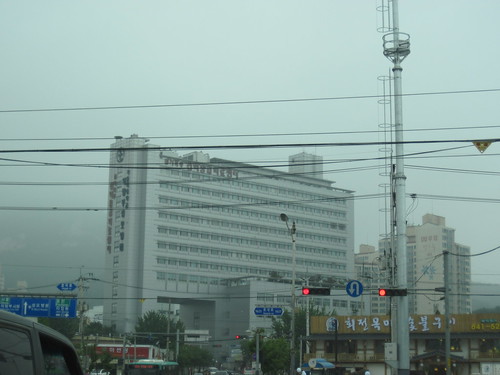


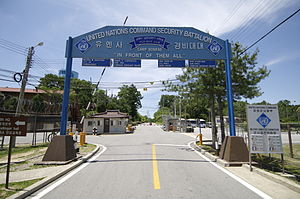


 Tanks doing gunnery at the KTC. Image via


 US and ROK soldiers train together at the KTC. Image via


 Quonset huts on Camp Coiner. Picture from the