The 2nd Infantry Divison, USFK lone combat unit in Korea is composed of two main hubs. The first hub are the camps located in the Uijongbu area just north of Seoul. Uijongbu is home to logistical, communications, and command & control units while the city of Dongducheon located 20 kilometers north of Uijongbu on Highway 3, is home to the division’s combat arms units. The division’s infantry, armor, engineer, and artillery units are all located in the Dongducheon area:
Camp Kwangsa-ri
The first camp in the Casey area is called Camp Kwangsa-ri, which is located halfway between Dongducheon and Uijongbu. The camp serves as a ammunition storage facility for the 2ID and is only staffed with a handful ordinance soldiers, a few American civilian workers, many Korean workers, and a ROK Army unit. I have been to Camp Kwangsa-ri more times than I care to remember handling ammunition issues, but the biggest story to ever come out of this camp was when a corruption scandal was uncovered on the camp in 2005 involving a Korean worker named Mr. Kim who was stealing expended ammunistion brass from the camp to resell to a private company. Mr. Kim made $300,000 from the scam and is still at large to this day.
Dongducheon
Just of the road from Camp Kwangsa-ri is the city of Dongducheon. Dongducheon by Korean standards is considered a backwater city even though it has a population of nearly 80,000 people. The city also has long had a seedy reputation due to being home to a large number of US military camps over the years:
The city and especially Camp Casey and Hovey are ringed with steep mountains including the popular local mountain Soyosan that makes up the northern boundary of Camp Casey. A river runs through the center of the city and is known to flood from time to time. In 1997 the entire Dongducheon “ville” area was underwater during the worst flood in recent memory.
Most people in the city either directly or indirectly are dependent on the USFK presence for their livelihood. However, factories staffed with third world laborers continue to sprout up in the area to contribute to the local economy as well. The mixture of Koreans, third world laborers, and US soldiers does give the city a vibe very different from everywhere else in Korea.
Camp Casey
The biggest camp by far in Dongducheon is Camp Casey:
The camp was named in 1952 after Major Hugh Casey who was an engineer officer that was awared the Distinguished Service Cross for combat actions during the evacuation of Hungnam, North Korea. Casey would later die in December 1951 when the light observer plane he was flying in was shot down by ground fire and crashed on a small hill in the middle of present day Camp Casey. This hill to this day is marked by a large white cross that can be seen from just about anywhere on Camp Casey.
Camp Casey is a large sprawling base located farther north than any other major US military camp in Korea. The camp is only 15 miles straight line distance from the DMZ that separates the two Koreas. Camp Casey is so close to the DMZ you would think it would be quite a spartan installation. That is not the case, as the camp has every facility any other US Army installation has:
It has numerous eating establishments both fast food and sit down restaurants. There are two different Burger King locations, a Popeye’s Chicken, Dunkin Donuts, Anthony’s Pizza, and a Taco Bell. The Primo’s restaurant has a really good lunch buffet that is worth checking out as well.
The largest PX in 2ID can be found here to buy all the latest products and a decent commissary that includes most the foods you would find in the states. The camp also has a nice bookstore and sports shop. The PX also has a number of Korean stores where you can buy typical Korean products, but they are quite expensive compared to buying the same items off post.
Camp Casey is filled with athletic facilities. There are gyms and weight rooms are spread out all over the camp plus numerous football and softball fields are available as well. Throughout the year there are numerous athletics leagues running that encompasses every major sport played in the US. The competition in these leagues is usually very competitive because most soldiers are in Korea away from their families for a year and thus focus much on sports to keep them busy.
The camp also has plenty of entertainment options. There are multiple bars on the camp and a dance club located in Primo’s. Near the PX there is also a nice bowling alley for the bowlers out there. The golf course is quite popular and usually filled unsurprisingly with Korean golfers.
Some of the major units on Camp Casey include Taskforce 1-72 Armor, 2-9 Infantry, 302nd Brigade Support Battalion, 1-38 Field Artillery, & 6-37 Field Artillery.
Golsandong
An unusual fact about Camp Casey is that it actually contains its own Korean village called Golsandong:
The village is actually spread out among the hills to the east of Camp Casey and contains 48 homes with 116 residents:
These homes can only be reached by driving through Camp Casey. So if you are stationed on Camp Casey and see some Koreans driving farming equipment on post, now you know why.
Camp Hovey
Located adjacent to Camp Casey is the medium sized installation of Camp Hovey.
The camp is named after Master Sergeant Howard Hovey who ended up being one of the last Americans to die during the Korean War during the battle of Pork Chop Hill in July 1953. For his heroic actions defending the hill from the massive Chinese offensive he was awarded the Distinguished Service Cross.
MSG Howard Hovey
Camp Hovey has plenty of facilities to include a restaurant and club, a video store, gymnasium, and sports field. One minus about Camp Hovey is the distance from the PX and commissary on Camp Casey. It is about a 20 minute bus ride from Hovey to reach the PX.
The front gate of the camp is bordered by the sleazy and run down ville of Toko-ri:
You can read more about Teokgeo-ri at the below link:
Some of the major units on Camp Hovey includes 1-15 Field Artillery, 4-7 US Cavalry, & 1st Brigade Special Troops Battalion.
Camp Mobile
Located right across Highway 3 from Camp Casey is small installation Camp Mobile:
Camp Mobile was known for decades by 2ID soldiers as the “Turtle Farm” because it was the location of the 2ID Replacement Company. The new soldiers that arrived at Camp Mobile were known as “turtles” because they had so long to go before their tour in Korea would be complete. Since the Replacement Company was on the camp the Central Issue Facility (CIF) was established on Camp Mobile to field gear to all the new soldiers.
I remember my first time pulling into Camp Mobile. I had been on a bus from Kimpo Airport and pulled into this camp that reminded me more of a concentration camp than a military installation due to the drab buildings, quonset huts, and barbed wire. This place was not a welcoming site to anyone pulling into 2ID for the first time. Fortunately the Replacement Company was moved to the much more hospitable Camp Stanley in Uijongbu. The company is now known as the Warrior Readiness Company.
Camp Mobile also has an air strip on it that is used for helicopter landings as well as UAV operations. The only thing I remember more than arriving to the “turtle farm” for the first time was waiting in the freezing cold of February for four hours on the air strip to do an air assault training operation with the 1-503 Infantry. We absolutely froze waiting for the helicopters that would never seen to show up. Finally we were told it was to cold and the visibility to poor for the helicopters to come. There was some seriously pissed off infantrymen that day.
Camp Nimble
Just down the road from both Camp Casey and Camp Mobile is the now vacated Camp Nimble:
Camp Nimble before closing, was home to two companies from the 702nd MSB. These two companies contained the military semi-trucks used to transport cargo and equipment for the division. This may be why it was named Camp Nimble:
I’m sure the camp had its good points, but to me Camp Nimble never seemed like a good place to be stationed and the roads leading from the camp were quite narrow and definitely a traffic hazard for military vehicles trying to drive through there. Fortunately this camp has finally been closed down.
Camp Castle
Just north of Camp Casey is the small installation of Camp Castle. Camp Castle for decades was home to the engineers units thus the reason for the name of Camp Castle. The engineers moved off the camp in 2004 and has been occupied by the 702nd Brigade Support Battalion since:
Something unusual about this camp is that the motorpool is located on the opposite side of Highway 3 from the rest of the camp. The motorpool is accessed by a pedestrian overpass.
Camp Castle is further divided with a small warehouse located just north of Camp Castle’s main post which is known as Camp Castle North:
The warehouse on Camp Castle North is used by the division to turn in old equipment to the support battalion unit that operates the warehouse. This is another place I have spent way to much time at before.
Overall, the Camp Casey area is not a bad posting considering how close to freedom’s frontier one is stationed. Combined the camps have just about every facility you could expect on any other US military installation and transportation to and from the post continues to improve, especially with the opening of the new subway station in Dongducheon. So if you get stationed in the Camp Casey area it is not the end of the world and it is not that bad of a place. Like most things in Korea, it is all what you make of it.
Note:You can read more from the ROK Drop featured series “A Profile of USFK Bases” at the below link:
Located just north of Seoul and about an hour south of Dongducheon, is the suburban city of Uijongbu:
Besides being nationally famous for serving the best budaechigae in the country the city is also home to soldiers of the Second Infantry Division. Below is a graphic of the locations of current and former USFK camps in Uijongbu:
Out of all of these camps only two remain operational today, Camp Red Cloud in the city’s northwest and Camp Stanley to the city’s southeast. All of the remaining camps have been closed since 2005 as part of USFK’s transformation program to reduce the force footprint in Korea. If you look at the map all of these camps used to be on the outskirts of the old city of Uijongbu. However, as Korea prospered economically so did Uijongbu and the camps were completely swallowed up by the surrounding city.
The urban density of Uijongbu played a part in the decision to reduce soldiers and consolidate camps in Uijongbu. After a number of these camps were closed down the anti-US groups started protesting that these camps were polluted wastelands that were a danger to the surrounding Korean community. During a recent visit to Uijongbu, I decided to see what the current status of the camps really is.
The first camp I started at was Camp Red Cloud:
Camp Red Cloud (CRC) is the home to the headquarters of the 2nd Infantry Division and a few miscellaneous units associated with the division headquarters. Here is a picture of the camp from a nearby mountain:
The camp’s namesake is Corporal Mitchell Red Cloud, a Winnebago Indian from Wisconsin that was post-humanously awarded the Medal of Honor during the Korean War. The camp is quite nice and has a busy golf course that is usually over flowing with Korean golfers. Here is a picture of the division headquarters:
You can view more pictures of CRC at the below link:
From CRC I crossed the busy highway in front of the camp and walked down the road through the small “ville” in front of CRC and towards Camp La Guardia. The ville area in front of CRC is not really your typical soldier “ville” in Korea and is more of what you see in a typical Korean neighborhood. Camp La Guardia like many 2ID camps closed down in 2005. The camp is actually built around an old airstrip that originally gave the camp it’s name by being named after La Guardia Airport in New York. Before closing down, Camp La Guardia served as the home for an engineer bridging company because the runway provided plenty of room to park the large engineer equipment. The engineers are long gone and when I approached the front gate I noticed a ROK Army soldier guarding the gate. I asked him if I can take a picture of the camp from inside the gate and he would not let me. So I took this picture later on in the day from Cheonbosan Mountain that overlooks Uijongbu:
From La Guardia I walked down to the Uijongbu train station which sits adjacent to Camp Falling Water. Camp Falling Water used to serve as the home for the Department of Public Works (DPW). DPW is staffed with Korean workers that are responsible for maintenance operations on the USFK camps. Camp Falling Water is a very small camp, more like a collection of warehouses, that was closed down in 2005 as well.
From the train station I caught a bus to Camp Kyle that sits on the northeast side of the city. The camp is named after 2nd Lieutenant Darwin Kyle who was post-humanously awarded the Medal of Honor during the Korean War. This camp was also closed in 2005 and was home to a maintenance company and a quartermaster company when it closed. At the camp’s entrance I once again talked to a couple of ROK Army guards that told me I could not take pictures of the camp because it was Top Secret. For being some place so Top Secret it sure was easy to get a picture by walking over to the nearby pedestrian overpass and taking a picture of the camp from up there:
No that is not a massive oil slick on the camp as the anti-US groups would have you believe, but just water from an earlier rain shower. I did see some ROK Army trucks moving around the camp, but besides that no activity at all. From Camp Kyle I walked along the side of the camp and followed a trail that leads up Cheonbo Mountain behind the camp and took this overhead view of the camp:
Notice that some how all these green trees are some how growing on this polluted USFK camp. From up on the mountain I could also see Camp Essayons which lies on the western slope of the mountain:
Camp Essayons many years ago was once home to an engineer unit that named the camp after the Corps of Engineers motto of Essayons, which is French for “Let Us Try”. Camp Essayons was last home to a military intelligence battalion before the camp also closed down in 2005 as part of the USFK transformation.
From the very top of the mountain I could see Camp Stanley as well, that lies to the city’s southeast on the slopes of Mt. Surak:
Camp Stanley is named after Colonel Thomas Stanley who was killed in a vehicle accident in Italy in 1944 during World War II.
Camp Stanley is currently still open and is mainly a logistical base for the 2nd Infantry Division. Camp Stanley has actually escaped being surrounded by urban sprawl due to the fact that is located right next to a Korean prison and it’s adjacent rice paddies. The Korean prison is the building you see above with the blue roof. From Camp Stanley you can sometimes hear the prisoners singing songs and cadence from the prison. You can often see them working in the prison’s rice paddies as well. The picture below is of Camp Stanley as viewed from Surak Mountain:
Across the street from Camp Stanley you can see the rice paddies the prisoners work in that helps give the area a distinct aroma during the summer months. The quality of life on Camp Stanley greatly improved two years ago with the opening of the new PX on the camp:
Camp Stanley is also home to the only real soldier “ville” in Uijongbu where one can find the typical juicy bars, pawn shops, chicken on a stick shacks, counterfeit clothing stores, coin & plaque shops, and other typical staples of a “ville” in Korea:
You can read more about Camp Stanley at the below link:
Finally, from Cheonbo Mountain I had a bird’s eye view over tiny Camp Sears:
Camp Sears was once home to a headquarters battery of a short-range air defense battalion. The Camp was named after Sergeant First Class Jerome Sears who was awarded the Distinguished Service Cross during the Korean War. The camp closed as well in 2005. While walking down the mountain towards the camp I could see that some how locals were growing crops along the polluted fence line of this USFK Camp:
Quite shocking that locals would be willing to eat crops grown in such polluted soil. I then walked to the front gate of the camp and found no one guarding the camp and was able to take this picture of the front of the camp:
Once again the oasis of green growing in the middle of the dense urban jungle of Uijongbu is quite striking. The fact is that these USFK camps are much cleaner than an equivalent ROK Army base that has been open for 50 years. The camps in general are much cleaner than surrounding communities as well. The camps have plenty of trees and open space that could be turned into useful parks and facilities for the city of Uijongbu. The local government had big plans to turn the camps into parks and administrative centers for the city. Camp La Guardia and Camp Falling Water would have been an excellent locations to turn into a large city park in the section of the city in desperate need of some green space.
However, as usual the outside anti-US groups ruined things for the surrounding community by pushing their bogus pollution agenda. Because of the anti-US groups the hand over of the land was delayed for two years and when the camps were finally handed over, the land was given to the ROK Army instead of the local government. Many people I know in Uijongbu are very upset by the interference of the anti-US groups.
If anti-US groups like Green Korea really cared about the environment, instead of making bogus camp pollution claims, they should be complaining that USFK should clean the graffiti on Cheonbo Mountain overlooking Uijongbu. This faded unit crest is of the old 702nd MSB unit that was stationed at Camp Sears more than a decade ago:
The mountain also has other smaller patches of graffiti from other units as well. Now this is something that I can legitimately see people complaining to USFK to clean up, however Green Korea is silent. It is because the anti-US groups like Green Korea do not care about the environment and instead were formed to promote an anti-USFK agenda that has since been linked to a North Korean spy ring. Creating as many obstacles as possible to prevent the USFK transformation was the goal of Green Korea and their North Korean puppet masters, not any concern about the environment. So in the end the USFK transformation happened anyway and the only people that lost out due to the anti-US groups were the people of Uijongbu.
If you have an interesting or funny veteran story from your time in Korea I would love to hear it. If it is a good story I am willing to publish it here on the ROK Drop. It doesn’t matter what decade you served just as long as it is interesting or funny. If you have a story to share you can e-mail the story to me.
Thanks for reading the ROK Drop.
Note:You can read more from the ROK Drop featured series “A Profile of USFK Bases” at the below link:
Wars are often filled with lots of “what ifs” and the Korean War was no different. One of these “what ifs” was a little known battle in the opening days of the war outside of the city of Uijongbu. Uijongbu is located about 20 kilometers north of the South Korean capitol of Seoul and is the primary transit point to reach the city from the north. The battle for this city would decide if the nation’s capitol would fall to the North Korean invaders 57 years ago.
Uijongbu 57 Years Ago. Highway 3 is the road running north and Highway 43 runs northeast
On June 25, 1950, the North Korean (NK) 3rd Division crossed the DMZ and battled the ROK Army 2nd Division in the Pocheon area which lies 25 kilometers Northeast of Uijongbu up highway 43. The NK 4th Division moved south of the DMZ and fought the ROK 7th Division just North of Dongducheon in the vicinity of Soyosan mountain which is the mountain that lies to the north of today’s American Army base Camp Casey. The ROK 7th Division was able to cause heavy casualties on the NK 4th Div. as they withdrew South from Soyosan to Dongducheon, and then to Deokjong. The ROK Army at the time did not have the man power, tanks, or equipment the North Koreans had. Never the less the ROK 7th Div. continued to put up a stingy defense as they withdrawed South towards Uijongbu along Highway 3.
In the above map you can see Highway 3 and Highway 43 running south where the ROK Army has defensive positions lining each side of both highways all the way to Uijongbu.
Meanwhile the ROK 2nd Div. withdrew from Pocheon after they were actually able to get the NK 3rd Div. to momentarily withdraw from Pocheon. The surviving elements of the ROK 2nd Div. took up positions in hilly terrain overlooking the highway 43 approach to Uijongbu. The hills were defended by two battalions of ROK 2nd Div. infantry soldiers and were facing an entire advancing NK 3rd Div. reinforced with T-34 tanks.
The plan was to have the ROK 7th and 2nd Divisions counterattack and stop the North Korean advance before it reached Uijongbu. The ROK 2nd Div. was to counterattack from their high ground overlooking Highway 43 and the ROK 7th Div. was to counterattack from their high ground just North of Uijongbu over looking Highway 3. However, the ROK 2nd Div. never counterattacked and stayed in positions as the North Koreans brought their armored column at them. The ROK soldiers fired artillery at the T-34s but it had no effect. The tanks were actually so unconcerned about the ROK defense that they just simply drove right by them into Uijongbu. The North Korean infantry following behind the tanks eventually began to engage the 2nd Div. soldiers. Once engaged the soldiers began to retreat further into the country side and melt away. The NK 3rd Div. now had an easy path into Uijongbu and shed very little blood to gain it.
Uijongbu as seen one year after the end of the Korean War. Picture from the qsl.net site which has many great historic pictures of Korea.
The NK 4th Div. on the other hand had shed much blood in their fight with the stingy ROK 7th Div. as they fought down the Highway 3 corridor. However, with North Korean tanks now in their rear due to the collapse of the ROK 2nd Div. the 7th never got a chance to launch a counterattack to destroy the NK 4th Div. Instead they had to withdraw to the Southern end of Uijongbu where they began to engage both the NK 4th and 3rd Divisions. The 7th Div. could not hold up against such an onslaught and withdrew from Uijongbu. The North Koreans now had Uijongbu and a clear path to Seoul. The North Koreans eventually captured Seoul two days later and had destroyed 60% of the ROK Army in the process.
In the above graphic you can see where the memorial along Highway 43 stands today just northeast of Uijongbu. You can also see how the North Korean tanks just simply drove right through the ROK Army defenders on the hill and into Uijongbu.
Uijongbu During the Korean War
Uijongbu as seen in 2007.
I can’t help but wonder what would have happened if the ROK 2nd Div. hadn’t collapsed and counterattacked from their positions instead of retreating? General Lee who commanded the Division is on record as saying that he did not execute the counterattack plan because his reinforcements had not arrived and he would of taken great losses during any counterattack. So rather then see himself and his men die in battle they felt they could not win, they retreated. If the 2nd could of held its line, the ROK 7th would of surely held its line against the NK 4th Div. who they had inflicted heavy casualties on. By holding the line one more day reinforcements would of come from further South to shore up the front line.
The collapse of the ROK 2nd Division ended up being the last straw that broke the camels back because over in the Munsan corridor to the West of Uijongbu the legendary Korean General Paik Sun Yup was holding his line in the vicinity of the Imjim River and Pukhan mountain. General Paik is regularly an honored guest at USFK functions and a person I have had the pleasure to meet. The man is literally the living embodiment of Korea’s modern history.
During the early days of the Korean War the then Colonel Paik was was the commander of the ROK 1st Div. The 1st Div. was the only division to stop the North Korean advance. However, with the collapse of the 2nd Division, Seoul would fall on the 4th day of the invasion and the ROK 1st Div. was now surrounded on three sides and forced to withdraw across the Han River leaving behind all their heavy equipment and only bringing what they could carry with them across the river.
If the ROK 2nd would of held the entire western front line could of possibly held. Additionally the hasty capture of Seoul caused the Han River bridges to be prematurely destroyed trapping much of the withdrawing ROK Army units such as the 7th Div. North of the Han River. Much of the equipment and soldiers of these units ended up captured and killed by the North Koreans. This rapid destruction of the ROK Army would eventually lead to the withdrawal to the Pusan Perimeter where the UN backed American military eventually intervened with enough combat power to stabilize the front lines. The stablized lines allowed General Douglas MacArthur to execute his famous Incheon Landing Operation and with it the destruction of the North Korean military. But what if the front lines were stabilized in the vicinity of Seoul when the American and UN forces intervened? Could have the American and UN forces crushed the North Koreans quick enough before China had a chance to prepare their forces to intervene in Korea? Who knows but it is interesting to think about the possibilities.
Today the site where the ROK 2nd Div. had their defensive positions is now commemorated with a very large memorial recognizing the war dead from the 2nd Div. during the early days of the war. The memorial is actually quite beautiful and well maintained. It is definitely a worthy tribute to remember the division’s war dead. However, every time I think about the ROK 2nd Div. even at the memorial, I can’t help but think of, what if.
Memorial located on the hill commemorating the Battle of Uijongbu
Sometimes heroism in warfare is not always won on the battlefield. Heroism can also occur in the rear ranks by strong leaders organizing and motivating logistical and support units to operate at full capacity to support the frontline units. Often in warfare the rear logistical units can become to complacent due to their distance from the frontline combat units. This complacency inevitably causes inefficiency that ultimately effects the frontline soldiers. This inefficiency and displacement from combat often causes tension between the frontline and rear echelon units that usually leads to colorful names for the rear troops. This has been a fact throughout the wars America has fought. Frontline soldiers today often call the rear echelon troops Foblins (FOB is a forward operating base). During the Korean War they were known as REMF’s (Rear End Motherfu****s). It was these REMF’s that would lead to one of the most embarrassing incidents of the entire Korean War.
Koje-do is a large island located in the southeast of Korea. It covers some 383 squared kilometers and is the second largest island in Korea only behind Cheju-do Island. The island has much historical significance with it’s links to the legendary Korean Admiral Yi Sun-shin. Today the island serves as a holiday destination for people from Pusan and as the home of the Daewoo ship building industry. However, probably the most infamous incident in the island’s history has to be the Koje Island communist prisoner of war (POW) camp constructed on the island during the Korean War. Long before there was Abu Graib there was Goje Island. What happened at Abu Graib totally and utterly fails in comparison to the incompetence and horror of Goje Island during the Korean War.
During the increasing combat on the Pusan Perimeter the US and allied forces found themselves with increasing numbers of North Korean POWs. It was decided that a camp had to be constructed to house the POWs. Goje Island was chosen as the site because of the fact that it was an island making it difficult to escape and it was far from the front making rescue attempts impossible. Additionally it was away from Pusan thus preventing the vital port in Pusan being clogged due to the amount of POWs held there, if the allies had to withdraw from Korea. The area chosen on the island to build the site a flat valley near the center of island that had access to a seaport to resupply the island from. Hap hazard housing and facilities were constructed on the site and very quickly POWs began to fill the camp. After the successful Inchon Landing Operation the amount of POWs increased greatly as even more North Korean troops were captured by the allies. With the entry of the Chinese into the war the camp continued to fill up well past it’s maximum capacity.
The following facts should give you some idea of how overcrowded the POW camp was. The facts are from March 1952, in the article “Prisoner’s Island: Tension and Tedium Rule Koje’s Barbed-Wire World”. This was an extensive story about life for the prisoners on Koje island off the east coast of South Korea. The story appeared in Vol. 32, Issue Number 13, pages 92 to 98 in the March 31, 1952 issue of LIFE magazine. Here are the facts:
Koje had 3,000 Prisoners of War under the age of 17
170,000 prisoners lived there
38,000 of the POWs were Korean civilians pressed into Red armies
21,000 were Chinese POW’s
111,000 were North Korean POWs of both sexes between the ages of 6 and 63
60% of the Chinese POWs were illiterate
24% of the Koreans were illiterate
Messages were sent from compound to compound via dragonflies
Each arriving prisoner received about $50 worth of GI uniform
Compound 66 had 2,600 North Korean officers who believed in communism
6,000 Koreans and 13,000 Chinese signed anti-Communist petitions, sometimes in blood
In February of 1952, 69 POWs in Compound 62 died in a riot
Prisoners of War on Koje studied language, history, manual crafts, modern farming, and the difference between democracy and totalitarianism.
To put the massiveness of these numbers into perspective, Abu Graib never held more than 4,000 prisoners at its peak in 2004.
Overcrowding and Incompetence
The overcrowding combined with an ideological battle within the camp made living conditions increasingly unbearable. The POWs segregated themselves into gangs that either believed in communism or capitalism and even further divided themselves by religion as Christianity was increasingly accepted by the prisoners. The gang like atmosphere in the prison bares a striking similarity to America’s prisons today by how prisoners segregate themselves into gangs based on ethnicity. The different gangs regularly fought for turf and influence in the prison camp.
The guards that secured the compound rarely if ever went inside the compound. Most of them were rear echelon troops bored and uninterested in duty on the island. The prisoners pretty much ran the prison themselves with the American soldiers standing guard outside the wire.
Due to the lax security within the compound the communist block was able to intimidate and crush opposition and when they had accumulated enough strength within the camp, they decided it was time to start waging war against the Americans from within inside the camp as well. They knew they couldn’t begin a conventional fight against the Americans because they would all just eventually be shot and killed. They decided the best way to open up another front against the Americans was to begin a propaganda war from inside the camp. This campaign would have better results than they ever could have imagined.
North Korean POW camp leader Colonel Lee Hak-ku.
On the morning of May 7th, 1952, the commander of the communist faction North Korean Colonel Lee Hak-ku requested that the commander of the prison, Brigadier General Francis Dodd urgently come and meet with him for an important reason. BG Dodd had met with COL Lee before and didn’t expect anything unusual from this request. In a well rehearsed and coordinated move COL Lee’s men surrounded the General and his guards and quickly subdued the guards and pushed them out of the compound and grabbed the general and moved him deep within the compound. The prisoners all pulled out their home made weapons and threatened to kill the general if any attempt to enter the compound was made. The seizure of the American general made instant headlines. Americans woke up to headlines of torture and abuse at Goje Island because the prisoners made demands that the US stop torturing, abusing, and starving them if they wanted their commander back. This was of course nonsense but to other nations around the world who didn’t know any better they of course began to wonder, “What the heck are the Americans doing on Goje Island?”
Additionally the communist block had a field day with the propaganda value of the Goje Island uprising. Here is what Pravda in Moscow wrote in response to the uprising:
Koje Island! Again the gloomy shadow of Maideneck (a Nazi extermination camp in Poland) has come upon the world, again the stench of corpses…… the groans of the tortured…… we learn that “civilized” Americans can be yet more inhuman, yet more infamous than the bloody Hitlerites. Dachau was a death camp, Maidenek was a death factory; Koje is a whole island of death. The American hangmen are torturing, tormenting, and killing unarmed people here. They are experimenting with their poisons on them….
This Kind of War
Page 398
To echo the communists claims the Red Cross condemned the treatment of prisoners on Goje Island as well. They condemned the over crowding, violence in the camp, and the lack of food reaching some prisoners because the communist leaders would store the food for themselves and only hand it out to prisoners loyal to their movement. The Red Cross also would not condone any force to put down the uprising and regain control of the camp in order to meet acceptable humanitarian standards. The Red Cross could provide no advice on how to meet acceptable standards, but was quick to criticize the Eighth Army forces guarding the prison for not meeting those standards.
COL Lee had scored a massive propaganda victory by claiming torture and abuse after capturing the general that was repeated and endorsed in newspapers across the globe. He even scored a bigger victory when another General, BG Charles Colson arrived to take charge of the camp and agreed to demands made by the prisoners to stop torture and abuse in exchange for General Dodd. Before releasing Dodd, the North Koreans put him on trial for war crimes and forced him to the statement that Colson had approved earlier.
After the release of General Dodd, General Colson retracted the signed statement made by Dodd, but by agreeing to the demands in the first place it had the effect of legitimizing the North Koreans’ claims of torture and abuse to the world’s media. The global media was having a feeding frenzy over the Goje Island story and it began to directly effect the truce negotiations being waged at Panmunjom. The US military brass was furious at what was going on at Goje Island and at General Colson for agreeing to the prisoner’s demands.
There were problems on Goje Island, but the prisoners were always fed and did what they wanted in the camp. The biggest problem on the camp was the overcrowding, because no one expanded the camp because everyone thought the war would end any day and all the prisoners would go home. The problems in the camp was not from torture or abuse, but from incompetence of the people running the camp. This incompetence would end once a man named Brigadier General Haydon Boatner.
The New Commander Takes Charge
Brigadier General Haydon Boatner was an old China hand for the US military. He served in China during World War II and spoke fluent Mandarin. He was serving as the assistant division commander of the Second Infantry Division on the frontlines of the Korean War when he went on leave for R&R in Japan. It was while on leave in Japan that he was notified that he was taking over the Geoje Island POW camp. The camp had been commanded by rear echelon troops and the Eighth Army commander General Mark Clark wanted a proven combat leader to fix the mess that the rear echelon commanders had created on Goje Island and General Boatner conveniently on leave in Japan was just the man he needed.
General Boatner soon arrived in Pusan and received a debriefing from General Colson on the situation on Goje Island. While in Pusan he even ran into the recently released General Dodd who was visibly a shaken man after being held hostage and was on his way to Tokyo to report to his superior there over the incident. Dodd would go on to be reduced one rank to colonel and forcibly retired from the military. While meeting with General Colson, Boatner was amazed how oblivious he was to the media frenzy over Goje Island. There was little access to the media in Korea, but in Tokyo the media frenzy in the newspapers could not be missed and Colson would soon find out about the frenzy after meeting with Boatner and returning to Japan where he was also disciplined for his part in the Goje Island mess.
Boatner found the lack of information reaching Korea to be even worse once he arrived on Goje Island. The first thing the command staff on Goje wanted to do once he arrived was to throw him a cocktail party. General Boatner couldn’t believe that the staff on Goje was more concerned about cocktail parties than ending the uprising and the subsequent propaganda beating the US was taking due to the mess on Goje Island. The priorities of the soldiers on Goje Island became only more evident as Boatner looked around the camp. He found soldiers in different uniforms and some soldiers carrying weapons and others not. The reason he found for the lack of weapons was the fear of accidental discharges. For a commander that had fought on Heartbreak Ridge, Boatner could not believe the attitude of the soldiers he found on Goje Island. General Boatner immediately ordered one standard uniform and put everyone under arms to the objection of the staff he inherited. They were an absolute disgrace and he was going to fix it.
Internationalizing the Problem
Boatner discovered that this attitude was allowed to manifest because many of the officers and soldiers that the Army found unfit for combat had been sent to this island instead of the frontlines. General Boatner decided it was time to start a purge to rid the camp of the unfit soldiers and leaders. He relieved over 400 soldiers from the island and now had to replace them. To replace them Eighth Army sent him combat team from the 187th Airborne from Japan, a Canadian company, a British company, a few Greek soldiers, and a Turkish company. The Eighth Army commander General Clark received a lot of criticism from the governments of the soldiers sent to Goje because these countries wanted nothing to do with what was going on with Goje Island. It was a political kryptonite that everyone wanted to steer clear of, but General Clark felt the problem on Goje was a UN problem and not solely a US problem and by sending foreign units there it internationalized the problem.
Expanding the Camp
After General Boatner had successfully conducted his purge and refocused the attention of the camp on regaining control of the prisoners and not holding cocktail parties, he then focused on expanding the camp in order to break up the organized groups of prisoners. Boatner know that he had to expand the compound quickly because the camp was not only making international headlines that were disgracing the country, but was also being used for political fodder during the negotiations at Panmunjom.
One of the most sensitive issues being discussed during the negotiations was the return of POWs at Goje Island. The allies wanted to give the prisoners an option of either staying in South Korea or returning to North Korea or China. The Chinese and North Korean negotiators wanted all the prisoners sent back to North Korea and China. When challenged that many of the prisoners wanted to stay in South Korea the communist negotiators would counter that the prisoners only say that because they are being inhumanely tortured on the island and would hold up western media reports that had sensationalized what was going on at Goje Island to prove it. Additionally images of the daily protests at the Goje camp complete with prisoners chanting communist slogans and holding up pictures of Marxist leaders were filling the daily newspapers across the globe feeding the perception of torture, abuse, and the fact that all the prisoners wanted to be returned to North Korea and China.
An engineer unit was sent to Goje to help expand the camp. Initially the engineer commander was more concerned about building a new PX for the soldiers than expanding the camp, but General Boatner set him straight and ordered his men to work 24 hours a day building the new barracks to house the prisoners. The PX could wait.
Breaking the Enemy’s Will
Along with Boatner’s efforts to restore discipline in his troops and expand the camp he also needed to break the will of the enemy. Boatner felt that since the prisoners’ commander North Korean Colonel Lee Hak-ku had successfully brought massive media attention on the island that at anytime he could order his men to attempt a massive prison break that would end in the deaths of many prisoners further causing disgrace to the US military and the condemnation of the world. Boatner had to work on breaking up the loyalty of the prisoners to Colonel Lee.
The prisoners would challenge General Boatner’s authority on just his second day on the job. A Chinese faction of soldiers loyal to Colonel Lee began to cause a commotion in the camp. General Boatner went to the camp to see what was going on. He was amazed to see 6,500 Chinese soldiers in perfect formation chanting slogans and holding propaganda signs. Outside the wire the American soldiers were gathered hooting and hollering back at the Chinese. It was a chaotic scene that Boatner was quick to get control of. He ordered his aid to bring the commander of the US soldiers to him and the Chinese commander. Boatner proceeded to scald the US commander to take control of his men. The commander, a lieutenant colonel had served under General Boatner on the frontlines of the war and quickly responded and got control of his men and stopped the hollering at the Chinese.
Boatner than turned his attention to the Chinese commander who was a colonel in the Chinese Army that spoke a northern Chinese accent that Boatner understood completely. The colonel not realizing Boatner could speak Chinese brought an interpreter with him that reiterated demands about the Geneva Convention, Panmunjom, and the usual communist talking points of the day. General Boatner, to the Chinese commander’s shock, responded in perfect Mandarin that he was full of crap and then proceeded to tell him the names of respected Chinese generals he had fought with during World War II. The fact that he could speak Mandarin combined with his association with prominent Chinese commanders impressed the Chinese commander. The Chinese commander agreed to end the protest and through small acts of Chinese cultural understanding over the proceeding days Boatner was able to win the respect of the Chinese commander. In just a few short days General Boatner had already eroded support for Colonel Lee Hak-ku’s uprising in the prison.
Next Boatner turned his attention to eliminating the communist propaganda such as signs and statues that had been erected around the camp. Boatner wanted to avoid one large operation that the prisoners could organize against and cause a massive incident that could turn into blood shed which would be reported around the world. Boatner decided instead to use well timed raids that featured tanks backed with soldiers trained in riot control. Boatner’s men raided one compound at a time over a series of days to slowly destroy all the propaganda around the camp thus avoiding one large operation. Slowly but surely General Boatner was able to eliminate the communist propaganda inside the camp. In the first week of Boatner’s command it was clear to all the prisoners that there was a new boss in town and it wasn’t Colonel Lee Hak-ku.
Isolating the Prisoners
It was long known that villagers outside of the Goje POW camp were helping the prisoners inside the camp with supplies and the sending of messages back to their masters in North Korea and in turn influencing the on going negotiations at Panmunjom. Many of the villagers on Goje were actually North Korean civilians relocated from Wonsan and Hangnum in North Korea. Among the evacuated civilians were many North Korean agents that were aiding the prisoners in the camp. General Boatner knew he had to stop this rat line running from Goje to Panmunjom and the only way to do that would be by forcibly moving thousands of villagers away from the camp.
The problem with doing that was that with the Red Cross and media hanging around would condemn such an act. However, the problem with the civilians supporting the prisoners got so bad that Boatner had to do something about them before he could move on fully ending the uprising in the prison. Boatner sent trucks to the village to move the villagers. The military in two days was able to move the entire village and burn the huts down. It brought some bad headlines in the short term, but in long term it totally isolated the North Korean leadership within the prison.
Ending the Revolt
It took 30 days for the engineers to complete the expansion of the prison and during this time General Boatner was able to restore discipline among his own troops, divide loyalties within the prison, and end the rat line of communications from and to the prison. The last thing that had to be done was to end the revolt and restore order.
With the new camp constructed the time was now here to begin moving prisoners into the new and more secure compound. There was tens of thousands of prisoners total on Goje divided in separate camps of 6,500 prisoners. General Boatner chose the most violent camp with the head communist leadership, including Colonel Lee Hak-ku in Camp 76 to begin the movement of the prisoners from. Boatner felt that by crushing opposition here first, it would set an example to the rest of the prisoners. Using crack paratroopers from the 187th Airborne Brigade, Boatner had his men completely surround Camp 76. The men were under very explicit orders to use non-lethal means to move the prisoners and could only shoot to kill with the permission of the commanding officer only. It was imperative that the operation didn’t turn into a blood bath for the world’s media to report. The paratroopers had trained for weeks for this operation and were ready to put down the uprising by chopping off it’s head at Camp 76.
Weapons found hidden within the Geoje Island POW camp.
All at once on June 10th, 1952, the soldiers cut down the wire around the camp and moved in. The paratroopers moved in slowly and deliberately subduing prisoners. As they moved further into the camp the prisoners set fire to the buildings creating a smoke screen to fight the paratroopers in. The paratroopers began throwing concussion grenades into the smoke which had the effect of breaking up the frontlines of the resistance. As prisoners fled the impact of the grenades they were quickly captured by the paratroopers. The last 150 holdouts made one last ditch effort to fight off the paratroopers by hunkering down in trenches they had dug. As the paratroopers closed in on the trenches some of the prisoners panicked and ran towards the paratroopers to give themselves up. However, as they ran from the trenches the hard core communist cadre chased after them and killed some of the defectors. The paratroopers quickly moved in to stop the slaughter and a melee ensued. You can watch historic video footage of the operation at this link.
Once the operation was over 43 POWs had been killed and 135 wounded with half these casualties coming from the communists attacking their own people. Only one paratrooper who had been speared to death was killed in the operation. The paratroopers searched through the compound and found corpses hanging from inside the buildings to serve as an example to anyone that did not resist the Americans. They also found detailed plans by the communist to conduct a mass prison break on June 20th and slaughter anyone in there path in order to make maximum headlines against the Americans.
Outside the paratroopers found Colonel Lee hiding in a ditch and dragged him to his new compound. The leader of the communist uprising had gone down without a fight. The 6,500 prisoners in the notorious Camp 76 had been broken down and moved to the new compound and divided into more secure compounds of 500 prisoners per camp. The smaller number of prisoners per camp made it harder for them to organize and easier for the guards to manage. After this operation the rest of Goje’s prisoners voluntarily moved without confrontation to the new camp. By June 12th all the prisoners had been moved and General Boatner was firmly in charge of Goje Island. Colonel Lee and the rest of the prisoners of the Goje POW camp would never give General Boatner and his successors anymore problems for the rest of the war
Lessons Learned from the Geoje Island Incident
The US forces during the Korean War had been completely unprepared for the detaining of massive amounts of enemy prisoners. During World War II the US military dealt with few prisoners because very few Japanese ever surrendered. In the European theatre the allies didn’t start taking massive amounts of German prisoners until the war was just about over and the Germans had lost their will to fight. During the Korean War the US had taken massive amounts of prisoners and the enemy was far from being vanquished. Additionally these prisoners came from an alien culture and ideology that US commanders understood little about. Enemy prisoners looked at using prison as just another front in their war against the US and its allies.
To compound the problem the US commanders were so consumed with fighting the immediate war little emphasis was put into the handling of prisoners and possible propaganda value to the enemy for any mistreatment. Additionally the assigning of poor soldiers and officers to manage the prisoners combined with the inadequate facilities to house the prisoners would lead to strategic consequences later in the war.
The mistakes made during the Korean War in the handling of prisoners would repeat itself to a much smaller degree during Operation Iraqi Freedom and the Abu Graib prison abuse controversy, but the propaganda value was just as valuable to not just the immediate enemy, but all the interests opposed to America in general as well.
Here are some of the big lessons learned I think the military can take away from these two very big historical blights on the image of the US military in the last 50 years. First of all, plans need to be made to house prisoners before going to war. Before the war even started there should have been an engineer unit designated to immediately begin building a compound to house prisoners. The Korean War was an unexpected war, but the Iraq War had plenty of prior planning and unfortunately the prior planning did little to plan for the amount of prisoners the US would end up holding. One engineer company during the Korean War built a camp to hold tens of thousands of prisoners in one month. What if the US military built a camp of similar size in the desert some where in Iraq to hold prisoners instead of Abu Graib? This would have easily prevented the overcrowding of the prison.
Secondly, Abu Graib should have never been chosen as a place to hold prisoners to begin with due to its notorious image from the Saddam Hussein era of power in Iraq. What if during the Korean War the US military started holding prisoners within Soedaemun Prison in Seoul? What kind of message would that have sent to the general Korean population during the war? During the Korean War Goeje Island was actually a well chosen location for a prison that planners during the Iraq War could have learned a lot from.
Next thing is that a mission as politically sensitive as handling prisoners of war at a detention facility should be handled by only highly professional soldiers. Who in the world thought it was a good idea to have people like Charles Graner and Lynndie England to have such authority over prisoners? Janice Karpinski was just a female version of Francis Dodd. Abu Graib was surrounded by just as much incompetence as Goje Island during the Korean War. It wasn’t until competent leadership backed by crack troops were conditions in the camp able to improve on Goje Island. The lesson learned is that highly professional units with excellent leadership that deal exclusively with handling prisoners of war should be formed before a war is even initiated. The adhoc nature of soldiers and agencies thrown together in Abu Graib caused an environment ripe for abuse.
Finally, internationalizing the Goje prison by General Boatner was a brilliant idea because it shares responsibility for anything that happens within the prison. The international media glee over Abu Graib would probably have been much more tempered if more countries were involved in the management of the prison. This is something that should become a standard practice in future conflicts.
These were all painful lessons learned in the aftermath of the Goje Island Incident that would unfortunately be forgotten 50 years later in Iraq. Military planning requires more than just maneuvering infantry and tanks and hopefully in future conflicts the US military properly plans to deal with the handling of prisoners of war. Especially when such an issue can have such strategic impact, which in the case of Abu Graib is still being felt today. The painful lessons learned from Abu Graib could have been avoided with a close study and appreciation of the experiences of General Haydon Boatner on Goeje Island.
Former USFK soldier and convicted murderer Kenneth Markle who was just recently released from ROK prison, has apparently spoken out over at Lost Nomad proclaiming his innocence in the 1992 murder of Korean prostitute Kum E. Yoon. This murder is the most brutal as well as the most publicly known murder by a US servicemember in Korea and has long been used by anti-US groups to influence public opinion against USFK in Korea.
I can remember a few years back being in charge of a force protection detail at Camp Red Cloud when my soldiers working the front gate called me to come to the gate. I went to the gate and the typical anti-US loons were out there with signs with the murdered body of Ms. Yoon on it as well as the crushed bodies of the two girls killed in the 2002 armored vehicle accident. That was the first time I had ever seen pictures of the brutal murder, that even years after it happened are still sickenly used for political reasons.
Markle says he didn’t do it and we would be surprised if we read the court transcripts. Well then he should scan post them on a webpage and let us with interest in the case read them. He is the one convicted for the murder and thus the burden of proof is on him to prove he is innocent.
———————————————————————————-
Note: An updated posting about this case can be read at the below link:
An issue that has gained recent attention is the issue of sexual assaults in Korea. There has been plenty of recent attention in Korea on sexual assaults against minors and other Korean women. Many of the recent high profile assaults against these women have been by repeat rapists who had received lenient jail time measured in months after their first sexual assault. These cases has caught the attention of the Korean media and hopefully this attention will lead to positive change in Korean society against sexual predators by not immediately condemning women who have been raped as prostitutes for example or giving these monsters who rape women light sentences which is right now an all to common practice in Korea.
Despite the media coverage of the sexual assault problems in Korea, something that has continued to be ignored by the Korean media is sexual assaults against foreign women in Korea. I have highlighted a number of assaults against female foreigners in Korea. Here are a few examples of past assaults on foreign women in Korea. A 19 year old female soldier newly arrived to Korea from Incheon airport was raped by a cab driver bringing her to Seoul. Then there is also the Jamie Penich murder in Itaewon that should be familiar to many expats out there. Then most recently the rape of an Army officer in Taegu that was almost totally buried by the Korean media.
If you don’t believe me that these stories are buried go ask the nearest Korean if they have heard about the rape of the US Army officer. They will probably tell you they never heard about it. Now ask them if they heard about the drunk idiot GI in Uijongbu who hit a beer bottle over a Korean guy’s head, they will probably tell you that they have heard of that, however. I just find it sad that a ville incident such as the beer bottle case would draw more publicity then a rape in Taegu, especially since the rapist wasn’t caught and could be still out there in Korean society raping more people. It just seems to me a rape case should draw as much media attention as possible in order to identify the rapist to ensure they are caught and cannot rape more women.
In an effort to educate people more about sexual assaults in Korea, I was contacted by a young lady who was sexually assaulted and beaten while teaching English at a hagwon in Seoul. For those familiar with prior assaults on foreign women in Korea you will see many similarities in this case with those prior cases in as far as how incompetent the Korean police are. The important thing is to learn from her story things that you can do to help yourself if you find yourself in a similar situation or maybe you are helping someone that unfortunately was assaulted because the Korean police are not there to help you.
With that in mind here is a story of a sexual assault in Korea that no one has probably heard of, but should of:
I came across this blog in doing my own research about the incidents of foreign females in Korea being assaulted and saw the story from back in July when a female military officer was assaulted by a cab driver. I am so lucky that I have found this blog and can spread the word about the dangers of being a foreign female in Korea and how biased the Korean media, police, hospitals, etc. might be to you if something horrible were to happen. I, too, was a victim and want anyone who wants to hear my story to listen up and spread the word.
I came to Seoul in February of last year to teach English. This was not my first time in Korea, having visited Korea in high school with my Korean friend and having also studied Korean language at Yonsei University in 2000-2001.
I was living in Seoul in what is considered to be one of the safest (aka richest) areas: Chungdam. I am sure you know the 24 hour McDonalds, Hard Rock Cafe, etc—I lived across the street from those places. On July 31, 2005, I arrived to my one room when around 11:20pm, my window slides open and a man is in the window. In the second that I sat frozen in my computer chair in shock/surprise/disbelief, he hopped down from the window and lunged at me and began to hit me with his fist repeatedly, while choking me with his other hand. After hitting me for a few minutes to where I was going unconscious, he ran over to my bag, grabbed my wallet, and in Korean, said the first word “Don, don, donâ€, which translated means “Money, money, moneyâ€. Being a Sunday night, I had just spent the last cash I had and I told him that in Korean. At this point, he began hitting me again. After only a few hits, however, he decided to begin choking me.
He gave up choking me and began hitting me more until I again was drifting in and out of consciousness.
He then decided to rape me. He first tried covering my bloodied face with a shirt but I quickly bled through it so he told me in Korean, “Wash your faceâ€. He went into my kitchen to get a knife and I knew it was my chance to get away. In that instant I found my cell phone and locked myself in the bathroom.
Once locked inside, I called the police. According to their police report was at 11::40pm. They did not arrive to my apartment until well after 12am despite a police station being only 5 minutes by walk from my house. I didn’t trust that the police believed me and understood to come so I also called my friends, but they too, were all far away. When the 2 policemen showed up, the man was gone. I told the police what happened and that I need to go to a hospital right away but their first words to me was to say “Where are your panties and give me your Alien Registration ID cardâ€. I managed to find my ID card and I gave it to him and then ran out my door to try to get someone else to get me an ambulance. The police came out and told me to sit in the back of their police car, which I did. Soon after, the ambulance came and they did not help into the ambulance on a stretcher. They opened up their sliding side door and told me to walk in. I did and lay down on the stretcher, unattended by anyone
The first place I was taken was called Samsung Medical Center. When we arrived there, again I was not taken in on a stretcher, but instead the two ambulance workers opened the door and told me to get out. As we were walking in, they did not assist me in walking and wouldn’t even open the hospital doors for me until I pulled up the back of my running pants which had slipped down to reveal the top of my panties. I was laid on a stretcher and someone came to clean my face and photograph my injuries. Within a short amount of time a number of my friends and coworkers began arriving and immediately we worked together to recall what I could of the attack while the hospital workers were deciding where to send me. I explained to them first of all what happened and asked them to please test my fingernails for his DNA because I probably scratched him. My friends (no police were to be found now) then got a pen and paper and were asking for his description and also began listing the places I could remember he touched: My window, my wallet, my bag, my refrigerator, my door lock, my sink faucet—all places that could be tested for fingerprints. This first hospital also took pictures of my injuries which now are LOST. The hospital has told the US Embassy that they do not have a camera to even take pictures; while they told my friend who inquired about them that they just don’t have record of my name for that date.
After I would guess about 40 minutes-1 hour, I was moved to a 2nd hospital—Hye-Min hospital in the northwest part of Seoul. I was put into the ambulance on a stretcher but again, was not tended to by any professionals. My two friends rode with me and when I began feeling nauseous and throwing up from the bumpy ride and my head injury, my friends were helping me not any professional workers. I do not remember the emergency room of Hye-Min Hospital and what I will tell you comes from my friends who were dealing with admitting me. This comes from 2 Korean friends, 1 American friend, and 1 Canadian friend. My friends were speaking with the man admitting me, he said that the hospital would not help me unless I paid him $1000.00 in cash because I was a ‘Russian prostitute who probably deserved what I got’. Finally after convincing him I was neither Russian, nor a prostitute and having my boss show up, they decided to admit me into Intensive Care. Despite my major injuries being associated with my head and eye, there was no eye doctor even available at this hospital. However, the first hospital claimed that the bigger hospitals’ ICUs were all full and they could not take me.
At this hospital, I basically laid for 1 day on an IV —no medications were given and very little monitoring was done. My blood pressure was checked maybe 2 times per day and I was given no heart/oxygen or any other standard monitors. Besides being in pain from my head injuries, I was unable to sleep or lay without pain due to severe neck and back strains from being choked. The bed was flat in a very uncomfortable position and I was told if I needed to be moved I would have to pound on the side of my bed to get a nurses attention because they didn’t have call buttons. Of course, when I did this, nurses would ignore me for 10-15 minutes or more. I was finally moved into the ICU of Yongdong Severance Hospital where I was given good treatment and finally tests were taken. I was given an immediate CT scan, along with X-rays and an eye doctor looked at my eyes. It was decided that I had a brain hemorrhage, fractured skull and other facial bones, ocular hemorrhaging. On day 3 of my ordeal, I was visited by a deputy of the US embassy and a Korean detective, who through my best Korean friend, interpreted what happened and the suspect description. No sketch was taken, however.
While in the hospital I was thinking about who this guy might be so I gathered a list of the places I walk a lot. Based on his skin tone and build, I figured he must work outside and suggested to the police to check 3 nearby construction sites near my house that I regularly walk by, 2 car shops or local taxis. Based on the glove marks around my neck, I figured he could be a taxi driver and a taxi driver lives in my building, yet the police never interviewed anyone in my building or the surrounding buildings. My friends interviewed my neighbors on their own who said they did in fact hear screams, but were too afraid to help and saw nothing. The police interviewed no one, took no suspect sketch, no DNA, and despite claiming that they took fingerprints, there was no evidence of the traditional black soot fingerprinting would leave at my apartment. There were no police reports sent out to the media and despite me and my friends calling every Korean and English news and television media outlet, no one would cover my story or even just release information regarding the suspect’s appearance. I also remembered that because I lived in the nicest area of Seoul, for “security†they have CCTV cameras up around the neighborhoods. My Korean friend called the police with this information and all of my other suggestions about where to find the suspect and their response to us was “We do things our way, we are handling it, leave us aloneâ€. I was never contacted by the police again. During my final day in the hospital, I finally got enough courage to look at the shirt I was wearing during the attack. The police did not collect it for evidence or DNA. Upon my examination, I found a short black hair to which I applied a piece of tape and called the police asking them to please come and pick it up—-it could be the suspect’s hair! Again, they responded, “We do things our way; we don’t have time for thatâ€. Finally, after returning to America and complaining to the Embassy, the police agreed to look at the hair and we fed-exd the shirt to the police. It was returned “tested†with the hair still in tact. Nice, right?
I do not even want to get into my school. Of course we know how hagwons are. All I will say, is that they deemed me to be too problematic to the school because they feared I would reveal where I worked and make them to have a bad reputation. When I was released from the hospital, I had made flyers to distribute throughout my neighborhood with a suspect description and I was told by my school and the police that I could not do so because it would make all Koreans look crazy. So, despite being promised I would have a job when I was completely, recovered, I never got the offer back.
After returning back to the USA, I am not aware of anything going on in the investigation. About 3 weeks after my attack, a Korean girl was found naked and murdered, dying from the same injuries I sustained and she only lived about 5 minutes from my house by walk. So after 1 month, the police requested I get a sketch of the suspect and started sending me pictures of sex offenders about 2 months after my attack. But of course, the mind is a great thing and tries to forget something like that, so making a sketch now is difficult. Due to the recent string of serial rapes in Korea, I have taken it on myself to try to find out anyone who is arrested in case I may recognize the guy. After seeing a picture the Taejon serial rapist who was captured in Seoul in February, he seemed familiar to me and so I contacted the Embassy. They said the police determined it was not the same man who attacked me based on a DNA mismatch. Oh, now they do have my perpetrator’s DNA? Up until this point, I was told they didn’t have anything. Suspicious is the fact that they will not give the embassy pictures of the man for me to identify.
That is my story. My goal is not to shock, not to expound hate on Korea or Korean people. My goal is to make us foreigners living in a seemingly “safe†country aware that even though these things do not appear in the papers, they can and do happen. More importantly, I am looking for ways I can help to get started programs for foreigners to provide safety education and resources. If you would be attacked, do you know enough Korean to call the police, or do you even know the police number? If you do suffer an attack, there are no rape crisis lines or centers for foreigners. Finding a psychologist who speaks English is also difficult.
We need to get together and make a positive change. Acknowledging that there is a problem is the first step. Now, let’s make a difference.
I know this post is long but I think the information provided in it is very important because I know I learned plenty from the writer’s tragic experience and hopefully others did as well.
Schools in Broward and Palm Beach counties are tapping a new source of teachers: South Korea.
The Asian nation has more teachers than it needs, and the Korean government is helping them find jobs abroad, said Andrea Seidman, president of Teachers Council, a nonprofit agency that helps place instructors.
Teachers Council has helped Broward and Palm Beach find Korean teachers in recent weeks. Broward has hired three for next year; Palm Beach likely will hire five, recruitment director Marcia Andrews said. Representatives of both school districts say they want to start with just a few to see how they adapt to American life.
I wonder if we can expect to see charming and artistic works of art from the children of Florida such as this seen in South Korea:
Consider the following question, posed to 400,000 Korean students in a grade school exam: Which of the following descriptions of Iraq after the Gulf War is incorrect?
A) Due to economic sanctions, infant mortality increased by 150 percent, and in some areas, 70 percent of newborns had leukemia.
B) The United States and Britain conducted a bombing campaign against Iraq for 11 years after the war, causing terror among the Iraqi people.
C) Cancer among Iraqi children in 1999 was 700 percent because of depleted uranium left from the bombing.
D) The infant mortality rate of Iraqi children in 1999 was 300 percent higher than it was a decade earlier.
E) Not a single Iraqi starved to death after the Gulf War because of the extensive food relief program.
This question, and many more like it, comprised a supplemental teaching package on the second Iraq war that was distributed two years ago by the Korea Teachers and Educational Workers Union, the Los Angeles Times reported in July 2003. The package allegedly included graphic photographs of child casualties and urban destruction from the 1991 Persian Gulf War.
According to national education law, teachers who belong to unions are permitted to incorporate such supplemental teaching materials into the mainstream curriculum. School principals technically have the power to regulate what is used, though this rarely occurs.
In one controversial instance, a teacher leading a class on the U.S. military role in South Korea showed her seventh-grade students a police photo of a naked Korean prostitute who was murdered and sexually assaulted in 1992 with an umbrella by an American serviceman.
The offending teacher, who subsequently did not lose her job, argued that such material was widely available on the Internet for public viewing. She echoed the opinion of other unionized educators who contend they oppose war of any kind, and are not waging a targeted smear campaign against the United States.
South Korean President Roh Moo Hyun — who dispatched the third-largest contingent of foreign troops to Iraq — supported the union’s position, saying that “antiwar education should be encouraged but only as long as it is not anti-American, in consideration of our diplomatic relations.”
Today’s texts contain pictures of North Korean food shops (“A lot of women,” reads the caption, helpfully, “are participating in economic activity”) and suggest students practice writing letters to their counterparts across the border (without mentioning that North Korea prohibits mail from the South.) In today’s classrooms, you can find a third-grade textbook with a cartoon of two boys from either side of the border deciding not to throw rocks at each other.
Northern Boy: I’m sorry I threw the rock at you first.
Southern Boy: I’m sorry, too. It is not right for brothers to throw rocks at each other.
Northern Boy: Our parents and ancestors would be grieved to see us fighting.
Southern Boy: Speaking of which, do you want to participate in the international Ping-Pong game together as one team? … If we become one team, we can make up for our weakness and no other country will be able to beat us.
Teachers need little encouragement to use such texts. Park Geun Byung, a teacher at Song Chun elementary school in Seoul, uses a storybook that instructs his fourth-grade class in the tale of an evil dragon that prevents a Romeo and Juliet on either side of a river from marrying. The river is plainly the DMZ. The evil dragon is meant to represent the U.S. Park is a believer in what he calls “unification education.” “Teachers,” he adds, “don’t have to be neutral.”
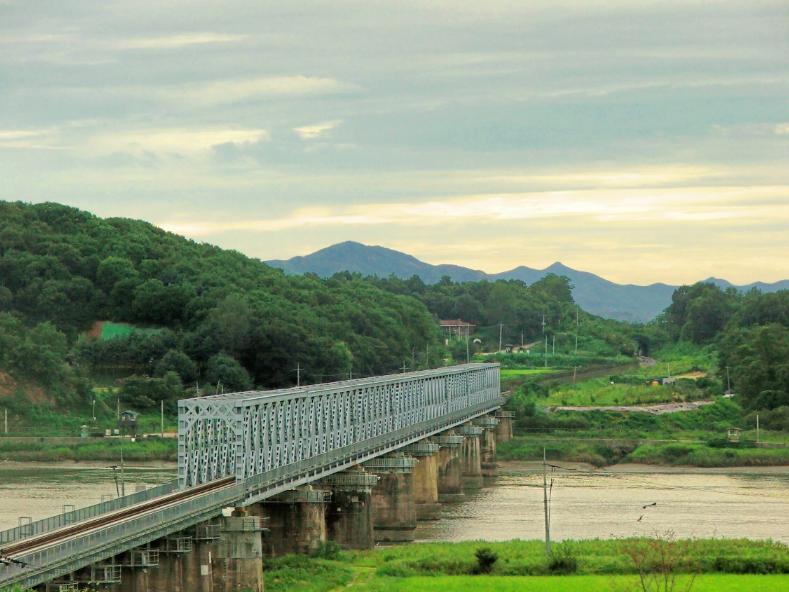
Freedom Bridge which crossed the Imjim River during the Korean War via Defense Media.
Now:
Notice the amount of trees that have since grown on the South Korean hillsides. The mountains you see in the background are the mountains near Kaeseong, North Korea.
The Yankees already had gone home or at least farther south when two buses carrying about ninety South Korean protesters arrived outside several U.S. bases near the Demilitarized Zone Tuesday.
The Western Corridor bases targeted by the protesters were vacated by 2nd Infantry Division units last year and soon will be returned to the South Korean government. So when the protesters mostly university students who were trailed by a few Korean National Police officers arrived, they found only empty buildings, rusting barbed wire and uninterested South Korean security guards.
Seth Robson hit that one on the head real well
Isn’t empty American bases what these people wanted to begin with?! That the Yankees go home, or in the case of the Western Corridor, go to Iraq?
Here is an idiot comment for you:
The lowest form of American culture spreads out from the bases,âsaid Lee Yongnam, 50, claiming that the soldiers bring crime and prostitution.
Okay, if the soldiers bring prostitution to Korea than how do you explain all the “barber shops” and “sports massage parlors” everywhere in Korea not to mention Paju? Shouldn’t have all these establishments in Paju closed down after the soldiers left? How come they are still there? Prostitution is a Korean problem not an American one. American MP’s cannot enforce Korean law. If this guy is so concerned about prostitution then get your own country’s police force to arrest the bar owners.
Here is another idiot comment:
Lee said the group was aware that the bases they visited had been vacated, but they chose to stage the protests to highlight their effect on the local community. The presence of the bases puts building restrictions on surrounding areas, he said, stunting industry and growth. The economies in areas outside the installations were fueled by bars and other businesses geared toward soldiers, so the soldiers departure had hurt the areas as much as their presence had, Lee said.
So does he want the US military to come back then? Plus the business owners in Dongducheon aren’t complaining about the soldiers. Just people like this.
These students came from Kyeonggi University and interestingly enough I met a student from Kyeonggi University when hiking up Pukhansan today. A good guy and former KATUSA who had obviously better things to do then hang out with idiots from his university at vacated camps.
I wonder if they visited the vacated camps because they got attacked by the business owners in Dongducheon the last time the idiots came up here?
Kang said he’s tired of U.S. military promises that officials will work to avoid accidents. He wants U.S. leaders to “take substantial measures†and “stick to them.â€
One idea, he said, is to restrict the movement of bigger military vehicles during peak traffic times.
I can guarantee that 2ID’s traffic accident rate is well below the Korean average. I have seen all kinds of accidents on these roads up here including one just yesterday I saw where a car took out a moped. 2ID puts a lot of emphasis in driver’s training. You have to go through a full week 40 hour block of instruction before being allowed to even take the driver’s test. When the soldiers take the driver’s test guess who tests them? A Korean official. The Korean official is the one that grades the tests and decides who passes and receives a learners permit. The US Army does not pass people on driver’s test the Koreans do.
Then after receiving the learners permit the soldier still has to receive 8 hours of road testing from the unit’s Master Driver before becoming officially licensed. It is by no means an easy process to get a license. Then just to dispatch a truck to drive off post there is a whole other set of procedures you have to go through that is not easy.
Then there are the procedures you have to go through for convoy operations. I once sat in a 4 hour convoy briefing with the Assistant Division Commander. Every driver and passenger in the convoy had to brief the General on his or her’s duties during the convoy. You really have to see one of these convoy briefings to realize how elaborate they are.
Then Mr. Kang’s idea to restrict 2ID vehicle movements during peak traffic times is not a good idea either. The traffic stays congested up here from eight in the morning till about seven at night. That would mean the military would have to work at night. I’m sure all the business and club owners in Dongducheon would love that. Anyway, at night accidents will still occur because of the number of drunk drivers on the road. In my unit there was a HMMWV that was hit by a drunk driver early one morning during a convoy movement when the drunk driver crossed the median. The drunk driver died in the wreck and seriously injured some soldiers. No headline news on that wreck.
I’m of the opinion that if military traffic is banned during the day then all the big trucks on the road should be banned during the day. I have seen numerous accidents involving the big Korean trucks but they don’t get put on the front page of the paper.
Here is something else I disagree with the protestors on:
Kang also blasted the process that South Koreans must use to request compensation from the U.S. military after an accident. Many South Koreans become frustrated, he said, because it’s too difficult — and takes too long — to fill out and submit paperwork for a claim he said usually doesn’t result in enough compensation. “The Korean victims cannot be compensated properly for all the damages,†Kang said.
Having worked a manuever damage control position here in Korea I can tell you we pay out big bucks to people for any property damage they receive due to 2ID vehicle accidents. It is by no means a difficult process. This is just propaganda Mr. Kang is throwing out there to smear the Army with.
What is interesting about this group of protestors is that there is only 2-4 of them out there when I drove by the other day. Not exactly a big following. In fact this whole thing has amazingly not been blown up out of proportion compared to 2002. Probably the fact she was an old ajumma in the highway where there is no crosswalk has something to do with it compared to two girls going to a birthday party getting crushed by a tracked vehicle in 2002. Though they to were walking on the highway.
I think a big factor that has prevented this from getting blown out of proportion was the quick action by the Army to show regret for what happened. Even President Bush gave his condolescences to President Roh the next day.
Also in 2002, it was only two years since the historic North and South summit in Pyongyang and many South Koreans began to feel the North really wasn’t that bad and that the US was the primary cause of tension on the peninsula.
Plus in 2002 you had the World Cup going on that drove nationalism to never before seen levels. This all combined into the xenophobic anti-American Hatefest that was 2002.
Now three years later it is obvious that North Korea is not a misunderstood cousin but a gangster state with their constant brinkmanship, defector testimonies, and lack of reciprocal benefits for all the aid that South Korea gives them.
Also the US is serious about removing troops from Korea. Many Koreans will say they want to troops to leave Korea but when it begins to happen people begin to drag their feet because the reality of no USFK begins to sink in. Even if they don’t want to admit it many people here in Korea still want us around.
Finally Korea’s xenophobia has been focused more on Japan than the US anymore due to the Dokdo and history textbook disputes. All of these things combined is what I believe has led to just 4 people protesting instead of the ten of thousands in 2002. Then again it is still only a week after the accident. Still plenty of time to begin a US Hatefest 2005.