Tag: South Korea

Female Activists Plan March from Pyongyang to Seoul

Just the fact that Pyongyang is allowing them to do this shows that they are useful idiots for the Kim regime:

interkorean flag

Female activists from around the world will march from Pyongyang to Seoul in May to express their wish for inter-Korean peace, a global non-profit said Sunday.

The Peace Development Fund said around 30 female activists will be participating in the march, which will see them cross the heavily fortified Demilitarized Zone (DMZ) bisecting the Korean Peninsula, on May 24.

The activists include American feminist Gloria Steinem, Nobel Peace Prize laureate Mairead Maguire and Chung Hyun-kyung, a professor at Union Theological Seminary in New York, the organization said.

“Our wish is to cross the DMZ, which separates tens of millions of Korean families, on foot to express our hope for peace,” the group said in a statement.

Participants will also hold peace seminars in the two Korean capitals and discuss the role of women in reducing inter-Korean tension.

The two Koreas are technically at war since the Korean War in the 1950s ended in an armistice, not a peace treaty.  [Yonhap]

I wonder what these activists leftists will do anything to criticize North Korean human rights or even the conscription of women for 5 years in the North Korean military?

Chinese Defense Minister Complains About Possible Deployment of THAAD to South Korea

Instead of complaining to the ROKs maybe the Chinese should get their own house in order by getting the North Koreans to quit making threats against South Korea which is why THAAD is reportedly being considered for deployment to South Korea in the first place:

China’s defense minister expressed concern Wednesday over a possible deployment of the United States’ advanced missile-defense (MD) system in South Korea, Seoul’s defense ministry said.

The U.S. has said it is considering deploying a Terminal High-Altitude Area Defense (THAAD) battery, an integral part of its MD system, to South Korea, citing evolving threats from North Korea. It is designed to shoot down short-, medium- and intermediate-range ballistic missiles at a higher altitude in their terminal phase using a hit-to-kill method.

“Chinese Defense Minister Chang Wanquan expressed concern over the possible THAAD deployment on the Korean Peninsula,” defense ministry spokesman Kim Min-seok told reporters, without further elaboration.

Chang made the remark to his South Korean counterpart Han Min-koo during a two-hour defense ministers’ meeting in Seoul.

“In response, Minister Han reaffirmed Seoul’s stance that Washington has not made any decision on the matter and has not asked South Korea (for any consultation). No agreement between Seoul and Washington exists on the issue,” Kim noted, adding that the missile-defense system “aims to solely deter and counter missiles from North Korea.”

It is the first time that a ranking Chinese official has raised the THAAD issue to South Korea publicly. China and Russia view it as a threat to their security, and critics also say it is part of a broader U.S. attempt to get the Asian ally to join its missile-defense system and could spark tensions with the neighbors.  [Yonhap]

You can read more at the link.

Chinese Defense Minister in Seoul for Talks this Week

I wonder if the topic of the Chinese fishing boats that keep violating South Korean waters will come up?:

china image

China’s defense minister flew into Seoul on Tuesday for talks with his South Korean counterpart on North Korea’s nuclear program and ways to boost bilateral military ties, officials here said.

Chang Wanquan is scheduled to meet with South Korean Defense Minister Han Min-koo on Wednesday to exchange views on the security situation on the Korean Peninsula and North Korea’s nuclear issue, according to the officials.

Chang, who will leave Seoul on Thursday, is the third Chinese defense minister to visit South Korea. The last ministerial visit was made in 2006.  [Yonhap]

You can read more at the link.

Park Administration Proposes Inter-Korean Railway

All I can think about when I read about this plan is a train full of potential hostages whenever the Kim regime needs to use them:

The Park Geun-hye administration unveiled Monday a series of new proposals for inter-Korean projects, including an ambitious plan to operate trains from Seoul to cities in the North this summer by linking severed railway lines.

Four government offices including the unification, foreign and defense ministries briefed Park on their proposals for unification preparation and projects they would like to push this year. The briefing was arranged after the government stated that this year should be a turning point in the unification of the two Koreas.

This year marks the 70th anniversary of Korea’s liberation from Japanese colonial rule and the subsequent national division.

“President Park declared her intention to prepare for unification at the New Year’s press conference on Jan. 12, and the ministries also agreed that the time has come to look back on seven decades of national division and prepare for unification,” a senior government official said.  [Joong Ang Ilbo]

You can read more at the link.

North Korea Claims It is Open To Talks With South Korea, But Are They Really?

There is a difference between open to talks and actually talking.  If the Kim regime feels they can get something for little to nothing in return then they will talk.  Kim Jong-il for the first Inter-Korean summit received $500 million for little to nothing in return.  In the mean time they can claim they are open to talks and look like the reasonable ones in the media and for their leftist supporters.  However, if the South Koreans do not give them what they want they can blame US-ROK military exercises or some other excuse to call their proposal.  In other words don’t get too excited by this announcement this is just business as usual for the North Koreans:

interkorean flag

Could an inter-Korean summit happen soon? That’s what the South Korean government is hoping, in light of the North Korean leader’s latest speech.

“We see North Korean leader Kim Jong-un’s speech as sincere and significant. Our government is looking forward to any form of inter-Korean talks in the near future.”

In Kim Jong-un’s [ ] nationally televised New Year’s speech, he said he’s open to talks with Seoul, even possibly with President Park Geun-hye.

“If the atmosphere and environment are right, there is no reason not to hold a high-level summit. We will make every effort to advance dialogue and cooperation.”

As North Koreans rang in the new year, Kim used his third annual address to speak on different issues, but spent the most time talking about improving ties with South Korea. Seoul is now urging Pyongyang to take steps to normalize relations, such as responding to its earlier proposal to hold talks this month.  The North Korean leader, however, also criticized South Korea’s military exercises with the U.S., calling them a source of tension.  [Arirang News]

Is Missile Defense Expansion In Asia Being Used to Pressure China?

Via One Free Korea comes this Yonhap article that explains how missile defense is one area the US can use to pressure China to reign in North Korean provocations:

china north korea image

The deployment of ballistic missile defense systems around North Korea by the United States and its allies could be an effective way to change China’s strategic thinking about Pyongyang, a U.S. congressional report said.

The Congressional Research Service made the point in a recent report, “North Korea: U.S. Relations, Nuclear Diplomacy, and Internal Situation,” saying Beijing would find it not in its national interest if provocative actions by the North lead to increased military deployments in the region.

When North Korea fired a long-range rocket in April 2012, a key focus of Chinese media coverage of the case was Patriot missile deployments that were made by the U.S. and its allies in response to the North’s launch, the report noted.

A subtext of those reports was that the North’s actions are feeding military developments that are not in China’s interests, it said.

“As part of the efforts by the United States and its allies to change China’s strategic thinking about North Korea, the BMD (ballistic missile defense) deployments may have an impact,” the report said. “Many observers, particularly in the United States and Japan, argue that continued North Korean ballistic missile development increases the need to bolster regional BMD capabilities and cooperation.”  [Yonhap]

You can read more at the link as well as over at One Free Korea who also believes that South Korea and Japan should also move towards developing their own nuclear arsenals to further pressure China.

GI Flashbacks: The 1970 Camp Red Cloud Motorpool Hanging

(Note: This is a guest posting from ROK Drop reader Steve McGee that served in Korea when the below incident happened.)

It was a normal day on March 6th 1970 and in the evening one of our guys had to pull guard duty at the motor pool at Camp Red Cloud.  The camp is located in the city of Uijongbu, South Korea.  The slicky boys would try to steal parts from the trucks if not the whole truck. It was fenced with barb wire at the top but they would still try. Earl Harms checked out his M-16 and two clips of live ammo that night and headed to the motor pool. Around 10:00pm he came through the barracks and I waved at him as he passed back by on his way out. The next morning we got up and headed for chow. After chow we went to work at the motor pool.

Camp Red Cloud 1965Camp Red Cloud’s main gate in 1966.  Picture from Flickr user Ottmar.

When I got there some people who had arrived early were already talking about not being able to find Earl. The motor pool was the old wood style with bays on one end and offices at the other with an OVM equipment room loft above the offices. The bays were high for the trucks which made the offices and OVM room two story. There were three offices, an outer office, a middle generator office and the tool room and a desk. The loft OVM room is where we stored extra equipment. The tool room had a ladder on the wall that went up to the OVM room. You could also access the OVM room from the bays.  In the outer office we had file cabinets and desk. His M-16 was leaning up against the file cabinets and the clips were laid on top. We started a search for him and some went out to check the grounds. I had a key to the tool room and went back and keyed the door. I sat down for  a minute at the desk and picked up a comic book.

When I sat down I looked up and noticed the sliding wood door to the tool room was slightly open and the light was on. I figured maybe he went up there and was sleeping. I went up the wall mounted ladder and slid the door open. There I found Earl hanging from the end of a rope stark naked. Why he was naked I don’t know. There was a five gallon gas can that was tipped over beside him. His clothes were all piled neatly just a couple of feet from him. His hand behind his back. I have tried over the years to zero in on my memory to see if his hands were tied. I froze in shock. I fell backwards off the ladder and landed smack on my ass. I jumped up and went running out screaming he’s dead, he’s dead. SGT Corey caught me outside and shook and slapped me. I had run by everyone one else as they thought I was nuts.

They took me next door to the other office and left. I remember sitting there watching an ambulance and MP’s rolling into the motor pool. After awhile the ambulance left. The MP’s and people still all over the place when they realized where they left me. They took me to the dispensary where I don’t remember a whole lot of. I remember seeing a doctor then I left with two guys with me. As we walked out the back door there was the ambulance with the back doors open and a black body bag inside. I did not find out until years later when I got my records that they had drugged me up pretty good. I do remember that I had two guys that went with me no matter where I went. To the bathroom even. I called them my shadows. I don’t know how many days after it happened my shadows told me the brass wanted me down at the motor pool. I told them No. They almost carried me down there.

Camp Red Cloud, 1965
Picture of Camp Red Cloud in 1966. Picture via Flickr user Ottmar.

When we got there we went in the outer office and they sat me in a chair. I remember there were MP’s, some officers and the CID. I should say here that he had just re-enlisted and was married to a Korean national, thus the CID. They started asking me questions and then opened a brief case and took out 8×10 glossy black and white pictures of what I already had burned in my mind. It was him hanging and where they had cut him down. I flipped out again and ran out of the motor pool with my shadows running after me. I never went back there again. I transferred to another unit until I left Korea. Earl was a friend and he drove the 5 ton wrecker and we use to make runs to the different units. I still have pictures of him in our year book. No one ever talked to me about it nor did I get any counseling. I was never told the end results of any investigation. I went on to spend 18 months in Germany with the 8th infantry division motor pool.

Since I got out I never talked to anyone about it. I have had PTSD and back problems from the fall off the ladder for which I am now totally disabled from. back in the early 80′s after joining the VVA and through the first councilor I ever talked to about it, we got my medical records. By chance I found a friend that served with me there. His name was Gerald. He lives just a short way from me. I had to have my wife call him and afterwards she says that he doesn’t know much more than me. He was the second one up the ladder after me and I did not know that. He said that he thought that it had to do with something sexual.  I started posting in the web site, Korean Tour of Duty and ROK Drop  about the incident to see if anyone I served with at that time could tell me more than what I knew.

This last year out of the clear blue I get an e-mail from Earl’s niece. She lives in Nebraska where the family is from and she had read my post as she was looking for answers to.  After several e-mails I told her what I knew. Earl’s mother is still alive and in a nursing home. The family does not believe what the Army report says. The funeral was held and Earl’s Korean wife came over for it. The funeral home director told the family that there were bruises on his body around his shoulders. Debbie ask if it would be alright if her uncle (Earl’s brother) could call me and I said sure. He did and after I told him he just said thanks and hung up. The mother must have a report from the military but she is not sharing it and Debbie is not wanting to ask her for it yet. Only family can get the official report until 60 years after the incident then  it opens to anyone. I was never told if it was suicide, a sexual thing or it was murder. Sure would like to know.

Note: You can read more GI Flashbacks articles by clicking on the below link: 

Heroes of the Korean War: Corporal Mitchell Red Cloud Jr.

Basic Information

  • Name: Mitchell Red Cloud Jr.
  • Born: July 2, 1924
  • Died: November 5, 1950
  • Korean War Service: 2-19 Infantry Regiment, 24th Infantry Division
  • Posthumously recognized with the Medal of Honor in 1951.


Picture of Mitchell Red Cloud Jr. in his US Army uniform. Picture via FreeRepublic.com.

Introduction

For soldiers that receive orders to the 2nd Infantry Division located near the Demilitarized Zone in South Korea one of the camps that all soldiers will eventually visit or at least hear about is Camp Red Cloud. This camp is located in the commuter city of Uijongbu just north of South Korea’s capitol of Seoul. Camp Red Cloud is home to 2ID’s division headquarters and other support units. Though every soldier in the 2nd Infantry Division knows of Camp Red Cloud very few actually know who the camp is named after. I can remember when I once had a lieutenant ask me if the camp was named after the sunsets seen from the camp over the mountains in the evenings. What many people do not realize is that Camp Red Cloud is actually named after a person and not for any red clouds seen in the air. The person the camp is named for is Mitchell Red Cloud Jr. who was recognized with the Medal of Honor for combat actions during the Korean War.

Mitchell Red Cloud Jr. was born on July 2, 1924 in Hatfield, Wisconsin on the traditional lands of the Winnebago Native-American tribe to Mitchell Red Cloud Sr. and Lillian Winneshiek. Mitchell Jr. was the oldest of three boys that the couple would have. As a boy Mitchell Jr. was well known for his outdoor skills that he perfected while going on hunting and fishing trips on the reservation. Mitchell Jr.’s schooling began at the Clay and Komensky Rural School before moving on to the Winnebago Indian School for a year. For high school he enrolled in the Black River Falls High School before deciding to drop out at the age of 16.

Red Cloud During World War II

Mitchell Jr. made the decision to drop out of high school because he wanted to pursue a career in the US military. Just one month after his 17th birthday he received permission from his dad to enlist in the Marine Corps. Red Cloud’s enlistment date into the Marines was on August 11, 1941. Due to his outdoors skills and physical conditioning honed from growing up on the Indian Reservation, Red Cloud excelled at boot camp and became an outstanding Marine. His first duty assignment was at Camp Elliot in San Diego when the Japanese bombed Pearl Harbor on December 7, 1941. After the bombing Red Cloud was assigned to the 2nd Marine Raider Battalion and deployed to the Pacific to fight in World War II. In November 1942, the then Private First Class Mitchell Red Cloud found himself in heavy combat on the island of Guadalcanal which was the scene of some of the most ferocious fighting of all of World War II.

Red Cloud spent a month in the jungle with the Raider Battalion fighting the Japanese on the island. After the US military was able to secure Guadalcanal from the Japanese, Red Cloud like many other personnel that served on the island became sick with the tropical diseases malaria and jaundice. He suffered extreme weight loss and was sent back to the US for medical evaluation in January 1943. The medical personnel recommended a discharge for Red Cloud but he refused. Red Cloud’s refusal to accept a discharge saw him redeployed to the Pacific theater again just in time to participate in another brutal fight against the Japanese; this time on the island of Okinawa. On May 17, 1945 while serving as a radio operator during the Battle of Okinawa PFC Red Cloud was shot in his left shoulder. He was medically evacuated to Guam for treatment before being shipped back to the US.


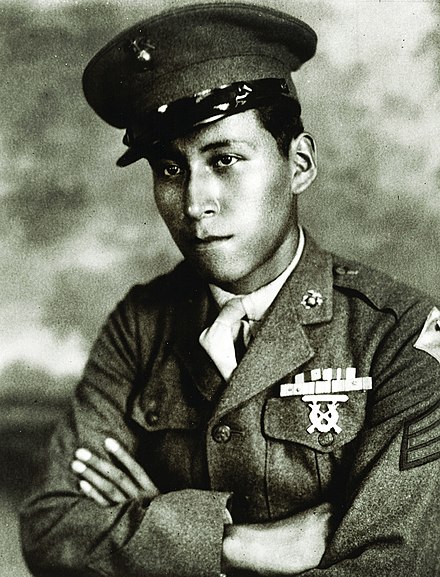
Picture of Mitchell Red Cloud in his Marine Corps uniform during World War II. Picture via Wikipedia.

With World War II over Red Cloud accepted his discharge from the Marines on November 9, 1945. The Marines gave him an honorable discharge and $56.70 before he returned to the Winnebago Indian Reservation in Wisconsin. While on the reservation Red Cloud got married and his wife gave birth to a daughter. Despite these personal developments in his life outside the military, Red Cloud decided after only two years on the reservation to reenlist in the US military. Red Cloud decided this time to not join the Marines, but instead the US Army in 1948. I wasn’t able to find anything definitive on why Red Cloud reenlisted in the military, but maybe he just grew restless after experiencing so much combat during World War II? Maybe it was just the more practical matter of providing for his family that caused him to reenlist in the military? His younger brother who had enlisted in the Army had just did in a peace time training accident; so maybe Mitchell enlisted in honor of his brother? Finally maybe he enlisted because after spending two years away from the Army he realized he is a true warrior and the military was his calling? For whatever the reasons were the US Army was getting an experienced soldier that was badly needed in the US military that had lost the vast majority of its combat veterans due to the post-World War II drawdown.

Red Cloud During the Korean War

The first unit Red Cloud was assign to was E company, 2 battalion, 19 Infantry Regiment of the 24th Infantry Division. The 24 ID at the time was responsible for conducting peacekeeping duties on the southern Japanese island of Kyushu. The assignment to Japan must have seemed like easy duty for Red Cloud compared to what he had been through during World War II. However, the relaxed time he spent in Japan didn’t last long when on July 3, 1950 the 24th ID was deployed to the Korean peninsula to stop the communist backed North Korean military that had invaded South Korea. The North Korean military crossed the DMZ that separates the two countries on June 25, 1950 and appeared to be on its way to reuniting the country that had been divided by US and Russian occupation forces after World War II. US President Harry Truman however decided to militarily intervene to stop the communist invasion of the Korean peninsula and the only troops immediately available to deploy to Korea were the peacekeeping troops located in Japan. Most of these troops were draftees that had not fought during World War II and had little combat training while stationed in Japan. Though these troops were eager to fight in what was being called a “police action” at the time; it would be up to hardened World War II vets like Mitchell Red Cloud to get these guys ready for battle. Red Cloud at the time of his deployment to Korea was a 25 year old Corporal who was respected by the men in his unit due to his prior combat experience.  He had the nickname “Chief”, was easy going, and was quick to give advice to the younger troops that all looked up to him.  They would soon learn to respect him even more.


Taskforce Smith soldiers arrive in Daejon during the Korean War, picture via Wikipedia.

Of the four US military divisions stationed in Japan, the 24ID was chosen to be the first to deploy to Korea.  The first element of the 24th Infantry Division to arrive in Korea was the ill fated Taskforce Smith that first saw action against the North Korean military just south of Osan. The light infantry unit found themselves in battle against a foe with Soviet provided tanks and due to the superior firepower Taskforce Smith was soundly defeated.  You can read more about Taskforce Smith at the below link:

Defeat would become a reoccurring theme for the other 24th ID units who were thrown into combat against the North Koreans with little to no weapons to combat the North Korean tanks. The battlefield chaos for the 24th ID reached its climax when the Division Commander Major General William Dean was captured during the Battle of Taejon. You can read more about General Dean at the below link:

This was the chaos that Corporal Red Cloud found himself in that most have been vastly different experience for him compared to his time in World War II. During that war he had fought in many successful battles against a much more dangerous enemy and now just a few years later he was part of one of the greatest military debacles in US history.

The 24th ID may have been soundly defeated by the North Koreans, but it and the other divisions from Japan that were thrown into battle, did enough to slow down the North Korean invasion until more troops from the US could arrive to help hold the Pusan Perimeter. Red Cloud and the rest of the men in the 2-19 Infantry Regiment saw combat soon after arriving in country on July 12, 1950. The unit saw combat during the defense of Daejon and then moved south towards Taegu and held part of the line along the Pusan Perimeter. Eventually General Douglas MacArthur would execute his famed Incheon Landing Operation that changed the course of the war and threw the North Koreans into a massive retreat. This allowed the 24th ID to reconstitute itself and soon enough Corporal Red Cloud and the rest of the personnel in the division were crossing the DMZ into North Korea to finish the war. In November 1950 the US military and its United Nations allies who had recently deployed troops to Korea, had advanced deep into North Korea when unbeknownst to them the Chinese military had decided to come to the aid of their communist ally North Korea. The unexpected attack by the Chinese caused the US and UN forces to a massive retreat that was quickly turning into yet another military debacle. This was the state of the war that Corporal Red Cloud now found himself in as he sat in a listening post on a hill north of the Chongchon River in North Korea on November 5, 1950.


The Chongchon River can be seen at the very bottom of the map which is located just north of the North Korean capitol city of Pyongyang. To the northwest of the river the positions of the 19th Infantry Regiment on November 1, 1950 can be seen. Map via Wikipedia.

The UN forces were in retreat and the bridge across the Chongchon River was a critical asset to support the southward movement of friendly forces. The 27th British Commonwealth Regiment which had just recently deployed to Korea and Red Cloud’s 19th Infantry Regiment were both positioned on the north side of the river to defend the bridge on November 2, 1950. Due to the shortage in personnel there was a five mile gap between the two units that was to be patrolled to prevent infiltration by the Chinese. However, the patrols ended up proving ineffective as the Chinese were able to successfully probe and discover this gap between the two units.

On the night of November 5, 1950 a 1,000 Chinese soldiers from the 355th Regiment were able to follow field telephone lines laid down in this gap to the positions of the 19th Infantry Regiment. Fortunately for E Company they had someone in a listening post that night that was awake and very attentive in looking for any Chinese infiltrating towards their position on Hill 123. That man was Corporal Red Cloud. A friend of Red Cloud’s in the company, Private First Class Ed Svach would later tell how Corporal Red Cloud had once told him that he could smell the Chinese coming. Red Cloud said, “It’s like hunting those Wisconsin deer. I can smell them coming.”

Red Cloud had been in a listening post that night with his assistant machine gunner on a ridge below the company command post. Red Cloud also knew how the Chinese liked to attack. The Chinese would launch a small frontal attack to draw attention that way but the main attack force would actually be infiltrating from the sides and rear. That is why Red Cloud set up his listening post to the side and rear of the company command post. At 3:20 AM in the morning Red Cloud let out a cry when he spotted Chinese infiltrating towards the E Company position who were following the communications wire leading to the command post. After being spotted the Chinese charged Red Cloud’s position from a 100 feet away and shot and killed his assistant machine gunner. Using his Browning Automatic Rifle (BAR), Red Cloud stood up out of his listening post and unleashed direct fire into the advancing Chinese. Red Cloud’s direct fire slowed the Chinese assault and bought time for the Company Commander, Captain Conway to wake everyone up and consolidate the defense of the E Company position.  Unfortunately Red Cloud’s warning was not enough to alert everyone in the company in time because the Chinese were able to shoot some of the US soldiers in their sleeping bags.  E Company was getting over run and one veteran of the battle is quoted in John McCain’s book, “Why Courage Matters” as saying:

“I wanted to bug out.  I just couldn’t figure out how”

While Red Cloud was holding off the initial Chinese assault he was shot twice in the chest. One of the E company medics, Perry Woodley went to Red Cloud’s position and applied pressure bandages to his two chest wounds. Red Cloud seemed fine and continued to fire his BAR at the Chinese. Woodley left Red Cloud to go help other wounded soldiers. He returned a short time later to check up on Red Cloud again. He found Red Cloud surrounded by about a dozen Chinese bodies and more severely wounded than from when he last saw him.


Position of the 2-19 Infantry Regiment north of the Chongchon River where Corporal Mitchell Red Cloud Jr. was killed in action. Notice the area that the Chinese infiltrated through just west of the 2-19th’s position to get into their rear area.  This was the gap between them and the British 27th Brigade which was mostly composed of Canadians that was supposed to be patrolled by both units to detect the Chinese.  Map via Wikipedia.

Woodley told Red Cloud that he had to get off the mountain or he was going to die there. Red Cloud refused medical evacuation from his position and instead propped his wounded body up on a tree to continue firing at the advancing Chinese with the BAR. One soldier at the bottom Pete Salter said that he actually used a web belt to tie Red Cloud to the tree so he could stay up right to keep firing. Something not widely known about this battle is that another man, PFC Joseph Balboni stayed in a position near Red Cloud that created a crossfire that pinned the Chinese down enough for other men in the company to try and escape down a draw to the south.

After Woodley and Salter left the position they could hear the BARs from Red Cloud and Balboni continuing to fire on the advancing Chinese.  The battle lasted for about an hour before Corporal Red Cloud and PFC Balboni would eventually be killed by the advancing Chinese.  However by this time the men of E Company were well alert and retreating off the hill side from the massive Chinese assault to supplementary fighting positions a 1,000 yards to the south. From there the regiment was able to consolidate and make a defensive line to hold off any further Chinese attacks.  There four quad 4′s with .50 cal machine guns were used to clear the hillsides of Chinese troops chasing the E Company survivors down the draw.  Other units in the battalion would not be as lucky as E Company, if you can call E Company lucky. The nearby A Company would be nearly wiped out as many soldiers were killed while sleeping in their foxholes due to the surprise Chinese attack. E Company soldiers that survived that battle said that their unit likely would have been wiped out too if it wasn’t for Corporal Red Cloud holding off the Chinese attack.

The next morning with the sun out which provided air cover, the battalion was able to return to the old E company position to retrieve the bodies of the deceased. They found that the dead Americans soldiers had been stripped to include Mitchell Red Cloud. The only deceased soldier not stripped was 1st Lieutenant Leslie Kirkpatrick who had all of his clothes and gear on except for a missing West Point ring. Kirkpatrick had been killed while coming to the aid of a wounded soldier during the battle. His body was found with his head lying on his helmet as if he was sleeping. It is believed that one of the other lieutenants in his company placed his body like that after recovering his West Point ring to give to his wife. However, that lieutenant had been killed as well during the battle and the Chinese stripped his body and took the ring. Kirkpatrick was a 1949 graduate of West Point. Of the 670 cadets that graduated that year, 41 of them to include Kirkpatrick were killed in action during the Korean War.

1942-LeslieKirkpatrick
Picture of Leslie Kirkpatrick as a cadet at West Point. Picture via SidneyLanier.org.

Red Cloud’s stripped down body was found lying near the tree where he died. He had been reportedly shot a total of eight times. All around Red Cloud were the bodies of Chinese soldiers. It was reported that over 30 Chinese bodies were found around Corporal Red Cloud’s position.  Corporal Red Cloud’s recovered body would eventually be laid to rest in the United Nations Cemetery in Pusan.  The other BAR gunner PFC Balboni would be credited with killing 17 enemy soldiers before being killed himself.  PFC Balboni would posthumously be recognized with the nation’s second highest honor, the Distinguished Service Cross.  In all the battalion estimated that about 500 enemy soldiers had been killed on the hill that day.

Post-Korean War Honors

A few months later in April 1951 the Congressional Medal of Honor was presented to Corporal Mitchell Red Cloud Jr.’s mother during a ceremony held at the Pentagon. She was presented the medal by General Omar Bradley. Here is what his Medal of Honor citation says:

At the Pentagon in April 1951, Lillian “Nellie” Red Cloud, mother of the late Cpl. Mitchell Red Cloud Jr., is handed the Medal of Honor awarded her son for his “dauntless courage and gallant self-sacrifice” against Chinese forces in North Korea the night of November 5, 1950. Gen. Omar N. Bradley, then-Chairman of the Joint Chiefs of Staff, is at left. ” – See more at: http://korea.stripes.com/base-info/cpl-mitchell-red-cloud-jr-annual-ceremony-planned#sthash.AZOcG1Oc.dpuf

Cpl. Red Cloud, Company E, distinguished himself by conspicuous gallantry and intrepidity above and beyond the call of duty in action against the enemy. From his position on the point of a ridge immediately in front of the company command post he was the first to detect the approach of the Chinese Communist forces and give the alarm as the enemy charged from a brush-covered area less than 100 feet from him. Springing up he delivered devastating pointblank automatic rifle fire into the advancing enemy. His accurate and intense fire checked this assault and gained time for the company to consolidate its defense. With utter fearlessness he maintained his firing position until severely wounded by enemy fire. Refusing assistance he pulled himself to his feet and wrapping his arm around a tree continued his deadly fire again, until he was fatally wounded. This heroic act stopped the enemy from overrunning his company’s position and gained time for reorganization and evacuation of the wounded. Cpl. Red Cloud’s dauntless courage and gallant self-sacrifice reflects the highest credit upon himself and upholds the esteemed traditions of the U.S. Army. for conspicuous gallantry and intrepidity in action at the risk of his life above and beyond the call of duty in Chonghyon, Korea, 5 November 1950.

At the Pentagon in April 1951, Lillian “Nellie” Red Cloud, mother of the late Cpl. Mitchell Red Cloud Jr., is handed the Medal of Honor awarded her son for his “dauntless courage and gallant self-sacrifice” against Chinese forces in North Korea the night of November 5, 1950. Gen. Omar N. Bradley, then-Chairman of the Joint Chiefs of Staff, is at left. ” Photograph via the Stars & Stripes

In 1955 his family was able to get his body moved from the UN Cemetery to the Ho-Chunk Cemetery on the Winnebago Indian Reservation back in Wisconsin so he could lay in rest with the rest of his tribe. His friend Ed Svach escorted the body back to the US where he remembered his friend being buried in the custom of the Winnebago people. The sides of his coffin were removed so his soul could escape, a bow and quiver of arrows was laid next to him so he could hunt in heaven, and bowl of fruit was laid next to him so head would have something to eat during the journey.


Mitchell Red Cloud Jr.’s grave in Wisconsin. Picture via FindaGrave.com.

In John McCain’s book, “Why Courage Matters: The Way to a Braver Life” he includes quotes from veterans from the battle that say they owe their lives to Mitchell Red Cloud. One of the survivors, Pete Salter said that during the battle he prayed to God in his foxhole to let him survive this fight and he would live a better life. He said his prayers were answered by Mitchell Red Cloud who sacrificed his life so many other men could survive. Salter in the mid-1960’s would take his kids to the Winnebago Indian Reservation to see the grave of Corporal Red Cloud. Salter broke down crying at the site of the grave of the man who had saved his life. Inscribed on Red Cloud’s grave are these words:

“The son of a Winnebago chief and warriors who believe that when a man goes into battle, he expects to kill, or be killed and if he dies he will live forever.”

Picture of marker above Mitchell Red Cloud’s grave site in Wisconsin. Picture via FindaGrave.com

Since Corporal Red Cloud’s death, the US military has made efforts to ensure that his memory does live forever by naming various military installations and equipment in his hnor. The first thing that I could find that was named after Red Cloud was when Camp Red Cloud in Uijongbu, South Korea was named after the Medal of Honor recipient.

Mitchell’s Club on Camp Red Cloud is named after him as well.  There is also a rifle range on Ft. Benning, Georgia that is named after him. On August 7th, 1999 the newly commissioned strategic sealift ship, the USNS Red Cloud was launched from its dock in San Diego in honor of the fallen warrior. His daughter Annita Red Cloud, his granddaughter Tris Yellow Cloud, and other dignitaries from the Ho-Chunk tribe were there for the ceremony.  Kenneth Kershaw, a veteran of E Company, 19th Infantry, who was able to survive the battle that night also attended the ceremony. He simply told the crowd that he attended the ceremony because “If it were not for the alarm sounded by Mitchell Red Cloud, I would not be here today.” The last commemoration I can find for Red Cloud was on the 50th anniversary of his death in 2000. The Korean War Commemoration Committee held a ceremony in honor of Red Cloud at his grave site in Black River Falls, Wisconsin. The committee presented Red Cloud’s daughter Annita with the Republic of Korea War Service Medal that had recently been authorized by Congress for Korean War veterans to wear.


USNS Red Cloud.  Picture via Navy.mil.

Despite these attempts by the military to honor Corporal Red Cloud within the American public and even the US military his story is widely unknown. Red Cloud’s life story is why I have continued to advocate for Hollywood to explore using stories from the Korean War as movie material. A movie based around E Company with Mitchell Red Cloud as a main character and climaxing with the Battle of Hill 123 would make for a great movie.  Red Cloud’s life is one to be remembered not just for his Korean War service, but for his service in World War II as well. There probably are not many US military servicemembers that fought at Guadalcanal and Okinawa during World War II and then the Busan Perimeter and then finally against the Chinese during their intervention into the Korean War. Clearly Mitchell Red Cloud Jr. is not only a Hero of the Korean War, but one of the nation’s most heroic military heroes that unfortunately few people know anything about.

Note #1: More stories about Heroes of the Korean War can be read at the below link:

Note #2: During my research I found only the two above photographs of Mitchell Red Cloud.  If anyone knows of more photographs of Red Cloud please leave a link in the comments section.

Note #3: If anyone knows where to find a picture of PFC Joseph Balboni I would like to post his picture here as well.

Note #4: If anyone knows of any other buildings or site named after Mitchell Red Cloud Jr. please leave a comment and share it with everyone else.

Further Reading:

History.net: Mitchell Red Cloud Jr.: Korean War Hero

Marine Raider Page: Mitchell Red Cloud

“From the Hudson to the Yalu”, by Harry Maihafer

“Why Courage Matters: The Way to a Braver Life”, by John McCain

“Medicine Bags & Dog Tags”, by Al Carroll

“Warriors In Uniform: The Legacy of American Indian Heroism”, by Herman Viola

Heroes of the Korean War: Private First Class Anthony T. Kaho’ohanohano

Basic Information

  • Name: Anthony T. Kaho’ohanohano
  • Born: Maui, Hawaii
  • Battlefield: Battle of Chup’a-ri
  • Date of Death: September 1, 1951
  • Medal of Honor Ceremony: May 3, 2011


Private First Class Anthony T. Kaho’ohanohano via Army.mil.

Introduction

The Korean War saw people from many countries come to the peninsula and fight and die to protect the Republic of Korea from communist aggression.  Some of those people who came to Korea to fight were Americans from the Hawaiian Islands.  In downtown Honolulu the Hawaii Korean War Memorial can be seen that lists the names of all 456 residents of Hawaii who died fighting in the Korean War.  The memorial is about a 100 feet in length, 6 feet high and made of polished granite and black lava rock.  On each of the rock squares is the name of each Hawaii resident that died during the war.

Early Life

One of the names on these blocks is Anthony T. Kaho’ohanohano from the Hawaiian Island of Maui.  Kaho’ohanohano was born in 1930 to a family with 5 other brothers and a sister.  This large family lived in a two bedroom house in the village of Wailuku in Maui.  Anthony graduated in 1949 from St. Anthony High School where he played both football and basketball and was known as the “humble giant”.  After high school he like all of his other 5 brothers joined the military; three of his other brothers joined the active Army, one other brother served in the Marines, and the last brother served in the National Guard.  Anthony initially enlisted in the Hawaii National Guard, but later joined the active Army on February 5, 1951 to fight in the Korean War.


Picture of Kaho’ohanohano as a high school football player via Wikipedia.

Korean War Service

Anthony Kaho’ohanohano was later that year deployed to South Korea where UN forces were battling communist aggression against the Republic of Korea.  By 1951 the war had changed dramatically from what appeared was going to be a rout of the North Korean military by the UN forces after the successful Incheon Landing Operation.  With the North Korean forces largely defeated the Chinese military secretly infiltrated across the Yalu River into North Korea where they launched a massive surprise attack against the UN forces.  The effectiveness of the Chinese surprise attack caused a full scale UN forces retreat back across the 38th parallel into South Korea.  The retreat was only halted in February 1951 when soldiers from the 2nd Infantry Division and their attached French Battalion under the command of two Heroes of the Korean War, Colonel Paul Freeman and Lieutenant Colonel Ralph Monclar stopped the Chinese advance at the Battle of Chipyong-ni.

The Chinese would attempt to regain their battle field momentum when they launched the “Chinese Spring Offensive” in April 1951.  However, United Nations units such as the British Gloucestershire Regiment commanded by Lieutenant Colonel James P. Carne, the Philippines Expeditionary Force To Korea (PEFTOK) commanded by Lieutenant Colonel Dionisio Ojeda, and the Princess Patricia’s Canadian Light Infantry commanded by Lieutenant Colonel J.R. Stone were able to stop the Chinese advance.  After the failed “Chinese Spring Offensive” the Korean War had largely turned into a stalemate near the 38th parallel where the opposing Army’s battled over hilltops that gave each side increased leverage during the Armistice Negotiations that had begun July 10, 1951 at Kaesong.

This is the war that Private First Class Anthony Kaho’ohanohano found himself entering in 1951when he was assigned to Company H, 17th Infantry Regiment, 7th Infantry Division.  In August, 1951 the 7th Infantry Division was deployed along the frontlines in the area north of Hwacheon which is an extremely mountainous region in the central area of the Korean peninsula.

This mountainous area made the control of high points extremely important in order to call for indirect fire and to better control the few roads in the area.  The 7th Infantry Division launched an operation on August 26, 1951 that would come to be known as the Battle of Chup’a-ri.  The small village  of Chup’a-ri was located in one of the main valleys in the area and the 7th Infantry was attempting to seize five key hills to the east of the village that would allow them to better control the valley and the  road that ran through it.  Additionally the control of these hills would put the UN forces in a better position tactically to reclaim the Kumsong River located two miles north of Chup’a-ri.


Map of the Chupa-ri area via the Korean War Project.

The 17th Infantry Regiment of the 7th Division that PFC Kaho’ohanohano was assigned to was tasked to secure three of these hills.  On August 26th the regiment began combat operations to secure Hill 461 that overlooked the valley and its access road, Hill 682 that was a mile to the east of 461, and Hill 851, which was one more mile east of 682.  For the next five days the regiment battled the Chinese 81st Division for control of these hills.  PFC Kaho’ohanohano’s company was part of the 2nd Battalion which was tasked to assault Hill 682.  By this point in the war, Anthony had found himself as the leader of a machine gun squad within his company.  On August 31, the unit was able to secure the hill, but the Chinese launched a massive counterattack against the 2nd battalion.  The fighting was ferocious with the Chinese blowing whistles to signal the next human wave attack against the American positions.  The overwhelming Chinese attacks eventually caused the 2nd Battalion soldiers to begin to withdraw off of Hill 682 the next day.


3D view of Hill 682 via the Korean War Project.

During the initial Chinese assault Kaho’ohanohano was wounded in the shoulder, but continued to fight on.  When his company began their withdrawal PFC Kaho’ohanohano ordered his squad to take up better positions lower down the hill while he provided covering fire for them.  Kaho’ohanohano gathered a satchel of grenades and extra ammunition to use against the on coming enemy.  His last words were reported to be “I’ve got your back” as he headed back to a position to hold off the Chinese attack.  The extra ammunition would not be enough though as Anthony eventually ran out of ammo and had to turn to his entrenching tool to fight off the enemy until he was killed.  He had fired so many rounds from his rifle that it had actually melted and was found bent.  Seeing his final stand against the Chinese, Kaho’ohanohano’s comrades charged back up the hill and defeated the Chinese onslaught.  When his unit re-secured the hill they found 11 dead Chinese bodies around Kaho’ohanohano’s position and two more found dead inside his position apparently killed by blunt force trauma to the head from Kaho’ohanohano’s entrenching tool.

By September 4th, the 7th Infantry Division had captured all 5 hills in the vicinity of Chup’a-ri, but PFC Kaho’ohanohano was far from being the only person killed during the battle.  In just his unit 17 other soldiers died defending Hill 682.  In total the 7th Infantry Division lost 175 soldiers with 594 more wounded in the Battle of Chup’a-ri.  What did the lives of all the soldiers gain the UN forces?  Well if you look at a map of South Korea it ultimately helped the UN forces consolidate about 10 square miles worth of territory.  Think how many more lives the Chinese lost trying to defend that territory?  Life was definitely cheap back then.

Kaho’ohanohano for his actions received the Army’s second highest decoration for combat, the Distinguished Service Cross in 1952.  However, his family believed that he deserved the nation’s highest honor, the Medal of Honor for his heroism during the Battle of Chup’a-ri.  Considering that another soldier in his battalion Corporal William F. Lyell was awarded the Medal of Honor for doing nearly the same thing as Kaho’ohanohano did during the battle, it would seem his family had a strong case.  However, it would take 60 years before the Kaho’ohanohano family would see Anthony be recognized with the Medal of Honor.  US Senator from Hawaii Daniel Akaka requested in 2004 that the Pentagon review Kaho’ohanohano Distinguished Service Cross documentation to see if it should be upgraded to a Medal of Honor.  Senator Akaka has long been an advocate for veterans from  Hawaii.  In 2000, he was able to get 22 veterans of Asian and Pacific ancestry to include 20 of them from the famed 442 Regimental Combat Team the Medal of Honor for combat actions during World War II.  Many advocates for these veterans believed that these minorities may have been overlooked for the Medal of Honor by commanders that were prejudice against minorities.


President Obama presents George Kaho`ohanohano, the nephew of Army Pfc. Anthony T. Kaho`ohanohano, a posthumous Medal of Honor during a White House ceremony.

The President of the United States Barack Obama, who was born in Hawaii himself, must have agreed as he upgraded Kaho’ohanohano’s Distinguished Service Cross to the Medal of Honor.  On May 3rd, 2011 at a White House ceremony President Obama presented PFC Kaho’ohanohano’s family with the Medal of Honor.

George Kaho’ohanohano, a retired Maui Police Department captain, also said it was a relief that their hard work had come to fruition. He added that he had a “lump” in his throat when he received the medal from Obama.

“When I looked at the family when I got it from the president, I saw couple of the family members crying; I saw a couple of family members with a broad smile. It was a wide range of what the family was going through,” he said.  [Maui News]

Here is Private First Class Anthony Kaho’ohanohano’s Medal of Honor citation:

The President of the United States of America, in the name of Congress, takes pleasure in presenting the Medal of Honor to (Posthumously) to Private First Class Anthony T. Kahoohanohano (ASN: RA-29040479), United States Army, for extraordinary heroism in connection with military operations against an armed enemy of the United Nations while serving with Company H, 2d Battalion, 17th Infantry Regiment, 7th Infantry Division. Private First Class Kahoohanohano distinguished himself by extraordinary heroism in action against enemy aggressor forces in the vicinity of Chup’a-ri, Korea, on 1 September 1951. On that date, Private Kahoohanohano was in charge of a machine-gun squad supporting the defensive positions of Company F when a numerically superior enemy force launched a fierce attack. Because of the overwhelming numbers of the enemy, it was necessary for the friendly troops to execute a limited withdrawal. As the men fell back, he ordered his squad to take up more tenable positions and provide covering fire for the friendly force. Then, although painfully wounded in the shoulder during the initial enemy assault, he gathered a supply of grenades and ammunition and returned to his original position to face the enemy alone. As the hostile troops concentrated their strength against his emplacement in an effort to overrun it, Private Kahoohanohano fought fiercely and courageously, delivering deadly accurate fire into the ranks of the onrushing enemy. When his ammunition was depleted, he engaged the enemy in hand-to-hand combat until he was killed. His heroic stand so inspired his comrades that they launched a counterattack that completely repulse the enemy. Coming upon Private Kahoohanohano’s position, the friendly troops found eleven enemy soldiers lying dead before it and two in the emplacement itself, beaten to death with an entrenching shovel.

Pfc. Anthony T. Kaho’ohanohano [KA ho OH hano hano]
– Killed in Action Sept. 1, 1951 in Chupa-ri, Korea
– Age: 21 years, 2 months
– Unit: Company H, 17th Infantry Regiment, 7th Infantry Division
– Years of Service: 3 years, 3 months, prior service with Hawaii National Guard. Enlisted with the U.S. Army Feb. 5, 1951
– Awards: Purple Heart (posthumously), Army Good Conduct Medal (posthumously), National Defense Service Medal, Korean Service Medal with one Bronze Service Star, United Nations Service Medal, Republic of Korean-Korean War Service Medal, The Republic of Korea’s Wharang Distinguished Military Service Medal with Silver Star (posthumously), Combat Infantryman Badge, Republic of Korea-Presidential Unit Citation


Anthony Kaho’ohanohano’s headstone via Army.mil.

Anthony Kaho’ohanohano is buried at the Makawao Veterans Cemetery on the slopes of Maui’s gigantic volcano called Haleakala.  In February 2012 the US military replaced his headstone to signify that he is a Medal of Honor recipient.  This replacing the headstone was the ultimate closure for Private First Class Kaho’ohanohano’s family who had fought for so long to see that he received the recognition he deserved as a Hero of the Korean War.

Note: You can read more of the ROK Drop featured series Heroes of the Korean War at the below link:

A Profile of Korea’s Teokgeo-ri Ville

Narrative

The city of Dongducheon is well known for being home to Camp Casey and soldiers from the 2nd Infantry Division.  This has made the Bosan-dong ville across the street from Camp Casey the main shopping and bar area for Soldiers stationed at the camp.  However, Bosan-dong isn’t the only ville in the Dongducheon area.  Camp Hovey is a smaller camp accessed from Camp Casey by a small valley known as the Hovey Cut between the two camps.  Just outside the gate of Camp Hovey is the small village of Teokgeo-ri:


Note that Teokgeo-ri has been spelled Toko-ri in the past.

At one time Teokgeo-ri was one of the sleaziest villes you could find in Korea since the clubs had to go out of their way to attract GI customers from the much larger and popular TDC Ville.  If you have ever watched the first Stars Wars movie and remember the bar with the space aliens in it in the city of Mos Eisley, that is what Teokgeo-ri was like a few years ago.

Obi-wan Kenobi once described Mos Eisley as a “wretched hive of scum and villainy”, Toko-ri wasn’t much different. However, instead of horned, green, or beady eyed aliens, Teokgeo-ri had Filipino and Russian juicy girls covered in chocolate and wax, a retarded barmaid, strippers that used to hold what was known as the P***y Olympics led by a Korean woman known as the Dragon Lady who did anatomy defying things with cigars and beer bottles, and to top it off there was even a midget. Before I had even ever stepped foot in Korea I had heard about the “Midget of Teokgeo-ri” from old crusty NCOs about how they used to “stick to the midget” especially on New Years; that is how well known she is in the US military. After seeing the midget for myself I can’t imagine why anyone would want to “stick it to the midget”, but hey to each their own.

Since I don’t have anything to do with the ville any more I’m not sure if any of this still goes on, but from what I hear Teokgeo-ri has really died down and even the midget has left the ville in recent years.  I hear that the clubs in an effort to stand out from their competition in the TDC ville are more active in prostitution.  Anyone know if this perception is true or not?

I started my walk around Teokgeo-ri from the main road that runs through the center of town.  From this road I noticed the first club I saw called the Black Jack:

As I continued to walk down the road I also saw the Fox Woods Club:

At the end of the street the road leads to Highway 364 which is a scenic drive up and over the mountains to Pocheon. I took a left and followed a small side road that leads to Camp Hovey:

The side road follows a creek on its eastern side and on the western side are more buildings from the village.  Here is the view looking across the creek towards the farm land from the side road:

Here is the view of the buildings I was approaching as I walked down the road:

This cluster of buildings were more clubs servicing Soldiers from Camp Hovey.  The first club with the Joy Club:

Next was Club Bounce and Club Hooah:

Here is the view looking back at these clubs:

Here is the view of the creek that runs through Teokgeo-ri and also flows through both Camp Hovey and Camp Casey:

This creek looks harmless enough now but when there is sustained rain this creek can really get swollen and flood which is something Camp Casey and Hovey experienced in recent years.

Here is view looking in the other direction across the rice paddies that border Teokgeo-ri:

As I walked further down the road I came upon this bridge that crosses the river:

Across the bridge there is a road that leads to Beaver’s.  Beaver’s is a BBQ restaurant frequented by US Soldiers that has been the subject of controversy in the past.  However, it was about this time that I started getting rained on pretty heavily and just decided to walk back to my car as quickly as possible instead:

As walked down the road Camp Hovey came into view:

The road in front me leads through this narrow ville, which I have had a few interesting times trying to drive a Humvee through before:

Instead of walking down the road towards Camp Hovey I took a left and headed back towards the downtown section of the city instead:

Along the way I walked by this US Army friendly hotel:

I then walked by the villages Post Office that appears to be having a problem with people leaving trash on their premises:

Here is a picture of a chicken and beer joint I passed as I walked through the ville:

Here is a side street in the middle of Teokgeo-ri I then followed where more clubs are located:

First is the DMZ Club:

Then there is the Grand Illusion:

Followed by Club NBA:

Here is the view looking back down the street at the clubs that I walked by:

From this street I then walked up a side alley to take me back to where I parked on the main road through town:

Along this road I saw few more clubs such as Club Obsession:

I then walked by the UN Club:

After coming back upon the main road through Teokgeo-ri I noticed a sign for the D&G Club:

Right next to the D&G Club was what was left of this burned down club:

Here is one final view of downtown Teokgeo-ri:

Conclusion

If it wasn’t for the fact that Teokgeo-ri is a sleazy ville it actually would be a nice place to live due to its scenic location.  The valley is quite beautiful and some people are starting to take notice of this fact as more and more large and expensive homes are being built along the hills around Teokgeo-ri.  I do have to say that in the past 10 years Teokgeo-ri has come a long ways and is not as sleazy as it once was.  Who knows maybe some day after the US military relocates from Dongducheon to Camp Humphreys further down south, maybe Teokgeo-ri will become an area more affluent people build their homes to take advantage of the village’s beautiful scenery?  With that said that concludes my walk around Teokgeo-ri.  If anyone has anything they want to add about the various clubs in the village and experiences they had in Teokgeo-ri in the past please share with everyone in the comments section.

Note: You can read more from the ROK Drop featured series “A Profile of USFK Bases” at the below link:

Comments

The flood in ’98 spawned most of the rebuilding you see today. While they have slightly polished the turd, it’s still a worthless cesspool of Horny GIs ,Flip whores, Soju laden Whiskey and Skunk OB.

I am wondering if there is any such thing as “skunk OB”.

In all the years of selling Korean beer, I never had a complaint about any of the beer tasting skunky.

Nor, outside of a GI ville, have I had strange-tasting Korean beer.

I suspect that “skunk OB” has more to do with the habit of GI bars refilling used bottles with draft beer and loosely recapping them by thumb in the afternoon.

Then, they go into the beer cooler where they loose much of their fizz and freshness after a day or three.

Ajuma brings them to the table with rapidly popped caps and nobody is the wiser.

Poor OB, which runs a squeaky-clean stainless steel and glass brewery where robots do most of the work, gets blamed for making skunky beer.

Some people deny this is possible. One guy wanted to argue that there was no way ajuma could serve him a refilled beer… he “would just know”. Besides, “I can hear the hiss when the cap comes off.” He denied my skepticism that anybody could here that in a noisy bar.

While he explained the intricacies of differentiating the nuances of opened and unopened beer, I kept eye contact, picked up an empty bottle off the bar, pressed a cap on it with my thumb… RIGHT IN FRONT OF HIM… and said, “Gosh, dude. I guess you are right. Let me buy you a beer.” I popped the top with an opener.

His attitude changed. “Thanks, man!” He lifted it back for a swig… and, of course, nothing came out.

In the history of stupid looks, it was in the top ten.

I was just up in that area today…had a lot of flood damage to many of the clubs. The Americans helped out quite a bit cleaning out their own favorite watering holes though!

“Poor OB, which runs a squeaky-clean stainless steel and glass brewery where robots do most of the work, gets blamed for making skunky beer.”

Who gets the blame for their recipes?

“Who gets the blame for their recipes?”

Budweiser.

Though this all looks scrubbed and clean compared to the Korea I remember from 1983 I sure do want to come back and take a tour. I really appreciate the photo journalism pages like this I’m finding on this site! Thanks

Just don’t make the mistake of going in December when it’s 14 below…

Note that the clubs are all several stories tall and windowless. All of the clubs are on the ground floor. What’s in the floors, above?

That is where the CSW’s are held (can’t escape if there are no windows….)

#5,

Directly or indirectly? And,while I’m at it since you know a thing or two about the booze business in Korea…Why are Korean breweries’ new products so bad?

A little useless Teokgeo-ri trivia that I learned from someone born and raised there.

The first syllable in the name is “tuk” (턱), which is the Korean word for “chin.” The second and third syllables are the word “geo-ri” (거리), which is the Korea word that has several related meanings, such as distance, range, an interval, a difference or a gap.

So…how/why did these two words get combined to make the name of a small mountainous village?

There are several trails up in the mountains, some of which are somewhat dangerous because one errant step and you could find yourself going down. So if someone took a wrong step, he/she could easily find him or herself falling into a cavity/depression of some sort and quickly be up to his/her chin in a hole. Thus, you fell to a depth (distance) “up to your chin.”

And so the name Teokgeo-ri was born.

Without giving it any thought – 99%+ of the people would guess the “ri” part of the name is the “ri” (리 里) that means village. But this is a rare case of a village name that ends with “ri” – and the “ri” means something other than village. Also, most Korean place names have Chinese characters behind the hangul spellings – but not this village. It’s name is pure Korean.

Teadrinker,

Have you not noticed that everybody is producing a “safe”, lowest-common-denominatior one-size-fits-all product?

This ranges from TV/movies/music to snacks/chain restaurants/beer to uninspired fashion/cars/consumer electronics.

Unique and appealing stuff is available… but it costs substantially more than the dreck passed off on the masses.

This is a side effect of the perverse form of macroeconomics currently being practiced and passed off as “capitalism”.

It would take pages and pages to explain… but some key points are… governments discourage small-scale innovation through over-regulation, employment law, and tax structure… large companies discourage anything but managed competition from their peers… the financial companies encourage stagnation through formula risk management… and short-term, golden parachute CEOs worrie about short-term gain at the expense of long-term failure, etc.

(Another interesting aspect is when this system fails, there will be many wagging their fingers and happily touting the “failure of capitalism”.)

So… with all this, every beer tastes like Budweiser… the lowest form of beer that is not exactly unpleasant… but certainly isn’t much more special than water.

Small companies interested in making great beer at a lower profit can’t get the approval or financing to get started and the big companies work together to keep it that way… and then they collectively try to shave pennies of cost off the thousand gallon tank by using inferior ingredients or faster processes which result in lower quality products across the board… but, with an army of focus groups, they are able to choose something the public will tolerate if they have no other choice… and then, after some time, the public forgets and the new crap becomes the new standard.

If all the contrived regulations and permits didn’t exist, any one of us could make fantastic beer out of our houses and sell it on the street at a reasonable price and make a reasonable profit… quickly becoming competition with the swill producers.

It can be done… but it requires big money. Gone are the days of Ma and Pa starting a big company out of their house and building the business one step at a time all on their own. Everyone from the big companies to the financial institutions to the government they control don’t want it to be that easy or that independent.

Actually, America has some great microbreweries but the big 3 (Bud, Miller, Coors) control distribution and lock them out best they can.

Prohibition killed many breweries and the small ones primarily came back because of one man… one kind of unexpected hero. While we love to make fun of him, we should probably always give him credit for this as we complain about him.

http://www.tnr.com/blog/jonathan-chait/76819/how-jimmy-carter-saved-beer

Anyway, that is a very babbling, unorganized, complex, and wide-ranging answer to why popular beer (and a lot of other things) suck… and seem to keep getting worse.

Hope it made sense.

Guitard,

I heard a slightly different story.

“Teokgeo-ri” does not really exist except as slang. It is not an official name… hence it is not a “ri”. It is a dong of Dongduchon. The official address is gwang-ahm-dong.

Teok-ga-ri came about because going over a hill in the area (possibly of the same name) caused one to be out of breath.

Korean slang for “out of breath” translates as “breath comes up to your chin”… which became, as you pointed out, “chin distance” or some similar idea.

I can’t vouch for my version being correct… but that’s what I heard.

#12,

With imports being increasingly popular, they could still produce a better quality product and charge a premium for it as they do in most countries. It would sell. But, as you were saying, they are shortsighted.

…The breweries are also owned by the same companies that produces and imports those imports…which makes me wonder what the markup is on imports.

  1. There are skunk beers. This happens because it is not stored properly.

A bar owner buys bulk and it sits in a non-climate controlled area; hot, cold, hot, cold…

It is exposed to the sun in summer in the back of a truck…

Expired beer.

Any combination of the above.

You get less skunks in the winter. Skunks have become more rare over the years but they most definitely exist.

Q: Why is Toko-ri CP worse than the Galactic Empire?

A: Spice isn’t the only load you have to dump before a patrol arrives.

To those of you who are interested in the concept of better beer in Korea, the following information is provided:

http://www.facebook.com/CraftworksKorea?ref=ts
http://www.craftworkstaphouse.com/
http://homebrewkorea.com/

Some folks are trying to give people good beer options – either by opening a bar or making it themselves.

Also, there’s a Korean-American guy who is running an American Craft Beer importing company here that currently supplies Anderson Valley, Lost Coast, and Rogue Brewing Company beers. They’re pricey, but good.

I lived in the old apartment complex at the far left of that 3rd pic for a long time. It used to be a foreigners only complex, sold to private individuals during our stay there (many of the apartments were subsequently renovated). That part of TDC was a nice, quiet place to live (sleazy clubs down the street, which I never visited, notwithstanding). I’d go back in a minute. Last time I was there that apartment complex wasn’t looking too good anymore, though…

The new OB beer, called “OB Gold”, is not bad. Its at least as good or better than any US mass produced beer. And I agree that being in brown bottles, cans or kegs there is little chance of a truly “skunky” Korean beer (except I suppose, Cafri, in the clear “High Life” style bottles), as “Skunky” aroma is a result of sunlight acting on the beer.

Leon,

I have heard the old “it sat around” used as an excuse… but I think it is just an excuse because nobody wants to believe they are drinking used beer.

Korean bar owners have not studied logistics nor do they speak of JIT… but they have neither the space nor the extra cash to keep weeks of unused beer lying around in a back room… so they rotate their entire supply in a week at most.

The distributors also rotate their supply quickly as storage space is expensive.

There never seems to be a skunky beer from a store, either… or Korean-only bars in non-GI areas.

I stand by my idea that skunky beer is due to the games GI bars play.

  1. Sorry CH. I personally know bar owners whose stock *might* have rotated, sitting in an (climate) uncontrolled area, for 5-6 months, maybe longer. I couldn’t believe how much beer they were buying versus how much they sold. Thinking of one owner in particular, I’m suspecting a huge bulk discount on nearly expired product. Possibly saving 3-5 cents a bottle! Oh, it’s worth it.

I know I never sold used beer in my bar but sometimes, but rarely, got a skunk.

As far as sunlight and brown bottles. Meh. Hauling brown bottles around on the back of an uncovered flatbed for a few days?…

oh man this brings back memories. was with the MP’s from 2004-2007 here. I remember the king club and mustang club the most. mustang for the crowd/music and king for the girls

I was in Camp Hovey – Toko-ri from 1966 to late 1968. I don’t know how it changed but then it was one of the most laid back places in Korea. The people were friendly and the food was great. The pot was cheap and it was mellow. The girls were all Korean, no foreign girls at all. There wasn’t a paved road anywhere to be seen, except in the camp. There were no buildings over one story that I can remember, even in camp. Most buildings were quonsets except for the mess hall and the officer’s quarters. The clubs were called the New Seoul Club and the Niagara Club, etc. A yobo (girlfriend) was $15.00 a month and it went up as you gained rank. We used to do field marches up to a place called Wang Bang Knee. If you wanted to go to TDC, you could take a Kimchi bus at the risk of your life. Going over the pass to TDC was always an adventure. The village was a floating mud puddle during monsoon season. I don’t think many of us wanted to go to TDC because we had our own little tucked away paradise. It was among the best times of my life. I would go back in a minute if it were still like that. Unfortunately it does seem to have changed a bit.

One of my buddies just returned from Hovey last week. He said Toko-ri is now Off Limits. He did say that since it is Off Limits, the MPs and the units patrols do not go there, it is a good get away.

  1. Is this an unofficial secret off-limits?

Re: OB and skunk beer – shit, when I was in Korea, I’d drink a semi-cold beer out of a homeless man’s shoe; In 1987 at 800 won, it was not a bad deal. When out and about, who cares about the beer?

As for Toko-ri: I lived a five minute walk from the main gate at Camp Casey. It was too easy just to go there. On 2 or 3 occasions, however, I wanted to see what Toko-ri might have to offer. While not dissapointed, I was not so impressed, either. I did meet one nice person at the Ace club, but not so nice that I went back. Honestly; why travel to go ride on a merry-go-round when you already live in Disneyland? I will admit that the cab rides were nice, especially if you told the adjushi to go fast; the ride through the mountains was nearly as fun as a roller coaster.

I was also stationed at Camp Hovey (1966-1968) where I met Steve Dudas and we became friends and still are. Tokori was a great little village back then. There was a road that went up behind the village along a stream – great place to stop and have a picnic – very scenic. I stayed overnight many times – returning back to base in the morning. We would buy a teapot full of Malkoli for about 40 won – drink that and smoke pot. I really had a great time there even extending my tour of duty for an additional year. Also had a great time touring much of South Korea. The people were very grateful for us being there and protecting them.

Looking at these pictures – I can’t believe how much everything has changed.

Toko-ri was a “ri” at one point. Mail to my hooch off base back in the 80′s was Kyonggi-do, Tongducheon-Shi, Kwang-am-dong, Toko-ri, and whatever the street address was.

I was stationed at Camp Hovey from 1989 -1990! I spent so much time “down range” in the ‘vill my buddies called me the Mayor of ToKoRi! You could usually find me at the Enjoy Club swilling something cold, hardly ever OB. I think they sold Bud there, can’t remember! Usually had a LBFM close by trying to hustle a drinky or a short time!! I was very glad to see the photos posted here but can only remember the “GI” Club and Jun Bar B Q! The Enjoy club was up that alley between the two in the pic! Tried to go by there the day before I PCS’ed but the place had been shut down for some reason. I’d like to go there again and see the place, but I am too old now to “Enjoy”!!!

I was stationed in Yongsan at the 121 Evac Hospital from 1979-1980. One of the few things that I didn’t like about Korea was that the beer sucked. There were 2 types, OB (OB is an appropriate name since it tasted like Obstetrical drainage) & Crown (less nasty in my opinion but not by much). I went back to Korea for a week after I retired in 1996 on the way to my wife’s home in Cambodia & they had Budweiser. It’s not great like Guinness, German, or Czech beers but it’s better than OB or Crown. I drank oceans full of soju, mokoli, & oscar when I was stationed there. The pot was just ok but you could get different pills or codeine cough syrup in the Korean pharmacies. For any law enforcement personnel reading this that is just what I heard. The year I spent in Korea was the best year of my life, it was one big party.

Perhaps drinking OB is just an acquired taste. I know that after several months in Korea, I acquired the taste quite nicely, thank you. Hell, I could even drink that wierd-ass “champagne”, Oscar, and not toss my biscuits. If one can tolerate (or even enjoy) soju or makkoli, one could certainly like OB!

Did anyone ever try kolyangju? It is a Chinese whiskey; that shit gave me a three day hangover. Never again!

Ahh Hovey ville! My first introduction to military night life in 1990. My first drink, my first time over seas, first time experiencing the “Drinky” culture…..the days. I love your comparison between the Casey ville and Hovey Ville…too accurate. I used to love going to Hovey Ville because I knew that all other G.I.’s were in Casey. But one time they shut Casey down and put it off limits, that night I think half of 2ID was in Hovey ville. I had never seen it so crowded. Thanks for the pics and memories.

Sorry for the double post – but this is a more appropriate place for this:

I went out the Camp Hovey gate and drove through Tokori last night. It was sometime between 9:00 and 10:00pm on a Saturday — and I literally did not see a single soldier.

My how things have changed . . .

Wow! I was stationed at Cp Hovey 69-71. I was a “Ville Rat” and actually married a girl from there, two sons, and doing well. It was a little broken down village and I can’t believe how it has changed. When you walk out the Hovey gate I actually bought the first building to the right, don’t know if it’s still there (if so I own it lol), it had been bought by a former MSG, two rooms and pretty snazzy for Tokori, I think I paid like $300, huge sum in those days…aaah they were good times….

I would love to go back and visit

I like Steve Dudas’s post, why go to TDC when we had a little bit of heaven on our front door. I also remember Steve, the New Seoul and Niagra Clubs.
True story…the little stream that floated thru Toko-ri and Camp Hovey. I had snuck out without a pass and somehow got thru the front gate…to get back I used an air mattress and floated right to my barracks which was just off the stream. I don’t think I was the first to do this, they always put up wire but somehow it always got torn down…great crazy memories…..

Interesting stories on how the name Tokori came about. You learn something new all the time. I’m wondering if there are still any references to Wang Bang Knee where we did our full pack marches back in 1966-68? It was uphill all the way out and uphill all the way back. Never figured out how they did that. I suspect the name ‘Wang Bang Knee’ is a G.I. given name but I’ll let you break it down. Obviously somebody with a tauxan chargee who was bragging about it.

By the way, Bill Coughlin, I was in HHC, 2/32nd. Which company were you in?

I was at Hovey in spring and summer of 1971.
HHC 1/23. We had just come off the DMZ over at Libby bridge. Brought my girl from Changpa ri down to Toko’ri. We had a hootch just out the back gate and up on the hill on the right.
It was cool. Work on base 8-5 then down to the vill for the night and all weekends.
No having to be back by midnight and only 25% of your unit able to be on pass like it was when we were across the river.
The vill was a bit of a mud hole though,but it was in that beautiful valley. It’s funny I just moved from Irvine Ca where I lived for 24 years and it now has a huge Korean population. In 2000 a Korean family bought the house next door and hearing Korean bought back lots of memories.When I tell the Koreans that I was there in the army they almost always say thanks to me for serving. I sold my house to a Korean family when I move here in Tulsa Ok. The family got $250,000 from their parents in Korea for the down payment. South Korea has come a long way.

Toko’ri was there from 84 to 86 good time had by all remember thunder runs and jungle juice thought i died and went to heaven lots of girls too hahahaha thanks for the memories do they still do the horn run on saterdays

What a deference. I was station at Hovey in 1966. What a rat hole then. Muddy streets 4 inches deep, shanty town at best. Mothers selling their daughters. I see it’s still Loaded with bars and whores. Had some fun though, culture shock back then for sure.

I was there in 1977…..mud streets, dirt roads (MSR 1 was barely paved then), tanks and 2/5 trucks on the main roads, that was To ko ri and TDC….

Then you can imagine what it was like in 1966. Same mud but probably more of it and that refreshing aroma from the rice paddies when the first spring thaw occurred. You remember that aroma, right? Straight from the hard work of the honeydippers. By the end of the first week, you didn’t even notice the smell anymore. Ah, what a place. I would go back in a minute if it still existed.

wow… is this really Tokori ? I was stationed at Hovey from oct 71 – Jan 73. I was a gate guard for some of that time, and the rest of the time I was in HHC 1/23 Inf commo, on the hill just above the Motor Pool.. or the commo chief of Combat support and spent some time on the Z. I was a 17 year old kid, and sure remember some of the best times I had in my life. I never looked at it as a bad place, I had so much fun how could I. It was a dirty mud hole that I do remember, but hell I still enjoyed my time there so much that if given the chance I would do it again…..

I was stationed at Camp Hovey from Oct 1966-1967. Met and married my first wife there. Three kids and four grandchildren later I still have mixed memories of the place. I long for the days when a dollar would buy just about anything.

Was with HHC 3/32 as Radar Operator from Jan 67 thru May 68. I totally agree with comments regarding “the time of our lives”. Toko-ri was a real eye opener for a 19 yr old. Like the old west. Spent all your money on beer in the clubs and to mamasan for the short time with the bar girls. The town was really nothing more than wooden shacks and some store fronts with dirt roads and an occassional town well. The bars and clubs were always packed with G.I.’s and the music blared in the streets from the time you walked through the Hovey gate. The surrounding rice paddies brought tears to your eyes during the spring thaws, and frozen toes when walking guard on the dikes in winter during alerts. Spent 3 months on the Z at GP Hendrix, and never regretted a day spent in Korea. It was great being 19 and innocent.

I was an 11 Bravo at Hovey in 1-503 Inf, 87-88. I raised a lot of hell that year. What sucked about Korea was that all of the NCOs and Officers lived cheek to jowl with you-no family to go home to, so they were more involved in a soldiers personal life more than at a typical stateside assignment. Also, they would pull your pass for the smallest of infractions or just for the hell of it. Having said that, outwitting NCOs and Officers was something I enjoyed doing. I had an overnight pass every night-even when I was restricted. I preferred Toko-Ri to TDC because I had my favorite bar and knew the owners and was treated pretty decently. I went back to Korea from 94-97. Things had really changed.

I was with CS 2bg 34inf in Nov1959-1960. Toki-ri was a primitive village through I drove my jeep on the way to my alert station. The streets were unpaved and often muddy. The stench from open sewers was worse than the rice paddies. When the Niagra Club opened it was a time for celebration, because it was the most substantial building in the village. There was a more convenient community north of Toki-ri that we used to village via a hole in the fence. It was necessary to traverse the rice paddies, because there was no road.

Just ran across a guy who was at Toko-Ri the same time I was there…it’s interesting that all of our memories are the same….it was a dirty little village, but it also had it’s good points, good times….I think Steve said it best, the smell was awful, but after a week you got used to it. I spent over two years there and would have spent the rest of my military career there if they let me…great crazy times

CHIPPERB… Was same unit & time as you .. 87-88. Look up Camp Hovey page on FB. What company were you with??
Tokori was THE BEST !! In 87-88 it was our ‘ville!! We loved it there!! Great clubs & places to eat once you got to know your way around. I’m not talking Vegas here but, for the time, place, & circumstances. If you’ve been there you know what I’m saying.

I was there in 91-92 as medic in the 1/5th. I can honestly say I had the time of my life down in Toko-Ri. All I can remember was the Grand Illusion and the Wild Rose or Yellow Rose. Looked a lot different 21 yrs ago. There was a lot of “juicey” girls then but you figured them out and they also figured you out. They would just await the next “Turtles” to show up. Poor girls…good times! How about that SoJu??!! Was kind of happy to throw my boots over that power line and fly outta that hole. What I really miss is the food! I’d like to get a group together and ride the train to Ouijambu(sp), take the subway to Iaetawon and party the weekend on HookerHill. Anyone remember the HeavyMetal Club or the King Club? How about drinking Kettles on the Hill when the clubs closed long enough to restock? The only place that stayed open really late or all night was that club on the top floor of the building at the bottom of Hooker Hill. I didn’t hit Seoul til I was in country for 7 months. Too much to do in TDC and Toko-Ri. “AlwaysReadySir”-Second to None

I lovedf Korea 1973-1976 Gun Fighter in Charge was with C co 1/9 inf KEEP UP THE FIRE mancho heavy dragons loved that PEACH Osker could find me at papa son club mosa>>>>11 C4 P and 95 B4 P mortors and Military Police

the club pictured that was burned out, looked like the old Olympus club….had a lot of Filipinas in there….great times!!!! HHC 1-9 1998-2000

I remember like it was yesterday, i spent my last weeks in 06 at casey,and tokori my club was the indian head. I was in search of the famous tokori midget. how i miss the cool fall, early winter nights waking in the cold with a nice soju buzz smoking a cheap Korean cigarette and watching the juicy girls tremble, wearing almost nothing…. one day i’ll go back

11B 1/38th in 77/78. I remember Toko-Ri as a great place. More class than that dump outside Fort Polk for sure. There was unofficial pressure to take up with a Yobo full time in the village to keep you away from the bar girls. I still remember the little hearts the “official” girls wore they got from their last medical checkup. Sort of a “Best used by” date.

With Charlie, 2/32, at Hovey in 1969-70. Toko-ri was always our choice…getting over to TDC took too much time and I ran into some problems there with slicky boys on a couple of occasions. Mostly hung out at the Niagara in Toko-ri with pal Sonny Koger. Yup, the place stunk to high heavens and the best part of winter was that the ville didn’t smell as bad. These pix show an entirely different place. Paved roads? Wow.

Still a little new to computers at 55, was at C 1/9th from 77 to 78. Never heard anyone mention the top 10 VD guide bill board at the Main gate at Camp Casey, have a photo of it. Tokori was mainly a week day thing when we weren,t in the field and you could hit the house boy Mr Cho up for a loan with interest, the New Seoul club was my favorite.TDC was mostly the payday weekend deal but one thing for sure I would not of traded that one year for the three spent in Germany.

1968-69 Tdc Was good for a17 year old to grow up

Served 11 months on Train Fire Range at Camp Casey from Aug. 64 to July 65. Worked at zero range where personnel learned how to set the sight on there rifle and how to use use there weapon. Served with a great group of men.
Cpl

I’ve been serving in Yongsan for a couple of years now and I’m having a great time! Funny, we are on exercise in Daegu. We were talking about the midget of Tokori yesterday and if it was an urban legend. That’s how I stumbled onto this blog through a google search. I love hearing the old stories and have a few myself.

Not to disappoint but Teokgeori is almost about shutdown. There is only maybe 4 bars still open and yes, the prostitution is still prosperous, but you dont see hardly any GIs or CPs/MPs hanging around…they mostly go to the TDC Ville now. BUT, GIs looking for a quick lay you will see out in these few clubs and it isnt that they are there for drinks only! Anyone with a brain knows what their plan is, been there done that. The prostitution goes on in the TDC Ville as well though…its all who you know and if Ajima know you or not. Pay your $200 to $300 dollar barfine and the girl is yours for the night! Not like in the 90′s when you could go upstairs for a shortime for nearly nothing! but than again, I used to get laid in a dark corner with the girl riding me…no need to pay to take her out and MPs/CPs would just turn a blind eye back than anyways. Attempt at stopping Human Trafficking from the Philippines is a joke! Talk to most of them, they use Hong Kong as the “back door” to enter Korea to work in the clubs. The club burned down in teh picture, the fat Korean guy who used to own it married a juicy and now lives in the Philippines. The Midget from Teokgeori works in a Korean bar near Camp Red Cloud in Uijeongbu. The club system will never go away as long as there are foreigners in Korea spending money…the KTO has too much power! Now if the 2ID Commander had a pair like the Osan Commander, than that would make a HUGE difference in TDC with no Filipinas! But hey, I’d like to see the Koreans come back anyways, and they are slowly gaining ground with the bar “Beerland” being all Koreans, which is nice! But in typical Korean fashion, they will suck your wallet dry if you let em! There is a club owner that used to own Hans Club across from the Bosan-Dong train station and now owns a little bar called Hans in the TDC Ville. Notorious for having her girls runaway. She even tried to prevent it one by taking the Filipinas to Pocheon to prostitute out to Koreans, but that only lasted for about a year. I’ll end, I could write a book on TDC, been there so many years and know the system used in the bars! Oh and Yongsan…dont even waste my time going there. You gotta carry an “Off-Limits” list with you just to find a place to go in Itaewon…not worth my time. Waiting to see what happens outside the Camp Humphreys gate as it grows…a small club district right now, but I foresee it growing. Again, another place easy to get laid…been there recently, done that. Break curfew, it FUN! What’s the worst that could happen, they send me home to the States?? YIPPEE!

Funny, I was in Casey in 1999 in 2/72 Armor and me and my Filipino friend went to Tokori to see the midget. I’m pretty sure she worked at the bar that was shown as burned down. Anyway, we walk in and my friend isn’t much more than 4 1/2 feet tall and the midget walks up and he starts laughing. I look at him and I look at the midget and I look back at him and I couldn’t help but laugh, too.

I just dreamt about my experiences in 93/94 there in Tokiri… what a time I had. New Seoul Club was the name of the place and the girl I liked most was Sauni. I knew nothing about life and I was introduced to it from Korea, don’t know if that is good or bad. Thanks for posting all your stories. Maybe one day I will return, only reenlisted once but was for Hawaii. Got out and moved on with life. Stay out of trouble and enjoy your service gentlemen.

1968 was a good year

Glad to hear the New Seoul Club is still around. It was there when I was there in 1966. I think it was about half way down the road that went left when you entered Tokori – before the road went out into the countryside (rice paddies, along the river). The road that went straight was the road that the Kimchi buses took to get to TDC. There was also the Niagara Club and a few others that I can’t quite remember now. The word ‘concrete’ was unknown in Tokori as the roads – both of them – were muddy ditches that the deuce and a halfs lurched through during monsoon season. And occasionally some villager would pretend he was hit by one of the Army vehicles so he/she could collect a few bucks. When I saw that on a M.A.S.H episode, it took me back because it was so true. Earl, what company were you with? I was HHC, 2/32, 7th Inf. Company clerk (original Radar O’Reilly).

127 th sig battalion Korea 67/68 101st airborne nam 69/70

Is Toko-ri even worth going to? Itaewon seems more like a tourist trap. There’s got to be some old school clubs left out there.

Mike: depends on your definition of old school, but anything that an ‘old timer’ remembers from the pre-1990s – that kind of club scene completely disappeared by the early ’90s. And it ain’t been the same ever since.

I was there in 2002 and it was pretty tame even then. Didn’t see any women covered in chocolate or wax, maybe a few giving discreet handjobs in back booths, and alas we missed the midget as well. I think the main difference these days is that you’ll be unlikely to find any Russian women there. I was in the main ville up there five years ago and it was practically all Filipinas even then, with the odd Korean woman here and there.

There are still lots of Russian women working Texas Street in Busan these days. The older ones charge W10,000 for a lady drink at the little bars along the main drag, and the younger ones tend to work the noraebangs, where they can pull more coin from a Korean clientele. There are also a lot of Russian streetwalkers in the back alleys if that’s your thing, and some of them can be pretty freaky. The drunk Russian seamen wandering about also make things interesting — they’re a friendly bunch on the whole, but things can quickly turn ugly if you’re not careful, but that’s pretty much par for the course.

All the way to Busan for a Russian chick? Too far a weeknight.

Well, there’s always Rio in It’aewon. You won’t find too many “tourists” there.

King Baeksu: I hear you brother. I’ve never been to Rio, couldn’t even tell you where it’s located.

Guitard: For what it’s worth, my definition of old school would be clubs where political correctness and the morality police are extinct. About 3 years ago there was a lot more Russians frequenting the bars in Itaewon. They must have relocated somewhere else with more earning potential.

Jan 67 to Dec 68, got there the day that N Korea took the Pueblo….cant remember the unit anymore except that I was a mechanic in the motorpool for HQ company at Hovey when it was 7th Inf…. Hard to remember much of it but Toko-ri was all mud, narrow alleys, sweet young girls and the OB was better than the Schlitz they sent over. Now I find myself needing proof that I was rotated to the DMZ where we got the agent orange. VA doesn’t have records of it even though I went thru Libby bridge so many times I didn’t need clearance. It was good times..what I remember of it..

Im from bounce club. I miss korea. I worked there for 9months and our boss have to send us home becoz clubs are getting shut down. Im happy seeing these pictures it reminds me of the day that i met alot of new people army korean pilinos …. It brings back memories hope i can get a contact no. Of the owner of bounce club. I really miss them.

#76

Don’t you know you were a victim. You were rescued from human trafficking.

Thanks GI Korea, you refreshed my memories. I was stationed on Hovey from 1998 to 1999. I just remember that I was in charge of the Warrior Passes, 2/17 FA HHB Unit, I was the king . I really had an excellent time in Tokori with my body Pedro. All those photos gave me a flash back.