
More evidence that Americans are the biggest anti-Americans. Koreans protesters do not even come close to crap like this I have seen in the states
Stupid Protestors
| August 28, 2005
More evidence that Americans are the biggest anti-Americans. Koreans protesters do not even come close to crap like this I have seen in the states
The dispute the Camp Humphrey’s commander and the Anjong-ri club owners has finally come to an end:
Club owners outside Camp Humphreys in Pyeongtaek will fire bar workers who engage in prostitution as well as any of the “entertainment†agencies that provide female bar employees who might later take part in the sex traffic, the head of a local merchants group said Friday.
The merchants also will fire any worker selling alcohol to underage U.S. servicemembers, said Kim Ki-ho, merchants association president in Anjung-ri, the Pyeongtaek City district in which Camp Humphreys is located.
This dispute ended pretty much how they always do, the club owners vow to change their ways then wait a while and go back to the old ways after some time passes and there has been a personnel change over. They continue their old ways until someone calls them on it again. The bar owners face no legal consequences for human trafficking, prostitution, and selling alcohol to minors from the Korean law enforcement, so they will always continue to play this Off Limits game with the Army. The Army needs to police itself instead of relying on the clubs to do the policing for them.
 The 9th Infantry Regiment’s Liscum Bowl is returning to Korea:
The 2nd Infantry Division’s greatest trophy, the Liscum Bowl, will return to South Korea after more than two years’ absence while it was restored in the United States.
Maj. Karl Ivey, 2nd ID spokesman, said last week that the silver punch bowl, which has been in America since 2003, would be back at the 2nd ID Museum at Camp Red Cloud by April.
The Liscum Bowl may quite possibly be the world’s most expensive punch bowl because it is valued at $2.5 million dollars. I hoped they are not sending it by US mail back here because it will assuredly get lost in the 2ID post office just like the DVD’s and magazines I order and never get.
The bowl does have some interesting history:
Lt. Col. Ryan Kuhn, the 2nd Battalion, 9th Infantry Regiment commander, said the bowl was named in honor of former 9th Infantry Regiment commander Col. Emerson H. Liscum, killed in action in Tientsin, China, on July 13, 1900.
“It is where we got our motto, ‘Keep up the fire’ — Col. Liscum’s last words right before he was fatally wounded in combat,†Kuhn said.
According to the 9th Infantry Regiment’s Web site, the bowl is made from silver presented to the regiment by the Chinese prince Li Hung Chang in 1900 in appreciation for the unit’s actions at Tientsin to quell the Boxer Rebellion.
The 9th Infantry Regiment the Manchus has had long and interesting history. The regiment was first formed in 1799 and fought in the Civil War, battled Indians all along the Great Plains including fights against Gerinomo and Crazy Horse. The battalion also fought in the Spanish-American War including fighting for San Juan Hill and Santiago. The regiment then was moved to the Phillipines and then deployed in 1900 to China to quell the Boxer Rebellion and earning the Liscum Bowl and the name the Manchus. The regiment then joined the 2nd Infantry Division in France in 1917 to fight in World War I. The regiment also fought in Europe during World War II by landing on Omaha Beach during the D-Day landing operation and marching on through Germany.
In 1950 the regiment was once again put into action fighting the communist agressors during the Korean War. Then in 1966 the battalion was deployed to Vietnam where they remained for four and half years before going back state side. As part of the 7th Infantry Division the 9th Infantry Regiment than took part in Operation Just Cause in Panaman before rejoining the 2nd Infantry Division in Korea where it remains today.
Sounds like the Hollywood Bar in Itaewon isn’t so bad if you can get in that is:
And if you are coming to Korea next week and are wondering where to meet Korean women amenable to westerners “charms”…well that takes us full circle. Yes, Itaewon is the place to go. And for the English teachers that live in Seoul, Itaewon means only one place…Hollywoods.
Unlike the majority of other bars in the area, Hollywoods features a female clientele that aren’t working, in the strictest sense anyway. And this is the main reason that Hollywoods attracts as many women as it does men. Yes, every weekend hordes of goggle eyed expats stand around Hollywoods’ dance floor ogling the nymph-like Korean waifs that dance on seductively. The number of ageing western men that have beautiful young Koreans draped all over them is staggering, and a real indicator of why so many English teachers stay in Korea for years at a time. If you can’t get a girl in your local town, don’t worry! Come to Korea and find a beautiful Korean girl who will be with you simply because you are western, loaded, or both. While this might seem like an overly cynical attitude, one trip to Hollywoods on a Saturday night will turn you into a believer. There is a stigma about Asian girls in the west that has them penned as pliant, cooing submissives, frigid until marriage and even that is dependent on father’s blessing. Well, Hollywoods and Itaewon in general puts that myth to bed.
Anybody willing to confirm this?
(Hat Tip: Japundit)
Over the past weekend I attended the Imjingak Peace Festival located near the Korean Demilitarized Zone just outside the small city of Imjingak along the Imjin River:

Here is what I learned during the Imjingak Peace Festival that is an English translation of one of the poems on display at the festival:
I still rise, you can record me with severe force, lies in the history, I don’t care if you trample over me with slander, I still rise… It is a form of a video poem with the background poem of America’s representative hostess, Maya Angelou who gave a congratulatory speech at US President Bill Clinton’s inauguration. This poem is dedicated to the children that went through pain and died from the chemical weapons that was used by the US Army at the US & Iraq war.
The poem doesn’t translate very well into English but the last part about the US Army using chemical weapons on the Iraqis I found absurd. Even at a Peace Festival there has got to be a cheap shot taken at America. I wonder how many kids there read this and went home thinking those horrible Americans used chemical weapons on Iraqi kids. Absurd. However, as absurd as this is, the Imjingak Peace Festival really isn’t all the bad of an event to check out.

Imjimgak Peace Park with train station in the background.
The Peace Festival is being held in the city of Imjingak which is located on the south side of the Imjin River near the Korean War truce village of Panmunjom and the border with North Korea. Imjingak is actually closer to Kaeseong, North Korea than to Seoul. From the park that the festival is located at you can still see the current reality of the tensions on the border. The military presence is heavy in the area with regular guard points and lots of barb wired fencing along the river banks. However, it did feel odd to have such a nice park and also a carnival sitting so close to the heavily militarized DMZ. But this is reality in the modern day Korea.

Guard post along the Imjim River.
One of the first exhibits you will see is located in large white circus tent that included the before mentioned poetry which I found very boring, some videos about North-South relations which were all in Korean, African art display, and pictures from East Timor. I found all of these displays uninteresting.
From there it was on to the Paju Soybean Museum. I didn’t know what it was at first. I was hoping it was some kind of DMZ display. That is what I came here to look at. It may not have been a DMZ display but I did learn about all the wonders of the Paju Soybean. The Paju Soybean at the museum is referred to as a “world famous” soybean product. I must be out of touch because this is the first time I have heard of the “world famous” Paju Soybean.
Next I got to see a performance from a Nigerian dance troupe:

They actually were entertaining watch. However, the first thing that popped into mind was if they were the ones kicked out of the Hollywood Bar last week. Also for some of my commenters that say all Nigerians are here in Korea to sell drugs; none of the Nigerian performers tried to sell me drugs.
Anyway from there I proceeded to find the photography display of Yann Arthus-Bertrand I had seen an article in the Chosun Ilbo about his display of aerial DMZ pictures and I really wanted to go check it out. I was not disappointed by the display. In fact the display featured more of his international photos then his Korea photos. His international photos I found to be more intriguing than the DMZ photos. I really wasn’t to impressed by his DMZ photos when compared to his other works. There was a few good DMZ pictures that I liked but most of his pictures were taken during the winter which is Korea’s most unphotogenic time of year because everything is very gray and brown. Here is a picture that was in the Chosun I liked:


This is a picture of the old North Korean Worker’s Party building in old Chorwon. Chorwon for those who haven’t been there is an interesting tour to see the DMZ infiltration tunnel and the old city of Chorwon which features many old abandoned buildings such as the Worker’s Party building destroyed during the Korean War.
There are books available for sale of Arthus-Bertrand’s work. There is a large picture book that costs 58,000 won and a smaller book for 25,000 won. I was impressed enough with his photography to buy the smaller book. The books are all in Korean unfortunately but I can read enough Hangul to read where the pictures are taken. The ajushi selling the books told me that major bookstores in Seoul carry the English version of the book.
Click Here to check out more of Arthus-Bertrand’s international pictures. Unfortunately he doesn’t have pictures from Korea posted yet. He is a very talented photographer and I recommend anyone interested in photography to check out his work.

International Pictures

Korea Pictures
The final thing I did at the festival was check out Freedom Bridge where the South Korean POW’s crossed over after being released from North Korea at the conclusion of the Korean War.

Old Freedom Bridge

Freedom Bridge
The bridge has since been turned into a well maintained park. The far end of the bridge facing North Korea has been sealed and is covered with unification messages.

Unification messages left on the end of Freedom Bridge

New Unification Bridge across the Imjin River used today.
If a DMZ history lesson is not what your looking for at the Peace Festival you can always just go to have fun at the amusement park.

DMZ Carnival
Yes that is right there is an amusement park adjacent to the DMZ. I don’t know if this makes this the World’s Most Dangerous Amusement Park, but a novelty none the less.
So if you have time and live in the Seoul area the Peace Festival is worth a visit if you are interested in DMZ history and photography. Plus the ride out to Imjimgak is a scenic one through the Korean country side which is something I always enjoy. Plenty of fresh air and the crowds are manageable. Beats hanging out in the city all weekend, so if you are in the area go check it out.
To get to Imjimgak just take highway 1 North from Seoul by car or take a train to Imjimgak from the Uijongbu train station. The Imjimgak train station is located adjacent to the Peace Festival, you can’t miss it.

Freedom Bridge which crossed the Imjim River during the Korean War via Defense Media.
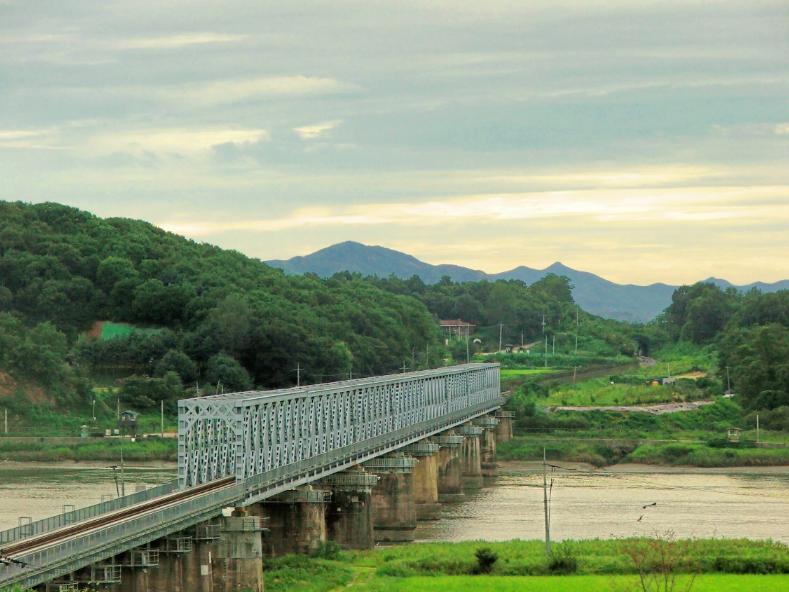
Notice the amount of trees that have since grown on the South Korean hillsides. The mountains you see in the background are the mountains near Kaeseong, North Korea.
What genius figured this out?
The most dangerous time for sexual assaults is from midnight to 4 a.m., with guest houses and public baths the most common locations. That conclusion is suggested by police data on sexual assault from 2001-2005 released to Grand National Party lawmaker Yoo Jeong-bok.
Even more shocking is that young women were the ones most targeted for sexual assaults.
Here is an interesting Aritcle in East Asian Affairs about the online radio station, Free NK that was founded by North Korean defectors and now may have to stop their programming because of threats against them by South Koreans:
We’re not talking big time here. Free North Korea broadcasts live for just one hour each evening. And its start-up costs, a modest 30 million won (US$26,000), were financed wholly by other defectors; not South Koreans, much less the government in Seoul. Its seven-strong staff are realistic about their chances of being heard inside North Korea, where Internet access is all but non-existent. But even in megawired South Korea, they have only 3,000 members so far, with only a modest 10,000 logging onto the site.
So, for now Free NK remains a still small voice crying in the wilderness, seeking to lighten the enforced darkness imposed on North Koreans by their benighted leaders. Topics covered include news, literature, and even philosophy, as well as the often dramatic experiences of defectors. Bravo. More power to them. What person with an ounce of human decency could possibly not wish Free NK well?
Alas, these are not rhetorical questions. Fact is, many South Koreans are not sympathetic – and some are downright nasty. From day one, Free NK has been hassled and harassed – to the point where, after less than a month on the air, it now may have to close down: the building’s landlord can’t cope with the pressure, so he’s given Free NK notice to quit by the end of this month.
I have to wonder how many of these threats are coming from Pyongyang hired goons, but the article concludes with an interesting theory:
Even if the actual bullies are a minority, their violence – for that’s what it is – has been nourished in a noxious new soil that is spreading in Seoul these days. I fear I was wrong about democratization in South Korea. At least some of those who fought against dictatorship weren’t, and aren’t, true democrats. What they hated was the generals’ right-wing politics, not authoritarianism per se.
Such self-styled “progressives”, who rule the roost in the new South Korea, seem to me merely to have turned the old values inside out, rather than made true progress. I sometimes think Koreans don’t do shades of gray, but prefer gestalt conversions: a total switch of world view. They flip.
In the bad old days, woe betide you if you said anything good about North Korea in Seoul. Now it’s a mirror image: If you say anything bad about Kim Jong-il, you’re a traitor. Even if, like the defectors of Free NK, you’ve suffered grievously under the Dear Leader – and therefore know whereof you speak, unlike head-in-sand fellow-travellers living safely south of the border.
I never thought of it that way. Maybe today’s progressives really don’t mind authoritism along as they are the ones in charge.
Hat Tip: Asiapundit
One Free Korea is reporting about a large bust in Atlantic City of a Chinese gang that was smuggling both drugs and counterfeit money from North Korea into the country:
The guests thought they were headed to an early afternoon wedding on a yacht docked near Atlantic City. They ended up in jail instead, courtesy of an elaborate ruse by federal authorities hoping to bust up an international smuggling ring.
Lengthy undercover investigations on opposite sides of the country resulted in indictments of 87 Asians and U.S. citizens on charges of smuggling counterfeit money, drugs and cigarettes into the United States, law enforcement officials said Monday.
Authorities said they seized $4.4 million in high-quality fake $100 bills, more than 1 billion counterfeit cigarettes worth $42 million, and ecstasy, methamphetamine and Viagra worth hundreds of thousands of dollars. Some of the cigarettes were made in China, said acting assistant Attorney General John Richter.
(…)
Of particular concern, Secret Service officials said, was the group’s apparent ability to generate counterfeit U.S. currency that could fool even the most sophisticated detection devices. A government source said the bills, known as “super notes” because they were virtually identical to real currency, had been made in North Korea. The bills were seized before they entered the U.S. money supply, authorities said.
One Free Korea brings up some good questions that need to be answered concerning this bust:
1. Were any North Korean nationals caught or implicated?
2. Were other branches of the same organization operating in third countries? What countries?
3. Will international cooperation be sufficiently swift to snip those branches?
4. Will it be enough to shut down the entire network?
5. Is there a connection to North Korean diplomats, who routinely finance their official functions through illegal activity?
6. Where were the drugs made?
7. Were any of those caught connected to the Chinese government?
8. In the end, how badly will this hurt the finances of the North Korean regime?
I have always found Andrei Lankov’s writing very informative and insightful and his latest in the Korea Times about the North Korean black market is no different:
The North Korea of the 1960s or 1980s was not a society of complete equality. It had its rich and poor. But the affluent people were affluent either because the party-state bureaucracy chose them, such as government officials and a handful of the most prominent scholars and writers, as well as people who were allowed to work overseas and were paid in hard currency, or allowed them to be affluent. For example, this was the case with the repatriates from Japan. From the late 1980s, the situation changed. Some people began to make money not because they were paid and showered with privileges, but because they learned how to use market capitalism.
The markets began to grow explosively around 1990, and North Korean “black capitalism’’ was conceived around this time. The first really rich people began to appear, even though they had to hide their success both from the authorities and their fellow countrymen. And one had to use whatever advantages one had, as competition was tough. In the late 1990s, the North Koreans used to say “there are only three types of people in North Korea: those who starve, those who beg and those who trade.’’
The breakdown of the economy in North Korea also had the side effect of empowering women:
When economic disaster struck, this arrangement had unintended consequences. The men kept going to their factories and offices, even if their wages were becoming meaningless. They were afraid of the still formidable state machine, they wanted to keep the status traditionally associated with proper jobs and they also needed the rations _ as long as the rations were forthcoming. Women, especially housewives, were free to pursue completely different economic strategies. They took up market commerce with great enthusiasm and soon comprised a majority of North Korean vendors. This also meant that the women’s earnings became the major source of income in many Korean families.
This is an interesting article as always from Lankov worth checking out.
