After many news reports and documentaries about Nogeun-ri came out, director Lee Sang-woo felt obliged to make a fictional film to tell the story. He wanted to ask the U.S. government whether there was no other way than war, a question still relevant today.
“Writing the scenario, I asked myself what story I have to tell. This is not going to be about the incident, not the event, but it’s going to be about the people. It is going to tell the relationships that people had in the small community and how intimate and beautiful they were, and ask them (the U.S. military) if they knew what they were doing. They were destroying these beautiful human beings, Lee said after shooting the film’s last scene in Sunchang, South Jeolla Province, early this week.
Expect another anti-American hatefest film much like Welcome to Dongmakgol that drew record Korean audiences with it’s story of North and South Korean soldiers joining together to kill Americans in order to save a rural village during the Korean War.
Why do I think it will be an anti-American hatefest film? Just look at what the Yonhap article says about the No Gun-ri tragedy:
Cows plowing rice farms, children bathing in a nearby stream and elderly men playing chess on a lazy afternoon — this was life in Nogeun-ri, Yeongdong County, central South Korea, before a nightmarish event occurred in July, 1950.
The incident came without warning on the 31st day of the Korean War. The sky split open as U.S. warplanes appeared and strafed hundreds of villagers walking along a railroad track. They were leaving their homes under a directive from retreating U.S. soldiers in the advance of North Korean communists.
Survivors, cornered under a railroad bridge at Nogeun-ri, were indiscriminately machine-gunned. Out of about 500 villagers, only 25 remained, the witness and families of the victims say.
As usual the Korean media gets the whole incident wrong from the start. A theme in recent Korean movies is that life in rural villages was some kind of idealistic paradise until the big, bad Americans come and ruined it. If anyone wants a good cinematic example of what life before, during, and after the Korean War was like in rural Korean villages than I encourage you to see the excellent Korean movieThe Taebak Mountains. Watch this movie and then compare it to the crap that is Dongmakgol. The people in these villages were dirt poor and life was hard which made many of these villages agreeable towards communism and uprise against the South Korean government including villages in the No Gun-ri area.
Also the villagers were not evacuated by US soldiers and without a doubt they were not strafed by US aircraft during the No Gun-ri timeframe as the Yonhap article claims. Finally 500 people did not die at No Gun-ri, maybe 50 at best. How do I know all of this? Read my series of postings that I did last year on this very subject. The evidence is overwhelming about what really happened at No Gun-ri but when Pulitzer Prizes and millions of dollars in compensation money are at stake, who cares about the truth?
British sailors who are in port at Pusan stopped by the United Nations Cemetery in Pusan to pay their respects.
If you haven’t been to the UN cemetery in Pusan you really should go. The cemetery has graves from many of the countries involved in the Korean War and the experience is quite sobering especially when you realize the few thousand graves there are just a small minute fraction of the overall war dead from the Korean War. Another interesting fact about the cemetery is that it is the only UN operated cemetery in the world. It is a quiet, pleasant place, which is actually quite amazing considering it sits in the middle of one of Korea’s busiest cities.
It was July 17th, 1950, with orders from Lieutenant General Walton Walker to continue to hold the South Korean city of Taejon in order to delay the advancing North Koreans the US24ID commander Major General William Dean found himself with a broken division, which was heavily decimated by the preceding two weeks of fighting. The division was at less than 50% strength, morale extremely low, the division had no communications, few vehicles, little equipment, short on food, running low on ammunition, and completely surrounded by 20,000 pissed off North Koreans. So MG Dean did what any good general would do in these circumstances, he grabbed a bazooka.
For the next three days MG Dean and what few men he had left in his immediate area conducted an urban guerrilla campaign against the North Koreans in Taejon. One of the things LTG Walker had brought with him along with the bad news that the US24ID had to hold on in Taejon, was a supply of a new anti-armor weapon, the 3.5in bazooka that was billed as being able to penetrate the armor of the North Korean T-34 tanks that had so devastated the US combat formations. Using hit and run tactics MG Dean and his tank killer teams actually enjoyed some success in knocking out the T-34 tanks in Taejon including MG Dean’s team personally knocking out one tank.
North Korean T-34 Destroyed by One of MG Dean’s Tank Killer Teams in Taejon.
Some have criticized MG Dean for essentially turning himself into just another infantryman and losing command and control of his combat formations. The problem was he had no formations left to command and control. The soldiers left in the division had essentially turned into individual teams fighting their own war of survival in the city. There was no communications left to organize and command formations with, so MG Dean figured the only way to command and control what he had left was at the front lines and he decided to kill a few North Koreans while he was at it as well.
Ultimately in Taejon the biggest problem ended up not being the T-34s but the amounts of North Korean infantry infiltrating into the city dressed in the white clothes of South Korean civilians. This caused confusion and hesitation for many US soldiers who were hesitant to fire against them.
Remember these soldiers just three weeks prior were lounging around doing occupation duty in post-World War II Japan and now not even a month later they are in the fight of their lives against a ruthless enemy with more men, weapons, and armor who are more than willing to dress like civilians in order to gain a tactical advantage. This willingness to dress like civilians would lead to later controversies as the US was blamed for killing civilians; claims that still resonate to this day from some elements in South Korean society.
Despite all the difficulties General Dean and his men faced, they were able to delay the North Koreans in Taejon from July 17th all the way to July 20th before MG Dean made the decision that he and his remaining men evacuate the city. That day elements from the recently arrived 1st Cavalry Division had arrived on the outskirts of Taejon to help evacuate the 24ID soldiers left in Taejon. The 24ID had paid in blood to give the 1CAV the time needed for them to deploy from Japan to Korea. The 1CAV was now about to begin paying their own dues in blood as well.
Overall, from the 7 hours Taskforce Smith first bought for the US in the first American battle in the Korean War, to the 3 days MG Dean and his men bought with their guerrilla campaign in Taejon; the destruction of the 24ID and the loss of thousands of American lives bought the US military a total of two precious weeks of time. The American leadership was literally trading lives for time and the 24ID prevented the clock from running out for both the Americans and the South Koreans they gave their lives for to defend.
With the 1CAV trying to evacuate the 24ID, MG Dean and his small team tried to reach them in one of the few Jeeps they have left, but under heavy North Korean fire his driver missed the turn that would have taken them to the outskirts of the city where the 1CAV was located. With North Korean fire increasing the Jeep could not turn around and MG Dean ordered the driver to just keep driving straight and that is what he did. Eventually the General Dean and his men reached the outskirts of the city and split up and hid in the hillsides. They hoped to escape and evade the North Koreans long enough to make it back to friendly lines. MG Dean evaded the North Koreans for 35 days before he was eventually captured. When he was discovered MG Dean attacked the North Korean soldiers hoping they would kill him. However, the North Koreans held him down and tied him up. They brought him back to the local police station where they discovered that this old, dirty, malnourished man was actually an American General.
The saddest part about General Dean’s capture was that his location wasn’t discovered by chance by the North Koreans, but he was rather in fact turned in by South Koreans. A little known fact about South Korea before the Korean War was the amount of communist sympathizers in the southern provinces of the country. The ROK government before, during, and even after the Korean War had to commit ROK Army units to quell multiple communist uprisings in the South Korean countryside. For multiple historical reasons, communism was an attractive ideology for many South Korean peasants. MG Dean was turned in to the North Korean authorities by one of these communist sympathizers in South Korea.
This betrayal of MG Dean would cause him to serve over three years in North Korean POW camps. MG Dean would not see freedom again until September of 1953. After his release from North Korea MG Dean said that he would not have awarded himself a wooden star for what he did, instead the President of the United States awarded him the Medal of Honor.
December 1953 Issue of TIME Magazine Featuring MG Dean
After the withdrawal south of the Kum River and the destruction of the bridges across it, the US21st regiment now found itself with a total of only 325 men between the two battalions that composed the regiment to face the approximately 20,000 NKPA soldiers bearing down on them on the opposite bank of the river. MG Dean decided to move up the 19th Infantry regiment from Taejon and what was left of the 34th Regiment from their earlier fight in Choenan to reinforce the 21st. With the addition of the 19th and the 34th roughly 4,300 men were now in defensive positions south of the Kum River while the men of 21st took up a reserve positions behind the other two regiments, to face the two advancing North Korean divisions supported by 50 tanks. Total combat power of the division stood at 11,000 men and the US24th Division had already lost roughly 1,800 men and many more would be lost before this battle was over.
The US34th manned the left flank of the Kum River defense. It is important to keep in mind that the US34th’s combat power was greatly diminished after their defeat and withdrawal from both Pyeongtaek and Choenan. The regiment was short of personnel, weapons, and equipment. The equipment they were most short on was radios, which would ultimately play a key role in the failure of the Kum River defense. L company of the US34th was on the farthest left flank of the US defensive line. The company commander had no communications with anyone, which means he had no situational awareness of the overall battle plan. The North Koreans began shelling L company’s position and began their river crossing operation. Seeing the overwhelming North Korean unit approaching and not knowing where the other US units were the commander decided to withdraw his unit all the way back to the battalion headquarters. The commander was relieved on the spot by the battalion commander for leaving his position and allowing the North Koreans to cross the river. Keep in mind that this commander had been withdrawing since his unit first made contact with the North Koreans back in Pyeongtaek. Withdrawing had become a natural reaction to an overwhelming North Korean attack. Retreat had become contagious and L company wasn’t the only ones doing it. Ultimately the entire US34th regiment withdrew leaving the US19th to face the two North Korean divisions by themselves.
Before the North Koreans began any operations on the US19th regiment, their scouts had located the positions of the US field artillery positions located to the rear of the US19th. The North Korean infantry simply crossed the river where the US34th had withdrawn and walked around and to the rear of the US19th to destroy the field artillery locations. The US field artillery were really the only guns capable of stopping the North Korean armor. In one quick attack the North Koreans were able to destroy a battalion of US field artillery and further limit their already desperate ability to destroy NKPA armor.
However, the US19th continued a rugged defense against the NKPA infantry which had crossed the Kum and was eventually able to repel them, while US air power was able to inflict heavy damage on enemy tanks trying to forge the Kum River. Amazingly the US regiment held off two North Korean divisions and even inflicted heavy casualties on them while doing so. For the entire day of July 15th things were actually looking up. However, it wouldn’t last, things would change quite drastically that night.
The North Koreans realized the amount of casaulties from US air strikes during the day made night operations an absolute must. In the early morning hours of July 16th at 0300, all hell broke loose on the Kum River. The North Koreans through everything they had at the US19th across the Kum River. Every element including the regimental command post found themselves under attack sustained enemy attack. Colonel Winstead the commander of the US19th organized a counterattack force of his unit’s clerks, supply personnel, cooks, and staff officers. The counterattack was actually successful at driving a large formation of North Korean infantry back across the river, but both the regiment’s key officers the adjuntant and operations officers were killed leading the counterattack force.
US Soldiers Battle the North Koreans Along the Kum River North of Taejon
The death of officers, particularly senior officers, in the early weeks of the Korean War was a reoccurring theme due to the lack of communications which caused senior officers to personally organize and lead attacks instead of giving commands over the radio to subordinates. This would phenomenom would have a cumulative effect, as unit’s lost their key leaders, discipline of the troops dropped, which contributed to the tendency to instantly retreat once confronted by the enemy. An old axiom says that leaders lead from the front; no where was that more true than the early weeks of the Korean War.
Even though the counterattack caused a large formation of the North Koreans to retreat, many others were able to infiltrate into the regiment’s rear areas and set up road blocks to prevent the resupply of the regiment. Many of the North Koreans setting up these road blocks had infiltrated dressed in the white clothes of South Korean refugees. Supply personnel located in these rear areas were not to keen about mounting any counterattack against the North Korean road blocks.
By late afternoon the regiment was given orders to withdraw, but the roadblocks prevented most of the US units from withdrawing with their vehicles. With many of the regiment’s officers dead, a majority of the US soldiers simply decided to retreat cross country and left all their vehicles where they were at instead of fighting their way through the road blocks. Some made out of the Kum River defense and others didn’t. In fact retreating soldiers straggled into Taejon all that night and the next morning including COL Winstead who was severely wounded and exhausted from the sustained fighting of the Kum River defense. On the morning of July 17th less than half of the US19th regiment had made it back to Taejon. The rest were either dead, captured, or missing.
MG Dean now had three regiments that were actually only regiments in name only. The US21st regiment was depleted from the Taskforce Smith battle at Osan and the hill defense north of the Kum River, while the US34th regiment was smashed at Pyeongtaek and Choenan, and the US19th regiment was now less than half strength from trying to hold the Kum River. MG Dean wanted to withdraw the 24th Division from Taejon, but LTG Walker flew up to Taejon and in a face to face meeting told MG Dean the 24ID had to keep delaying the North Korean advance at Taejon because the follow on US forces had not arrived in theatre yet to defend the Naktong River line. The US forces were literally looking at being pushed into the sea if the 24ID didn’t hold on.
MG Dean understood what LTG Walker ordered was essentially suicide for him and his men, but he obeyed the order and what was left of the 24ID prepared to try and hold Taejon. The fate of the entire Korean War would fall on the shoulders of these few determined men.
One of the first real heroes of the Korean War was without a doubt Major General William Dean. MG Dean was the commanding general of the 24th Infantry Division. The 24th Infantry Division was stationed in Japan conducting occupation duties prior to the start of the Korean War. With the outbreak of the Korean War the division was picked to deploy from Japan to Korea to stop the North Korean advance. The most famous unit from this division would go down in history known as Taskforce Smith.
Normally a general would want his division to deploy as a single unit and fight as a single formation, however due to the speed of the North Korean assault the 24ID had to deploy piece meal in order to delay the North Korean advance to the southern port city of Pusan. Taskforce Smith was just the first of all the 24ID’s battalions to be deployed to Korea in this piece meal manner.
Starting with Taskforce Smith, which first engaged the North Korean People’s Army (NKPA) on July 5th, 1950 just North of Osan, every battalion of the 24ID would eventually be defeated and over run by the numerically and militarily superior NKPA forces. 24ID units were defeated in Pyeongtaek and Choenan as well. What was left of the 24ID fell back to the division headquarters in Taejon commanded by MG Dean.
MG Dean knew immediately the strategic importance of Taejon. The Kum River ran to the north of the city and provided the only natural defensive line for the US forces to take advantage of before falling back to the last and final natural defensive line the Naktong River near Pusan. Additionally the additional units from the US mainland and Japan had not arrived in theatre yet to relieve the 24ID much less set up an defensive line along the Naktong River. The bottom line was that if Taejon fell quickly the war was lost because the North Koreans could quickly advance to Pusan and end the war before US reinforcements arrived on the peninsula. MG Dean knew his division had to fight to the end in order to buy time for the US forces. It was a job no general would want but Dean executed it without complaint.
US 8th Army Commander Lieutenant General Walker and Major General Dean Confer before the Battle of Taejon
MG Dean utilized what was left of his 24ID’s, 21st Infantry Regiment (Taskforce Smith was part of), 19th Infantry Regiment, and the almost combat ineffective 34th Infantry Regiment which had it’s commanding officer killed in action and the entire regiment almost destroyed before retreating from Choenan. Dean assigned the 3rd Battalion of the 21st Infantry the sister battalion of Taskforce Smith, to man the hill tops north of the Kum River. The Taskforce Smith remnants would remain in reserve. The regiment was commanded by COL Stephens who was given orders on July, 10th 1950 by MG Dean to hold the positions for 4 days.
The next day the regiment found themselves in a life and death battle with first the North Korean 3rd Division which days earlier the North Korean leader Kim Il-sung, had designated the “Seoul” Division for “liberating” Seoul. The NK 3rd Division’s morale was high and headed straight for the US3-21 battalion. The NK 3rd Division used their tried and true tactics of massing fire on the Americans while tanks and infantry flanked around them and set up road blocks denying the Americans their natural avenues of retreat. These road blocks caused units to disentegrate as soldiers ran wildly to escape the North Koreans instead of conducting an orderly withdrawal. Often the soldiers when they did retreat would just drop their rifles and helmets due to their weight and run as fast as possible once their unit was over run by the NKPA. By mid-day on July 11th the lead 21IN battalion was overrun and their battalion commander Lieutenant Colonel Jensen killed along with most of his staff.
COL Stephens from his command post in the rear began to round up the straglers retreating from the front. COL Stephens quickly reorganized the soldiers and then committed the 1-21 battalion (Taskforce Smith) into action once again. By this time the battalion plus worth of soldiers was now facing two complete North Korean Divisions, both the NK4th and NK3rd Divisions. Ironically enough the Taskforce Smith soldiers had retreated once from the NK4th and now found themselves going into battle once again against them.
On a side note, some may remember both of these North Korean divisions as well from an earlier posting I did on The Battle of Uijongbu.
Russian Made T-34 Tank that Devastated Both ROK and US Militaries During the Early Years of the Korean War
Much like the original Taskforce Smith battle against the NK4th north of Osan, the unit aquitted themselves quite well, but just didn’t have the man power and equipment to handle the North Korean tanks and their superior numbers. In fact it is amazing the 21st Infantry held out until July 12th before requesting withdrawal south of the Kum River from MG Dean. MG Dean agreed and the 21st moved south of the Kum River by 1600 on the 12th. MG Dean had ordered the 21st to hold their positions for 4 days, it was quite amazing I think that they even lasted the three days they did against the two North Korean divisions.
If anything this fight so far had demonstrated that the NKPA divisions were not the unstoppable force at the beginning of the war as is widely believed. The NK4th could have been forced to retreat by the ROK7th Division during the Battle of Uijongbu if the ROK2nd Division hadn’t withdrew during the battle allowing their rear to be exposed by the NK3rd. Earlier the during the battle in Pocheon further up the highway 43 corridor north of Seoul the ROK2nd actually forced the NK3rd into retreat before the ROK2nd was forced to retreat to Uijongbu where they did ultimately collapse. With a shortage of men and no anti-armor weapons the ROK military actually aquitted themselves quite well considering the circumstances and now the Americans with the same limitations in fire power and men had also proven that this was not an invincible enemy when confronted by determined men.
Though history has judged Taskforce Smith harshly, the reality is that the soldiers of not only Taskforce Smith, but also the entire US21st Infantry Regiment fought bravely and should be remembered for the determined defense they put up against tremendous odds early on in the Korean War. As courageously as they fought, more fighting for the US21st and the rest of the 24ID was to come.
In honor of the 56th anniversary of Taskforce Smith engaging the North Koreans for the first time during the Korean War today; I have decided to repost my prior series of postings covering the deployment and battle of the American unit to Korea.
Here are the links below to my complete series covering the soldiers of Task Force Smith:
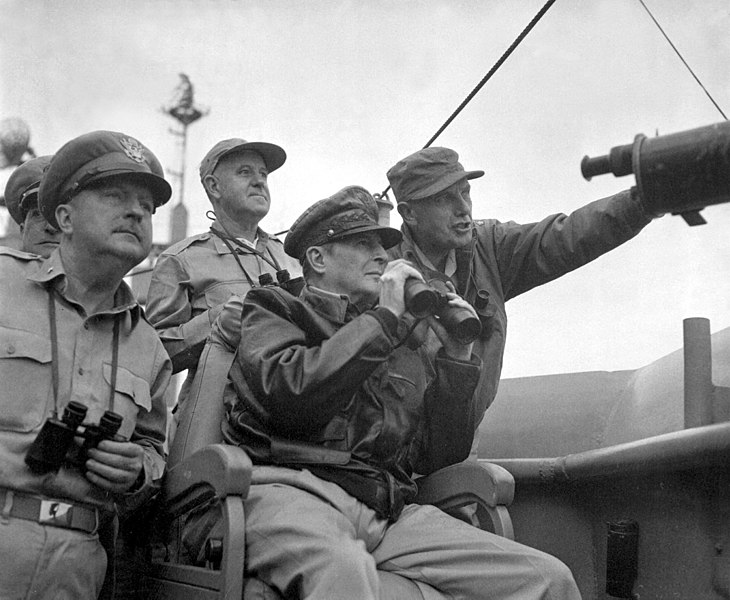
The Incheon Landing, code named “Operation Chromite” is quite possibly the most recognized action taken during the Korean War and what is most amazing about the operation is the fact that it happened at all. Just about every general in the Pentagon was against General MacArthur’s plan to invade Incheon because of the great danger involved in navigating Incheon’s infamous tidal flats. Everyone else was convinced that Kunsan or even Osan south of Incheon were better locations to launch an amphibious operation of this magnitude. MacArthur knew that this is where the North Koreans would expect the UN forces to land and the North Korean were in fact making preparations for landings in these areas because they believed no one was foolish enough to try and land at Incheon. Well no one accept General MacArthur.
MacArthur convinced the Secretary of Defense that his plan was the right course of action and eventually using has famous flare and prestige MacArthur was able to convince the Joint Chief’s of Staff and President Harry Truman to sign off on his plan. However, visions of landing crafts trapped in the Incheon mud which would be sitting ducks for the North Korean artillery raced through everyones minds.
Fortunately the successful “Operation Trudy Jackson” put those fears to rest. The operation allowed General MacArthur’s armada of ships containing the newly constituted X Corps and associated combat power to safely navigate the treacherous Incheon Bay the night of September 14, 1950. The bright light of the Palmi-do lighthouse proved to be a critical navigational aid for the sailors involved with the landing.
Lt. Eugene Clark’s successful intelligence gathering also allowed General MacArthur to gain much needed knowledge about the enemy’s strong points and weaknesses. However, General MacArthur had one weakness himself. The X Corps that would carry out the operation was highly inexperienced. The X Corps commanded by MacArthur’s close friend and advisor Major General Edmond Almond was created specifically for the invasion of Incheon and featured many troops with no combat experience.
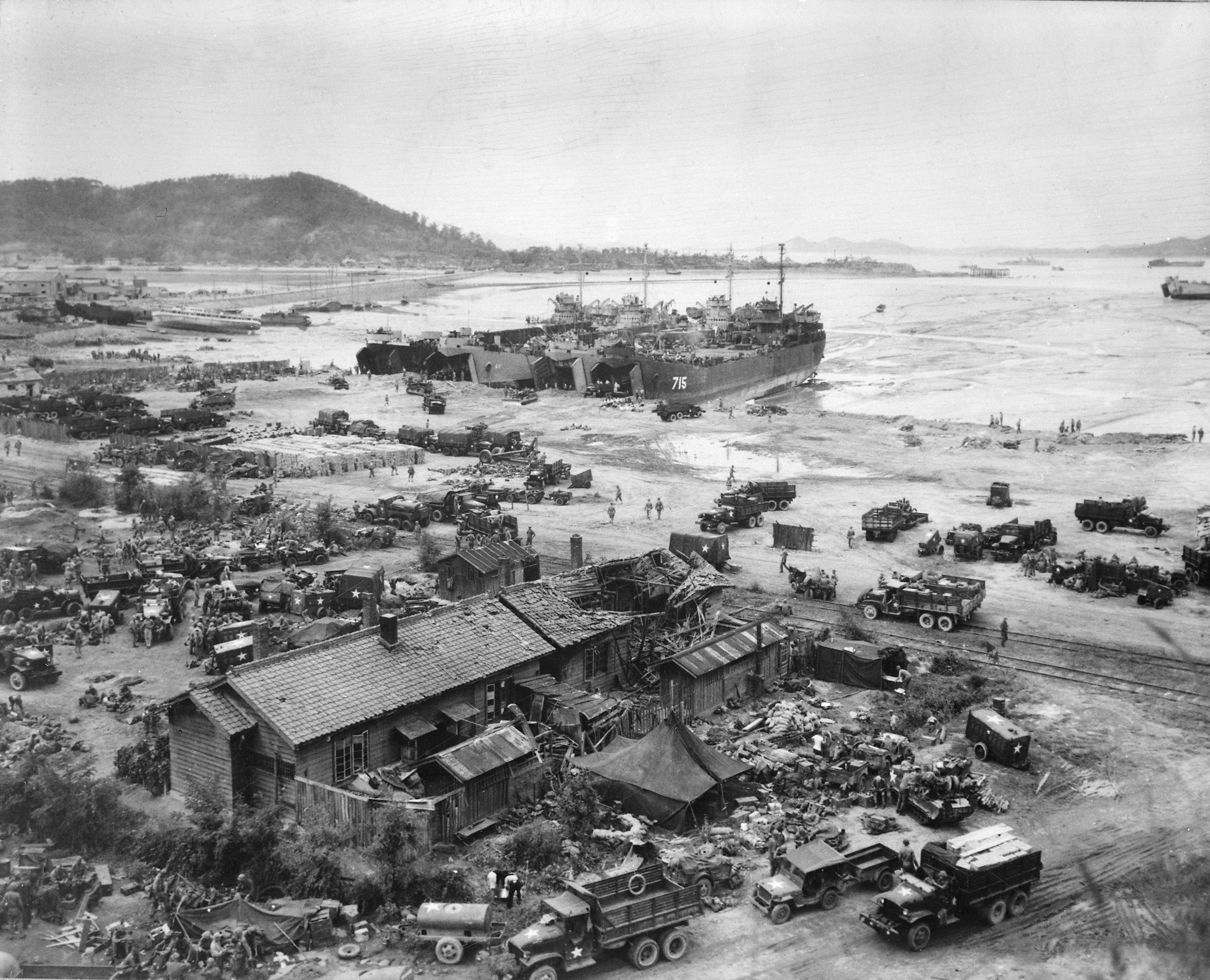
Picture of Ships Landing at Red Beach in Northern Incheon. Notice Radar Hill of Wolmi-do Island in the Background.
Two of the three Marine regiments that composed the 1st Marine Division involved in the operation had no combat experience. In fact the 1st Marine Regiment of the 1st Marine Division was activated in August and staged in Japan preparing for the invasion and the 7th Marine Regiment was activated on the 1st of September before deploying to fight at Incheon. Both of these regiments were filled with replacements from state side school houses, half of them were from the US Marine Reserve, and Marines transferred from the Mediterranean. The 5th Marine Regiment of the 1st Marine Division on the other hand were battle hardened Marines who fought in ferocious battles along the Naktong River Line during the Pusan Perimeter defense. They were the only unit in the X Corps with combat experience.
The 7th Infantry Division which was the Army’s contribution to the invasion was in worse shape than the Marines. They were the division responsible for occupation duty in Japan. However, as the war raged on in Korea the division was stripped for replacement soldiers in Korea. In August of 1950 the 7th Division was at approximately half strength. By channeling all infantry and artillery replacements into the 7th Division and transferring 8,000 ROK Army KATUSA trainees from Pusan to join the 7th Division in Japan, the division was able to near 100% strength by September.
However, these 8,000 KATUSA soldiers were merely nothing more than poor Korean boys taken from the refugee camps of Pusan for KATUSA training before being picked up for the Incheon invasion. They had not received any English or military training before leaving for Japan. Many of the KATUSAs in fact wore only shorts and sandals when they reported to their respective units in Japan.
To say the US invasion force lacked experience was an understatement but they did have numbers because X Corps when it was all said and done was composed of over 70,000 soldiers. MacArthur however, would rely heavily on the battle hardened 5th Marine Regiment to spearhead the landing at Incheon.
Incheon Landing Scheme of Maneuver
For two days prior to the landing the North Korean positions had been bombed repeatedly by US naval and air power. At 6:30AM on September 15, 1950 Marines from the battle hardened 5th Marine Regiment with nine Pershing tanks landed on Green Beach on Wolmi-do Island. The island sat in the middle of the harbor and had to be secured before the remaining invasion force could land at Incheon proper. The Marines secured the island in one and a half hours and killed or captured 400 North Korean soldiers while only suffering 17 wounded themselves.
However, the tide receded by 8:30AM and the invasion fleet had to retreat or risk being stuck in the mud flats. The Marines on Wolmi-do had to hold the island from an enemy counter attack along the tidal barrier connecting the island to the mainland until the tide rose again and more troops could land. The Marines held the island until 5:32PM when the tide rose again and the remaining Marines from the 1st Marine Division stormed Red Beach to the North and Blue Beach to the south of Wolmi-do, crushing the enemy resistance in the city of Incheon.
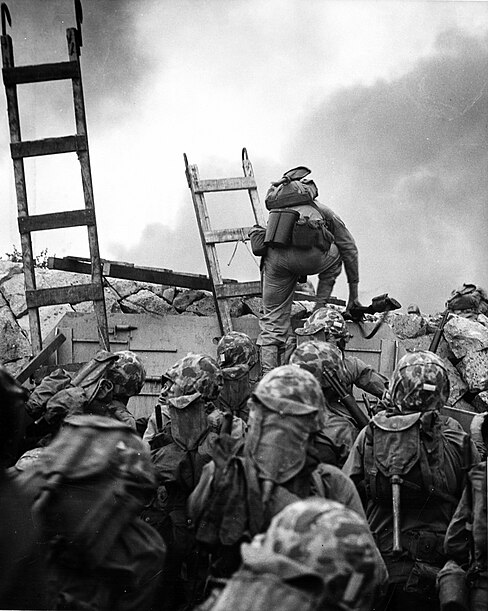
A picture of a Marine climbing a 15 foot high tidal barriers with a ladder while being shot at by North Koreans hiding in buildings over looking his position became the iconic image of the landing .
Lieutenant Baldomero Lopez of the Marine Corps is shown scaling a seawall after landing on Red Beach. Minutes after this photo was taken, Lopez was killed when smothering a live grenade with his body. He was posthumously awarded the Medal of Honor.
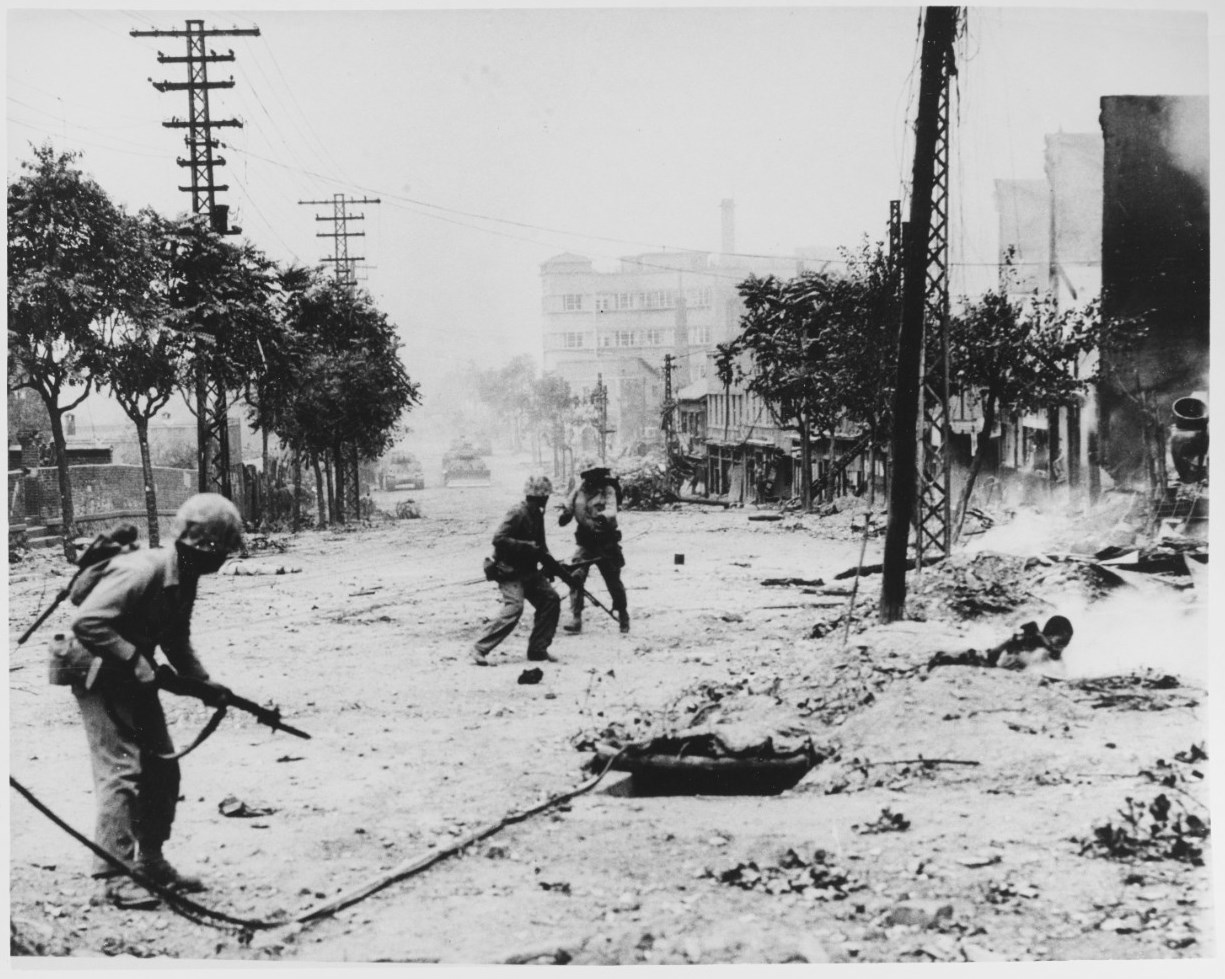
There had been no such amphibous landing during World War II into a city like what was being attempted now. Also during this time of combat in the streets of Incheon the Pershing tanks and Marines on Wolmi-do began to cross the tidal barrier to enter Incheon and also engage the overwhelmed North Koreans.
Heavy Fighting in the Streets of Incheon.
By 0130 on 16 September, 1950 the Marines had secured all their objectives in Incheon and allowed the ROK Special Marines to enter the city and mop up any remaining enemy forces, which they did with great brutality. Overall the X Corps had only 20 men killed, 174 wounded, and one MIA in taking Incheon. It was truly a brilliant amphibious operation constructed by General MacArthur.
The harbor was secured and the remainder of the X Corps, mostly the 7th Division, unloaded their equipment and men and began the march to capture Seoul. By September 26, 1950 Seoul was in UN forces hands and the North Korean supply lines had been effectively cut to their forces in the south. The 8th Army units at the Pusan perimeter mounted an offensive against the North Koreans and quickly the North Korean units were crushed by MacArthur’s hammer and anvil tactic. The North Koreans would never recover from this major defeat until the Chinese entered the war. But that is a story for another posting.
Information about the Incheon Landing was provided by the Kmike.com website and the book, This Kind of War by T.R. Fehrenbach.
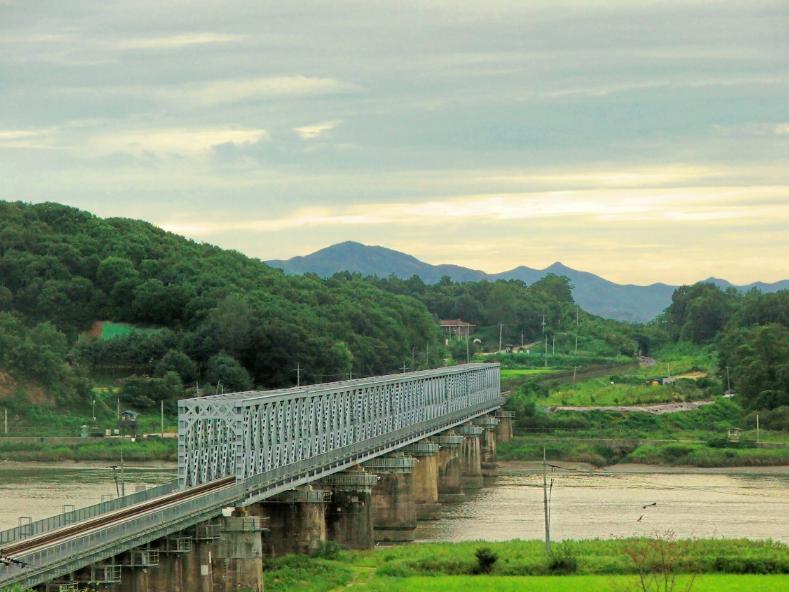
Freedom Bridge which crossed the Imjim River during the Korean War via Defense Media.
Now:
Notice the amount of trees that have since grown on the South Korean hillsides. The mountains you see in the background are the mountains near Kaeseong, North Korea.
The controversy continues over how to settle a civilian massacre that U.S. troops committed during the Korean War at Nogun-ri, a rural village in central South Korea, as Washington considers the case closed.
The U.S. Department of Defense said Thursday that it stands by its announcement in 2001, when then U.S. President Bill Clinton offered a memorial and scholarship fund. The Koreans rejected the proposal, calling it insufficient.
It is not that the compensation is insufficient it is more like the compensation isn’t going directly into their pockets:
The dispute centers on who should benefit from the $1 million monument and the annual scholarship fund of $560,000 that will run for five years.
The White House intends them to cover all South Korean civilian victims of the Korean War, while the Nogun-ri victims say the beneficiaries should be restricted to that single incident.
(…)
He said that since 2001 the U.S. Department of Defense has set aside roughly $500,000 each year to fund the scholarship program.
“Each year, the funds have been returned because there have been no applicants for these scholarships, but they are still available,’’ Hicks said.
The U.S. Embassy in Seoul was not immediately available for comment, however a spokesman there assumed the families had been notified of the American fund but said it had not received any applications.
Concerning the $1 million budget for the memorial monument, the Pentagon said some of it has already been paid to a Korean firm to design the monument. He did not specify the amount, but the Korean families claim one-tenth of the fund was spent in 2003.
There is compensation available for the claimants that can be used to give a college education to members of their families. IMHO the reason they are not using the college scholarship fund is because they are still holding out hope that the US government will eventually just give them direct compensation to put this issue at rest. If the US gives them direct compensation I guarantee the government would be setting a precedent that would cause more people to come forward demanding compensation from other tragedies of the Korean War, real or imagined.
I don’t think the Korean govnernment wants direct compensation either because their own ROK soldiers and secret police are also accused of killing civilians during the war. Direct compensation may also cause people to demand compensation from the Korean government as well.
The idea of the scholarship fund and memorial plus a public statement of regret from President Clinton I believe is fare compensation for a tragedy that was largely caused by the mass confusion and conditions of the early period of the Korean War. I’m still waiting for North Korea and China to start a scholarship fund for all the civilians they killed during the war as well. How come nobody is demanding compensation from them?
Korea’s popular citizen news service, Oh My News, recently published their own version of what happened at Nogun-ri. It is safe to say that this article of “journalism” or should I say docu-fiction tends to focus more on fantasy then the actual facts. Take this passage here as the first example:
Once the story broke and grabbed headline attention, the victims began to step forward. The Seoul government was placed between a rock and a hard place. Continuing to muzzle the victims would strengthen the notion that the Seoul government was a mere puppet of Uncle Sam. After all, its main reason for suppressing the story was to please him.
What evidence does the author, a Mr. Young Kim offer that the Korean government was trying to suppress the story because of pressure from the US? He has no evidence. Also how is this considered journalism? Sounds like propaganda to me. But wait there is more:
The massacre of innocent civilians by American troops was, of course, well-known among the victims and their relatives, but the Seoul government had for years labeled anyone mentioning the massacre “communists,” and brutally prosecuted them. Ironically, it took a fair-minded American journalist to disclose the massacre.
Once again he provides no evidence of his claims and then calls the AP reporters “fair minded” when the principle source of their reporting Edward Daily was uncovered as a liar by US News and World Report and the Stars and Stripes newspaper through simple background checks of Daily’s past these real journalists uncovered that Daily wasn’t even a combat arms soldier, did not earn the awards he claimed to have won, and wasn’t even anywhere near Nogun-ri at the time of the incident. Daily wasn’t the only one. Other veterans that made key claims about Nogun-ri were later found to have not even been there. Then according to Robert Bateman’s Book, Nogun-ri, the lead AP reporter Charles Hanley admitted to the discrepancies in the veterans stories but ran with the article anyway. There was a Pulitzer Prize to think about.
Some how Kim failed to mention all this in his article. Then the claim that this was covered up for decades is absolutely false. In Bateman’s book he provides articles from major US newspapers such as the New York Times that documents the killing of civilians by US soldiers during the Korean War. This is not new news but the story needs the air of a great government cover up to catch the readers attention. Then Kim goes on to try and use the Pentagon investigative report of the incident as evidence that the US soldiers blatantly killed the refugees. Here is the excerpt from the Pentagon report he used:
The Korean villagers stated that on July 25, 1950, U.S. soldiers evacuated approximately 500 to 600 villagers from their homes in Im Gae Ri and Joo Gok Ri. The villagers said the U.S. soldiers escorted them towards the south. Later that evening, the American soldiers led the villagers near a riverbank at Ha Ga Ri and ordered them to stay there that night. During the night, the villagers witnessed a long parade of U.S. troops and vehicles moving towards Pusan. On the morning of July 26, 1950, the villagers continued south along the Seoul-Pusan road. According to their statements, when the villagers reached the vicinity of No Gun Ri, U.S. soldiers stopped them at a roadblock and ordered the group onto the railroad tracks, where the soldiers searched them and their personal belongings. The Koreans state that, although the soldiers found no prohibited items (such as weapons or other military contraband), the soldiers ordered an air attack on the villagers by radio communications with U.S. aircraft. Shortly afterwords, planes flew over and dropped bombs and fired machine guns, killing about 100 villagers on the railroad tracks. Those villagers who survived sought protection in a small culvert underneath the railroad tracks. The U.S. soldiers drove the villagers out of the culvert and into the larger double tunnels nearby (this report subsequently refers to these tunnels as the “double railroad overpass”). The Koreans state the U.S. soldiers then fired into both ends of the tunnels over four days (July 26-29, 1950), resulting in approximately 300 additional deaths.
If you notice in this excerpt this is all the claims made by the refugees that Army logged in their report, not the findings of the actual report. If you notice he makes no references to the claims of what happened made by the soldiers that were there. If Kim was a real journalist he would of read more from the report especially the interviews with the soldiers. In Chapter 5, of Robert Bateman’s book, No Gun Ri he quotes interviews from soldiers who were at Nogun-ri. The US-ROK report doesn’t state that soldiers evacuate the villagers. It stated that it was possible but unlikely:
While the U.S. Review Team cannot rule out the possibility that the movement of the villagers occurred as described by the Korean witnesses, there was no sound military reason for soldiers to travel approximately three miles off their designated movement route to the village of Im Gae Ri during a hasty withdrawal for the purpose of encouraging an additional 400 refugees onto the already crowded roads and aggravating further the congested conditions. It is also unlikely that the soldiers would have performed this evacuation given the widespread knowledge and fear of North Korean infiltrators believed to be present in refugee concentrations.
The reason for wanting to keep refugees away from the front line was because North Korean soldiers had been infiltrating into the Americans rear areas by posing as civilians. Why would these US soldiers in a desperate retreat go so far out of there way to evacuate a Korean village to further fill the US frontlines with civilians? It makes no sense.
A lesser known fact was that the area around the villages of Yongdong and Nogun-ri were filled with South Korean communist sympathizers that were actively ambushing American soldiers in the area. In fact just weeks before the start of the Korean War an entire ROK Army division was in this area battling the communist insurgents. Then the accounts of the aircraft strike are easily proven to be inaccurate due to veteran testimony and aerial recon photographs.
I could go on and on dispelling Mr. Kim’s myths but please read my complete Focus On: No Gun Ri series for a complete factual analysis of what happened instead of Mr. Kim’s mythology. There was a tragedy at Nogun-ri, know doubt about it. Civilians were killed by US soldiers. I don’t dispute that. What I do dispute is the factors that caused it and the numbers of civilians killed. The anti-American crowd like Mr. Kim wants you to believe that these soldiers were cold heartless killers just waiting to kill helpless Korean refugees under orders from their uncaring commanding general, so the US Army wouldn’t have to deal with the refugee problem anymore.
This is the mythology Mr. Kim and his ilk are pushing and they are winning this information battle. I am willing to bet most Americans and Koreans believe Mr. Kim’s version of events. That is the continuing tragedy of this incident. The advocacy journalism these reporters are using to push their anti-military or in the case of Mr. Kim, anti-USFK agendas is truly disturbing. They are actively wanting to smear the honor of aged veterans who sacrificed their youth to save Korea from communism.
It is bad enough the Korean War is considered the Forgotten War in America but now it is becoming the Revised War in an effort to smear the veterans and in turn Americans themselves. Oh My News is an interesting outlet for citizen journalism but it is becoming citizen propaganda instead. Isn’t there editors that check what is being posted? How am I supposed to take an article from Oh My News seriously in the future when they let such propaganda as Mr. Kim’s article be reported? I exposed this guy in 15 minutes of typing. Shouldn’t journalists have some kind of responsibility to verify facts before reporting a story? If Oh My News doesn’t believe in checking the credibility of a story than they need to change their name to Oh My Tabloid News. At least then they are being intellectually honest.
For more about Mr. Young Kim you can check out his Kimsoft site and draw your own conclusions about if he has an anti-USFK agenda or not.