Sailors in Japan are beginning to experience the restrictions that were at one time common place for servicemembers stationed in South Korea:
U.S. Navy sailors have one less hour of revelry in Japan’s bars and nightclubs after Navy Region Japan tightened up liberty restrictions recently imposed on all service members in the country. U.S. sailors in Japan must adhere to a midnight-to-5 a.m. ban on drinking in public establishments off base, according to the order from Rear Adm. Ian Johnson. They may not even be in those places during those hours. The order, which took effect Wednesday, was coordinated with U.S. 7th Fleet, Navy Region Command spokesman Cmdr. Paul Macapagal told Stars and Stripes by email Wednesday.
The Japanese are responding to recent Chinese provocations into their ADIZ and EEZ with sailing through the Taiwan Strait:
A Japan Maritime Self-Defense Force warship sailed through the Taiwan Strait for the first time on Wednesday, according to a local media report. The destroyer JS Sazanami, along with Australian and New Zealand vessels, sailed south from the East China Sea and through the 110-mile-wide channel separating the island from mainland China, Kyodo News reported, citing an unnamed source who was “familiar with the matter.” The ships were believed to be headed to the South China Sea to participate in exercises, the report said.
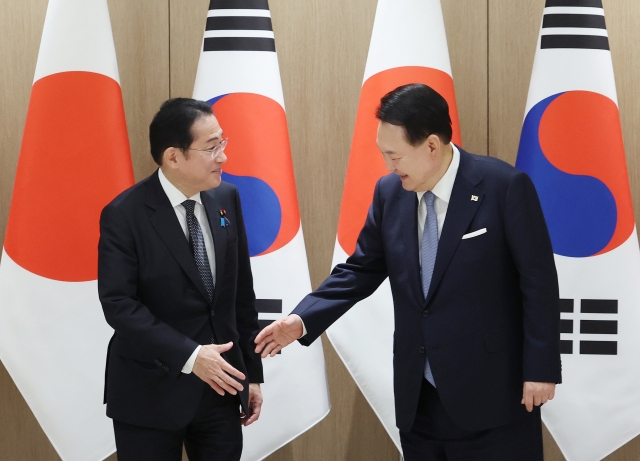
The Korean left is of course trying to appeal to anti-Japanese sentiment because Prime Minister Kishida did not give yet again another apology for things that happened 80+ years ago:
The main opposition party slammed President Yoon Suk Yeol of “flattering” his Japanese counterpart, Prime Minister Fumio Kishida, accusing him of making consecutive concessions to Tokyo without securing a formal apology or compensation for its historical grievances.
A day after the Japanese prime minister left Seoul, the main opposition Democratic Party of Korea on Sunday pledged to revise rules to stop comfort women statues at home and abroad from being defaced or meddled with, without disclosing details. It also promised to elicit Japan’s formal apology and compensation for its past wrongdoings.
“The Japanese government has been constantly pouring in diplomatic efforts to take down the comfort woman statues in Germany and Italy, but the Yoon administration is merely repeating the disastrous pro-Japan flunkeyism, much less a strong reaction to them,” the women’s club of the party said in a statement.
Kishida on Friday repeated his remarks from his previous visit to Seoul in March 2023 that he had inherited “all of his predecessors’ recognition of history,” including a declaration between former Korean President Kim Dae-jung and former Japanese Prime Minister Keizo Obuchi in 1998 — under which Japan recognized its past suffering inflicted on the South Korean people when Japan colonized the Korean Peninsula.
Kishida also reiterated his 2023 remarks, saying it was “heartbreaking that many South Koreans went through difficult and sad experiences in the past,” in an apparent reference to Japan’s abuse of Korean forced labor, though delivered in an informal and personal tone.
Japan clearly has apology fatigue and what Kishida did was just reemphasize the apologies of previous Japanese leaders instead of making yet another new apology. According to this Joong Ang Ilbo article Japan has made 63 apology statements to Korea. However, according to the same article 85% of Koreans think Japan is not sincere in their apologies. This is why the Korean left continues to jump on this issue because it is good politics for them to bash Japan and attack Korean conservatives on.
The fear is with these territorial incursions is that one day a lower level commander may take action against one of these provocations which leads to a larger conflict:
Recent incursions by China into Japan’s territorial waters and airspace showcase a deliberate effort by Beijing to normalize its increasingly assertive actions against its regional neighbors, according to two defense experts. A Chinese survey vessel on Saturday briefly entered territorial waters off Kagoshima prefecture on Kyushu, the southernmost of Japan’s four main islands. Five days earlier, on Aug. 26, a Chinese Y-9 surveillance aircraft breached Japanese airspace over a small island off Kyushu, an unprecedented action by a Chinese military aircraft.
The incidents add to an already tense relationship between China and Japan, whose claims in the Senkaku Islands are repeatedly tested by the Chinese coast guard. China’s coast guard is even more aggressive against the Philippine coast guard, bumping hulls and employing water cannons and other measures in territorial disputes in the Philippine exclusive economic zone of the South China Sea.
The two incursions of Japanese territory were “provocative and risked flaming tensions in the region,” according to Brian Hart, a fellow with the Center for Strategic and International Studies’ China Power Project. “The greater long-term implication is that Beijing is employing its military forces in increasingly provocative ways, which heightens the risks of misperceptions, miscalculations, and dangerous accidents,” Hart told Stars and Stripes by email Wednesday.
I am sure the KCTU and the other leftist clowns will be out in force if Kishida visits South Korea for a summit with Yoon. Anyway it will be interesting to see if Kishida does visit, if he makes any new apologies for Imperial Japan’s colonial actions in South Korea:
South Korea is in talks with Japan over a trip to Seoul by outgoing Japanese Prime Minister Fumio Kishida, the presidential office said Sunday.
The move could set the stage for summit talks between President Yoon Suk Yeol and Kishida, and represents a step forward compared with just days earlier, when South Korea said that no decision had been made yet after Japan’s Kyodo News reported that Kishida was considering holding summit talks with Yoon in South Korea in early September before stepping down.
“We are in discussions with Japan over Prime Minister Kishida’s visit to South Korea and will make public the decision once it is made,” a presidential official told Yonhap News Agency by phone.
Here we go again with the Korean leftists trying to raise anti-Japanese sentiment for political purposes:
Seoul’s presidential office is facing mounting pressure as controversial remarks regarding Japan by President Yoon Suk Yeol’s foreign policy aide have prompted criticism from the opposition for bringing humiliation to South Korea.
Labeling the aide’s remarks as carrying the intention of a “pro-Japanese traitor” — or “chinil” in Korean, describing those overly favorable to Japan to the extent of betraying national interests — the liberal main opposition Democratic Party of Korea pledged Tuesday to propose a bill to prohibit people who had previously praised or justified Japan’s 1910-45 colonial rule of the Korean Peninsula from becoming public officials. The main opposition party also pledged to introduce the bill as closely aligned with its core party policy, meaning that party members would all vote for it to counter Yoon’s conciliatory approach to Japan.
The latest controversy hails from a media interview with Kim Tae-hyo, the first deputy director of the presidential National Security Office. Kim said in an interview with public broadcaster KBS on Friday evening that Yoon’s omission of Japan’s wartime wrongdoing from his Liberation Day speech comes from Seoul’s forward-looking approach to its bilateral ties with Tokyo.
“If Japan turns a blind eye to its history and fails to say what it should say, we should harshly complain about it and try to change that,” Kim said.
“But what matters is Japan’s feelings (about apologizing),” Kim added. “When we pressure someone who does not feel inclined to do so to apologize, does that truly help Korea-Japan relations and cooperation? The level of trust between Kishida and Yoon seems very high.”
This answer was in response to the interviewer’s question about criticism over Seoul’s failure to speak up boldly about bilateral issues with Tokyo.
You can read more at the link, but why doesn’t the Korean Democractic Party instead of passing a bill to ban people who make pro-Japanese statements from holding office pass a bill saying that if you make pro-North Korean statement you cannot hold public office? Japan for many decades has not been a threat to South Korea and has strong economic and cultural ties. North Korea on the otherhand continues to be a threat on all fronts to South Korea.
The reason the Democractic Party doesn’t want to pass a bill banning people with pro-North Korea views from holding office is because many of them would have to leave government then. The Korean left is filled with those sympathetic to North Korea and even spies.
If the government wants to pass a bill, pass one against those holding pro-China views. China is the nation that most recently attacked and devestated South Korea during the Korean War five years after the Imperial Japanese were defeated. China continues to be the nation that enables North Korea to be the threat to South Korea that it is today not Japan.
It has been a while since GI crime has been an issue on Okinawa, but the disclosure of these two sexual assault cases has given the island’s left wing government plenty to complain to USFJ about:
The U.S. military has yet to announce new restrictions on troops stationed in Japan despite calls from local authorities after two service members were indicted for alleged sexual crimes on Okinawa. “There is currently no update right now in terms of any changes to liberty policy at the moment,” Gunnery Sgt. Jonathan Wright, spokesman for U.S. Forces Japan, told Stars and Stripes by phone Monday.
Tensions have escalated on Okinawa, where the U.S. military stations approximately 30,000 service members, more than 50% of its troops in Japan, following disclosures in late June of the two indictments by the Naha Public Prosecutors Office. The commanding generals of Okinawa-based III Marine Expeditionary Force and Marine Corps Installations Pacific directed their commanders to “reinforce their expectations of standards and conduct across the force,” III MEF spokesman 1st Lt. Owen Hitchcock said by email Monday.
You can read more at the link, but as I have said before, the expectation of zero crime from US servicemembers is unrealisitic. There is always going to be some crime that happens, what matters is how low is the crime rate and is it being properly prosecuted? I have seen no indications of a high crime rate on Okinawa from US troops and clearly cases are being prosecuted as these latest incidents show.
Japanese vending machines are great and they are about to get an upgrade:
The ubiquitous Japanese vending machine is keeping its place on U.S. military bases, despite a nationwide round-up of obsolete machines. Many of the 4.1 million vending machines across Japan, each worth around $13,000, will be replaced this summer when Japan rolls out a new set of bank notes featuring holograms to stop counterfeiting, according to a New York Times report June 8. Some older machines will not accept the new currency. The change-out will not affect most vending machines on U.S. military bases from Misawa Air Base in the north to Marine Corps camps in the south, according to the Army and Air Force Exchange Service and the Navy Exchange. They and local contractors maintain and operate 3,800 machines.
You can read more at the link, but I wish the U.S. could have as many convenient vending machines as Japan. However, the high crime rate compared to Japan makes it impossible in the U.S.