Two months ago the infamous DMZ Christmas tree was pulled down and now for whatever reason the Defense Ministry has decided to allow a Christian group to construct a new one:
A North Korean religious association slammed a South Korean Christian group’s plan to light a big Christmas tree in the Aegibong Peak Observatory in Gimpo, south of the Demilitarized Zone (DMZ).
It said Friday that the lighting is, “an act of madness and it is unacceptable.”
“The Christian Council of Korea (CCK) attempts to use religion as a means to spur confrontation between the people of the two sides. It should realize that the malicious plan could lead to a military action from the North,” the North’s association said.
The reaction came weeks after the CCK unveiled a plan to set up a big Christmas tree in the observatory and light it on Dec. 23. The tree will be dressed in Christmas lights for two weeks until Jan. 6, the group said.
The Ministry of National Defense approved the plan. [Korea Times]
You can read more at the link, but the tree is used by the ROK military as a psychological warfare weapon. The North Koreans can look across the border and see the lights of South Korea to include this Christmas tree which stands in stark contrast to the regular power outages they face in North Korea.
I wonder if this was a quid pro quo to get North Korea to return to talks or even release Jeffrey Fowle?:
A giant steel Christmas tree near the border with North Korea that served as a propaganda symbol for the South for 43 years has been pulled down.
It used to stand at Aegibong Peak in Gimpo, Gyeonggi Province and twinkle a message of progress, consumerism and born-again Christianity across the border, to the fury of the North Korean regime.
The local government now plans to build a peace park with the budget of W29.6 billion (US$1=W1,052) there.
Military authorities pulled it down on Oct. 15-16 citing safety reasons. The structure “was rated very dangerous in a safety inspection of military facilities and structures in November last year,” a Defense Ministry spokesman said. [Chosun Ilbo]
You can read more at the link, but few people seem fooled by the safety reasons cited when it has been there for 43 years.
Unsurprisingly the North Koreans are blaming the ROK for the latest border clash despite their soldier intentionally violating the MDL:
North Korea has threatened to retaliate against South Korea if the South continues to make a military response against its patrol activities around the heavily armed inter-Korean border, the defense minister said Monday.
In a telephone message, the North denounced the South firing shots against its soldiers after warning broadcasts, claiming its activity around the military demarcation line (MDL) was just patrols, the ministry said.
The North also said it will continue to patrol around the MDL in the future.
The North’s response came after its second straight provocation around the border between Saturday and Sunday.
On Saturday, about 10 North Korean soldiers who were approaching the MDL near Cheolwon, a central border city of the South, returned to their side after warning shots were fired by the South’s soldiers. On Sunday, other North Korean soldiers advanced toward the MDL near Paju, a city located about 40 kilometers northwest of Seoul to cause warning shots from South Korean soldiers. The North’s soldiers exchanged fire with the South’s soldiers before going back. [Yonhap]
You can read more at the link, but this is just another example of how the North Koreans continuously try and keep tensions high to pressure the South Koreans to make concessions as well as to make international headlines to show the world they are still a threat. The latest concessions they want is for the ROK to stop the balloon launches and modify the NLL.
I guess this how you exchange pleasantries on the DMZ:
South and North Korea exchanged fire across the heavily fortified border on Sunday, but there was no report of South Korean casualties.
The incident took around 5:40 p.m. when South Korea fired warning shots against North Korean soldiers who were approaching the military demarcation line in Paju after broadcasting warning messages.
North Korea apparently fired back against South Korea, according to South Korea’s Joint Chiefs of Staff, noting two marks from North Korean guns were found in a South Korean guard post.
South Korea also returned fired against North Korea, according to the JCS. [Yonhap]
When people think of provocations from North Korea most people today think that the deadliest incidents from the rogue regime have been targeted against South Korea. The largest loss of life from one provocation by North Korea was the sinking of the ROK Navy ship the Cheonan in 2010 that killed 46 personnel on the ship and wounded 56 more. What many people don’t realize is that the US military historically has been subject to many provocations from North Korea as well to include the 2nd deadliest attack, the shoot down of an EC-121 reconnaissance plane that killed all 31 men on board.
This deadly attack occurred on April 15, 1969 when the EC-121 which used the call sign “Deep Sea 129” was shot down in international waters 167 kilometers off the coast of North Korea. The EC-121 is an intelligence gathering platform that picks up radio transmissions in the area that it is conducting surveillance of. The mission of the Deep Sea 129 would not only be to pick up radio transmissions from North Korea, but from China and Russia as well. The military has conducted these flights on behalf of the National Security Agency (NSA) for many years.
The routine flight of the Deep Sea 129 began at 0700 local time when it took off from Atsugi, Japan. On board were 8 officers and 23 enlisted men under the command of LCDR James Overstreet. The plane first flew over Japan and then over the Sea of Japan. Once over the Sea of Japan the EC-121 flew in a clockwise ellipse as it collected signal intelligence from the region. LCDR Overstreet was given orders that his flight pattern would not go any further than 90 kilometers from North Korea. Radars at Osan Airbase in South Korea as well as back in Yokota Airbase in Japan tracked the missions progress as well as looking for any aircraft being dispatched from North Korea. At 12:34 local time radars at Osan Airbase detected that two MIG-17s had been launched by North Korea. At 13:00 Deep Sea 129 issued a routine report and everything seemed normal. At 13:22 the radars as Osan lost track of the two MIG-17s and reacquired them at 13:37. When the aircraft were reacquired it became obvious that the MIGs were dispatched to intercept the EC-121. At 13:44 Deep Sea 129 was alerted that they were being intercepted. At 13:47 the MIGs had reached the vicinity of Deep Sea 129 and then at 13:49 the EC-121 disappeared from the radar screen.
After the EC-121 disappeared from the radar screen the operators originally thought that it may have followed normal procedures and dropped to an altitude below radar coverage. This thought prevailed because the operators figured that if the MIGs were acting hostile to the EC-121 than LCDR Overstreet would have radioed something back to Japan. However, after 10 minutes had past and no radio transmission had been received from LCDR Overstreet, people began to fear the worst. Two US jets were dispatched from Japan to conduct a Combat Air Patrol of the area where the EC-121 had last been tracked. By 14:44 almost an hour after Deep Sea 129 was last tracked, the CAP planes could not find the EC-121 and the command in Japan decided to send an urgent message back to the Pentagon and the White House that they feared the EC-121 had been shot down.
The reactions from political leaders in Washington once the news was heard was initially very harsh. On Capitol Hill, Mendel Rivers, chairman of the House Armed Services Committee, proclaimed: ‘There can be only one answer for America-retaliation, retaliation, retaliation!’ Chairman of the House Armed Services Committee, Rep. L Mendel Rivers, called for military retaliation against North Korea with “whatever is necessary. If nuclear weapons are required, let them have it. It’s time to give them what they ask for.”
As the political leadership back at the US reacted to the shoot down the military command back in Japan prepared a massive search and rescue effort to recover the plane and any survivors. The plane had life rafts the crew could have used if the plane crashed intact. The seas were not too rough and temperatures were in the 40s. So if the crew survived the crash they had a high chance of survival in the conditions if found quickly. The search was conducted by C-130s from Japan that were supported by a K-135 Stratotanker to provide fuel support. These search and rescue aircraft were further supported by CAP aircraft. In total 26 aircraft were used during the search and rescue operation. Besides the aircraft two American destroyers, the USS Dale and the USS Tucker reached the suspected crash site around 9PM. The Soviet Union would also dispatch two destroyers to search for survivors as well. The Soviets were probably eager to show the US they did not support the North Koreans actions by assisting with the search and rescue. The Soviet destroyer the Vdokhnovenie recovered pieces of the downed aircraft as well as the only two bodies found during the entire search effort. The bodies of LTJG Joseph R. Ribar and AT1 Richard E. Sweeney were turned over to the USS Tucker on April 17th. This ended the search and rescue operation and the bodies of the other 29 crew members were never recovered.
With the end of the search and rescue operation, US President Richard Nixon had to decide on what to do in response to North Korea’s deadly provocation. During this time period North Korea had even taken the rare step of bragging on their state radio station of shooting down the aircraft that they said was flying over their territorial waters. Despite calls for retaliation from various political figures Nixon decided to go with most other officials were recommending which was essentially to do nothing. With the war raging in Vietnam many US officials thought it was unwise to open up a possible second front war on the Korean peninsula. So he decided not to do anything provocative against the North Koreans such as bombing the airfield where the MIGs that shot down the EC-121 flew from. Instead he conducted a show of force by continuing the reconnaissance flights while backed with appropriate naval and Air Force support to protect them. This showed American resolve to the North Koreans while not creating a second war in Asia.
What I cannot understand is why the EC-121 was left without escort of some kind in the first place? The mission of the EC-121 was very similar to what the USS Pueblo ship was doing when it was fired upon and captured by the North Koreans in 1968. Considering that North Korea had shown previously an intent to target US reconnaissance efforts it seems surprising to me that the Pentagon was allowing the EC-121 flights off the coast of North Korea to continue with out a fighter escort or at least ships in the Sea of Japan that could provide better early warning of any potential North Korean fighters trying to intercept them.
Below is a list of all the lives that were lost by this act of North Korean aggression. Like all the other lives brought to an early end by the thugs and killers of the Kim regime in North Korea these men should not be forgotten:
Petty Officer 1st Class Eli Redstone rings the bell twice for each of the 31 U.S. troops killed on April 15, 1969, when North Korean fighters downed their EC-121 reconnaissance plane over the Sea of Japan. Wednesday’s ceremony marked the 40th anniversary of the attack. Matthew M. Bradley/Courtesy of the U.S. Navy
10 years ago, the 2002 West Sea Naval Battle, also known as the 2nd Battle of Yeonpyeong took place which at the time was an event that clearly showed the contradictions within South Korean society in regards to their perceptions of North Korea and the United States. Before getting into the political and social aspects of this battle, first let me recap what happened.
Replica of ROK Chamsuri 357 that fought in the 2nd Battle of Yeonpyeong.
On June 29, 2002, one day before the closing ceremony of the World Cup being held in Korea that year, the North Koreans likely tried to draw attention from away from all the glory South Korea had been receiving from their amazing World Cup performance that year by prevoking a naval battle in the West Sea. They did this by sending a patrol boat, the Yukto 388 across the disputed Northern Limit Line that demarcates the border between North and South Korea along the Yellow Sea. The ship crossed near Yeonpyeong Island which is the same island that the North Koreans launched an artillery attack against in 2010 that killed two ROK Marines as well as two civilians.
A South Korean naval vessel the Chamsuri 357 was sent to escort the North Korean ship back into North Korean waters shortly before 10 AM that day. A 2nd North Korean ship the Tungsangot 684 then crossed the NLL as well. Both North Koreans ship crossed 3-5 kilometers south of the NLL before being intercepted by the Chamsuri 357. Since a 2nd North Korean ship was spotted the Chamsuri 358 was dispatched to help as well. The two South Korean ships intercepted the North Korean ships and issued three warnings by radio to return across the NLL.
That is when the North Korean ship the Tungsangot began to open fire with its 85mm gun at about 450 meters away causing severe damage to the South Korean Chamsuri 357. In this initial attack five sailors on the Chamsuri 357 were killed to include the captain Lieutenant Yun Yong-ha. Despite heavy damage the crew of the Chamsuri 357 fired back and the Chamsuri 358 began to open fire as well on the two North Korean ships. As additional ROK Navy ships began to respond to the attack both North Korean ships retreated back across the NLL where the Tungsangot was seen burning heavily. The battle was over before 11:00 AM when ROK Naval authorities decided not to pursue the North Korean ships across the NLL in order to avoid escalating the conflict. The clash ultimately ended up costing the lives of six South Korean sailors with 18 more wounded.
It is believed that the North Koreans suffered 13 deaths and 25 wounded, but their two ships were both able to limp back into harbor while the Chamsuri would eventually sink while being towed away from the NLL. North Korean defectors would later provide details about the aftermath of the battle. In September of 2002 the gunner of the 85mm gun that made the deadly hit against the Chamsuri 357 was honored by the North Korean authorities as a “Hero of the Republic”. The North Korean sailor named Seo Ju Cheol was then allowed to visit his hometown where a big celebration was given in his honor.
There was also celebrating in South Korea after the battle as well, but it wasn’t for the sailors that bravely fought off the North Korean provocation. Instead the country largely ignored the battle in its euphoria of not only hosting a widely successful World Cup, but the fact that the South Korean team reached the tournament’s semi-finals sending nationalism in the country to an all-time high. In fact the ROK sailors would receive little recognition at all by the South Korean government. The Kim Dae-jung government at the time wanted to minimize what happened and keep the grieving families quiet because they did not want to upset their Sunshine Policy with North Korea, especially in a presidential election year in the ROK. Interestingly many of these same ROK politicians were busy encouraging or doing nothing about the anti-Americanism in the aftermath of the US Army Armored Vehicle Accident that tragically killed two South Korean teenagers two weeks before the naval clash. So basically the Korean government turned a blind eye to the premeditated murder of six ROK sailors while actively encouraging anti-Americanism against their long-time ally because of a tragic traffic accident.
In commemoration of the second anniversary of the West Sea naval battle, memorial services were held at the headquarters of the Navy’s 2nd Fleet in Pyeongtaek, Gyeonggi Province on Tuesday. Hwang Eun-tae, father of the late Petty Officer First Class Hwang Do-hyun, weeps while reading a letter in front of his son’s portrait.
Even more heartless was the the fact that the South Korean government sent no flag officers to attend a memorial ceremony or the President even offer any condolences to the families after the attack. USFK however did send representatives to the ceremony and USFK Commander General LaPorte offered the families his condolences. The memorial service was held on a ROK Navy base in order to minimize media access and prevent anti-North Korean activist groups from attending the memorial. One wife of a deceased sailor was so fed up with how the Korean government treated her, that she left Korea and went to the United States. This is what she said before boarding the plane:
“If the indifference and inhospitality shown to those soldiers who were killed or wounded protecting the nation continue, what soldier will lay down his life in the battlefield?”
Here’s a quote from one of the fathers of one of the murdered sailors that really struck a cord with me:
The father said, “My son is buried in the National Cemetery. But I’m going to take my son’s remains to my family burial site in my hometown.” Having watched the situation develop, he thought his son who was killed by North Korean soldiers was considered nothing more than a criminal.
Some parents said that they are more scared of people who consider the U.S. a bigger enemy than North Korean leader Kim Jong-il, who killed their son. We lose courage to defend the country, when we hear that a wife whose husband fell in the battle is preparing to leave this country. Reading a condolence letter from the USFK commander to mark the second anniversary, the wife said, “The Americans remember my husband and his brothers-in-arms better than Koreans… Frankly, I hate Korea.” [Chosun Ilbo]
“Frankly, I hate Korea”, no those are not the words of a disgruntled American expat or GI saying that, that is a Korean woman who was so outraged by the actions of the Korean government that she left the country. She is not alone in her criticism of the Korean government over what happened in 2002.
The Chosun Ilbo newspaper published a series of interviews from some of the sailors injured in the 2002 attack and here are excerpts of what they had to say:
Another naval gunner, Kim Taek-jung, 25, has given up his dream of becoming a civil engineer and is preparing for the civil service exam instead. “Because civil engineering requires active work at the site, I’ve made a realistic decision to become a public servant, I still have four or five pieces of shrapnel in my body,” Kim said. “One night I remembered the faces of my six dead comrades, but I couldn’t recall the name of one of them, so I sobbed all night.”
Although they suffer from sleepless nights and nightmares, those without external injuries are not entitled to benefits as “persons of merit.” Ko Kyug-rak, 25, also a naval gunner, said, “For over a year after the incident I was unable to sleep more than three hours a night.” Aboard the patrol boat that turned into a sea of flame, Ko saw his peers burned and their heads blown away and lost some of his hearing. But when he went to a military hospital to claim benefit, Ko was given cool treatment. “A doctor ignored the psychological problems and only asked me to show any external wounds,” he said. “If benefits for persons of merit are granted for this level of injuries, the doctor said, it would have an adverse effect on the state budget.”
Another wounded veteran, Kim Myun-joo, 26, has applied for meritorious benefit twice, but in vain. “I’m just sad because I feel like that post-traumatic stress disorder and efforts to safeguard the country are being neglected,” he said
Of the six victims this paper interviewed, three have office jobs and three are students, all trying hard to make a future for themselves despite the difficulties. What they want from the country is just one thing: that it remembers that many young people were killed or wounded while safeguarding the country on June 29, 2002. “I just wish they remembered the battle once a year, even if they don’t pay much attention. Nothing else,” said Lee Jae-yong, 25.
President Roh did not attend a memorial ceremony for the murdered sailors and the memorial services in later years were attended largely by ROK Navy and USFK leaders. The South Korean ruling party failure to honor these brave sailors was only a further example of the failure of the Sunshine Policy. The South Korean government gave massive amounts of aid to North Korea and they murder South Korean sailors, fire a tactical ballistic missiles, and test nuclear weapons among of host of other provocations. Probably the worst example of North Korean appeasement is how the South Korean political left ignored the plight of hundreds of South Korean citizens that had been abducted by North Korean commandos and agents over the years. A South Korean wife of one of the abductees had to mount her own personal rescue operation to free her husband from enslavement in North Korea while the South Korean government did nothing to assist her. So the 2nd Battle of Yeonpyeong was just one of many incidents in a long line of appeasement of North Korea. In the ensuing years the South Korean government under left wing President Roh Moo-hyun would send North Korea a record of over one billion dollars in aid which is more than they pay to help fund the US-ROK alliance.
Fortunately once President Lee Myung-bak was elected to office he ended the outrage committed against the families of the deceased sailors and began a policy of properly honoring the veterans from West Sea Naval Battle. In fact a replica of the Chamsuri 357 now sits at the War Memorial in Yongsan where children visit it to learn about the West Sea Naval Battle.
In fact the change in attitude under the Lee Myung-bak government caused the wife of the deceased ROK sailor to return home from the US:
The widow of Petty Officer Han Sang-guk, who was killed in a June 2002 naval battle with North Korea near Yeonpyeong Island in the West Sea, will return to her mother country in April three years after her departure to the U.S. Kim Jong-seon left the country in April 2005 due to disappointment that the government ignored those killed in the battle. Kim told the Chosun Ilbo on Monday she is winding up her life in the U.S. and booked a flight leaving for South Korea on April 1.
Kim had said until last year she would not return to South Korea although she missed her family, since the nation seemed to pay inappropriate respect to the young soldiers who sacrificed their lives for it. Now she has changed her mind, motivated by reports that president-elect Lee Myung-bak’s Transition Team and the Defense Ministry decided to upgrade the memorial service for the victims of the West Sea Battle to a state event. [Chosun Ilbo]
In addition to honoring the sailors killed in the 2nd Batlle of Yeonpyeong, the Lee administration also drastically cut aid to the North Koreans. The North Koreans would respond by not only launching the artillery attack against Yeonpyeong Island, but also sinking the ROK Naval vessel the Cheonan that resulted in the deaths of 46 ROK sailors. However, unlike the brave sailors of the 2nd Battle of Yeonpyeong these sailors were not forgotten and continue to be honored by the ROK government for their service to the nation. Hopefully it never happens again that any ROK servicemember who gives their life for their nation should ever be forgotten and their families treated like criminals by the government they were serving to protect. Considering all the provocations in recent years along the North Limit Line there will undoubtedly be more ROK servicemembers murdered by the North Korean regime which shows that today there isn’t a bigger DMZ Flashpoint than the Northern Limit Line.
Note:You can read more DMZ Flashpoints articles at the below link:
The Korean Demilitarized Zone (DMZ) was established with the signing of the armistice agreement that ended the Korean War on July 27, 1953. It was agreed upon that the DMZ would separated the two Koreas by creating a buffer zone four kilometers wide across the width of the 151 mile wide Korean peninsula. This buffer zone would be created in roughly the same positions that the warring parties had ended the conflict at. The Military Demarcation Line (MDL) would be the official border between the two countries while the two kilometers of the buffer zone to the north of the MDL would be monitored by North Korea while the two kilometers of the buffer zone of the south of the MDL would be monitored by South Korea. It was further agreed upon that no opposing force would enter the territory, air space, or contiguous waters under the control of the other country.
The United States military used to monitor the area of the DMZ north of the Imjim River with the 2nd Infantry Division as well as along the Chorwon corridor with the 7th Infantry Division. The 7th Infantry Division with redeployed in Korea in the 1970’s leaving the 2nd Infantry Division to continue their monitoring of the DMZ north of the Imjim River. The 2nd Infantry Division ultimately gave up the sole responsibility of monitoring the DMZ north of the Imjim River in the 1980’s and has now handed over all responsibilities for monitoring the demilitarized zone to the Korean Army. Besides the monitoring of the DMZ by the ROK Army a small contingent of civil police authorized by the armistice man 114 guard posts that monitor activity on the DMZ. The DMZ Civil Police also man two guard posts that overlook the Neutral Nations Supervisory Commission (NNSC) housed at the Swiss/Swedish Camp, the Joint Security Area (JSA), and Tae Song Dong.
Military Armistice Commission
The Military Armistice Commission (MAC) was formed to be a body that would have the responsibility to negotiate any violations of the Armistice Agreement. This job was increasingly important over the years as the North Koreans have repeatedly violated the Armistice. From 1953 to 1994 the MAC was composed of a UNC component and a North Korean/Chinese component. Each component is comprised of five senior officers. Three of the officers must be the rank of general or a flag officer of some kind. The two remaining officers must be at least a colonel. During an official MAC meeting only the senior officer on each side can speak. The meetings are held inside one of the blue UN buildings situated on the MDL at the Joint Security Area at Panmunjom.
Anything spoken during these MAC meetings must be read in three languages, English, Korean and Chinese. The meetings also follow very strict guidelines, which further makes the meetings proceed at an extremely slow pace. The last official MAC meeting was held in 1991. Since then the North Koreans have refused to participate in an official MAC meeting because a South Korean general was appointed as the senior member of the UNC component. In 1994 in violation of the Armistice the North Koreans withdrew from the MAC altogether.
The United Nations Command Military Advisory Committee (UNCMAC) Secretariat is responsible for ensuring that United Nations Command (UNC) units comply with the 1953 armistice. The UNCMAC is responsible for investigating and reporting on any violation of the armistice on either side of the DMZ. Military personnel from either side of the border are not authorized to cross the MDL. Only the NNSC and a small number UNCMAC personnel are authorized to cross the MDL on certain occasions. The UNCMAC is also responsible for providing translators as well as scheduling official MAC meetings.
However, with the withdrawal of the North Koreans from the MAC in 1994 the UNCMAC has shifted from its primary administrative role to being the main channel of communication between the two sides. The UNCMAC Secretariat meetings held between the two sides which is supposed to be for administrative reasons has now turn into quasi MAC meetings with the secretariats now discussing things such as Armistice violations, the transfer of detained personnel, as well as the return of remains of deceased personnel on each side.
Neutral Nations Supervisory Commission
The Neutral Nations Supervisory Commission (NNSC) was established by the Armistice Agreement as an independent, fact-finding body outside of the MAC, but responsible for reporting to the MAC. The NNSC is composed of four senior officers from four nations that did not participate in the Korean War. Each side chooses two of the officers that will compose the NNSC. Historically officers from Switzerland and Sweden composed the UNC side while officers from Poland and Czechoslovakia formed the North Korean side.
The NNSC was originally formed to investigate Armistice violations outside of the DMZ. This was intended to ensure both sides maintain a military status quo which existed when the ceasefire was signed. However, North Korea regularly prohibited NNSC teams from investigating in North Korea. Due to pressure from North Korea Czechoslovakia withdrew from the NNSC in 1993 and Poland withdrew in 1995. The Swiss and Swedish team remains and they continue to meet weekly to discuss reports from the UNC side in regards to Armistice issues. Despite this, the NNSC’s role on the DMZ is largely ceremonial.
Joint Security Area (JSA)
With the creation of the various bodies to manage the Armistice Agreement an area was needed to conduct the every day business of these bodies. Thus it was agreed upon that a Joint Security Area (JSA) at the village of Panmunjom where the Armistice negotiations took place, would be created.
The JSA is roughly 800 meters wide and is roughly circular in shape and bisected by the Military Demarcation Line. The MAC buildings where negotiations and meetings are held in are painted blue and divided down the middle by the MDL.
The JSA also has a building on each side of the MDL that serves as the Joint Duty Office. Since the senior officers that compose each component of the MAC are based in Seoul for the UNC and in Kaesong for the North Koreans they leave liason officers at all times at the JSA that work out of the Joint Duty Offices. These JDOs pass messages from the MAC to the secretaries on the other side of the JSA. Military policemen only are used to guard the JSA. Each side may only have 35 military policemen on duty in the JSA at one time. These policemen are also allowed to maintain an administrative area in the JSA. The NNSC is also allowed to keep an administrative area at the JSA to conduct meetings in as well.
Camp Bonifas
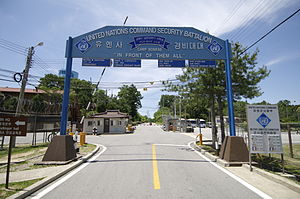
The most forward deployed base in all of United States Forces Korea is Camp Bonifas:
The camp was established after the Korean War to support operations at the Joint Security Area. Camp Bonifas is located approximately 400 meters south of the JSA and was originally called Camp Kitty Hawk. The name of the camp was changed after two American officers, Captain Arthur G. Bonifas and First Lieutenant Mark T. Barrett were murdered by North Korean soldiers in the infamous “Axe Murder Incident”. After the attack the camp was renamed in honor of CPT Bonifas.
The camp is home to the soldiers of the United Nations Command Security Force. The Korean and American soldiers that compose this battalion-sized element are responsible for the 24-hour security of the United Nations Command personnel and their guests that are working at or visiting the JSA.
The unit is also responsible for controlling the entry and exit of all vehicle and personnel into the area along with providing security for the Korean civilians that live within the Tae Song Dong farming village (Freedom Village) that lies within the DMZ. Finally the soldiers are also responsible for conducting tours of the JSA for both civilians and military personnel. The tours are available in English, Japanese, Chinese, and Korean. Roughly 100,000 people conduct a tour of the JSA annually. If you live in Korea and have not done one of these tours I highly recommend you do so. Probably the most unusual aspect of Camp Bonifas is that it is home to what is called the “world’s most dangerous golf course” by Sports Illustrated since the one hole course has minefields around it.
Today US and Korean soldiers continue to serve “In Front of Them All” as the battalion’s motto goes. Even though tensions continue between the two countries, major incidents on the DMZ have greatly diminished in recent years.
The base with the main combat power to support DMZ operations is Camp Greaves located just to the south of Camp Bonifas on the north side of the Imjim River:
The camp is named after Corporal Clinton Greaves of Company C, 9th U.S. Cavalry, who fought off a band of Apaches in 1879 to save fellow cavalrymen. Camp Greaves was founded by the 1st Marine Division during the Korean War in 1953. After the war the Marines used the camp as a patrol base to monitor the DMZ from. After Marines left they were replaced by various units over the years to include the 1st Amphibious Tractor Battalion; the 3rd Battalion, 19th Infantry Regiment, 24th Infantry Division; the 1st Squadron, 9th Cavalry, 1st Cavalry Division; and various 2nd Infantry Division battalions. The last 2ID unit stationed on Camp Greaves was the 1-506 Infantry Regiment. The 1-506th had been stationed on Camp Greaves since 1987 and their unit motto was “Stands Alone”, which I always found funny considering the thousands of ROK soldiers stationed nearby. With that said when the 1-506th was stationed in Korea I always found them to be a very high speed and motivated unit whenever I worked with them. Camp Greaves was closed in 2004 as part of the USFK transformation plan. After its closure half the camp was handed over to the ROK Army’s 1st Infantry Division and the other half is slated to become a $40 million DMZ theme park that is scheduled to open in 2018.
After its closure Camp Greaves like other Western Corridor camps has been the subject of protests though the protests around Camp Greaves is different from the left wing environmentalists that have been protesting other camps. The Camp Greaves protesters are from the Paju area who want the land the camp sits on to be given to the local government for development and not given to the ROK Army.
Warrior Base
Warrior Base is located near the Unification Bridge on the northern side of the DMZ. The base is used to house range control for the various firing ranges located around the DMZ area in the Western Corridor as well providing tent and barracks housing for units training in the area.
Here is a picture of Warrior Base which I have fond memories of spending nights in the tents there while training on the DMZ:
The DMZ includes two villages authorized by a subsequent agreement to the Armistice that ended the war. One village is Tae Song Dong (Freedom Village) on the South Korean side and the second village is Kichong-dong (Propaganda Village) on the North Korean side of the DMZ. Tae Song Dong is located about half a kilometer southwest of the JSA while Kichong is located about a half kilometer northwest of the JSA. Here is a Google Earth image of Tae Song Dong:
Residency in Tae Song Dong is strictly controlled. Only original inhabitants of the village or their direct descendants may live in the village. Kichong-dong on the other hand appears to be a normal village by day with North Koreans working in the fields but at night the workers are bussed to where they live in the nearby city of Kaesong. Only a small custodial staff actually lives in the village. Kichong-dong is referred to by UNC soldiers as “Propaganda Village” due to the loud broadcasts of propaganda blasted from speakers in the village over the years. Here is a Google Earth image of the Propaganda Village:
Here is a a picture of the “Propaganda Village” as seen from the South Korean side of the DMZ:
Located in the Joint Security Area is the Bridge of No Return. This bridge received this name because in 1953 prisoners of war from the allied nations, the Koreas, and China were given the one time option of returning to their home countries. When one walked across the bridge they could not return thus giving the bridge its name The Bridge of No Return.
Image of the Bridge of No Return via the DMZ webpage.
Besides being the setting for the swapping of POWs the bridge was also the scene of the Axe Murder Incident on August 18, 1976 that saw two American officers brutally killed by North Korean soldiers while trying to trim a tree. The murder of these two officers nearly led to war on the peninsula as the US brought in extra ground, air, and naval power to the peninsula to cut down the tree.
Freedom Bridge
Before the Korean War two side by side railway bridges extended across the Imjim River that were used for rail traffic between the then South Korean city of Kaesong and the capitol city of Seoul. However during the surprise North Korean attack against the Republic of Korea launched on June 25, 1950 the South Korean military failed to destroy the bridges. The explosives on the bridges had failed to explode and the North Korean military quickly captured the bridges, which greatly aided the speed of their assault south on Seoul. One of the bridges was destroyed in 1951 as the allies marched north against both the North Koreans and the Chinese forces that had entered the war. The allies were able to successfully capture the last remaining bridge across the Imjim in late 1951.
Freedom Bridge which crossed the Imjim River during the Korean War via Defense Media.
This bridge took on increased importance as peace talks began at the village of Panmunjom just north of the Imjim River. The bridge was refurbished to handle the increased amount of traffic that flowed back and forth from Panmujom every day. On February 16, 1952 the refurbishing was complete and the bridge officially became known as Freedom Bridge. The bridge lived up to its moniker when allied POWs were returned to South Korea after the signing of the Armistice Agreement and they crossed this bridge by ambulance on their return to a reception station set up at Munsan. This route from Panmunjom across the bridge became known as Liberty Lane afterwards.
Freedom Bridge today.
On June 15, 1998 a four-lane bridge dubbed the Tongil (Unification) Bridge was opened across the Imjim River in response to increased traffic to the north side of the Imjim River. The opening of the Tongil Bridge has caused Freedom Bridge to be largely unused today, but it still stands as a testament to the days of the Korean War.
Tongil Bridge
Illegal North Korean Tunnels
In the 1970’s North Korean dictator Kim Il-sung ordered his divisions along the Demilitarized Zone to each dig and maintain two tunnels that infiltrated into South Korea. Evidence of this plan became evident until 1974. On the morning of November 15, 1974, a ROK Army patrol in the west-central sector of the DMZ noted steam rising from the ground. They thought they had found evidence of a hot spring and began digging to see if they had indeed found one.
Instead of a hot spring they found a tunnel that was a mere 18 inches below the surface. While excavating the site the South Korean patrol began to take fire from a North Korean guard post. The patrol began to return fire back at the North Koreans to cover their retreat away from the area. Fortunately no one was injured in the exchange of fire. The South Koreans returned with a larger force to further excavate the site and discovered that the tunnel ran from North Korea and extended one kilometer into South Korea before it was discovered by the patrol. The tunnel was reinforced with concrete slabs, had electric power, weapons storage, sleeping areas, and even a narrow gauge rail line with carts. It was believed that the tunnel was big enough to hold one regiment of soldiers at a time which would have allowed the North Koreans to infiltrate an entire division into South Korea in a matter of hours.
On November 20th as a United Nations MAC team investigated the site, an investigation that the North Korean UNCMAC members refused to participate in, a North Korean explosive booby trap went off killing two MAC investigators, US Navy Commander Robert M. Ballinger and ROK Marine Corps Major Kim Hah Chul. Five more US soldiers and one ROK Army soldier were injured in the blast. Commander Ballinger was the first US casualty on the DMZ since 1969. Just a few months later on March 19, 1975 another tunnel was discovered approximately eight miles northeast of Chorwon. Excavation of the tunnel found that the tunnel was two meters high, less then two meters wide, and about 2,300 meters in length with 1000 meters of the tunnel extending into South Korea. The North Koreans denied digging the tunnel and claimed the South Koreans dug it themselves.
On October 17, 1978 another tunnel was discovered under the DMZ. The prior two tunnels had been in relatively isolated locations however this tunnel was different because it was dug only four kilometers from Panmunjom along the main invasion route into South Korea. Similar to the prior tunnels this tunnel was created with a two by two interior and could have been used to infiltrate thousands of soldiers into South Korea. Of course the North Koreans denied any knowledge of constructing the tunnel. The fourth North Korean tunnel was discovered on March 3, 1990 northeast of the small city of Yanggu in the remote Punchbowl area of Gangwon province. Surprisingly a week later the North Koreans actually admitted to constructing the tunnel in order to “facilitate peaceful reunification”.
Picture of entrance to the 4th entrance tunnel via Wikipedia.
Conclusion
I hope everyone enjoyed this profile of the Western section of the Korean Demilitarized Zone. If you haven’t visited Panmunjom while in South Korea I highly recommend you do so. It is a fascinating place to see that many US military servicemembers and their ROK counterparts over the years have kept safe for visitors. Likewise these same servicemembers have helped keep the ROK safe from North Korean provocations and invasions with their service on freedom’s frontier on the Western Korean Demilitarized Zone.
Note:You can read more from the ROK Drop featured series “A Profile of USFK Bases” at the below link:
Besides several typos (minor issue), I noticed that the description of Camp Bonifas states that the camp is “located approximately 400 meters south of the JSA”. The camp is actually approximately 100 meters from the southern boundary of the DMZ, which since the JSA is in the middle of the 4km wide DMZ, would mean the camp is approximately 2000m from the JSA.
A small correction, but one I’ve been making comments on ever since the Axe Murder Incident, when the official US Army report stated that the (QRF) “Rescue SQuad” (actually a platoon), was over a mile away from the DMZ at the time of the incident, when the Camp wasn’t even a mile away from the DMZ, and at the time of the incident, the QRF Platoon was at the QRF site about 300m away, and then sat at CP#2 (the entrance to the JSA) while the 3rd Plt. leader waited for orders from Capt. Bonifas (who was already dead) to enter the JSA. Finally LTC Vierra arrived at CP#2 from Camp Kitty Hawk and ordered the 3rd Plt. into the JSA, so at no time was anybody ever “over a mile away from the DMZ”.
Thanks for this very thorough overview, I really enjoyed reading it.
I am a 1.5 gen and while growing up in Korea, I distinctly remember that axe incident and the odd feeling of uneasiness that fell on our household. I was too young to fully comprehend what exactly occurred but just remember the elders being really cautious…much more than usual.
I was at Osan AB for two years. Arrived after the murder of the two officers but there was still a lot of uneasiness, the Air Base was still on alert. I was also there during the discovery of the third tunnel. This was a big dill in Korea at the time, but made very little news in the US.
[…] versa. I’ll spare you the history lesson about Korea’s DeMilitarized Zone – but ROK Drop’s post is detailed, accurate, and full of win. Suffice it to say that the sites you’ll see are […]
I had heard many of these terms, places, incidence mentioned when I was there in ’83 at Camp Pelham (later named Gary Owen) but I can appreciate much of this information in a clearer context after reading your post. You have a way of making information entertaining to read while not diminishing the seriousness of some of these events.
Very good perspective of the Korean DMZ. Some facts presented are disputable, but otherwise great source of information and good pictures. Congratulations to the one who put this together and best wishes for you in the future.
With the passing of the NK president Kim Jong-Il this week, it will be most interesting to see how things develop under the rule of Kim-Un, the expected new leader of the North.
Bill is correct in his remarks, above–and he should know, since he was there at the time.
Another small correction: the Google Earth “pin” for Camp Bonifas is actually on the edge of the helipad between it and Camp Liberty Bell. Camp Bonifas (formerly Advance Camp) is south of the road–unless all the new buildings just to the west of the pin have been incorporated into the compound since 1976. Thanks for posting.
HALF of Camp Bonifas is created from the old Camp Kitty Hawk, the other half is from Camp Liberty Bell, which of course sat diagonally across the road from Kitty Hawk and was the Advance Camp for the Forward Most Deployed Infantry Company (Co A) in the forward most deployed Inafantry Battalion in the US Army (1st Bn 9th Inf Manchu) in my day 79-81. LOL We were the Po’ COuntry Cousins that everyone forgets about right across the road. We wasnt fancy, we were just the ones that kept everyone else on the Z from getting thier asses flattenned by the entire KPA before help could arrive from the REMF’s.
I wish I had spent more time touring these historic monuments during my time in the ROK. The two incidents that stick out in my mind were the 9/11 lockdown and the two school girls who were accidentally run over.
I was stationed at Camp Casey 1978-1979 and we were constantly on alert, they were finding tunnels then.I always felt the ground shaking. I have alot of bad memories from the 13 months I spent there.It’s a SHAME…..
I was stationed at PanMumJom as a military policeman from 1964 to 1965. I loved my duty there even though at times it was scary. I can’t remember a night that we didn’t hear gun fire or those damn speakers. We got a lot of respect from Korean’s wherever we went. They respected that United Nations patch and the men who wore it.
I was stationed at Panmunjom during the USS Pueblo incident march 1968.My MOS is 11B10 and by April I remember getting paid a combat pay.The damn speakers are still there.I was awarded with a bayonet badge, for crossing the demarcation line.
Is there anyone there who was stationed in the same place and time range? please I want to hear from you.
[…] spare you the history lesson about Korea’s DMZ – but ROK Drop’s post is detailed, accurate, and full of win. Suffice it to say that the sites you’ll see are […]
Thanks for posting this–It brought back memories of my day at the DMZ while participating in Team Spirit in the late 1980s as a MSgt. with the Army Reserve’s 302nd Public Affairs Unit from Los Alamitos, L.A. Co., CA.
There was an incident in 1977 2chinooks on a training excersise collided in the Z several we’re killed and one survived. NK returned them to us a couple of weeks later.
Would have liked to see a little love for Fire Base 4P3. Everyone stationed from JSA to Freedom Bridge knew that we had their back. Was stationed at Camp Pelham from 90-91 during the first Gulf War and did 3-4 rotations up there. Remember celebrating Cristmas and New Years (no booze of course)shadowing the grunt patrols with our 155mm towed howitzers. GUNS OF THE DMZ!!!
[…] spare you the history lesson about Korea’s DMZ – but ROK Drop’s post is detailed, accurate, and full of win. Suffice it to say that the sites you’ll see are […]
ALL OVER DMZ 70 71 LOTS OF PATROLS OUT OF GP MARTIN.NOT TOO MUCH HEARD ABOUT PEOPLE WHO WERE ON GUARD POSTS.REMEMBER SEEING MDL SIGN AND BACKING UP REAL SLOW.IMJIN SCOUT FROM ACTA E5.ANYONE WITH PICS PLEASE SEND mkikasdmz@att.net
I was stationed at Camp Stanley and the “First to Fire” 1st 15th FA from Oct 1979 – Jun 1980. I was a Forward observer and went to the DMZ three times and was involved in an international incedent on the DMZ when two 105′s were laid 1400 mils out of safe and we shot four rounds into North korea. What an experience it was!! 24 hours later I was in the air going home. Travis AB never looked better!! I was awarded the ARMY Accomidation medal for my actions as a PFC Gen Kingston looked surprised when he was pinning the medal on my chest and said “Damn Soldier, You are the yougest I have ever given this medal to” I am a proud Disabled Veteran and I want to thank you for your service……thnx me
I am researching the DMZ and trying to get clarity on the current status of the UNC-JSA force. Are there US Soldiers currently assigned to this unit conducting patrols along the DMZ?
Will try again had loss first attempt, had arrived at Casey 22 Jun 77 did the turtle farm thing then went I got to Hovey the 1/9th was getting ready to go to the DMZ so I was restricted to post and didn’t see Toko-ri until over a month later. Don’t know to today what part of the DMZ that we went to, one of the first patrols that I was getting ready to go on a 5.56 round whizzed by my head while still inside the compound, a Pfc who wasn’t supposed to even have the magazine in the well had sighted in on me with his starlight scope and squeezed off the round missing my head by inches, could hear the buzz sound as it went by.The PLT SGT come running and chewed his ass, saying son I will stick my foot so far up your ass I will have shit stained knee caps, I know that the SOP was that everybody inserted the magazine as you walked out the compound gate and only the point man and Squad leader actually chambered a round keeping the safety on, this is a true story and I know that it doesn’t even compare to combat but if that round would of been slightly to the right most likely it would of been said that dumb hillbilly from Kentucky done went and got himself killed the first month in country. Goes to show what that can happen.
A man is a man etc, not going to make this a hometown topic. When something happens that sticks in your mind like yesterday that was 35 plus years ago you tell it like it was and what was said. Don’t really care about your hip text u this u that. Never sucked and never will friend.
Unknown to a lot of people was a small unit based out of Yongsan. It was basically an engineer unit that did nothing but search for tunnels on the DMZ. This was in 78 when I was there. I was tasked to take my bulldozer to the DMZ to help look for the tunnel later discovered. However I was short and they sent someone else. When he came back about a week later he walked up and punched me. They sent him out into a area to dig trenches where they thought a tunnel might be. He kept hearing noises in front of his blade. He started to get off the dozer to inspect to see if something was wrong. Everybody started hollering and waving at him so he backed out of the area. They told him what he was hearing were landmines exploding and not to worry about it, but to keep a blade of dirt in front of the dozer at all times to be safe. He said it was the longest week of his life.
I have had an increasing amount of inquiries from former Korea veterans in regards to the spraying of Agent Orange in areas near the DMZ. This spraying occurred during a period of heightened tensions along the DMZ where the North Koreans increased infiltrators into South Korea in an attempt to start an insurgency, ambush soldiers, attack US camps, bomb barracks, and even try to assassinate the South Korean President during a period that became known as the 2nd Korean War. Agent Orange was sprayed along the DMZ areas in order to kill foliage in order to more easily spot North Korean infiltrators. Agent Orange has since been proven to be the cause of a number of health defects with veterans that served in both Vietnam and Korea.
The spraying of Agent Orange in Korea has now been verified by the US government and the VA wants people who may have been exposed to it to come in:
The government is offering to examine Cold War American troops who served in Korea three decades ago for possible exposure to the defoliant Agent Orange.
In a little-publicized initiative, the Veterans Affairs Department expanded a program previously offered to Vietnam War veterans to include people who served in Korea in 1968-69.
The rule change follows by a year the Pentagon’s disclosure that South Korean troops sprayed Agent Orange, which contained the toxic herbicide dioxin, during that time along the demilitarized zone between North and South Korea.
The decision to give vets free Agent Orange Registry exams, for diseases and medical conditions associated with exposure to the herbicide, is set out in a directive issued Sept. 5 and posted on the department’s http://www.va.gov World Wide Web site.
Agent Orange and other similar herbicides were used during the Vietnam War to eliminate forest cover by defoliating broad sections of jungle mainly to facilitate pursuit of infiltrators and supplies moving into South Vietnam from the north. After it appeared probable that the defoliant caused numerous serious illnesses and birth defects, the VA set up the Agent Orange Registry in 1978, three years after the war ended, for U.S. veterans with in-country Vietnam War military service. More than 300,000 veterans have participated so far.
“Now that we understand that it was sprayed there,” said VA spokesman Jim Benson, “we can say, `If you were in Korea, you may be exposed, and we would like you to come in.”’
The VA may want these veterans to come in, but they want them to prove they were in an area that was sprayed for Agent Orange, which may be tough to do for people that were stationed in units away from the DMZ and did a short temporary duty stint near the DMZ that may have exposed them to Agent Orange. The Pentagon claims that the Agent Orange was only sprayed along the southern portion of the DMZ which is the 2 kilometer wide strip of land on the South Korean side of the border. Even if this is true the Agent Orange could still have washed into other areas and the water supply by rain I would think?
The four combat brigades of the 2nd Infantry Division, including the following units:
a) 1-38 Infantry
b) 2-38 Infantry
c) 1-23 Infantry
d) 2-23 Infantry
e) 3-23 Infantry
f) 3-32 Infantry
g) 109th Infantry
h) 209th Infantry
i) 1-72 Armor
j) 2-72 Armor
k) 4-7th Cavalry
Also, the 3rd Brigade of the 7th Infantry Division, including the following units:
a) 1-17th Infantry
b) 2-17th Infantry
c) 1-73 Armor
d) 2-10th Cavalry
This veteran’s site has a number of good links on it that should help people looking for information on Agent Orange in Korea for those who are interested. However, does anyone else have any good information or links to share to help veterans that may have been exposed to Agent Orange?