Introduction
The heart of United States Forces Korea is without a doubt Yongsan Garrison, which is appropriately located in the middle of the city that is at the heart of the entire nation of South Korea, Seoul.

Seoul is a vibrant and massive city with a population of over 10 million people. In the middle of this megalopolis is the expansive USFK camp Yongsan Garrison. To put the location of Yongsan Garrison into perspective imagine a 630 acre foreign military base in the middle of Manhattan in New York. That is what Yongsan Garrison is like.
The camp wasn’t always surrounded by such dense urban sprawl. It was originally constructed as an Army garrison during the Imperial Japanese colonial period of Korea between 1904-1945. In fact some of the older buildings that remain on Yongsan can be dated back to the Japanese colonial period. When the Japanese built the Garrison is was located south of Seoul which was mostly farmland at the time and close to the Han River. The Han River was where boats from the Yellow Sea would travel up to deliver goods to Seoul. This was also convenient for transporting military supplies and personnel as well to the garrison.

Old Japanese brick prison administration building picture via Army-Technology.com.
Interestingly enough the Yongsan area was actually used even prior to the arrival of the Japanese colonial forces as a military area for foreign armies due to its closeness to the Han River. In the 13th century the area was used as a garrison for the occupying Mongolian Army as well as in the 16th century by the invading Japanese samurai as part of the Hideyoshi invasion of Korea. Prior to the Japanese colonization of Korea in the 20th century the area had been used by the Chinese military as well who set up a headquarters in the Yongsan area in 1882. Due to its foreign military history it is easy to see why many Koreans have mixed feelings about the location of US troops at Yongsan Garrison.

Regimental Bachelor Officers’ Quarters; later Imperial Japanese Army Hospital; now JUSMAG-K Headquarters.
During the colonial period, Yongsan Garrison would remain under Japanese control until it was handed over to the United States military with the surrender of the Japanese Imperial Army at the end of World War II. The garrison was used by US military occupying forces until 1948 and after the withdrawal of the occupying force, the garrison was used by the US military’s Korean Military Advisory Group (KMAG) soldiers that advised and helped train the Republic of Korea (ROK) Army.
In June 1950 with the start of the Korean War, Yongsan Garrison was captured in less then a week by the invading North Korean forces. With the September 1950 Incheon Landing Operation led by General Douglas MacArthur, Yongsan would be recaptured by the US military to only be lost yet again a few months later with the Chinese entry into the war. By March 1951 the US military and their allies had recaptured Seoul and Yongsan Garrison once again from the Chinese. Considering the amount of warfare the garrison saw during the Korean War it is amazing how many of the old Imperial Japanese buildings actually survived the conflict.
Today most of the brick buildings seen on Yongsan Garrison date from the Japanese colonial period.


After the Korean War, Yongsan Garrison went on to become the home of United States Forces Korea (USFK), the United Nations Command (UNC), the Combined Forces Command (CFC), as well as the home of Eighth United States Army (EUSA). With such commands that are important both militarily as well as diplomatically, Yongsan Garrison is of extreme importance to both the United States and Korea.


Yongsan Garrison Today
Yongsan Garrison is currently home to over 25,000 US military servicemembers, DOD civilian contractors, and their families. In addition approximately 1,000 Korean Augmentees to the US Army (KATUSAs) serve on the compound along with 3,000 Korean civilian employees. Some of the major units stationed on Yongsan or its satellite camps are the USFK headquarters, 8th US Army headquarters, 18th Medical Command, 121 General Hospital, 175th Finance, Armed Forces Network Korea, Corps of Engineers Far East District, 1st Signal Brigade, and the 501st Military Intelligence to name a few.

8th Army Headquarters on Yongsan Garrison.

Combined Forces Command Headquarters on Yongsan Garrison.
Yongsan Garrison is currently considered one of the top installations in the entire US Army by recently receiving third place in the Army Communities of Excellence competition. The recognition is well deserved considering the excellent facilities on the post. The post is divided into North and South Posts which are divided by a wide Korean public road. In recent years an overpass was constructed over this road to allow vehicles to drive from each side of the garrison without having to exit on to the Korean road.

121 General Hospital image via Wikipedia.
As I said before the facilities on the post are excellent. Yongsan has a very big Post Exchange (PX) and a massive commissary stocked with every type of American food you can think of. The post has most of the popular fast food restaurants as well as fine dining at restaurants located at the four star hotel the Dragon Hill Lodge on south post. The post’s Navy Club also continues to be a popular attraction on the compound. (Update: Navy Club closed in 2015.)

The Post Exchange (PX) on Yongsan Garrison.
An important difference between Yongsan Garrison and most other USFK facilities in Korea is the amount of families that live on Yongsan. Due to the number of families living on the post the installation operates a number of schools and community programs to create a good family environment on the compound. For soldiers stationed in the 2nd Infantry Division without their families it is a strange experience to go to Yongsan and see junior NCOs driving privately owned vehicles and taking their families shopping at the commissary.

Yongsan Apartment Housing.
The majority of the command sponsored families live on South Post or over at Hannam Village. The majority of housing on South Post is in individual homes while Hannam Village is composed of a highrise apartment complex of 1162 apartments that vary between 2, 3, & 4 bedrooms that are a 20 minute walk from Yongsan Garrison. I have heard nothing but good things about the housing on South Post where the majority of senior leadership lives; however I have heard nothing, but bad things about the Hannam Village where mostly junior soldiers live. Not only have I heard and read bad things about the apartments from people who live there, but the Stars & Stripes has reported on it as well. (Update: Hannam Village was closed in 2014.)

Those that are not housed on South Post or over at Hannam Village are authorized to live in an off post apartment. Off post apartments can be very hit and miss in quality and are notorious for landlord sharks defrauding the military and servicemembers out of money.
Dragon Hill Lodge
One of the key attractions of USFK is without a doubt the Dragon Hill Lodge hotel located on the south post of Yongsan Garrison. This massive hotel opened in May 1990 and was constructed using Morale Welfare & Recreation (MWR) funds raised through soldier programs such as the slot machines in operation on USFK camps in Korea. No Congressional funding was used to construct the hotel and to this day the hotel operates through an MWR program called the Armed Forces Recreational Centers. The Dragon Hill Lodge is one of four AFRC hotels across the globe with the others being in Hawaii, Germany, and Florida.

The hotel has 394 rooms and suites that come with queen size beds, sofas, private bathrooms, DVD players, etc. The hotel also has a number of western style restaurants to include fast food such as Subway and Pizza Hut. My personal favourite is the Oasis Mexican Restaurant that I believe serves the best Mexican food in Korea. The hotel also has a massive exercise and swimming facility for its guests. It is also popular for weddings and other large catered functions.
The Dragon Hill Lodge is rated as a four star hotel and for those staying there it definitely deserves its rating. I have only stayed at the Dragon Hill Lodge on TDY orders and have enjoyed every time I have stayed there. However, the one downside of the hotel is its price. Prices for rooms are based on rank and duty status and the average cost for a room is over $200. There are various reasons for the high prices at the hotel, but for soldiers on leave most can get a hotel room for less then a $100.

The Dragon Hill Lodge on Yongsan Garrison.
Even with the projected closing of Yongsan Garrison by 2012 the Dragon Hill Lodge is scheduled to remain a US military property which will mean that US servicemembers will be able to continue to use this great facility even after it closes.
Camp Kim
Located literally across the street from the main post of Yongsan Garrison is Camp Kim. Camp Kim is known to most GIs stationed in Korea as where the Seoul United Service Organization (USO) is located. Going to the USO is the only reason I have ever personally visited Camp Kim. The USO actually runs an excellent facility at Camp Kim and the best I have seen in USFK. Definitely worth checking out if you are a soldier stationed in Korea.

However, there is more to Camp Kim then just the USO. The camp is also home to the Special Operations Command – Korea (SOCKOR) which is the lone US special forces unit assigned to the Korean theatre of operations. The 1st Signal Brigade Project Support Directorate is also located at the camp. This directorate provides a number of technical and communications support capabilities for USFK.
Camp Kim also houses the Vehicle Processing Center for USFK which provides customer service for privately owned vehicles (POVs) of USFK servicemembers and their families. Finally the Korean Service Corps (KSC) is based out of Camp Kim which is a large organization of Korean civilian workers that provide direct peace time and combat support services to the US military in Korea.
Camp Coiner
On the northern part of the land that encompasses Yongsan Garrison is the small USFK installation of Camp Coiner. This camp was named after 2nd Lieutenant Randall Coiner assigned to the 3rd Battalion, 31st Infantry Regiment of the 7th Infantry Division who was posthumously awarded the Silver Star for actions taken in 1953 during the Korean War near the village of Sokkagae.
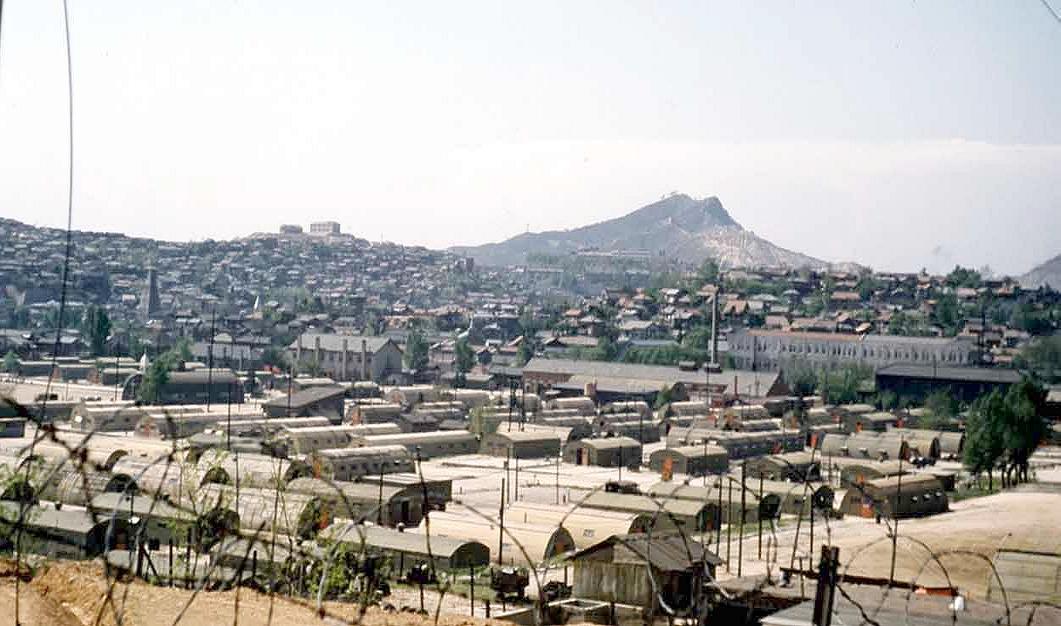
 Quonset huts on Camp Coiner. Picture from the Stars & Stripes.
Prior to the US military taking control of the camp from the Imperial Japanese Army, Camp Coiner was used as a garrison for a horse drawn artillery unit. Currently the camp is home to elements of 8th PERSCOM, the 8th MP Brigade, 17th Aviation Brigade, and the 1st Signal Brigade. The camp is relatively small and only encompasses a total of 55 acres. (Update: In the future Camp Coiner will be tore down and become the location of a new US embassy compound.
Far East District Compound
The US Army’s Corps of Engineers Far East District has been based out of the extremely small Far East District Compound a block from Seoul’s massive Dongdaemun shopping district. The land that the compound was constructed on was originally owned by Seoul National University, but with the outbreak of the Korean War the South Korean government seized the land in order for the Corps of Engineers to start operations from the camp in 1951.
Since then with the economic development of Seoul, the surrounding community has swallowed up the small camp which some citizens of Seoul view as a eye sore. It also has been targeted by anti-US protesters from Hanchongryun that burned a hole in the US flag on the post. Recently the camp has been targeted by protesters angered by not being paid for services rendered while working on the project to expand Camp Humphreys.
The Far East District Compound is scheduled to be handed over back to the Korean government as part of the USFK transformation plan which has led to internal Korean fight between the ROK Ministry of Defense and Seoul National University over who really owns the land. Currently the compound is scheduled to close by 2012 and the land will be sold by the Ministry of Defense to the Korean National Housing Corporation. The camp is 142,000 square feet in size and is estimated that each 10.8 square feet in the compound is worth $85,000. The property is worth hundreds of millions of dollars thus making it quite clear why Seoul National University and the Ministry Defense are fighting over who controls the property.
Camp Jackson
Located in the far northern Dobong-gu suburb of Seoul is the small US military installation Camp Jackson. The camp was named after Private First Class George W. Jackson who was awarded the Silver Star during the Korean War. The camp is one of the smallest in Korea but probably has the prettiest back drop of any camp with the massive granite spires of beautiful Mt. Dobong soaring over the camp.
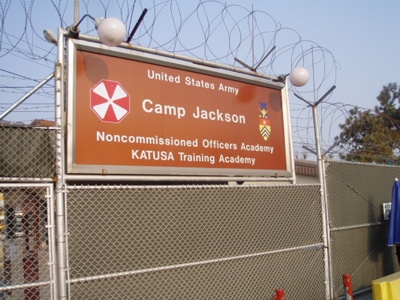
Camp Jackson used to be home to a field artillery Target Acquisition Battery that was assigned about 100 soldiers on the camp. In 1968 on the slopes of Mt. Dobong outside of the camp a continuing gun fight with Korean soldiers against North Korean infiltrators sent to kill Korean President Park Chung-hee erupted and could be heard from the camp.
Today there is no field artillery unit stationed on the installation and instead Camp Jackson is home to the Wightmen Non-commissioned Officer Academy that trains newly promoted US Army E-5 sergeants in basic NCO skills. Camp Jackson is also home to the very unique Korean Augmentee to the United States Army (KATUSA) training academy. Korea is the one US ally that has a sizable number of soldiers that serve side by side in US units. These Korean Army soldiers are called KATUSAs. The KATUSA program was first initiated in the early years of the Korean War to provide US units with translators and local cultural knowledge. KATUSAs continue to provide these important capabilities along with conducting clerical, driving, maintenance, etc. work within their respective units.
All ROK Army draftees that are selected for the KATUSA program after passing rigorous English language tests must attend the KATUSA academy at Camp Jackson. For all KATUSAs this is their first initiation into serving with US soldiers. The NCOs that train both the NCOs and KATUSAs at the academy are of high quality but unfortunately a sexual assault against a KATUSA trainee mired the school’s image a few years ago. Since then the academy has had a clean record and continues to produce great young NCOs and KATUSA soldiers for the United States Forces Korea.
Camp Jackson is scheduled to be handed back over to the Korean government as part of the USFK transformation plan by 2012. (Update: The relocation plan to move the NCO Academy to Camp Humphreys has been delayed to 2017.)
K-16
The K-16 airbase is located just south of the Han River in the Seoul suburb of Soengnam. The airbase was actually the old Seoul City Airport which during the Korean War was converted into a full time military base. It received the name K-16 because airfields during the war were given code names. The original name of the base was Seoul Airbase but its codename of K-16 is what stuck and it continues to be identified as K-16 Airbase to this day.
The airbase today is 86 acres in size and controlled by the Korean Air Force 15th Composite Wing who plays host to the US Army’s 2-2 Aviation Battalion and its support units such as the 595th Maintenance Company. The 2-2 Aviation Battalion is equipped with Blackhawk helicopters and only moved to the base in 2005 from their former home at Camp Stanley in Uijongbu. The battalion was moved from Camp Stanley as part of the USFK transformation plan. K-16 also hosts a small security force that is responsible for defending Camp Post Tango located on the base. CP Tango is the primary warfighting center where any contingency on the Korean peninsula would be commanded and controlled from.
The airbase is also the entry and departure point for many VIPs flying to and from Seoul to include the South Korean president and American government officials. However, the thing that K-16 is probably most known for to USFK servicemembers is the nearby Sungnam golf course. The Sungnam golf course is not only popular with US servicemembers but with Koreans as well.
It is important to note that there are no plans to close the airfield as part of the USFK transformation plan to consolidate units around the hubs of Camp Humphreys and Osan Airbase. In fact money is actually flowing into K-16 now with major upgrades to the facilities taking place including brand new apartments for the servicemembers to be housed in.
Camp Market
Camp Market is yet another military installation that was originally constructed by the Imperial Japanese army in the 1930’s as a logistics base for supplies coming through the port of Incheon. Like with Yongsan Garrison, the Camp Market area was handed over to the US occupation troops after World War II. The area was captured by the North Koreans in the opening week of the Korean War and was recaptured in September 1950 with the Incheon Landing Operation. After the landing General McArthur used the area as a logistical base. The camp was lost again in December 1950 with the entry of the Chinese into the war. The camp was recaptured from the Chinese in March 1951.
After the Korean War the area became known as a logistical base for the US Marine Corps and in 1963 the area was given to the US Army which established the Army Support Command (ASCOM) in the area. ASCOM became the main logistical hub for the US military until most of the land and facilities for ASCOM was closed and turned over to the Korean government in 1973. Only the Camp Market area was not turned over and remains a small logistical base for USFK in Incheon.
Today Camp Market is composed of 34 warehouses that has a combined total of 852,495 square feet of storage space to store goods and supplies for USFK facilities. The Defense Reutilization and Marketing Office as well as the Army Air Force Exchange Service (AAFES) distribution and bakery is based out of Camp Market to provides products and baked goods to PXs and commissaries across USFK. Approximately 600 civilians work at Camp Market with the vast majority of them being Korean contract workers.
The Future of USFK Facilities in Seoul
As the decades passed in Seoul and the Korean economic miracle took hold of the city, it began to grow at a remarkable rate to where today Yongsan Garrison has been totally engulfed and surrounded by the city. A dense urban environment surrounds the garrison on all sides instead of the farmland that surrounded the garrison when it was first constructed by the Japanese.
This urban development has caused many problems for the US military in Korea because the 630 acres that composes the garrison causes both development and traffic problems for the city of Seoul. The location of the garrison also allows activists groups to easily use the garrison to conduct their anti-US protests at any time.
Recognizing the problems of the current location of Yongsan Garrison the United States military has tried for years to get the base relocated outside of Seoul and has been continually met with South Korean governmental delays to any proposed move. The first proposal to move the garrison was actually initiated back in 1987 with then Korean President Roh Tae-woo. By 1990 a Memorandum of Understanding was signed to relocate Yongsan Garrison.
However, in 1993 a new Korean president had come to power, Kim Young-sam who that year canceled the plan move, deeming it to expensive because Seoul was to pay for the cost of moving the garrison. However, it was probably no coincidence that the Korean government also killed the Yongsan move the same year the North Korean nuclear crisis was happening and the nation was on the brink of war with the North Koreans. After war was avoided with the signing of the Agreed Framework talks about relocating the garrison were effectively delayed even further with the onset of the Asian Financial Crisis in 1997.
Talks to relocate Yongsan did not seriously heat up again until 2003 when US President George Bush and Defense Secretary Donald Rumsfeld pushed the Korean government to relocate the garrison. On January 17, 2004 during the Sixth Future of the Alliance talks, an agreement was struck to relocate Yongsan Garrison to Camp Humphreys which is located about 50 kilometers south of Seoul. A small area of land would remain controlled by the US military at Yongsan to serve as the home for a new US embassy as well as keeping the Dragon Hill Lodge for the use of US servicemembers. The remainder of Yongsan was supposed to be turned into Seoul’s very own Central Park, but business interests and politics may sink this idea.
The original plan was to have the base relocated by 2008. However, technical problems and South Korean governmental delay games pushed the date of the relocation back to 2010, then 2013 and then finally back to 2012. Now there is even attempts by the South Korean government to push the relocation all the way back to 2015. With such governmental delay games being played out it is easy to see that Yongsan Garrison is probably going to be around for many more years to come and I can think of quite a few people who will be happy about that. (Update: Most of Yongsan Garrison is hoped to be moved to Camp Humphreys by the end of 2017.)
Note: You can read more from the ROK Drop featured series “A Profile of USFK Bases” at the below link:

Comments
[…] TChahng: May 12th, 2008 at 10:55 pm […]
In my opinion the 2012 move date will never happen. Years ago I believed all the misinformation being put out by leadership about a 2008 move – not anymore!
Great work GI Korea, nicely written. And thanks for including the FED Compound. Most folks don’t even know we’re here.
Just one correction. The Google Earth image for Dragon Hill incorrectly identifies the building. The push pin identifies the First Replacement Company’s facility, Bldg. 4034 which is across the parking lot from DHL. DHL is actually the large “X” shaped gray roof at the bottom of the image (under the copyrights).
thanks again.
Fred, thanks and you are correct about mislabeling DHL. I was sloppy with the pin mark and have fixed the image. Thanks.
Pete I am at the point now that I won’t believe Yongsan will really move until I actually see it happen with my own two eyes.
Great post. How do you find the time to do these?
And I think you’re right on the final point, Yongsan will likely be a USFK base for the foreseeable future. Any ROK politico with half a brain knows that soon after the U.S. is gone from Seoul and then Korea, either the Chinese or the Japanese will want to establish a foothold. Stability in northeast Asia hinges on stability on the Korean peninsula.
Who can Korea depend upon to be the Hidden Dragon behind her Crouching Tiger? Someday that will be necessary, and I will say, Hell Yes!
These long posts like this one I actually type up as a Word file and leave it saved on my desktop and just slowly add to it over time. Once it is done I just cut and paste it into my blogging program. I have been slowly typing up this Yongsan post for probably about three months.
You forgot CP TANGO…
I too admire how you can keep a fairly steady stream of these posts coming week after week given your busy professional schedule.
I admire the consistency – which I sorely lack. I can only manage to work in heated spurts.
[…] Click here to read more. Click here to return to Korea Click here to return to MySpace News. […]
[…] main logistical support hub at the time and the only remnants of it that remains today is Camp Market. The story initially develops by following Mike’s interactions with fellow soldiers in the […]
[…] … metacomm.co.kr/forum/USAG%20Humphreys%20Relocation… • Found on Google A Profile of USFK Camps in Seoul May 13, 2008 … The US Army?s Corps of Engineers Far East District has been based …. Camp […]
[…] expect to live in back in the states. Even families that are command sponsored find themselves in Yongsan for example living in the Hanam Apartments which I have often heard referred to as “The Ghetto”. This is a […]
I was in the 135th FST and i served in Korea from 1996 to 1997, i will never forget the team of people i met there, if anyone can read this please email me any jobs that can help our soldiers in the duty. I am a US Army Vet, and i am so proud of the work we did there, we took over Mash, i designed the coin for the 135th FST, I would love to hear from anyone there, it really brings back so many good memories. To all those in 121 GH i miss you all…….
Great stuff. I have a picture of Camp Coiner in my collection that will show how the area looked in 1960. I am sure you can not see any of that big hill now, since the area is all high rises now.
http://www.qsl.net/wd4ngb/cpcoiner1960.jpg
I spent 61-62 at Camp Coiner and going to all signal corps sites to set up our carrier communications deuce and a half. any pics of TV hill Uijongbu, Pyontec
I was with MILPERCEN-K at Coiner in 80-81 and USAGY in 84-85 (and even Camp Stanley in 73-74). If anyone has any photos of these locations during these periods, I’d appreciate the memories.
Station at Camp Coiner, 67-68, looking to conect with others, signal
Stationed at Camp Long Wonju 1973-1974 lookimg for buddie Robert Gambrell stationed Camp long 1972-1973
in 1973 K-16 was little more than the small Air Base and maybe 10 farm houses across the road does CXamp Long still exist where I set up communications van on a duce and a half with generator
I was station at Camp Market. It seems surreal that I spent two years there. I was only required one year, but within the first 6 months I extend my tour for the rest of my enlistment. What a weird place. You could run around the installation in less than half an hour and it was surrounded by large apartment buildings. At times it was a lonely place when everyone left home for the weekend. Once you step outside, it was a diffrent world. It seemed I was the only foreigner walking around on that part of the city. I use to get stared at all the time. Alot of shady deals went down at the commisary and at the “club” or casino. Korean women who were married to officers showed up in their BMWs and load their vehicles with beer and other items they would sell of post. The casino was closed for GI’s at 10pm during the weekend, but oddly you could see the Korean national patrons playing the slot machines with the doors locked. The club manager always kicked me out when I showed up with my camcorder!
I was 1SGT of an MI Co on Camp Coiner in 1987-88 (the Olympics). Great tour of duty, loved Itaewon.
What can you tell me about Camp Grey (not to be confused with Camp Grey Annex), located (previously) in Yongdungpo.
Greatest time of my life spent @ Seoul American High School,,71-74..Those who hated Korea, never really “saw” Korea, the culture shock of the far east and the pre concieved ideas blind some people.
Raul N Aguilar
I’m wondering why it never occurred to me to extend my stay in Korea at Camp Pelham in 1983. Had I known how boring stateside duty was (at least at Fort Ord)I would have spent my whole enlistment time in Korea. I clearly remember that moment on the runway..leaving the country..we all cheered when we heard and felt the rubber wheel lift off that runway when we departed. But deep down I felt sad..feeling like I had just scratched the surface of the experience and yet was leaving and would probably never be there again. I’m so grateful for sites such as this where I can check out the scene there a little bit and see the same sort of sentiments from others who served there. If ESL teaching paid a bit more..I’d probably be heading back now.
For anyone that served in the Seoul area in the 1950s or 1960s the below link may be of interest:
http://rokdrop.com/2012/06/28/filmmaker-looking-to-interview-us-rok-military-veterans-for-documentary/
I think there is a small error about Ascom City in your history. Ascom was indeed a Marine supply point during and for a short time (no pun intended) after the Korean War, but I think it became property of the US Army in early 1954. I went to Korea on my first tour in 1956 on the USS Freeman and we processed through Ascom and boarded unheated trains for Uijongbu. I spent a month in the 121 Evac hospital in 1961 on my second tour and it was indeed at Ascom and I didn’t see a Marine. The Marines withdrew from Korea in either 1954 or ’55 and the 24th Infantry Division took their place. I served with the 7th Div just south of Kumwha.
Richard Sullivan has it right. I went thru there in Feb 1960 also was assigned there July 1962 thru August 1964. It became ASCOM when the seven technical services were combined and consolidated I believe early 1963 to form a depot. I worked on the eventual movement of supplies to Waegwan Camp Carroll before I went to Japan.
Ascom was a supply depot before the Korean War as I was surprised to read on page 509 of Roy Appleman’s “From the Naktong to the Yalu” nearly 50 years ago in his account of the Inchon landing and subsequent liberation of Seoul.
“…During the night of 16-17 September, the 2d Battalion, 5th Marines, occupied a forward defensive position commanding the Seoul highway just west of Ascom City. Behind it the 1st Battalion held a high hill…”
Anyone as rabid about military history as me or someone with just a little curiosity of what happened where they were assigned would find the Army’s official history very interesting.
Ascom was a supply depot before the Korean War thats very true I believe the 24th Infantry Division had it prior to the war but not sure. I actually found a picture showing the Marines moving thru Bupyong Dong about three days ago sent it to my son who was a marine and a avid Korean War junkie. Him and his brother actually lived for a year on that same street while I was in Vietnam.
Sorry Richard your right 24th took it after the war from the Marines my mistake. Sometimes its had to keep it straight in my head. Ha Ha
Ron, I never made a MISTEAK! Where/when were you in Vietnam? I was there also.
1st time was 1965 at the Inventory Control Center down by the docks in Saigon. Then I was at Hq,USARV Long Binh 1968,1969. I was pretty lucky tour wise. Also spent two tours on Okinawa, Panama,Hawaii,Korea (two times) and one year at the Pentagon before I retired.
My 1st tour in Korea was 1960 7th Cav Camp Custer. I recall the 1st meal in Korea while at ASCOM was always a steak. Anytime of the day. Beat that junk on the ship.
I arrived in Korea on 5 January 1965 at Incheon aboard the USS Breckinridge bound for 7th Inf Div at Camp Casey. On Aug. 15, 1965, was transferred to Yongsan Garrison for assignment with the 199th Personnel Services Company. Separated from the US Army as SP5, at the 38th Replacement Co., then stationed at ASCOM/Camp Market on 23 Feb. 1966. Was hired as a temp GS3, Clerk-Typist with the ACofS, G5, Civil Affairs, 8th US Army on May 1, 1966. Thus began my civil service career. With the exception of nearly 3 years (Oct ’81-April ’82 and May 2007 – May 2009) I have lived in Korea and worked as a Public Affairs Specialist or Officer for about 35 years. Retired on 30 Sep 2008 at my last Public Affairs Officer position with the US Army Corps of Engineers, Sacramento District, California with 41 years of service (included 2 years of active duty). Worked on Yongsan Garrison for most of my life and living in numerous places in Seoul and now living in Yongin, near the Korean Folk Village.
I enjoy living in Korea and probably know more about this nation than I do about the US. I’ve traveled to almost all of the US military installations in Korea in the ’60s and ’70s and less travel in the ’80s, 90s and later.
Enjoy reading the comments and seeing the photos on the web related to our US military presence in the Republic of Korea. Appreciate the efforts of people like you who post these items of history.
I was never a military brat but I lived with my father in Seoul for many years. My dad worked for Dunham and Smith who supplied the military with food stuffs, electrical goods and you name it. So I was familiar with many of the bases. Especially Osan. I am looking forward to going back to Yongsan where I spent many of fond memories.