Especially of interest with this missile defense test is that Japanese intelligence may be included as part of the test:
South Korea plans to conduct its first missile defense drill in the first half of next year to test the effectiveness of locally developed defense programs in the face of North Korea’s missile and nuclear threats, a government source said Monday.
South Korea has been developing its own Kill-Chain and Korean Air and Missile Defense (KAMD) systems to better detect and respond to military provocations from the North.
“Military authorities are planning our first independent Korean Peninsula missile defense drill during the first half of next year,” the source said, speaking on condition of anonymity.
“I understand that the drill is aimed at testing the effectiveness of the KAMD and Kill-Chain systems that have been developed by our military and identifying any flaws.”
The drill is expected to run on the missile defense simulation model developed jointly with the United States, the source added.
The exercise is also likely to use military intelligence provided by Japan under a trilateral pact signed earlier in the day.
(Yonhap)
I did not realize that in Korea that it is actually illegal to give a veteran hiring preference, but this governmental committee is trying to change this in an effort to reform ROK military culture:
A committee meant to reform the military culture recommended that the government give extra points to job applicants who complete military service, a move that could reignite the controversy over the divide between men and women.
The committee recommended that such applicants be given a bonus 2 percent on company examinations, but that only 10 percent of successful applicants at a single company can receive the benefit.
It also said an individual can only receive the benefit five times in his lifetime while those who received heavy punishment for serious wrongdoings will be excluded from the proposed benefits, according to the committee.
“To help encourage draftees to successfully carry out their military duty, the ministry will review the recommendation that calls for giving extra credits to enlistees when they apply for a job,” the defense ministry said.
The move, however, could draw opposition from women, who are not obligated to serve in the military, at a time when the job market remains tight.
In 1999, the Constitutional Court ruled as unconstitutional the law giving males who served in the military an advantage in applying for public service positions, saying it was unfair to women and the disabled. [Yonhap]
You can read more at the link, but if the ROK is serious about changing the military culture then spend the money to professionalize more of the military.
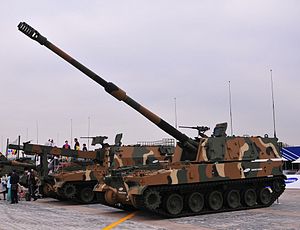
A South Korean defense company will sign a deal with Poland, today, to sell 120 locally developed self-propelled howitzers, a military source said Tuesday.
“Samsung Techwin Co. will sign a contract with Poland’s defense ministry at 7 p.m. in Korea to export K-9 self-propelled howitzers,” the source said, asking not to be identified. “Under the contract, the company will directly supply 24 howitzers by 2017. The remaining 96 will be produced in Poland.”
The total export value is estimated at about $320 million (347 billion won), according to the source.
Samsung Techwin developed the 155-millimeter howitzer for the nation’s armed forces in 1998 to replace K-55 howitzers. Equipped with state-of-the-art firing and mobility systems, the K-9 has a maximum range of 40 kilometers. [Korea Times]
You can read more at the link, but this arms purchase by Poland is definitely aimed at upgrading the country’s defenses in wake of Russian aggression in the region. Samsung Techwin ought to send a big thank you note to Putin for the increased business to the arms market that the South Koreans have been trying to expand for many years.
Unsurprisingly more and more Koreans do not believe in the mandatory service required of all males to defend the country:
More parents hope their sons can skip compulsory military service, which they consider a waste of precious years in their young lives.
According to a recent survey, seven out of 10 respondent or 70.2 percent, said they would encourage young men to “tough it out,” but the percentage was much smaller among people under 50.
Some 40.2 percent whose sons are nearing conscription age said they would prefer them to be exempt if possible. The proportion was slightly bigger among mothers than fathers with 42.5 percent as against 37.9 percent.
In a similar survey by a high school in Busan in August, 38.1 percent of respondents said they want to avoid conscription if possible. Only 34.5 percent agreed that military service is inevitable at a time when the nation remains divided, and even fewer or 27.4 percent agreed that it is “natural and honorable” to serve in the military.
That suggests some 70 percent do not see the point.
Asked why they do not look forward to their military service, 39.5 percent cited the hard life in barracks, 32.3 percent violence and bullying, and 28.2 percent said it would be a waste of time. [Chosun Ilbo]
There has been baby steps in the past to professionalize the ROK Army, but the fact that the ROK government is able to maintain such a large force for little money is going to be hard to change because a professional army is expensive. Just ask the Pentagon.
Here I was thinking that transgender people wanted to have their junk cut off?:
A South Korean transgender woman Wednesday lodged a human rights complaint against the military for forcing her to undergo genital surgery in order to be exempted from military duty.
The 22-year-old trans woman went through a mandatory medical checkup for the draft in 2012. She submitted a medical report that confirms a “crisis in sexual identity” and documents on her cross-sex hormone therapy to apply for a military exemption.
The Military Manpower Administration (MMA), however, rejected it, saying she would need to present convincing evidence that she would never be able to become a man again.
She had no choice but to undergo an orchiectomy and was exempted from the military duty in October 2013.
“The MMA demanded her to come up with an irreversible proof, obviously referring to the surgical removal of testicles,” Yun Da-rim, secretary general of the Korean Sexual-Minority Culture and Rights Center, told the Korea Observer.
“Those who receive military medical checkups are in their early 20s and many of them simply cannot afford to have genital surgery. Can you imagine how much an ordeal a transgender woman has to suffer to live with male conscripts?”
Yun argued that trans women should be exempted from their compulsory military duty without undergoing genital surgery as no measures have been taken to protect the rights of sexual minorities in the barracks. [Korea Observer]
You can read more at the link, but if you still have your male body parts than you are a male and should do your mandatory military service like every other male. Letting transgender people dodge mandatory service without the surgery would lead to non-transgender people claiming they are transgender to avoid mandatory service as well. The ROK military needs a standard and clearing have male body parts is a pretty clear standard.
This is probably the first time I have heard of Koreans unhappy with one of its national teams winning a gold medal:
The South Korean baseball team Sunday clinched the gold at the Incheon Asian Games, but a lot of people here seem to have more reasons to mock their achievement than celebrate or be proud of it.
They think players will enjoy greater benefits than they deserve — exemption from the country’s mandatory two years of military service. Ironically, their gold has also led to fierce discussion about abolishing such rewards to athletes.
“I wish they lost the game,” 29-year-old baseball fan Park Tae-yang said. “I do not understand why Korea, in the 21st century, still has to give military exemption for athletes on the grounds that they help promote the country.”
Such harsh feelings against the national team are also based on the fact that South Korea is the only country that sent professional baseball players, who appeared desperate for a military exemption, and let them compete against teams consisting mostly of amateur players. [Korea Times]
You can read more at the link, but it does seem kind unfair to all the other males in Korea that they have to do their mandatory service obligation while these professional athletes now will get out of it because they blew out a bunch of Asian amateur baseball teams.
I have always liked this idea of a combined division and it appears it will become a reality:
Headquarters of the 2nd Infantry Division in Uijongbu.
South Korea and the United States have agreed to establish a combined division of their troops next year that will be tasked with carrying out wartime operations, Seoul’s defense ministry said Thursday.
The unit, slated to be organized in the first half of next year, will be comprised of the U.S. 2nd Infantry Division and a South Korean brigade-level unit, according to the ministry.
The 2nd Division commander plans to head the newly-made joint staff of the combined unit, with South Korea’s brigadier general-level officer to be its vice chief, the ministry said, adding that an equal number of dozens of service personnel from the two sides will form the leadership.
“While being operated in a separate fashion in peacetime, the 2nd Division and the Korean brigade will carry out joint exercises when necessary,” a ministry official said, asking not to be named.
In time of war, the two entities will get together to carry out diverse “strategic operations” such as eliminating weapons of mass destruction as well as civil missions against North Korea, he noted, without elaborating further. [Yonhap]
You can read more at the link, but the article says this will not impact the relocation of the 2ID to Camp Humphreys. However, I wonder how it is going to impact the residual combat power in Area 1 that has long been discussed.
Two year ago the South Korean government tried to puchase the Global Hawks and was denied. I guess if you fail once try, try again:
South Korea said Wednesday it is still seeking to buy unmanned aerial vehicles (UAVs) from the United States despite Washington’s previous refusal to sell it the high-altitude spy plane. The defence ministry plans to acquire four Global Hawk UAVs by 2012, a spokesman told AFP. The 45-million-dollar craft can cruise at an altitude of 19,500 metres (more than 64,000 feet) for up to 42 hours and identify 30-centimetre (12-inch) objects on the ground.
South Korea is seeking the planes partly so it can keep a better watch over North Korea, as it takes over greater responsibility for its defence from its ally the United States.
But its request for the Global Hawks was rejected in 2005. The US says that the Missile Technology Control Regime, which covers the unmanned plane, should be revised first.
So why was the Global Hawks denied to South Korea two years ago you may ask? Unsurprisingly, this is why:
The U.S. is thought to have rejected the request for fear that the core technology might be leaked. Some are known to be worried that confidential information collected on North Korea using the Global Hawk might be leaked to the North.
It is pretty much no secret in the military community that anything given or sold to South Korea ends up being leaked to the North and nothing in the last two years has changed this fact. If anything trust between the US and Korea has decreased even more.
Look at who the US did sell the Global Hawk too:
The Defense Acquisition Program Administration said, While continuously requesting the U.S to sell us the Global Hawk, we are also developing a domestic mid-altitude UAV system. However, the mid-altitude UAV system development will be possibly completed around 2015. On the other hand, Japan received consent to buy the Global Hawk last June, and it has already secured budgets and commenced preparations to introduce the Global Hawk into its system.
This is probably the main reason why South Korea wants the Global Hawk, simply because Japan has them.
I have posted before that the long term readiness of the ROK Army will be affected if the Korean government does not do more to professionalize the force. I say this because in the past, completing your mandatory service in the ROK military was considered a gate you passed to become a man in Korean society. People who did not do their national service were looked down upon. Today though it is the complete opposite, mandatory service is something at best to be avoided. What has changed this attitude so drastically over the course of only a decade? First all living standards have increased where people don’t want to spend two years of their lives living in a cramped barracks getting beat down by superiors for a next to nothing pay check. Secondly and most importantly in my opinion is that the youth being conscripted into the ROK military do not see the North Korean threat as a legitimate threat to the nation. The progressives in the South Korean educational system have successfully indoctrinated an entire South Korean generation into the bogus belief that North Korea is just some misunderstood uncle that doesn’t mean any harm to South Korea. Don’t believe me? Then read this.
This announcement by the ROK military is at least one small baby step towards professionalizing the force if it comes to pass:
The military is considering hiring about 40,000 “salaried volunteer soldiers” between 2011 and 2020 to help overhaul the military conscription system, sources at the Defense Ministry said Monday.
Under the plan, those who volunteer to remain in the military for an additional year after their two-year mandatory service would be paid an annual salary of about 15 million won, they said.
The ministry initially announced that it would maintain about 20,000 salaried voluntary servicemen but is considering increasing the number to fill the possible manpower gap from the reduction in service period, the sources said.
The Defense Ministry needs these volunteers because of the national government’s plan to reduce national service from 24 months to 18 months for most conscriptees. It is speculated the ruling party is doing this just to score political points in this year’s presidential election with Korea’s youth population, which is probably the case, but I like the possible unintended consequence of having the military recruit volunteers instead of relying on draftees.
The pay of approximately $15,000 for that extra year is actually pretty competitive with the pay of an American military E4 with 2 years of service which comes out to $20,976. You consider the cheaper of cost of living in Korea and it is pretty much even. Plus if living conditions and treatment of the soldiers improves this may be appealing to many youths. However, a professional military requires budget increases, which many in the government don’t want to give:
“We are in close consultation with related government agencies about the increase in the salaried soldiers as an alternative to the cut in the service period,” a ministry official said on condition of anonymity. “But the budget planning agency now opposes it, citing the whopping additional budget required.”
The Ministry of Planning and Budget estimates that about 1.2 trillion won of additional budget on top of the 621 trillion of defense spending for the Defense Reform 2020 scheme would be required only for soldiers’ payment, he said.
That is why I dislike the draftee system because the politicians can keep getting away with sending over a billion dollars to North Korea while Korean youths for two years are treated no better than a Kaseong slave labor worker. I find it ironic that the amount of money needed to fund this voluntary service program is nearly equal to the amount of money being sent to North Korea this year. If Korean youths really wanted to make a difference in this next election they should vote for someone who is going to legitimately work to create an all volunteer military so no one will have to be conscripted in the first place instead of the demagogues looking to score cheap political points at the expensive of national security and the welfare of their citizens.