Silly season between the ROK and Japan continues. I expect the ROK government will continue to push anti-Japanese issues to their domestic audience up to the March 1st Independence Movement Day holiday:
Defense Minister Jeong Kyeong-doo leaves the ministry headquarters in Seoul on Jan. 23, 2019. (Yonhap)
South Korean Defense Minister Jeong Kyeong-doo has instructed the Navy to sternly deal with the repeated low-altitude flybys by Japanese warplanes, describing them as “a serious provocation by an ally,” his ministry said Saturday. He made the remarks during his unscheduled visit to the Fleet Command in the southern port city of Busan, the ministry said later in a release. The minister was briefed on the details regarding multiple close-range flights by Japanese maritime patrol planes toward South Korean destroyers in recent weeks.
South Korea’s military on Thursday released five photos captured from two videos of a Japanese warplane’s “threatening” low-altitude flyby close to its destroyer a day earlier. The disclosure came as Tokyo rejected Seoul’s claim that its P-3 maritime patrol plane buzzed by South Korea’s 4,500-ton destroyer Daejoyeong at an altitude of 60 to 70 meters and just 540 meters away in international waters south of the peninsula on Wednesday. The Korean Navy filmed what it called Japan’s “provocative” flight with an infrared camera and handheld camcorder on the destroyer during the incident that sharply heightened tensions between the neighbors. Seoul initially mulled releasing the videos but decided later to disclose just still photos, apparently in line with its stance to “act with restraint.”
You can read more at the link, but notice how the ROK uses the term “buzzed”. I don’t think they quite understand that when the term is used in English people generally think of an aircraft flying right over the observer. In this case the Japanese plane was over half a kilometer away from the ship.
This is pretty jacked up that Coast Guard personnel serving in Japan have to get food from a pantry. Regardless it is good to see servicemembers helping other servicemembers in need:
Information Systems Technician 1 Joseph Bruce takes donated items from the food pantry at Yokota Air Base, Japan, Thursday, Jan. 24, 2019.
Servicemembers working without pay due to the government shutdown picked up donated groceries from a food pantry Thursday at the home of U.S. Forces Japan in western Tokyo. Twenty-two Coast Guardsmen, including 15 at Yokota and seven in Singapore, aren’t being paid during the shutdown, which started more than a month ago. The impasse stems from House Democrats’ refusal to provide President Donald Trump with the billions he demands to build a wall on the U.S. border with Mexico. Other military branches have continued to receive paychecks, but the Coast Guard, a part of the Department of Homeland Security, not the Defense Department, has gone unfunded. Coast Guard Commandant Adm. Karl Schultz on Wednesday publicly criticized the lack of pay. “Ultimately, I find it unacceptable that Coast Guard men and women have to rely on food pantries and donations to get through day-to-day life as servicemembers,” he said in a video posted to his Twitter account.
For those that have not been following this issue, the Japanese side does not dispute the forced labor claim, what they dispute is that they already paid compensation with the 1965 treaty. Instead of handing out money for individual compensation, the ROK government used the money to develop the economy instead.
In this Nov. 29, 2018, file photo, victims of Japan’s forced labor and their family members arrive at the Supreme Court in Seoul, South Korea. A South Korean district court said Wednesday, Jan. 9, 2019, it has decided to freeze the local assets of a Japanese company involved in compensation disputes for wartime Korean laborers. The sign reads ” Mitsubishi Heavy Industries apologize and compensate victims.” (AP Photo/Ahn Young-joon)
A South Korean court said Wednesday it has ordered the seizure of local assets of a Japanese company after it refused to compensate several wartime forced laborers, in an escalation of a diplomatic brawl between the Asian neighbors. Japan called the decision “extremely regrettable” and said it will push for talks with Seoul on the issue. In a landmark ruling in October, South Korea’s Supreme Court ordered Nippon Steel & Sumitomo Metal Corp. to pay 100 million won ($88,000) each to four plaintiffs forced to work for the company when Japan colonized the Korean Peninsula in 1910-45.
But the company refused to follow that ruling, siding with Japan’s long-held positon that all colonial-era compensation issues were settled by a 1965 treaty that restored diplomatic relations between the two governments. Japanese officials said they could take the issue to the International Court of Justice.
You can read more at the link, but is the ROK government going support someone who makes a compensation claim against China for their role in the destruction of South Korea during the Korean War that killed tens of thousands of South Koreans?
By the way Joshua Stanton over at One Free Korea makes a good point, I wonder how much the sagging Moon administration approval ratings have to do with this?
I haven't read the news today. Are the South Korean president's approval ratings down? https://t.co/Tway5G267Y
The first criticism in the video is that the Japanese aircraft flew at a low and threatening altitude. Here is a screen capture from the ROK perspective of the patrol plane. Does this look like a threatening aircraft?:
The next claim is that Japan is wrong about being in compliance with international law. The ROK video shows that the altitude and distance level the Japanese aircraft maintained was applicable only to civil aircraft according to international law:
This actually discredits Korea’s criticism because then the Japanese patrol aircraft could then fly at whatever altitude it wanted if there is no international standard military aircraft are held to. If there was a military standard between the ROK and Japan I would think they would have included it in the video.
The next claim in the video is that the Korean ship did not use its fire control radar against the Japanese plane. The video says the ship only had its search radar on. To counter the Japanese claim of the use of a fire control radar the video focuses on the fact that no guns from the ship were pointed at the aircraft. This is a completely separate issue that the Japanese side has never claimed. The issue was the use of the fire control radar.
The video also asks that if the fire control radar was used why didn’t the plane use emergency measures to escape. Watching the Japanese video it is clear the crew knew no weapons were pointed at them and thus likely did not feel threatened by the Korean ship.
The next claim is that the Japanese radio communications were unclear. The video had just one short snippet of audio which was unclear. However, there was much more broadcasts by the Japanese plane. I can understand though how trying to understand English spoken with a Japanese accident over a radio could be difficult for the crew on the ROK ship to understand.
Regardless the whole radio issue is really not important compared to the fire control radar issue. The ROK video concludes demanding that the Japanese release their radar data. The technology that nation’s use to collect radar frequency data is sensitive information that I would be surprised is released. However supposedly the Japanese are now considering it:
The South Korean video is “awful,” a senior Defense Ministry official said, adding, “We have to keep rebutting.” The official noted that the South Korean video did not include radio messages sent by the Japanese patrol plane to the South Korean destroyer, which had been on the Japanese video. Depending on the responses of South Korea, Tokyo is considering releasing radar wavelength data, usually a military secret, as additional evidence for its claim, sources familiar with the situation said. Frustration is growing among an increasing number of Japanese government officials at South Korean President Moon Jae-in’s failure to act to resolve tensions over the incident.
Overall in my opinion the ROK video is not convincing, but will likely serve well for the domestic audience in Korea. Does anyone else have any other opinions on the ROK video?
Finally what is really amazing about this whole issue is that between most other countries this would likely be resolved internally between defense ministries instead of being fought over on Youtube. However, as we have seen with so many issues between ROK and Japan domestic politics get involved. As I have said repeatedly the Chinese and the North Koreans are loving this.
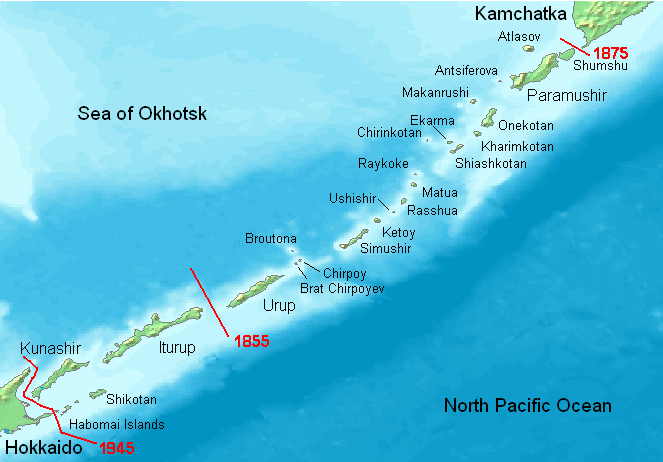
This is why the Russians hurried to seize the Kuril Islands after World War II and have refused to give them back, it is all about keeping the Sea of Okhotsk a giant Russian lake:
The Kuril Islands
A Russian government source said the document obtained by Kyodo News was drawn up sometime after this summer. It remains unknown whether the plan was approved by Putin. Russian media recently reported on the envisioned military buildup in the area. By setting up a defense line around the islands in the Sea of Okhotsk, Russia is aiming to keep foreign vessels out of the waters where its nuclear submarines are deployed, while also securing the free navigation of the Russian Pacific Fleet, which is headquartered in Vladivostok. According to the document, new shore-to-ship missiles systems called the Bastion, with a range of more than 300 kilometers (over 180 miles), and the Bal, with a range of over 130 km (over 80 miles), will be deployed on six islands and on the Kamchatka Peninsula. Missile systems were deployed in 2016 on Etorofu and Kunashiri, two of the four islands and islets off Hokkaido that are claimed by Japan.
This could get ugly very quickly if the South Korean government decides to forcibly seize assets from Japanese companies to pay for these court rulings:
South Korean victims of forced labor during Japan’s colonial rule have begun taking steps to seize the assets held in South Korea by a Japanese firm implicated in the Japan’s wartime crime.
The lawyers for Lee Chun-sik and three other South Koreans forced to work for Nippon Steel and Sumitomo Metal Corporation recently asked a local court in Pohang, North Gyeongsang Province to issue a writ of execution to have the company’s assets in the country seized.
The company reportedly holds eleven billion won worth stocks of PNR, a joint venture with POSCO.
In late October, South Korea’s Supreme Court had ordered the Japanese firm to compensate the four victims 100 million won each.
Following the top court’s decision, the victims’ lawyers requested that the company answer how it will compensate, but has yet to give a reply.
The major issue here is that the Japanese government says that all compensation claims were paid for with the 1965 pact that saw $500 million from Japan given to South Korea. The ROK government at the time could have compensated everyone back then with that money, however it was instead used for the overall development of the country such as improving infrastructure.
The money ultimately helped with the country’s economic development at the expense of direct compensation to those effected by Japan’s colonial rule. This is why Japan is so strongly against the court rulings they feel they have already paid compensation for.
With that all said when is the ROK government going to launch lawsuits on behalf of victims of North Korea’s kidnappings and provocations in far more recent times than Japan’s colonial rule that began over a century ago?
Just another example of the hypocrisy from North Korea. The only reason the Japanese are going all in on missile defense is because the threat from the Kim regime. Just last year the North Koreans fired a missile over Japan:
North Korea’s state media on Saturday criticized Japan for conducting a test of a new missile interceptor system, which is being co-funded by the United States and Japan, arguing that the move could chill the “peace atmosphere” on the Korean Peninsula. The U.S. and Japan have jointly developed the SM-3 Block IIA interceptor, and they successfully conducted a test of the new interceptor in Hawaii earlier this month. In an English-language commentary, the North’s Korean Central News Agency said, “Japan’s incitement of the bellicose atmosphere is a serious act of harassing peace to chill the peace atmosphere on the Korean peninsula and the region and strain the situation.” “It is the revelation of the crafty trick of the Japanese reactionaries to further ratchet up the tension on the Korean peninsula and meet their own interests,” the commentary said.
The Japanese are now claiming that its patrol plane was targeted by the South Korean Navy ship multiple times which means this was likely no accident if true:
A diplomatic row between South Korea and Japan escalated for a third day since a South Korean destroyer allegedly locked its radar on a Japanese surveillance plane Thursday during an operation to rescue a distressed North Korean vessel.
A Japanese Defense Ministry official on Sunday said that the South Korean warship targeted a Japanese patrol plane “multiple times for several minutes using its attack-purpose radar.” He reiterated demands by Japan’s Minister of Defense Takeshi Iwaya a day earlier that Seoul apologize for what he called an “extremely dangerous act.”
Iwaya said that the South Korean Gwanggaeto the Great-class destroyer aimed its fire control radar at a Japanese P-1 patrol plane that was conducting surveillance operations over its waters near central Honshu on Thursday.
The Moon administration is saying this all lies and that the Japanese government is using this distract domestic attention:
South Korea voiced “strong regrets” Monday over Japan’s repeated claim that its Navy ship directed fire-control radar at Tokyo’s patrol aircraft last week, a Seoul official said. Korea’s foreign ministry expressed its view during director-general talks with Japan in Seoul. “We have voiced strong regrets that Japan has unilaterally made its own claims to the media,” the official said on condition of anonymity. “The two sides sufficiently explained their positions, but there appear to be gaps in their views. But we have agreed to continue communication going forward, if need be,” he added. On Friday, Tokyo publicly accused a South Korean warship of having targeted its Maritime Self-Defense Force’s P-1 patrol aircraft on Thursday. Seoul rejected the claim, saying Tokyo misinterpreted its naval operation to help a North Korean ship drifting near a sea border in the East Sea. Despite Seoul’s denial, Tokyo has repeatedly raised the issue, sparking speculation that the Japanese government appears to be trying to divert attention from its waning public support.
Reading this Korean government statement has me wondering if the ROK Navy ship locked its weapons control radar on the Japanese aircraft to divert it from collecting intelligence on whatever they were doing with the North Korean ship.
I also find it ironic that the ROK government is claiming that the Japanese government is using the incident to divert domestic political attention when the ROK government regularly uses the Dokdo or comfort women issues to do the same thing.
Korean Gwanggaeto the Great destroyer [NEWS1]
Here is another statement from the ROK government that does not make sense:
South Korea’s Defense Ministry on Saturday dismissed the claims that its destroyer aimed its radar at the Japanese plane, and said that the ship had been carrying out routine operations at the time. A source within the South Korean Navy later clarified that the radar had been used to search for a North Korean vessel that had been marooned for several days off the peninsula’s east coast on Thursday.
The South Korean Navy that day rescued three North Korean sailors off the distressed fishing boat and recovered one body. They were then handed over to the North across the demilitarized zone on Friday.
Though it acknowledged the South Korean navy had indeed been carrying out a search and rescue operation that day, Japan’s Defense Ministry refused to accept Seoul’s explanations over the use of the radar, saying it was not an appropriate instrument for a maritime search maneuver.
As the Japanese Defense Ministry stated, a maritime search radar is different from the weapons control radar. The only explanation that makes sense is that the ROK Navy ship locked on the aircraft to divert it away from their operation with the North Korean vessel. The obvious next question is what was so sensitive about a supposed search and rescue mission that a ROK Navy ship did something as provocative as locking a weapons control radar on a Japanese patrol plane to divert it?
Or could this all just be simple incompetence by the ROK Navy?
Here is another example of South Korea needlessly raising tensions with Japan:
P-1 patrol planes used by Japan’s Maritime Self-Defense Force. Japan said a South Korean warship locked a targeting radar on such a plane Thursday. (Photo courtesy of JMSDF)
Japan’s defense minister protested to South Korea Friday after one of Seoul’s warships allegedly trained a weapon-guiding radar on a Japanese patrol plane over the Sea of Japan. The incident, which took place the day before, resulted from “extremely dangerous behavior that could create unexpected consequences,” Takeshi Iwaya said. He said that Tokyo would “strongly urge” Seoul to prevent it from happening again. The Japanese government lodged a protest with South Korea through diplomatic channels.
This is the first time the Japanese government has publicly leveled such accusations at South Korea. The incident could exacerbate already-strained relations between the neighbors, after a string of South Korean court rulings ordering compensation for citizens who were forced to work for Japanese companies during World War II. At about 3 p.m. Thursday, a South Korean Gwanggaeto the Great-class destroyer locked its fire control radar on a P-1 patrol craft belonging to the Maritime Self-Defense Force, according to the Japanese Defense Ministry. The plane, based out of the Atsugi Air Base in Kanagawa Prefecture, was patrolling inside Japan’s exclusive economic zone off the Noto Peninsula and was “at a distance” from a disputed set of islets called Takeshima by Japan and Dokdo by South Korea, the ministry said.
You can read more at the link, but I doubt this was a mistake considering that South Korea has been busy executing a Dokdo defense drill this month against the imaginary Japanese invasion of Dokdo while ignoring the very real threat of a North Korean invasion.