

Picture of the Day: South Korea’s “Naked Marathon”
| February 18, 2026
The way I look at it, is that I have no issues with a Chinese automaker selling their cars in the U.S. if they use American labor, follow American labor and environmental laws, and are not subsidized by the Chinese government:
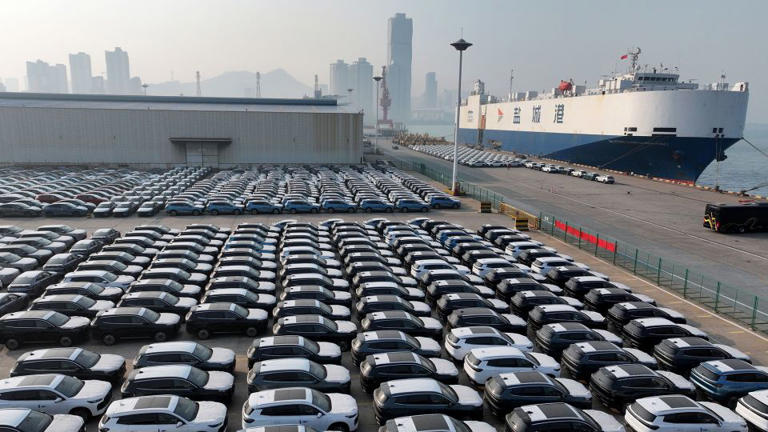
Aerial view of new vehicles waiting for shipment to overseas markets in a port in Lianyungang in eastern China. – FeatureChina/AP
Chinese cars could be at an American dealership sooner than you think, and that’s good news for US consumers.
Chinese car companies make more vehicles than anyone else on Earth and export more as well. But high tariffs and hostile US-China trade relations have kept them out of the American market.
That’s likely to change, according to experts, with Chinese autos hitting US showrooms in the next five to 10 years.
“The ambition is there,” said Lei Xing, an independent auto analyst and former chief editor of China Automotive Review magazine, even if companies have to build factories here rather than ship cars here from China.
He said multiple Chinese automakers have shown “readiness to come to the US, to build in the US.”
That would be helpful for American car buyers. Greater competition means more choices, especially for EVs, which in turn should lower prices. But it would also squeeze the profits and market share of the car companies already selling in the US, likely affecting the nearly 1 million people who work for them.
Chinese cars shipped to America come with a 100% tariff, by far the highest tariff rate for any import. But President Donald Trump, a critic of most Chinese products, recently seemed welcoming of Chinese brands if they build plants in the US.
You can read more at the link.
I have to give President Lee credit, he has been governing smartly since taking office and his approval rating continues to show this:
President Lee Jae Myung’s approval rating rose to 56.5 percent last week, a survey showed Monday, driven by the government’s efforts to stabilize the property market.
The rating was up 0.7 percentage point from the previous week, while the negative assessment fell 0.2 percentage point to 38.9 percent, according to the survey by Realmeter, commissioned by a local business news outlet.
Realmeter attributed the increase to Lee’s ongoing push to curb home prices by ending an exemption from the heavy capital gains tax for owners of multiple homes and the stock market’s rise.
You can read more at the link.

I can understand taxing someone someone owning multiple homes if they are not renting out the properties and letting it sit vacant waiting for the price to rise. If the property is rented out then the owner is not contributing to the housing issue:

President Lee Jae Myung said Monday that “unfair privileges” granted to owners of multiple homes should be scrapped and that greater burdens should be imposed on them, reaffirming his commitment to rein in the overheated real estate market.
Lee signaled a tougher stance on such homeowners in his latest social media message on housing, saying the negative effects of holding multiple homes outweigh the positives.
“The government should reclaim unfair privileges in taxation, finance and regulation granted to owners of multiple homes and make them bear a certain level of responsibility and burden in relation to social problems, as this is consistent with fairness and common sense,” Lee wrote on social media platform X.
You can read more at the link.
I guess with so many conservatives being tried and put into jail there are not many left to operate a Youtube channel compared to the ruling liberal party:

In the 300-seat National Assembly, lawmakers are increasingly using the US-based video platform to bypass traditional media and speak directly to voters, with some pulling in half a million subscribers.
Estimates compiled by The Korea Herald from publicly available YouTube data show that, as of Feb. 1, 25 South Korean lawmakers had more than 100,000 subscribers, qualifying them for silver play buttons. Of these, 19 were from liberal or left-leaning parties and six were conservatives.
Rep. Jung Chung-rae, a four-term lawmaker and chair of the Democratic Party, topped the list with 687,000 subscribers, followed by Reps. Kim Byung-joo and Park Sun-won with more than 500,000 each. Other Democratic Party lawmakers with large followings included Reps. Park Ju-min and Choo Mi-ae, both exceeding 300,000 subscribers, while Rep. Yong Hye-in of the minor Basic Income Party ranked fifth overall with 375,000.
Among conservatives, first-term lawmaker Rep. Joo Jin-woo led the People Power Party with 362,000 subscribers, followed by Reps. Yu Yong-weon, Ahn Cheol-soo, Cho Jung-hun and Na Kyung-won. Rep. Lee Jun-seok, chair of the minor conservative Reform Party, also surpassed 200,000 subscribers.
You can read more at the link.
Back in the day when I was growing up we called two friends living together roommates, not molecular families:

Last year, South Korea surpassed 8 million single-person households for the first time.
According to data released in December by the Ministry of Data and Statistics, 8.045 million households were made up of just one person, up from 7.166 million in 2021, bringing the share of solo households to 36.1 percent, the highest level on record. The proportion has climbed steadily, crossing 30 percent in 2019 and 35 percent in 2023, with Seoul posting the largest concentration of people living alone.
As the country’s single-person households reach record levels, “Two Women Living Together” arrives as both an intimate memoir and a subtle social argument about how people might live and care for one another outside the institution of marriage.
Co-written by Kim Ha-na and Hwang Sun-woo, two friends who decided in their 40s to buy a home together rather than marry, the book chronicles their decision to grow old together under one roof.
You can read more at the link, but this article truly demonstrates why South Korea has one of the world’s lowest birthrates.

The Gyeongbu Expressway in southern Seoul is packed with vehicles on Feb. 13, 2025, a day before the Lunar New Year holiday period. (Yonhap)