Besides the usual bombastic statements about turning Seoul into a “Sea of Flames” in response to the upcoming Foal Eagle/Key Resolve exercise, here is what I continue to find satisfaction in the fact that this continues to really anger the Kim regime:
Earlier Sunday, the North’s military warned that it would destroy South Korean border towns if Seoul continues to allow activists to launch propaganda leaflets toward the communist country.
In a separate statement carried by KCNA, it accused South Korean activists and lawmakers of flying balloons carrying hundreds of thousands of leaflets and DVDs critical of North Korea’s government on the North’s most important national holiday, an apparent reference to leader Kim Jong Il’s 69th birthday, which was Feb. 16. [Associated Press]
The continual angry responses from the North Korean regime against the balloon launches continues to be a sign that this continues to be an effective way to counter the regime propaganda apparatus within North Korea. I would hope though that the South Korean military is taking these threats seriously because I would not be surprised if the North Koreans try something in the coming weeks in response to the balloon launches like they are threatening.
The Korean Demilitarized Zone (DMZ) was established with the signing of the armistice agreement that ended the Korean War on July 27, 1953. It was agreed upon that the DMZ would separated the two Koreas by creating a buffer zone four kilometers wide across the width of the 151 mile wide Korean peninsula. This buffer zone would be created in roughly the same positions that the warring parties had ended the conflict at. The Military Demarcation Line (MDL) would be the official border between the two countries while the two kilometers of the buffer zone to the north of the MDL would be monitored by North Korea while the two kilometers of the buffer zone of the south of the MDL would be monitored by South Korea. It was further agreed upon that no opposing force would enter the territory, air space, or contiguous waters under the control of the other country.
The United States military used to monitor the area of the DMZ north of the Imjim River with the 2nd Infantry Division as well as along the Chorwon corridor with the 7th Infantry Division. The 7th Infantry Division with redeployed in Korea in the 1970’s leaving the 2nd Infantry Division to continue their monitoring of the DMZ north of the Imjim River. The 2nd Infantry Division ultimately gave up the sole responsibility of monitoring the DMZ north of the Imjim River in the 1980’s and has now handed over all responsibilities for monitoring the demilitarized zone to the Korean Army. Besides the monitoring of the DMZ by the ROK Army a small contingent of civil police authorized by the armistice man 114 guard posts that monitor activity on the DMZ. The DMZ Civil Police also man two guard posts that overlook the Neutral Nations Supervisory Commission (NNSC) housed at the Swiss/Swedish Camp, the Joint Security Area (JSA), and Tae Song Dong.
Military Armistice Commission
The Military Armistice Commission (MAC) was formed to be a body that would have the responsibility to negotiate any violations of the Armistice Agreement. This job was increasingly important over the years as the North Koreans have repeatedly violated the Armistice. From 1953 to 1994 the MAC was composed of a UNC component and a North Korean/Chinese component. Each component is comprised of five senior officers. Three of the officers must be the rank of general or a flag officer of some kind. The two remaining officers must be at least a colonel. During an official MAC meeting only the senior officer on each side can speak. The meetings are held inside one of the blue UN buildings situated on the MDL at the Joint Security Area at Panmunjom.
Anything spoken during these MAC meetings must be read in three languages, English, Korean and Chinese. The meetings also follow very strict guidelines, which further makes the meetings proceed at an extremely slow pace. The last official MAC meeting was held in 1991. Since then the North Koreans have refused to participate in an official MAC meeting because a South Korean general was appointed as the senior member of the UNC component. In 1994 in violation of the Armistice the North Koreans withdrew from the MAC altogether.
The United Nations Command Military Advisory Committee (UNCMAC) Secretariat is responsible for ensuring that United Nations Command (UNC) units comply with the 1953 armistice. The UNCMAC is responsible for investigating and reporting on any violation of the armistice on either side of the DMZ. Military personnel from either side of the border are not authorized to cross the MDL. Only the NNSC and a small number UNCMAC personnel are authorized to cross the MDL on certain occasions. The UNCMAC is also responsible for providing translators as well as scheduling official MAC meetings.
However, with the withdrawal of the North Koreans from the MAC in 1994 the UNCMAC has shifted from its primary administrative role to being the main channel of communication between the two sides. The UNCMAC Secretariat meetings held between the two sides which is supposed to be for administrative reasons has now turn into quasi MAC meetings with the secretariats now discussing things such as Armistice violations, the transfer of detained personnel, as well as the return of remains of deceased personnel on each side.
Neutral Nations Supervisory Commission
The Neutral Nations Supervisory Commission (NNSC) was established by the Armistice Agreement as an independent, fact-finding body outside of the MAC, but responsible for reporting to the MAC. The NNSC is composed of four senior officers from four nations that did not participate in the Korean War. Each side chooses two of the officers that will compose the NNSC. Historically officers from Switzerland and Sweden composed the UNC side while officers from Poland and Czechoslovakia formed the North Korean side.
The NNSC was originally formed to investigate Armistice violations outside of the DMZ. This was intended to ensure both sides maintain a military status quo which existed when the ceasefire was signed. However, North Korea regularly prohibited NNSC teams from investigating in North Korea. Due to pressure from North Korea Czechoslovakia withdrew from the NNSC in 1993 and Poland withdrew in 1995. The Swiss and Swedish team remains and they continue to meet weekly to discuss reports from the UNC side in regards to Armistice issues. Despite this, the NNSC’s role on the DMZ is largely ceremonial.
Joint Security Area (JSA)
With the creation of the various bodies to manage the Armistice Agreement an area was needed to conduct the every day business of these bodies. Thus it was agreed upon that a Joint Security Area (JSA) at the village of Panmunjom where the Armistice negotiations took place, would be created.
The JSA is roughly 800 meters wide and is roughly circular in shape and bisected by the Military Demarcation Line. The MAC buildings where negotiations and meetings are held in are painted blue and divided down the middle by the MDL.
The JSA also has a building on each side of the MDL that serves as the Joint Duty Office. Since the senior officers that compose each component of the MAC are based in Seoul for the UNC and in Kaesong for the North Koreans they leave liason officers at all times at the JSA that work out of the Joint Duty Offices. These JDOs pass messages from the MAC to the secretaries on the other side of the JSA. Military policemen only are used to guard the JSA. Each side may only have 35 military policemen on duty in the JSA at one time. These policemen are also allowed to maintain an administrative area in the JSA. The NNSC is also allowed to keep an administrative area at the JSA to conduct meetings in as well.
Camp Bonifas
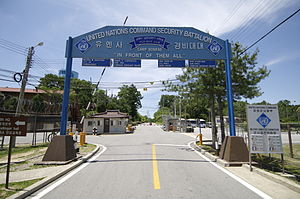
The most forward deployed base in all of United States Forces Korea is Camp Bonifas:
The camp was established after the Korean War to support operations at the Joint Security Area. Camp Bonifas is located approximately 400 meters south of the JSA and was originally called Camp Kitty Hawk. The name of the camp was changed after two American officers, Captain Arthur G. Bonifas and First Lieutenant Mark T. Barrett were murdered by North Korean soldiers in the infamous “Axe Murder Incident”. After the attack the camp was renamed in honor of CPT Bonifas.
The camp is home to the soldiers of the United Nations Command Security Force. The Korean and American soldiers that compose this battalion-sized element are responsible for the 24-hour security of the United Nations Command personnel and their guests that are working at or visiting the JSA.
The unit is also responsible for controlling the entry and exit of all vehicle and personnel into the area along with providing security for the Korean civilians that live within the Tae Song Dong farming village (Freedom Village) that lies within the DMZ. Finally the soldiers are also responsible for conducting tours of the JSA for both civilians and military personnel. The tours are available in English, Japanese, Chinese, and Korean. Roughly 100,000 people conduct a tour of the JSA annually. If you live in Korea and have not done one of these tours I highly recommend you do so. Probably the most unusual aspect of Camp Bonifas is that it is home to what is called the “world’s most dangerous golf course” by Sports Illustrated since the one hole course has minefields around it.
Today US and Korean soldiers continue to serve “In Front of Them All” as the battalion’s motto goes. Even though tensions continue between the two countries, major incidents on the DMZ have greatly diminished in recent years.
The base with the main combat power to support DMZ operations is Camp Greaves located just to the south of Camp Bonifas on the north side of the Imjim River:
The camp is named after Corporal Clinton Greaves of Company C, 9th U.S. Cavalry, who fought off a band of Apaches in 1879 to save fellow cavalrymen. Camp Greaves was founded by the 1st Marine Division during the Korean War in 1953. After the war the Marines used the camp as a patrol base to monitor the DMZ from. After Marines left they were replaced by various units over the years to include the 1st Amphibious Tractor Battalion; the 3rd Battalion, 19th Infantry Regiment, 24th Infantry Division; the 1st Squadron, 9th Cavalry, 1st Cavalry Division; and various 2nd Infantry Division battalions. The last 2ID unit stationed on Camp Greaves was the 1-506 Infantry Regiment. The 1-506th had been stationed on Camp Greaves since 1987 and their unit motto was “Stands Alone”, which I always found funny considering the thousands of ROK soldiers stationed nearby. With that said when the 1-506th was stationed in Korea I always found them to be a very high speed and motivated unit whenever I worked with them. Camp Greaves was closed in 2004 as part of the USFK transformation plan. After its closure half the camp was handed over to the ROK Army’s 1st Infantry Division and the other half is slated to become a $40 million DMZ theme park that is scheduled to open in 2018.
After its closure Camp Greaves like other Western Corridor camps has been the subject of protests though the protests around Camp Greaves is different from the left wing environmentalists that have been protesting other camps. The Camp Greaves protesters are from the Paju area who want the land the camp sits on to be given to the local government for development and not given to the ROK Army.
Warrior Base
Warrior Base is located near the Unification Bridge on the northern side of the DMZ. The base is used to house range control for the various firing ranges located around the DMZ area in the Western Corridor as well providing tent and barracks housing for units training in the area.
Here is a picture of Warrior Base which I have fond memories of spending nights in the tents there while training on the DMZ:
The DMZ includes two villages authorized by a subsequent agreement to the Armistice that ended the war. One village is Tae Song Dong (Freedom Village) on the South Korean side and the second village is Kichong-dong (Propaganda Village) on the North Korean side of the DMZ. Tae Song Dong is located about half a kilometer southwest of the JSA while Kichong is located about a half kilometer northwest of the JSA. Here is a Google Earth image of Tae Song Dong:
Residency in Tae Song Dong is strictly controlled. Only original inhabitants of the village or their direct descendants may live in the village. Kichong-dong on the other hand appears to be a normal village by day with North Koreans working in the fields but at night the workers are bussed to where they live in the nearby city of Kaesong. Only a small custodial staff actually lives in the village. Kichong-dong is referred to by UNC soldiers as “Propaganda Village” due to the loud broadcasts of propaganda blasted from speakers in the village over the years. Here is a Google Earth image of the Propaganda Village:
Here is a a picture of the “Propaganda Village” as seen from the South Korean side of the DMZ:
Located in the Joint Security Area is the Bridge of No Return. This bridge received this name because in 1953 prisoners of war from the allied nations, the Koreas, and China were given the one time option of returning to their home countries. When one walked across the bridge they could not return thus giving the bridge its name The Bridge of No Return.
Image of the Bridge of No Return via the DMZ webpage.
Besides being the setting for the swapping of POWs the bridge was also the scene of the Axe Murder Incident on August 18, 1976 that saw two American officers brutally killed by North Korean soldiers while trying to trim a tree. The murder of these two officers nearly led to war on the peninsula as the US brought in extra ground, air, and naval power to the peninsula to cut down the tree.
Freedom Bridge
Before the Korean War two side by side railway bridges extended across the Imjim River that were used for rail traffic between the then South Korean city of Kaesong and the capitol city of Seoul. However during the surprise North Korean attack against the Republic of Korea launched on June 25, 1950 the South Korean military failed to destroy the bridges. The explosives on the bridges had failed to explode and the North Korean military quickly captured the bridges, which greatly aided the speed of their assault south on Seoul. One of the bridges was destroyed in 1951 as the allies marched north against both the North Koreans and the Chinese forces that had entered the war. The allies were able to successfully capture the last remaining bridge across the Imjim in late 1951.
Freedom Bridge which crossed the Imjim River during the Korean War via Defense Media.
This bridge took on increased importance as peace talks began at the village of Panmunjom just north of the Imjim River. The bridge was refurbished to handle the increased amount of traffic that flowed back and forth from Panmujom every day. On February 16, 1952 the refurbishing was complete and the bridge officially became known as Freedom Bridge. The bridge lived up to its moniker when allied POWs were returned to South Korea after the signing of the Armistice Agreement and they crossed this bridge by ambulance on their return to a reception station set up at Munsan. This route from Panmunjom across the bridge became known as Liberty Lane afterwards.
Freedom Bridge today.
On June 15, 1998 a four-lane bridge dubbed the Tongil (Unification) Bridge was opened across the Imjim River in response to increased traffic to the north side of the Imjim River. The opening of the Tongil Bridge has caused Freedom Bridge to be largely unused today, but it still stands as a testament to the days of the Korean War.
Tongil Bridge
Illegal North Korean Tunnels
In the 1970’s North Korean dictator Kim Il-sung ordered his divisions along the Demilitarized Zone to each dig and maintain two tunnels that infiltrated into South Korea. Evidence of this plan became evident until 1974. On the morning of November 15, 1974, a ROK Army patrol in the west-central sector of the DMZ noted steam rising from the ground. They thought they had found evidence of a hot spring and began digging to see if they had indeed found one.
Instead of a hot spring they found a tunnel that was a mere 18 inches below the surface. While excavating the site the South Korean patrol began to take fire from a North Korean guard post. The patrol began to return fire back at the North Koreans to cover their retreat away from the area. Fortunately no one was injured in the exchange of fire. The South Koreans returned with a larger force to further excavate the site and discovered that the tunnel ran from North Korea and extended one kilometer into South Korea before it was discovered by the patrol. The tunnel was reinforced with concrete slabs, had electric power, weapons storage, sleeping areas, and even a narrow gauge rail line with carts. It was believed that the tunnel was big enough to hold one regiment of soldiers at a time which would have allowed the North Koreans to infiltrate an entire division into South Korea in a matter of hours.
On November 20th as a United Nations MAC team investigated the site, an investigation that the North Korean UNCMAC members refused to participate in, a North Korean explosive booby trap went off killing two MAC investigators, US Navy Commander Robert M. Ballinger and ROK Marine Corps Major Kim Hah Chul. Five more US soldiers and one ROK Army soldier were injured in the blast. Commander Ballinger was the first US casualty on the DMZ since 1969. Just a few months later on March 19, 1975 another tunnel was discovered approximately eight miles northeast of Chorwon. Excavation of the tunnel found that the tunnel was two meters high, less then two meters wide, and about 2,300 meters in length with 1000 meters of the tunnel extending into South Korea. The North Koreans denied digging the tunnel and claimed the South Koreans dug it themselves.
On October 17, 1978 another tunnel was discovered under the DMZ. The prior two tunnels had been in relatively isolated locations however this tunnel was different because it was dug only four kilometers from Panmunjom along the main invasion route into South Korea. Similar to the prior tunnels this tunnel was created with a two by two interior and could have been used to infiltrate thousands of soldiers into South Korea. Of course the North Koreans denied any knowledge of constructing the tunnel. The fourth North Korean tunnel was discovered on March 3, 1990 northeast of the small city of Yanggu in the remote Punchbowl area of Gangwon province. Surprisingly a week later the North Koreans actually admitted to constructing the tunnel in order to “facilitate peaceful reunification”.
Picture of entrance to the 4th entrance tunnel via Wikipedia.
Conclusion
I hope everyone enjoyed this profile of the Western section of the Korean Demilitarized Zone. If you haven’t visited Panmunjom while in South Korea I highly recommend you do so. It is a fascinating place to see that many US military servicemembers and their ROK counterparts over the years have kept safe for visitors. Likewise these same servicemembers have helped keep the ROK safe from North Korean provocations and invasions with their service on freedom’s frontier on the Western Korean Demilitarized Zone.
Note:You can read more from the ROK Drop featured series “A Profile of USFK Bases” at the below link:
Besides several typos (minor issue), I noticed that the description of Camp Bonifas states that the camp is “located approximately 400 meters south of the JSA”. The camp is actually approximately 100 meters from the southern boundary of the DMZ, which since the JSA is in the middle of the 4km wide DMZ, would mean the camp is approximately 2000m from the JSA.
A small correction, but one I’ve been making comments on ever since the Axe Murder Incident, when the official US Army report stated that the (QRF) “Rescue SQuad” (actually a platoon), was over a mile away from the DMZ at the time of the incident, when the Camp wasn’t even a mile away from the DMZ, and at the time of the incident, the QRF Platoon was at the QRF site about 300m away, and then sat at CP#2 (the entrance to the JSA) while the 3rd Plt. leader waited for orders from Capt. Bonifas (who was already dead) to enter the JSA. Finally LTC Vierra arrived at CP#2 from Camp Kitty Hawk and ordered the 3rd Plt. into the JSA, so at no time was anybody ever “over a mile away from the DMZ”.
Thanks for this very thorough overview, I really enjoyed reading it.
I am a 1.5 gen and while growing up in Korea, I distinctly remember that axe incident and the odd feeling of uneasiness that fell on our household. I was too young to fully comprehend what exactly occurred but just remember the elders being really cautious…much more than usual.
I was at Osan AB for two years. Arrived after the murder of the two officers but there was still a lot of uneasiness, the Air Base was still on alert. I was also there during the discovery of the third tunnel. This was a big dill in Korea at the time, but made very little news in the US.
[…] versa. I’ll spare you the history lesson about Korea’s DeMilitarized Zone – but ROK Drop’s post is detailed, accurate, and full of win. Suffice it to say that the sites you’ll see are […]
I had heard many of these terms, places, incidence mentioned when I was there in ’83 at Camp Pelham (later named Gary Owen) but I can appreciate much of this information in a clearer context after reading your post. You have a way of making information entertaining to read while not diminishing the seriousness of some of these events.
Very good perspective of the Korean DMZ. Some facts presented are disputable, but otherwise great source of information and good pictures. Congratulations to the one who put this together and best wishes for you in the future.
With the passing of the NK president Kim Jong-Il this week, it will be most interesting to see how things develop under the rule of Kim-Un, the expected new leader of the North.
Bill is correct in his remarks, above–and he should know, since he was there at the time.
Another small correction: the Google Earth “pin” for Camp Bonifas is actually on the edge of the helipad between it and Camp Liberty Bell. Camp Bonifas (formerly Advance Camp) is south of the road–unless all the new buildings just to the west of the pin have been incorporated into the compound since 1976. Thanks for posting.
HALF of Camp Bonifas is created from the old Camp Kitty Hawk, the other half is from Camp Liberty Bell, which of course sat diagonally across the road from Kitty Hawk and was the Advance Camp for the Forward Most Deployed Infantry Company (Co A) in the forward most deployed Inafantry Battalion in the US Army (1st Bn 9th Inf Manchu) in my day 79-81. LOL We were the Po’ COuntry Cousins that everyone forgets about right across the road. We wasnt fancy, we were just the ones that kept everyone else on the Z from getting thier asses flattenned by the entire KPA before help could arrive from the REMF’s.
I wish I had spent more time touring these historic monuments during my time in the ROK. The two incidents that stick out in my mind were the 9/11 lockdown and the two school girls who were accidentally run over.
I was stationed at Camp Casey 1978-1979 and we were constantly on alert, they were finding tunnels then.I always felt the ground shaking. I have alot of bad memories from the 13 months I spent there.It’s a SHAME…..
I was stationed at PanMumJom as a military policeman from 1964 to 1965. I loved my duty there even though at times it was scary. I can’t remember a night that we didn’t hear gun fire or those damn speakers. We got a lot of respect from Korean’s wherever we went. They respected that United Nations patch and the men who wore it.
I was stationed at Panmunjom during the USS Pueblo incident march 1968.My MOS is 11B10 and by April I remember getting paid a combat pay.The damn speakers are still there.I was awarded with a bayonet badge, for crossing the demarcation line.
Is there anyone there who was stationed in the same place and time range? please I want to hear from you.
[…] spare you the history lesson about Korea’s DMZ – but ROK Drop’s post is detailed, accurate, and full of win. Suffice it to say that the sites you’ll see are […]
Thanks for posting this–It brought back memories of my day at the DMZ while participating in Team Spirit in the late 1980s as a MSgt. with the Army Reserve’s 302nd Public Affairs Unit from Los Alamitos, L.A. Co., CA.
There was an incident in 1977 2chinooks on a training excersise collided in the Z several we’re killed and one survived. NK returned them to us a couple of weeks later.
Would have liked to see a little love for Fire Base 4P3. Everyone stationed from JSA to Freedom Bridge knew that we had their back. Was stationed at Camp Pelham from 90-91 during the first Gulf War and did 3-4 rotations up there. Remember celebrating Cristmas and New Years (no booze of course)shadowing the grunt patrols with our 155mm towed howitzers. GUNS OF THE DMZ!!!
[…] spare you the history lesson about Korea’s DMZ – but ROK Drop’s post is detailed, accurate, and full of win. Suffice it to say that the sites you’ll see are […]
ALL OVER DMZ 70 71 LOTS OF PATROLS OUT OF GP MARTIN.NOT TOO MUCH HEARD ABOUT PEOPLE WHO WERE ON GUARD POSTS.REMEMBER SEEING MDL SIGN AND BACKING UP REAL SLOW.IMJIN SCOUT FROM ACTA E5.ANYONE WITH PICS PLEASE SEND mkikasdmz@att.net
I was stationed at Camp Stanley and the “First to Fire” 1st 15th FA from Oct 1979 – Jun 1980. I was a Forward observer and went to the DMZ three times and was involved in an international incedent on the DMZ when two 105′s were laid 1400 mils out of safe and we shot four rounds into North korea. What an experience it was!! 24 hours later I was in the air going home. Travis AB never looked better!! I was awarded the ARMY Accomidation medal for my actions as a PFC Gen Kingston looked surprised when he was pinning the medal on my chest and said “Damn Soldier, You are the yougest I have ever given this medal to” I am a proud Disabled Veteran and I want to thank you for your service……thnx me
I am researching the DMZ and trying to get clarity on the current status of the UNC-JSA force. Are there US Soldiers currently assigned to this unit conducting patrols along the DMZ?
Will try again had loss first attempt, had arrived at Casey 22 Jun 77 did the turtle farm thing then went I got to Hovey the 1/9th was getting ready to go to the DMZ so I was restricted to post and didn’t see Toko-ri until over a month later. Don’t know to today what part of the DMZ that we went to, one of the first patrols that I was getting ready to go on a 5.56 round whizzed by my head while still inside the compound, a Pfc who wasn’t supposed to even have the magazine in the well had sighted in on me with his starlight scope and squeezed off the round missing my head by inches, could hear the buzz sound as it went by.The PLT SGT come running and chewed his ass, saying son I will stick my foot so far up your ass I will have shit stained knee caps, I know that the SOP was that everybody inserted the magazine as you walked out the compound gate and only the point man and Squad leader actually chambered a round keeping the safety on, this is a true story and I know that it doesn’t even compare to combat but if that round would of been slightly to the right most likely it would of been said that dumb hillbilly from Kentucky done went and got himself killed the first month in country. Goes to show what that can happen.
A man is a man etc, not going to make this a hometown topic. When something happens that sticks in your mind like yesterday that was 35 plus years ago you tell it like it was and what was said. Don’t really care about your hip text u this u that. Never sucked and never will friend.
Unknown to a lot of people was a small unit based out of Yongsan. It was basically an engineer unit that did nothing but search for tunnels on the DMZ. This was in 78 when I was there. I was tasked to take my bulldozer to the DMZ to help look for the tunnel later discovered. However I was short and they sent someone else. When he came back about a week later he walked up and punched me. They sent him out into a area to dig trenches where they thought a tunnel might be. He kept hearing noises in front of his blade. He started to get off the dozer to inspect to see if something was wrong. Everybody started hollering and waving at him so he backed out of the area. They told him what he was hearing were landmines exploding and not to worry about it, but to keep a blade of dirt in front of the dozer at all times to be safe. He said it was the longest week of his life.
War heroes are typically thought of as the guys that kept cool under fire and fought heroically against the enemy. Other war heroes were leaders that were able to inspire their soldiers to victory against overwhelming odds. Then yet you have other heroes that through cunning, detailed planning, and motivation were able to turn a defeat into a victory. A war hero that is less heard about are servicemembers who became heroes simply being a humanitarian. Being a humanitarian may not at first glance seem to be the proper criteria for someone to be called a war hero, but I think by the end of this narrative everyone will agree that Chaplain Russell L. Blaisdell is without a doubt a Hero of the Korean War.
Background
After the allies successful landing at Incheon and the recapture of Seoul in September 1950, thousands of Korean children in Seoul had been left parentless and homeless due to the North Korean capture of the city that led to many parents either dying in the fighting or being executed by the North Korean occupiers. These orphans lived in the rubble of the many destroyed buildings in the Korean capitol and subsisted on what little food they could beg from people passing by and particularly American soldiers.
These orphans wore rages, were filthy, and disease ridden which over time would only get worse as they lived in the rubble of Seoul with the rats that had become fat and happy from nibbling on all the dead bodies lying on Seoul’s destroyed streets. As American servicemen patrolled the streets of Seoul the bodies of dead orphans could increasingly be seen on the side of the roads as they died from cold, hunger, and disease. With the heart of winter approaching those that weren’t yet dead would soon be if help wasn’t provided for them soon.
Dead orphan pictured on the streets of Seoul during the Korean War.
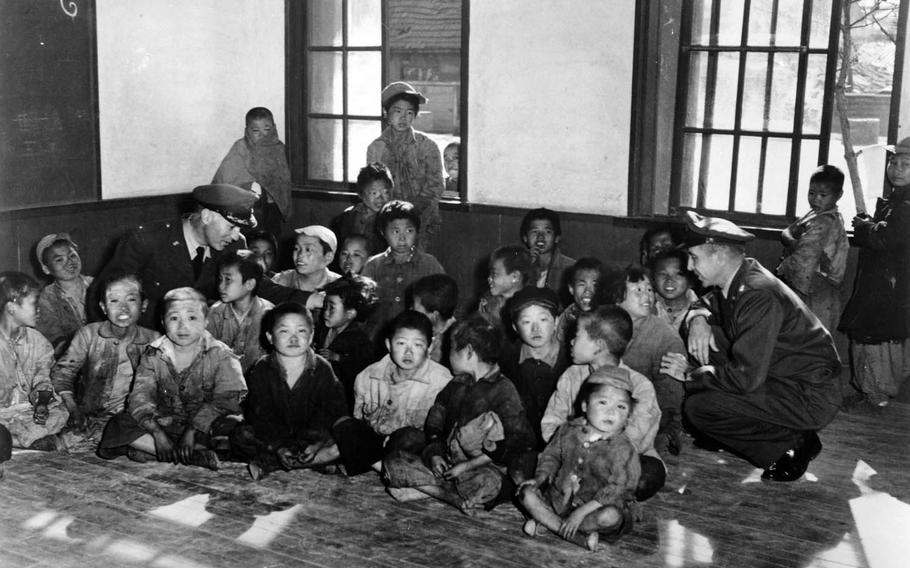
When American forces re-established air operations at the Yeoido Island airfield near downtown Seoul, the airmen stationed with the 5th US Air Force began to take in some of the cuter looking orphans onto the base to serve as unit mascots. Most of these orphans were aged around 4-7 years and received clean clothes and medical care on the base. Soon approximately 100 orphans were living on the Air Force base and proved too be many for the base to properly care for. A donation drive was held in order to raise money to create a new orphanage in Seoul to house the children in. $1,600 was raised and a prior orphanage was renovated in Seoul in order to move the children into. This orphanage could only house the 100 children and far more money and resources were needed in order to find homes for the approximately 6,000 more orphaned children roaming the streets of Seoul. Obviously much more needed to be done.
The Air Force chaplains spearheaded an effort to work with the American Red Cross, the Korean Red Cross, YMCA, Catholic Missions, Protestant Missions, and what was remaining of the local Seoul government to establish a large facility to house orphans. Seoul Mayor Lee Kyu-bong provided the Air Force with a large school to house, clean, and care for orphans in. The idea was that this would be a temporary location to process and care for the orphans as orphanages around Seoul were repaired and staffed to eventually move them to, to be housed permanently.
Chaplains from the 5th Air Force drove through the streets of Seoul daily picking up orphans to bring back to what became known as The Seoul Orphan Center. The center could process 50 orphans a day which meant it was going to take many weeks to process all the orphans remaining in Seoul’s streets. It was literally a race against the clock to find and process all the orphans before winter hit the country. One of the chaplains out there working hard to locate the orphans was Chaplain and Lieutenant Colonel Russell Blaisdell.
New arrivals at the 5th Air Force’s Seoul processing center for orphans, before evacuation to Jeju Island on Dec. 20, 1950. With them are Chaplain Col. Wallace Wolverton, left, and Chaplain Lt. Col. Russell Blaisdell. (Courtesy of U.S. Air Force)
Read more at: https://www.stripes.com/theaters/asia_pacific/operation-kiddy-car-keeping-a-korean-war-hero-s-memory-alive-1.476030 Source – Stars and Stripes
The Surprise Chinese Offensive
As Thanksgiving of 1950 approached it appeared the war was wrapping up with the United Nations forces quickly moving in and occupying most of North Korea. However, a new menace was lurking in the surrounding hillsides waiting to attack. The Chinese had secretly moved hundreds of thousands of soldiers into the North Korean hillsides in preparation for a surprise attack against the allied forces. The Chinese military launched a massive offensive on Thanksgiving and caught the allied forces totally by surprise. Casualties were heavy as US forces retreated south down the peninsula from the Chinese invaders.The Chinese forces were barreling down on Seoul and the city was on the verge of being captured by the enemy.
At this time the Seoul Orphanage Center and the Yeouido Airfield had approximately over a thousand orphans housed between the two locations. Something had to be done to get the orphans out of Seoul in order to save them from being caught up in yet another battle to retake Seoul. Chaplain Russell Blaisdell would be the man that would figure out how to get the orphans out of the city. Blaisdell was able to get a small number of orphans out on what little space was remaining on convoys leaving the city and heading south. To get the rest of the orphans evacuated from the city Blaisdell made arrangements with Lieutenant Colonel Dean Hess who was an Air Force advisor training the new Korean Air Force, to house the children at a US Air Force airfield on the Korean Island of Jeju-do island.
The first plan was to ship the children by sea to Jeju-do on a Korean boat leaving the port at Incheon to transport cement to Jeju Island. Once the children reached Jeju-do LTC Hess would pick them up and take them to the airfield to be housed. On December 15, 1950, Chaplain Blaisdell led a convoy of trucks carrying 950 orphans and 110 Korean staff members to care for the orphans, to Incheon. Chaplain Blaisdell and the children waited for four days in a small school building for the boat to arrive which for various reasons did not arrive. Blaisdell and his chaplain’s assistant who was also his driver, Staff Sergeant Merle Y. Strang with the assistance of the Korean helpers tried their best to care for the children during this time, but eight of the most sick orphans died anyway during this timeframe waiting for the boat.
Chaplain (Lt. Col.) Russell Blaisdell, left, and Staff Sgt. Merle “Mike” Strang in an undated photo. (U.S. Air Force)
On December 19, 1950 the boat finally arrived and after loading up its cargo the Colonel in charge of the port told Blaisdell that the children could not load up on the boat because there was not enough room for them. Apparently cement was more important then saving the lives of these children. With the Chinese military bearing down on Seoul, Chaplain Blaisdell knew he had to do something and quick to get the children evacuated before the Chinese arrived.
Chaos at the Port
Blaisdell drove back to Yeoido Airport to see if he could get help to get the children evacuated. Chaplain Blaisdell was hoping to get in contact with any general that could order the colonel back in Incheon to allow the children to board the boat. The generals had already left and the person Blaisdell ended up talking to was Colonel T.C. Rogers who was the Chief of Operations for the 5th Air Force. Blaisdell explained the situation to Colonel Rogers who immediately devised an alternate plan to transport the children to Jeju-do. Colonel Rogers coordinated for sixteen C-54 transport planes to fly the children the next morning to Jeju-do from the Gimpo Airfield; all Chaplain Blaisdell had to do now was get the children from Incheon to the airfield.
It was 5PM by the time the coordination with Colonel Rogers was completed so Blaisdell had to hurry back to Incheon and try to coordinate for some trucks. That night back at the port in Incheon, Blaisdell was able to reserve trucks from the port logistics command to transport the children the next morning. 24 trucks were to arrive at 05:30 to pick up the children and take them to the Gimpo Airfield to board their scheduled planes by 08:00. However, as usual the logistics personnel at the port let down the chaplain. At 05:30 no trucks appeared. By 0700 still no trucks had arrived and Chaplain Blaisdell became extremely worried that the kids would miss their flight.
Blaisdell noticed trucks dropping off ammo to be loaded on a boat at the port. Blaisdell walked up to each truck that finished unloading and ordered the driver to take his truck to the school where the orphans were housed to begin loading the children. If the driver protested the order he showed them his Lieutenant Colonel rank and repeated that it was an order. The drivers complied, but this ended up causing an uproar at the port as trucks began disappearing to the school. Another Lieutenant Colonel came out to confront Blaisdell about taking his trucks, but once the chaplain explained the situation then this Lieutenant Colonel became eager to help him. With the assistance from this Lieutenant Colonel, the chaplain was able to get the trucks he needed. However, the time was now 08:30 and not one truck had been loaded yet. Chaplain Blainsdell couldn’t help, but wonder if the transport planes would wait for him and the kids?
Operation Kiddy Car Airlift
Chaplain Blainsdell was able to get the trucks loaded and quickly as possible and over a thousand orphans and Korean civilian carers were finally on there way to the Gimpo Airfield in Seoul to fly to Jeju Island; the only question that remained was whether the transport planes had waited for them considering how late they were to arrive? If the planes had not waited for the orphans what would the Chaplain do with the Chinese army now on the outskirts of Seoul? Would he steal these trucks to move the orphans further south and leave the soldiers back at the port with no transportation to escape the Chinese hordes themselves? These were all options that Chaplain Blaisdell prayed he didn’t have to deal with.
As the trucks entered the gates into the Gimpo Airfield the chaplain’s prayers were answered as all sixteen C-54 transport planes had waited for the kids to arrive. Colonel Cecil Childre, the Commander of Combat Cargo in Korea had stayed with the planes and ensured that they did not leave. The children, carers, and supplies were all quickly loaded into the planes and were off to Jeju-do. Chaplain Blaisdell had many worries about what to do once they got to Cheju-do because everything on the Jeju-do end of what had become known as Operation Kiddy Car Airlift had been left to Lieutenant Colonel Dean Hess.
Air Force Lt. Cols. Richard Blaisdell and Dean Hess with Korean children evacuated during Operation Kiddy Car in in December 1950 in an undated photo. (U.S. Air Force)
When the planes landed on Jeju Island Chaplain Blaisdell was surprised to see the entourage that awaited them at the airfield. Major General Howard Turner, the Chief of Air Force operations in Korea, led a group of people that included the governor of Jeju and other dignitaries to welcome the children. LTC Hess had transportation for the children at the airfield as well as procuring a school to house the children in. Things were going much better on zjeju Island then what the chaplain experienced back at the port at Incheon, until he arrived at the school where the children would be staying.
The Jeju Agricultural School for Boys was adequate enough to house all the children in, but the biggest problem with the place was that it had no running water. The nearest water source was 3.5 miles away in Jeju City. Also much supplies had to bought to cloth the children, buy blankets, heat the building, and most importantly feed the over one thousand mouths staying at the school. To make matters worse was that the care givers that came with Chaplain Blaisdell were extremely inexperienced at running an orphanage. Help would soon arrive though.
Seoul Mayor Lee Kyu-bong visited the orphanage and took note of the problems getting the orphanage established. He contacted a former orphanage director in Seoul he was friends with Ms. Whang On-soon, to come to Jeju and manage the orphanage. She had operated an orphanage in Seoul for 11 years and had just recently returned from England where she had studied child welfare. She agreed to become director of the orphanage and ended up being the perfect person for the job.
With Ms. Whang managing the orphanage, increased funding, and an overwhelming American public response from the U.S. media to send clothing and blankets to the children on Jeju-do; the orphanage was slowly but surely beginning to get the resources to properly care for the children. Blaisdell left Jeju not to long after the successful Operation Kiddy Car Airlift, but would go one to revisit the orphanage four months later and was amazed by the progress of the orphanage.
Ms. Wang had completely fixed the building, had nurses providing care for the children, the orphans all had proper clothes, and had even restarted their schooling. Chaplain Blainsdell counted 872 orphans during his visit which was nearly a hundred fewer then the 965 he left the mainland with. This was because some of the orphans had been reclaimed by their parents who had lost their children during the course of the war and heard about the airlift. They subsequently contacted the government to see if their children were part of the airlift. Chaplain Blaisdell was deeply impressed and has always only taken credit for getting the kids to Jeju and gives all credit for the success of the orphanage to Ms. Wang.
THUNDERBIRD GIFT-Lt. Gen. Claude B. Ferenbaugh, deputy Eighth Army commander, presents a check for $595 to Mrs. On Soon Whang, director of the Orphans’ Home of Korea, Jeju Island. Brig. Gen. Dwight E. Beach, Eighth Army (Fwd.) chief of staff, watches the presentation. The check is the semi-annual interest on a $41,000 trust fund set up for the perpetual support of the orphanage. (USA Photo)
Operation Gift Lift
Chaplain Russell Blaisdell would make one make a final trip to the orphanage on Christmas Eve 1952. He flew in fittingly on a C-54 piloted by one of the key officers who made Operation Kiddy Car Airlift a success Colonel Cecil H. Childre. The Japanese Air Defense Force had donated a number of toys and $1,600 in cash to the growing orphanage which at this point was home to approximately 1600 children.
HEADQUARTERS FIFTH AIR FORCE, KOREA-A small Korean war orphan gets help from Lt. Col. Dean Hess of Marietta, Ohio, as he climbs down from a plane after being presented with a package full of toys from the United States. A plane load of toys, food and clothing was recently flown to the more than 800 war orphans housed on the island of Cheju-Do, 75 miles off Korea’s south coast. The orphanage formerly sponsored by the Fifth Air Force is now under control of the Republic of Korea Air Force, but bundles from well wishers in the United States continue to pour in for the orphans. Col. Hess, senior USAF advisor with the ROK Air Force, and Capt. George N. Metcalf of Sweeton, Illinois (in plane) assisted in the bundle delivery to the war tots.
Chaplain Blaisdell was even further amazed by how much the orphanage continued to improve:
For those who witnessed the orphans’ plight during the exodus from Seoul, the change they noted during the recent visit to the Home was astonishing. More amazing still were the diverse talents the now healthy youngsters demonstrated.
In the group led on a tour of the premises by Mrs. Whang were Col. Childre; Chaplain Blaisdell; Miss Harris; Chaplain (1st Lt.) Howard Singer, deputy air chaplain for JADF; M/Sgt. Grady Hawkins, NCOIC of the 1st Comm. Sq. and S/Sgt. Elmer W. Wheeler, motor sergeant for a motor vehicle sq., both of Nagoya.
IN ONE ROOM, TO the music of an organ, a group of tots did several Korean dance routines. Then five year old Sung Soon stepped forward and in a clear, sweet voice sang Silent Night in English.
Mrs. Whang led her guests to another room. Here in a large circle, several other orphans were knitting socks and sweaters. None of them was over nine, yet their workmanship was flawless.
IN STILL ANOTHER room some 21 youngsters, heavily blanketed, were abed with colds.
This was the improvised hospital the Home maintains for the orphans whose illnesses are not serious. Adjoining it is a well stocked dispensary in which a nurse and a pharmacist are always present.
A 21 piece band, comprised solely of orphans, entertained the visitors for over half an hour with march and concert music. The program was heightened by four small drum majorettes who paraded smartly about the room, swinging, tossing and catching their batons in unison with the celerity of veteran drum majors.
IN ANOTHER WING of the building other orphans were painting Christmas cards which they themselves had designed, while still others were fashioning envelopes. Learning of the Orphans’ Home in Hong Kong, the Rev. V.J.R. Mills, general secretary for the Christmas Children’s Fund of Richmond, Va., visited the Home in April, 1951. He went away favorably impressed.
Before long the Home was receiving $400 monthly from the benevolent organization. The Reverend revisited the Home last September. Before leaving he promised Mrs. Whang that the Home’s allotment would be increased in January.
The day ended with a smart drill exercise by the Home’s Boy Scout troop. Afterward, Col. Childre, accompanied by Chaplain Blaisdell and Mrs. Whang, inspected the rigid troopers.
In two years these orphans went from losing their parents, being desolate, and near death to becoming Boy Scouts. Ms. Wang had obviously done an incredible job and Chaplain Blaisdell would return to the United States knowing that the orphanage was in capable hands and that his mission was complete. However, this wouldn’t be the end of the story.
Jeju-do orphanage’s Scout troop parades for guests. More pictures from the orphanage can be viewed here.
The Controversy of Kiddy Car Airlift
After the end of the Korean War in 1953, the orphanage established on Jeju-do after the successful completion of Kiddy Car Airlift was moved back to Seoul to a permanent facility that would remain under the management of Ms. Wang On-soon. The orphanage remained a top notch facility caring for the orphaned children. However, the orphanage would come under controversy with the publication of a book by Lieutenant Colonel Dean Hess titled Battle Hymn in 1956 in which he took credit for the evacuation of the children from Seoul and everything Blaisdell did was marginalized.
The book Battle Hymn.
The distortion of what happened with Operation Kiddy Car Airlift only got worse when a movie based on the book was released the following year and starred Rock Hudson playing LTC Hess where everything that Chaplain Blaisdell did to save the orphans was portrayed as LTC Hess doing it. Amazingly Blaisdell is not even mentioned in the movie. To this day because of the book and the movie many people still think LTC Hess was the one responsible for Operation Kiddy Car Airlift when Hess only played the role of providing a place for the orphans to stay on Jeju-do.
The drama of making the airlift happen was due to Chaplain Blaisdell, Staff Sergeant Strang as well as Colonel T.C Rogers and Colonel Cecil Childre; LTC Hess had nothing to do with the actual airlift credited to him in his book and movie. This didn’t stop LTC Hess from accepting credit for the children’s rescue and he would even go on to accept the highest Korean award, The Order of Cultural Merit, from the Korean President Posun Yun after the release of the movie. He was the first American servicemember to ever receive this award despite the fact he didn’t even do what the award was given to him for.
After the release of the book and movie Staff Sergeant Strang contacted Chaplain Blaisdell to blow the whistle on LTC Hess, but the chaplain recommended that they both keep quiet about the issue because Hess had agreed to send all proceeds from the book and movie to the orphanage. Here is an excerpt of what Blaisdell wrote to Strang:
“The goal of our efforts, in regard to the orphans … was the saving of lives, which would otherwise have been lost. That was accomplished. In a sense, Mike, well-doing has its own reward, which is not measured in dollars, prestige, or good will, provided the avowed principle is fulfilled in the publication of the book and the preparation of the movie, which is to turn all proceeds over to the orphans. I rest content and would not becloud the issue at this time with an attempt to criticize or correct the portions which we know to be false. In the event that the proceeds did not go to the orphans in Korea I may be inclined to change my attitude.”
LTC Hess did send all the money he earned to the orphanage which he should be credited for doing, but it does not change the fact that he continued to take credit for something that he did not do and denied proper recognition to the people who were responsible for making Operation Kiddy Car Airlift a success.
The Schindler of Korea Returns
Chaplain Blaisdell would not receive his due recognition for his contribution to Operation Kiddy Car Airlift until 50 years after the successful completion of the operation. His grandson was working for the company Bechtel which had him working on a joint project with Hyundai. Chaplain Blaisdell’s grandson mentioned his grandfather’s story to a Korean translator he was working with who in turn decided to go look for Ms. Whang On-soon. Amazingly he discovered that Ms. Wang was still alive and was now 102 years old.
Once this was discovered plans were put into place to have the two meet in Korea and revisit the orphanage Blaisdell helped to start that was still operating in Seoul. The Korean media became notified of the impending visit and the itinerary for Chaplain Blaisdell continued to expand. When Chaplain Blaisdell returned to Korea on January 26, 2001 at the age of 90 an entourage of media and Korean officials were on hand to meet him at the airport. During his visit he would meet with Korean President Kim Dae-jung’s wife Lee He-ho, he also met the Korean Prime Minister Lee Han-dong, as well as receiving a number of awards from Korean veterans associations, religious groups, and community organizations.
The most important thing on his itinerary was obviously meeting up with Ms. Whang after so many years. The two met at the orphanage he helped to establish that is still to this day owned by Ms. Whang’s family. The reunion was obviously quite an emotional one. In addition to meeting Ms. Whang, Chaplain Blaisdell also had the opportunity to meet with many of the orphans he helped rescue from Seoul during the war. Chaplain Blaisdell spoke with them and showed them his photo album where the orphans tried to pick out their faces from the many photos of the children Blaisdell took.
Finally during his visit to Korea, Chaplain Blaisdell accepted an honorary Doctorate Degree from Kyung Hee University. During the ceremony where he was awarded his doctorate, this is the speech Chaplain Blaisdell gave to the audience:
“I come here with a very humble spirit. This was far and beyond anything that my mind had dreamed. The welcome I have received since arriving in Seoul was the greatest of my life. The heartfelt feelings of the orphans and the other citizens of Seoul bring tears to my eyes.
“I have been asked many times since I have arrived, ‘Why did you do it?’ At first the question seemed peculiar. But then I realized you have a different culture; you have a different background.
“I am a minister of the gospel of Jesus Christ. And as a Christian I must follow the teachings of Jesus, and He said that those who would follow Him must take care of those who are unable to take care of themselves. His last statement was, ‘As you have done it unto one of the least of these, you have done it unto me.’ Therefore, it is part of my nature. To see anyone in serious trouble, young or old, and not to do something, to me, is a sin. Therefore, what little I did personally was only a natural reaction to a very, very difficult situation.
“There is, I believe, a great need in the world today for humanitarianism, for people who have to think of the have-nots. We must consider all people our brethren. There are many differences. We still are children of God, and, therefore, they are all our brothers and our sisters and our children. I would hope some day that spirit would gain momentum and give the world a sense of peace, of belonging, a fellowship. Even as two brothers in a family will argue, maybe even fight, they are still brothers. And they must come together some day.
“Now the people of Korea have had far more than your share of extreme difficulty. I am aware somewhat of what your elderly people have gone through. But today you have an opportunity to go unboundedly into a new world. You have now democratized South Korea. You have given the vote to the people. You have a constitution and rule and law that forbid this domination that your ancestors were doomed to accept. Your economic situation has developed miraculously, far more than anyone outside of Korea could have thought possible.
“Now is the time for you to take stock to determine where you are and where you are going as a free people. For as the privileges of democracy descend upon each one, so do the responsibilities. You must join the world of nations as a partner in getting these truths and this freedom to every man and woman in the world. And you can. You can help now.
“I am happy for this occasion. I am happy that people recognize how much an individual can do when the circumstances are such as these were. There will be millions of those situations.
“I had a long talk with a blind man last night, a man of indomitable courage, a man who was in the midst of the first aggression. A bomb blinded him for life. He’s still picking [debris] from his cheeks. His face was smashed. As he attempted to go back home to Seoul he was kicked, stomped upon, berated, harassed, and only a few people helped him. That spirit must go.
“[To have seen] the faces of the orphans who are now useful citizens here was more than ample. May God bless you all in your future endeavors. I have enjoyed my visit. And I have with humility accepted the honorable doctorate.” [Chaplain Russell Blaisdell]
Chaplain Blaisdell’s recognition for his part in Operation Kiddy Car Airlift was long overdue, and the Korean media began to refer to Chaplain Blaisdell as the “Schindler of Korea“. Blaisdell would return to America after his amazing trip back to Korea. Blaisdell unfortunately would never have the opportunity to return again when he passed away in 2007 at the age of 96. The efforts by everyone involved in operation Kiddy Car Airlift was truly incredible. It was truly a miracle that Chaplain Blaisdell had helped to create and that is why he is a Hero of the Korean War.
Camp Mujuk was established in 1980 to assist the III Marine Expeditionary Force (MEF) with training deployments to the Korean peninsula. Mujuk means invincible in Korean and is an 84 acre facility located approximately 400 kilometers southeast of Seoul and 6 kilometers south of the port city of Pohang. The camp used to be owned by the ROK Marine Corps, but as part of the camp close outs and consolidations that began back in 2004, Camp Mujuk became the responsibility of the US Marine Corps to maintain:
When viewed on Google Earth the small size of this facility is quite evident:
Camp Mujuk’s location in Pohang is important because it is only about a mile from the home base of the 1st ROK Marine Corps Division. The camp is used as a base to house Marines that rotate to the peninsula for various exercises such as Foal Eagle, Key Resolve, and Ulchi Focus Lens (UFL), which is where US Marines train with their ROK Marine Corps counterparts. Though US Marines only come on the peninsula to train with their ROK Marine counterparts they are still subject to anti-US protests at training exercises they conduct on the peninsula to include even this year’s 2010 Key Resolve exercise:
In past protests, demonstrators actually were jailed when they assaulted US Marines during amphibious landing exercises.
In preparation for these regular training exercises a small detachment of Marines man the camp full time. According to Global Security.com the camp is manned with 32 Marines full time who usually rotate out after 6 months. With such a small full time troop presence at Camp Mujuk this means the camp has limited facilities such as a mini-PX and barber shop:
The camp does have the ROK Hard Cafe, which I suspect visiting troops probably share chuckles about when they see the cafe’s name:
Besides being a camp for visiting Marines to house themselves at during training exercises, the camp also serves to maintain pre-positioned aviation and ground ordinance facilities in the area. Here is a look at the facilities that Camp Mujuk has for visiting Marines:
Here is Camp Mujuk’s headquarters area with the American and ROK flags flying overhead:
You can see the camp’s gym on the right of this picture that Im sure gets plenty of use when visiting Marines are on the base:
00309-N-9573A-002 CAMP MUJUK, Republic of Korea (March 9, 2010) Marines from 3D Marine Logistics Battalion and Republic of Korean (ROK) Marines warm up with a set of jumping jacks before conducting training at the ROK Mountain Warfare Training Center. The 3D Marine Logistics Battalion is stationed in Okinawa, Japan, and is in Korea to participate in Key Resolve/Foal Eagle 2010. Exercise Freedom Banner involves the movement of U.S. Marine Corps equipment on Maritime Propositioning Force ships and is part of Exercise Foal Eagle. Key Resolve is primarily a command-post exercise with computer-based simulations. (U.S. Navy photo by Mass Communication Specialist 1st Class Bobbie G. Attaway)
When Marines are not training they are also trying to make a positive impact within the Korean community by conducting Good Neighbor activities such as sponsoring orphanages.
Like other US camps in Korea, Camp Mujuk also has markers commemorating Heroes of the Korean War such as Marine Corporal Joseph Vittori who was awarded the Congressional Medal of Honor for actions during the Korean War:
Corporal Vittori was killed in action against the Chinese on September 16, 1951. Here is his Medal of Honor citation:
For conspicuous gallantry and intrepidity at the risk of his life above and beyond the call of duty while serving as an Automatic Rifleman in Company F, Second Battalion, First Marines, First Marine Division (Reinforced), in actions against enemy aggressor forces in Korea on 15 and 16 September 1951. With a forward platoon suffering heavy casualties and forced to withdraw under a vicious enemy counterattack as his company assaulted strong hostile forces entrenched on Hill 749, Corporal Vittori boldly rushed through the withdrawing troops with two other volunteers from his reserve platoon and plunged directly into the midst of the enemy. Overwhelming them in a fierce hand-to-hand struggle, he enabled his company to consolidate its positions to meet further imminent on slaughts. Quick to respond to an urgent call for a rifleman to defend a heavy machine gun positioned on the extreme point of the northern flank and virtually isolated from the remainder of the unit when the enemy again struck in force during the night, he assumed position under the devastating barrage and, fighting a singlehanded battle, leaped from one flank to the other, covering each foxhole in turn as casualties continued to mount, manning a machine gun when the gunner was struck down and making repeated trips through the heaviest shellfire to replenish ammunition. With the situation becoming extremely critical, reinforcing units to the rear pinned down under the blistering attack and foxholes left practically void by dead and wounded for a distance of 100 yards (91 m), Corporal Vittori continued his valiant stand, refusing to give ground as the enemy penetrated to within feet of his position, simulating strength in the line and denying the foe physical occupation of the ground. Mortally wounded by enemy machine-gun and rifle bullets while persisting in his magnificent defense of the sector where approximately 200 enemy dead were found the following morning, Corporal Vittori, by his fortitude, stouthearted courage and great personal valor, had kept the point position intact despite the tremendous odds and undoubtedly prevented the entire battalion position from collapsing. His extraordinary heroism throughout the furious night-long battle reflects the highest credit upon himself and the United States Naval Service. He gallantly gave his life for his country.
Here is another Marine hero commemorated at Camp Mujuk, Lieutenant Colonel Alfred Gordon:
Lieutenant Colonel Gordon was a veteran of World War II before seeing service in the Korean War. During the war he was the pilot of a AD-2 Skyraider or Marine Attack Squadron 121. On November 18, 1951, while on a combat mission over North Korea, his aircraft was struck by anti-aircraft fire and caught fire. LTC Gordon tried to bail out at a low altitude, but was killed during the attempt. Lieutenant Colonel Gordon was posthumously awarded the Purple Heart, the Combat Action Ribbon, the Korean Service Medal, the United Nations Service Medal, the National Defense Service Medal, the Korean Presidential Unit Citation, the Republic of Korea War Service Medal and the World War II Victory Medal.
Conclusion
That concludes my Camp Mujuk history lesson, which as readers can see isn’t much considering it is a small camp that has a small permanent troop presence, but that doesn’t mean the camp isn’t important. It is the premier site to host training between two important allied forces; the US Marines and the ROK Marine Corps. The importance of this camp will ensure that it will continue to play an important part of the US-ROK alliance long after many other camps of similar size are closed on the peninsula.
The Marmot has the movie trailer posted over at his site for everyone to check out, but here is what I have to wonder if Lee bothered to inform viewers watching the movie of these relevant facts surrounding the No Gun Ri issue:
Out of the original 12 American witnesses quoted in the Pulitzer Prize winning Associated Press article that the only 4 GI’s that fully confirmed the AP’s account of what happened were later proven to not be there, the 4 more were intentionally misquoted by the AP, 1 veteran’s testimony is inconsistent and suspect, and the other 3 said no massacre occurred at No Gun Ri.
The historical documents do not even support the claims of a massacre of 400 people at No Gun Ri.
Here is probably the most telling fact, that despite intensive searches of the No Gun Ri area not one bone was ever found despite supposedly 400 people being killed there. To further put this into perspective other areas where far less people were killed during the Korean War extensive skeletal remains were found, but not a No Gun Ri.
There are plenty of more facts that totally debunk the established mythology about what happened at No Gun Ri that I think judging by the movie poster I doubt director Lee Sang-woo informs viewers of any of this. Speaking of the movie poster Extra Korea! makes a very good observation of how the No Gun Ri movie poster is very similar to a North Korea propaganda poster.
Do you see the supposed 400 bodies?
What is most ironic about the No Gun Ri issue is that we already know what happened there that tragic day in July 1950 if people bothered to listen to veterans who were actually there instead of those who were not. What really happened at No Gun Ri is best summarized by the account given by Buddy Wenzel who the AP for some reason did not include in their article. This is what Wenzel had to say about what happened at No Gun Ri that day:
The civilians started coming down the railroad tracks, on paths on both sides of the tracks… The front ones, there were like maybe 15 or 20 of them, and they were getting thicker beyond that. Somebody said, “Fire over their heads for a warning.” … I got out of my hole with about 30 other guys; we all had M-1s. Now, we had one machine gun up on the railroad tracks and another air cooled machine gun on the right. Well when we fired over their heads they panicked. … That’s when some of them started to run towards us. We were firing over them all this time.
Then somebody yelled, “We’re being fired at,” then there was a bunch that started shooting into the refugees … This all happened in a minute, but it all came out when we panicked ‘cause we thought we were getting shot at.
There was a lieutenant that was running down to that group I was with. I saw this little girl that was sort of in front, she was maybe four or five years old and she was coming down the track I shot towards her and she fell. Well, this lieutenant ran out there and picked up this little girl. Why … I can’t tell you. That’s why the lieutenant was yelling, “Cease fire,” and he was running. She was out there in front, by herself, and flailing here arms and throwing her arms down.
After the cease-fire I stayed where I was, maybe 10-15 yards from the track, and maybe six or eight guys went down the tracks from the group that I was with, and a few went down from on top of the tracks. One of the guys went down there and searched a few of the bodies, he … found a body with a burp gun, and he yelled, “Here’s the goddamned gun,” and he held it straight up and slammed it down on the tracks.
It is pretty clear that a tragedy did happen that day at No Gun Ri but it was not the “Korean My Lai” the AP journalists were so eager to create. The fact of the matter is that you had GI’s that were on the retreat and wary of North Korean infiltrators who fired warning shots over the top of the refugees in order to prevent them from advancing toward their frontline. This firing over the refugees was probably interpreted by the gunmen within the column as being directed towards them and they fired back which ended up causing US soldiers to fire directly into the refugee column.
Other veteran witness statements, Soviet shell casings found underneath the bridge, unit supply records showing Soviet weapons turned into the 7th Cavalry supply personnel, and prior documented instances of civilian clothed guerrilla fighters engaging US troops makes for a strong case that there were gunmen within the refugee column. These gunmen were likely South Korean communist guerrillas because before the Korean War began the Yongdong area of South Korea was a known communist guerrilla hide out. US veteran witnesses who were proven to be at No Gun Ri say the gun men they found dead underneath the bridge wore no uniforms. These veterans also say that the number of refugees killed underneath the bridge from the brief firing numbered to about 4-9 killed with more wounded. It is impossible to know, but some of those wounded could have died later on increasing the death toll. Determining the exact death toll is impossible but it is not the 400 or simply “hundreds” as the AP claims. Additionally the inability to find any remains at the site only further confirms the much lower death toll.
Yes it was a tragedy what happened but the circumstances, motivations, and the numbers dead are vastly different from the narrative that Lee Sang-woo wants people to believe with his movie. I mentioned this over at the Marmot’s Hole, but what I find most detestable about this movie was that Lee intentionally waited until the 60th anniversary of the Korean War to release it instead of releasing it 4 years ago when he completed the movie. He had to have known that ceremonies and other commemorative events would be held to honor returning Korean War veterans and he went out of his way to slime them with this movie filled with lies.
– See more at: http://webcache.googleusercontent.com/search?q=cache:LtyqiVMSwZ8J:rokdrop.com/page/648/%3Fchocaid%3D397+&cd=11&hl=en&ct=clnk&gl=us#sthash.LhGd9CCh.dpuf
Korean Army soldiers of the Sixth Engineer Brigade under the Sixth Army Corps conduct a river-crossing exercise over the Hantan River in Yeoncheon, Gyeonggi, yesterday. The exercise is part of the annual Key Resolve/Foal Eagle drills between Korea and the United States. The drills end today. [YONHAP]
I have been waiting for some time to pass before posting about this, but felt a month after his death was an appropriate time to remember Kalani. Many ROK Drop readers may remember Kalani as a guest contributor on this site that provided great historical postings about Kunsan and Osan Air Force Bases. Kalani also maintained his fantastic site Kanaka in Korea that is filled with great Korea related information. Much of the information Kalani used for his postings was gathered from talking to both US veterans and Korean business owners over the years. The insights from his interviews along with Kalani’s own personal knowledge from living for many years in Korea always made for interesting reading. Fortunately his daughter plans on keeping the webpage up in memory of her father, which I was glad to hear.
I first met up with Kalani a year and half ago and took a walking tour with him of Songtan. His knowledge of all the changes in Songtan over the years was truly impressive and really caused me to look at Songtan in a different way. I also found him to be a very kind man that loved his wife and daughter very much. Kalani will surely be missed by all who knew him and I wish his family well as they go through this difficult time. Rest in Peace Kalani.
This is a problem that really pisses me off when soldiers leave not only their wife in Korea, but even their kids as well:
U.S. Army officials have started an “Abandoned Spouses Hotline” here in hopes of helping women left stranded — both intentionally and unintentionally — by their soldier-husbands.About 30 women have gotten help courtesy of the year-old outreach program, which officials hope will become a model for U.S. military communities around the world.
Most have not been abandoned in the classic sense. Many were foreign-born military wives who needed help working through the maze of immigration paperwork necessary to join their husbands in the U.S. or at their next duty stations.
However, in about a half-dozen instances, the program has come to the aid of women whose husbands have left South Korea with no apparent intention of taking their wives or children with them.
“That is really, really bad,” said Elizabeth Samarripa, the Army Community Services outreach program coordinator for Area I, the northernmost region of South Korea. “It is against Army regulations. You cannot abandon your family.” [Stars & Stripes]
When 2BCT deployed to Iraq in 2004 that is when this issue was most prevalent. I can understand that some of these soldiers get buyers remorse after marrying some of these juicy girls from the ville, but that still doesn’t mean you can abandon them, especially if you have a kid.
If this is true, the North Korean regime has a lot more hard cash in reserve than I thought:
North Korean leader Kim Jong-il has US$4 billion hidden in secret accounts in European banks to continue his lavish way of life if he is forced to flee the country, the Sunday Telegraph reported.
“The money is the profits from impoverished North Korea selling its nuclear and missile technology, dealing in narcotics, insurance fraud, the use of forced labour in its vast gulag system, and the counterfeiting of foreign currency,” the British daily said. “Much of the money was held in Swiss banks until authorities there began to tighten regulations on money laundering.”
“Kim’s operatives then withdrew the money — in cash, in order not to leave a paper trail — and transferred it to banks in Luxembourg,” it added.
Swiss banks kept customers’ account information in closely guarded secret even in the case of criminals until Switzerland signed information exchange agreements with the U.S., France and other countries after the G20 summit in London last April warned that sanctions could be imposed on nations that refuse to cooperate. [Chosun Ilbo]
You can read more at the link, but it is ridiculous that these banks are not sharing information in regards to the ill gotten money of the North Korean regime.
– See more at: http://webcache.googleusercontent.com/search?q=cache:LtyqiVMSwZ8J:rokdrop.com/page/648/%3Fchocaid%3D397+&cd=11&hl=en&ct=clnk&gl=us#sthash.LhGd9CCh.dpuf
Last night on 20/20 they had a special on the Hollywood “Bling Ring” that broke into and robbed the homes of numerous celebrities in the Los Angeles area. 20/20 interviewed one of the key members of the group Nick Prugo who along with the alleged leader Rachel Lee began the burglarizing of the celebrities’ homes.
Alleged members of the “Bling Ring,” clockwise from top left: Diana Tamayo, Johnny Ajar, Alexis Neiers, Roy Lopez Jr., Courtney Ames and Nick Prugo.
They eventually began to recruit other people in their crime spree to include helping to sell off some of the goods like watches and jewelery they were stealing. The interview with Prugo was interesting in the fact that it showed that these burglaries was motivated by more than celebrity obsession, these teenagers also had a drug problem and like many thieves they were using the stolen goods to also finance their drug addiction. Also of interest was that Lee and Prugo first met in an alternative high school for troubled teens which shows these two have had plenty of issues in the past. Prugo claims to be a shy person who first became part of the “in crowd” that Lee was part of when they met at this high school:
Struggling, Prugo transferred to an alternative school, Indian Hills High in Agoura Hills, Calif. There he met Rachel Lee, who he said would change his life.
“She was always really nice to me, always kind of took me under her wing,” Prugo said.
Lee was everything Prugo wasn’t. She was upper-class, popular, the consummate “it” girl who would bring Prugo into the Calabasas inner circle and introduce him to the vibrant L.A. party scene.
She also had a history of trouble with the law and was on probation for petty theft. “Their relationship is very interesting,” said Nancy Jo Sales, a writer who profiled the alleged burglars for Vanity Fair. “She was this very powerful girl, who is popular and has this kind of wild streak. He, on the other hand, is this very timid, searching kind of personality. He’s friendless and they get together and trouble ensues.”
Prugo got to know Lee’s friends.
“She introduced me to her friends and they were all pretty and like her and we clicked,” said Prugo. “I’m hanging out with all these pretty women and, you know, [it] made me feel good.”
His new social network included a teen named Courtney Ames and reality star hopefuls Alexis and Gabby Neiers. Prugo was suddenly thrust into the L.A. nightlife. He started doing drugs, he said.
“I started stealing from my parents for money for these drugs,” Prugo said.
Prugo says he suddenly found himself in a daze of boozy, coke-induced all-nighters. [ABC News 20/20]
What I didn’t like about Prugo in the interview was that he was trying to blame everything on Rachel Lee and he was just following her around because he was infatuated with her.
Anyway besides 20/20, Vanity Fair also did a feature this week on the “Bling Ring”, and what I found surprising by this article was how easy it was to rob these homes. Some of these homes they literally walked up to them knocked on the door to see if someone was home and then rob them if no one was there. Some of the homes actually had unlocked doors for them to gain access with. You would think these rich celebrities would have an expensive security system or even a night watchman on their properties? I also had to laugh that they robbed Paris Hilton because they figured she was dumb:
They picked Paris Hilton as their first victim, Prugo said, because they figured she was “dumb.” “Like, who would leave a door unlocked? Who would leave a lot of money lying around?”
One night in October of 2008, he says, he and Lee entered Hilton’s sprawling tile-roofed mansion in a gated community in the Hollywood Hills, opening the front door with a key they had found under the mat. “Stupid,” Prugo said, shrugging. He said he found the sensation of suddenly being in Hilton’s home “horrifying. There was that percentage of ‘Wow, this is Paris Hilton’s house,’ but as soon as I put my foot in the door I was just wanting to run out.”
He says he served as a lookout at the top of the stairs while Lee went into Hilton’s bedroom to search for valuables. “I was sweating unnaturally. Every five minutes, I was yelling, Let’s get the fuck out of here. She was like, It’s fine, it’s fine, let’s keep going.”
Lee took some expensive bras and a designer dress that night, he says (he can’t remember which; there would be so many). They took a bottle of Grey Goose vodka from Hilton’s “nightclub room.” They took “crumpled cash,” he claims, “fifties, hundreds,” from Hilton’s purses.
The idea was to take so little that the heiress wouldn’t notice—and so they could come back again. Hilton actually didn’t notice or at least didn’t report any of the Bling Ring burglaries until December 19, 2008, when Roy Lopez allegedly stole close to $2 million worth of her jewelry, stuffing it into one of her Louis Vuitton tote bags. [Vanity Fair]
Readers probably won’t be surprised to find out that Paris Hilton is a drug user either:
“We found about, like, five grams of coke in Paris’s house” on another night, Prugo told police; he says they snorted it and left. Then they “drove around Mulholland, having the best time of our lives.”
Hilton’s lawyer denied this allegation by Prugo.
Another interesting fact from the article was that Rachel Lee’s mother is a North Korean immigrant:
She was a fashionable girl whom Prugo and Neiers describe as “spoiled” and “haughty.” She had troubles of her own; apparently she didn’t get along with her mother, Vickie Kwon, a North Korean immigrant and owner of two centers of the tutoring company Kumon. Prugo claims, “Rachel hates her stepfather,” whom her mother married when Lee was in her early teens. (Neither Lee nor Kwon responded to requests for comment.) [Vanity Fair]
Since Rachel Lee is 19 years old that must mean that her mom immigrated to the US around 1990 right before the Great Famine happened in North Korea and the mass defections from the country we see today began to happen. So there must be an interesting back story to how her defected from North Korea back then. Rachel’s dad is a South Korean businessman David Lee who lives in Las Vegas. Rachel moved in with him in the months before her arrest.
Anyway read the rest of the Vanity Fair article but this statement here from Prugo pretty much sums him up:
He said he believes that confessing was “the turning point in my life. I want to make it clear that everything I had in my possession I gave back. It was really hard for me to do that, but the stuff wasn’t mine anyway, so I’m a piece of shit for taking it.