Category: Korea-Business

Korean Opposition Leader Supports Different Minimum Wage for Foreign Workers

It seems to me that having a lower minimum wage for foreign workers will increase unemployment because small business owners will look for foreigners to hire instead of Koreans:

Hwang Kyo-ahn, chairman of the main opposition Liberty Korea Party, speaks during a meeting with local business owners at the Busan Chamber of Commerce and Industry in Busan, Wednesday. Yonhap

Korea’s opposition party leader has vowed to introduce a “different” minimum wage system for foreign workers.

Hwang Kyo-ahn, chairman of the main opposition Liberty Korea Party (LKP), said Wednesday he will press ahead with revising related laws to lighten small business owners’ financial burden. He made the pledge at a meeting with employers in Busan.

Given “the different degrees of their contribution to Korea,” he said, it is “not fair” to set the same minimum wage for Korean and foreign workers.

“Koreans contribute more to the country, for example, by paying more in taxes,” Hwang said. “Our party will revise related laws to improve the situation (for employers).”

His remarks come amid complaints that steep minimum wage hikes over the past two years have pushed many small businesses to the edge.

But Article 6 of the Labor Standards Act stipulates that an employer cannot discriminate against workers on the basis of gender, nationality, religion and social status.

Korea Times

You can read more at the link.

Korean Small Business Owners Want a Lower Minimum Wage for Foreign Workers

What this will lead to is small business owners hiring foreigners instead of Koreans that will ultimately create higher unemployment:

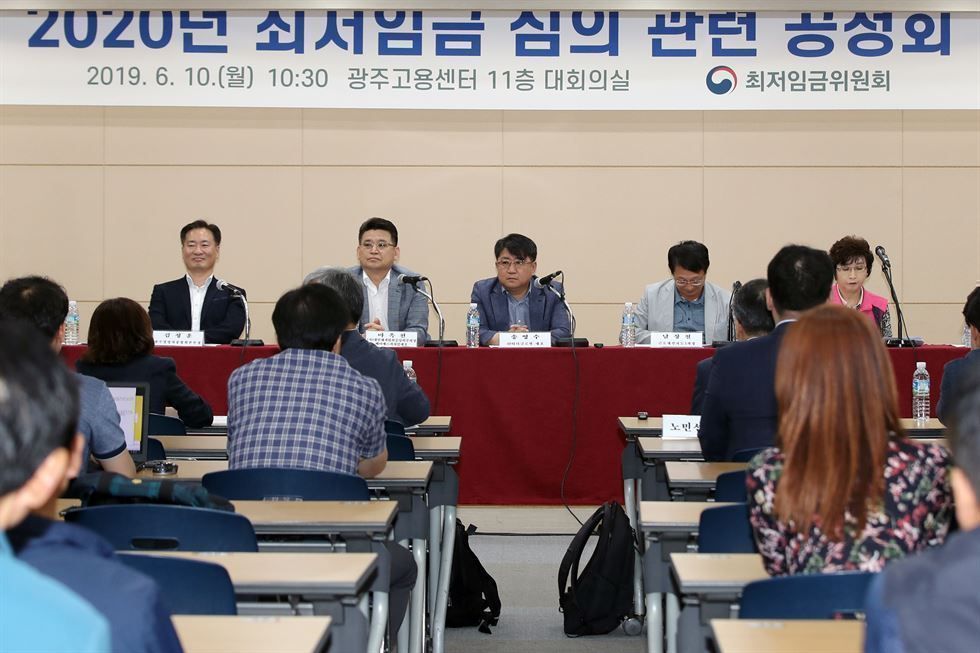
Representatives of employers, workers and the government attend the public hearing on next year’s minimum wage in Gwangju, South Jeolla Province, Monday. Yonhap

Small business owners want the government to introduce a lower minimum wage for foreign workers in Korea.

At Monday’s public hearing on next year’s minimum wage in Gwangju, South Jeolla Province, representatives of employers said “steep” minimum wage hikes over the past two years have pushed many small businesses to the edge and that the government should help them by adopting a “different” wage system for foreign workers.

Song Young-soo, a small business owner in Gwangju, was among participants who reportedlyvoiced the need for a lower minimum wage for foreign employees, who they say show lower labor productivity than Korean workers mainly because of communication problems.

According to a Korea Federation of Small and Medium Business survey early this year, the productivity of an average foreign worker (E-9 visa holder) was 87.5 percent of a Korean worker.

Korea Times

You can read more at the link.

Video on How the Korean War Created Samsung

Below is a well made Youtube video that goes into the history of Samsung.

I did not realize that Samsung was founded as a truck company in Daegu by Lee Byung-chul who was chummy with the Imperial Japanese. He eventually moved his business down to Masan which was the main port the Japanese were using to export out of Korea.

Lee Byung-chul

After the colonial occupation Lee would go on to become friends with President Rhee Syngman and business continued to grow. Then during the Korean War business continued to thrive as he had contracts to move U.S. supplies and equipment with his trucks. After the war is when Samsung grew dramatically as it expanded into building construction and other industries to where today it is Korea’s flagship global business conglomerate.

Tweet of the Day: President Trump Very Happy with Lotte Group

Fight Between Taxi Drivers and Ride Sharing Apps Continues in Korea

Back in May when the Korean government announced a resolution to the fight between taxi drivers and the Kakao ride sharing app, I predicted this issue would come up again. That is because this picture clearly indicates both sides were not happy with the agreement and tensions are now boiling over again:

After more taxi drivers resort to extreme methods of protest, an organization comprised of the government, ruling party and taxi companies was created to find a compromise. After 45 days of discussions, the taxi and carpool companies finally reached an agreement on March 7.

In their agreement, carpooling hours were limited to 7 a.m. to 9 a.m. and 6 p.m. to 8 p.m., weekends and national holidays excluded. For the taxi industry, parties agreed to reduce the number of taxi drivers with advanced age and implement a monthly salary for taxi drivers. Not all parts of the agreement were carried out accordingly. 

“After announcing that a social agreement was made, we haven’t had a working session, not one,” said Kang Shin-pyo, the leader of the National Taxi Labor Union, in an interview with the JoongAng Ilbo. In the agreement, there was a section where parties agreed to create an organization for discussion between the ruling Democratic Party (DP) and the companies.

The National Assembly has not made much progress either. The Land Infrastructure and Transport Committee held a subcommittee meeting to examine the bill on March 27, but could not reach a conclusion due to objections from the opposition Liberty Korea Party. The discussion is currently suspended.

Joong Ang Ilbo

You can read more at the link.

Korean Jobless Rate Hits a 19 Year High

Something to keep in mind that these jobless numbers have probably been modified as much as possible to make it not look as bad since President Moon fired the prior head of Statistics Korea and replaced her with an ally. The actual jobless is probably far worse:

Over 1.24 million people remained jobless in April, the highest in 19 years, a clear indication of the tightening job market amid an economic slowdown here, government data showed Wednesday. 

Statistics Korea said the number of jobless stood at 1,245,000, up 84,000 from a year earlier and the highest number since June 1999 when the agency began compiling related data. 

The jobless rate also jumped to 4.4 percent in April, up 0.3 percentage points year-on-year, the highest since 2000 when it stood at 4.5 percent. 

The rate for those aged between 15 and 29 reached 11.5 percent, up 0.8 percentage points from a year earlier, also the highest since April 2000. 

You can read more at the link.

Trade Minister Wants US to Give South Korea Relief from Auto Tariffs

I wonder if the ROK will get auto tariff relief when they decide to pay the amount President Trump has asked them to pay for the upkeep of the US-ROK alliance?

South Korea’s Trade Minister will visit the U.S. next week to call for the country’s exemption from potential U.S. tariffs on auto imports. 

Minister Yoo Myung-hee announced the plan in a meeting with reporters on Tuesday, emphasizing that South Korea cannot be complacent or sit idle on the issue. 

She plans to leave for the U.S. on Monday and meet with officials from the White House, Commerce Department, US Trade Representative as well as members of Congress. 

U.S. President Donald Trump has until Friday of next week to decide whether auto import tariffs are necessary for national security under Section 232 of the Trade Expansion Act. If a conclusion is made that such a measure is needed, the U.S. can impose tariffs of 25 percent on imported cars.

KBS World Radio

Tweet of the Day: South Korean Economy Shrinks

Wall Street Journal Review of Foldable Samsung Smartphone Draws Criticism

South Koreans know how to dominate online reactions and this Wall Street Journal reporter is finding that out:

The Wall Street Journal’s “mocking” review of Samsung Electronics’ Galaxy Fold smartphone has caused a controversy here as some internet users have criticized the U.S. newspaper for posting an “insensitive” video on YouTube.

Critics said Monday the paper’s journalist should have offered a thorough and independent review of Samsung’s latest smartphone in the video rather than focused on ridiculing it.

In February, Samsung unveiled its first foldable smartphone and the device is set to hit the U.S. market April 26, but the phone has been criticized by U.S. reviewers as the top layer of the display easily peels off, which can cause serious damage to the screen. 

WSJ reporter Joanna Stern posted the video review of the Galaxy Fold, Friday (local time). In the three-minute video, the reporter put a sausage inside the screen of the smartphone, showed clips of peeling a banana and orange and folded a colored piece of paper.

The video has gone viral logging more than 570,000 hits as of 3 p.m. Monday, but has generated negative responses from some viewers, recording 22,000 thumbs-downs while having 10,000 thumbs-ups. More than 4,400 people left comments on the video, many expressing anger over mocking the device by putting a sausage and other objects inside the smartphone.

Korea Times

You can read more at the link and view the review below.

Large Minimum Wage Increase Leads to Massive Job Losses in South Korea

This should not be surprising to anyone that rapidly increasing the minimum wage will cause small business owners such as restaurant owners to cut jobs because they cannot afford to pay them:

Restaurant jobs in Korea have been vanishing quickly, according to data released Tuesday.

Analysts say the loss in jobs is largely the result of the rapid increases in the minimum wage over the past two years.

According to the Supplementary Results of the Local Area Labor Force Survey in the Second Half of 2018, the number of people employed by restaurants last October was down 104,000 from the same month a year earlier.

That fall was the largest of all categories in the survey.

Other categories also showing major year-on-year declines included: employment agencies, down 85,000; retailers, with 37,000 jobs lost; and land transport services, with 28,000 fewer jobs. Due to troubles at domestic automakers, employment by auto part manufacturers was down 28,000.

By job types, the number of retail workers decreased by 63,000 in October 2018 year on year, followed by construction workers (at a negative 48,000), drivers (down 40,000) and food and beverage service workers (with a fall of 38,000 year on year).

Analysts believe the rapid rise in the minimum wage is largely to blame.

Joong Ang Ilbo

You can read more at the link.