In what would become the final days of World War II, the two Japanese cities of Hiroshima and Nagasaki, were destroyed by atomic bombs dropped by the US Air Force, first on August 6, 1945 and then again on August 9, killing at least 120,000 people initially, and around twice as many over time due to radiation poisoning.
The primary reasons given for dropping the two bombs was that it would force Japan to unconditionally surrender. Japan did ultimately surrender on August 15, 1945. The other reason was that it would save American and Japanese lives overall due to the US military not needing to invade the Japanese main land.
With this week’s anniversary of the atomic bombings of Hiroshima and Nagasaki, there has been a run up of articles in the media and elsewhere chronicling the anniversary of this event.
First of all the main question many people ask is if the atomic bombings of Japan were necessary?
Setting up surrender talks sanctioned by both the U.S. and the Japanese governments would likely have been difficult. But there is no easy way of ending a war. The primary question is not what is the easier path, but what path will bring a lasting peace while sparing the most Allied lives and, secondarily, “enemy” civilian lives.
While it cannot be proven, had officially sanctioned communication been made by the Allies or the U.S. to Japan thru Konoye, the various peace feelers, or other credible diplomatic channel stating that Japan’s time had completely run out due to the impending threats of nuclear destruction and Soviet invasion, and that immediate surrender would mean the opportunity to retain their throne, there is a good chance the Japanese doves would have enlisted the Emperor to bring Japan to surrender in late July or early August of 1945.
I disagree that setting up surrender talks would of led to the unconditional surrender of Japan. The Japanese at the time practiced the samurai code of Bushido where they would not surrender. Any deal made in peace talks would likely not be called a surrender but a cease fire to save face for the Japanese militarists in charge of the country. Plus I believe the militarists would never of allowed a complete American occupation of Japan because then that would be a symbol of defeat.
With a cease fire in a place and no occupation how different would Japan be today? The militarists would of still been in power after the war and deeply bitter about their failure to win the war. This scenario sounds very familiar to World War I when the Germans were not forced to unconditionally surrender due to the allied armies, particularly the French and English, being worn down with heavy casualties and looking to end the war any way possible, thus the Armistice Agreement was reached. The Armistice directly led to Hitler’s popularity and rise because the Germans never felt defeated after World War I.
The attitude in Japan would of been much the same way if the militarists stayed in power. Why do I think this you ask? It is pretty clear that the mentality in Japan would never accept a complete surrender through negotiations. It took the fire bombing of Tokyo, the bloody fights on Iwo Jima and Okinawa, the Russian entry into the war, plus not one but two atomic bombs before they finally surrendered nearly a week after the second atomic bomb on August 15th. The Japanese did not initially feel compelled to surrender when they believed they could win a bloody fight on their home islands which could of caused the US to eventually seek a ceasefire instead of conquering all of Japan.
So yes, I agree surrender talks may have potentially worked and saved the lives lost from the atomic bombings, but without the unconditional surrender of Japan would it have led to another war years later? Who knows, but this is the thought that General MacArthur and many other people of this generation that fought in World War I had in the back of their minds. They did not want to repeat the mistakes of World War I, thus MacArthur’s famous saying, “There is no substitute for victory.”
In addition there was great thought put into determining the amount of American casualties that the US would potentially lose in an invasion of the Japanese mainland. Operation Olympic was the code name for the US military operational plan to invade the southern Japanese mainland island of Kyushu. The casualty estimate of the invasion of this island range anywhere from 63,000 – 100,000 US lives. Keep in mind these are just the estimates of the one southern Japanese island.
The Japanese were preparing for the all out defense of their homeland called Operation Ketsu-go. Read the link for an in depth look at the defensive plan to protect the Japanese main land. It is obvious that this would have been a bloody fight which was backed up by the American losses of 10,000 Americans dead and missing in the Marianas, 5,500 dead at Leyte, 9,000 dead during the Luzon campaign, 6,800 at Iwo Jima, 12,600 at Okinawa, and 2,000 killed at Peleliu that weighed heavily on the minds of America’s leaders.
The vicious fighting on Okinawa saw the US versus Japanese casualties approaching a 2-1 ratio. Just imagine if someone invaded the United States how hard would Americans fight to protect their homeland? I can guarantee that just about every able body person with a gun besides the citizens of San Francisco and Berkley would take up arms against the invaders. Plus the amount of civilians killed on Okinawa due to the fighting was heavy, not to mention villagers that killed themselves by jumping off of cliffs with their children instead of surrendering to the Americans. Would the Japanese mainland be any different.
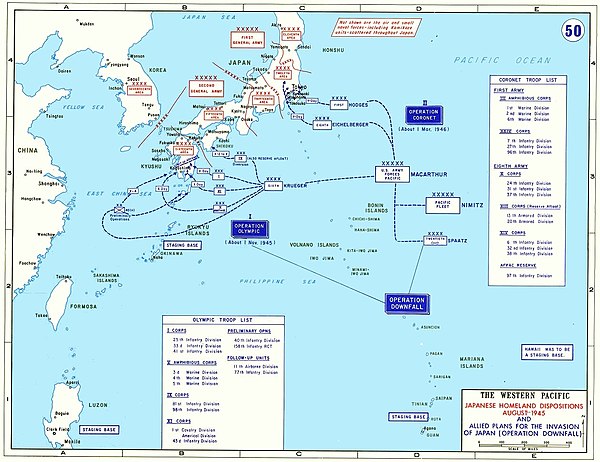
Operation Olympic, the proposed invasion plan of the Japanese main land during World War II. Notice no plans were ever made to occupy Korea initially.
An additional factor weighing on the minds of US leaders was the fact this would be primarily a lone US invasion. The fall of Germany was helped by the combined allied armies in the western front and the Russian offensive in the east. In fact, the Russian Army during their 23 day invasion of East Germany lost 78,291 dead. Just an incredible number. Should the US leaders have expected anything different in Japan?
Then the final factor is the, Revenge Factor. Any politician that would of allowed the Japanese to end the war without unconditional surrender would have committed political suicide. The American public wanted revenge and complete victory after what happened at Pearl Harbor. Allowing the Japanese regime that initiated the attack on Pearl Harbor to stay in place would not be acceptable to the American public.
As you can see there are many factors that went into the nuclear bombings. This was not a rash decision made to kill as many people as possible. It was a shrewd calculated strategic decision made at the highest echelons of the US leadership to end the war quickly with the least amount of lives lost. I know many people would also dispute bombing civilians but World War II was fought by the rules of “total war” where civilians were considered legitimate targets in order to break national will power. Look what the Japanese did in China and other areas in Asia. Look what the Germans did in their bombing of Britian. The US military and other allied nations responded in kind in both theaters with the carpet bombings of Germany most notably Dresden and the fire bombings of Japan. In fact the fire bombing of Tokyo cost more lives than dropping the atomic bomb on Hiroshima. “Total War” may not seem like a humanitarian concept, but when the survival of the nation is at stake countries will do whatever is necessary to save their nation. Does anyone doubt if the Germans or the Japanese developed the bomb before the Americans that they would of use it on American or allied targets?
I really do not see another alternative that would of worked that would of caused the unconditional surrender of Japan and the occupation of Japan that followed other than dropping the atomic bomb.
Now one thing I do dispute was the need to drop the second atomic bomb. I can understand Hiroshima, but Truman may have been to quick to bomb Nagasaki. The city must not have been a big military target since it had not received heavy bombing prior to the dropping of the nuclear bomb. So for stategic purposes it was not necessary to bomb for any other reason to break national will power.
A factor I think Truman probably took into account was the fact that the Soviet military entered the war on August 8, 1945 one day before the bombing of Nagasaki. The Soviet invasion had both pros and cons for Truman. The pro was that the invasion would put more pressure on the Japanese to surrender. The negative was that the Soviets were gobbling up territory before the US military could claim territory which I think Truman took into account. If the war dragged on any longer the Soviets could of very welled occupied all of Korea and the northern Japanese main land island of Hokkaido since they had already occupied the Kuril islands.
Maybe a few more days should have been alloted for the Japanese leadership to judge the effects of the Russian entry into the war. Maybe the threat of Soviet occupation would of finally made the Japanese surrender and allow the Americans to occupy them. If this didn’t work then the nuclear option was available.
I feel Truman didn’t take this option into account because he ordered the bombing of Nagasaki only one day after the Soviet entry into the war. I think the fear of the Soviets gobbling up large chunks of territory in Japan is what forced Truman’s hand to bomb Nagasaki. The American leadership felt that the occupation of Japan was critical in the soon to be developed containment policy of the Soviet Union. If the United States did not control all of Japan or ended up with a split Japan then the Soviets would have the advantage in controlling all of northeast Asia. This was definitely geo-politics at its most cunning level.
In a history class I took in college a Japanese student explained in class that he believed the US should have dropped the first atomic bomb out in the ocean in order to show the ruling militarist the might of the atomic bomb without targeting civilians. I countered his point that if dropping an atomic bomb on Hiroshima did not force the militarists to surrender than how was dropping a bomb in the ocean going to make them surrender? In fact it took two atomic bombings of Japanese cities and the entry of the Russians into the war in order to get the Japanese to finally surrender.
The other argument the Japanese student brought up was why the US did not drop a nuclear bomb on Berlin. That is because the US did not have a nuclear capability by the time Germany surrendered and even if it did the casualty ratio of an invasion of Germany is much lower compared to Japan. First of all it was a land battle where US tanks were able to roll right into Germany from France, secondly Germany was beat and actually was fighting harder to stop the Russian advance in order to be occupied by the Americans. With Japan the US forces would have had to do an amphibious landing followed by a vicious fight against fanatical defenders, which would have made casualties on both sides extremely high. There are clear differences between nuking Japan and Germany.
With 50 years of hindsight it is easy to sharpshoot Truman’s decision, but ultimately he did what he felt was in the best interest of the United States; not the best interest of Japan. This is important to keep in mind because I’m sure he felt the cost of Japanese civilian lives were secondary to protecting the lives of US serviceman and the geo-politics of protecting US national security by implementing the containment strategy of the Soviet Union. I still think that the bombing of Nagasaki may have been to quick, but today you really can’t argue with the results because the Soviet Union is history and Japan is one of the world’s wealthiest countries with the world’s second largest economy. However, I do fully agree with the Hiroshima Peace Park’s motto of never letting this tragedy happen again.
Previous Posting: Remembering Nagasaki




