Staff from Korea Post collect mattresses made by Daijin Bed Co., which have been found to release radiation at levels that exceed the safety standard, in Seoul on June 16, 2018. (Yonhap)
Here is yet another example of why President Trump calls them the “fake news” media:
At one point Trump described migration as a big problem for Europe then said to Abe: “Shinzo, you don’t have this problem, but I can send you 25 million Mexicans and you’ll be out of office very soon,” according to an official quoted by the Journal (AFP Photo/Nicholas Kamm)
Donald Trump threatened Japan’s Prime Minister Shinzo Abe he would ship 25 million Mexicans to his country, one of a series of bizarre missives that jarred fellow leaders at last week’s acrimonious G7 meet, according to a report on Friday.
The Group of Seven summit gathering of top industrialized democracies finished in disarray after the US president abruptly rejected its consensus statement and bitterly attacked Canada’s Prime Minister Justin Trudeau.
Behind the scenes, Trump’s counterparts were dismayed by verbal jabs on topics ranging from trade to terrorism and migration, The Wall Street Journal said, quoting European officials who were present.
At one point he described migration as a big problem for Europe then said to Abe: “Shinzo, you don’t have this problem, but I can send you 25 million Mexicans and you’ll be out of office very soon,” creating a sense of irritation in the room, according to an EU official. [AFP]
You can read more at the link, but Trump did not “threaten” Shinzo Abe as this article claims. He was clearly using sarcasm to make a point to the people in the room. Any journalist publishing articles insinuating that Trump literally meant to round up 25 million illegal immigrants and ship them to Japan are clearly dishonest and part of the fake news problem.
Over at the Diplomat there is an interesting article published about former US President Jimmy Carter’s failed attempt to remove US ground troops from South Korea during his term in office:
South Korean President Park Chung Hee, right, leads American President Jimmy Carter to his awaiting helicopter after Carter arrived for two days of talks in Korea (June 29, 1979).
With U.S. President Donald Trump once more touting his desire to withdraw the 28,500 U.S. troops currently stationed in South Korea, it is perhaps worthwhile briefly examining the last time an American president attempted to remove U.S. forces from the Korean Peninsula. U.S. President Jimmy Carter in the late 1970s was ultimately stopped by congressional obstruction, the Pentagon, and the intelligence community, among others, from implementing a troop withdrawal policy he had repeatedly promised during his presidential campaign in 1976. Put otherwise, and to use 21st century Trumpian parlance: the so-called “deep state” stopped Carter from executing his plans.
During the 1976 presidential campaign — the same year two American soldiers were axed to death by North Korean soldiers in the demilitarized zone — Carter repeatedly voiced his desire to pull out the 40,000 American soldiers (out of which only 15,000 were combat troops) from South Korea, where they served as a de factotripwire to deter a North Korean invasion. For example, at a Foreign Policy Association luncheon that year Carter declared: “I believe that it will be possible to withdraw our ground forces from South Korea on a phased basis over a time span to be determined after consultation with both South Korea and Japan.” [The Diplomat via a reader tip]
You can read much more at the link, but basically the intelligence community changed its assessment to state that North Korea had a military advantage over South Korea and removing US ground troops would only increase their advantage. This gave opponents of Carter’s troop removal plan the backing they needed to oppose and eventually stop it. President Carter has always been skeptical of the assessment and how the bureaucracy circled the wagons to stop his troop withdrawal strategy.
Carter wanted to pull out the ground troops to put pressure on South Korean President Park Chung-hee to implement democratic reforms. Carter may have failed in his quest to remove US ground troops, but he did indirectly succeed in getting Park Chung-hee removed from office. In October 1979, Park was assassinated by the Korean CIA chief Kim Jae-gyu as part of a coup attempt against him. After the coup attempt failed, Kim said one of the reasons for the coup was to restore the US-ROK relationship that had been so badly damaged by Park’s rule.
So are there any lessons President Trump could learn from Carter’s failed bid to remove US ground troops from Korea if he decides to do that? I don’t think so because of how different the circumstances are. It is clear today that South Korea has a conventional military advantage over North Korea thus muting concerns that US military leadership may have. When former Defense Secretary Donald Rumsfeld moved entire combat brigade from South Korea in 2004 to send to Iraq there was little pushback because of the ROK military advantage.
If President Trump does decide to remove US troops from Korea as part of a larger deal over North Korea’s nuclear weapons, I suspect there would be little pushback compared to what Carter experienced.
What do I think about today's joint agreement? It has zero practical value. The U.S. could have extracted serious concessions, but it was not done. N.Korea will be emboldened and the U.S. got nothing: https://t.co/FXkkURMnpC
I have to admit I cringed a little bit when I first saw this, but the follow on criticism has been over the top:
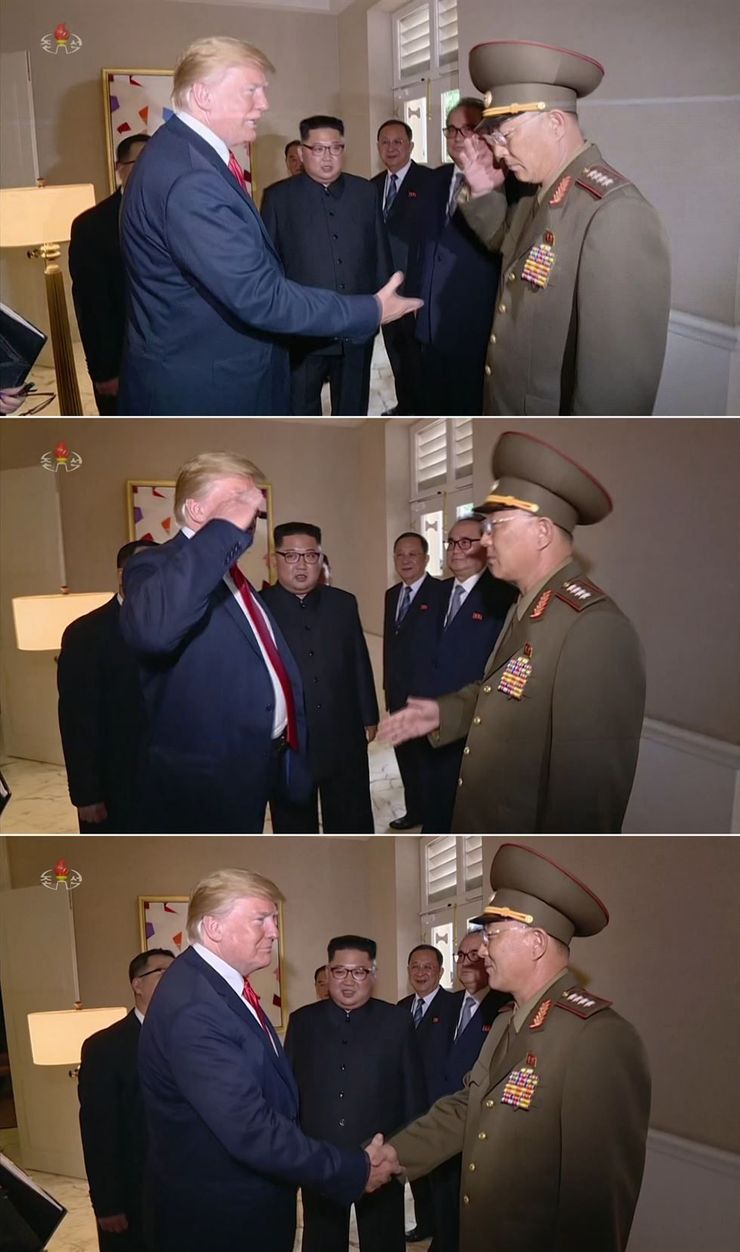
Newly released video footage from North Korean state media shows President Donald Trump returning a salute to a North Korean military general during this week’s summit in Singapore, an extraordinary display of respect from a US president to a top officer of a hostile regime.
In the military, returning a salute from a military officer of a friendly foreign nation is common practice for US military officers and considered a display of military professionalism. There is no rule that a US president is obliged to return a salute, which is considered a sign of mutual respect.
After Trump and North Korean leader Kim Jong Un walked down a colonnade to shake hands, the pair entered into a room filled with various members of Kim’s delegation, the video from North Korean broadcaster KCTV news shows.
Trump starts to shake hands with those in the room. Upon encountering North Korean Gen. No Kwang Chol, who was in full uniform, Trump first extends his hand, to which the general responds with a salute. Trump then salutes back, extends his hand again and the two men shake hands. [CNN]
You can read more at the link, but the salute as expected has become red meat for the usual Trump critics to sensationalize. The over the top criticism of what appeared to a reflexive action by the President is about as stupid as the over top criticism of former President Obama bowing to the Saudi King. With that said if Obama had done this his critics would be doing the same thing that Trump critics are doing now.
From what I have read there really isn’t any regulation stating that a President is supposed to salute military personnel much less foreign military personnel. Saluting apparently started with President Reagan and follow on Presidents have continued this tradition.
There’s no regulation that stipulates presidents must salute the troops. In fact, for the first 192 years of our republic, it didn’t happen. None of the first 38 commanders in chief did it. And some of those dudes had some serious military experience. Eisenhower? Grant? I mean, Teddy Roosevelt was a war hero. Surely he felt compelled to click his heels together and cut a perfect knife-handed salute when he passed a uniform service member, right? Wrong. It was literally something that Ronald Reagan made up one day. [Task and Purpose]
Interestingly I did find buried at the very end of a Dallas Morning News article criticizing Trump’s salute, that President Obama did occasionally salute foreign military personnel as well:
A cursory check of photo archives shows that Obama on occasion returned a foreign official’s salute. [Dallas Morning News]
The White House for its part is defending the salute as being part of “common courtesy“. Well the so call common courtesy is sure to be immortalized with endless amount of Internet memes highlighting this salute.
Kwon Yang-sook, wife of late former President Roh Moo-hyun, votes at a polling station in Gimhae, South Gyeongsang Province, on June 13, 2018. (Yonhap)
I understand these banks have to do due diligence in preparation to support any investments in North Korea, but this is all irrelevant unless the Trump administration drops sanctions:
South Korean banks, including Shinhan Financial Group and KB Financial Group — have set up task forces to conduct research on inter-Korean economic projects.
Earlier this month, Shinhan Financial launched a task force on North Korea.
The task force was manned by executives from the financial holding firm’s affiliates, including Shinhan Bank.
KB Financial has also set up a task force to review how it could take part in North Korea’s fiancial business operations if inter-Korean cooperation gains further momentum.
KEB Hana Bank will launch a team to draw up plans for financial support in North Korea when inter-Korean economic projects resume.
An official at KEB Hana Bank said the bank is interested in opening a branch in North Korea, but it will be possible “when political conditions are ripe.” [Yonhap]
As I have been saying the suspension of joint exercises with South Korea is something that is easily reversible and can be used as negotiating leverage against the Kim regime:
Secretary of State Mike Pompeo, left, toasts North Korean officials, including Vice-Chairman of the Central Committee Kim Yong Chol, in New York City, May 30, 2018.
President Donald Trump will resume military exercises with South Korea if the North stops negotiating in good faith over its nuclear weapons program, the top U.S. diplomat said Wednesday.
The tempered expectations were markedly different from the optimistic tone set by Trump in a series of tweets earlier in the day. [Stars & Stripes]
You can read more at the link, but I think we will know whether North Korea is negotiating in good faith by the Key Resolve exercise timeframe early next year. If North Korea is not making any irreversible progress towards denuclearization I would expect this exercise would be executed as scheduled.