Congratulations to First Lieutenant Ji Eun Jeong for being awarded the US Army’s Expert Infantryman Badge. She is considered the first female ROK Army officer to receive the badge. Two years ago two female ROK Army NCOs became the first Korean females to be awarded the EIB:
May 26, 2016 – CAMP CASEY, Republic of Korea – Soldiers congratulate Republic of Korea Army 1st Lt. Ji Eun Jeong, a platoon leader in the 115th Mechanized Infantry Battalion, 90th Mech. Inf. Brigade, 30th Mech. Inf. Division, on earning an U.S. Army Expert Infantryman Badge. Jeong, a 25-year-old from Seoul, South Korea, is the first female ROK officer to complete the EIB. South Korean officers are not actually authorized to wear the U.S. badge, but were pinned during the ceremony and awarded a certificate of achievement. (U.S. Army photo by Staff Sgt. Keith Anderson, 1st Armored Brigade Combat Team Public Affairs, 1st Cav. Div.) [PACOM.mil]
Here are some statistics of how many failed to pass the testing:
Republic of Korea Army 1st Lt. Ji Eun Jeong, a platoon leader in the 115th Mechanized Infantry Battalion, 90th Mech. Inf. Brigade, 30th Mech. Inf. Division, raises her hands in victory May 26, as she approaches the finish line of the 12-mile ruck march at Camp Casey, South Korea. Jeong is the first female ROK officer to earn the U.S. Army Expert Infantryman Badge. (U.S. Army photo by Sgt. Christopher Dennis, 1st Armored Brigade Combat Team Public Affairs, 1st Cav. Div.)
Included in the final number to complete the challenge were more than 40 ROKA Soldiers, including Republic of Korea Army 1st Lt. Ji Eun Jeong, a platoon leader in the 115th Mechanized Infantry Battalion, 90th Mech. Inf. Brigade, 30th Mech. Inf. Division. Jeong was the first female ROK officer to earn the EIB. A female ROK NCO completed the grueling challenge last year to earn her EIB.
“I want a specialty for infantry, and EIB is a challenge for female Soldiers,” said Jeong.
Of the 627 Soldiers who started the EIB testing in South Korea May 22, only 131 finished and earned the honor of wearing the Expert Infantryman Badge. And of those, 29 distinguished themselves as “True Blue” Infantryman by successfully completing every event without retest and receiving first time “go’s” on every evaluation – 18 U.S. and 11 South Korean Soldiers. [DVIDS]
That is a pretty high attrition rate and thus shows how hard the awardees worked to get the EIB. According to the Korea Times 1st Lt. Jeong did 200 pushups, 200 sit-ups and ran 7 kilometers each day to prepare for the test. She also qualified for the ROK Army’s version of the EIB in November 2015 which made her eligible to compete for the US Army’s EIB last month. Incredibly the attrition rate for the ROK Army EIB is much higher than the US Army EIB:
Only infantry personnel are eligible to participate in both the EIB test and South Korea’s equivalent test.
The U.S. military officially opened the door for women on ground combat jobs beginning in January and there were no female participants from the U.S. side this year, according to the South Korean military.
In November 2015, Jeong was the only woman among the four successful candidates who took the South Korean infantry test. A total of 85 soldiers took the test then. [Korea Times]
Only 4 of 85 passed the ROK Army EIB testing which is pretty amazing. It sounds like the US Army get our infantrymen to compete in the ROK Army EIB testing for an additional skills challenge.
This is a horrible tragedy for the unit involved in this accident at Ft. Hood. With that said there had to be some serious lack of risk assessment and leadership to allow something like this to happen:
A motorist passes through a low-water crossing near New Braunfels, Texas, on Thursday, June 2, 2016. ERIC GAY/AP
Five soldiers were killed and four were missing after an Army troop carrier was washed from a low-water crossing and overturned Thursday in a rain-swollen creek at Fort Hood, the Texas Army post said.
Three soldiers were found dead shortly after the 2½-ton truck was toppled by the swift current of Owl Creek during a morning training exercise. Two more bodies were found late Thursday night, according to a Fort Hood statement. Three soldiers were rescued and were hospitalized in stable condition.
No further details were provided in the statement, but spokesman Chris Haug said the search continued for the four soldiers who remain missing. Army officials planned a briefing early Friday to provide an update. [Stars & Stripes]
You can read more at the link, but hopefully they can find the four missing soldiers. It is just amazing the amount of bad things that seem to happen at Ft. Hood.
Does anyone think two weeks is enough training to make either a male or a female an infantryman?:
A sergeant in the Wyoming National Guard has become the Army’s first female enlisted infantry soldier.
Sgt. Shelby Atkins on Thursday graduated alongside 32 male soldiers from a two-week infantry qualification and transition course at Camp Guernsey Joint Training Center in Wyoming. The course was designed to train soldiers for the Wyoming Guard’s first infantry unit in more than 100 years.
“She’s the first female Army [noncommissioned officer] in the total Army to be granted the infantry [military occupational specialty],” said Jack Harrison, a spokesman for the National Guard Bureau. [Army Times]
This accusation bothers me because the accuser waited until the Plumley was dead before accusing him of stolen valor. This prevented Plumley from defending himself:
Command Sgt. Maj. Basil Plumley, Lt. Gen. Hal Moore and Joseph Galloway at Fort Benning, Ga. COURTESY OF JOSEPH GALLOWAY
The late Command Sgt. Maj. Basil Plumley, a legend in the U.S. Army and famously depicted by the actor Sam Elliott in the Vietnam War movie “We Were Soldiers,” is under review by Army officials for having worn unauthorized combat and valor awards, according to a report on Military.com.
Plumley died of cancer in 2012, but Brian Siddall, an independent researcher who has devoted years of his life researching Plumley’s service records and the exploits of other service members in World War II, uncovered discrepancies between Plumley’s official documents and widely reported accounts of his service.
In the 1992 book “We Were Soldiers Once … and Young,” co-written by Joe Galloway and retired Lt. Gen Hal Moore and on which the movie is based, Plumley is a central character and is introduced as a soldier who had made four combat jumps in World War II as well as a combat jump in the Korean War. According to Siddall, service records indicate that Plumely served as a scout in a glider unit and participated in two glider assaults during World War II and never deployed to Korea. [Stars & Stripes]
Here is the part of the accusation that really bothers me:
“I just want the correct information out there because there are so many people that are really heroes, and it is so frustrating when they give the hero status to someone who was anything but,” Siddall told Military.com.
Even if Plumley exaggerated his combat awards he is without a doubt an American military hero based on his actions during the battle of the Ia Drang in Vietnam.
With that said it does appear true that Plumley did not serve during the Korean War which makes me wonder why he would claim something like that? As far as the other accusations it appears instead of parachuting into Normandy during World War II he landed in a glider which was just as dangerous. As far as awards earned during World War II I can definitely see discrepancies happening from that time frame so I put little weight in that.
This murder case in Hawaii has just gotten a whole lot weirder. Obviously this NCO has some serious sexual issues if he is having affairs, watching child porn and prostituting himself to other men:
An Army medic charged with conspiring with his lover to kill his wife in Hawaii will be court-martialed for child pornography and prostitution charges that surfaced while investigating the killing.
Sgt. Michael Walker’s general court-martial is set for June 20 and June 21 at Wheeler Army Airfield on Oahu, said Jim Guzior, spokesman for Tripler Army Medical Center, where Walker has been assigned since 2013. A pretrial hearing is scheduled for next week.
Walker has pleaded not guilty to a murder charge in civilian court in the killing of Catherine Walker, who was found stabbed to death in November 2014 in the military housing the couple shared in Honolulu.
Army prosecutors revealed new allegations during a military judicial hearing in March, where they said Michael Walker is accused of possessing and viewing child pornography and receiving money in exchange for sex with men. [Stars & Stripes]
This story from Ft. Bragg is well worth spending a few minutes to read because it is hilarious:
The civilian found living in the barracks of Fort Bragg’s 3rd Special Forces Group was a “con-artist” who had never served in the armed forces, but had enough knowledge of the military to dupe others into believing he was a soldier, according to an investigation obtained by The Fayetteville Observer.
The report does not name the civilian, citing personal privacy, but according to public arrest records that match the circumstances described by the military, the civilian in the barracks was Triston Marquell Chase, 20.
U.S. Army Special Operations Command public affairs officers declined to say what name the civilian was known by to 3rd Group soldiers.
According to the investigative report, the civilian posed as an explosive ordnance disposal specialist for A Company, 1st Battalion, 3rd Special Forces Group. He was discovered after a drunken driving arrest on Fort Bragg in December. The civilian — and Chase, according to state court records — has six felony charges from 2014, including identity theft and larceny of a firearm, pending in Harnett County.
In the days following Chase’s arrest, military officials unraveled the story of how he exploited the lack of oversight in the barracks to obtain a room key, access the barracks and live there for months. [Fayetteville Observer]
This guy must have been quiet the personality considering he had people loaning him their cars, and women regularly stopping by:
The person said he felt sorry for the man and provided him a key to his barracks room on the third floor, according to the investigation.
Investigators learned multiple women had visited the civilian in his barracks room and brought him food. One person told investigators that the man said he never had any money because he used his funds to take care of his family.
Heck this guy was even holding room inspections and holding his own formations!:
The fact-finding soldiers went to the barracks where they saw the man outside with six soldiers standing in formation with no Army combat uniform tops, just brown T-shirts, according to the investigation.
The officer told the man he needed to speak with him. The man said he was busy because “my supervisor told me to get these guys straight.” (……..)
The man had become such a staple around the barracks that several soldiers said they had seen him conducting room inspections and assigning rooms to new soldiers, according to the investigation.
Sounds like the Army should get this guy to enlist and serve as the barracks manager.
You would think the Army would have waited to promote a story like this until after she had completed the basic infantry course. You would think the PAO types would have learned this lesson after the embarrassment of the first female combat engineer enlistee who went AWOL:
A Louisiana woman is seeking to make history, enlisting to be the first female infantryman in the United States Army.
25-year-old Tammy Barnett raised her right hand in Shreveport, Louisiana, opting to join the US Army Infantry, a deviation from her original plans when she found out she could be first.
“I was going to go military police, but infantry is similar, and they are more on the front lines, like law enforcement here and I said that’s what I want to do,” said Barnett, a former police officer.
Barnett hopes to make history and lead the way for more women who want to go into the infantry.
“They told me that I would be the first female in history to go infantry in the military,” said Barnett.
“I hope that I give them the courage, because I’m a small female, if I can do it, they can do it too, this could give them the courage to step out of their comfort zone,” explained Barnett. [Popular Military]
You can read more at the link, but she is going to be in for a rude awakening when she finds out that the infantry is nothing like being a policeman other than they are both proficient with shooting weapons. Just for the record I continue to support women in combat arms roles as long as they meet the same standards as men. For example I wonder if Ms. Barnett will have to pass the same physical fitness test and other physical requirements as her male infantry recruits?
According to a court, the threshold for religious accommodation is that the accommodation cannot affect unit cohesion and morale, good order and discipline, healthy and safety:
A decorated army officer is now officially permitted to wear a religious beard and turban in uniform thanks in part to a ruling late Thursday.
Capt. Simratpal Singh — a lifelong practicing Sikh, who was a West Point graduate, Army Ranger and Bronze Star recipient —was previously given a temporary accommodation in December. When it was set to expire in February, Singh sued after he was told by the Army he had to report for days of gas mask and helmet testing, citing religious discrimination.
He eventually won, with a court document saying that the temporary order would only be revoked if his beard and turban affected “unit cohesion and morale, good order and discipline, healthy and safety.”
According to The Sikh Coalition, which is currently representing Singh, he is the first Sikh American to receive a religious accommodation while serving. [Mashable]
You can read more at the link, but there have been other Sikhs who have had religious accommodations made for them by the military so I am not sure why Singh is being claimed as the first. In fact there is an entire Wikipedia page dedicated to sikhs who have served in the US military.
The recent animated film 300 dramatized the Battle of Thermopylae in 480 BC that featured a protracted battle between a small Spartan force led by King Leonidas that was tasked with delaying the advance of the much larger force of invading Persians led by King Xerxes.
The battle was portrayed as the small Spartan force protecting the fledgling start of western democracy from being enslaved by the dictatorial Persian King. This movie would go on to be a huge box office success and raise public awareness about the significance of the battle. However, though this famous historical battle happened nearly 2,500 years ago few people today (even in Greece) realize that Greek soldiers over 60 years ago had fought in their own modern day Battle of Thermopylae during the Korean War for similar reasons and fortunately even better results.
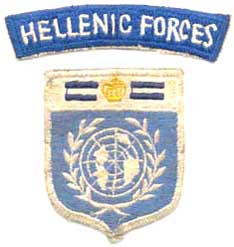
Patch worn by Greek soldiers that fought in the Korean War.
Background
When the United Nations authorized the use of force to expel the North Korean military who had invaded South Korea on June 25, 1950 for the sole purpose of reuniting the peninsula under communism, one of the nations that provided a large contingent of combat troops was the nation of Greece. Greece volunteered to supply one Air Force transport squadron and one combat infantry battalion of 840 men to fight in the defense of the Republic of Korea.
It would seem strange at first that a small nation like Greece would be willing to send so many soldiers to fight in a war that on the surface would appear to have nothing to do with them considering how far Korea is from Greece. However, before the Korean War Greece had its own internal civil war against a communist movement that was ultimately crushed by the Greek government. Greece’s own experience against communist backed forces caused much Greek sympathy with the situation that South Korea was faced with back in 1950.
Greek soldiers parade through Athens prior to departing to Korea. Picture from the book, Eagle of the Triangle.
Another factor that influenced Greece’s decision to go to war in Korea was that their ancient rivals, the nation of Turkey had also agreed to send a large combat force in support of the US led war effort in South Korea. Turkey had sent a large combat force to build stronger defense relations with the United States in case Turkey ever needed military assistance in return from the US due to the looming threat of Soviet expansionism. Much of the same thought process could be attributed to the Greek government that sat on the frontier of Soviet expansionism as well. So there was a variety of reasons for why the Greeks decided to go to war in Korea and with that decision the Greeks really did their best to put together a capable combat force to fight for the freedom of South Korea.
Arrival in Korea
The Greeks arrived in Korea on December 9, 1950 and their Air Force transport squadron was immediately put to use in support of allied operations. The Greek ground forces which were deployed under the name, The Royal Hellenic Battalion had to go through initial pre-combat training at the allied training facility located in Daegu. Unlike some other allied nations that had arrived in Daegu for training the Greek forces were quite well trained on arrival due to many of the soldiers in the unit having prior combat experience fighting in the Greek civil war.
By January the Royal Hellenic Battalion would see its first combat operation when it was assigned to the 1st Cavalry Division and fought in the Battle of Hill 381 at Icheon on January 29, 1951. The 334th Regiment of the Chinese 112th Division conducted a surprise attack that night against the Greek battalion. The Royal Hellenic Battalion inflicted heavy casualties on the Chinese troops giving them confidence that they could hold their own in what was becoming a bloody war.
The unit would go on to conduct other combat operations in Korea with the 1st Cavalry Division, but when the Korean War’s frontline began to solidify and the war turned into one of holding hill top garrisons as peace talks went on at Panmunjom, the Greeks spent a year defending the South Korean frontier near the village of Yeoncheon just north of Seoul before being moved to conduct operations in the Chorwon area which had by then begun to be known as the infamous Iron Triangle.
Despite the amount of combat the Greeks had seen in two and half years of fighting in the Korean War the bloodiest fighting and their greatest combat achievement of the entire war would occur ironically enough during the very last days of the war.
Prelude to Battle
By June of 1953 an armistice from the peace talks at Panmunjom appeared to be imminent. The Chinese military leadership understood that a truce could be signed at any time and thus they began a series of operations to capture key strategic territory from the United Nations forces that would give the communist allies a military advantage when a truce was signed. One of the most key pieces of terrain that the Chinese wanted to capture was a lonely mountain top outpost in the Iron Triangle known simply as Outpost Harry.
Outpost Harry had received its name because other adjacent hilltops were known as Tom, Dick, and then there was Harry. However, unlike Outposts Tom & Dick, Harry stretched out as a peninsula like landmass from the rest of the allies’ frontlines and the landmass was connected to a Chinese occupied hilltop known as Star Hill. The hill top that the allies garrisoned on OP Harry was 1,280 feet high and looked across the ridge line of the landmass back at Star Hill which was only about 400 yards away and slightly taller then OP Harry.
The reasons the Chinese decided that OP Harry was an important tactical landmass to capture was because the hill offered the best observation of the surrounding area that allowed the allies easy view of any enemy troop movements on their side of the frontline. If the hill was captured the allies wouldn’t just lose their ability to observe Chinese troop movements, but the allies would also have to fall back a distance of about 10 kilometers because the Chinese would have the ability to rain down accurate artillery on the allied side of the border due to the great observation the hilltop provided of the Kumwha Valley that the allies currently occupied.
At the time OP’s Tom, Dick, & Harry were all being defended by the US 15th Infantry Regiment of the US 3rd Infantry Division. At the time, the Greek Battalion, which had become known as the Sparta Battalion was under the command of Lieutenant Colonel George Koumanakos and was attached to the 15th Infantry to help fortify this section of the frontline. Companies from the regiment would rotate defending the outposts the regiment was responsible for holding on their sector of the frontline. The regiment at the time had roughly 4,000 soldiers including the Greek Battalion to defend their sector.
Article in the January 9, 1953 edition of the Stars & Stripes newspaper shortly after Lieutenant Colonel Koumanakos took command of the Greek Battalion.
The Chinese on the other hand had decided to commit their entire 74th Division of 13,000 soldiers in their offensive operation to capture OP Harry from the US 15th Infantry Regiment and fully expected the operation to be a quick and easy success due to the sheer size of the force they were committing. The confidence of the Chinese was quite evident to the soldiers of the 15th Infantry defending the OP because the Chinese made no effort to disguise their offensive operation. It was clear that the Chinese were going to launch an attack as additional troops, equipment, and supplies could be seen entering the Chinese side of the frontline. An attack was imminent and the soldiers of the 15th Regiment to include Colonel Koumanakos and his men of the Sparta Battalion braced themselves for the heavy combat to come.
The Battle of Outpost Harry Begins
The Chinese assault began on June 10, 1953 with a heavy artillery and mortar barrage on the allied positions. A night time assault which was customary by Chinese forces during the Korean War due to the allies’ air superiority was launched against all the 15th Infantry Regiment’s positions to include the Chinese main effort attacking across the ridge line from Star Hill to capture OP Harry. The American defenders of OP Harry held off the Chinese attack until day break, but fighting continued.
Just after midnight on June 12th the Chinese forces through hand to hand fighting against US forces had captured the northern trench of OP Harry. Once the trench line was captured the Chinese then began efforts to reinforce it before proceeding over the hilltop to capture the southern trench line the US forces still occupied. As the Chinese began to reinforce the trench line a US counterattack using heavy artillery and tanks targeting Chinese soldiers trying to reinforce those in the trench line was launched. The Chinese began to take heavy casualties and by day break withdrew out of the northern trench line when it became apparent they would not be able to successfully hold it from US air attack once the sun came up.
During the day the Chinese continued their artillery barrage on OP Harry as a fresh batch of US forces rotated on to the hilltop while the prior unit carried their dead and wounded off the mountain. Over 200 dead and wounded were pulled off the hill from the previous days fighting all because of the need to hold a bald barren hill. The next night would be a near exact repeat of the night before as the Chinese would once again capture the northern trench line to only lose it once again due to a US counterattack and the Chinese having to abandon the trench line at daybreak. The next day the American unit dragged their dead and wounded back down the hill and were replaced by another American company just like the unit before it.
This cycle would continue until June 15th when Lieutenant Colonel Koumanakos was alerted that his men of the Greek Expeditionary Force would be the next unit to defend OP Harry. By this time nearly two US infantry battalions of soldiers had been decimated by the five prior days of fighting on the hill and the Greeks would be the next to withstand the fury of the Chinese attacks.
Defending “Outpost Harros”
On the morning of June 16th the Greeks began their march up the hill to OP Harry as American soldiers from the 15th Infantry Regiment they were replacing, dragged their dead and wounded down the mountain. By now the Greeks had begun to call Outpost Harry, Outpost Harros which means death in the Greek language. This moniker was appropriate considering the amount of blood that was being spilled to defend this remote hilltop fortress. When the Greeks reached the top of the hill they were amazed to find there was nearly nothing left standing due to the blasting the hilltop had taken from Chinese artillery. The Greek soldiers had knew the hilltop had been fairly devastated, but even though they were forewarned about the damage done to OP Harry the level of destruction once on the hilltop still surprised them and made them wonder how anybody had survived such an attack in the first place? More importantly it made them wonder how they were going to survive such an attack as well?
Picture of a US 3rd Infantry Division soldier posing with a Greek soldier during the Korean War. Image from the Outpost Harry Survivors Association Newsletter, April 2006.
Realizing how the hill could not be held if the fortifications were not reconstructed, Lieutenant Colonel Koumanakos immediately had his soldiers with the aid of Korean Service Corps workers, begin redigging the trench lines as well as reconstructing the sandbagged fortifications. The Chinese rarely ever attacked during the day so as much work as possible had to be completed during the daylight hours they had left. The Greek soldiers felt like they were digging up a graveyard due to the sheer amount of Chinese bodies left on the hill. The smell of death wreaked everywhere from the decomposing Chinese bodies. Occasionally the Greek soldiers and KSC workers would find an American body intermingled with the masses of Chinese bodies which really showed how up close and personal the hand to hand combat had been to hold the hill. As the American bodies were found the Greeks would carry them back down the hill to be transported to a casualty collection point. It was a grim task that made the Greek soldiers wonder if the next morning it would be them being dragged down the mountain like their American comrades?
Reconstruction on the southern trench line of OP Harry was going well, but Lieutenant Colonel Koumanakos faced a great problem with trying to refortify the northern trenchline of the hilltop garrison. When he sent soldiers to the northern side of the hill to begin the reconstruction the Chinese soldiers were able to see them unlike with the southern trench line and began to rain down accurate mortar fire on them. The first casualties for Colonel Koumanakos men during the Battle of Outpost Harry came from this mortar barrage. Koumanakos ordered his men back to the southern side of the hill and decided to wait until dark to begin work on the northern trenchline again.
Items and pictures of the Greek Expeditionary Force during the Korean War on display at the War Memorial of Korea in the Yongsan District of Seoul.
This was a risky proposition considering the Chinese usually attack at night which meant the soldiers probably had little time to reconstruct the trench. As night fell Colonel Koumanakos pulled his machine gun teams forward to overwatch the soldiers he had working in the darkness to reconstruct the northern fortifications. Surprisingly that night the Chinese did not attack the outpost. The Greeks were lucky that the Chinese had taken a night off on their offensive to reconsolidate and rest their troops. Ceasing this opportunity Colonel Koumanakos had has men work through the night to rebuild the northern defenses. At daybreak the Chinese saw the Greek soldiers working on the northern defenses again and began firing mortar rounds at them. With some of the fortifications reconstructed enough to shelter from mortar fire in, the Greek commander decided to keep his troops on the northern hill face in order to keep improving the defenses. The Greeks worked throughout the day improving the northern defenses despite the mortar fire and then that night they readied themselves for the inevitable Chinese onslaught that was sure to come.
The Final Chinese Offensive
At 11PM the night of June 17th the Chinese onslaught did come as the Chinese after their operational pause made their last ditch effort to capture OP Harry. However, this time it wasn’t the Americans they would be fighting, but the men of Lieutenant Colonel Koumanakos’ Greek Battalion. Just like in the prior battles the Chinese just through sheer numbers were once again able to get into the northern trench line. Lieutenant Colonel Koumanakos just like the ancient Spartan warrior King Leonidas fought hand to hand with his soldiers against the numerically superior foes. By midnight the Greeks were able to push the Chinese back out of the northern trench line with the aid of a massive artillery barrage the allied forces employed against the advancing Chinese. Despite this initial setback the Chinese were not done with the Greeks yet.
The Chinese launched another attack on the northern trench and this time brought even more soldiers to capture it. The Greeks fought on the hill for three more hours that included once again hand to hand combat in the northern trench line. The Chinese by 3AM on June 18th had recaptured the northern trench line and tried to refortify by massing a ring of artillery fire around the position to deter any counterattack. However, Colonel Koumanakos decided to commit another Greek company of men backed by a platoon of US tanks to recapture the trench line. The Greek soldiers charged through the artillery fire and descended into the trenches to expel the Chinese invaders. The counterattack was successful and the Greeks recaptured the northern trench.
Picture from the Outpost Harry Survivors Association Newsletter, April 2006.
Day break on June 18th approached and the Chinese still had not captured OP Harry and were in fact reeling from the heavy casualties inflicted on them by the gallant Greek defense. Seeing that they had no chance of recapturing their lost positions the Chinese decided to start withdrawing back down the hill in defeat. The Battle of Outpost Harry would be a combat victory worthy of the recognition of their ancient Greek ancestors since the Greek Battalion had held their ground despite overwhelming odds.
However, like the American units they had replaced, the next morning the Greeks began their grim task of dragging their own dead and wounded back down the mountain. Amazingly the Greek casualties had been relatively light in comparison to the Chinese with six Greeks being killed in action with 21 others wounded. The Greek battalion would continue to rotate companies on to OP Harry until June 21st when they handed the outpost back over to the US 15th Infantry Regiment. After the final battle against the Greek defenders the Chinese never did attack again as the allies continued to hold the hill.
The Aftermath
It is estimate out of 13,000 Chinese soldiers used to assault OP Harry 4,500 of them died with many more wounded which left the entire Chinese division combat ineffective for the few remaining weeks of the war. The allies losses were heavy though they were no where near as bad the sacrifice in blood the Chinese made on their assault of OP Harry. American units had 91 men killed as well 8 Korean KATUSA soldiers. The Greeks would ultimately loose 15 men over the course of the eight day battle to defend OP Harry. American and Greek units also had a combined total of 419 more men wounded in action. The amount of men that died, Chinese, American, Greek, and Korean over eight days of fighting over a featureless hill is staggering; especially when one considers that when the ceasefire was signed a little over a month later on July 27, 1953, the allied forces agreed to abandon this featureless hill anyway as part of the Armistice Agreement.
Korea, May, 1953: Two American soldiers cross the battered terrain surrounding Outpost Harry, where enemy troops regularly mounted attacks from three sides. One sergeant recalled a battle during which “the first Red I met came along the trench yelling ‘Comrade, comrade’ holding a grenade in one hand and firing a burp gun with the other.” In mid-June, the Americans weathered an eight-day assault by more than 13,000 Chinese troops. [Stars & Stripes]
There has probably never been as many people killed and wounded in the history of warfare fighting over such an utterly barren and featureless rock. To make matters worse the sacrifice of the men of the Battle of Outpost Harry have never been truly remembered since they are overshadowed by more famous battles during the Korean War that didn’t nearly have the same amount of lives lost.
Despite all this, it is important to realize these men did not die in vain. The valiant defense of OP Harry showed the Chinese that the allies were still resolved to defend South Korea as well as delivering a huge blow to Chinese morale with the steep casualties they received attacking OP Harry. These steep casualties served to speed up the armistice talks to end the war to stop the heavy losses the Chinese were taking. The fact that the large agricultural plain of the Kumwha Valley remains as part of South Korea today is largely because of the sacrifice in blood made by the men who fought on OP Harry back in 1953. I wonder how many people in South Korea know that the existence of a large portion of some of the nation’s most productive agricultural land is because of the largely unknown efforts of a battalion of soldiers from the far away land of Greece?
Greek display at the War Memorial of Korea in the Yongsan District of Seoul.
In the aftermath of the battle a number of awards for combat valor were handed out to include for the first time in US military history five Distinguished Unit Citations to five different companies for actions during one battle. Distinguished Unit Citations were award to four companies from the US 15th Infantry Regiment and to Company P of the Greek Sparta Battalion that conducted the hand to hand fighting to hold Outpost Harry on the final night of the Chinese assault.
Company P Greek Expeditionary Forces Battalion (Second Award) is cited for extraordinary heroism and outstanding performance of duty in action against an armed enemy in the vicinity of Surang-NI, Korea during the period 17 June to 18 June 1953. Assigned the defense of a vital outpost position (Harry), the company encountered a major enemy assault on the evening of June 17. After an intense concentration of enemy mortar and artillery fire, the hostile forces, which had taken up an attack position on the northeast and northwest side of the outpost , moved rapidly through their own and friendly artillery fire to gain a foothold on the northern slope of the position. Refusing to withdraw, Company P closed in and met the attackers in a furious hand to hand struggle in which many of the enemy were driven off. The aggressors regrouped, quickly attacked a second time, and again gained the friendly trenches. Immediately, the Greek Forces launched a series of counterattacks, simultaneously dispatching a diversionary force to the east of the outpost which successfully channeled the enemy thrusts. After 2 hours of close in fighting, the aggressors were again routed and the friendly positions restored. The outstanding conduct and exemplary courage exhibited by members of Company P, Greek Expeditionary Forces Battalion, reflects great credit on themselves and are in keeping with the finest traditions of the military service and the Kingdom of Greece.
Lieutenant Colonel Koumanakos’ six month tour of duty in Korea would come to an end on July 20, 1953 just days before the signing of the Armistice Agreement officially ending the war. He would receive many combat awards due to his service in Korea. Most notably he was awarded the US Legion of Merit and Silver Star for his actions during the Korean War.
Article from the March 25, 1954 edition of the Stars & Stripes newspaper.
In total the Greek forces in the Korean War would be awarded six Distinguished Unit Citations, along with individual servicemembers being recognized with 32 Silver Stars and 110 Bronze Stars from the US military. A total of 4,992 Greeks would fight in the Korean War with 18 officer and approximately 200 enlisted men killed in action and 400 more wounded. The final Greek unit would redeploy from the Korean peninsula in 1955 with the stabilization of the Demilitarized Zone.
From the December 7, 1955 edition of the Stars & Stripes newspaper.
Koumanakos would go on to become a Major General in the Greek Army and would remain the nation’s most decorated military officer before retiring and unfortunately passing away in 2003. Unfortunately in 1968 a military junta that took control of Greece ended up imprisoning the then retired Major General Koumanakos. They imprisoned him due to his domestic fame that the junta feared could one day cause him to become a political rival.
Article from the July 9, 1969 edition of the Stars & Stripes newspaper.
However, nothing in Lieutenant Colonel Koumanakos long military career would be able to surpass the truly heroic stand against overwhelming odds by the soldiers of the Greek Battalion he commanded during the Korean War. Lieutenant Colonel Koumanakos was not only respected by the soldiers of the Sparta Battalion, but many US soldiers respected him as well as evident by this passage from a book written by a soldier who fought in the Battle of Outpost Harry:
For the first time in my experience we had company. In addition to the scouts, this bunker housed a forward observer for the artillery, along with his aides and other occasional guests. For example, it was the custom of the commander of the Greek Battalion, Colonel Koumanakos to sleep on the front line when his troops were on line. He and his staff would come forward to the outpost at night, returning to their battalion headquarters to work during the day. This resolve of the high ranking Greek officers to expose themselves to the same dangers as their men impressed me at the time and still impresses me. Our squad had not seen its own officer up front in the two months I been on the line. So far as we knew, neither had our other squads seen him. To see the lieutenant, someone had to drive back to regimental headquarters. If the lieutenant needed to communicate with us, he used the telephone, if it was working, or the radio.
We Are Innocents: An Infanryman in Korea
By William D. Dannenmaier, page 119 Outpost Harry Survivors Association Newsletter, April 2006.
Lieutenant Colonel Koumanakos may not have been singularly as heroic as King Leonidas, but his combat leadership as witnessed by both Greek and American soldiers is sure to have made the spirit of King Leonidas proud and that is why he and all the soldiers of the Greek battalion are truly heroes of the Korean War.







 Picture of ridgeline leading to OP Harry from the


