Tag: South Korea

Household Debt Setting New Records In Korea

South Korea is really a housing bubble burst away from a major recession considering all the debt that people have tied up in their homes:

Record high household debt, including credit cards, edged closer to 1,090 trillion won ($994.3 billion) in December largely due to the central bank’s cut in the benchmark interest rate.

The Bank of Korea reported on Thursday that household debt at the end of December was 1,089 trillion won, a 2.8 percent increase from the previous record of 1,059.2 trillion won in the third quarter of 2014. When compared to the end of 2013, household debt expanded 6.6 percent from 1,021.4 trillion won.

Overall household debt has set records for seven consecutive quarters.(………………)

“The household debt to disposable income ratio, which is an indicator of households’ debt burden, at the end of 2013 was 160.7 percent, which is relatively high compared to major advanced economies, including the United States,” said Kim Yong-beom, director general of the financial policy bureau at the Financial Services Commission. “But the financial debt to financial asset ratio is holding steady at 46 percent. The government has been making persistent efforts to reform the structure of mortgage loans.”  [Joong Ang Ilbo]

You can read more at the link.

Korean Gunman Kills Three With Hunting Rifle Before Killing Himself; Police to Change Hunting Regulations

Via a reader tip comes this story of a gunman in South Korea who killed three people before committing suicide:

A gunman shot and killed three people Friday before he was found dead at a home in a city near the capital Seoul in the second such incident in three days, police officials said.

Shooting incidents are rare in South Korea, which tightly controls gun possession, and the two deadly shootings this week will likely trigger a debate on whether the country should tighten its control on hunting weapons that can be legally owned.

A police official from Hwaseong City, who didn’t want to be named, citing office rules, said the victims included a policeman who was one of the first officers to arrive at the scene. The official said the suspect is believed to be the brother of one of the victims, whose wife was also dead.

The suspect was found dead with a gunshot wound in what the police believed to be a suicide. The daughter-in-law of the dead couple managed to escape by jumping from a second-floor window before alerting the police, and is currently being treated at a hospital for a minor back injury.

Police said the murder weapon was believed to be a hunting gun. The gunman had retrieved the gun from a nearby police station about an hour before the morning shooting, the police official said.

South Koreans can obtain licenses for shotguns and air rifles for the purpose of hunting animals, but they are required to keep the weapons at police stations and use them only during legal hunting periods. It wasn’t immediately clear whether the suspect owned the gun or had a proper license for it.  [Fox News]

You can read the rest at the link, but according to Yonhap the shooter was 75 years old and checked out the hunting rifle shortly before the shooting:

Police said Jeon often got drunk and demanded money from his brother, according to his neighbors.

He took out a hunting rifle from a police station an hour before the shooting and told the officers he would return after he finishes hunting the next day.

Police officers said they did not notice anything suspicious about the man despite his old age and frequent visits to the substation to take out guns.

The incident came two days after another gunman killed three people in the central city of Sejong before turning the gun on himself.

Civilians are rarely armed with guns in South Korea. Only those with genuine reasons are allowed to own one, and it must be stored at police substations. [Yonhap]

You can read the rest at the link, but the Korean police plan to limit the amount of substations now that can hold guns and require re-licensing for hunting weapons every three years now in response to this incident.


North Korea Discovers How to Use “Social Security” To Raise Money for the Kim Regime

You have to hand it to the North Koreans for being creative here and showing how to take money from people and then claim it to be a Social Security program like we do here in the US:

interkorean flag

North Korea has notified South Korea of its unilateral decision to raise the minimum wage for its workers at the Kaesong Industrial Complex by 5.18 percent, the unification ministry said Thursday.

In a fax message sent Tuesday, the North said it would increase the minimum wage from $70.35 to $74 starting on March 1, a ministry official told reporters.

In addition, the North announced that it would collect 15 percent of their basic wage plus overtime payments as “social security,” he said. Currently, the South’s firms pay 15 percent of the basic wage alone.

The North Korean workers’ average wage amounted to $141.4 per month in 2014, according to the ministry’s data.

Under Pyongyang’s plan, South Korean firms will have to pay $164 on average for a North Korean worker a month, up 5.53 percent from the current $155, said the official.

He stressed that the South’s government can’t accept the North’s move.

“The two sides are supposed to set wages for workers at the complex and other working conditions through mutual consultations,” he said. “The government will advise our firms to pay the current level of wages until the issue is settled through consultations between the related authorities of the two sides.”  [Yonhap]

You can read more at the link.

Picture of the Day: At Home Alcohol Consumption Increases in Korea

Via the Korea Herald.

It is Now Legal to Cheat On Your Spouse In South Korea

The anti-adultery law has been repealed by a South Korean court:

South Korea’s Constitutional Court threw out a decades-old anti-adultery law on Thursday, reflecting a growing importance of personal choice over marital order in a traditionally group-oriented society.

In a 7-2 decision, the nine-member bench ruled that Article 241 of the criminal code was unconstitutional.

“The article violates individuals’ freedom to choose their sexual partners and their right to privacy,” said an opinion presented by five of the justices. “Not only is the anti-adultery law gradually losing its place in the world, it no longer reflects our people’s way of thinking.”

Two other justices supported this view, saying family issues should not be criminal, or even if so, the weight of the penalty should vary according to the intricacy of the matter.

The remaining two justices voiced opposition, saying the law was necessary to protect sexual ethics and the institution of marriage.

Under the landmark ruling, some 5,400 people indicted or convicted of adultery after Oct. 30, 2008, when the law was last upheld, may ask for a suspension of indictment or a retrial.

South Korea had been one of the few remaining countries in Asia that prohibits infidelity, next to North Korea and Taiwan. Extramarital affairs here had been banned under the criminal law since 1953, and before that, only women were held accountable for some fooling around.  [Yonhap]

You can read more at the link, but this decision made me think of the good, old Sergeant Han case who was a Camp Red Cloud Non-Commissioned Officer who faced 10 months in prison for adultery and lying about an offer of marriage to his girlfriend.

Why China Has Been So Adamant About Stopping the Deployment of THAAD to South Korea

The Korea Herald has an editorial that explains why they believe China has been so adamant at preventing the deployment of the THAAD missile defense system to South Korea:

China’s dogged opposition to the potential deployment of an additional U.S. missile defense asset to South Korea has raised questions over Beijing’s true intensions, given that the interception system does not pose any serious security threat to China.

Some assume the opposition to the Theater High-Altitude Area Defense system is intended to forestall any potential negative ramifications for China’s security. Others say the dissent appears designed to weaken the South Korea-U.S. alliance.

Despite the fact that THAAD is a wholly defensive system capable of targeting only North Korean missiles directed at South Korea, top Chinese officials ― most recently China’s Defense Minister Gen. Chang Wanquan ― have repeatedly voiced opposition to THAAD.

Military experts say that, contrary to lingering speculations, THAAD could not shoot down Chinese intercontinental ballistic missiles headed for the U.S. mainland, or pose any missile threat to China, should it be based on the peninsula.  [Korea Herald]

Here is what the article says about the radar being used for intelligence collection:

China may take issue with the radar system with the argument that THAAD could be used to gather intelligence about Chinese military activities. But China is already under the scrutiny of a host of U.S. intelligence, surveillance and reconnaissance assets including military satellites, and vice versa.

You can read much more at the link, but the editorial believes this is simply a ploy by the Chinese to create tension between the US and the ROK in order to weaken the alliance.

Missing South Korean Teenager Confirmed To Have Joined ISIS

How much does anyone want to bet that this 18-year old South Korean was a loser in real life and getting involved with ISIS is something that makes him feel empowered at something for the first time?:

Shown is a screen capture from the Twitter account of a South Korean teenager believed to have sneaked into Syria from Turkey recently to join the militant Muslim group Islamic State. (Yonhap file photo)

A South Korean teenager who vanished in Turkey last month has joined the Islamic State (IS) militant group and has been receiving training, lawmakers quoted South Korea’s national spy agency as saying Tuesday.

The 18-year-old, identified only by his surname Kim, disappeared on Jan. 10 during a trip to the southern Turkish town of Kilis and was last seen leaving a hotel.

He was reported to have crossed the border into Syria voluntarily to join the extremist group.

“Kim has joined IS and although the location hasn’t been confirmed, he has been receiving training,” lawmakers quoted an official of the National Intelligence Service (NIS) as saying during a meeting of the parliamentary intelligence committee.

“The agency said it has confirmed that Kim has been staying in a training camp,” a lawmaker said, requesting anonymity, without further elaboration.  [Yonhap]

You can read more at the link.

Poultry Prices Set to Rise In Korea Due to US Chicken Ban

Here is the latest ban on a US food import to Korea:

korea us flag image

The government’s import ban on U.S. chicken is feared to raise poultry prices.

U.S. poultry accounts for half of Korea’s chicken imports, or over 10 percent of consumption here.

In particular, prices of chicken legs could soar if the ban continues because Korea imports tens of thousands of chicken legs each year.

According to the Ministry of Agriculture, Food and Rural Affairs, Sunday, Korea has banned the import of U.S.-bred chicken since Dec. 20, two days after a highly-pathogenic avian influenza virus was found in chickens on an Oregon farm.

Since then, no U.S. poultry has been brought into Korea unless they were killed before Dec. 20, or were heat-treated at over 70 degrees Celsius.  [Korea Times]

You can read more at the link.

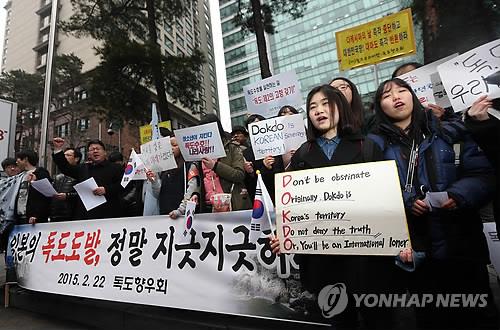
150 Koreans Protest Japan’s Takeshima Day

You would think these people would have something better to do than protest at the Japanese embassy:

http://img.yonhapnews.co.kr/etc/inner/EN/2015/02/22/AEN20150222001900315_01_i.jpg

Scores of South Koreans assembled in central Seoul on Sunday to denounce Japan for holding a ceremony that promotes Tokyo’s territorial claim over South Korea’s easternmost islets of Dokdo.

In 2005, Japan’s Shimane Prefecture, which claims administrative sovereignty over the islets, designated Feb. 22 as a day to promote Takeshima, the Japanese name for Dokdo. Since then, Shimane has hosted various programs to strengthen its territorial claims to the islets on this day.

Tokyo sent a vice-minister-level official to this year’s ceremony as a government representative, marking the third year in a row that it has sent a ranking official to the controversial event.

Some 150 South Koreans, who belong to a civic group promoting South Korea’s sovereignty over Dokdo, gathered in front of the Japanese embassy here to call for Tokyo to cancel the designation.  [Yonhap]

You can read the rest at the link, but Shimane prefecture is basically the Mississippi of Japan.  It is a poor province and in the case of Shimane it is depended on fishing and the Dokdo Islets have good fishing grounds and thus why the government in Shimane continues to promote Takeshima Day.

South Korean BMD Architecture To Be Interoperable with the US

The US may want an interoperable BMD architecture with the ROK, but they continue to maintain they are going to develop their own BMD system:


Building an interoperable missile defense system is a key focus the United States places on trilateral cooperation with its two key Asian allies, South Korea and Japan, a senior American diplomat said.

Principal Deputy Assistant Secretary of State Anita Friedt made the remark at the Japan Institute of International Affairs in Tokyo earlier Friday, echoing what Assistant Secretary Frank Rose said during a recent trip to Seoul, according to the State Department.

“With regards to trilateral cooperation among the United States, Japan, and the ROK … Developing an interoperable regional missile defense architecture is an important future area of focus in light of the increasing nuclear and missile threats posed by North Korea,” she said.

“We believe that future trilateral cooperation between the United States, the ROK, and Japan can positively impact our deterrence efforts against North Korean aggression and send a powerful message of deterrence to the DPRK (North Korea),” she added.

The U.S. wants to build a regional missile defense with South Korea and Japan in a move that critics say is aimed not only at countering North Korean threats, but also keeping China in check. Seoul has said it will build its own Korean Air and Missile Defense System (KAMD) in a way that is interoperable with the U.S. system.  [Yonhap]

You can read more at the link, but the ROK is trying to take the middle road on this to balance their relationship with China and the US.  China doesn’t want an interoperable architecture so the ROK has maintained they will build their own missile defense system.  However, as the article states the ROK’s KAMD system can be developed to be interoperable with the US if needed.