Here is another great read from ROK Drop favorite B.R. Myers who discusses how the likely ultimate goal of the current Inter-Korean talks is to lead to Seoul being able to circumvent UN sanctions:
It seems very likely, then, that the North and South had discussed the Games and agreed on key points well before Kim Jong Un’s “surprising” reference to the event in his New Year’s address. In another sign of close coordination, key phrases from that speech turned up in the joint statement issued after the first talks.
I have seen a few American op-eds warning Moon not to be naive, but I don’t believe he seriously expects the current round of talks to make the North more amenable to discussing disarmament. Regardless of his astute rhetoric to the contrary, which is aimed at Washington, denuclearization is not a priority to him or the left in general, which has long seen the North’s nuclear program as America’s problem, and no serious threat to the South.
The two Korean governments are now getting on so well because they share the short-term objective of making the North look better despite its refusal to disarm — better to the South Korean people above all, but also to the world community, whose support is vital if the South is to regain its ethnic license to bypass UN sanctions on the North. It’s hardly unrealistic for Moon to hope for such a result. [B.R. Myers]
As I have been saying repeatedly the glamorization of North Korea’s Masik Ski Resort and Mt. Geumgang are all intended to convince both the domestic and international public that South Korea should be able to restart tours to North Korea. These tours were a major cash cow for the Kim regime before they were shut down in 2008 after a South Korean grandma was shot in the back and killed by a North Korean soldier.
Here is another passage from his article I think has a lot of truth to it in regards to describing the younger generation in South Korea:
It wouldn’t do, in any case, to make too much of young people’s dissatisfaction about either the hockey team or the planned entrance into the stadium under the peninsula flag. Moon is right in distinguishing it from principled opposition to inter-Korean reconciliation. (Not that he would be put off by that either.) As I have written before, the young here generally shift between nationalism and state spirit depending on which of the two requires less action or sacrifice from them at the time in question.
The lack of strong ideological education in support of the ROK nation before one’s self is something the Kim regime is clearly taking advantage of to push their agenda.
Anyway as alway I recommend reading all of B.R. Myers article at the link.
South Korean Oceans Minister Kim Young-choon (C) attends a ceremony at the King Sejong Station on King George Island, near the northern part of the Antarctic, on Jan. 23, 2018, to bury a time capsule to celebrate the 30th anniversary of the country’s first polar research institute in the continent, in this photo released by the maritime ministry. Members of the King Sejong Station sealed their personal belongings, equipment and photos in the time capsule, which will be opened 70 years later to mark the base’s centennial. (Yonhap)
This photo captures a moment after firefighters put out a fire that broke out at a hospital in Miryang, South Gyeongsang Province, on Jan. 26, 2018. (Yonhap)
A fire gutted the ground floor of a hospital in southeastern South Korea and sent toxic fumes raging through the six-story building, killing at least 37 people and injuring 131 others in one of the country’s deadliest blazes in a decade.
Nearly 180 people were inside Sejong Hospital in Miryang, some 280 kilometers southeast of Seoul, when the fire broke out around 7:30 a.m. Witnesses said they first saw smoke coming from the hospital’s emergency room or a dressing room for nurses next to it.
The death toll was reported to have climbed to 41, but officials later corrected it, saying some victims were counted twice. Still, the toll could rise further as 18 of the injured are in serious condition, officials said.
The fire completely burned the hospital’s first floor, but didn’t reach the higher levels. But smoke was seen billowing from windows on higher floors, and most of the fatal victims were believed to have died from inhaling toxic gas. The dead included one doctor and two nurses. [Yonhap]
You can read more at the link, but I wonder if we are going to find out later that emergency exits were blocked or locked contributing to the death toll?
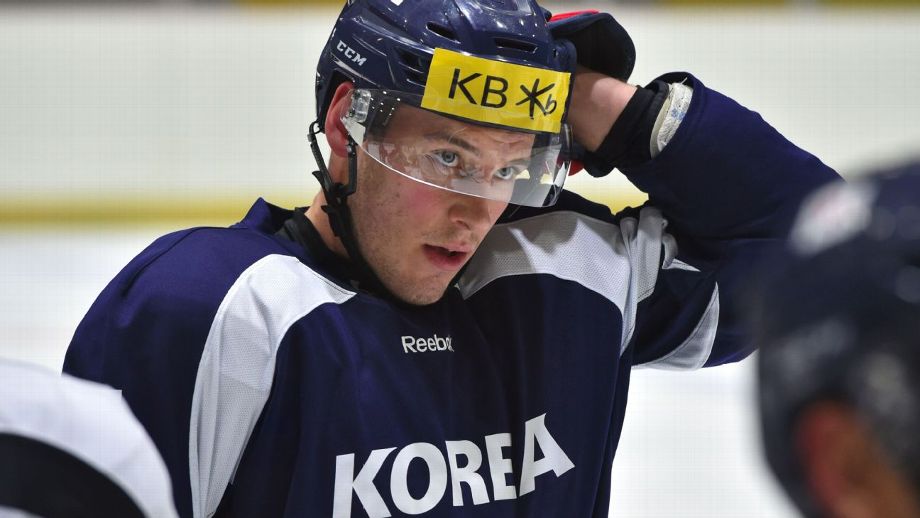
Via a reader tip comes this article about another free agent signing by South Korea for the upcoming Olympic Games. At least he earned his spot on the team and did not have it handed to him like the North Korean female ice hockey players:
In 2013-14, without much to lose, he signed with Anyang Halla, a team based about 12 miles south of Seoul, South Korea. He was driven to his apartment directly from the airport but couldn’t sleep because of jet lag. So he walked around the city and took it all in — the skyscrapers, the frantic bustling on the streets, the colorful billboards, all in a language he did not recognize. “What did I sign up for?” he wondered.
Five years later, Testwuide’s hockey career has been revived. He has rediscovered his passion for the game. He’s playing some of the best hockey of his life. In fact, Testwuide is getting ready to play on the world’s biggest stage, as an Olympian — and with a South Korean flag stitched to his jersey.
The tale of how a kid from Colorado became a South Korean citizen — with no connections or roots to the country — is quite remarkable. That Testwuide is preparing to be an Olympian is unfathomable, even to him. [ESPN]
You can read the rest at the link, but it is unclear from the article if he still has US citizenship or not. If he has dual citizenship then he gets the benefits of both playing in the Olympics and still being an American.
I think retired Army officer Steve Tharp makes a fair point to be concerned about an increase in anti-Americanism during the upcoming Winter Olympics. With that said I think the conditions are a bit different this time compared to the 2002 World Cup where this time I think the likelihood of a large increase in anti-Americanism is low:
Steve Tharp
What is unknown right now is how the Korean populace will react towards the United States and its athletes during the Olympics. In 1988, South Koreans were observed cheering wildly for the Soviet athletes during competitions against the Americans. In 2002, I watched on TV as the South Korean soccer team mimicked a speed skating maneuver in front of the American net after South Korea scored, which brought a very emotional reaction from their fans in the bar where I was watching the game. I found both events disconcerting.
A final factor will be the presence of the North Korean delegation. It has long been my contention that there is a zero-sum game in South Korea when it comes to sentiment for and against the U.S. and North Korea. When pro-North Korean sentiment increases, pro-U.S. sentiment goes down, and the converse is also true. A possible effect of the combined Korean delegation may be that some South Koreans view the U.S. and its athletes in a more negative manner.
I hope my concerns prove unfounded and that we don’t have another spike in anti-Americanism in the coming months. While there is never a good time for a wedge to be driven into the ROK-U.S. alliance, this seems an especially bad time given the current political and security situation. Let’s not repeat history but instead, as they say at the ROK-US Combined Forces Command, “Let’s Go Together!” [Korea Times]
You can read the whole article at the link, but during the World Cup timeframe many Koreans felt differently about North Korea due to the implementation of the Sunshine Policy. So when negative incidents involving Americans happened the ROK media, politicians, and public felt free to inflate their importance and bash the US. The 2002 Armored Vehicle Incident is a perfect example of this; the media published lies, politicians demagogued, and the public relentlessly bashed the US over a tragic traffic accident that USFK was deeply remorseful for.
During this same timeframe the North Koreans deliberately launched an attack that killed six ROK sailors and the media and politicians made excuses while the ROK public paid little notice. This is how strongly the Sunshine Policy altered the ROK public’s perceptions of the US and North Korea.
Since 2002, the Sunshine Policy has been revealed as a sham that gave the Kim regime billions of dollars to help develop their nuclear and ballistic missile programs. Additionally the North Koreans have made many deadly provocations to include sinking a ROK naval ship killing 46 sailors and even shelling a South Korean island with artillery. The change in perceptions of North Korea by the ROK public compared to 2002 is most evident by the relatively cool reception North Korean athletes are receiving that will attend the Winter Olympics.
With all these factors converging at the Winter Olympics I would not be surprised if US athletes receive cheers from the ROK public if they end up competing against a North Korean athlete.
Kim Jong-un may not have exactly told Koreans to surrender to his demands, but that is essentially what is being said in this statement:
North Korea sent a rare announcement addressed to “all Koreans at home and abroad” on Thursday, saying they should make a “breakthrough” for unification without the help of other countries, its state media said.
It said all Koreans should “promote contact, travel, cooperation between North and South Korea” while adding Pyongyang will “smash” all challenges against reunification of the Korean peninsula.
The announcement, issued after a joint meeting of government and political parties, added Koreans should wage an energetic drive to defuse the acute military tension and create a peaceful climate on the Korean peninsula.
Military tension on the Korean peninsula was a “fundamental obstacle” for the improvement of inter-Korean relations and unification, the North’s official news agency said.
It added joint military drills with “outside forces” has shown to be unhelpful for the development of relations between North and South Korea. [Reuters]
This message makes it pretty clear that the Kim regime wants the inter-Koreans ventures such as the Geumgang Resort tours and Kaesong Industrial Complex reopened as a means for foreign currency and to circumvent sanctions. That is why the Masik Ski Resort is being promoted so heavily as part of the Winter Olympics charm offensive by the North Koreans. They see that resort as another potential cash cow to circumvent sanctions.
This message also continues the Kim regime’s efforts to separate the ROK and the US by demanding joint military exercises be cancelled. I would not be surprised if the ROK government asks to cancel the already delayed Key Resolve exercise.
If anyone wants to get a dose of live North Korean cultural propaganda next month is your chance:
These photos taken Jan. 23, 2017 show the Gangneung Arts Center in Gangneung, 260 km east of Seoul, (top) and the National Theater of Korea in Seoul. (Yonhap)
North Korea has selected two concert venues in South Korea for its proposed art performances celebrating the PyeongChang Winter Olympics next month, the unification ministry said Tuesday.
In a message sent to South Korea on Tuesday night, North Korea said its art troupe hopes to perform at the Gangneung Arts Center in Gangneung on Feb. 8 and at the National Theater of Korea in Seoul on Feb. 11, the ministry said.
Gangneung, a coastal city located about 260 kilometers east of Seoul, is one of the Olympic venues along with nearby PyeongChang.
North Korea said its delegation plans to cross the land border into South Korea on Feb. 6 for the concerts before returning home on Feb. 12, according to the message, which was released by the ministry. [Yonhap]
Via a reader tip comes this news that the Blue House would like everyone to show respect towards North Korea during the upcoming Winter Olympics:
A conservative activist sets fire to a picture of North Korean leader Kim Jong-un and the North’s flag in front of Seoul Station Monday in protest against the North’s participation in the PyeongChang Winter Olympics. / Korea Times photo by Shim Hyun-chul
South Korea’s presidential office Cheong Wa Dae called on the public Tuesday to show more respect to all countries that will participate in the upcoming Winter Olympic Games, including North Korea, one day after a group of conservative activists staged a violent protest against the communist state.
“North Korea too is a participating country and we ought to respect it as we would respect all the others,” a ranking Cheong Wa Dae official told Yonhap News Agency.
The official added that the presidential office was set to release an official commentary on the issue.
The move comes one day after the South Korean activist group staged a protest rally in front of Seoul train station as a visiting North Korean delegation arrived there following its overnight visit to Gangneung, 240 kilometers east of Seoul, to inspect possible venues for a musical performance before or during the 2018 PyeongChang Winter Olympic Games. [Korea Times]
I would like to know what is there to respect about the Kim regime? Should Apartheid South Africa have been respected? As bad as Apartheid was it was nothing compared to human rights violations and threats to world peace posed by the Kim regime and they were banned from the Olympics.
ROK citizens should have the right to show their displeasure with the Kim regime. It will be interesting to see how the Moon administration tries to clamp down on protesters during the Winter Olympics.
The free agency in international sporting competitions continues to grow:
In this file photo, taken on Jan. 16, 2018, Seoul Samsung Thunders forward Ricardo Ratliffe gets set for a free throw during a Korean Basketball League (KBL) game against the Seoul SK Knights at Jamsil Gymnasium in Seoul. (Yonhap)
An American forward is set to play for South Korea men’s national basketball team, having completed the naturalization process on Monday.
Ricardo Ratliffe, who plays for the Seoul Samsung Thunders in the Korean Basketball League (KBL), passed his citizenship interview with the Ministry of Justice for special naturalization in the area of sports. He will be now eligible to play for the national team.
Ratliffe, a Virginia native, is considered one of the top foreign players in the KBL. The 28-year-old won the league championship in three consecutive seasons with Ulsan Mobis Phoebus from 2012 to 2015, before moving to the Thunders.
For the last six seasons, Ratliffe averaged 18.3 points and 10.3 rebounds per game. He also won the KBL’s top foreign player award twice.
Ratliffe is the fourth foreign basketball player to earn South Korean citizenship through the special naturalization process, following Moon Tae-young, Moon Tae-jong and Kim Han-byeol. However, since the previous players all had South Korean mothers, Ratliffe is the first naturalized player not of Korean descent [Yonhap]