A senior lawmaker from Korea’s ruling Democratic Party is on the record saying that their support among people in their 20s is falling because those people were “poorly educated under conservative administrations.”
It appears there are more problems with the quality of work done constructing the new buildings on Camp Humphreys:
Eighth Army commander Lt. Gen. Michael Bills, left, and Camp Humphreys garrison commander Col. Scott Mueller, right, address the community about housing concerns at Camp Humphreys, South Korea, Friday, Feb. 22, 2019.
A 10-year-old girl was stuck in an elevator for 45 minutes before somebody heard her screaming and called for help, her mother said. Soldiers complained about mold and temperature control problems in the barracks. Residents of Camp Humphreys gave commanders an earful Friday during a town-hall meeting about housing woes on the U.S. military’s new headquarters base in the rural area of Pyeongtaek, about 55 miles south of Seoul. Military and housing officials, who seemed surprised by the severity of some of the complaints, responded swiftly by sending people to check on the situation the next day. But many in the audience asked how the problems were allowed to occur considering many of the facilities are new and touted as state of the art. The meeting, held in the Four Chaplains memorial chapel, was part of a military-wide outreach effort seeking feedback from soldiers and their loved ones following congressional testimony and media reports revealing dangerous conditions on bases in the United States.
Here is what the USFK Commander had to say about this, which was essentially don’t blame us, but we are trying to fix it:
U.S. Forces Korea commander Gen. Robert Abrams explained that the Army Corps of Engineers, which oversaw the expansion project, could not do quality checks until 80 percent of the project was complete according to the bilateral agreement. The hospital and some other facilities have failed that test in the past, forcing the builders to go back and fix things even if that meant starting from scratch. “We’re actually at the mercy, if you will, of those contractors,” he told the audience. The four-star later clarified that he understands why South Korea wanted the oversight since it is making such a huge investment in the base. “We can provide feedback, which we do. We have direct access and we’re pretty aggressive about it,” he told Stars and Stripes. “I was really driving home the point that this is not the garrison’s fault and it’s not our Corps of Engineers’ fault.”
You can read more at the link, but the Camp Humphreys expansion project has been plagued by corruption scandals over the years so the fact Soldiers are dealing with apparently poor construction should not be too surprising to everyone.
Considering the strained relations currently in the ROK-Japanese relationship this decision is not surprising:
Japan will not send its warship to waters off the Korean Peninsula for a multinational maritime exercise this spring, a government source here said Friday, amid tensions over a military spat and historical issues. South Korea, the 10-member Association of Southeast Asian Nations (ASEAN) and other partner countries plan to stage the maneuvers from April 29 to May 2 in waters off South Korea’s southeastern port city of Busan and then from May 9 to May 13 in waters off Singapore. Japan will skip the drills near Busan, but take part in those around Singapore, the source said on condition of anonymity. The exercise will focus on enhancing multilateral cooperation in countering maritime crimes and protecting gas fields or other ocean-based facilities. The decision came at a meeting of the maritime security expert working group of the ASEAN Defense Ministers’ Meeting-Plus (ADMM-Plus), held in Busan from Thursday through Friday. South Korea and Singapore co-chair the working group this year. Seoul’s defense ministry confirmed that Japan will not deploy any vessels to the planned drills around Busan, but it plans to send two warships to the exercise in waters off Singapore.
It will be interesting to see how vigorously this crackdown is enforced:
Police and the justice ministry have launched a rare joint crackdown on undocumented foreign workers and their Korean employers.
The crackdown will last for one month during which officials will scrutinize workplaces known for having many illegal foreign workers. Primary targets include construction sites, massage parlors, bars and other night entertainment facilities.
Illegal foreign workers will be subject to deportation and banned from entering Korea for 10 years. Employers caught hiring them will be prosecuted.
If it wasn’t bad enough that so called “meritorious persons” are receiving much more lavish government benefits than veterans, now certain veterans may not even be able to get buried in a national cemetery:
National Cemetery, ROK
A controversy surfaced when the Ministry of Patriots and Veterans pursued an initiative to cancel burial benefits for military veterans with less than 20 years service but more than 10 years service and instead make room for the burial of those who participated in candlelight protests and those designated as “Democracy Movement Meritorious Persons.” This means certain military veterans will no longer be eligible to be buried at the national cemeteries. The Korean War Veterans Association and other veterans groups strongly opposed the move.
For something that is technically illegal in South Korea, it is widely practiced:
Members of women’s groups hold a performance at a square in Seoul in this September photo, to call for the abolishment of a law that punishes women who have abortions. Korea Times file
Around 20 percent of Korean women who get pregnant have abortions, according to a government survey, Thursday.
The Korea Institute of Health and Social Affairs (KIHASA) announced the result of the survey, which it conducted on behalf of the Ministry of Health and Welfare on 10,000 women aged between 15 and 44 online from September to October.
It was the third government survey on abortion, an illegal practice here ― except in certain life-threatening circumstances and in the cases of rape and incest ― but widely conducted secretly. Previous surveys were conducted in 2005 and 2010.
You can read more at the link, but to put this into perspective, this 20% number is very similar to the United States where it is estimated that 25% of women will have had an abortion by age 45.
Dr. Tara O over at the East Asia Research Center has another very interesting article published about how government compensation payments to “meritorious persons” from the Gwangju Uprising are so much higher than those given to Korean and Vietnam War veterans:
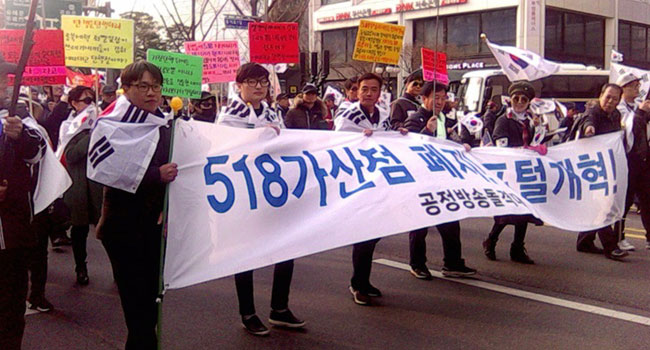
Youth march while holding sign: “Cancel the 5.18 extra points for civil servant employment”
The Gwangju Incident that began on May 18, 1980 is referred to as “5.18” in Korea. Those designated as 5.18 Yugogja (5.18 “Meritorious Persons”) and their families receive extensive benefits from the South Korean government. Unlike Korean War and Vietnam War veterans, whose status is determined by the Ministry of Patriots and Veterans, the 5.18 Yugongja is determined in Gwangju. While technically it falls under the Prime Minister’s office, de facto, the process and the decisions are made at the local government level. However, it is the national government that pays the benefits.
Below is an excerpt of a chart that shows the differences in compensation. Click the link to see the full chart:
Besides the extreme difference in compensation here is what makes this issue even more controversial is that the lists keeps growing. Plus politically connected people who were not even at Gwangju are now being selected as “meritorious persons” and getting the free cash and benefits:
For an event that occurred 39 years ago, it seems the number of 5.18 Yugongja should fall over time. However, the number has been increasing, especially in recent years. In 1990, the first year the 5.18 Yugongja designation occurred, the number was 2,224. As of August 2018, the number was 4,403. In 2017, the number was 4,377, so it has increased by 26 in 8 months. How is this possible?
It includes even those who were not present in Gwangju. National Assemblyman Lee Hae-chan, the leader of the Deoburreo Minju Party, publicly admitted, “I became a Gwangju democracy Movement Yugongja, although I hadn’t even gone to Gwangju (then).” (0:30). Lee Hae-chan was the former Prime Minister under Rho Moo-hyun and Education Minister under Kim Dae-jung. At least 30-40 other politicians are thought to be designated as 5.18 Yugongja.
This has caused conservative politicians to demand the release of the names of this growing list, but unlike the list of Korean and Vietnam War veterans this list is being kept secret. I think it is fair to say that certain people do not want the list released because it will show how it has become a way to reward politically connected people, thus why it keeps growing.
I am trying to think of an equivalent of politically connected corruption in the U.S. using a national medal of designation and I can’t think of one. The Presidential Medal of Freedom has long been given to politically connected people, but they are not getting huge payouts like in the ROK. Can anyone think of equivalent in the U.S. where politically connected people are getting huge payouts for an award or designation?
The USFK commander’s remarks makes me wonder if he inadvertently spoke about something already being discussed at higher levels?
This photo, taken on Dec. 11, 2018, shows U.S. Forces Korea Commander Gen. Robert Abrams attending an alliance event in Seoul. (Yonhap)
The U.S. Department of Defense has reaffirmed that the issue of the American troop presence in South Korea is not directly related to denuclearization talks between Washington and Pyongyang, multiple Seoul officials said Thursday. It delivered the message recently to Seoul’s Ministry of National Defense amid a controversy over U.S. Forces Korea (USFK) chief Gen. Robert Abrams’ remarks at a congressional session, which were seen as signaling the possibility of the U.S. troop withdrawal — or drawdown — after a peace treaty is signed with North Korea, according to the officials. In response to a senator’s question Tuesday about the USFK, the commander said his troops will stay on the peninsula, “Until there is a peace treaty, because we still remain in a state of armistice, a cessation of hostilities, until such time that there is a peace treaty between all of the parties.”
Are there any ROK Heads living in Korea excited about this news?:
The Seoul High Court ruled that the import of sex dolls should not be prohibited on grounds that that it corrupts public morals.
In 2017, a company made an import declaration of a 159-centimeter-tall headless sex doll made of silicon that resembles a female body, but Incheon Customs put the entry on hold, saying it corrupted public morals. (…….)
In reversing the lower court decision, the Seoul High Court said that while it may seem vulgar, it does not show the sexual areas in full display to justify the claim that it destroys human dignity.
The court added that the country should not interfere with one’s private life to protect dignity and freedom, and there are no legal grounds to regulate the import of sexual devices.
Fortunately this was just another small quake because I would hate to see what would happen if a massive quake ever hit the Korean peninsula:
A four-point-one magnitude earthquake struck off the southeastern city of Pohang on Sunday.
The Korea Meteorological Administration said that the quake took place at 12:53 p.m. in waters 50 kilometers east-northeast of the port city at a depth of 21 kilometers.
The KMA had earlier announced the quake’s magnitude was four but later revised it.
A KMA official said that it is a quake-prone region, but the magnitude is larger than usual, adding there have been no reports of damage received so far as the location is about 50 kilometers off the coast.