When people think of provocations from North Korea most people today think that the deadliest incidents from the rogue regime have been targeted against South Korea. The largest loss of life from one provocation by North Korea was the sinking of the ROK Navy ship the Cheonan in 2010 that killed 46 personnel on the ship and wounded 56 more. What many people don’t realize is that the US military historically has been subject to many provocations from North Korea as well to include the 2nd deadliest attack, the shoot down of an EC-121 reconnaissance plane that killed all 31 men on board.
This deadly attack occurred on April 15, 1969 when the EC-121 which used the call sign “Deep Sea 129” was shot down in international waters 167 kilometers off the coast of North Korea. The EC-121 is an intelligence gathering platform that picks up radio transmissions in the area that it is conducting surveillance of. The mission of the Deep Sea 129 would not only be to pick up radio transmissions from North Korea, but from China and Russia as well. The military has conducted these flights on behalf of the National Security Agency (NSA) for many years.
The routine flight of the Deep Sea 129 began at 0700 local time when it took off from Atsugi, Japan. On board were 8 officers and 23 enlisted men under the command of LCDR James Overstreet. The plane first flew over Japan and then over the Sea of Japan. Once over the Sea of Japan the EC-121 flew in a clockwise ellipse as it collected signal intelligence from the region. LCDR Overstreet was given orders that his flight pattern would not go any further than 90 kilometers from North Korea. Radars at Osan Airbase in South Korea as well as back in Yokota Airbase in Japan tracked the missions progress as well as looking for any aircraft being dispatched from North Korea. At 12:34 local time radars at Osan Airbase detected that two MIG-17s had been launched by North Korea. At 13:00 Deep Sea 129 issued a routine report and everything seemed normal. At 13:22 the radars as Osan lost track of the two MIG-17s and reacquired them at 13:37. When the aircraft were reacquired it became obvious that the MIGs were dispatched to intercept the EC-121. At 13:44 Deep Sea 129 was alerted that they were being intercepted. At 13:47 the MIGs had reached the vicinity of Deep Sea 129 and then at 13:49 the EC-121 disappeared from the radar screen.
After the EC-121 disappeared from the radar screen the operators originally thought that it may have followed normal procedures and dropped to an altitude below radar coverage. This thought prevailed because the operators figured that if the MIGs were acting hostile to the EC-121 than LCDR Overstreet would have radioed something back to Japan. However, after 10 minutes had past and no radio transmission had been received from LCDR Overstreet, people began to fear the worst. Two US jets were dispatched from Japan to conduct a Combat Air Patrol of the area where the EC-121 had last been tracked. By 14:44 almost an hour after Deep Sea 129 was last tracked, the CAP planes could not find the EC-121 and the command in Japan decided to send an urgent message back to the Pentagon and the White House that they feared the EC-121 had been shot down.
The reactions from political leaders in Washington once the news was heard was initially very harsh. On Capitol Hill, Mendel Rivers, chairman of the House Armed Services Committee, proclaimed: ‘There can be only one answer for America-retaliation, retaliation, retaliation!’ Chairman of the House Armed Services Committee, Rep. L Mendel Rivers, called for military retaliation against North Korea with “whatever is necessary. If nuclear weapons are required, let them have it. It’s time to give them what they ask for.”
As the political leadership back at the US reacted to the shoot down the military command back in Japan prepared a massive search and rescue effort to recover the plane and any survivors. The plane had life rafts the crew could have used if the plane crashed intact. The seas were not too rough and temperatures were in the 40s. So if the crew survived the crash they had a high chance of survival in the conditions if found quickly. The search was conducted by C-130s from Japan that were supported by a K-135 Stratotanker to provide fuel support. These search and rescue aircraft were further supported by CAP aircraft. In total 26 aircraft were used during the search and rescue operation. Besides the aircraft two American destroyers, the USS Dale and the USS Tucker reached the suspected crash site around 9PM. The Soviet Union would also dispatch two destroyers to search for survivors as well. The Soviets were probably eager to show the US they did not support the North Koreans actions by assisting with the search and rescue. The Soviet destroyer the Vdokhnovenie recovered pieces of the downed aircraft as well as the only two bodies found during the entire search effort. The bodies of LTJG Joseph R. Ribar and AT1 Richard E. Sweeney were turned over to the USS Tucker on April 17th. This ended the search and rescue operation and the bodies of the other 29 crew members were never recovered.
With the end of the search and rescue operation, US President Richard Nixon had to decide on what to do in response to North Korea’s deadly provocation. During this time period North Korea had even taken the rare step of bragging on their state radio station of shooting down the aircraft that they said was flying over their territorial waters. Despite calls for retaliation from various political figures Nixon decided to go with most other officials were recommending which was essentially to do nothing. With the war raging in Vietnam many US officials thought it was unwise to open up a possible second front war on the Korean peninsula. So he decided not to do anything provocative against the North Koreans such as bombing the airfield where the MIGs that shot down the EC-121 flew from. Instead he conducted a show of force by continuing the reconnaissance flights while backed with appropriate naval and Air Force support to protect them. This showed American resolve to the North Koreans while not creating a second war in Asia.
What I cannot understand is why the EC-121 was left without escort of some kind in the first place? The mission of the EC-121 was very similar to what the USS Pueblo ship was doing when it was fired upon and captured by the North Koreans in 1968. Considering that North Korea had shown previously an intent to target US reconnaissance efforts it seems surprising to me that the Pentagon was allowing the EC-121 flights off the coast of North Korea to continue with out a fighter escort or at least ships in the Sea of Japan that could provide better early warning of any potential North Korean fighters trying to intercept them.
Below is a list of all the lives that were lost by this act of North Korean aggression. Like all the other lives brought to an early end by the thugs and killers of the Kim regime in North Korea these men should not be forgotten:
Petty Officer 1st Class Eli Redstone rings the bell twice for each of the 31 U.S. troops killed on April 15, 1969, when North Korean fighters downed their EC-121 reconnaissance plane over the Sea of Japan. Wednesday’s ceremony marked the 40th anniversary of the attack. Matthew M. Bradley/Courtesy of the U.S. Navy
Korean War Service: 2-19 Infantry Regiment, 24th Infantry Division
Posthumously recognized with the Medal of Honor in 1951.
Picture of Mitchell Red Cloud Jr. in his US Army uniform. Picture via FreeRepublic.com.
Introduction
For soldiers that receive orders to the 2nd Infantry Division located near the Demilitarized Zone in South Korea one of the camps that all soldiers will eventually visit or at least hear about is Camp Red Cloud. This camp is located in the commuter city of Uijongbu just north of South Korea’s capitol of Seoul. Camp Red Cloud is home to 2ID’s division headquarters and other support units. Though every soldier in the 2nd Infantry Division knows of Camp Red Cloud very few actually know who the camp is named after. I can remember when I once had a lieutenant ask me if the camp was named after the sunsets seen from the camp over the mountains in the evenings. What many people do not realize is that Camp Red Cloud is actually named after a person and not for any red clouds seen in the air. The person the camp is named for is Mitchell Red Cloud Jr. who was recognized with the Medal of Honor for combat actions during the Korean War.
Mitchell Red Cloud Jr. was born on July 2, 1924 in Hatfield, Wisconsin on the traditional lands of the Winnebago Native-American tribe to Mitchell Red Cloud Sr. and Lillian Winneshiek. Mitchell Jr. was the oldest of three boys that the couple would have. As a boy Mitchell Jr. was well known for his outdoor skills that he perfected while going on hunting and fishing trips on the reservation. Mitchell Jr.’s schooling began at the Clay and Komensky Rural School before moving on to the Winnebago Indian School for a year. For high school he enrolled in the Black River Falls High School before deciding to drop out at the age of 16.
Red Cloud During World War II
Mitchell Jr. made the decision to drop out of high school because he wanted to pursue a career in the US military. Just one month after his 17th birthday he received permission from his dad to enlist in the Marine Corps. Red Cloud’s enlistment date into the Marines was on August 11, 1941. Due to his outdoors skills and physical conditioning honed from growing up on the Indian Reservation, Red Cloud excelled at boot camp and became an outstanding Marine. His first duty assignment was at Camp Elliot in San Diego when the Japanese bombed Pearl Harbor on December 7, 1941. After the bombing Red Cloud was assigned to the 2nd Marine Raider Battalion and deployed to the Pacific to fight in World War II. In November 1942, the then Private First Class Mitchell Red Cloud found himself in heavy combat on the island of Guadalcanal which was the scene of some of the most ferocious fighting of all of World War II.
Red Cloud spent a month in the jungle with the Raider Battalion fighting the Japanese on the island. After the US military was able to secure Guadalcanal from the Japanese, Red Cloud like many other personnel that served on the island became sick with the tropical diseases malaria and jaundice. He suffered extreme weight loss and was sent back to the US for medical evaluation in January 1943. The medical personnel recommended a discharge for Red Cloud but he refused. Red Cloud’s refusal to accept a discharge saw him redeployed to the Pacific theater again just in time to participate in another brutal fight against the Japanese; this time on the island of Okinawa. On May 17, 1945 while serving as a radio operator during the Battle of Okinawa PFC Red Cloud was shot in his left shoulder. He was medically evacuated to Guam for treatment before being shipped back to the US.
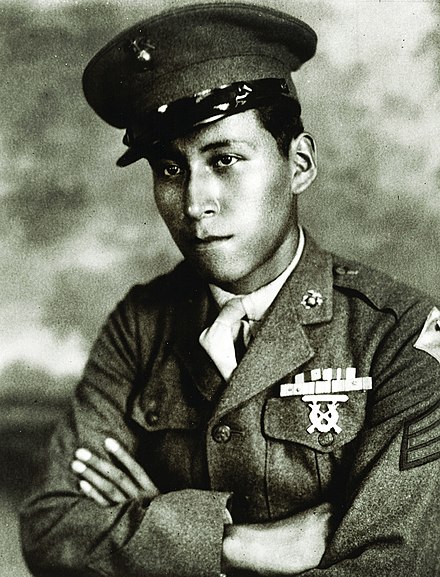
Picture of Mitchell Red Cloud in his Marine Corps uniform during World War II. Picture via Wikipedia.
With World War II over Red Cloud accepted his discharge from the Marines on November 9, 1945. The Marines gave him an honorable discharge and $56.70 before he returned to the Winnebago Indian Reservation in Wisconsin. While on the reservation Red Cloud got married and his wife gave birth to a daughter. Despite these personal developments in his life outside the military, Red Cloud decided after only two years on the reservation to reenlist in the US military. Red Cloud decided this time to not join the Marines, but instead the US Army in 1948. I wasn’t able to find anything definitive on why Red Cloud reenlisted in the military, but maybe he just grew restless after experiencing so much combat during World War II? Maybe it was just the more practical matter of providing for his family that caused him to reenlist in the military? His younger brother who had enlisted in the Army had just did in a peace time training accident; so maybe Mitchell enlisted in honor of his brother? Finally maybe he enlisted because after spending two years away from the Army he realized he is a true warrior and the military was his calling? For whatever the reasons were the US Army was getting an experienced soldier that was badly needed in the US military that had lost the vast majority of its combat veterans due to the post-World War II drawdown.
Red Cloud During the Korean War
The first unit Red Cloud was assign to was E company, 2 battalion, 19 Infantry Regiment of the 24th Infantry Division. The 24 ID at the time was responsible for conducting peacekeeping duties on the southern Japanese island of Kyushu. The assignment to Japan must have seemed like easy duty for Red Cloud compared to what he had been through during World War II. However, the relaxed time he spent in Japan didn’t last long when on July 3, 1950 the 24th ID was deployed to the Korean peninsula to stop the communist backed North Korean military that had invaded South Korea. The North Korean military crossed the DMZ that separates the two countries on June 25, 1950 and appeared to be on its way to reuniting the country that had been divided by US and Russian occupation forces after World War II. US President Harry Truman however decided to militarily intervene to stop the communist invasion of the Korean peninsula and the only troops immediately available to deploy to Korea were the peacekeeping troops located in Japan. Most of these troops were draftees that had not fought during World War II and had little combat training while stationed in Japan. Though these troops were eager to fight in what was being called a “police action” at the time; it would be up to hardened World War II vets like Mitchell Red Cloud to get these guys ready for battle. Red Cloud at the time of his deployment to Korea was a 25 year old Corporal who was respected by the men in his unit due to his prior combat experience. He had the nickname “Chief”, was easy going, and was quick to give advice to the younger troops that all looked up to him. They would soon learn to respect him even more.
Taskforce Smith soldiers arrive in Daejon during the Korean War, picture via Wikipedia.
Of the four US military divisions stationed in Japan, the 24ID was chosen to be the first to deploy to Korea. The first element of the 24th Infantry Division to arrive in Korea was the ill fated Taskforce Smith that first saw action against the North Korean military just south of Osan. The light infantry unit found themselves in battle against a foe with Soviet provided tanks and due to the superior firepower Taskforce Smith was soundly defeated. You can read more about Taskforce Smith at the below link:
Defeat would become a reoccurring theme for the other 24th ID units who were thrown into combat against the North Koreans with little to no weapons to combat the North Korean tanks. The battlefield chaos for the 24th ID reached its climax when the Division Commander Major General William Dean was captured during the Battle of Taejon. You can read more about General Dean at the below link:
This was the chaos that Corporal Red Cloud found himself in that most have been vastly different experience for him compared to his time in World War II. During that war he had fought in many successful battles against a much more dangerous enemy and now just a few years later he was part of one of the greatest military debacles in US history.
The 24th ID may have been soundly defeated by the North Koreans, but it and the other divisions from Japan that were thrown into battle, did enough to slow down the North Korean invasion until more troops from the US could arrive to help hold the Pusan Perimeter. Red Cloud and the rest of the men in the 2-19 Infantry Regiment saw combat soon after arriving in country on July 12, 1950. The unit saw combat during the defense of Daejon and then moved south towards Taegu and held part of the line along the Pusan Perimeter. Eventually General Douglas MacArthur would execute his famed Incheon Landing Operation that changed the course of the war and threw the North Koreans into a massive retreat. This allowed the 24th ID to reconstitute itself and soon enough Corporal Red Cloud and the rest of the personnel in the division were crossing the DMZ into North Korea to finish the war. In November 1950 the US military and its United Nations allies who had recently deployed troops to Korea, had advanced deep into North Korea when unbeknownst to them the Chinese military had decided to come to the aid of their communist ally North Korea. The unexpected attack by the Chinese caused the US and UN forces to a massive retreat that was quickly turning into yet another military debacle. This was the state of the war that Corporal Red Cloud now found himself in as he sat in a listening post on a hill north of the Chongchon River in North Korea on November 5, 1950.
The Chongchon River can be seen at the very bottom of the map which is located just north of the North Korean capitol city of Pyongyang. To the northwest of the river the positions of the 19th Infantry Regiment on November 1, 1950 can be seen. Map via Wikipedia.
The UN forces were in retreat and the bridge across the Chongchon River was a critical asset to support the southward movement of friendly forces. The 27th British Commonwealth Regiment which had just recently deployed to Korea and Red Cloud’s 19th Infantry Regiment were both positioned on the north side of the river to defend the bridge on November 2, 1950. Due to the shortage in personnel there was a five mile gap between the two units that was to be patrolled to prevent infiltration by the Chinese. However, the patrols ended up proving ineffective as the Chinese were able to successfully probe and discover this gap between the two units.
On the night of November 5, 1950 a 1,000 Chinese soldiers from the 355th Regiment were able to follow field telephone lines laid down in this gap to the positions of the 19th Infantry Regiment. Fortunately for E Company they had someone in a listening post that night that was awake and very attentive in looking for any Chinese infiltrating towards their position on Hill 123. That man was Corporal Red Cloud. A friend of Red Cloud’s in the company, Private First Class Ed Svach would later tell how Corporal Red Cloud had once told him that he could smell the Chinese coming. Red Cloud said, “It’s like hunting those Wisconsin deer. I can smell them coming.”
Red Cloud had been in a listening post that night with his assistant machine gunner on a ridge below the company command post. Red Cloud also knew how the Chinese liked to attack. The Chinese would launch a small frontal attack to draw attention that way but the main attack force would actually be infiltrating from the sides and rear. That is why Red Cloud set up his listening post to the side and rear of the company command post. At 3:20 AM in the morning Red Cloud let out a cry when he spotted Chinese infiltrating towards the E Company position who were following the communications wire leading to the command post. After being spotted the Chinese charged Red Cloud’s position from a 100 feet away and shot and killed his assistant machine gunner. Using his Browning Automatic Rifle (BAR), Red Cloud stood up out of his listening post and unleashed direct fire into the advancing Chinese. Red Cloud’s direct fire slowed the Chinese assault and bought time for the Company Commander, Captain Conway to wake everyone up and consolidate the defense of the E Company position. Unfortunately Red Cloud’s warning was not enough to alert everyone in the company in time because the Chinese were able to shoot some of the US soldiers in their sleeping bags. E Company was getting over run and one veteran of the battle is quoted in John McCain’s book, “Why Courage Matters” as saying:
“I wanted to bug out. I just couldn’t figure out how”
While Red Cloud was holding off the initial Chinese assault he was shot twice in the chest. One of the E company medics, Perry Woodley went to Red Cloud’s position and applied pressure bandages to his two chest wounds. Red Cloud seemed fine and continued to fire his BAR at the Chinese. Woodley left Red Cloud to go help other wounded soldiers. He returned a short time later to check up on Red Cloud again. He found Red Cloud surrounded by about a dozen Chinese bodies and more severely wounded than from when he last saw him.
Position of the 2-19 Infantry Regiment north of the Chongchon River where Corporal Mitchell Red Cloud Jr. was killed in action. Notice the area that the Chinese infiltrated through just west of the 2-19th’s position to get into their rear area. This was the gap between them and the British 27th Brigade which was mostly composed of Canadians that was supposed to be patrolled by both units to detect the Chinese. Map via Wikipedia.
Woodley told Red Cloud that he had to get off the mountain or he was going to die there. Red Cloud refused medical evacuation from his position and instead propped his wounded body up on a tree to continue firing at the advancing Chinese with the BAR. One soldier at the bottom Pete Salter said that he actually used a web belt to tie Red Cloud to the tree so he could stay up right to keep firing. Something not widely known about this battle is that another man, PFC Joseph Balboni stayed in a position near Red Cloud that created a crossfire that pinned the Chinese down enough for other men in the company to try and escape down a draw to the south.
After Woodley and Salter left the position they could hear the BARs from Red Cloud and Balboni continuing to fire on the advancing Chinese. The battle lasted for about an hour before Corporal Red Cloud and PFC Balboni would eventually be killed by the advancing Chinese. However by this time the men of E Company were well alert and retreating off the hill side from the massive Chinese assault to supplementary fighting positions a 1,000 yards to the south. From there the regiment was able to consolidate and make a defensive line to hold off any further Chinese attacks. There four quad 4′s with .50 cal machine guns were used to clear the hillsides of Chinese troops chasing the E Company survivors down the draw. Other units in the battalion would not be as lucky as E Company, if you can call E Company lucky. The nearby A Company would be nearly wiped out as many soldiers were killed while sleeping in their foxholes due to the surprise Chinese attack. E Company soldiers that survived that battle said that their unit likely would have been wiped out too if it wasn’t for Corporal Red Cloud holding off the Chinese attack.
The next morning with the sun out which provided air cover, the battalion was able to return to the old E company position to retrieve the bodies of the deceased. They found that the dead Americans soldiers had been stripped to include Mitchell Red Cloud. The only deceased soldier not stripped was 1st Lieutenant Leslie Kirkpatrick who had all of his clothes and gear on except for a missing West Point ring. Kirkpatrick had been killed while coming to the aid of a wounded soldier during the battle. His body was found with his head lying on his helmet as if he was sleeping. It is believed that one of the other lieutenants in his company placed his body like that after recovering his West Point ring to give to his wife. However, that lieutenant had been killed as well during the battle and the Chinese stripped his body and took the ring. Kirkpatrick was a 1949 graduate of West Point. Of the 670 cadets that graduated that year, 41 of them to include Kirkpatrick were killed in action during the Korean War.
Picture of Leslie Kirkpatrick as a cadet at West Point. Picture via SidneyLanier.org.
Red Cloud’s stripped down body was found lying near the tree where he died. He had been reportedly shot a total of eight times. All around Red Cloud were the bodies of Chinese soldiers. It was reported that over 30 Chinese bodies were found around Corporal Red Cloud’s position. Corporal Red Cloud’s recovered body would eventually be laid to rest in the United Nations Cemetery in Pusan. The other BAR gunner PFC Balboni would be credited with killing 17 enemy soldiers before being killed himself. PFC Balboni would posthumously be recognized with the nation’s second highest honor, the Distinguished Service Cross. In all the battalion estimated that about 500 enemy soldiers had been killed on the hill that day.
Post-Korean War Honors
A few months later in April 1951 the Congressional Medal of Honor was presented to Corporal Mitchell Red Cloud Jr.’s mother during a ceremony held at the Pentagon. She was presented the medal by General Omar Bradley. Here is what his Medal of Honor citation says:
At the Pentagon in April 1951, Lillian “Nellie” Red Cloud, mother of the late Cpl. Mitchell Red Cloud Jr., is handed the Medal of Honor awarded her son for his “dauntless courage and gallant self-sacrifice” against Chinese forces in North Korea the night of November 5, 1950. Gen. Omar N. Bradley, then-Chairman of the Joint Chiefs of Staff, is at left. ” – See more at: http://korea.stripes.com/base-info/cpl-mitchell-red-cloud-jr-annual-ceremony-planned#sthash.AZOcG1Oc.dpuf
Cpl. Red Cloud, Company E, distinguished himself by conspicuous gallantry and intrepidity above and beyond the call of duty in action against the enemy. From his position on the point of a ridge immediately in front of the company command post he was the first to detect the approach of the Chinese Communist forces and give the alarm as the enemy charged from a brush-covered area less than 100 feet from him. Springing up he delivered devastating pointblank automatic rifle fire into the advancing enemy. His accurate and intense fire checked this assault and gained time for the company to consolidate its defense. With utter fearlessness he maintained his firing position until severely wounded by enemy fire. Refusing assistance he pulled himself to his feet and wrapping his arm around a tree continued his deadly fire again, until he was fatally wounded. This heroic act stopped the enemy from overrunning his company’s position and gained time for reorganization and evacuation of the wounded. Cpl. Red Cloud’s dauntless courage and gallant self-sacrifice reflects the highest credit upon himself and upholds the esteemed traditions of the U.S. Army. for conspicuous gallantry and intrepidity in action at the risk of his life above and beyond the call of duty in Chonghyon, Korea, 5 November 1950.
At the Pentagon in April 1951, Lillian “Nellie” Red Cloud, mother of the late Cpl. Mitchell Red Cloud Jr., is handed the Medal of Honor awarded her son for his “dauntless courage and gallant self-sacrifice” against Chinese forces in North Korea the night of November 5, 1950. Gen. Omar N. Bradley, then-Chairman of the Joint Chiefs of Staff, is at left. ” Photograph via the Stars & Stripes
In 1955 his family was able to get his body moved from the UN Cemetery to the Ho-Chunk Cemetery on the Winnebago Indian Reservation back in Wisconsin so he could lay in rest with the rest of his tribe. His friend Ed Svach escorted the body back to the US where he remembered his friend being buried in the custom of the Winnebago people. The sides of his coffin were removed so his soul could escape, a bow and quiver of arrows was laid next to him so he could hunt in heaven, and bowl of fruit was laid next to him so head would have something to eat during the journey.
Mitchell Red Cloud Jr.’s grave in Wisconsin. Picture via FindaGrave.com.
In John McCain’s book, “Why Courage Matters: The Way to a Braver Life” he includes quotes from veterans from the battle that say they owe their lives to Mitchell Red Cloud. One of the survivors, Pete Salter said that during the battle he prayed to God in his foxhole to let him survive this fight and he would live a better life. He said his prayers were answered by Mitchell Red Cloud who sacrificed his life so many other men could survive. Salter in the mid-1960’s would take his kids to the Winnebago Indian Reservation to see the grave of Corporal Red Cloud. Salter broke down crying at the site of the grave of the man who had saved his life. Inscribed on Red Cloud’s grave are these words:
“The son of a Winnebago chief and warriors who believe that when a man goes into battle, he expects to kill, or be killed and if he dies he will live forever.”
Picture of marker above Mitchell Red Cloud’s grave site in Wisconsin. Picture via FindaGrave.com
Since Corporal Red Cloud’s death, the US military has made efforts to ensure that his memory does live forever by naming various military installations and equipment in his hnor. The first thing that I could find that was named after Red Cloud was when Camp Red Cloud in Uijongbu, South Korea was named after the Medal of Honor recipient.
Mitchell’s Club on Camp Red Cloud is named after him as well. There is also a rifle range on Ft. Benning, Georgia that is named after him. On August 7th, 1999 the newly commissioned strategic sealift ship, the USNS Red Cloud was launched from its dock in San Diego in honor of the fallen warrior. His daughter Annita Red Cloud, his granddaughter Tris Yellow Cloud, and other dignitaries from the Ho-Chunk tribe were there for the ceremony. Kenneth Kershaw, a veteran of E Company, 19th Infantry, who was able to survive the battle that night also attended the ceremony. He simply told the crowd that he attended the ceremony because “If it were not for the alarm sounded by Mitchell Red Cloud, I would not be here today.” The last commemoration I can find for Red Cloud was on the 50th anniversary of his death in 2000. The Korean War Commemoration Committee held a ceremony in honor of Red Cloud at his grave site in Black River Falls, Wisconsin. The committee presented Red Cloud’s daughter Annita with the Republic of Korea War Service Medal that had recently been authorized by Congress for Korean War veterans to wear.
Despite these attempts by the military to honor Corporal Red Cloud within the American public and even the US military his story is widely unknown. Red Cloud’s life story is why I have continued to advocate for Hollywood to explore using stories from the Korean War as movie material. A movie based around E Company with Mitchell Red Cloud as a main character and climaxing with the Battle of Hill 123 would make for a great movie. Red Cloud’s life is one to be remembered not just for his Korean War service, but for his service in World War II as well. There probably are not many US military servicemembers that fought at Guadalcanal and Okinawa during World War II and then the Busan Perimeter and then finally against the Chinese during their intervention into the Korean War. Clearly Mitchell Red Cloud Jr. is not only a Hero of the Korean War, but one of the nation’s most heroic military heroes that unfortunately few people know anything about.
Note #1: More stories about Heroes of the Korean War can be read at the below link:
Note #2:During my research I found only the two above photographs of Mitchell Red Cloud. If anyone knows of more photographs of Red Cloud please leave a link in the comments section.
Note #3:If anyone knows where to find a picture of PFC Joseph Balboni I would like to post his picture here as well.
Note #4: If anyone knows of any other buildings or site named after Mitchell Red Cloud Jr. please leave a comment and share it with everyone else.
Private First Class Anthony T. Kaho’ohanohano via Army.mil.
Introduction
The Korean War saw people from many countries come to the peninsula and fight and die to protect the Republic of Korea from communist aggression. Some of those people who came to Korea to fight were Americans from the Hawaiian Islands. In downtown Honolulu the Hawaii Korean War Memorial can be seen that lists the names of all 456 residents of Hawaii who died fighting in the Korean War. The memorial is about a 100 feet in length, 6 feet high and made of polished granite and black lava rock. On each of the rock squares is the name of each Hawaii resident that died during the war.
Early Life
One of the names on these blocks is Anthony T. Kaho’ohanohano from the Hawaiian Island of Maui. Kaho’ohanohano was born in 1930 to a family with 5 other brothers and a sister. This large family lived in a two bedroom house in the village of Wailuku in Maui. Anthony graduated in 1949 from St. Anthony High School where he played both football and basketball and was known as the “humble giant”. After high school he like all of his other 5 brothers joined the military; three of his other brothers joined the active Army, one other brother served in the Marines, and the last brother served in the National Guard. Anthony initially enlisted in the Hawaii National Guard, but later joined the active Army on February 5, 1951 to fight in the Korean War.
Picture of Kaho’ohanohano as a high school football player via Wikipedia.
Korean War Service
Anthony Kaho’ohanohano was later that year deployed to South Korea where UN forces were battling communist aggression against the Republic of Korea. By 1951 the war had changed dramatically from what appeared was going to be a rout of the North Korean military by the UN forces after the successful Incheon Landing Operation. With the North Korean forces largely defeated the Chinese military secretly infiltrated across the Yalu River into North Korea where they launched a massive surprise attack against the UN forces. The effectiveness of the Chinese surprise attack caused a full scale UN forces retreat back across the 38th parallel into South Korea. The retreat was only halted in February 1951 when soldiers from the 2nd Infantry Division and their attached French Battalion under the command of two Heroes of the Korean War, Colonel Paul Freeman and Lieutenant Colonel Ralph Monclar stopped the Chinese advance at the Battle of Chipyong-ni.
The Chinese would attempt to regain their battle field momentum when they launched the “Chinese Spring Offensive” in April 1951. However, United Nations units such as the British Gloucestershire Regiment commanded by Lieutenant Colonel James P. Carne, the Philippines Expeditionary Force To Korea (PEFTOK) commanded by Lieutenant Colonel Dionisio Ojeda, and the Princess Patricia’s Canadian Light Infantry commanded by Lieutenant Colonel J.R. Stone were able to stop the Chinese advance. After the failed “Chinese Spring Offensive” the Korean War had largely turned into a stalemate near the 38th parallel where the opposing Army’s battled over hilltops that gave each side increased leverage during the Armistice Negotiations that had begun July 10, 1951 at Kaesong.
This is the war that Private First Class Anthony Kaho’ohanohano found himself entering in 1951when he was assigned to Company H, 17th Infantry Regiment, 7th Infantry Division. In August, 1951 the 7th Infantry Division was deployed along the frontlines in the area north of Hwacheon which is an extremely mountainous region in the central area of the Korean peninsula.
This mountainous area made the control of high points extremely important in order to call for indirect fire and to better control the few roads in the area. The 7th Infantry Division launched an operation on August 26, 1951 that would come to be known as the Battle of Chup’a-ri. The small village of Chup’a-ri was located in one of the main valleys in the area and the 7th Infantry was attempting to seize five key hills to the east of the village that would allow them to better control the valley and the road that ran through it. Additionally the control of these hills would put the UN forces in a better position tactically to reclaim the Kumsong River located two miles north of Chup’a-ri.
The 17th Infantry Regiment of the 7th Division that PFC Kaho’ohanohano was assigned to was tasked to secure three of these hills. On August 26th the regiment began combat operations to secure Hill 461 that overlooked the valley and its access road, Hill 682 that was a mile to the east of 461, and Hill 851, which was one more mile east of 682. For the next five days the regiment battled the Chinese 81st Division for control of these hills. PFC Kaho’ohanohano’s company was part of the 2nd Battalion which was tasked to assault Hill 682. By this point in the war, Anthony had found himself as the leader of a machine gun squad within his company. On August 31, the unit was able to secure the hill, but the Chinese launched a massive counterattack against the 2nd battalion. The fighting was ferocious with the Chinese blowing whistles to signal the next human wave attack against the American positions. The overwhelming Chinese attacks eventually caused the 2nd Battalion soldiers to begin to withdraw off of Hill 682 the next day.
During the initial Chinese assault Kaho’ohanohano was wounded in the shoulder, but continued to fight on. When his company began their withdrawal PFC Kaho’ohanohano ordered his squad to take up better positions lower down the hill while he provided covering fire for them. Kaho’ohanohano gathered a satchel of grenades and extra ammunition to use against the on coming enemy. His last words were reported to be “I’ve got your back” as he headed back to a position to hold off the Chinese attack. The extra ammunition would not be enough though as Anthony eventually ran out of ammo and had to turn to his entrenching tool to fight off the enemy until he was killed. He had fired so many rounds from his rifle that it had actually melted and was found bent. Seeing his final stand against the Chinese, Kaho’ohanohano’s comrades charged back up the hill and defeated the Chinese onslaught. When his unit re-secured the hill they found 11 dead Chinese bodies around Kaho’ohanohano’s position and two more found dead inside his position apparently killed by blunt force trauma to the head from Kaho’ohanohano’s entrenching tool.
By September 4th, the 7th Infantry Division had captured all 5 hills in the vicinity of Chup’a-ri, but PFC Kaho’ohanohano was far from being the only person killed during the battle. In just his unit 17 other soldiers died defending Hill 682. In total the 7th Infantry Division lost 175 soldiers with 594 more wounded in the Battle of Chup’a-ri. What did the lives of all the soldiers gain the UN forces? Well if you look at a map of South Korea it ultimately helped the UN forces consolidate about 10 square miles worth of territory. Think how many more lives the Chinese lost trying to defend that territory? Life was definitely cheap back then.
Kaho’ohanohano for his actions received the Army’s second highest decoration for combat, the Distinguished Service Cross in 1952. However, his family believed that he deserved the nation’s highest honor, the Medal of Honor for his heroism during the Battle of Chup’a-ri. Considering that another soldier in his battalion Corporal William F. Lyell was awarded the Medal of Honor for doing nearly the same thing as Kaho’ohanohano did during the battle, it would seem his family had a strong case. However, it would take 60 years before the Kaho’ohanohano family would see Anthony be recognized with the Medal of Honor. US Senator from Hawaii Daniel Akaka requested in 2004 that the Pentagon review Kaho’ohanohano Distinguished Service Cross documentation to see if it should be upgraded to a Medal of Honor. Senator Akaka has long been an advocate for veterans from Hawaii. In 2000, he was able to get 22 veterans of Asian and Pacific ancestry to include 20 of them from the famed 442 Regimental Combat Team the Medal of Honor for combat actions during World War II. Many advocates for these veterans believed that these minorities may have been overlooked for the Medal of Honor by commanders that were prejudice against minorities.
President Obama presents George Kaho`ohanohano, the nephew of Army Pfc. Anthony T. Kaho`ohanohano, a posthumous Medal of Honor during a White House ceremony.
The President of the United States Barack Obama, who was born in Hawaii himself, must have agreed as he upgraded Kaho’ohanohano’s Distinguished Service Cross to the Medal of Honor. On May 3rd, 2011 at a White House ceremony President Obama presented PFC Kaho’ohanohano’s family with the Medal of Honor.
George Kaho’ohanohano, a retired Maui Police Department captain, also said it was a relief that their hard work had come to fruition. He added that he had a “lump” in his throat when he received the medal from Obama.
“When I looked at the family when I got it from the president, I saw couple of the family members crying; I saw a couple of family members with a broad smile. It was a wide range of what the family was going through,” he said. [Maui News]
Here is Private First Class Anthony Kaho’ohanohano’s Medal of Honor citation:
The President of the United States of America, in the name of Congress, takes pleasure in presenting the Medal of Honor to (Posthumously) to Private First Class Anthony T. Kahoohanohano (ASN: RA-29040479), United States Army, for extraordinary heroism in connection with military operations against an armed enemy of the United Nations while serving with Company H, 2d Battalion, 17th Infantry Regiment, 7th Infantry Division. Private First Class Kahoohanohano distinguished himself by extraordinary heroism in action against enemy aggressor forces in the vicinity of Chup’a-ri, Korea, on 1 September 1951. On that date, Private Kahoohanohano was in charge of a machine-gun squad supporting the defensive positions of Company F when a numerically superior enemy force launched a fierce attack. Because of the overwhelming numbers of the enemy, it was necessary for the friendly troops to execute a limited withdrawal. As the men fell back, he ordered his squad to take up more tenable positions and provide covering fire for the friendly force. Then, although painfully wounded in the shoulder during the initial enemy assault, he gathered a supply of grenades and ammunition and returned to his original position to face the enemy alone. As the hostile troops concentrated their strength against his emplacement in an effort to overrun it, Private Kahoohanohano fought fiercely and courageously, delivering deadly accurate fire into the ranks of the onrushing enemy. When his ammunition was depleted, he engaged the enemy in hand-to-hand combat until he was killed. His heroic stand so inspired his comrades that they launched a counterattack that completely repulse the enemy. Coming upon Private Kahoohanohano’s position, the friendly troops found eleven enemy soldiers lying dead before it and two in the emplacement itself, beaten to death with an entrenching shovel.
Pfc. Anthony T. Kaho’ohanohano [KA ho OH hano hano]
– Killed in Action Sept. 1, 1951 in Chupa-ri, Korea
– Age: 21 years, 2 months
– Unit: Company H, 17th Infantry Regiment, 7th Infantry Division
– Years of Service: 3 years, 3 months, prior service with Hawaii National Guard. Enlisted with the U.S. Army Feb. 5, 1951
– Awards: Purple Heart (posthumously), Army Good Conduct Medal (posthumously), National Defense Service Medal, Korean Service Medal with one Bronze Service Star, United Nations Service Medal, Republic of Korean-Korean War Service Medal, The Republic of Korea’s Wharang Distinguished Military Service Medal with Silver Star (posthumously), Combat Infantryman Badge, Republic of Korea-Presidential Unit Citation
Anthony Kaho’ohanohano is buried at the Makawao Veterans Cemetery on the slopes of Maui’s gigantic volcano called Haleakala. In February 2012 the US military replaced his headstone to signify that he is a Medal of Honor recipient. This replacing the headstone was the ultimate closure for Private First Class Kaho’ohanohano’s family who had fought for so long to see that he received the recognition he deserved as a Hero of the Korean War.
Note: You can read more of the ROK Drop featured series Heroes of the Korean War at the below link:
10 years ago, the 2002 West Sea Naval Battle, also known as the 2nd Battle of Yeonpyeong took place which at the time was an event that clearly showed the contradictions within South Korean society in regards to their perceptions of North Korea and the United States. Before getting into the political and social aspects of this battle, first let me recap what happened.
Replica of ROK Chamsuri 357 that fought in the 2nd Battle of Yeonpyeong.
On June 29, 2002, one day before the closing ceremony of the World Cup being held in Korea that year, the North Koreans likely tried to draw attention from away from all the glory South Korea had been receiving from their amazing World Cup performance that year by prevoking a naval battle in the West Sea. They did this by sending a patrol boat, the Yukto 388 across the disputed Northern Limit Line that demarcates the border between North and South Korea along the Yellow Sea. The ship crossed near Yeonpyeong Island which is the same island that the North Koreans launched an artillery attack against in 2010 that killed two ROK Marines as well as two civilians.
A South Korean naval vessel the Chamsuri 357 was sent to escort the North Korean ship back into North Korean waters shortly before 10 AM that day. A 2nd North Korean ship the Tungsangot 684 then crossed the NLL as well. Both North Koreans ship crossed 3-5 kilometers south of the NLL before being intercepted by the Chamsuri 357. Since a 2nd North Korean ship was spotted the Chamsuri 358 was dispatched to help as well. The two South Korean ships intercepted the North Korean ships and issued three warnings by radio to return across the NLL.
That is when the North Korean ship the Tungsangot began to open fire with its 85mm gun at about 450 meters away causing severe damage to the South Korean Chamsuri 357. In this initial attack five sailors on the Chamsuri 357 were killed to include the captain Lieutenant Yun Yong-ha. Despite heavy damage the crew of the Chamsuri 357 fired back and the Chamsuri 358 began to open fire as well on the two North Korean ships. As additional ROK Navy ships began to respond to the attack both North Korean ships retreated back across the NLL where the Tungsangot was seen burning heavily. The battle was over before 11:00 AM when ROK Naval authorities decided not to pursue the North Korean ships across the NLL in order to avoid escalating the conflict. The clash ultimately ended up costing the lives of six South Korean sailors with 18 more wounded.
It is believed that the North Koreans suffered 13 deaths and 25 wounded, but their two ships were both able to limp back into harbor while the Chamsuri would eventually sink while being towed away from the NLL. North Korean defectors would later provide details about the aftermath of the battle. In September of 2002 the gunner of the 85mm gun that made the deadly hit against the Chamsuri 357 was honored by the North Korean authorities as a “Hero of the Republic”. The North Korean sailor named Seo Ju Cheol was then allowed to visit his hometown where a big celebration was given in his honor.
There was also celebrating in South Korea after the battle as well, but it wasn’t for the sailors that bravely fought off the North Korean provocation. Instead the country largely ignored the battle in its euphoria of not only hosting a widely successful World Cup, but the fact that the South Korean team reached the tournament’s semi-finals sending nationalism in the country to an all-time high. In fact the ROK sailors would receive little recognition at all by the South Korean government. The Kim Dae-jung government at the time wanted to minimize what happened and keep the grieving families quiet because they did not want to upset their Sunshine Policy with North Korea, especially in a presidential election year in the ROK. Interestingly many of these same ROK politicians were busy encouraging or doing nothing about the anti-Americanism in the aftermath of the US Army Armored Vehicle Accident that tragically killed two South Korean teenagers two weeks before the naval clash. So basically the Korean government turned a blind eye to the premeditated murder of six ROK sailors while actively encouraging anti-Americanism against their long-time ally because of a tragic traffic accident.
In commemoration of the second anniversary of the West Sea naval battle, memorial services were held at the headquarters of the Navy’s 2nd Fleet in Pyeongtaek, Gyeonggi Province on Tuesday. Hwang Eun-tae, father of the late Petty Officer First Class Hwang Do-hyun, weeps while reading a letter in front of his son’s portrait.
Even more heartless was the the fact that the South Korean government sent no flag officers to attend a memorial ceremony or the President even offer any condolences to the families after the attack. USFK however did send representatives to the ceremony and USFK Commander General LaPorte offered the families his condolences. The memorial service was held on a ROK Navy base in order to minimize media access and prevent anti-North Korean activist groups from attending the memorial. One wife of a deceased sailor was so fed up with how the Korean government treated her, that she left Korea and went to the United States. This is what she said before boarding the plane:
“If the indifference and inhospitality shown to those soldiers who were killed or wounded protecting the nation continue, what soldier will lay down his life in the battlefield?”
Here’s a quote from one of the fathers of one of the murdered sailors that really struck a cord with me:
The father said, “My son is buried in the National Cemetery. But I’m going to take my son’s remains to my family burial site in my hometown.” Having watched the situation develop, he thought his son who was killed by North Korean soldiers was considered nothing more than a criminal.
Some parents said that they are more scared of people who consider the U.S. a bigger enemy than North Korean leader Kim Jong-il, who killed their son. We lose courage to defend the country, when we hear that a wife whose husband fell in the battle is preparing to leave this country. Reading a condolence letter from the USFK commander to mark the second anniversary, the wife said, “The Americans remember my husband and his brothers-in-arms better than Koreans… Frankly, I hate Korea.” [Chosun Ilbo]
“Frankly, I hate Korea”, no those are not the words of a disgruntled American expat or GI saying that, that is a Korean woman who was so outraged by the actions of the Korean government that she left the country. She is not alone in her criticism of the Korean government over what happened in 2002.
The Chosun Ilbo newspaper published a series of interviews from some of the sailors injured in the 2002 attack and here are excerpts of what they had to say:
Another naval gunner, Kim Taek-jung, 25, has given up his dream of becoming a civil engineer and is preparing for the civil service exam instead. “Because civil engineering requires active work at the site, I’ve made a realistic decision to become a public servant, I still have four or five pieces of shrapnel in my body,” Kim said. “One night I remembered the faces of my six dead comrades, but I couldn’t recall the name of one of them, so I sobbed all night.”
Although they suffer from sleepless nights and nightmares, those without external injuries are not entitled to benefits as “persons of merit.” Ko Kyug-rak, 25, also a naval gunner, said, “For over a year after the incident I was unable to sleep more than three hours a night.” Aboard the patrol boat that turned into a sea of flame, Ko saw his peers burned and their heads blown away and lost some of his hearing. But when he went to a military hospital to claim benefit, Ko was given cool treatment. “A doctor ignored the psychological problems and only asked me to show any external wounds,” he said. “If benefits for persons of merit are granted for this level of injuries, the doctor said, it would have an adverse effect on the state budget.”
Another wounded veteran, Kim Myun-joo, 26, has applied for meritorious benefit twice, but in vain. “I’m just sad because I feel like that post-traumatic stress disorder and efforts to safeguard the country are being neglected,” he said
Of the six victims this paper interviewed, three have office jobs and three are students, all trying hard to make a future for themselves despite the difficulties. What they want from the country is just one thing: that it remembers that many young people were killed or wounded while safeguarding the country on June 29, 2002. “I just wish they remembered the battle once a year, even if they don’t pay much attention. Nothing else,” said Lee Jae-yong, 25.
President Roh did not attend a memorial ceremony for the murdered sailors and the memorial services in later years were attended largely by ROK Navy and USFK leaders. The South Korean ruling party failure to honor these brave sailors was only a further example of the failure of the Sunshine Policy. The South Korean government gave massive amounts of aid to North Korea and they murder South Korean sailors, fire a tactical ballistic missiles, and test nuclear weapons among of host of other provocations. Probably the worst example of North Korean appeasement is how the South Korean political left ignored the plight of hundreds of South Korean citizens that had been abducted by North Korean commandos and agents over the years. A South Korean wife of one of the abductees had to mount her own personal rescue operation to free her husband from enslavement in North Korea while the South Korean government did nothing to assist her. So the 2nd Battle of Yeonpyeong was just one of many incidents in a long line of appeasement of North Korea. In the ensuing years the South Korean government under left wing President Roh Moo-hyun would send North Korea a record of over one billion dollars in aid which is more than they pay to help fund the US-ROK alliance.
Fortunately once President Lee Myung-bak was elected to office he ended the outrage committed against the families of the deceased sailors and began a policy of properly honoring the veterans from West Sea Naval Battle. In fact a replica of the Chamsuri 357 now sits at the War Memorial in Yongsan where children visit it to learn about the West Sea Naval Battle.
In fact the change in attitude under the Lee Myung-bak government caused the wife of the deceased ROK sailor to return home from the US:
The widow of Petty Officer Han Sang-guk, who was killed in a June 2002 naval battle with North Korea near Yeonpyeong Island in the West Sea, will return to her mother country in April three years after her departure to the U.S. Kim Jong-seon left the country in April 2005 due to disappointment that the government ignored those killed in the battle. Kim told the Chosun Ilbo on Monday she is winding up her life in the U.S. and booked a flight leaving for South Korea on April 1.
Kim had said until last year she would not return to South Korea although she missed her family, since the nation seemed to pay inappropriate respect to the young soldiers who sacrificed their lives for it. Now she has changed her mind, motivated by reports that president-elect Lee Myung-bak’s Transition Team and the Defense Ministry decided to upgrade the memorial service for the victims of the West Sea Battle to a state event. [Chosun Ilbo]
In addition to honoring the sailors killed in the 2nd Batlle of Yeonpyeong, the Lee administration also drastically cut aid to the North Koreans. The North Koreans would respond by not only launching the artillery attack against Yeonpyeong Island, but also sinking the ROK Naval vessel the Cheonan that resulted in the deaths of 46 ROK sailors. However, unlike the brave sailors of the 2nd Battle of Yeonpyeong these sailors were not forgotten and continue to be honored by the ROK government for their service to the nation. Hopefully it never happens again that any ROK servicemember who gives their life for their nation should ever be forgotten and their families treated like criminals by the government they were serving to protect. Considering all the provocations in recent years along the North Limit Line there will undoubtedly be more ROK servicemembers murdered by the North Korean regime which shows that today there isn’t a bigger DMZ Flashpoint than the Northern Limit Line.
Note:You can read more DMZ Flashpoints articles at the below link:
This is just the tip of the iceberg in regards to the number of North Korean spies in South Korea, but at least they put four of them away in jail:
Four South Koreans were jailed for up to nine years Thursday for spying for North Korea and passing on the information to Pyongyang’s agents in Japan and China.
The Seoul Central District Court gave a fifth person a suspended jail term, a court spokeswoman told AFP.
The five were arrested last July on charges of violating the South’s security law.
The court passed a nine-year sentence on a 49-year-old man surnamed Kim, and jail terms ranging from five to seven years on the other three.
The five were convicted of collecting intelligence on South Korean political circles as well as on the activities of pro-North Korean groups in the South.
The prosecutors had demanded life imprisonment for Kim, citing his alleged long-term direct ties with North Korea and reluctance to repent. [Asia One]
You can read more about these convicted spies at these prior ROK Drop postings here and here. As usual these spies had ties to the South Korean academic and political left.
Last month ROK Drop readers may remember that the Lowy Institute was offering to have reader provided questions answered by Chinese Professor Zhu Feng. I offered a number of questions and two of them were presented to Mr. Feng to answer. Here is the answer Professor Feng gave in regards to the repatriation of North Korean refugees:
What does Professor Zhu Feng think of the forced repatriation of refugees back to North Korea where they are either imprisoned or executed?
I think it’s a controversial issue, but the problem is that if China refuses to repatriate that would signal that Beijing wants to bring down the North Korean regime. So I know such repatriation is cold blooded, and it’s a big embarrassment for China’s policy on North Korea. I have to say, China’s policy implementation in this regard always keeps one eye open the other eye closed. Officially, we will repatriate, but in practice we keep the net quite loose. [The Interpreter]
You can read more at the link such as what Mr. Zhu thinks of the “Glans Plan” as well as current Chinese policies towards North Korea. By the way thank you to the Lowy Institute for hosting this as well as to Professor Zhu Feng for agreeing to answer questions from readers. I recommend ROK-Heads check out the Lowy Institute’s website The Interpreter which provides some good reads for those interested in Asia-Pacific issues.
I get asked quite often by people not familiar with North Korea what book I would recommend they read to become more familiar with the country? I have always believed that , “The Two Koreas” by Don Oberdorfer is the best book to read for those wanting to learn about the contemporary history of the Korean peninsula. However, after reading “The Two Koreas” I would highly recommend for those wanting to get a deeper understanding of North Korea to then read, “The Cleanest Race” by B.R. Myers.
This book I believe is currently the best read about North Korea simply because of the analysis done by Myers in regards to interpreting North Korean propaganda that has provided a whole new perspective on why the country behaves the way it does. Something else I liked about the book was that it was a quick read. Unlike other books about North Korea that can be quite an effort to read due to the huge amount of information cited, Myers’ book to me appeared to be written to where the author figured that people reading his book have already read up quite a bit on North Korea so he doesn’t add a whole bunch of additional pages to his book rehashing in depth North Korean history. Instead Myers keeps the book centered around his analysis of North Korean propaganda that explains why the regime behaves the way it does.
Myers makes it quite evident early in the book that he despises the left and right ideological battles that often encompass debates about North Korea. Myers believes that people fall back on these ideological biases to explain North Korea simply because so few analysts can understand Korean to be able to read relevant official texts put out by the regime. I think Myers does have a valid point here that many people who do opine about North Korea do not have the language skills that he has used to develop his views on the North Korean regime. I don’t think that not being able to speak Korean completely invalidates someone’s opinion, but I do think it enhances the creditability of the viewpoint of someone who does have a deep understanding of the Korean language.
That is why I think that Myers’ viewpoint that North Korea is not a hard line Stalinist or Communist government should be taken very seriously. By the way I don’t believe North Korea is a Stalinist or Communist state either, I have viewed it more of a Soprano State. Anyway instead of using these common terms to describe the government in North Korea, Myers instead believes that the country is a military dominated society led by a racist and maternal regime. Myers’ then goes on to provide example after example of North Korean propaganda and other anecdotes that show how the regime brainwashes its people to believe that the:
“Korean people are too pure blooded and therefore too virtuous, to survive in this evil world without a great parental leader. “
That parental leader was at first Kim Il-sung and after his death in 1994 his son Kim Jong-il began to fill that same role. Myers even goes on to write about how the North Korean regime’s racist propaganda efforts are actually very similar to those of the old Imperial Japanese government that once colonized the Korean peninsula. As much as the North Koreans proclaim to hate the Imperial Japanese they have in fact perfected their racist policies. The bottom line is that outside observers need to realize that the North Korean regime uses paranoid race based nationalism to guide their policy decisions. When looking at North Korea in this context then much of their belligerent actions makes sense.
Something else Myers comments on in the book are that he believes the North Korean refugees in China are “economic migrants” because half of them voluntarily return to North Korea. I disagree with this because the North Koreans he is referring to I don’t believe should be considered under the term refugee. That is because it is well known that many North Koreans shuttle back and forth across the border due to the poor economic and food situation in North Korea. The term refugee should apply to those who want to defect to South Korea or some other nation like the US. He also claims that the rest of the refugees that do defect remain admirers of the Cult of Kim. This is not true of all refugees that come to South Korea, though there has been plenty of refugees who have said that due to the brainwashing they have received their entire lives it is hard to let go of the Cult of Kim especially when they hear someone criticizing Kim Il-sung. I guess it would be like hearing someone criticize George Washington with facts that you believe to be untrue simply because of what you have been taught about the man your whole life. I think the fact that North Koreans are often treated as second class citizens in South Korea and are not accustomed to a capitalist system that rewards hard work may cause some of the refugees to long for their home land as well.
Though I disagree with him on the refugee issue, I do agree with him on another major point in the book that the North Korean regime does not fear an external attack more than an internal legitimacy crisis. Myers points out that many foreign observers read the Korean Central News Agency (KCNA) and assume it mirrors what the North Korean propaganda outlet is putting out to its domestic audience. Instead here is how Myers says KCNA presents itself in Korean:
“……the DPRK presents itself to the outside world as a misunderstood country seeking integration into the international community, it presents itself to its own citizens as a rogue state that breaks agreements with impunity, dictates conditions to groveling U.N. officials, and keeps its enemies in constant fear of ballistic retribution. Generally speaking the following rule of thumb applies: the less accessible a propaganda outlet is to the outside world, the blunter and more belligerent it will be in its expression of the racist orthodoxy.”
This fear of an internal legitimacy crisis is why I have long supported that South Korea and the US should fight an information war within North Korea by using defector radio broadcasts and smuggling in subversive media such as Korean dramas into the country to erode the Cult of Kim. This eroding of the racist and paternalistic ideology of the Cult of Kim is why the regime has so strongly responded to the propaganda balloon launches by North Korean refugee groups within South Korea.
Like I mentioned earlier in this posting I highly recommend that everyone who has basic knowledge about Korea pick up and read this book. I would not recommend this to be the first book someone reads about Korea because I really think to appreciate this book readers need to have some background in Korean contemporary history. Once readers have that background, this book is definitely an eye-opening and informative read that will leave people interested in North Korea with a much better understanding of why the regime acts the way it does.
I’ve read his book and it was an eye-opening experience. I agree with your that North Korea is neither Stalinist nor Communist. It’s a kleptocracy. Murder, corruption, and theft…every one from the highest ranking official down to the lowly army private are complicit.
Ya know what… Koreans have never had a nuclear weapon. North Koreans are Koreans too … if they develop ICBM pointed right at Tokyo, Washington DC,& Beijing, Moscow then wouldn’t that make NK / SK an inpregnable fortress? ^^
Yes, excellent book and he’s an excellent speaker if you get a chance to see his lecture in person. I too think he’s got nK pegged better than any of the other well-known nK experts though it is interesting to see him and Andrei Lankov debate.
@1 – That is why I consider North Korea to be a Soprano State considering all their criminal enterprises they are engaged in. After reading Myers I now think of it more as a Soprano State supported by a race based ideology that backs the Cult of Kim which helps keep the status quo iin place for the regime elite.
@3 – Definitely pick this book up and it is available on Kindle which is how I read the book.
@4 – If I ever had the opportunity Myers does seem like a very interesting person to listen to. A debate between him and Lankov would be very interesting but I think they would actually be in agreement on most NK issues.
I’ve read this book and think Myers makes some great points. I think he disregards some factors too much such as the role of Confucianism and Kim Il Sung’s use of Protestant Christian themes. That said, his theories make a lot of sense. Personally I think we always get the stinky end of the stick when dealing with DPRK because we operate under the “Communist Oligarcy” template with these guys when it is only partially relevant!
I also enjoyed his dis-assembly of the Korean nation myth. I’ve used the knowledge gained here a couple times to shut down the “we’re a 5,000 year old country” claptrap. You want to look back to Tongun and Old Chosun? Well, I’ll just have to counter that with Pericles and Athens !
I have not read the book so the review by GI Korea is excellent and appreciated.
I could not help but think of the rise of similar race themes in the PRC’s internal propaganda. It would be interesting to see a similar analysis of China’s domestic targeted news and information. In China’s case it takes on a much bigger scope, involving far flung islands and people of Chinese “blood” born in other countries. One has to wonder if China did not learn some lessons from DPRK propaganda, considering the PRC’s history of leaving the international camp, following the break with the USSR and China’s ongoing need to mold a domestic and even off shore population in the free information age.
Besides the usual bombastic statements about turning Seoul into a “Sea of Flames” in response to the upcoming Foal Eagle/Key Resolve exercise, here is what I continue to find satisfaction in the fact that this continues to really anger the Kim regime:
Earlier Sunday, the North’s military warned that it would destroy South Korean border towns if Seoul continues to allow activists to launch propaganda leaflets toward the communist country.
In a separate statement carried by KCNA, it accused South Korean activists and lawmakers of flying balloons carrying hundreds of thousands of leaflets and DVDs critical of North Korea’s government on the North’s most important national holiday, an apparent reference to leader Kim Jong Il’s 69th birthday, which was Feb. 16. [Associated Press]
The continual angry responses from the North Korean regime against the balloon launches continues to be a sign that this continues to be an effective way to counter the regime propaganda apparatus within North Korea. I would hope though that the South Korean military is taking these threats seriously because I would not be surprised if the North Koreans try something in the coming weeks in response to the balloon launches like they are threatening.
The Korean Demilitarized Zone (DMZ) was established with the signing of the armistice agreement that ended the Korean War on July 27, 1953. It was agreed upon that the DMZ would separated the two Koreas by creating a buffer zone four kilometers wide across the width of the 151 mile wide Korean peninsula. This buffer zone would be created in roughly the same positions that the warring parties had ended the conflict at. The Military Demarcation Line (MDL) would be the official border between the two countries while the two kilometers of the buffer zone to the north of the MDL would be monitored by North Korea while the two kilometers of the buffer zone of the south of the MDL would be monitored by South Korea. It was further agreed upon that no opposing force would enter the territory, air space, or contiguous waters under the control of the other country.
The United States military used to monitor the area of the DMZ north of the Imjim River with the 2nd Infantry Division as well as along the Chorwon corridor with the 7th Infantry Division. The 7th Infantry Division with redeployed in Korea in the 1970’s leaving the 2nd Infantry Division to continue their monitoring of the DMZ north of the Imjim River. The 2nd Infantry Division ultimately gave up the sole responsibility of monitoring the DMZ north of the Imjim River in the 1980’s and has now handed over all responsibilities for monitoring the demilitarized zone to the Korean Army. Besides the monitoring of the DMZ by the ROK Army a small contingent of civil police authorized by the armistice man 114 guard posts that monitor activity on the DMZ. The DMZ Civil Police also man two guard posts that overlook the Neutral Nations Supervisory Commission (NNSC) housed at the Swiss/Swedish Camp, the Joint Security Area (JSA), and Tae Song Dong.
Military Armistice Commission
The Military Armistice Commission (MAC) was formed to be a body that would have the responsibility to negotiate any violations of the Armistice Agreement. This job was increasingly important over the years as the North Koreans have repeatedly violated the Armistice. From 1953 to 1994 the MAC was composed of a UNC component and a North Korean/Chinese component. Each component is comprised of five senior officers. Three of the officers must be the rank of general or a flag officer of some kind. The two remaining officers must be at least a colonel. During an official MAC meeting only the senior officer on each side can speak. The meetings are held inside one of the blue UN buildings situated on the MDL at the Joint Security Area at Panmunjom.
Anything spoken during these MAC meetings must be read in three languages, English, Korean and Chinese. The meetings also follow very strict guidelines, which further makes the meetings proceed at an extremely slow pace. The last official MAC meeting was held in 1991. Since then the North Koreans have refused to participate in an official MAC meeting because a South Korean general was appointed as the senior member of the UNC component. In 1994 in violation of the Armistice the North Koreans withdrew from the MAC altogether.
The United Nations Command Military Advisory Committee (UNCMAC) Secretariat is responsible for ensuring that United Nations Command (UNC) units comply with the 1953 armistice. The UNCMAC is responsible for investigating and reporting on any violation of the armistice on either side of the DMZ. Military personnel from either side of the border are not authorized to cross the MDL. Only the NNSC and a small number UNCMAC personnel are authorized to cross the MDL on certain occasions. The UNCMAC is also responsible for providing translators as well as scheduling official MAC meetings.
However, with the withdrawal of the North Koreans from the MAC in 1994 the UNCMAC has shifted from its primary administrative role to being the main channel of communication between the two sides. The UNCMAC Secretariat meetings held between the two sides which is supposed to be for administrative reasons has now turn into quasi MAC meetings with the secretariats now discussing things such as Armistice violations, the transfer of detained personnel, as well as the return of remains of deceased personnel on each side.
Neutral Nations Supervisory Commission
The Neutral Nations Supervisory Commission (NNSC) was established by the Armistice Agreement as an independent, fact-finding body outside of the MAC, but responsible for reporting to the MAC. The NNSC is composed of four senior officers from four nations that did not participate in the Korean War. Each side chooses two of the officers that will compose the NNSC. Historically officers from Switzerland and Sweden composed the UNC side while officers from Poland and Czechoslovakia formed the North Korean side.
The NNSC was originally formed to investigate Armistice violations outside of the DMZ. This was intended to ensure both sides maintain a military status quo which existed when the ceasefire was signed. However, North Korea regularly prohibited NNSC teams from investigating in North Korea. Due to pressure from North Korea Czechoslovakia withdrew from the NNSC in 1993 and Poland withdrew in 1995. The Swiss and Swedish team remains and they continue to meet weekly to discuss reports from the UNC side in regards to Armistice issues. Despite this, the NNSC’s role on the DMZ is largely ceremonial.
Joint Security Area (JSA)
With the creation of the various bodies to manage the Armistice Agreement an area was needed to conduct the every day business of these bodies. Thus it was agreed upon that a Joint Security Area (JSA) at the village of Panmunjom where the Armistice negotiations took place, would be created.
The JSA is roughly 800 meters wide and is roughly circular in shape and bisected by the Military Demarcation Line. The MAC buildings where negotiations and meetings are held in are painted blue and divided down the middle by the MDL.
The JSA also has a building on each side of the MDL that serves as the Joint Duty Office. Since the senior officers that compose each component of the MAC are based in Seoul for the UNC and in Kaesong for the North Koreans they leave liason officers at all times at the JSA that work out of the Joint Duty Offices. These JDOs pass messages from the MAC to the secretaries on the other side of the JSA. Military policemen only are used to guard the JSA. Each side may only have 35 military policemen on duty in the JSA at one time. These policemen are also allowed to maintain an administrative area in the JSA. The NNSC is also allowed to keep an administrative area at the JSA to conduct meetings in as well.
Camp Bonifas
The most forward deployed base in all of United States Forces Korea is Camp Bonifas:
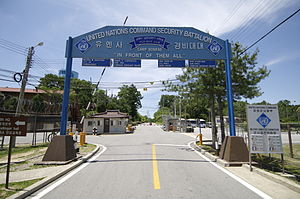
The camp was established after the Korean War to support operations at the Joint Security Area. Camp Bonifas is located approximately 400 meters south of the JSA and was originally called Camp Kitty Hawk. The name of the camp was changed after two American officers, Captain Arthur G. Bonifas and First Lieutenant Mark T. Barrett were murdered by North Korean soldiers in the infamous “Axe Murder Incident”. After the attack the camp was renamed in honor of CPT Bonifas.
The camp is home to the soldiers of the United Nations Command Security Force. The Korean and American soldiers that compose this battalion-sized element are responsible for the 24-hour security of the United Nations Command personnel and their guests that are working at or visiting the JSA.
The unit is also responsible for controlling the entry and exit of all vehicle and personnel into the area along with providing security for the Korean civilians that live within the Tae Song Dong farming village (Freedom Village) that lies within the DMZ. Finally the soldiers are also responsible for conducting tours of the JSA for both civilians and military personnel. The tours are available in English, Japanese, Chinese, and Korean. Roughly 100,000 people conduct a tour of the JSA annually. If you live in Korea and have not done one of these tours I highly recommend you do so. Probably the most unusual aspect of Camp Bonifas is that it is home to what is called the “world’s most dangerous golf course” by Sports Illustrated since the one hole course has minefields around it.
Today US and Korean soldiers continue to serve “In Front of Them All” as the battalion’s motto goes. Even though tensions continue between the two countries, major incidents on the DMZ have greatly diminished in recent years.
The base with the main combat power to support DMZ operations is Camp Greaves located just to the south of Camp Bonifas on the north side of the Imjim River:
The camp is named after Corporal Clinton Greaves of Company C, 9th U.S. Cavalry, who fought off a band of Apaches in 1879 to save fellow cavalrymen. Camp Greaves was founded by the 1st Marine Division during the Korean War in 1953. After the war the Marines used the camp as a patrol base to monitor the DMZ from. After Marines left they were replaced by various units over the years to include the 1st Amphibious Tractor Battalion; the 3rd Battalion, 19th Infantry Regiment, 24th Infantry Division; the 1st Squadron, 9th Cavalry, 1st Cavalry Division; and various 2nd Infantry Division battalions. The last 2ID unit stationed on Camp Greaves was the 1-506 Infantry Regiment. The 1-506th had been stationed on Camp Greaves since 1987 and their unit motto was “Stands Alone”, which I always found funny considering the thousands of ROK soldiers stationed nearby. With that said when the 1-506th was stationed in Korea I always found them to be a very high speed and motivated unit whenever I worked with them. Camp Greaves was closed in 2004 as part of the USFK transformation plan. After its closure half the camp was handed over to the ROK Army’s 1st Infantry Division and the other half is slated to become a $40 million DMZ theme park that is scheduled to open in 2018.
After its closure Camp Greaves like other Western Corridor camps has been the subject of protests though the protests around Camp Greaves is different from the left wing environmentalists that have been protesting other camps. The Camp Greaves protesters are from the Paju area who want the land the camp sits on to be given to the local government for development and not given to the ROK Army.
Warrior Base
Warrior Base is located near the Unification Bridge on the northern side of the DMZ. The base is used to house range control for the various firing ranges located around the DMZ area in the Western Corridor as well providing tent and barracks housing for units training in the area.
Here is a picture of Warrior Base which I have fond memories of spending nights in the tents there while training on the DMZ:
The DMZ includes two villages authorized by a subsequent agreement to the Armistice that ended the war. One village is Tae Song Dong (Freedom Village) on the South Korean side and the second village is Kichong-dong (Propaganda Village) on the North Korean side of the DMZ. Tae Song Dong is located about half a kilometer southwest of the JSA while Kichong is located about a half kilometer northwest of the JSA. Here is a Google Earth image of Tae Song Dong:
Residency in Tae Song Dong is strictly controlled. Only original inhabitants of the village or their direct descendants may live in the village. Kichong-dong on the other hand appears to be a normal village by day with North Koreans working in the fields but at night the workers are bussed to where they live in the nearby city of Kaesong. Only a small custodial staff actually lives in the village. Kichong-dong is referred to by UNC soldiers as “Propaganda Village” due to the loud broadcasts of propaganda blasted from speakers in the village over the years. Here is a Google Earth image of the Propaganda Village:
Here is a a picture of the “Propaganda Village” as seen from the South Korean side of the DMZ:
Located in the Joint Security Area is the Bridge of No Return. This bridge received this name because in 1953 prisoners of war from the allied nations, the Koreas, and China were given the one time option of returning to their home countries. When one walked across the bridge they could not return thus giving the bridge its name The Bridge of No Return.
Image of the Bridge of No Return via the DMZ webpage.
Besides being the setting for the swapping of POWs the bridge was also the scene of the Axe Murder Incident on August 18, 1976 that saw two American officers brutally killed by North Korean soldiers while trying to trim a tree. The murder of these two officers nearly led to war on the peninsula as the US brought in extra ground, air, and naval power to the peninsula to cut down the tree.
Freedom Bridge
Before the Korean War two side by side railway bridges extended across the Imjim River that were used for rail traffic between the then South Korean city of Kaesong and the capitol city of Seoul. However during the surprise North Korean attack against the Republic of Korea launched on June 25, 1950 the South Korean military failed to destroy the bridges. The explosives on the bridges had failed to explode and the North Korean military quickly captured the bridges, which greatly aided the speed of their assault south on Seoul. One of the bridges was destroyed in 1951 as the allies marched north against both the North Koreans and the Chinese forces that had entered the war. The allies were able to successfully capture the last remaining bridge across the Imjim in late 1951.
Freedom Bridge which crossed the Imjim River during the Korean War via Defense Media.
This bridge took on increased importance as peace talks began at the village of Panmunjom just north of the Imjim River. The bridge was refurbished to handle the increased amount of traffic that flowed back and forth from Panmujom every day. On February 16, 1952 the refurbishing was complete and the bridge officially became known as Freedom Bridge. The bridge lived up to its moniker when allied POWs were returned to South Korea after the signing of the Armistice Agreement and they crossed this bridge by ambulance on their return to a reception station set up at Munsan. This route from Panmunjom across the bridge became known as Liberty Lane afterwards.
Freedom Bridge today.
On June 15, 1998 a four-lane bridge dubbed the Tongil (Unification) Bridge was opened across the Imjim River in response to increased traffic to the north side of the Imjim River. The opening of the Tongil Bridge has caused Freedom Bridge to be largely unused today, but it still stands as a testament to the days of the Korean War.
Tongil Bridge
Illegal North Korean Tunnels
In the 1970’s North Korean dictator Kim Il-sung ordered his divisions along the Demilitarized Zone to each dig and maintain two tunnels that infiltrated into South Korea. Evidence of this plan became evident until 1974. On the morning of November 15, 1974, a ROK Army patrol in the west-central sector of the DMZ noted steam rising from the ground. They thought they had found evidence of a hot spring and began digging to see if they had indeed found one.
Instead of a hot spring they found a tunnel that was a mere 18 inches below the surface. While excavating the site the South Korean patrol began to take fire from a North Korean guard post. The patrol began to return fire back at the North Koreans to cover their retreat away from the area. Fortunately no one was injured in the exchange of fire. The South Koreans returned with a larger force to further excavate the site and discovered that the tunnel ran from North Korea and extended one kilometer into South Korea before it was discovered by the patrol. The tunnel was reinforced with concrete slabs, had electric power, weapons storage, sleeping areas, and even a narrow gauge rail line with carts. It was believed that the tunnel was big enough to hold one regiment of soldiers at a time which would have allowed the North Koreans to infiltrate an entire division into South Korea in a matter of hours.
On November 20th as a United Nations MAC team investigated the site, an investigation that the North Korean UNCMAC members refused to participate in, a North Korean explosive booby trap went off killing two MAC investigators, US Navy Commander Robert M. Ballinger and ROK Marine Corps Major Kim Hah Chul. Five more US soldiers and one ROK Army soldier were injured in the blast. Commander Ballinger was the first US casualty on the DMZ since 1969. Just a few months later on March 19, 1975 another tunnel was discovered approximately eight miles northeast of Chorwon. Excavation of the tunnel found that the tunnel was two meters high, less then two meters wide, and about 2,300 meters in length with 1000 meters of the tunnel extending into South Korea. The North Koreans denied digging the tunnel and claimed the South Koreans dug it themselves.
On October 17, 1978 another tunnel was discovered under the DMZ. The prior two tunnels had been in relatively isolated locations however this tunnel was different because it was dug only four kilometers from Panmunjom along the main invasion route into South Korea. Similar to the prior tunnels this tunnel was created with a two by two interior and could have been used to infiltrate thousands of soldiers into South Korea. Of course the North Koreans denied any knowledge of constructing the tunnel. The fourth North Korean tunnel was discovered on March 3, 1990 northeast of the small city of Yanggu in the remote Punchbowl area of Gangwon province. Surprisingly a week later the North Koreans actually admitted to constructing the tunnel in order to “facilitate peaceful reunification”.
Picture of entrance to the 4th entrance tunnel via Wikipedia.
Conclusion
I hope everyone enjoyed this profile of the Western section of the Korean Demilitarized Zone. If you haven’t visited Panmunjom while in South Korea I highly recommend you do so. It is a fascinating place to see that many US military servicemembers and their ROK counterparts over the years have kept safe for visitors. Likewise these same servicemembers have helped keep the ROK safe from North Korean provocations and invasions with their service on freedom’s frontier on the Western Korean Demilitarized Zone.
Note:You can read more from the ROK Drop featured series “A Profile of USFK Bases” at the below link:
Besides several typos (minor issue), I noticed that the description of Camp Bonifas states that the camp is “located approximately 400 meters south of the JSA”. The camp is actually approximately 100 meters from the southern boundary of the DMZ, which since the JSA is in the middle of the 4km wide DMZ, would mean the camp is approximately 2000m from the JSA.
A small correction, but one I’ve been making comments on ever since the Axe Murder Incident, when the official US Army report stated that the (QRF) “Rescue SQuad” (actually a platoon), was over a mile away from the DMZ at the time of the incident, when the Camp wasn’t even a mile away from the DMZ, and at the time of the incident, the QRF Platoon was at the QRF site about 300m away, and then sat at CP#2 (the entrance to the JSA) while the 3rd Plt. leader waited for orders from Capt. Bonifas (who was already dead) to enter the JSA. Finally LTC Vierra arrived at CP#2 from Camp Kitty Hawk and ordered the 3rd Plt. into the JSA, so at no time was anybody ever “over a mile away from the DMZ”.
Thanks for this very thorough overview, I really enjoyed reading it.
I am a 1.5 gen and while growing up in Korea, I distinctly remember that axe incident and the odd feeling of uneasiness that fell on our household. I was too young to fully comprehend what exactly occurred but just remember the elders being really cautious…much more than usual.
I was at Osan AB for two years. Arrived after the murder of the two officers but there was still a lot of uneasiness, the Air Base was still on alert. I was also there during the discovery of the third tunnel. This was a big dill in Korea at the time, but made very little news in the US.
[…] versa. I’ll spare you the history lesson about Korea’s DeMilitarized Zone – but ROK Drop’s post is detailed, accurate, and full of win. Suffice it to say that the sites you’ll see are […]
I had heard many of these terms, places, incidence mentioned when I was there in ’83 at Camp Pelham (later named Gary Owen) but I can appreciate much of this information in a clearer context after reading your post. You have a way of making information entertaining to read while not diminishing the seriousness of some of these events.
Very good perspective of the Korean DMZ. Some facts presented are disputable, but otherwise great source of information and good pictures. Congratulations to the one who put this together and best wishes for you in the future.
With the passing of the NK president Kim Jong-Il this week, it will be most interesting to see how things develop under the rule of Kim-Un, the expected new leader of the North.
Bill is correct in his remarks, above–and he should know, since he was there at the time.
Another small correction: the Google Earth “pin” for Camp Bonifas is actually on the edge of the helipad between it and Camp Liberty Bell. Camp Bonifas (formerly Advance Camp) is south of the road–unless all the new buildings just to the west of the pin have been incorporated into the compound since 1976. Thanks for posting.
HALF of Camp Bonifas is created from the old Camp Kitty Hawk, the other half is from Camp Liberty Bell, which of course sat diagonally across the road from Kitty Hawk and was the Advance Camp for the Forward Most Deployed Infantry Company (Co A) in the forward most deployed Inafantry Battalion in the US Army (1st Bn 9th Inf Manchu) in my day 79-81. LOL We were the Po’ COuntry Cousins that everyone forgets about right across the road. We wasnt fancy, we were just the ones that kept everyone else on the Z from getting thier asses flattenned by the entire KPA before help could arrive from the REMF’s.
I wish I had spent more time touring these historic monuments during my time in the ROK. The two incidents that stick out in my mind were the 9/11 lockdown and the two school girls who were accidentally run over.
I was stationed at Camp Casey 1978-1979 and we were constantly on alert, they were finding tunnels then.I always felt the ground shaking. I have alot of bad memories from the 13 months I spent there.It’s a SHAME…..
I was stationed at PanMumJom as a military policeman from 1964 to 1965. I loved my duty there even though at times it was scary. I can’t remember a night that we didn’t hear gun fire or those damn speakers. We got a lot of respect from Korean’s wherever we went. They respected that United Nations patch and the men who wore it.
I was stationed at Panmunjom during the USS Pueblo incident march 1968.My MOS is 11B10 and by April I remember getting paid a combat pay.The damn speakers are still there.I was awarded with a bayonet badge, for crossing the demarcation line.
Is there anyone there who was stationed in the same place and time range? please I want to hear from you.
[…] spare you the history lesson about Korea’s DMZ – but ROK Drop’s post is detailed, accurate, and full of win. Suffice it to say that the sites you’ll see are […]
Thanks for posting this–It brought back memories of my day at the DMZ while participating in Team Spirit in the late 1980s as a MSgt. with the Army Reserve’s 302nd Public Affairs Unit from Los Alamitos, L.A. Co., CA.
There was an incident in 1977 2chinooks on a training excersise collided in the Z several we’re killed and one survived. NK returned them to us a couple of weeks later.
Would have liked to see a little love for Fire Base 4P3. Everyone stationed from JSA to Freedom Bridge knew that we had their back. Was stationed at Camp Pelham from 90-91 during the first Gulf War and did 3-4 rotations up there. Remember celebrating Cristmas and New Years (no booze of course)shadowing the grunt patrols with our 155mm towed howitzers. GUNS OF THE DMZ!!!
[…] spare you the history lesson about Korea’s DMZ – but ROK Drop’s post is detailed, accurate, and full of win. Suffice it to say that the sites you’ll see are […]
ALL OVER DMZ 70 71 LOTS OF PATROLS OUT OF GP MARTIN.NOT TOO MUCH HEARD ABOUT PEOPLE WHO WERE ON GUARD POSTS.REMEMBER SEEING MDL SIGN AND BACKING UP REAL SLOW.IMJIN SCOUT FROM ACTA E5.ANYONE WITH PICS PLEASE SEND mkikasdmz@att.net
I was stationed at Camp Stanley and the “First to Fire” 1st 15th FA from Oct 1979 – Jun 1980. I was a Forward observer and went to the DMZ three times and was involved in an international incedent on the DMZ when two 105′s were laid 1400 mils out of safe and we shot four rounds into North korea. What an experience it was!! 24 hours later I was in the air going home. Travis AB never looked better!! I was awarded the ARMY Accomidation medal for my actions as a PFC Gen Kingston looked surprised when he was pinning the medal on my chest and said “Damn Soldier, You are the yougest I have ever given this medal to” I am a proud Disabled Veteran and I want to thank you for your service……thnx me
I am researching the DMZ and trying to get clarity on the current status of the UNC-JSA force. Are there US Soldiers currently assigned to this unit conducting patrols along the DMZ?
Will try again had loss first attempt, had arrived at Casey 22 Jun 77 did the turtle farm thing then went I got to Hovey the 1/9th was getting ready to go to the DMZ so I was restricted to post and didn’t see Toko-ri until over a month later. Don’t know to today what part of the DMZ that we went to, one of the first patrols that I was getting ready to go on a 5.56 round whizzed by my head while still inside the compound, a Pfc who wasn’t supposed to even have the magazine in the well had sighted in on me with his starlight scope and squeezed off the round missing my head by inches, could hear the buzz sound as it went by.The PLT SGT come running and chewed his ass, saying son I will stick my foot so far up your ass I will have shit stained knee caps, I know that the SOP was that everybody inserted the magazine as you walked out the compound gate and only the point man and Squad leader actually chambered a round keeping the safety on, this is a true story and I know that it doesn’t even compare to combat but if that round would of been slightly to the right most likely it would of been said that dumb hillbilly from Kentucky done went and got himself killed the first month in country. Goes to show what that can happen.
A man is a man etc, not going to make this a hometown topic. When something happens that sticks in your mind like yesterday that was 35 plus years ago you tell it like it was and what was said. Don’t really care about your hip text u this u that. Never sucked and never will friend.
Unknown to a lot of people was a small unit based out of Yongsan. It was basically an engineer unit that did nothing but search for tunnels on the DMZ. This was in 78 when I was there. I was tasked to take my bulldozer to the DMZ to help look for the tunnel later discovered. However I was short and they sent someone else. When he came back about a week later he walked up and punched me. They sent him out into a area to dig trenches where they thought a tunnel might be. He kept hearing noises in front of his blade. He started to get off the dozer to inspect to see if something was wrong. Everybody started hollering and waving at him so he backed out of the area. They told him what he was hearing were landmines exploding and not to worry about it, but to keep a blade of dirt in front of the dozer at all times to be safe. He said it was the longest week of his life.
If this is true, the North Korean regime has a lot more hard cash in reserve than I thought:
North Korean leader Kim Jong-il has US$4 billion hidden in secret accounts in European banks to continue his lavish way of life if he is forced to flee the country, the Sunday Telegraph reported.
“The money is the profits from impoverished North Korea selling its nuclear and missile technology, dealing in narcotics, insurance fraud, the use of forced labour in its vast gulag system, and the counterfeiting of foreign currency,” the British daily said. “Much of the money was held in Swiss banks until authorities there began to tighten regulations on money laundering.”
“Kim’s operatives then withdrew the money — in cash, in order not to leave a paper trail — and transferred it to banks in Luxembourg,” it added.
Swiss banks kept customers’ account information in closely guarded secret even in the case of criminals until Switzerland signed information exchange agreements with the U.S., France and other countries after the G20 summit in London last April warned that sanctions could be imposed on nations that refuse to cooperate. [Chosun Ilbo]
You can read more at the link, but it is ridiculous that these banks are not sharing information in regards to the ill gotten money of the North Korean regime.
– See more at: http://webcache.googleusercontent.com/search?q=cache:LtyqiVMSwZ8J:rokdrop.com/page/648/%3Fchocaid%3D397+&cd=11&hl=en&ct=clnk&gl=us#sthash.LhGd9CCh.dpuf