This is just the tip of the iceberg in regards to the number of North Korean spies in South Korea, but at least they put four of them away in jail:
Four South Koreans were jailed for up to nine years Thursday for spying for North Korea and passing on the information to Pyongyang’s agents in Japan and China.
The Seoul Central District Court gave a fifth person a suspended jail term, a court spokeswoman told AFP.
The five were arrested last July on charges of violating the South’s security law.
The court passed a nine-year sentence on a 49-year-old man surnamed Kim, and jail terms ranging from five to seven years on the other three.
The five were convicted of collecting intelligence on South Korean political circles as well as on the activities of pro-North Korean groups in the South.
The prosecutors had demanded life imprisonment for Kim, citing his alleged long-term direct ties with North Korea and reluctance to repent. [Asia One]
You can read more about these convicted spies at these prior ROK Drop postings here and here. As usual these spies had ties to the South Korean academic and political left.
Last month ROK Drop readers may remember that the Lowy Institute was offering to have reader provided questions answered by Chinese Professor Zhu Feng. I offered a number of questions and two of them were presented to Mr. Feng to answer. Here is the answer Professor Feng gave in regards to the repatriation of North Korean refugees:
What does Professor Zhu Feng think of the forced repatriation of refugees back to North Korea where they are either imprisoned or executed?
I think it’s a controversial issue, but the problem is that if China refuses to repatriate that would signal that Beijing wants to bring down the North Korean regime. So I know such repatriation is cold blooded, and it’s a big embarrassment for China’s policy on North Korea. I have to say, China’s policy implementation in this regard always keeps one eye open the other eye closed. Officially, we will repatriate, but in practice we keep the net quite loose. [The Interpreter]
You can read more at the link such as what Mr. Zhu thinks of the “Glans Plan” as well as current Chinese policies towards North Korea. By the way thank you to the Lowy Institute for hosting this as well as to Professor Zhu Feng for agreeing to answer questions from readers. I recommend ROK-Heads check out the Lowy Institute’s website The Interpreter which provides some good reads for those interested in Asia-Pacific issues.
I get asked quite often by people not familiar with North Korea what book I would recommend they read to become more familiar with the country? I have always believed that , “The Two Koreas” by Don Oberdorfer is the best book to read for those wanting to learn about the contemporary history of the Korean peninsula. However, after reading “The Two Koreas” I would highly recommend for those wanting to get a deeper understanding of North Korea to then read, “The Cleanest Race” by B.R. Myers.
This book I believe is currently the best read about North Korea simply because of the analysis done by Myers in regards to interpreting North Korean propaganda that has provided a whole new perspective on why the country behaves the way it does. Something else I liked about the book was that it was a quick read. Unlike other books about North Korea that can be quite an effort to read due to the huge amount of information cited, Myers’ book to me appeared to be written to where the author figured that people reading his book have already read up quite a bit on North Korea so he doesn’t add a whole bunch of additional pages to his book rehashing in depth North Korean history. Instead Myers keeps the book centered around his analysis of North Korean propaganda that explains why the regime behaves the way it does.
Myers makes it quite evident early in the book that he despises the left and right ideological battles that often encompass debates about North Korea. Myers believes that people fall back on these ideological biases to explain North Korea simply because so few analysts can understand Korean to be able to read relevant official texts put out by the regime. I think Myers does have a valid point here that many people who do opine about North Korea do not have the language skills that he has used to develop his views on the North Korean regime. I don’t think that not being able to speak Korean completely invalidates someone’s opinion, but I do think it enhances the creditability of the viewpoint of someone who does have a deep understanding of the Korean language.
That is why I think that Myers’ viewpoint that North Korea is not a hard line Stalinist or Communist government should be taken very seriously. By the way I don’t believe North Korea is a Stalinist or Communist state either, I have viewed it more of a Soprano State. Anyway instead of using these common terms to describe the government in North Korea, Myers instead believes that the country is a military dominated society led by a racist and maternal regime. Myers’ then goes on to provide example after example of North Korean propaganda and other anecdotes that show how the regime brainwashes its people to believe that the:
“Korean people are too pure blooded and therefore too virtuous, to survive in this evil world without a great parental leader. “
That parental leader was at first Kim Il-sung and after his death in 1994 his son Kim Jong-il began to fill that same role. Myers even goes on to write about how the North Korean regime’s racist propaganda efforts are actually very similar to those of the old Imperial Japanese government that once colonized the Korean peninsula. As much as the North Koreans proclaim to hate the Imperial Japanese they have in fact perfected their racist policies. The bottom line is that outside observers need to realize that the North Korean regime uses paranoid race based nationalism to guide their policy decisions. When looking at North Korea in this context then much of their belligerent actions makes sense.
Something else Myers comments on in the book are that he believes the North Korean refugees in China are “economic migrants” because half of them voluntarily return to North Korea. I disagree with this because the North Koreans he is referring to I don’t believe should be considered under the term refugee. That is because it is well known that many North Koreans shuttle back and forth across the border due to the poor economic and food situation in North Korea. The term refugee should apply to those who want to defect to South Korea or some other nation like the US. He also claims that the rest of the refugees that do defect remain admirers of the Cult of Kim. This is not true of all refugees that come to South Korea, though there has been plenty of refugees who have said that due to the brainwashing they have received their entire lives it is hard to let go of the Cult of Kim especially when they hear someone criticizing Kim Il-sung. I guess it would be like hearing someone criticize George Washington with facts that you believe to be untrue simply because of what you have been taught about the man your whole life. I think the fact that North Koreans are often treated as second class citizens in South Korea and are not accustomed to a capitalist system that rewards hard work may cause some of the refugees to long for their home land as well.
Though I disagree with him on the refugee issue, I do agree with him on another major point in the book that the North Korean regime does not fear an external attack more than an internal legitimacy crisis. Myers points out that many foreign observers read the Korean Central News Agency (KCNA) and assume it mirrors what the North Korean propaganda outlet is putting out to its domestic audience. Instead here is how Myers says KCNA presents itself in Korean:
“……the DPRK presents itself to the outside world as a misunderstood country seeking integration into the international community, it presents itself to its own citizens as a rogue state that breaks agreements with impunity, dictates conditions to groveling U.N. officials, and keeps its enemies in constant fear of ballistic retribution. Generally speaking the following rule of thumb applies: the less accessible a propaganda outlet is to the outside world, the blunter and more belligerent it will be in its expression of the racist orthodoxy.”
This fear of an internal legitimacy crisis is why I have long supported that South Korea and the US should fight an information war within North Korea by using defector radio broadcasts and smuggling in subversive media such as Korean dramas into the country to erode the Cult of Kim. This eroding of the racist and paternalistic ideology of the Cult of Kim is why the regime has so strongly responded to the propaganda balloon launches by North Korean refugee groups within South Korea.
Like I mentioned earlier in this posting I highly recommend that everyone who has basic knowledge about Korea pick up and read this book. I would not recommend this to be the first book someone reads about Korea because I really think to appreciate this book readers need to have some background in Korean contemporary history. Once readers have that background, this book is definitely an eye-opening and informative read that will leave people interested in North Korea with a much better understanding of why the regime acts the way it does.
I’ve read his book and it was an eye-opening experience. I agree with your that North Korea is neither Stalinist nor Communist. It’s a kleptocracy. Murder, corruption, and theft…every one from the highest ranking official down to the lowly army private are complicit.
Ya know what… Koreans have never had a nuclear weapon. North Koreans are Koreans too … if they develop ICBM pointed right at Tokyo, Washington DC,& Beijing, Moscow then wouldn’t that make NK / SK an inpregnable fortress? ^^
Yes, excellent book and he’s an excellent speaker if you get a chance to see his lecture in person. I too think he’s got nK pegged better than any of the other well-known nK experts though it is interesting to see him and Andrei Lankov debate.
@1 – That is why I consider North Korea to be a Soprano State considering all their criminal enterprises they are engaged in. After reading Myers I now think of it more as a Soprano State supported by a race based ideology that backs the Cult of Kim which helps keep the status quo iin place for the regime elite.
@3 – Definitely pick this book up and it is available on Kindle which is how I read the book.
@4 – If I ever had the opportunity Myers does seem like a very interesting person to listen to. A debate between him and Lankov would be very interesting but I think they would actually be in agreement on most NK issues.
I’ve read this book and think Myers makes some great points. I think he disregards some factors too much such as the role of Confucianism and Kim Il Sung’s use of Protestant Christian themes. That said, his theories make a lot of sense. Personally I think we always get the stinky end of the stick when dealing with DPRK because we operate under the “Communist Oligarcy” template with these guys when it is only partially relevant!
I also enjoyed his dis-assembly of the Korean nation myth. I’ve used the knowledge gained here a couple times to shut down the “we’re a 5,000 year old country” claptrap. You want to look back to Tongun and Old Chosun? Well, I’ll just have to counter that with Pericles and Athens !
I have not read the book so the review by GI Korea is excellent and appreciated.
I could not help but think of the rise of similar race themes in the PRC’s internal propaganda. It would be interesting to see a similar analysis of China’s domestic targeted news and information. In China’s case it takes on a much bigger scope, involving far flung islands and people of Chinese “blood” born in other countries. One has to wonder if China did not learn some lessons from DPRK propaganda, considering the PRC’s history of leaving the international camp, following the break with the USSR and China’s ongoing need to mold a domestic and even off shore population in the free information age.
Besides the usual bombastic statements about turning Seoul into a “Sea of Flames” in response to the upcoming Foal Eagle/Key Resolve exercise, here is what I continue to find satisfaction in the fact that this continues to really anger the Kim regime:
Earlier Sunday, the North’s military warned that it would destroy South Korean border towns if Seoul continues to allow activists to launch propaganda leaflets toward the communist country.
In a separate statement carried by KCNA, it accused South Korean activists and lawmakers of flying balloons carrying hundreds of thousands of leaflets and DVDs critical of North Korea’s government on the North’s most important national holiday, an apparent reference to leader Kim Jong Il’s 69th birthday, which was Feb. 16. [Associated Press]
The continual angry responses from the North Korean regime against the balloon launches continues to be a sign that this continues to be an effective way to counter the regime propaganda apparatus within North Korea. I would hope though that the South Korean military is taking these threats seriously because I would not be surprised if the North Koreans try something in the coming weeks in response to the balloon launches like they are threatening.
The Korean Demilitarized Zone (DMZ) was established with the signing of the armistice agreement that ended the Korean War on July 27, 1953. It was agreed upon that the DMZ would separated the two Koreas by creating a buffer zone four kilometers wide across the width of the 151 mile wide Korean peninsula. This buffer zone would be created in roughly the same positions that the warring parties had ended the conflict at. The Military Demarcation Line (MDL) would be the official border between the two countries while the two kilometers of the buffer zone to the north of the MDL would be monitored by North Korea while the two kilometers of the buffer zone of the south of the MDL would be monitored by South Korea. It was further agreed upon that no opposing force would enter the territory, air space, or contiguous waters under the control of the other country.
The United States military used to monitor the area of the DMZ north of the Imjim River with the 2nd Infantry Division as well as along the Chorwon corridor with the 7th Infantry Division. The 7th Infantry Division with redeployed in Korea in the 1970’s leaving the 2nd Infantry Division to continue their monitoring of the DMZ north of the Imjim River. The 2nd Infantry Division ultimately gave up the sole responsibility of monitoring the DMZ north of the Imjim River in the 1980’s and has now handed over all responsibilities for monitoring the demilitarized zone to the Korean Army. Besides the monitoring of the DMZ by the ROK Army a small contingent of civil police authorized by the armistice man 114 guard posts that monitor activity on the DMZ. The DMZ Civil Police also man two guard posts that overlook the Neutral Nations Supervisory Commission (NNSC) housed at the Swiss/Swedish Camp, the Joint Security Area (JSA), and Tae Song Dong.
Military Armistice Commission
The Military Armistice Commission (MAC) was formed to be a body that would have the responsibility to negotiate any violations of the Armistice Agreement. This job was increasingly important over the years as the North Koreans have repeatedly violated the Armistice. From 1953 to 1994 the MAC was composed of a UNC component and a North Korean/Chinese component. Each component is comprised of five senior officers. Three of the officers must be the rank of general or a flag officer of some kind. The two remaining officers must be at least a colonel. During an official MAC meeting only the senior officer on each side can speak. The meetings are held inside one of the blue UN buildings situated on the MDL at the Joint Security Area at Panmunjom.
Anything spoken during these MAC meetings must be read in three languages, English, Korean and Chinese. The meetings also follow very strict guidelines, which further makes the meetings proceed at an extremely slow pace. The last official MAC meeting was held in 1991. Since then the North Koreans have refused to participate in an official MAC meeting because a South Korean general was appointed as the senior member of the UNC component. In 1994 in violation of the Armistice the North Koreans withdrew from the MAC altogether.
The United Nations Command Military Advisory Committee (UNCMAC) Secretariat is responsible for ensuring that United Nations Command (UNC) units comply with the 1953 armistice. The UNCMAC is responsible for investigating and reporting on any violation of the armistice on either side of the DMZ. Military personnel from either side of the border are not authorized to cross the MDL. Only the NNSC and a small number UNCMAC personnel are authorized to cross the MDL on certain occasions. The UNCMAC is also responsible for providing translators as well as scheduling official MAC meetings.
However, with the withdrawal of the North Koreans from the MAC in 1994 the UNCMAC has shifted from its primary administrative role to being the main channel of communication between the two sides. The UNCMAC Secretariat meetings held between the two sides which is supposed to be for administrative reasons has now turn into quasi MAC meetings with the secretariats now discussing things such as Armistice violations, the transfer of detained personnel, as well as the return of remains of deceased personnel on each side.
Neutral Nations Supervisory Commission
The Neutral Nations Supervisory Commission (NNSC) was established by the Armistice Agreement as an independent, fact-finding body outside of the MAC, but responsible for reporting to the MAC. The NNSC is composed of four senior officers from four nations that did not participate in the Korean War. Each side chooses two of the officers that will compose the NNSC. Historically officers from Switzerland and Sweden composed the UNC side while officers from Poland and Czechoslovakia formed the North Korean side.
The NNSC was originally formed to investigate Armistice violations outside of the DMZ. This was intended to ensure both sides maintain a military status quo which existed when the ceasefire was signed. However, North Korea regularly prohibited NNSC teams from investigating in North Korea. Due to pressure from North Korea Czechoslovakia withdrew from the NNSC in 1993 and Poland withdrew in 1995. The Swiss and Swedish team remains and they continue to meet weekly to discuss reports from the UNC side in regards to Armistice issues. Despite this, the NNSC’s role on the DMZ is largely ceremonial.
Joint Security Area (JSA)
With the creation of the various bodies to manage the Armistice Agreement an area was needed to conduct the every day business of these bodies. Thus it was agreed upon that a Joint Security Area (JSA) at the village of Panmunjom where the Armistice negotiations took place, would be created.
The JSA is roughly 800 meters wide and is roughly circular in shape and bisected by the Military Demarcation Line. The MAC buildings where negotiations and meetings are held in are painted blue and divided down the middle by the MDL.
The JSA also has a building on each side of the MDL that serves as the Joint Duty Office. Since the senior officers that compose each component of the MAC are based in Seoul for the UNC and in Kaesong for the North Koreans they leave liason officers at all times at the JSA that work out of the Joint Duty Offices. These JDOs pass messages from the MAC to the secretaries on the other side of the JSA. Military policemen only are used to guard the JSA. Each side may only have 35 military policemen on duty in the JSA at one time. These policemen are also allowed to maintain an administrative area in the JSA. The NNSC is also allowed to keep an administrative area at the JSA to conduct meetings in as well.
Camp Bonifas
The most forward deployed base in all of United States Forces Korea is Camp Bonifas:
The camp was established after the Korean War to support operations at the Joint Security Area. Camp Bonifas is located approximately 400 meters south of the JSA and was originally called Camp Kitty Hawk. The name of the camp was changed after two American officers, Captain Arthur G. Bonifas and First Lieutenant Mark T. Barrett were murdered by North Korean soldiers in the infamous “Axe Murder Incident”. After the attack the camp was renamed in honor of CPT Bonifas.
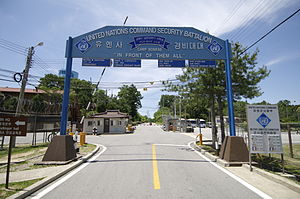
The camp is home to the soldiers of the United Nations Command Security Force. The Korean and American soldiers that compose this battalion-sized element are responsible for the 24-hour security of the United Nations Command personnel and their guests that are working at or visiting the JSA.
The unit is also responsible for controlling the entry and exit of all vehicle and personnel into the area along with providing security for the Korean civilians that live within the Tae Song Dong farming village (Freedom Village) that lies within the DMZ. Finally the soldiers are also responsible for conducting tours of the JSA for both civilians and military personnel. The tours are available in English, Japanese, Chinese, and Korean. Roughly 100,000 people conduct a tour of the JSA annually. If you live in Korea and have not done one of these tours I highly recommend you do so. Probably the most unusual aspect of Camp Bonifas is that it is home to what is called the “world’s most dangerous golf course” by Sports Illustrated since the one hole course has minefields around it.
Today US and Korean soldiers continue to serve “In Front of Them All” as the battalion’s motto goes. Even though tensions continue between the two countries, major incidents on the DMZ have greatly diminished in recent years.
The base with the main combat power to support DMZ operations is Camp Greaves located just to the south of Camp Bonifas on the north side of the Imjim River:
The camp is named after Corporal Clinton Greaves of Company C, 9th U.S. Cavalry, who fought off a band of Apaches in 1879 to save fellow cavalrymen. Camp Greaves was founded by the 1st Marine Division during the Korean War in 1953. After the war the Marines used the camp as a patrol base to monitor the DMZ from. After Marines left they were replaced by various units over the years to include the 1st Amphibious Tractor Battalion; the 3rd Battalion, 19th Infantry Regiment, 24th Infantry Division; the 1st Squadron, 9th Cavalry, 1st Cavalry Division; and various 2nd Infantry Division battalions. The last 2ID unit stationed on Camp Greaves was the 1-506 Infantry Regiment. The 1-506th had been stationed on Camp Greaves since 1987 and their unit motto was “Stands Alone”, which I always found funny considering the thousands of ROK soldiers stationed nearby. With that said when the 1-506th was stationed in Korea I always found them to be a very high speed and motivated unit whenever I worked with them. Camp Greaves was closed in 2004 as part of the USFK transformation plan. After its closure half the camp was handed over to the ROK Army’s 1st Infantry Division and the other half is slated to become a $40 million DMZ theme park that is scheduled to open in 2018.
After its closure Camp Greaves like other Western Corridor camps has been the subject of protests though the protests around Camp Greaves is different from the left wing environmentalists that have been protesting other camps. The Camp Greaves protesters are from the Paju area who want the land the camp sits on to be given to the local government for development and not given to the ROK Army.
Warrior Base
Warrior Base is located near the Unification Bridge on the northern side of the DMZ. The base is used to house range control for the various firing ranges located around the DMZ area in the Western Corridor as well providing tent and barracks housing for units training in the area.
Here is a picture of Warrior Base which I have fond memories of spending nights in the tents there while training on the DMZ:
The DMZ includes two villages authorized by a subsequent agreement to the Armistice that ended the war. One village is Tae Song Dong (Freedom Village) on the South Korean side and the second village is Kichong-dong (Propaganda Village) on the North Korean side of the DMZ. Tae Song Dong is located about half a kilometer southwest of the JSA while Kichong is located about a half kilometer northwest of the JSA. Here is a Google Earth image of Tae Song Dong:
Residency in Tae Song Dong is strictly controlled. Only original inhabitants of the village or their direct descendants may live in the village. Kichong-dong on the other hand appears to be a normal village by day with North Koreans working in the fields but at night the workers are bussed to where they live in the nearby city of Kaesong. Only a small custodial staff actually lives in the village. Kichong-dong is referred to by UNC soldiers as “Propaganda Village” due to the loud broadcasts of propaganda blasted from speakers in the village over the years. Here is a Google Earth image of the Propaganda Village:
Here is a a picture of the “Propaganda Village” as seen from the South Korean side of the DMZ:
Located in the Joint Security Area is the Bridge of No Return. This bridge received this name because in 1953 prisoners of war from the allied nations, the Koreas, and China were given the one time option of returning to their home countries. When one walked across the bridge they could not return thus giving the bridge its name The Bridge of No Return.
Image of the Bridge of No Return via the DMZ webpage.
Besides being the setting for the swapping of POWs the bridge was also the scene of the Axe Murder Incident on August 18, 1976 that saw two American officers brutally killed by North Korean soldiers while trying to trim a tree. The murder of these two officers nearly led to war on the peninsula as the US brought in extra ground, air, and naval power to the peninsula to cut down the tree.
Freedom Bridge
Before the Korean War two side by side railway bridges extended across the Imjim River that were used for rail traffic between the then South Korean city of Kaesong and the capitol city of Seoul. However during the surprise North Korean attack against the Republic of Korea launched on June 25, 1950 the South Korean military failed to destroy the bridges. The explosives on the bridges had failed to explode and the North Korean military quickly captured the bridges, which greatly aided the speed of their assault south on Seoul. One of the bridges was destroyed in 1951 as the allies marched north against both the North Koreans and the Chinese forces that had entered the war. The allies were able to successfully capture the last remaining bridge across the Imjim in late 1951.
Freedom Bridge which crossed the Imjim River during the Korean War via Defense Media.
This bridge took on increased importance as peace talks began at the village of Panmunjom just north of the Imjim River. The bridge was refurbished to handle the increased amount of traffic that flowed back and forth from Panmujom every day. On February 16, 1952 the refurbishing was complete and the bridge officially became known as Freedom Bridge. The bridge lived up to its moniker when allied POWs were returned to South Korea after the signing of the Armistice Agreement and they crossed this bridge by ambulance on their return to a reception station set up at Munsan. This route from Panmunjom across the bridge became known as Liberty Lane afterwards.
Freedom Bridge today.
On June 15, 1998 a four-lane bridge dubbed the Tongil (Unification) Bridge was opened across the Imjim River in response to increased traffic to the north side of the Imjim River. The opening of the Tongil Bridge has caused Freedom Bridge to be largely unused today, but it still stands as a testament to the days of the Korean War.
Tongil Bridge
Illegal North Korean Tunnels
In the 1970’s North Korean dictator Kim Il-sung ordered his divisions along the Demilitarized Zone to each dig and maintain two tunnels that infiltrated into South Korea. Evidence of this plan became evident until 1974. On the morning of November 15, 1974, a ROK Army patrol in the west-central sector of the DMZ noted steam rising from the ground. They thought they had found evidence of a hot spring and began digging to see if they had indeed found one.
Instead of a hot spring they found a tunnel that was a mere 18 inches below the surface. While excavating the site the South Korean patrol began to take fire from a North Korean guard post. The patrol began to return fire back at the North Koreans to cover their retreat away from the area. Fortunately no one was injured in the exchange of fire. The South Koreans returned with a larger force to further excavate the site and discovered that the tunnel ran from North Korea and extended one kilometer into South Korea before it was discovered by the patrol. The tunnel was reinforced with concrete slabs, had electric power, weapons storage, sleeping areas, and even a narrow gauge rail line with carts. It was believed that the tunnel was big enough to hold one regiment of soldiers at a time which would have allowed the North Koreans to infiltrate an entire division into South Korea in a matter of hours.
On November 20th as a United Nations MAC team investigated the site, an investigation that the North Korean UNCMAC members refused to participate in, a North Korean explosive booby trap went off killing two MAC investigators, US Navy Commander Robert M. Ballinger and ROK Marine Corps Major Kim Hah Chul. Five more US soldiers and one ROK Army soldier were injured in the blast. Commander Ballinger was the first US casualty on the DMZ since 1969. Just a few months later on March 19, 1975 another tunnel was discovered approximately eight miles northeast of Chorwon. Excavation of the tunnel found that the tunnel was two meters high, less then two meters wide, and about 2,300 meters in length with 1000 meters of the tunnel extending into South Korea. The North Koreans denied digging the tunnel and claimed the South Koreans dug it themselves.
On October 17, 1978 another tunnel was discovered under the DMZ. The prior two tunnels had been in relatively isolated locations however this tunnel was different because it was dug only four kilometers from Panmunjom along the main invasion route into South Korea. Similar to the prior tunnels this tunnel was created with a two by two interior and could have been used to infiltrate thousands of soldiers into South Korea. Of course the North Koreans denied any knowledge of constructing the tunnel. The fourth North Korean tunnel was discovered on March 3, 1990 northeast of the small city of Yanggu in the remote Punchbowl area of Gangwon province. Surprisingly a week later the North Koreans actually admitted to constructing the tunnel in order to “facilitate peaceful reunification”.
Picture of entrance to the 4th entrance tunnel via Wikipedia.
Conclusion
I hope everyone enjoyed this profile of the Western section of the Korean Demilitarized Zone. If you haven’t visited Panmunjom while in South Korea I highly recommend you do so. It is a fascinating place to see that many US military servicemembers and their ROK counterparts over the years have kept safe for visitors. Likewise these same servicemembers have helped keep the ROK safe from North Korean provocations and invasions with their service on freedom’s frontier on the Western Korean Demilitarized Zone.
Note:You can read more from the ROK Drop featured series “A Profile of USFK Bases” at the below link:
Besides several typos (minor issue), I noticed that the description of Camp Bonifas states that the camp is “located approximately 400 meters south of the JSA”. The camp is actually approximately 100 meters from the southern boundary of the DMZ, which since the JSA is in the middle of the 4km wide DMZ, would mean the camp is approximately 2000m from the JSA.
A small correction, but one I’ve been making comments on ever since the Axe Murder Incident, when the official US Army report stated that the (QRF) “Rescue SQuad” (actually a platoon), was over a mile away from the DMZ at the time of the incident, when the Camp wasn’t even a mile away from the DMZ, and at the time of the incident, the QRF Platoon was at the QRF site about 300m away, and then sat at CP#2 (the entrance to the JSA) while the 3rd Plt. leader waited for orders from Capt. Bonifas (who was already dead) to enter the JSA. Finally LTC Vierra arrived at CP#2 from Camp Kitty Hawk and ordered the 3rd Plt. into the JSA, so at no time was anybody ever “over a mile away from the DMZ”.
Thanks for this very thorough overview, I really enjoyed reading it.
I am a 1.5 gen and while growing up in Korea, I distinctly remember that axe incident and the odd feeling of uneasiness that fell on our household. I was too young to fully comprehend what exactly occurred but just remember the elders being really cautious…much more than usual.
I was at Osan AB for two years. Arrived after the murder of the two officers but there was still a lot of uneasiness, the Air Base was still on alert. I was also there during the discovery of the third tunnel. This was a big dill in Korea at the time, but made very little news in the US.
[…] versa. I’ll spare you the history lesson about Korea’s DeMilitarized Zone – but ROK Drop’s post is detailed, accurate, and full of win. Suffice it to say that the sites you’ll see are […]
I had heard many of these terms, places, incidence mentioned when I was there in ’83 at Camp Pelham (later named Gary Owen) but I can appreciate much of this information in a clearer context after reading your post. You have a way of making information entertaining to read while not diminishing the seriousness of some of these events.
Very good perspective of the Korean DMZ. Some facts presented are disputable, but otherwise great source of information and good pictures. Congratulations to the one who put this together and best wishes for you in the future.
With the passing of the NK president Kim Jong-Il this week, it will be most interesting to see how things develop under the rule of Kim-Un, the expected new leader of the North.
Bill is correct in his remarks, above–and he should know, since he was there at the time.
Another small correction: the Google Earth “pin” for Camp Bonifas is actually on the edge of the helipad between it and Camp Liberty Bell. Camp Bonifas (formerly Advance Camp) is south of the road–unless all the new buildings just to the west of the pin have been incorporated into the compound since 1976. Thanks for posting.
HALF of Camp Bonifas is created from the old Camp Kitty Hawk, the other half is from Camp Liberty Bell, which of course sat diagonally across the road from Kitty Hawk and was the Advance Camp for the Forward Most Deployed Infantry Company (Co A) in the forward most deployed Inafantry Battalion in the US Army (1st Bn 9th Inf Manchu) in my day 79-81. LOL We were the Po’ COuntry Cousins that everyone forgets about right across the road. We wasnt fancy, we were just the ones that kept everyone else on the Z from getting thier asses flattenned by the entire KPA before help could arrive from the REMF’s.
I wish I had spent more time touring these historic monuments during my time in the ROK. The two incidents that stick out in my mind were the 9/11 lockdown and the two school girls who were accidentally run over.
I was stationed at Camp Casey 1978-1979 and we were constantly on alert, they were finding tunnels then.I always felt the ground shaking. I have alot of bad memories from the 13 months I spent there.It’s a SHAME…..
I was stationed at PanMumJom as a military policeman from 1964 to 1965. I loved my duty there even though at times it was scary. I can’t remember a night that we didn’t hear gun fire or those damn speakers. We got a lot of respect from Korean’s wherever we went. They respected that United Nations patch and the men who wore it.
I was stationed at Panmunjom during the USS Pueblo incident march 1968.My MOS is 11B10 and by April I remember getting paid a combat pay.The damn speakers are still there.I was awarded with a bayonet badge, for crossing the demarcation line.
Is there anyone there who was stationed in the same place and time range? please I want to hear from you.
[…] spare you the history lesson about Korea’s DMZ – but ROK Drop’s post is detailed, accurate, and full of win. Suffice it to say that the sites you’ll see are […]
Thanks for posting this–It brought back memories of my day at the DMZ while participating in Team Spirit in the late 1980s as a MSgt. with the Army Reserve’s 302nd Public Affairs Unit from Los Alamitos, L.A. Co., CA.
There was an incident in 1977 2chinooks on a training excersise collided in the Z several we’re killed and one survived. NK returned them to us a couple of weeks later.
Would have liked to see a little love for Fire Base 4P3. Everyone stationed from JSA to Freedom Bridge knew that we had their back. Was stationed at Camp Pelham from 90-91 during the first Gulf War and did 3-4 rotations up there. Remember celebrating Cristmas and New Years (no booze of course)shadowing the grunt patrols with our 155mm towed howitzers. GUNS OF THE DMZ!!!
[…] spare you the history lesson about Korea’s DMZ – but ROK Drop’s post is detailed, accurate, and full of win. Suffice it to say that the sites you’ll see are […]
ALL OVER DMZ 70 71 LOTS OF PATROLS OUT OF GP MARTIN.NOT TOO MUCH HEARD ABOUT PEOPLE WHO WERE ON GUARD POSTS.REMEMBER SEEING MDL SIGN AND BACKING UP REAL SLOW.IMJIN SCOUT FROM ACTA E5.ANYONE WITH PICS PLEASE SEND mkikasdmz@att.net
I was stationed at Camp Stanley and the “First to Fire” 1st 15th FA from Oct 1979 – Jun 1980. I was a Forward observer and went to the DMZ three times and was involved in an international incedent on the DMZ when two 105′s were laid 1400 mils out of safe and we shot four rounds into North korea. What an experience it was!! 24 hours later I was in the air going home. Travis AB never looked better!! I was awarded the ARMY Accomidation medal for my actions as a PFC Gen Kingston looked surprised when he was pinning the medal on my chest and said “Damn Soldier, You are the yougest I have ever given this medal to” I am a proud Disabled Veteran and I want to thank you for your service……thnx me
I am researching the DMZ and trying to get clarity on the current status of the UNC-JSA force. Are there US Soldiers currently assigned to this unit conducting patrols along the DMZ?
Will try again had loss first attempt, had arrived at Casey 22 Jun 77 did the turtle farm thing then went I got to Hovey the 1/9th was getting ready to go to the DMZ so I was restricted to post and didn’t see Toko-ri until over a month later. Don’t know to today what part of the DMZ that we went to, one of the first patrols that I was getting ready to go on a 5.56 round whizzed by my head while still inside the compound, a Pfc who wasn’t supposed to even have the magazine in the well had sighted in on me with his starlight scope and squeezed off the round missing my head by inches, could hear the buzz sound as it went by.The PLT SGT come running and chewed his ass, saying son I will stick my foot so far up your ass I will have shit stained knee caps, I know that the SOP was that everybody inserted the magazine as you walked out the compound gate and only the point man and Squad leader actually chambered a round keeping the safety on, this is a true story and I know that it doesn’t even compare to combat but if that round would of been slightly to the right most likely it would of been said that dumb hillbilly from Kentucky done went and got himself killed the first month in country. Goes to show what that can happen.
A man is a man etc, not going to make this a hometown topic. When something happens that sticks in your mind like yesterday that was 35 plus years ago you tell it like it was and what was said. Don’t really care about your hip text u this u that. Never sucked and never will friend.
Unknown to a lot of people was a small unit based out of Yongsan. It was basically an engineer unit that did nothing but search for tunnels on the DMZ. This was in 78 when I was there. I was tasked to take my bulldozer to the DMZ to help look for the tunnel later discovered. However I was short and they sent someone else. When he came back about a week later he walked up and punched me. They sent him out into a area to dig trenches where they thought a tunnel might be. He kept hearing noises in front of his blade. He started to get off the dozer to inspect to see if something was wrong. Everybody started hollering and waving at him so he backed out of the area. They told him what he was hearing were landmines exploding and not to worry about it, but to keep a blade of dirt in front of the dozer at all times to be safe. He said it was the longest week of his life.
If this is true, the North Korean regime has a lot more hard cash in reserve than I thought:
North Korean leader Kim Jong-il has US$4 billion hidden in secret accounts in European banks to continue his lavish way of life if he is forced to flee the country, the Sunday Telegraph reported.
“The money is the profits from impoverished North Korea selling its nuclear and missile technology, dealing in narcotics, insurance fraud, the use of forced labour in its vast gulag system, and the counterfeiting of foreign currency,” the British daily said. “Much of the money was held in Swiss banks until authorities there began to tighten regulations on money laundering.”
“Kim’s operatives then withdrew the money — in cash, in order not to leave a paper trail — and transferred it to banks in Luxembourg,” it added.
Swiss banks kept customers’ account information in closely guarded secret even in the case of criminals until Switzerland signed information exchange agreements with the U.S., France and other countries after the G20 summit in London last April warned that sanctions could be imposed on nations that refuse to cooperate. [Chosun Ilbo]
You can read more at the link, but it is ridiculous that these banks are not sharing information in regards to the ill gotten money of the North Korean regime.
– See more at: http://webcache.googleusercontent.com/search?q=cache:LtyqiVMSwZ8J:rokdrop.com/page/648/%3Fchocaid%3D397+&cd=11&hl=en&ct=clnk&gl=us#sthash.LhGd9CCh.dpuf
It looks like North Korea’s activities helping the Iranian military is continuing to expand:
An open-source intelligence publishing group says North Korea may be helping Iran build new rocket-launch facilities.
IHS Jane’s said Friday that a new rocket-launch pad was spotted by satellite in the city of Semnan some four hours east of the Iranian capital of Tehran. According to the London-based intelligence group, analysis suggests that Iran has been collaborating with North Korea to build the launch pad.
Jane’s said Iran made public its “Simorgh” space-launch vehicle (SLV) on February third but did not make public the location of the rocket’s launch complex.
Jane’s was quoted as saying that the platforms seen on the new gantry tower resemble those seen on the gantry tower at North Korea’s new launch pad at Tongchang and a drainage pit 170 meters in front of the pad also mirrors one at Pyongyang’s new west-coast launch site.
The group also said that the first stage of the Simorgh strongly resembles the North Korean Unha-Two, with four clustered engines and nearly the same dimensions. [KBS Global]
You can read more about North Korea and Iran’s military cooperation here, here, and here.
I went on Google Earth and did a little exploring around the Semnan area in Iran and was able to located the launch facility supposedly constructed by the North Koreans:
This launch facility is located way out in a very isolated desert area:
Here is the lonely base camp that I imagine must suck to be stationed at:
Here is the actual launch site itself:
Here are two launch sites from the North Korea and judging from the Google Earth imagery they actually don’t like all that much a like:
Can any readers make out obvious similarities from the Google Earth imagery because I sure can’t.
This looks like it may be interesting read though the information provided by the defector is a bit dated:
A North Korean colonel who spent two decades going on European shopping sprees for his country’s rulers said Thursday the late dictator Kim Il Sung lived in luxury while many people struggled to survive in his impoverished communist nation.
Kim Jong Ryul, who spent 16 years under cover in Austria, also described how the “great leader” and his son and successor Kim Jong Il spent millions pampering and protecting themselves with Western goods — everything from luxury cars, carpets and exotic foods, to monitors that can detect heartbeats of people hiding behind walls and gold-plated handguns.
The colonel’s account — told in a new book by Austrian journalists Ingrid Steiner-Gashi and Dardan Gashi — shows the deep divide between the lifestyles of the North Korean leadership and their citizens, who sometimes must subsist eating tree bark, knowing they will be sent to labor camps if they criticize the government. [MSNBC]
In the late night darkness of the Korean DMZ on April 14, 1968 one of the deadliest incidents along this tension filled border would occur. That night four UN Command personnel would lose their lives after a deadly North Korean ambush of their truck. Here is how the Stars & Stripes would report the story:
ALONG THE DMZ, Korea — Observers at the scene of Sunday night’s bold ambush by Communist North Koreans who machine-gunned and killed four United Nations Command soldiers reached one conclusion: “I don’t see how anybody survived this.”
About 20 bullet holes could be seen in the shattered front windshield of the truck. Both headlights were blasted out. Three of the tires were punctured and at least 40 rounds had ripped through the truck’s rear canvas cover. Two UNC troops survived the attack, but were wounded.
A pool of dried blood, a severed wristwatch, glass fragments and discarded bandage wrappers were scattered around the ground near the truck.
A U.S. Army spokesman said parts of a Soviet fragmentation grenade were found.
Lt. Col. M. G. Engle, chief of the UNC Joint Observation Team, found several empty North Korean ammunition clips and numerous spent rounds of Soviet-made 7.62-mm bullets near the ambush scene.
Engle had arrived here to meet with a North Korean delegation at 6 a.m. Monday to investigate the ambush, but the Communists failed to show up. They had been asked by Rear Adm. J. V. Smith, UNC senior member of the Military Armistice Commission, to participate in a Joint Observer Team (JOT) investigation.
Meanwhile, Lt. Col. Herman A. Praeger, commander of the 8th U.S. Army Support Command Advance Camp three miles south of Panmunjom, described the machine-gun fire which cut down the relief guards as “deadly accurate and delivered from close range.”
Praeger, one of the first U.S. officials to arrive at the scene, shortly after 11 p.m. Sunday, said about 200 rounds of machine-gun fire came from both sides of the dirt road.
The three-quarter-ton truck, lights on and flying a white flag in accordance with armistice rules, carried three men in the cab and three others in the back under cover of the canvas top, according to Praeger.
The UNC guards were carrying .45-cal. pistols but it was not known whether they returned any shots, Praeger said.
The dead and injured were taken by helicopter to the 121st Evac. Hospital in ASCOM after the ambush.
The truck and guards were from the support element at the Advance Camp, not from the 2nd Inf. Div. as previously reported.
Of interest is this ambush occurred at the same time that the US was negotiating for the release of the crew from the USS Pueblo that had been captured back in January 1968. Additionally President Lyndon B. Johnson was meeting the next day with ROK President Park Chung-hee in Hawaii to discuss the USS Pueblo Incident and the sending of an additional 50,000 ROK soldiers to Vietnam. Arguably the North Koreans were sending a message about their resolve for US capitulation on the USS Pueblo issue and give Park reason to not send more troops to Vietnam.
April 16, 1968 edition of the Stars & Stripes.
August 17, 1968 edition of the Stars & Stripes.April 16, 1967 edition of the Stars & Stripes.
Conclusion
This ambush of the vehicle was one that followed a series of deadly North Korean provocations during the late 1960′s to include an ambush of Camp Liberty Bell, the Camp Walley barracks bombing, along with other attacks; most notably the Blue House Raid. This period of increased North Korean attacks would eventually come to be known as the DMZ War. This period of American military history is little known, but had important strategic consequences for the US military that unfortunately the four UN Command soldiers killed in the truck ambush would never live to see.
You can read more DMZ Flashpoint articles at the below link:
I remember in 1980(?) an incident at the DMZ that ocurred during the turmoil after Pak Chung Hee was assassinated. An ambush in the DMZ that was emphatically denied by the North Koreans, even though the evidence of spent shells and NK hats(?) were found.
It would seem that the KCIA at the time had planned the ambush to implicate the North and bring the US closer in supporting the new military regime in South Korea. The south was in tumoil at the time with riots and many killed in demonstrations,(est 200+) by the military, at Kwang Ju (?)
What does that have to do with this article? I don’t know, but it jogged my memory.
One of the best reads on this subject was written by then Major Daniel Bolger. He is now Major General Bolger and the CG of 1st CAV. His Leavenworth Paper Number 19, Scenes from an Unfinished War: Low-Intensity Conflict in Korea, 1966-1968, is well worth the read. It can be found at: http://www-cgsc.army.mil/carl/resources/csi/Bolge…
A writer sent a comment regarding Agent Orange drums being used/stored in ASCOM Eighth Army during his tour, I believe 1968/1969 he did not leave an E-Mail address, I would appreciate communicating with anyone who served at ASCOM who could help other Vets with similar Agent Orange exposure claims, I also served there from 1967-1969 and could help.
A writer sent a comment regarding Agent Orange drums being used/stored in ASCOM Eighth Army during his tour, I believe 1968/1969, I would appreciate communicating with anyone who served at ASCOM who could help many Vets with similar Agent Orange exposure claims, I also served there from 1967-1969 and could help.
my husband was in korea at the time 16 men died and they could not fire back they had no ammo in thier weapons. After this episode they were sent to the DMZwith a .45 and an m14.
I was home on leave waaiting to go to Korea on the night the truck ws ambushed. I saw the news report on tv. When I arrived in Korea I was assigned to JSA and replaced the Sgt. who was killed on the truck that was ambushed. There were firefights every night during that year along the DMZ. It was truly a forgotten war.
MIke Johnson
Sgt. E5
JSA Apr-Oct 1968
This story was distorted by the Army from the very beginning. I suspect that they wanted to minimize things due to the Viet Nam War having priority. There were about 10 or 11 people in that vehicle. Unbelieveably, the driver survived the initial attack and was later killed after begging for his life. One guy in front survived by playing dead. Another 2 in the back. SSgt. Robert Hawkins, A Co. 1/38 Inf. put together how it was done. 3 North Koreans, an L-shaped ambush with grenades and AK-47 fire. Hours afterwards they were trailed by blood hounds into Freedom Village. SSgt. Hawkins decided not to trail the NK’s into the village for fear of civilian harm.
My brother, LeRoy R. Jacks, Jr. was one of the surviving American soldiers that were in that jeep that day. There were only 6 people in that jeep, according to him. When the jeep was fired upon, the jeep stopped and the driver stood up saying “We surrender” and then they were immediately fired upon. My brother said that he got hit and one of the soldiers fell on top of him, which is probably what saved his life. He said they got close enough to take his gun out of its holster. He knew they were not taking prisoners so he just “froze” there. When he was able to finally come “home”, he showed us slides of the jeep and the clothes they had on. It was really a miracle that anyone lived that day. He also showed us slides of the “alleged” peace talks at Panmunjom where they were discussing the incident termed “The Pueblo Crisis” While they were supposed to be concerned with human lives, the two sides were trying to upstage the other side as to “which side had the higher flag”. Every day there were taller flags. This was nothing but “Trivial Pursuit” at a time when the lives of our servicemen were in jeopardy. My brother passed away 10 years ago of cancer. He was only one week away from his 55th birthday which was on July 29. He was never “proud” of the incident .
Your date is incorrect. It happened on 14 April 1968 not 17 April 1968. It happened on Easter Sunday morning. Look up Easter Sunday in 1968 and see what date it fell on. I remember the date because I was assigned to the US Army Support Group, JSA at the time. One of my worst days in the Army.
I WAS ON CHECK POST 3/THE BRIDGE/ THE DAY OF THE ATTACK WHEN THINGS BEGAN TO HAPPEN 1 A SGT E5 WAS THERE WITH A JEEP VISITING A FLUKE WHEN THE N KOKEAN COVERED 3/4 TON CAME ACROSS THE BRIDGE MY JOB WAS TO OBSERVE, LOG AND GUESS HOW MANY OCCUPANTS AT 25MPH TODAY THEY STOPPED THE JEEP CAUGHT THEM BY SURPRISE AND THEY DIDNOT LIKE IT I WAS HEADING OUTSIDE TO SEE WHAT THESE ASSHOLES WERE UP TO BUT WAS ORDERED TO STAND DOWN AND STAY PUT LOTS OF YELLING AND RUNNING AROUND OUTSIDE AND AN OFFICER DIRECTING TO SLASH ALL 4 TIRES WHICH THEY DID AND LEFT INTO JSA CALL TO MOTOR POOL SGT AND JEEP LEFT NOON CHOW RELIEF TRUCK /THE TRUCK/ WAS LATE I CALLED IN TOLD TO WAIT THELL CHECK 1 HR LATER CALLED AGAIN TOLD TO KEEP THE LINE CLEAR AND REPORT ANY THING STANGE? SOON THE TROOPS ARRIVED IWAS TOLD NOTHING REPORT BACK TO ADVANCE CAMP MY 45 TAKEN AWAY THEY WERE AFRAID OF REPRISALS AND BACK TO SEOUL IN 12HRS WE WERE TOLD NOTHING NEVER QUESTIONED AND I ALWAYS THOUGHT IT WAS COVERED TILL NOW AND THE INTERNET I FIRMLY BELIVE THE GUNS AND THE MEN THAT KILLED OUR TROOPS WERE IN THE BACK OF THAT TRUCK
North Korean human rights activist Park Sang-hak wasn’t lying, he was back out there today sending up his propaganda balloons into North Korea:
Civic groups fly anti-N. Korea leaflets
Dec. 3, PAJU, South Korea — Members of conservative civic groups fly balloons carrying anti-North Korea leaflets in the South Korean border town of Paju, north of Seoul, on Dec. 3. In the leaflets, the civic groups urged the North to repatriate the hundreds of South Koreans abducted by North Korea since the end of the Korean War in 1953. (Yonhap)