Even if the US helped broker a deal between South Korea and Japan, so what? It is in the US’s as well as Japan’s and the ROK’s national interests to work together when threats like the one posed by the Kim regime a real issue today:
North Korea claimed Monday that the United States pulled strings on a controversial deal between South Korea and Japan over Tokyo’s wartime sex slaves in a bid to strengthen its alliance with the two countries.
In December, Seoul and Tokyo reached a landmark deal to resolve the issue of Japan’s coercion of Korean women into sexual slavery during World War II. But some of surviving South Korean victims accused their government of failing to obtain Japan’s acknowledgment of legal responsibility and rashly reaching the deal without consulting them.
“The U.S. placated South Korea and Japan and forced them to sit in front of a negotiating table over the issue,” the Korean Central News Agency said. “The agreement was reached, masterminded by the White House which is seeking to use the two allies as storm troops for its control over Asia.”
The North’s claim came as the United Nations Security Council is working on a fresh resolution for stronger sanctions against North Korea over its nuclear test on Jan. 6. [Yonhap]
That is what the National Interest answers for its readers:
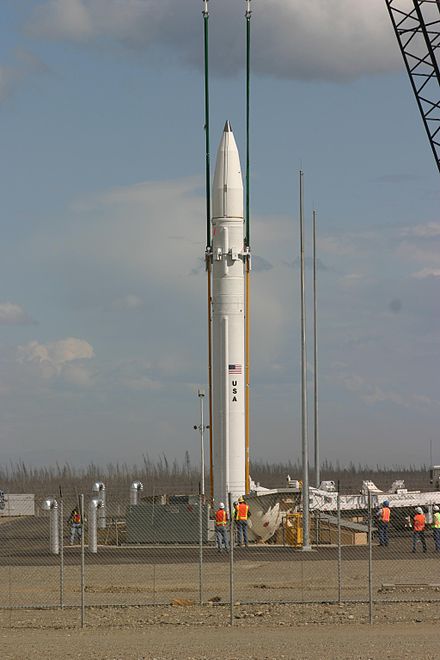
Ground Based Interceptor at Ft. Greeley, Alaska via Wikipedia.
But as with almost all North Korean developments and proclamations from the exalted “supreme leader” Kim Jong-un, it’s hard to say what’s real and what’s a delusional fantasy. Nonetheless, Washington has to take the possibility of a nuclear-tipped North Korean ICBM seriously. What, then, can the United States do to stop a North Korean ICBM that’s headed towards the American homeland?
To a large extent the United States has prepared from this eventuality. The best way to stop a North Korean ICBM would be to eliminate the target before it’s launched. But if the regime in Pyongyang—in a move that would guarantee a devastating U.S. nuclear retaliation—manages to launch a missile towards an American city, Washington has an operational missile defense system in place.
The Missile Defense Agency’sGround-based Midcourse Defense (GMD) element provides Washington the ability to destroy a limited number of incoming intermediate and long-range ballistic missiles threats in space to defend the United States. There are interceptors already in place at Fort Greely, Alaska, and at Vandenberg Air Force Base, California. Right now there are a total of thirty interceptors deployed, but there are plans to add fourteen more missiles. [National Interest]
You can read more at the link about other missile defenses the US has, but first of all launching an ICBM at the US would be a weapon of last resort since the US response would be so devastating against the North Koreans. Additionally the rocket they are threatening to fire now would be easy to destroy left of launch since it takes days to prepare it for launch. That is why the North Koreans have fielded the KN-08 ICBM that is road mobile and much more easier to launch. However, it has never been tested and many have claimed they are mock ups.
For all we know the Kim regime could be playing the same games that Saddam Hussein did with exaggerating his military capability. However, military leaders have to prepare for the worst case a threat poses and thus why the Kim regime’s threats are taken so seriously.
North Korean leader Kim Jong-un (C) is featured being heartily greeted by women workers of the Kim Jong Suk Pyongyang Textile Mill that he visited in this photo carried by the country’s official media, the Korean Central News Agency, on Jan. 28, 2016. The news report said Kim expressed deep satisfaction “picturing to himself students going to and from school with cheerful laughter, carrying with them locally produced fashionable bags” manufactured at the facility. (Yonhap)
The data inconclusive, but I would not be surprised if the North Koreans did in fact test some hydrogen bomb components:
The U.S. now believes North Korea might have attempted to test components of a hydrogen bomb on January 6, after further review and analysis of the latest intelligence information.A U.S. official directly familiar with the latest U.S. assessment said there may have been a partial, failed test of some type of components associated with a hydrogen bomb. The assessment comes after careful examination of the latest intelligence analysis of the test data.
But the official emphasized there is no final conclusion.Immediately following the test earlier this month, White House Press Secretary Josh Earnest said the initial analysis that have been conducted was “not consistent” with a successful hydrogen bomb test.The U.S. still does not accept North Korea’s claim that it tested a hydrogen bomb, but air sampling conducted after the test has proved inconclusive, the official said. That prompted another look at the seismic data.
That analysis shows the test was conducted more than two times deeper underground than originally assessed — at a depth consistent with what might be needed for a hydrogen bomb.However, the size of the seismic event and other intelligence indicates it was not likely a fully functioning device. The official said it’s possible the North Koreans believe they conducted a full hydrogen bomb test, but the U.S. believes it was likely only some components, perhaps a detonator, that exploded. [CNN]
It appears that the North Koreans are preparing for a response to any United Nations sanctions the US may be trying to get implemented in response to their recent nuclear test. In fact US Secretary of State John Kerry is in China trying to get the Chinese government to agree to a sanctions deal. A rocket test would be a fitting way to thumb their noses at any UN sanctions that may be passed:
Speculation mounted Friday that North Korea is preparing a rocket or long-range missile launch to follow its recent nuclear test, with Japan reportedly ordering its military to shoot down any projectile that threatened its territory.
With existing UN Security Council resolutions banning North Korea from the use of ballistic missile technology, any launch would be a further slap in the face of the international community which is struggling to find a united response to the January 6 nuclear test.
Following a Japanese report that cited government sources as saying a rocket launch could come as early as next week, two US defence officials confirmed ongoing activity at the North’s Sohae satellite complex.
“The indications are that they are preparing for some kind of launch,” one US official told AFP, speaking on condition of anonymity.
“Could be for a satellite or a space vehicle — there are a lot of guesses. North Korea does this periodically — they move things back and forth,” the official said.
The United States regularly monitors North Korea from space, while Japan began satellite monitoring of the country in 2003.
North Korea successfully put a satellite into orbit with its Unha-3 carrier in December 2012. [AFP]
You can read more at the link, but the best report I have read about any possible launch is over at 38 North which has a lot of good commercial imagery of the test site and have settled on this conclusion of what the North Koreans are doing:
The level of activity throughout the Sohae facility at the launch pad, covered rail station, VIP housing area, launch control bunker and NADA facilities (particularly the helipad) raise justifiable concerns that North Korea may be preparing for the launch of a space launch vehicle. Moreover, the level of activity throughout the site is unlikely to be justified by what appears to be an imminent rocket engine test. If Pyongyang is preparing for a rocket launch, available imagery indicates that a launch is not imminent and that the North may be at an early stage of preparation.
However, there is a high level of uncertainty about this judgment for a number of reasons. First, the gantry tower work platforms are covered by an environmental cover and are folded forward, obscuring any view of whether a rocket is inside or not. Second, the movable transfer structure could easily allow for stages to be assembled and transferred to the gantry tower during periods of darkness or heavy cloud cover. In the earlier image the structure did not appear to have moved since the snowfall observed in a December 4 image as its tracks remained snow covered. Since the entire launch pad area is now clear of snow, any movement by the structure cannot be determined. Third, commercial satellite imagery coverage of the test site is not continuous and therefore observers only have snapshots of activity at the launch pad.
If North Korea follows previous pre-launch preparation practices, we would expect to see in the coming days increased site-wide activity, traffic at the fuel/oxidizer storage bunkers, activity at the launch pad and the presence of tracking equipment. [38 North]
Considering the political fall out every time an American is arrested it is amazing that a travel ban has not been instituted on North Korea a long time ago. If a travel ban is not instituted then the US government should at least make it very clear that it will not negotiate to get detainees released:
Passengers board an Air Koryo plane bound for Beijing at the Pyongyang International Airport in Pyongyang, North Korea, in June 2015. The U.S. State Department has long warned against travel to North Korea, but it is now reportedly seeking a ban on tourism.
Without banning it outright, the U.S. State Department has long warned against travel to North Korea. But, post nuclear test, the U.S. is now reportedly seeking a ban on tourism and restrictions to keep the North’s flagship airline, Air Koryo, from flying into and out of airports abroad. Most tourists board their flights to Pyongyang from Beijing.
As yet, none of the major North Korea travel agencies are canceling upcoming trips. One of the year’s biggest tourist draws, the Pyongyang marathon, is just months away.
They are, however, concerned about the fallout from Warmbier’s arrest.
China-based Young Pioneer stressed in a news release that Warmbier was the first of the 7,000 people it has taken to North Korea over the past eight years to face arrest. Uri Tours, based in New Jersey, told AP that it has also had only one such case — American Matthew Miller, who ripped up his tourist visa on arrival in what he has said was a deliberate attempt to get arrested. (……….)
“Critics claim that tourism is an avenue for the DPRK government to arrest Americans as political hostages. However, this has not been our experience,” she said. “We’ve taken many American tourists and with the exception of Matthew Miller, they’ve all returned safely with positive feedback.” [Stars & Stripes]
Here is another interesting read from the former Prime Minister of South Korea Kim Jong-pil. This time he discusses his views on the Sunshine Policy and why it was never going to work. History has shown he was correct:
Prime Minister Kim Jong-pil looks into North Korea with binoculars during a visit to an eastern frontline unit on Dec. 9, 1998. [KIM JONG-PIL]After his return to Seoul, Kim invited me and my wife Young-ok for a dinner at the Blue House on June 20, which was my first encounter with him in five months. Welcoming me, Kim said with a smile, “I felt pretty lonely without you.”
I replied, “You pulled off a major feat this time.”
Kim told me in greater detail of the progress he had made with Kim Jong-il during his stay in Pyongyang.
I told him, “I hope that agreement could lay down a path for the two sides toward an era of reconciliation.”
But in fact, I disagreed with the second clause of the agreement. If the two Koreas are reunified with different political systems, the problems in such a dual system would be enormous. I was firm in my belief that reunification would be complete only under one form of government as Italy had done in the 19th century.
The pursuit of reunification is a matter that calls for thorough contemplation and a long view. It should not be tackled with simple optimism or the illusion that the North could simply open up to the South and the outside world after a prolonged period of engagement. We need to be patient in waiting for change within the Pyongyang regime over the long run. Suppose we have a day of reunification suddenly and have to live with 20 million fellow citizens in the North. It wouldn’t be stretch to say half of our national income would be spent on assisting the North in a reunified Korea. I wonder how people would react to a government decision to take away half of their incomes just to nurture the North’s basket case of an economy.
A president should not be in a hurry to complete his or her North Korea policy during a single five-year term. We should wait and see what changes occur in the North as time goes by. For a considerable period of time, Seoul must spend its energy on strengthening our national power. West Germany achieved a peaceful reunification because it had the capacity to embrace East Germany. And West Germans were not hesitant to pour their money into reinvigorating the moribund economy of the East and elevating the standard of living of East Germans.
Former President Kim Dae-jung prided himself on moving the country a step closer to reunification. In fact, nothing has changed much since his summit 16 years ago. But Kim had the honor of winning the Nobel Peace Prize in December 2000. That was the real fruit of his tireless efforts to engage North Korea. [Joong Ang Ilbo]