Tag: North Korea

Defector Describes Sex Slaves and Brutal Executions in North Korea

As with many of these defector accounts it is impossible to know how true the claims really are:

A North Korean defector has told of Kim Jong Un’s teen sex slaves, lavish caviar lunches and gory public executions. Hee Yeon Lim, 26, is the daughter of a high-ranking soldier from Pyongyang and a member of the regime’s inner circle.

But when her father, Col. Wui Yeon Lim, 51, passed away, she and her family decided to flee the country in 2015. Now in South Korea, Hee Yeon has spoken of what life was like inside the secretive rogue state.

She told the Mirror she saw “terrible things” in her home city of Pyongyang despite her family’s relative privilege. She said officials came to her school to pick out teen schoolgirls to work at the chubby dictator’s homes. The escapee said they would only choose the prettiest girls, who were taught to feed him caviar and massage him.

If they refused, they would “disappear,” she said.

Hee Yeon — who has met the despot — also told how he would dine out on imported delicacies like caviar and Chinese “bird’s nest soup,” which can cost $2,700 a kilo (2.2 pounds).

And she described one occasion when she was forced to watch as a group of 11 musicians accused of making a pornographic video were slaughtered. Hee Yeon told how she and her classmates were ordered out of their classrooms in the middle of the day by soldiers who took them to a stadium at the city’s Military Academy.

She said the hooded and gagged victims were brought out and tied to the end of anti-aircraft guns in front of some 10,000 spectators. The escapee then recalled how the guns were fired one by one, saying: “The musicians just disappeared each time the guns were fired into them.  [New York Post]

You can read more at the link.

North Korean Foreign Minister Threatens to Conduct Hydrogen Bomb Test Over the Pacific

Would such a test be pretext to launch a bombing strike, especially since they would have to fire over Japan to do this nuclear test?:

The United States began using the Marshall Islands as a nuclear testing site beginning in 1946.

Hours later, Kim’s foreign minister told reporters in New York that Pyongyang could launch a nuclear missile test in response. “This could probably mean the strongest hydrogen bomb test over the Pacific Ocean. Regarding which measures to take, I don’t really know since it is what Kim Jong Un does,” said Ri.  [CNN]

You can read more at the link.

North Korea Owes New York City $156,000 In Parking Tickets

Good luck New York City trying to get this money out of North Korea:

As if the U.S. and North Korea hadn’t had enough bilateral tensions, outstanding parking fines from North Korea’s diplomatic mission to the U.N. add insult to injury. According to NBC New York, the mission owes as much as $156,000 to the city of New York for more than 1,300 unpaid tickets that date back to the 1990s.

Jong Jo, identified as secretary of North Korea’s U.N. mission, came to his country’s defense. “It is false,” Jong told NBC New York. “Whenever we have a ticket, we pay. Because, you know, if we have three tickets the city does not allow us to renew their permission.”

In fact, a 2002 Memorandum of Understanding between the State Department and New York does allow the city to deny a diplomatic parking decal from vehicles that have three or more unpaid parking tickets, NBC New York reported. Even though the majority of tickets accrued by the diplomatic mission occurred after 2002, the city said that debt from parking tickets prior to that year still has to be paid.  [Newsweek]

You can read more at the link.

Would North Korea Be Willing to Use Their Missiles to Launch Future Provocations Against the United States?

Here is an excerpt from article forwarded to me that speculates how the Kim regime may try and use their missiles to launch provocations against the United States to cause a split in the US-ROK alliance:

You can read the rest at the link.  However, I don’t think the Kim regime would use their missiles to launch a provocation against the United States because the South Koreans would have to back US retaliations as part of the US-ROK alliance.  However, where things muddier is what if he launched a missile provocation against Japan?  Would the South Korean government be willing to back retaliation in support of Japan?

Tweet of the Day: The US to Sanction Anyone Doing Business with North Korea

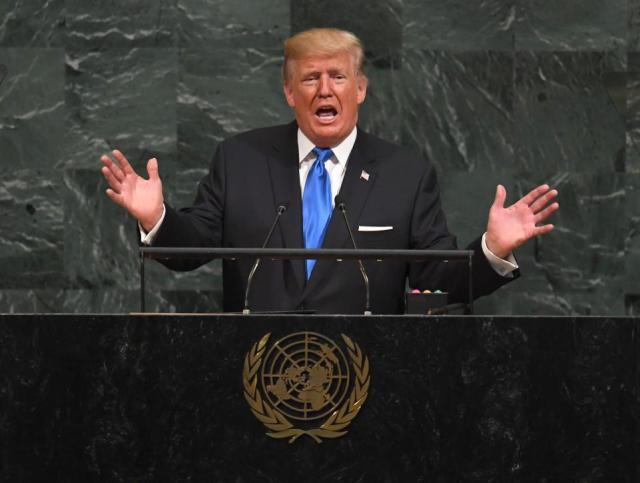
North Korean Official Responds to President Trump’s UN Speech By Saying He Sounds Like a “Barking Dog”

I doubt this will be the only response from North Korea after President Trump’s very blunt address given towards North Korea at the UN this week:

North Korea has ridiculed President Donald Trump’s threats over its missile program, comparing his comments during his maiden speech to the United Nations to the sound of a “barking dog.”

Speaking on Tuesday, Trump said the U.S. would “have no choice but to totally destroy” North Korea and earlier this week on Twitter referred to Kim Jong Un as “Rocket Man.”

North Korea’s delegation left the hall in New York ahead of Trump’s speech, but the country’s foreign minister, Ri Yong Ho, compared Trump’s remarks to the sound of a dog barking in televized remarks to the press in New York.

“There is a saying that goes: ‘Even when dogs bark, the parade goes on’,” Ri said, quoted in Reuters. “If [Trump] was thinking about surprising us with dog-barking sounds then he is clearly dreaming.”

When asked about the “Rocket Man” remarks, Ri quipped “I feel sorry for his aides,” a perceptive comment given the now viral image on social media showing Trump’s Chief of Staff John Kelly covering his eyes in apparent dismay at the president’s speech.  [Newsweek]

You can read more at the link.

Andrei Lankov On Why the United States Should Pursue A North Korean Freeze Deal

A ROK Drop favorite Dr. Andrei Lankov has an article published in NK News that once again advocates for a “freeze deal” with North Korea:

Andrei Lankov

Of course, it is politically impossible to be excessively frank about such a plan, as the admission that North Korea is a de facto nuclear state would damage international non-proliferation efforts and bring about a tidal wave of virtue signaling behavior from U.S. hard-liners, including many legislators.

To cushion these problems, a freeze deal will have to be presented as merely the “first step on the long and winding road to North Korea’s denuclearization” which will surely happen at some point in a rather distant future.

So far, the idea of a freeze, while widely discussed among the mid-level officials, remains a taboo at the higher levels of the U.S. bureaucracy. This is vital: this is exactly the levels where such decisions have to be made.

This author is skeptical about the immediate prospects of a freeze. It will take some time (probably, years) before U.S. decision makers get over their natural tendency to deny the unpleasant truth. Nonetheless, serious discussion of a freeze as a theoretical possibility has already begun, and numerous opponents of this idea have already made good arguments about what is problematic about such a plan.

Unfortunately, in spite of being a long-time proponent of the freeze idea, I cannot help but admit that many of their arguments are correct, but on balance, there are still valid reasons to accept the freeze solution as a deal which, while flawed and imperfect, is still better than its alternatives.  [NK News]

You can read more at the link, but as I have said before I think any freeze deal should include robust inspections and the risk of a retaliatory bombing strike if it is not complied with.  The risk of war on the peninsula by noncompliance by the Kim regime would give motivation to the Chinese to make sure the Kim regime is complying with the deal.

Tweet of the Day: The First Rocket Man

Spain Becomes Latest Nation to Remove North Korean Ambassador

I don’t know why any country would want a North Korea ambassador in the first place considering the rampant criminal enterprises conducted out of North Korean embassies:

On Monday, Spain asked the North Korean ambassador in Madrid to leave the country by the end of September, the first European country to expel a North Korean diplomatic envoy.

The move follows similar steps by Mexico, Peru and Kuwait earlier this month. It also comes as the international community steps up its efforts to heighten sanctions against the nuclear-weapons seeking state.

The United Nations Security Council unanimously adopted Resolution 2375 last week, which put a cap on the country’s crude oil imports and a ban on its textile exports.

The United States has called on other countries to cut diplomatic and trade ties with the North in a bid to further isolate the Kim Jong-un regime.

“Today, the North Korean ambassador was summoned and was told of the decision to consider him persona non grata, therefore he must stop working and leave the country before Sept. 30,” the Spanish foreign ministry said in a statement, according to Reuters.  [Korea Times]

You can read more at the link.

US Secretary of Defense Says There Are Military Options Against North Korea that Don’t Put Seoul at Risk

Of course the United States has military options that do not threaten Seoul.  In fact one was just executed with the recent B-1 show of force bombing exercise in South Korea.  The real question is if there are military options to remove North Korea’s ICBM and nuclear facilities without endangering Seoul:

The United States has military options for North Korea that do not put Seoul at grave risk, Washington’s top defense official said Monday.

The remark by Defense Secretary Jim Mattis marks a departure from the popular argument that there is no viable military option that would not leave thousands of South Koreans and U.S. service members dead.

“Yes, there are,” Mattis told reporters at the Pentagon when asked whether there were military options that would not seriously endanger Seoul. “But I will not go into details.”

Mattis said he discussed with South Korean Defense Minister Song Young-moo the issue of reintroducing tactical nuclear weapons to South Korea to counter North Korea’s nuclear and ballistic missile threats. But he declined to say whether the option is under consideration.  [Yonhap]

You can read more at the link.