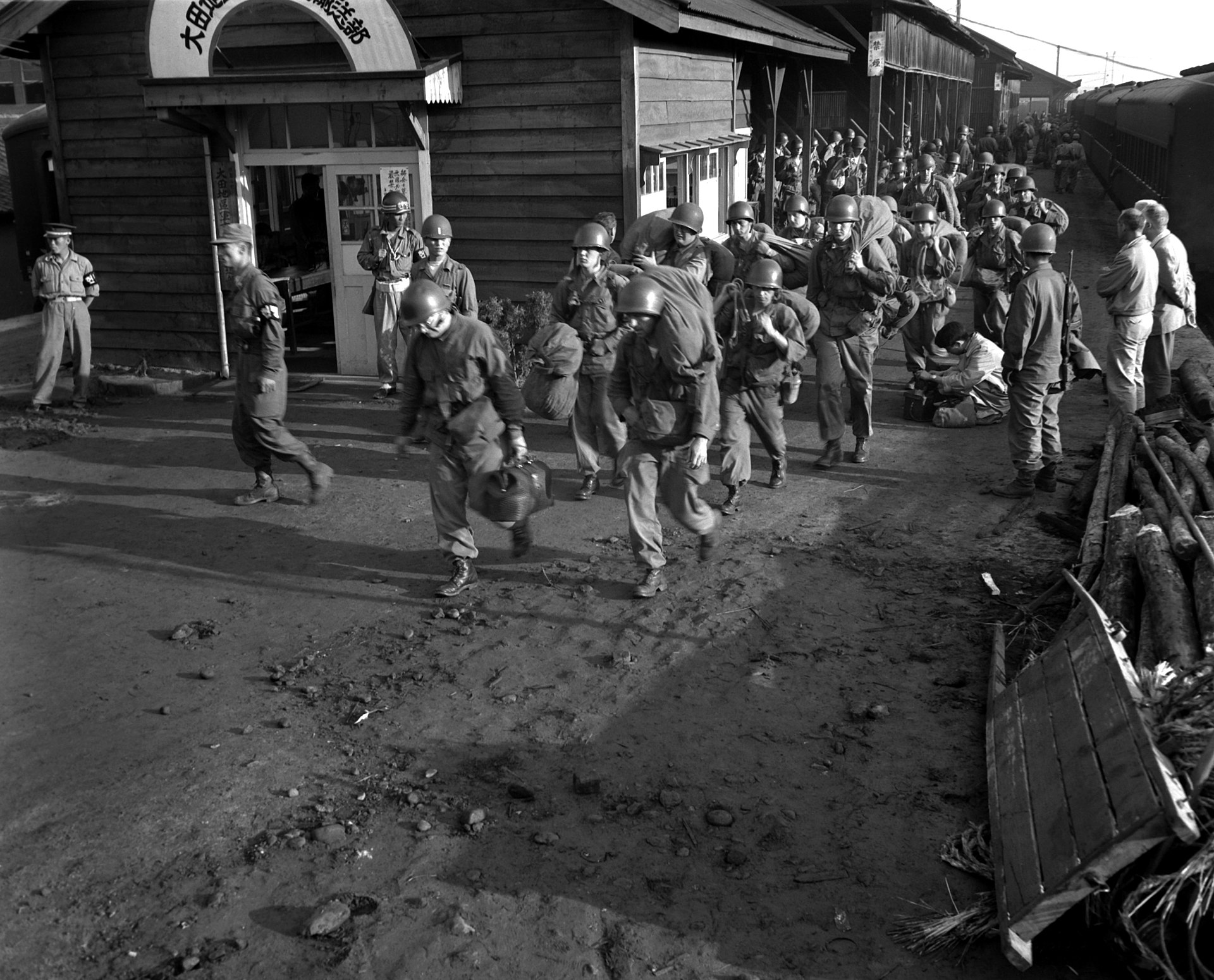
A wounded soldier on a hospital ship in Incheon, Korea eats Thanksgiving dinner, in 1952. ( National Museum of Health and Medicine/Flickr ) via the Atlantic.
For this week’s #TBT, we’re going a little more lighthearted. Marilyn Monroe, one of the world’s more famous actresses, appearing with the #USO Camp Show, “anything Goes,” poses for the shutterbugs after a performance at the 3rd U.S. Inf. Div. area.1954. (U.S. Army photo by Cpl. Welshman.) [USFK Facebook page]
For some of you that served in the Korean War or had family members who did maybe you can help identify some of the people in these photos:
More than 5.7 million Americans served in the Korean War from 1950 to 1953. The U.S. Department of Defense chronicled America’s involvement through photographs, a collection of which found its way into the care of Air Force veteran Betty Perkins-Carpenter, a resident of Penfield, New York. Now, Perkins-Carpenter would like to pass on these original photos, which remain in excellent quality, to the men and women pictured in them or their families.
The Democrat and Chronicle, owned by the same parent company as Army Times, has teamed up with Kodak Alaris to share the photos with a wide audience. Digital files scanned by Kodak Alaris have been used to create this website.
Keep an eye open for people or places you might recognize. You can search the gallery for a name, hometown, battle or date by using the search bar below. Click a photo to view it in a larger format and access a link to email Perkins-Carpenter to inquire about a photo. [Army Times]
Considering that last year the North Korean government spent a lot of money renovating a Korean War cemetery honoring North Korean veterans of the Korean War; I would not be surprised if the Chinese leadership were unhappy that their cemetery did not receive the same treatment:
North Korea has begun renovation work on a cemetery in the North’s capital for Chinese soldiers who were killed during the 1950-53 Korean War, China’s state media reported Tuesday.
China’s ambassador to North Korea, Liu Hongcai, attended a ceremony in Pyongyang to celebrate the start of renovation work, the Chinese Communist Party mouthpiece, the People’s Daily, reported on its website. [Yonhap]
Korean War Service: 2-19 Infantry Regiment, 24th Infantry Division
Posthumously recognized with the Medal of Honor in 1951.
Picture of Mitchell Red Cloud Jr. in his US Army uniform. Picture via FreeRepublic.com.
Introduction
For soldiers that receive orders to the 2nd Infantry Division located near the Demilitarized Zone in South Korea one of the camps that all soldiers will eventually visit or at least hear about is Camp Red Cloud. This camp is located in the commuter city of Uijongbu just north of South Korea’s capitol of Seoul. Camp Red Cloud is home to 2ID’s division headquarters and other support units. Though every soldier in the 2nd Infantry Division knows of Camp Red Cloud very few actually know who the camp is named after. I can remember when I once had a lieutenant ask me if the camp was named after the sunsets seen from the camp over the mountains in the evenings. What many people do not realize is that Camp Red Cloud is actually named after a person and not for any red clouds seen in the air. The person the camp is named for is Mitchell Red Cloud Jr. who was recognized with the Medal of Honor for combat actions during the Korean War.
Mitchell Red Cloud Jr. was born on July 2, 1924 in Hatfield, Wisconsin on the traditional lands of the Winnebago Native-American tribe to Mitchell Red Cloud Sr. and Lillian Winneshiek. Mitchell Jr. was the oldest of three boys that the couple would have. As a boy Mitchell Jr. was well known for his outdoor skills that he perfected while going on hunting and fishing trips on the reservation. Mitchell Jr.’s schooling began at the Clay and Komensky Rural School before moving on to the Winnebago Indian School for a year. For high school he enrolled in the Black River Falls High School before deciding to drop out at the age of 16.
Red Cloud During World War II
Mitchell Jr. made the decision to drop out of high school because he wanted to pursue a career in the US military. Just one month after his 17th birthday he received permission from his dad to enlist in the Marine Corps. Red Cloud’s enlistment date into the Marines was on August 11, 1941. Due to his outdoors skills and physical conditioning honed from growing up on the Indian Reservation, Red Cloud excelled at boot camp and became an outstanding Marine. His first duty assignment was at Camp Elliot in San Diego when the Japanese bombed Pearl Harbor on December 7, 1941. After the bombing Red Cloud was assigned to the 2nd Marine Raider Battalion and deployed to the Pacific to fight in World War II. In November 1942, the then Private First Class Mitchell Red Cloud found himself in heavy combat on the island of Guadalcanal which was the scene of some of the most ferocious fighting of all of World War II.
Red Cloud spent a month in the jungle with the Raider Battalion fighting the Japanese on the island. After the US military was able to secure Guadalcanal from the Japanese, Red Cloud like many other personnel that served on the island became sick with the tropical diseases malaria and jaundice. He suffered extreme weight loss and was sent back to the US for medical evaluation in January 1943. The medical personnel recommended a discharge for Red Cloud but he refused. Red Cloud’s refusal to accept a discharge saw him redeployed to the Pacific theater again just in time to participate in another brutal fight against the Japanese; this time on the island of Okinawa. On May 17, 1945 while serving as a radio operator during the Battle of Okinawa PFC Red Cloud was shot in his left shoulder. He was medically evacuated to Guam for treatment before being shipped back to the US.
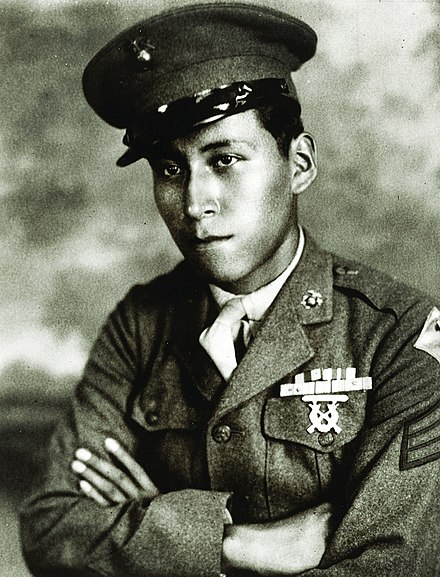
Picture of Mitchell Red Cloud in his Marine Corps uniform during World War II. Picture via Wikipedia.
With World War II over Red Cloud accepted his discharge from the Marines on November 9, 1945. The Marines gave him an honorable discharge and $56.70 before he returned to the Winnebago Indian Reservation in Wisconsin. While on the reservation Red Cloud got married and his wife gave birth to a daughter. Despite these personal developments in his life outside the military, Red Cloud decided after only two years on the reservation to reenlist in the US military. Red Cloud decided this time to not join the Marines, but instead the US Army in 1948. I wasn’t able to find anything definitive on why Red Cloud reenlisted in the military, but maybe he just grew restless after experiencing so much combat during World War II? Maybe it was just the more practical matter of providing for his family that caused him to reenlist in the military? His younger brother who had enlisted in the Army had just did in a peace time training accident; so maybe Mitchell enlisted in honor of his brother? Finally maybe he enlisted because after spending two years away from the Army he realized he is a true warrior and the military was his calling? For whatever the reasons were the US Army was getting an experienced soldier that was badly needed in the US military that had lost the vast majority of its combat veterans due to the post-World War II drawdown.
Red Cloud During the Korean War
The first unit Red Cloud was assign to was E company, 2 battalion, 19 Infantry Regiment of the 24th Infantry Division. The 24 ID at the time was responsible for conducting peacekeeping duties on the southern Japanese island of Kyushu. The assignment to Japan must have seemed like easy duty for Red Cloud compared to what he had been through during World War II. However, the relaxed time he spent in Japan didn’t last long when on July 3, 1950 the 24th ID was deployed to the Korean peninsula to stop the communist backed North Korean military that had invaded South Korea. The North Korean military crossed the DMZ that separates the two countries on June 25, 1950 and appeared to be on its way to reuniting the country that had been divided by US and Russian occupation forces after World War II. US President Harry Truman however decided to militarily intervene to stop the communist invasion of the Korean peninsula and the only troops immediately available to deploy to Korea were the peacekeeping troops located in Japan. Most of these troops were draftees that had not fought during World War II and had little combat training while stationed in Japan. Though these troops were eager to fight in what was being called a “police action” at the time; it would be up to hardened World War II vets like Mitchell Red Cloud to get these guys ready for battle. Red Cloud at the time of his deployment to Korea was a 25 year old Corporal who was respected by the men in his unit due to his prior combat experience. He had the nickname “Chief”, was easy going, and was quick to give advice to the younger troops that all looked up to him. They would soon learn to respect him even more.
Taskforce Smith soldiers arrive in Daejon during the Korean War, picture via Wikipedia.
Of the four US military divisions stationed in Japan, the 24ID was chosen to be the first to deploy to Korea. The first element of the 24th Infantry Division to arrive in Korea was the ill fated Taskforce Smith that first saw action against the North Korean military just south of Osan. The light infantry unit found themselves in battle against a foe with Soviet provided tanks and due to the superior firepower Taskforce Smith was soundly defeated. You can read more about Taskforce Smith at the below link:
Defeat would become a reoccurring theme for the other 24th ID units who were thrown into combat against the North Koreans with little to no weapons to combat the North Korean tanks. The battlefield chaos for the 24th ID reached its climax when the Division Commander Major General William Dean was captured during the Battle of Taejon. You can read more about General Dean at the below link:
This was the chaos that Corporal Red Cloud found himself in that most have been vastly different experience for him compared to his time in World War II. During that war he had fought in many successful battles against a much more dangerous enemy and now just a few years later he was part of one of the greatest military debacles in US history.
The 24th ID may have been soundly defeated by the North Koreans, but it and the other divisions from Japan that were thrown into battle, did enough to slow down the North Korean invasion until more troops from the US could arrive to help hold the Pusan Perimeter. Red Cloud and the rest of the men in the 2-19 Infantry Regiment saw combat soon after arriving in country on July 12, 1950. The unit saw combat during the defense of Daejon and then moved south towards Taegu and held part of the line along the Pusan Perimeter. Eventually General Douglas MacArthur would execute his famed Incheon Landing Operation that changed the course of the war and threw the North Koreans into a massive retreat. This allowed the 24th ID to reconstitute itself and soon enough Corporal Red Cloud and the rest of the personnel in the division were crossing the DMZ into North Korea to finish the war. In November 1950 the US military and its United Nations allies who had recently deployed troops to Korea, had advanced deep into North Korea when unbeknownst to them the Chinese military had decided to come to the aid of their communist ally North Korea. The unexpected attack by the Chinese caused the US and UN forces to a massive retreat that was quickly turning into yet another military debacle. This was the state of the war that Corporal Red Cloud now found himself in as he sat in a listening post on a hill north of the Chongchon River in North Korea on November 5, 1950.
The Chongchon River can be seen at the very bottom of the map which is located just north of the North Korean capitol city of Pyongyang. To the northwest of the river the positions of the 19th Infantry Regiment on November 1, 1950 can be seen. Map via Wikipedia.
The UN forces were in retreat and the bridge across the Chongchon River was a critical asset to support the southward movement of friendly forces. The 27th British Commonwealth Regiment which had just recently deployed to Korea and Red Cloud’s 19th Infantry Regiment were both positioned on the north side of the river to defend the bridge on November 2, 1950. Due to the shortage in personnel there was a five mile gap between the two units that was to be patrolled to prevent infiltration by the Chinese. However, the patrols ended up proving ineffective as the Chinese were able to successfully probe and discover this gap between the two units.
On the night of November 5, 1950 a 1,000 Chinese soldiers from the 355th Regiment were able to follow field telephone lines laid down in this gap to the positions of the 19th Infantry Regiment. Fortunately for E Company they had someone in a listening post that night that was awake and very attentive in looking for any Chinese infiltrating towards their position on Hill 123. That man was Corporal Red Cloud. A friend of Red Cloud’s in the company, Private First Class Ed Svach would later tell how Corporal Red Cloud had once told him that he could smell the Chinese coming. Red Cloud said, “It’s like hunting those Wisconsin deer. I can smell them coming.”
Red Cloud had been in a listening post that night with his assistant machine gunner on a ridge below the company command post. Red Cloud also knew how the Chinese liked to attack. The Chinese would launch a small frontal attack to draw attention that way but the main attack force would actually be infiltrating from the sides and rear. That is why Red Cloud set up his listening post to the side and rear of the company command post. At 3:20 AM in the morning Red Cloud let out a cry when he spotted Chinese infiltrating towards the E Company position who were following the communications wire leading to the command post. After being spotted the Chinese charged Red Cloud’s position from a 100 feet away and shot and killed his assistant machine gunner. Using his Browning Automatic Rifle (BAR), Red Cloud stood up out of his listening post and unleashed direct fire into the advancing Chinese. Red Cloud’s direct fire slowed the Chinese assault and bought time for the Company Commander, Captain Conway to wake everyone up and consolidate the defense of the E Company position. Unfortunately Red Cloud’s warning was not enough to alert everyone in the company in time because the Chinese were able to shoot some of the US soldiers in their sleeping bags. E Company was getting over run and one veteran of the battle is quoted in John McCain’s book, “Why Courage Matters” as saying:
“I wanted to bug out. I just couldn’t figure out how”
While Red Cloud was holding off the initial Chinese assault he was shot twice in the chest. One of the E company medics, Perry Woodley went to Red Cloud’s position and applied pressure bandages to his two chest wounds. Red Cloud seemed fine and continued to fire his BAR at the Chinese. Woodley left Red Cloud to go help other wounded soldiers. He returned a short time later to check up on Red Cloud again. He found Red Cloud surrounded by about a dozen Chinese bodies and more severely wounded than from when he last saw him.
Position of the 2-19 Infantry Regiment north of the Chongchon River where Corporal Mitchell Red Cloud Jr. was killed in action. Notice the area that the Chinese infiltrated through just west of the 2-19th’s position to get into their rear area. This was the gap between them and the British 27th Brigade which was mostly composed of Canadians that was supposed to be patrolled by both units to detect the Chinese. Map via Wikipedia.
Woodley told Red Cloud that he had to get off the mountain or he was going to die there. Red Cloud refused medical evacuation from his position and instead propped his wounded body up on a tree to continue firing at the advancing Chinese with the BAR. One soldier at the bottom Pete Salter said that he actually used a web belt to tie Red Cloud to the tree so he could stay up right to keep firing. Something not widely known about this battle is that another man, PFC Joseph Balboni stayed in a position near Red Cloud that created a crossfire that pinned the Chinese down enough for other men in the company to try and escape down a draw to the south.
After Woodley and Salter left the position they could hear the BARs from Red Cloud and Balboni continuing to fire on the advancing Chinese. The battle lasted for about an hour before Corporal Red Cloud and PFC Balboni would eventually be killed by the advancing Chinese. However by this time the men of E Company were well alert and retreating off the hill side from the massive Chinese assault to supplementary fighting positions a 1,000 yards to the south. From there the regiment was able to consolidate and make a defensive line to hold off any further Chinese attacks. There four quad 4′s with .50 cal machine guns were used to clear the hillsides of Chinese troops chasing the E Company survivors down the draw. Other units in the battalion would not be as lucky as E Company, if you can call E Company lucky. The nearby A Company would be nearly wiped out as many soldiers were killed while sleeping in their foxholes due to the surprise Chinese attack. E Company soldiers that survived that battle said that their unit likely would have been wiped out too if it wasn’t for Corporal Red Cloud holding off the Chinese attack.
The next morning with the sun out which provided air cover, the battalion was able to return to the old E company position to retrieve the bodies of the deceased. They found that the dead Americans soldiers had been stripped to include Mitchell Red Cloud. The only deceased soldier not stripped was 1st Lieutenant Leslie Kirkpatrick who had all of his clothes and gear on except for a missing West Point ring. Kirkpatrick had been killed while coming to the aid of a wounded soldier during the battle. His body was found with his head lying on his helmet as if he was sleeping. It is believed that one of the other lieutenants in his company placed his body like that after recovering his West Point ring to give to his wife. However, that lieutenant had been killed as well during the battle and the Chinese stripped his body and took the ring. Kirkpatrick was a 1949 graduate of West Point. Of the 670 cadets that graduated that year, 41 of them to include Kirkpatrick were killed in action during the Korean War.
Picture of Leslie Kirkpatrick as a cadet at West Point. Picture via SidneyLanier.org.
Red Cloud’s stripped down body was found lying near the tree where he died. He had been reportedly shot a total of eight times. All around Red Cloud were the bodies of Chinese soldiers. It was reported that over 30 Chinese bodies were found around Corporal Red Cloud’s position. Corporal Red Cloud’s recovered body would eventually be laid to rest in the United Nations Cemetery in Pusan. The other BAR gunner PFC Balboni would be credited with killing 17 enemy soldiers before being killed himself. PFC Balboni would posthumously be recognized with the nation’s second highest honor, the Distinguished Service Cross. In all the battalion estimated that about 500 enemy soldiers had been killed on the hill that day.
Post-Korean War Honors
A few months later in April 1951 the Congressional Medal of Honor was presented to Corporal Mitchell Red Cloud Jr.’s mother during a ceremony held at the Pentagon. She was presented the medal by General Omar Bradley. Here is what his Medal of Honor citation says:
At the Pentagon in April 1951, Lillian “Nellie” Red Cloud, mother of the late Cpl. Mitchell Red Cloud Jr., is handed the Medal of Honor awarded her son for his “dauntless courage and gallant self-sacrifice” against Chinese forces in North Korea the night of November 5, 1950. Gen. Omar N. Bradley, then-Chairman of the Joint Chiefs of Staff, is at left. ” – See more at: http://korea.stripes.com/base-info/cpl-mitchell-red-cloud-jr-annual-ceremony-planned#sthash.AZOcG1Oc.dpuf
Cpl. Red Cloud, Company E, distinguished himself by conspicuous gallantry and intrepidity above and beyond the call of duty in action against the enemy. From his position on the point of a ridge immediately in front of the company command post he was the first to detect the approach of the Chinese Communist forces and give the alarm as the enemy charged from a brush-covered area less than 100 feet from him. Springing up he delivered devastating pointblank automatic rifle fire into the advancing enemy. His accurate and intense fire checked this assault and gained time for the company to consolidate its defense. With utter fearlessness he maintained his firing position until severely wounded by enemy fire. Refusing assistance he pulled himself to his feet and wrapping his arm around a tree continued his deadly fire again, until he was fatally wounded. This heroic act stopped the enemy from overrunning his company’s position and gained time for reorganization and evacuation of the wounded. Cpl. Red Cloud’s dauntless courage and gallant self-sacrifice reflects the highest credit upon himself and upholds the esteemed traditions of the U.S. Army. for conspicuous gallantry and intrepidity in action at the risk of his life above and beyond the call of duty in Chonghyon, Korea, 5 November 1950.
At the Pentagon in April 1951, Lillian “Nellie” Red Cloud, mother of the late Cpl. Mitchell Red Cloud Jr., is handed the Medal of Honor awarded her son for his “dauntless courage and gallant self-sacrifice” against Chinese forces in North Korea the night of November 5, 1950. Gen. Omar N. Bradley, then-Chairman of the Joint Chiefs of Staff, is at left. ” Photograph via the Stars & Stripes
In 1955 his family was able to get his body moved from the UN Cemetery to the Ho-Chunk Cemetery on the Winnebago Indian Reservation back in Wisconsin so he could lay in rest with the rest of his tribe. His friend Ed Svach escorted the body back to the US where he remembered his friend being buried in the custom of the Winnebago people. The sides of his coffin were removed so his soul could escape, a bow and quiver of arrows was laid next to him so he could hunt in heaven, and bowl of fruit was laid next to him so head would have something to eat during the journey.
Mitchell Red Cloud Jr.’s grave in Wisconsin. Picture via FindaGrave.com.
In John McCain’s book, “Why Courage Matters: The Way to a Braver Life” he includes quotes from veterans from the battle that say they owe their lives to Mitchell Red Cloud. One of the survivors, Pete Salter said that during the battle he prayed to God in his foxhole to let him survive this fight and he would live a better life. He said his prayers were answered by Mitchell Red Cloud who sacrificed his life so many other men could survive. Salter in the mid-1960’s would take his kids to the Winnebago Indian Reservation to see the grave of Corporal Red Cloud. Salter broke down crying at the site of the grave of the man who had saved his life. Inscribed on Red Cloud’s grave are these words:
“The son of a Winnebago chief and warriors who believe that when a man goes into battle, he expects to kill, or be killed and if he dies he will live forever.”
Picture of marker above Mitchell Red Cloud’s grave site in Wisconsin. Picture via FindaGrave.com
Since Corporal Red Cloud’s death, the US military has made efforts to ensure that his memory does live forever by naming various military installations and equipment in his hnor. The first thing that I could find that was named after Red Cloud was when Camp Red Cloud in Uijongbu, South Korea was named after the Medal of Honor recipient.
Mitchell’s Club on Camp Red Cloud is named after him as well. There is also a rifle range on Ft. Benning, Georgia that is named after him. On August 7th, 1999 the newly commissioned strategic sealift ship, the USNS Red Cloud was launched from its dock in San Diego in honor of the fallen warrior. His daughter Annita Red Cloud, his granddaughter Tris Yellow Cloud, and other dignitaries from the Ho-Chunk tribe were there for the ceremony. Kenneth Kershaw, a veteran of E Company, 19th Infantry, who was able to survive the battle that night also attended the ceremony. He simply told the crowd that he attended the ceremony because “If it were not for the alarm sounded by Mitchell Red Cloud, I would not be here today.” The last commemoration I can find for Red Cloud was on the 50th anniversary of his death in 2000. The Korean War Commemoration Committee held a ceremony in honor of Red Cloud at his grave site in Black River Falls, Wisconsin. The committee presented Red Cloud’s daughter Annita with the Republic of Korea War Service Medal that had recently been authorized by Congress for Korean War veterans to wear.
Despite these attempts by the military to honor Corporal Red Cloud within the American public and even the US military his story is widely unknown. Red Cloud’s life story is why I have continued to advocate for Hollywood to explore using stories from the Korean War as movie material. A movie based around E Company with Mitchell Red Cloud as a main character and climaxing with the Battle of Hill 123 would make for a great movie. Red Cloud’s life is one to be remembered not just for his Korean War service, but for his service in World War II as well. There probably are not many US military servicemembers that fought at Guadalcanal and Okinawa during World War II and then the Busan Perimeter and then finally against the Chinese during their intervention into the Korean War. Clearly Mitchell Red Cloud Jr. is not only a Hero of the Korean War, but one of the nation’s most heroic military heroes that unfortunately few people know anything about.
Note #1: More stories about Heroes of the Korean War can be read at the below link:
Note #2:During my research I found only the two above photographs of Mitchell Red Cloud. If anyone knows of more photographs of Red Cloud please leave a link in the comments section.
Note #3:If anyone knows where to find a picture of PFC Joseph Balboni I would like to post his picture here as well.
Note #4: If anyone knows of any other buildings or site named after Mitchell Red Cloud Jr. please leave a comment and share it with everyone else.
While reading through his memoirs about his time in Korea he provides an extensive and very interesting history of how the naming of Camp Red Cloud in Uijongbu came to be:
Did I tell you the story about the naming of Camp Red Cloud? Well, I think this is worth telling. My compound there, the corps headquarters, had always been called Jackson Six, which was our telephone exchange. That seemed to me a rather inadequate name. I told somebody — my G-1, I guess, or PR officer, whoever it was — to start digging and find some people in this corps who got a Congressional Medal of Honor during combat and let’s name our compound here, our headquarters, for the most worthy. They came up with several names, and they had a couple of lieutenants. One of them was the Lieutenant Shea that I mentioned, who had just reported to my division and was killed on Pork Chop Hill. She was sort of a favorite of mine, because he held the two-mile record at West Point, about 30 seconds faster than I had held it 30 years before. I had a great feeling for Shea and when I went back home had a review and presented the decoration to his mother. Shea was one of the names, and there were two or three other lieutenants. I finally looked this list over and spotted the name of Corporal Mitchell Red Cloud. I thought that was interesting; what did he do. I got the citation, and Mitchell Red Cloud had done about everything a soldier could do; he charged a bunker and knocked off about 20 of the enemy and finally — even after he was badly wounded, tossed a grenade in a bunker before he died. So what about Mitchell Red Cloud? Well, Mitchell Red Cloud’s mother was the daughter of a chief of the Winnebago Indian Tribe. I said, “Now let’s get hold of all the records we can, and we’ll put in and get this camp named Camp Red Cloud.” I was thinking of the relationship between a native American and a native Asian. We did this, and I had a brass plaque made. I put the brass plaque on a tremendous rock on the more or less flat sloping side in front of I Corps (Group) headquarters, where it is today. We put it in front, right at our flagpole. On Armed Forces Day, 1957, I decided that we had the authority to redesignate and announce it at the Armed Forces Day meeting.
It was a lovely May day; I had all the Diplomatic Corps, President Rhee and his wife, Ambassador Dowling and his wife, General Decker, I believe, or White — all the Americans. We had about 150 people that were there for the ceremony and then for lunch at my club, which I had built or greatly extended across the street. They were sitting there. General Lemnitzer came over; he was always great because my wife had remained in Tokyo, so he brought her over. She was sitting in the front row of seats next to Mrs. Rhee. The President was standing there on one side of this curtain. I was going to say something about Camp Red Cloud, draw the curtain, and expose this plaque, and then the President was to make some remarks. This all happened; we pulled the cord and it worked, fortunately, and the brass was there, so I read what the brass plaque said. Then I said, “How wonderful it is that an American, a native American, an Indian whose ancestors lost their country to us, came over here to fight for the freedom of the native men of Asia.” I went on and built this one up for a little bit, and emphasized that he gave his life for the freedom of Asian people. I then turned it over to President Lee. Well, he said excitedly what a great thing this was. Mrs. Rhee was getting itchier by the moment because she knew that he frequently went of on tangents, and my wife was keeping her calm, saying, “Never mind everything is going to be alright.”
The President launched into this one. He said, “Yes American Indians are exactly like Asian people. I think American Indians came from Asia.” But then he said, “Why is it that all the time you have American movies over here, you show soldiers and cowboys killing American Indians? Asian people don’t like to see white men killing American Indians.” The he said, “Never again will a motion picture be shown in Korea that has the American soldiers or cowboys killing American Indians.” And they never have, but this doesn’t mean that our compound cannot. There was quite a “to-do,” Mrs. Rhee was so upset. I said, “This is nothing. What he said is true, but this happened more than a hundred years ago.” Of course to them this could be happening today. The dates aren’t shown frequently, and they think this is still going on out in the West. It is bad psychology.
Before I left there to come back to the United States at the end of that year, the end of 1957, I wrote back to G-2 and I said, “Listen, you have got to go out and get me tow of the finest pictures, portraits, grand portraits of American Indian chiefs that you can get for me to present to President Rhee.” Mrs. Trudeau and I were invited there for dinner at Chung Mu Dae, now the Blue House, with President and Mrs. Rhee. He presented me with another Korean decoration and then I said, “Your Excellency (or Mr. President), I have a presentation I would like to make to you.” He said, “Certainly.” So we went into the next room. The portraits were on the wall. I had this all planned with his people bringing him in and then we were going to flip the covers back. I said, “Mr. President, you remember the day we named the I Corps Headquarters Camp Red Cloud for Mitchell Red Cloud, the American Indian who came to fight for your freedom in Asia?” He said, “Oh, yes, I remember”. “Well,” I said, “I want to show you, I want to present to you a pair of portraits of other famous American Indians who are high in our esteem in our country also.” I’ve forgotten which ones they were, but I presented them to him; he thought it was tremendous. Goddam it, they looked more like him than he did himself, if he had a headdress on. It was terrific!
This was a very interesting read and I have to wonder what ever happened to those two portraits? I wonder if they are still on display in Cheongwadae?
Note:You can read more GI Flashbacks articles by clicking on the below link:
Private First Class Anthony T. Kaho’ohanohano via Army.mil.
Introduction
The Korean War saw people from many countries come to the peninsula and fight and die to protect the Republic of Korea from communist aggression. Some of those people who came to Korea to fight were Americans from the Hawaiian Islands. In downtown Honolulu the Hawaii Korean War Memorial can be seen that lists the names of all 456 residents of Hawaii who died fighting in the Korean War. The memorial is about a 100 feet in length, 6 feet high and made of polished granite and black lava rock. On each of the rock squares is the name of each Hawaii resident that died during the war.
Early Life
One of the names on these blocks is Anthony T. Kaho’ohanohano from the Hawaiian Island of Maui. Kaho’ohanohano was born in 1930 to a family with 5 other brothers and a sister. This large family lived in a two bedroom house in the village of Wailuku in Maui. Anthony graduated in 1949 from St. Anthony High School where he played both football and basketball and was known as the “humble giant”. After high school he like all of his other 5 brothers joined the military; three of his other brothers joined the active Army, one other brother served in the Marines, and the last brother served in the National Guard. Anthony initially enlisted in the Hawaii National Guard, but later joined the active Army on February 5, 1951 to fight in the Korean War.
Picture of Kaho’ohanohano as a high school football player via Wikipedia.
Korean War Service
Anthony Kaho’ohanohano was later that year deployed to South Korea where UN forces were battling communist aggression against the Republic of Korea. By 1951 the war had changed dramatically from what appeared was going to be a rout of the North Korean military by the UN forces after the successful Incheon Landing Operation. With the North Korean forces largely defeated the Chinese military secretly infiltrated across the Yalu River into North Korea where they launched a massive surprise attack against the UN forces. The effectiveness of the Chinese surprise attack caused a full scale UN forces retreat back across the 38th parallel into South Korea. The retreat was only halted in February 1951 when soldiers from the 2nd Infantry Division and their attached French Battalion under the command of two Heroes of the Korean War, Colonel Paul Freeman and Lieutenant Colonel Ralph Monclar stopped the Chinese advance at the Battle of Chipyong-ni.
The Chinese would attempt to regain their battle field momentum when they launched the “Chinese Spring Offensive” in April 1951. However, United Nations units such as the British Gloucestershire Regiment commanded by Lieutenant Colonel James P. Carne, the Philippines Expeditionary Force To Korea (PEFTOK) commanded by Lieutenant Colonel Dionisio Ojeda, and the Princess Patricia’s Canadian Light Infantry commanded by Lieutenant Colonel J.R. Stone were able to stop the Chinese advance. After the failed “Chinese Spring Offensive” the Korean War had largely turned into a stalemate near the 38th parallel where the opposing Army’s battled over hilltops that gave each side increased leverage during the Armistice Negotiations that had begun July 10, 1951 at Kaesong.
This is the war that Private First Class Anthony Kaho’ohanohano found himself entering in 1951when he was assigned to Company H, 17th Infantry Regiment, 7th Infantry Division. In August, 1951 the 7th Infantry Division was deployed along the frontlines in the area north of Hwacheon which is an extremely mountainous region in the central area of the Korean peninsula.
This mountainous area made the control of high points extremely important in order to call for indirect fire and to better control the few roads in the area. The 7th Infantry Division launched an operation on August 26, 1951 that would come to be known as the Battle of Chup’a-ri. The small village of Chup’a-ri was located in one of the main valleys in the area and the 7th Infantry was attempting to seize five key hills to the east of the village that would allow them to better control the valley and the road that ran through it. Additionally the control of these hills would put the UN forces in a better position tactically to reclaim the Kumsong River located two miles north of Chup’a-ri.
The 17th Infantry Regiment of the 7th Division that PFC Kaho’ohanohano was assigned to was tasked to secure three of these hills. On August 26th the regiment began combat operations to secure Hill 461 that overlooked the valley and its access road, Hill 682 that was a mile to the east of 461, and Hill 851, which was one more mile east of 682. For the next five days the regiment battled the Chinese 81st Division for control of these hills. PFC Kaho’ohanohano’s company was part of the 2nd Battalion which was tasked to assault Hill 682. By this point in the war, Anthony had found himself as the leader of a machine gun squad within his company. On August 31, the unit was able to secure the hill, but the Chinese launched a massive counterattack against the 2nd battalion. The fighting was ferocious with the Chinese blowing whistles to signal the next human wave attack against the American positions. The overwhelming Chinese attacks eventually caused the 2nd Battalion soldiers to begin to withdraw off of Hill 682 the next day.
During the initial Chinese assault Kaho’ohanohano was wounded in the shoulder, but continued to fight on. When his company began their withdrawal PFC Kaho’ohanohano ordered his squad to take up better positions lower down the hill while he provided covering fire for them. Kaho’ohanohano gathered a satchel of grenades and extra ammunition to use against the on coming enemy. His last words were reported to be “I’ve got your back” as he headed back to a position to hold off the Chinese attack. The extra ammunition would not be enough though as Anthony eventually ran out of ammo and had to turn to his entrenching tool to fight off the enemy until he was killed. He had fired so many rounds from his rifle that it had actually melted and was found bent. Seeing his final stand against the Chinese, Kaho’ohanohano’s comrades charged back up the hill and defeated the Chinese onslaught. When his unit re-secured the hill they found 11 dead Chinese bodies around Kaho’ohanohano’s position and two more found dead inside his position apparently killed by blunt force trauma to the head from Kaho’ohanohano’s entrenching tool.
By September 4th, the 7th Infantry Division had captured all 5 hills in the vicinity of Chup’a-ri, but PFC Kaho’ohanohano was far from being the only person killed during the battle. In just his unit 17 other soldiers died defending Hill 682. In total the 7th Infantry Division lost 175 soldiers with 594 more wounded in the Battle of Chup’a-ri. What did the lives of all the soldiers gain the UN forces? Well if you look at a map of South Korea it ultimately helped the UN forces consolidate about 10 square miles worth of territory. Think how many more lives the Chinese lost trying to defend that territory? Life was definitely cheap back then.
Kaho’ohanohano for his actions received the Army’s second highest decoration for combat, the Distinguished Service Cross in 1952. However, his family believed that he deserved the nation’s highest honor, the Medal of Honor for his heroism during the Battle of Chup’a-ri. Considering that another soldier in his battalion Corporal William F. Lyell was awarded the Medal of Honor for doing nearly the same thing as Kaho’ohanohano did during the battle, it would seem his family had a strong case. However, it would take 60 years before the Kaho’ohanohano family would see Anthony be recognized with the Medal of Honor. US Senator from Hawaii Daniel Akaka requested in 2004 that the Pentagon review Kaho’ohanohano Distinguished Service Cross documentation to see if it should be upgraded to a Medal of Honor. Senator Akaka has long been an advocate for veterans from Hawaii. In 2000, he was able to get 22 veterans of Asian and Pacific ancestry to include 20 of them from the famed 442 Regimental Combat Team the Medal of Honor for combat actions during World War II. Many advocates for these veterans believed that these minorities may have been overlooked for the Medal of Honor by commanders that were prejudice against minorities.
President Obama presents George Kaho`ohanohano, the nephew of Army Pfc. Anthony T. Kaho`ohanohano, a posthumous Medal of Honor during a White House ceremony.
The President of the United States Barack Obama, who was born in Hawaii himself, must have agreed as he upgraded Kaho’ohanohano’s Distinguished Service Cross to the Medal of Honor. On May 3rd, 2011 at a White House ceremony President Obama presented PFC Kaho’ohanohano’s family with the Medal of Honor.
George Kaho’ohanohano, a retired Maui Police Department captain, also said it was a relief that their hard work had come to fruition. He added that he had a “lump” in his throat when he received the medal from Obama.
“When I looked at the family when I got it from the president, I saw couple of the family members crying; I saw a couple of family members with a broad smile. It was a wide range of what the family was going through,” he said. [Maui News]
Here is Private First Class Anthony Kaho’ohanohano’s Medal of Honor citation:
The President of the United States of America, in the name of Congress, takes pleasure in presenting the Medal of Honor to (Posthumously) to Private First Class Anthony T. Kahoohanohano (ASN: RA-29040479), United States Army, for extraordinary heroism in connection with military operations against an armed enemy of the United Nations while serving with Company H, 2d Battalion, 17th Infantry Regiment, 7th Infantry Division. Private First Class Kahoohanohano distinguished himself by extraordinary heroism in action against enemy aggressor forces in the vicinity of Chup’a-ri, Korea, on 1 September 1951. On that date, Private Kahoohanohano was in charge of a machine-gun squad supporting the defensive positions of Company F when a numerically superior enemy force launched a fierce attack. Because of the overwhelming numbers of the enemy, it was necessary for the friendly troops to execute a limited withdrawal. As the men fell back, he ordered his squad to take up more tenable positions and provide covering fire for the friendly force. Then, although painfully wounded in the shoulder during the initial enemy assault, he gathered a supply of grenades and ammunition and returned to his original position to face the enemy alone. As the hostile troops concentrated their strength against his emplacement in an effort to overrun it, Private Kahoohanohano fought fiercely and courageously, delivering deadly accurate fire into the ranks of the onrushing enemy. When his ammunition was depleted, he engaged the enemy in hand-to-hand combat until he was killed. His heroic stand so inspired his comrades that they launched a counterattack that completely repulse the enemy. Coming upon Private Kahoohanohano’s position, the friendly troops found eleven enemy soldiers lying dead before it and two in the emplacement itself, beaten to death with an entrenching shovel.
Pfc. Anthony T. Kaho’ohanohano [KA ho OH hano hano]
– Killed in Action Sept. 1, 1951 in Chupa-ri, Korea
– Age: 21 years, 2 months
– Unit: Company H, 17th Infantry Regiment, 7th Infantry Division
– Years of Service: 3 years, 3 months, prior service with Hawaii National Guard. Enlisted with the U.S. Army Feb. 5, 1951
– Awards: Purple Heart (posthumously), Army Good Conduct Medal (posthumously), National Defense Service Medal, Korean Service Medal with one Bronze Service Star, United Nations Service Medal, Republic of Korean-Korean War Service Medal, The Republic of Korea’s Wharang Distinguished Military Service Medal with Silver Star (posthumously), Combat Infantryman Badge, Republic of Korea-Presidential Unit Citation
Anthony Kaho’ohanohano is buried at the Makawao Veterans Cemetery on the slopes of Maui’s gigantic volcano called Haleakala. In February 2012 the US military replaced his headstone to signify that he is a Medal of Honor recipient. This replacing the headstone was the ultimate closure for Private First Class Kaho’ohanohano’s family who had fought for so long to see that he received the recognition he deserved as a Hero of the Korean War.
Note: You can read more of the ROK Drop featured series Heroes of the Korean War at the below link:
Tokyo, Japan, February, 1953: Gen. Mark Clark, left, head of the United Nations Command, and Gen. James Van Fleet, outgoing commander of the U.S. Eighth Army and U.N. forces in Korea, rush between events at Clark’s headquarters at Pershing Heights in Tokyo’s Shinjuku district. Van Fleet, 60, was being honored on his way home to retirement after turning over command of the war effort to Gen. Maxwell Taylor. Van Fleet was called “the greatest general we have ever had” by President Truman.