Tag: Japan

Dokdo Idiot: Weed Killer Man

Here is another example of a Dokdo idiot:

A 55-year-old man reportedly consumed poison Friday in an apparent suicide attempt with a note urging the need to “stand up against” Japan’s claim to Korea’s easternmost islets of Dokdo, police said.

The man, only identified by his surname Choi, was rushed to a nearby hospital after he was found lying unconscious in front of the National Cemetery in southern Seoul around noon after reportedly consuming a bottle of weed killer to take his own life, according to police officials.

A suicide note was found in a notebook inside Choi’s car that was parked in front of the cemetery, which reads, “The Japanese government, which had once colonized this country, is now trying to take away the Dokdo islets from us as well. We must not succumb to their claims but must stand up against them.”

Choi had written several letters in the notebook containing similar contents that were addressed to the president of Korea and members of the National Assembly, and he was also found to have been carrying a flag with the slogan “Dokdo belongs to us (South Korea),” police said.

Family members said Choi was an ordinary citizen who has never joined any activist groups or taken part in such protests, but added that he began telling friends that he was “so angered by Japan” through text messages since last month.  [Korea Times]

Anti-Whaling Fight Heats Up In the South Sea

UPDATE #2: Japan Probe has news and pictures that the Sea Shepherd eco-loons attacked the Japanese whalers with an acid attack. That may explain why the whalers are so pissed off and holding the two eco-loons.

________________________________

UPDATE #1: The Japanese reversed their decision and are not going to release the two eco-loons now:

Sea Shepherd founder and Steve Irwin captain Paul Watson said today he had received an email from the Japan’s Institute of Cetacean Research (ICR) which said a halt to protests by the ship was a condition of returning his crew.

“They are saying that we have to agree to not take any action against their whaling activities, not to video or photo their whaling activities and want us to send a boat – a small zodiac – 10 miles over the horizon to pick up my crew, which I am not going to do,” Mr Watson said.

“It endangers the life of the crew, to put them out in these waters in a small boat, 10 miles out of view. So I am not going to meet these demands.

“When you hold hostages and make demands, that is the definition of a terrorist organisation, and that is the way they are acting.” [News.com]

Paul Watson would know a thing or two about being a terrorist organization considering his own bombing campaigns and arrest warrants for him in multiple countries. This could turn into a very interesting diplomatic battle if the Japanese take the detained intruders back to Japan. I doubt it would get that far but who knows if these Sea Sheppard loons keep causing trouble.

______________________________________________

Things are heating up in the high seas of the southern ocean as the eco-terrorists from the Sea Shepherd Society are claiming the Japanese have taken two of their members hostage:

TWO anti-whaling activists from a protest ship, an Australian and a Briton, are being held hostage aboard a Japanese whaling vessel in an escalation of the whaling wars in the Southern Ocean.

Benjamin Potts, 28, of Sydney, and Giles Lane, 35, from Britain, crew members of the Sea Shepherd Conservation Society vessel Steve Irwin, boarded the Japanese whaling vessel Yushin Maru No 2 about 5pm (AEDT) yesterday to deliver a plea to stop killing whales.

Sea Shepherd Conservation Society international director Jonny Vasic said the two men were tied to a radar mast in freezing conditions for up to three hours after their capture, a claim denied by Japan’s Institute of Cetacean Research (ICR), which is running the whale hunt. [AFP]

These eco-terrorists must have read the handbook of fellow terrorist group Al Qaeda and claim torture when you are captured because the media will echo it enough that people will eventually believe it. The Japanese had every right to restrain them and lock them in an office because remember these are the same people who rammed their ship and threw acid at the Japanese whalers last year and lied about it. Plus the boarding of the ship is can be construed as piracy especially when the ship they are on flies a pirate flag.

It is interesting that Sea Shepherd even found the Japanese whalers because they were having a little inter-anti-whaling war with the Greenpeace that would not help them with the location of the Japanese fleet. Fortunately a whale decided to show them the way:

Greenpeace declined to comment on Esperanza’s position, but the western location confirmed Sea Shepherd president Paul Watson’s belief that the whalers were likely to be working north of Prydz Bay, in the Co-operation Sea, where he was headed.

He also said a whale showed him the way. Yesterday a large humpback whale surfaced beside the Steve Irwin and seven times raised his long flipper into the air, and seven times brought it down pointing in a direction due west, as if to say go this way.” [The Age]

Folks, I can’t make this stuff up. So the next time you see a whale raise his flipper in the air you know he must be pointing at a Japanese whaler somewhere. The Sea Shepherd crew isn’t the only ones providing high seas eco-loon comedy:

The only smell that turns me on is the smell of diesel. This is why, especially at night, I used to go down to the Engine Room, stroke my engines, then dip my hands into the diesel. Unfortunately, I was caught in action one night, so I had to think of other ways to make it look more natural. This is why every now and again, I start breaking engines into pieces, only to reassemble them again. Not that there is anything wrong with our propulsion system on board, or because of lack of maintenance, but this is the only way for me to get my hands dirty in diesel oil.

This is a personal blog entry from a member of the crew of the Greenpeace ship named Bent. If his picture isn’t the definition of a eco-loon I don’t know what is:

Australian blogger Tim Blair says, maybe the whale was really trying to warn the Sea Shepherd crew to stay away from Greenpeace’s Bent. That might be a good idea. Anyway the two Sea Shepherd members detained by the Japanese are going to be released. After a call from the Australian Foreign Minister to Japan the Japanese have agreed to release the two and hopefully not to Bent.

Some more interesting information coming out of Australia is that they passed a law banning Japanese whaling in the Australian Antarctic Territory. There is only one problem next to no one recognizes the Australian Antarctic Territory. Australia claims 42% of Antarctic territory, yes I said 42% they are claiming! Only Britain, New Zealand, Norway, and France recognizes Australia’s claim because they have big claims themselves:

Is it any wonder why the vast majority of the world does not take their claim seriously? It is also why the Australian government will not send the Royal Australian Navy to arrest the whalers because they know that in an international court they will lose. So the court decision by the Australian court is nothing more then empty rhetoric.

Some more empty rhetoric from the Australian government is the customs ship they were going to send to monitor Japanese whaling and make a case at an international court against the Japanese. Like I said before they won’t take a case to international court because they would lose and that might explain why the custom ship has not even arrived yet in Antarctic waters and the Japanese are about ready to head back home. Like I said empty rhetoric, but the press and the public continue to buy it.

Another blow to the eco-loons is that the leading environmentalist and Australian of the Year Tim Flannery has come out and said Japanese whaling is not a environmental conservation issue and that the hunted whale populations are sustainable:

ENVIRONMENTALIST and 2007 Australian of the Year Tim Flannery has declared his support for the hugely unpopular Japanese whaling program.

As Australia prepares to monitor the whaling fleet in Antarctica amid rising diplomatic tensions with Japan, Professor Flannery says there is nothing unsustainable about its annual cull of up to 1000 whales – particularly the common minke whale.

“In terms of sustainability, you can’t be sure that the Japanese whaling is entirely unsustainable,” Professor Flannery told The Daily Telegraph. “It’s hard to imagine that the whaling would lead to a new decline in population.” [The Daily Telegraph]

The next time anyone brings up whaling as an environmental conservation issue I will direct them to this quote from Flannery even though I have repeatedly linked to whale populations compared to the numbers hunted as evidence. So since it is not a territorial issue and it is not an environmental conservation issue than what is the remaining reason for attacking Japanese whaling?

The only reason left is that the whales are smart and cute which is what the anti-whaling people believe. They literally think whales are the people of the sea and it is cannabalism to eat them. However, such reasoning does not motivate the public at large to come out and support the anti-whaling campaign. The anti-whaling groups know this and thus have to rely on spreading disinformation that the Japanese are hunting the last whales into extinction and violating Australian territorial rights.

I have long said that negotiations with the Japanese that would allow them to catch a quota of whales every year commercially at numbers probably lower than what they are whaling now through the IWC could be reached. However, when one side is against whaling period and sends ships to attack the Japanese it has caused the Japanese to make this issue one of nationalism that they will not back down from which is making any agreement impossible. This is an issue in need of statesmanship but when your statesman is someone like Bent expect only more comedy and idiocy to continue.

Debating the Decision to Drop the Atomic Bomb On Hiroshima

In what would become the final days of World War II, the two Japanese cities of Hiroshima and Nagasaki, were destroyed by atomic bombs dropped by the US Air Force, first on August 6, 1945 and then again on August 9, killing at least 120,000 people initially, and around twice as many over time due to radiation poisoning.

The primary reasons given for dropping the two bombs was that it would force Japan to unconditionally surrender. Japan did ultimately surrender on August 15, 1945. The other reason was that it would save American and Japanese lives overall due to the US military not needing to invade the Japanese main land.

With this week’s anniversary of the atomic bombings of Hiroshima and Nagasaki, there has been a run up of articles in the media and elsewhere chronicling the anniversary of this event.

First of all the main question many people ask is if the atomic bombings of Japan were necessary?

Setting up surrender talks sanctioned by both the U.S. and the Japanese governments would likely have been difficult. But there is no easy way of ending a war. The primary question is not what is the easier path, but what path will bring a lasting peace while sparing the most Allied lives and, secondarily, “enemy” civilian lives.

While it cannot be proven, had officially sanctioned communication been made by the Allies or the U.S. to Japan thru Konoye, the various peace feelers, or other credible diplomatic channel stating that Japan’s time had completely run out due to the impending threats of nuclear destruction and Soviet invasion, and that immediate surrender would mean the opportunity to retain their throne, there is a good chance the Japanese doves would have enlisted the Emperor to bring Japan to surrender in late July or early August of 1945.


I disagree that setting up surrender talks would of led to the unconditional surrender of Japan. The Japanese at the time practiced the samurai code of Bushido where they would not surrender. Any deal made in peace talks would likely not be called a surrender but a cease fire to save face for the Japanese militarists in charge of the country. Plus I believe the militarists would never of allowed a complete American occupation of Japan because then that would be a symbol of defeat.

With a cease fire in a place and no occupation how different would Japan be today? The militarists would of still been in power after the war and deeply bitter about their failure to win the war. This scenario sounds very familiar to World War I when the Germans were not forced to unconditionally surrender due to the allied armies, particularly the French and English, being worn down with heavy casualties and looking to end the war any way possible, thus the Armistice Agreement was reached. The Armistice directly led to Hitler’s popularity and rise because the Germans never felt defeated after World War I.

The attitude in Japan would of been much the same way if the militarists stayed in power. Why do I think this you ask?  It is pretty clear that the mentality in Japan would never accept a complete surrender through negotiations. It took the fire bombing of Tokyo, the bloody fights on Iwo Jima and Okinawa, the Russian entry into the war, plus not one but two atomic bombs before they finally surrendered nearly a week after the second atomic bomb on August 15th. The Japanese did not initially feel compelled to surrender when they believed they could win a bloody fight on their home islands which could of caused the US to eventually seek a ceasefire instead of conquering all of Japan.

So yes, I agree surrender talks may have potentially worked and saved the lives lost from the atomic bombings, but without the unconditional surrender of Japan would it have led to another war years later? Who knows, but this is the thought that General MacArthur and many other people of this generation that fought in World War I had in the back of their minds. They did not want to repeat the mistakes of World War I, thus MacArthur’s famous saying, “There is no substitute for victory.”

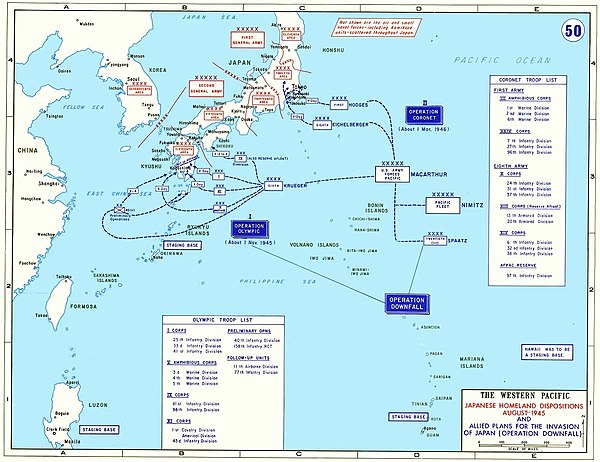
In addition there was great thought put into determining the amount of American casualties that the US would potentially lose in an invasion of the Japanese mainland. Operation Olympic was the code name for the US military operational plan to invade the southern Japanese mainland island of Kyushu. The casualty estimate of the invasion of this island range anywhere from 63,000 – 100,000 US lives. Keep in mind these are just the estimates of the one southern Japanese island.

The Japanese were preparing for the all out defense of their homeland called Operation Ketsu-go. Read the link for an in depth look at the defensive plan to protect the Japanese main land. It is obvious that this would have been a bloody fight which was backed up by the American losses of 10,000 Americans dead and missing in the Marianas, 5,500 dead at Leyte, 9,000 dead during the Luzon campaign, 6,800 at Iwo Jima, 12,600 at Okinawa, and 2,000 killed at Peleliu that weighed heavily on the minds of America’s leaders.

The vicious fighting on Okinawa saw the US versus Japanese casualties approaching a 2-1 ratio. Just imagine if someone invaded the United States how hard would Americans fight to protect their homeland? I can guarantee that just about every able body person with a gun besides the citizens of San Francisco and Berkley would take up arms against the invaders. Plus the amount of civilians killed on Okinawa due to the fighting was heavy, not to mention villagers that killed themselves by jumping off of cliffs with their children instead of surrendering to the Americans. Would the Japanese mainland be any different.


Operation Olympic, the proposed invasion plan of the Japanese main land during World War II. Notice no plans were ever made to occupy Korea initially.

An additional factor weighing on the minds of US leaders was the fact this would be primarily a lone US invasion. The fall of Germany was helped by the combined allied armies in the western front and the Russian offensive in the east. In fact, the Russian Army during their 23 day invasion of East Germany lost 78,291 dead. Just an incredible number. Should the US leaders have expected anything different in Japan?

Then the final factor is the, Revenge Factor. Any politician that would of allowed the Japanese to end the war without unconditional surrender would have committed political suicide. The American public wanted revenge and complete victory after what happened at Pearl Harbor. Allowing the Japanese regime that initiated the attack on Pearl Harbor to stay in place would not be acceptable to the American public.

As you can see there are many factors that went into the nuclear bombings. This was not a rash decision made to kill as many people as possible. It was a shrewd calculated strategic decision made at the highest echelons of the US leadership to end the war quickly with the least amount of lives lost. I know many people would also dispute bombing civilians but World War II was fought by the rules of “total war” where civilians were considered legitimate targets in order to break national will power. Look what the Japanese did in China and other areas in Asia. Look what the Germans did in their bombing of Britian. The US military and other allied nations responded in kind in both theaters with the carpet bombings of Germany most notably Dresden and the fire bombings of Japan. In fact the fire bombing of Tokyo cost more lives than dropping the atomic bomb on Hiroshima. “Total War” may not seem like a humanitarian concept, but when the survival of the nation is at stake countries will do whatever is necessary to save their nation. Does anyone doubt if the Germans or the Japanese developed the bomb before the Americans that they would of use it on American or allied targets?

I really do not see another alternative that would of worked that would of caused the unconditional surrender of Japan and the occupation of Japan that followed other than dropping the atomic bomb.

Now one thing I do dispute was the need to drop the second atomic bomb. I can understand Hiroshima, but Truman may have been to quick to bomb Nagasaki. The city must not have been a big military target since it had not received heavy bombing prior to the dropping of the nuclear bomb. So for stategic purposes it was not necessary to bomb for any other reason to break national will power.

A factor I think Truman probably took into account was the fact that the Soviet military entered the war on August 8, 1945 one day before the bombing of Nagasaki. The Soviet invasion had both pros and cons for Truman. The pro was that the invasion would put more pressure on the Japanese to surrender. The negative was that the Soviets were gobbling up territory before the US military could claim territory which I think Truman took into account. If the war dragged on any longer the Soviets could of very welled occupied all of Korea and the northern Japanese main land island of Hokkaido since they had already occupied the Kuril islands.

Maybe a few more days should have been alloted for the Japanese leadership to judge the effects of the Russian entry into the war. Maybe the threat of Soviet occupation would of finally made the Japanese surrender and allow the Americans to occupy them. If this didn’t work then the nuclear option was available.

I feel Truman didn’t take this option into account because he ordered the bombing of Nagasaki only one day after the Soviet entry into the war. I think the fear of the Soviets gobbling up large chunks of territory in Japan is what forced Truman’s hand to bomb Nagasaki. The American leadership felt that the occupation of Japan was critical in the soon to be developed containment policy of the Soviet Union. If the United States did not control all of Japan or ended up with a split Japan then the Soviets would have the advantage in controlling all of northeast Asia. This was definitely geo-politics at its most cunning level.

In a history class I took in college a Japanese student explained in class that he believed the US should have dropped the first atomic bomb out in the ocean in order to show the ruling militarist the might of the atomic bomb without targeting civilians. I countered his point that if dropping an atomic bomb on Hiroshima did not force the militarists to surrender than how was dropping a bomb in the ocean going to make them surrender? In fact it took two atomic bombings of Japanese cities and the entry of the Russians into the war in order to get the Japanese to finally surrender.

The other argument the Japanese student brought up was why the US did not drop a nuclear bomb on Berlin. That is because the US did not have a nuclear capability by the time Germany surrendered and even if it did the casualty ratio of an invasion of Germany is much lower compared to Japan. First of all it was a land battle where US tanks were able to roll right into Germany from France, secondly Germany was beat and actually was fighting harder to stop the Russian advance in order to be occupied by the Americans. With Japan the US forces would have had to do an amphibious landing followed by a vicious fight against fanatical defenders, which would have made casualties on both sides extremely high. There are clear differences between nuking Japan and Germany.

With 50 years of hindsight it is easy to sharpshoot Truman’s decision, but ultimately he did what he felt was in the best interest of the United States; not the best interest of Japan. This is important to keep in mind because I’m sure he felt the cost of Japanese civilian lives were secondary to protecting the lives of US serviceman and the geo-politics of protecting US national security by implementing the containment strategy of the Soviet Union. I still think that the bombing of Nagasaki may have been to quick, but today you really can’t argue with the results because the Soviet Union is history and Japan is one of the world’s wealthiest countries with the world’s second largest economy. However, I do fully agree with the Hiroshima Peace Park’s motto of never letting this tragedy happen again.

Previous Posting: Remembering Nagasaki

Remembering Nagasaki

nagasakibomb
The atomic bombing of Nagasaki

The city of Nagasaki during World War II was one of the largest sea ports on the southern island of Kyushu. Along with the seaports the city was also home to many important industrial companies. During the course of the war for whatever reason the city had escaped the B-29 bombings that were ravaging other areas of Japan. However, on August 9, 1945 the bombing the city received would more than make up for the prior lack of bombing.

On August 9, 1945, the crew of the American B-29 Superfortress “Bockscar,” flown by Major Charles W. Sweeney and carrying the nuclear bomb nicknamed “Fat Man,” found their primary target, Kokura, and it was obscured by heavy clouds. After three runs over the city and running low on fuel Major Sweeney decided to head for the secondary target, Nagasaki.

nagasaikaftermath
The aftermath of the Nagasaki bombing.

At 11:02, a break in the clouds over Nagasaki allowed the bombardier, to visually sight the target. The weapon, containing a core of 8 kg of plutonium-239, was dropped over the city’s industrial sector. It exploded 1,540 feet above the ground between the Mitsubishi Steel and Arms Works, in the south, and the Mitsubishi-Urakami Ordnance Works (Torpedo Works), in the north, the two main targets in the city.

Some 75,000 of Nagasaki’s 240,000 residents were killed, followed by the death of at least as many from resulting sickness and injury.

nagasakibeforeandafter
Nagasaki before and after the bombing

I haven’t had a chance to travel to Nagasaki, but I would really like to in the future. The city actually has a very colorful history despite the nuclear bombing. The city was the first port to be visited by and opened up to European traders in the late 1500’s.

nagasaki today
Nagasaki today

A very interesting book about this period of time and the city of Nagasaki is the book Samurai William, by Giles Milton. Judging by the above picture the city appears to have remarkably recovered since the atomic bombing. The big question is if the atomic bombings of Hiroshima and Nagasaki were necessary? That is something we will look at tomorrow.

Next Posting: The Decision to Drop the Bomb

Previous Posting: From the Trinity Site to Hiroshima 


From the Trinity Site to Hiroshima

Today is the anniversary of the atomic bombing of the Japanese city of Hiroshima. There is much controversy centering around whether the US should of dropped the atomic bomb on Japan to end World War II. In this series of postings I will discuss this issue along with providing the historical context that went into the decision to use nuclear weapons.

From the Trinity Site to Hiroshima

The first nuclear weapon was tested at the Trinity Site on White Sands Missile Range in New Mexico at 5:29:45 a.m. Mountain Time on July 16, 1945. The 19 kiloton bomb was put on a 100 foot steel tower and exploded, causing what witnesses said, the sun to rise twice that day.

I have actually visited the Trinity Site on the White Sands Missile Range which is open to the public only twice a year. One girder of the original tower remains, the rest was evaporated, and the sand below the explosion was turned into a emerald green colored glass called Trinitite. Visitors are told not to pick it up because the glass is still radioactive.


Trinitite lying in the sand.


This is the memorial at the center of the Trinity Site.

The MacDonald Ranch house is where the nuclear bomb was assembled and also served as home to the scientists during the assembly phase of the nuclear bomb. When it came time to test the bomb the house was vacated, but some how the house survived the nuclear explosion:


The MacDonald farmhouse about 3 kilometers from the Trinity Site.

What makes the house’s survival more amazing is that structures around the farmhouse were leveled by the bomb:

trinitysite4

trinitysite3

But even more amazing then the house surviving is that this windmill some how survived:

trinitysite2

This same phenomenon of singular structures remaining while others were completely obliterated by the bomb would happen again the next month in Hiroshima on August 6, 1945.
hiroshima1
Hiroshima after the bombing in 1945

Hiroshima was a city of military importance. The city contained the headquarters of the Fifth Division and the 2nd General Army Headquarters, which commanded the defense of all of southern Japan. The city was also a communications center, a storage point, and an assembly area for the Japanese military. There was military justification for the attack to go along with the perceived need of the US leadership to break the will of the Japanese people by destroying an entire city. The weather was good, and the crew and equipment of the Enola Gay B-29 aircraft piloted and commanded by Colonel Paul Tibbets, took off to bomb their primary target of Hiroshima. The Enola Gay dropped the nuclear bomb called “Little Boy” over the central part of the city. It exploded about 600 meters (2,000 feet) above the city, killing initially an estimated 80,000 civilians. The radiation poisoning would claim twice as many lives as the initial bombing.

Today Hiroshima is a thriving city that has a deep memory of the tragedy of August 6, 1945. The city has erected a museum and memorial to mourn the victims of the atomic bombing. It is almost hard to believe today that Hiroshima was the site of an atomic bombing:
hiroshima2
Hiroshima today is a thriving city.

Next Posting: Remembering Nagasaki

The NE Asian Space Race

China has been vigorously expanding their space program which includes such successes as recently launching astronauts into orbit.  Korea has also recently begun expanding their space program including the announcement of the construction of a state of the art launch pad on the Korean island of Goheung.  Now Japan is officially announced a significant expansion of their space program as well:

Japan is building upon its past successes in space to forge a range of initiatives, from disaster warning systems, probes to Mercury, Venus and Jupiter, as well as conduct an aggressive lunar exploration campaign.

Read the whole article, but the Japanese space agenda is definitely ambitious.  All in all I’m glad to see this Northeast Asian space race because hopefully this increased competition will further push our own US space program and industries which have become increasingly stagnant in recent years.  If it takes the Chinese landing on the moon to get the US space program moving again than I’m all for it.

The Real Moral Bankruptcy of the Comfort Women Issue

The Chosun Ilbo today has an editorial about a phone call placed between Japanese Prime Minister Shinzo Abe and US President George Bush. Here is what the reportedly discussed:

According to Japanese media reports, Abe said in the 20-minute phone call that he had apologized to women forced into sexual slavery during World War II and his remarks on the issue hadn’t been accurately conveyed.

(more…)

Is Change Coming to the History Taught at the Yushukan Museum?


Bronze tori gate in the park leading to the Yasukuni Shrine in Tokyo. This bronze tori is supposed to be the largest in the world.

For those that don’t know, the Yasukuni Shrine has been a source of friction between Japan and their Asian neighbors, most notably Korea and China, in recent years. Both countries regularly condemned Japan when former Japanese Prime Minister Junichiro Koizumi would periodically visit the shrine because the shrine honors Japanese war dead including war criminals from World War II. Yasukuni enshrines the names of approximately 2.5 million Japanese who died during the Meiji era of Japanese history. Interestingly enough, something you won’t hear too many Koreans talk about, is that over 21,000 Koreans who fought for the Japanese Imperial military during World War II are also enshrined in Yasukuni. Think of it in the spirit of the Vietnam War Memorial, but instead of a wall a Shinto shrine is used. Korea and China believe the shrine should not include Japanese war criminals from World War II and Japan thinks otherwise.


Statue of Omura Masujiro who organized the Meiji military and promoted the modernization of the military in line with western standards. He was assassinated by discontented samurai in 1869, but his movement to modernize the military lived on.

Having been to the shrine myself, I don’t find the shrine insulting to China, Korea, or anyone else for that matter. There was no banners of General Tojo and other war criminals that the media would lead you to believe that this shrine is all about. In fact the shrine was actually pretty simplistic and underwhelming. The shrine was filled with old Japanese men, some wearing their old Imperial Japanese military hats, hanging out, bowing at the shrine, and then sitting down on the benches smoking their pipes, and maybe sharing memories of their time in the military with each other. These old guys seem hardly a threat to peace and stability in northeast Asia.

The reason the Koreans and the Chinese get so worked up by the Yasukuni issue is because politicians in each of those respective countries use the Yasukuni issue to deflect attention away from their own governmental short comings. George Will in this Washington Post article probably best explains the political dynamics behind both countries’ position on the Yasukuni issue:

Between that enshrinement and 1984, three prime ministers visited Yasukuni 20 times without eliciting protests from China. But both of Japan’s most important East Asian neighbors, China and South Korea, now have national identities partly derived from their experience as victims of Japan’s 1910-45 militarism. To a significant extent, such national identities are political choices .

Leftist ideology causes South Korea’s regime to cultivate victimhood and resentment of a Japan imagined to have expansionism in its national DNA. The choice by China’s regime is more interesting. Marxism is bankrupt and causes cognitive dissonance as China pursues economic growth by markedly un-Marxist means. So China’s regime, needing a new source of legitimacy, seeks it in memories of resistance to Japanese imperialism.

Actually, most of China’s resistance was by Chiang Kai-shek’s forces, Mao’s enemies. And Mao, to whom there is a sort of secular shrine in Beijing, killed millions more Chinese than even Japan’s brutal occupiers did.


Another bronze tori gate before passing through a large wooden gate leading to the Yasukuni Shrine.

However, something a lot of people don’t realize is that their is more to the shrine than the shrine itself. Near the shrine is the Yushukan Museum that is supposed to chronicle Japan’s long military history. After visiting the museum and interpreting the displays from the minimal English language signs, I can safely say that the museum is something that I can see people getting worked up over. The museum’s view of history is vastly different from what is accepted as agreed upon history in the west. If the history being exhibited by the museum was so slanted in English, I can only imagine how bad the display’s signs in Japanese must be.

Most of the museum chronicles the various samurai wars during Japan’s feudal times and then into the Tokugawa era. I would have liked to read what was displayed for the Hideyoshi invasions of Korea between 1592 and 1598 but there was no English language signs available at the time. Really the vast majority of the museum is quite interesting until you get into the post Meiji Restoration years. For one the exhibit for the Russo-Japanese War claimed that the Japanese Army liberated the Korean peninsula from foreign rule and were greeted by an enthusiastic Korean populace as liberators. This is true to an extent because there was many people in Korea happy to see the end of the corrupt Chosun dynasty, however the exhibit made no mention of the brutal Japanese occupation that would follow the end of the Russo-Japanese War. The exhibit also maintained that the Japanese brought much industry and modernization to the peninsula. Once again true to extent, but it makes no reference to the fact that the modernization of the peninsula was implemented in order to increase areas such as rice production in order to ship the majority of Korean grown rice to Japan.


The last bronze tori gate before entering the Yasukuni Shrine.

The World War II exhibit was also quite provocative. According to the museum, World War II is known as the Asia Co-prosperity War where the Japanese single handedly liberated one Asian country after another from foreign colonial occupation and the Asian people were all happy to be liberated. No mention of the atrocities committed by the invading Japanese troops. Additionally the museum blames the US for the attack at Pearl Harbor. Since the US implemented a trade embargo on the Japanese, the militarists felt that an attack by the Americans against Japan would only naturally come next. The museum even alleges that the United States even had a plan to attack Japan in the works and would have been executed if Japan had not pre-empted the American attack by conducting the bombing of Pearl Harbor. The American President Franklin Roosevelt was committed to an attack on Japan as a way for the US to escape the Great Depression. One theme I have picked up on at the museum is that every attack the Japanese conducted was only executed because of foreign colonizers threatening Japan and its neighbors. Japan never wanted to colonize any country, they just wanted to liberate Asians from foreigners.


An elderly couple pay their respects at the Yasukuni Shrine.

This is of course nonsense. I posted before on this, but the Japanese felt modernization of Japan and the colonization of nearby countries were the best way to expand Japanese power and to compete against western rivals. The Japanese had no altruistic reasons of freeing oppressed Asians from European colonizers; it was simply about building Japanese power and influence and the attack on Pearl Harbor was where they over reached in spreading their power and influence. The problems with the museum are to numerous to list here, but the shrine organizers now have a plan to fix it.


Statue outside the Yushukan museum honoring the kamikaze pilots of World War II.

Ampontan has a great posting on the hiring of a former Japanese diplomat, Hisahiko Okazaki, who’s job it will be to reinterpret the historical displays at the Yushukan museum. Unfortunately it appears Mr. Okazaki is just reinterpreting the history in a different way that is equally as distorted as the prior historical displays. Mr. Okazaki in his new interpretation of history has found a new way to blame the US for the Japanese involvement in World War II. Instead of President Roosevelt provoking the war in order to escape the Great Depression, there is a new boogie man, the Hull Note:

The Hull Note of 1941 was, however, meant to close negotiations, so I did not raise any objection to a new quotation from the Stimson Diary, which said that all that was left after the issuance of the note would be to wait for Japan to attack.
It is a historical fact that Roosevelt induced Japan to carry out a first strike. The indication of this fact does not cast aspersions on Yasukuni Shrine’s intellectual integrity.
In his book Diplomacy, former U.S. Secretary of State Henry Kissinger wrote, Roosevelt must have been aware that there was no possibility that Japan would accept (the Hull Note). America’s participation in the war was the great achievement made through the extraordinary efforts of a great and courageous leader.

Fortunately Ampontan shoots down this claim rather quickly:

What Okazaki fails to mention is that the Hull Note was issued on November 26, 1941, fewer than two weeks before the attack on Pearl Harbor. The Japanese strike force had already set sail the day before (American time, but also the 26th Japanese time). They could have been recalled, but the Hull Note made it certain that they wouldn’t be.

Mr. Okazaki must have taken some notes from the anti-American Korean nationalists that use the obscure Taft-Katsura Agreement to bash the United States with. You would think a country like Japan that is so advanced in areas like democracy, human rights, technology, business, etc. would be mature enough to settle this history dispute between them, China, and Korea instead of relying on changing distorted history with revised history. Every country has history that it would rather forget about. You wouldn’t believe how many different countries I’ve been to and people have asked me if Native-Americans still live in teepees and if we have any plans of wiping the rest of them out. Or how many times self righteous foreigners preach to me about the horrors of General Custer and why the US government should condemn him as a war criminal. As annoying as these claims are, not once has someone claimed to me that the US government is trying to cover up the injustices committed against Native-Americans.


Japanese World War II Zero in the Yushukan museum.

By interpreting history the way the Yushukan museum does, it keeps alive the perception that the Imperial Japanese of World War II is still what represents Japanese policy in regards to its Asian neighbors today. This perception is what allows the political demagogues in Korea and China to use anti-Japanese sentiment to deflect attention away from their own political short comings. I just don’t see how Japan will be able to seek a position on the United Nation’s Security Council if it can’t work out an agreement to solve this distorted history issue with its neighbors. If Japan cannot work out an agreement to this issue, how will Japan ever have international creditability to deal with much larger and important issues such as the Israeli-Palestinian issue? Until these issues are solved Japan will never have the credibility and influence in the world that it’s population and economic might should render it.


A steam engine that actually operated on the infamous Thai-Burma Railway made famous by the movie, A Bridge On the River Kwai.

The Taft-Katsura Agreement; An American Sell Out of Korea?

A recent topic of dispute among commenters at the Marmot’s Hole is the alleged American sell out of Korea to Japan with the mutual signing of the Taft-Katsura Agreement. This piece of history, little known to everyone else in the world, is treated with almost Dokdo like reverence in Korean society. This agreement is often used by Koreans to blame the US for the Japanese colonization of Korea. You think I’m exaggerating? Let me remind everyone what the South Korean Unification Minister had to say on this subject:

A hundred years ago, the Philippines became a U.S. colony and the Korean Peninsula a Japanese one owing to the Taft-Katsura Agreement” of 1905, Chung said. The division of the nation and Korean War were not our will either, nor was the failure of the Gwangju Uprising. A century later, Chung promised a hot summer in which our fate will be decided not by North Korea, China, the United States, Japan or Russia, but by our own pride and self-determination.

Unification Minister Chung Dong-young, July 2005

I will focus this posting on just the Taft-Katsura Agreement, though much of the rest of Minister Chung’s comments are just as equally ridiculous as blaming the US for Japanese colonialism. This view is so indoctrinated into Koreans that many foreigners in Korea end up believing it as well because they hear it so often from Koreans they work with. So is this Korean claim true? To determine this you have to first look at the historical context of the era.

The Japanese had been effectively interfering with Korea’s internal affairs since the 1880’s, but China continued to wield the most influence over the country due to it’s protectorate status over Korea. The Japanese were eager to gain a main land Asian colony to where natural resources could be accessed in order to continue the Japanese modernization of both it’s economy and military. The Japanese felt quick modernization was needed in order to prevent the western powers from exploiting and colonizing Japan like they had China. Gaining control of Korea’s natural resources was critical along with securing strategic territory that had long been used as an invasion point into Japan. Plus acquiring a Korean colony would send a huge international message that Japan was a nation ready to colonize, and not be colonized by anyone.


Map of Sino-Japanese War troop movements

The Sino-Japanese War (June 1894-April 1895) between Japan and China was Japan’s first attempt to forcibly wield it’s new power. It is important to note the long time Korean ruling class, the Yangban, did not want to lose their privileged place in Korean society and had long tried to keep Korea isolated from the rest of the world. Thus the term the “Hermit Kingdom“. They feared that the opening up of the country and the economy would dilute the power they wielded within Korea.

Plus the Yangban suspicious of a military coup that would end their power, had not raised and funded a strong national military and had instead relied on their long time protectors the Chinese for national security. The strategic incompetence of not forming a strong domestic army became quite evident when in 1871 American Marines defeated Korean defenders of Kangwha-do island at the mouth of the Han River and occupied it for a short time. This embarrassment of the Korean military eventually led to the signing of the 1883 Jemulpo Agreement between the US and Korea. This treaty confirmed friendly relations between the US and Korea. The easy defeat of the Korean military by the US Marines is probably what began to give the Japanese rulers ideas of an easy conquest and colonization of Korea.

The 1894 Donghak Rebellion, a peasant uprising in the Cheolla province of southern Korea, was used by the Japanese government as an excuse to deploy 8,000 combat troops to Korea to quell the uprising. Before quelling the uprising the Japanese troops seized the Korean capitol of Seoul and captured the Korean emperor. Obviously the Chinese government was not happy about the Japanese power play to gain influence over Korea and began to deploy a force of soldiers to Korea. While this was going on the Japanese installed pro-Japanese Koreans to run the government who legitimized the Japanese use of force to protect Korea from the Chinese. Thus this began the Sino-Japanese War.

The Chinese ultimately lost the war and signed the Treaty of Shimonoseki in 1895 that effectively granted Japan imperial influence over Korea and parts of Manchuria without Chinese objections. With the Chinese military weakened after it’s bitter defeat by the Japanese; the European powers took advantage of the situation by occupying strategic areas of Manchuria before the Japanese could move in. Most notably the Russians who occupied a huge area of Manchuria and the entire Liaodong Peninsula. The occupying of strategic areas of Manchuria by the Europeans enraged the Japanese rulers who felt the plunders of their hard earned victory over China was stolen from them. The deployment of over 100,000 Russian soldiers into Manchuria after the 1900 Boxer Rebellion only furthered caused tensions to raise because the Japanese felt that the deployment meant that the Russians were there to stay. A series of treaties were signed between the Japanese and the Europeans in an effort to quell the building tensions in the area. These treaties gave Japan recognized control of the Korean peninsula to Japan while the Europeans would continue to control Manchuria and other areas of China.


Russian controlled Manchuria in dark red.

However, the tension did not subside and open warfare would break out between Russia and Japan. The Russo-Japanese War (Feb. 1904 – May1905) ended with the defeat of the Russian military and the destruction of nearly the entire Russian navy by the Japanese. This victory gave the Japanese undisputed control of not only the Korean peninsula but all of Manchuria as well. This victory had also showed the world that the Japanese were a country to be respected as the equals to any western nation with their defeat of the Russian military.

The Russo-Japanese War was officially ended with the signing of the Treaty of Portsmouth in the United States between the Russian and Japanese representatives. It was few months before this treaty was signed that the Taft-Katsura Agreement so remembered today by Koreans was agreed upon. This agreement effectively recognized that the US would not interfere with Japanese ambitions in Korea and Manchuria and that Japan would not interfere with American ambitions in the Philippines. The US leaders wanted official recognition of this reality from the Japanese so they would not have to spend the money fortifying the US colony in the Philippines from possible Japanese attack.

Plus this agreement and the following Treaty of Portsmouth would ensure regional stability after a decade of constant warfare in northeast Asia. All this agreement did was recognize reality at the time. How is recognizing reality a sell out?


Russian and Japanese delegates meet to sign the Treaty of Portsmouth

Also Koreans often site the 1883 Jemulpo Agreement as not being a mutual friendship treaty, but as a defensive pact between Korea and the US. They feel that the US was obligated to come to the defense of Korea against Japan. Here is the passage in the treaty they try to argue is a defensive pact:

Article I.

There shall be perpetual peace and friendship between the President of the United States and the King of Chosen and the citizens and subjects of their respective Governments. If other Powers deal unjustly or oppressively with either Government, the other will exert their good offices, on being informed of the case, to bring about an amicable arrangement, thus showing their friendly feelings.

Only in Korea is “exert their good offices” considered a defensive pact. Here is the meaning of “good offices” from dictionary.com:

1. influence, esp. with a person in a position of power: He got the job through the good offices of his uncle.

2. services rendered by a mediator in a dispute.

No where in this definition do I see defensive pact, but this is what many Koreans believe “good offices” means though the definition of it is quite clear. The only obligation the US had was to speak on Korea’s behalf if requested; no where in there does it say the US is obligated to deploy the 7th Cavalry to Korea to take Japanese scalps. However, this didn’t stop Koreans leaders after the signing of the Portsmouth Treaty to try and argue this same point that “good offices” meant a defensive pact with then President Teddy Roosevelt, but Roosevelt refused to meet them and discounted their claims. Can you blame him? Maybe he wasn’t showing “good offices” by refusing to meet them, but no where in the agreement does it say either that the Koreans have exclusive access to the American President. If the United States didn’t come to the aid of Korea during both the Sino-Japanese War and the Russo-Japanese War what made the Korean leaders think that the US would be willing to go to war with Japan now?

A defensive pact would be a formal document all in itself much like what the US and Korea has today, that lays out clear responsibilities of each side. Almost certainly if Korea wanted a defensive pact with the US at the time the US would have requested a military presence within Korea which the Yangban rulers did not want. The US did not have the naval ability that it has today or nearby colonies from which to quickly move troops to defend Korea from external attack thus the signing of a mutual defense pact would be pointless without a forward deployed American troop presence. Even if the Yangban rulers allowed a US troop presence I don’t think the US military could have supported it with it’s already large deployment of forces in the Philippines to put down the insurgency there from Moro guerrillas.

Too many Koreans confuse the US military might of today with the US military of 1905. In 1905 the US military was at the most equal to, if not weaker than the major European powers. If the Japanese had so decisively defeated the Russians whose country is located adjacent to both Korea and Manchuria, how can the United States located on the other side of the world, be expected to sail over to Korea and conduct a 1905 version of the Inchon Landing Operation?

To blame the US for Japanese colonization of Korea is ridiculous. Saying that the US didn’t do anything to help Korea I could agree with, but to blame the US for the Japanese colonization is just another absurd attempt at historical revisionism so prevalent in Korea today. If Koreans are looking to assign blame they should first look at themselves.

Shouldn’t the first responsibility of a government be to ensure national security? Obviously the Yangban were more interested in their own security than national defense. If the Korean government had opened up their economy and simultaneously built up and modernized their army after the embarrassing defeat to the Americans on Ganghwa Island over 20 years prior they may have been able to prevent what happened to them. Remember during the Sino-Japanese War only 8,000 Japanese soldiers were able to occupy Seoul and capture the government. 8,000 for crying out loud. Why should the US be expected to defend a country that isn’t even willing to protect itself from an invasion force of 8,000 soldiers? If the Koreans fought a protracted war against the Japanese to keep them out of Korea maybe the US would have done more to help the Koreans. As it turned out the Koreans did very little to expel the Japanese during both the Sino and Russo-Japanese Wars thus why would the US government feel an obligation to free Korea when it appeared they didn’t want to be free themselves?

The bottom line is that the corrupt and incompetent Korean rulers created the conditions that led to the Japanese colonization of Korea. In their quest to keep their own domestic status quo they ignored the changes in the power structure in northeast Asia, mainly that China could not be depended on to defend the peninsula from invasion. China could not even defend themselves from the western powers at the time, much less Korea. However, the Korean rulers kept their heads in the sand and did little to develop international relations and build their own domestic military to defend the nation. By gambling that the Chinese military would protect them was a bet that they lost. It was an even worse bet if they thought the Americans were obligated to come save them after that.

The Taft-Katsura Agreement is just one of a long line of historical revisionism endorsed by Korean politicians like Minister Chung I mentioned earlier that seek to blame foreigners, in particular the United States, for all the failings of the Korean government. If the failures of prior Korean governments was the fault of foreigners and the big, bad United States; then all the failures of the current Korean government most also be the fault of foreigners and the big, bad United States now. That is why the Korean government finds it so necessary to create a historical context in order to blame current problems on the US. So when the North Koreans detonate a nuclear weapon, who does the South Korean government blame for it? The United States of course, while totally remaining silent about the fact the South Korean government are the ones that financed the nuclear weapon by giving massive amounts of aid and hard cash to the North Koreans.

When the economy is sagging that must be the fault of the foreigners as well, so witch hunts against companies like Lone Star are undertaken in order to shift blame for the sluggish economy when in fact all this does is create further drag on the economy by drying up international investment into the country. That doesn’t matter though because the government has officially shifted blame once again to the big, bad foreigners. Don’t even get me started on Dokdo. I and others have shown over and over again how the Korean government has demagogued this issue for their own political advantage and once again Minister Chung was leading the way on this. Heck even the lack of English language skills, drugs, and defiling of women in Korea are blamed on “low quality foreign English teachers”. The list of outrageous claims against foreigners goes on and on.

What concerns me most is these backwards views are slowly but surely making it possible for history to repeat itself. Korean politicians today are becoming more and more like the Yangban of the Josen dynasty of the late 19th century. They are more interested in keeping the status quo and cementing their own power than ensuring the national security of the country. The current leftist government much like the Yangban are highly suspicious of the military and have thus sought to limit the power of the ROK military as much as possible. Thus you see massive cut backs in soldiers, a lack of national military strategy, along with deliberately causing a complacency within the ranks towards the nation’s main enemy North Korea.

Now combine this with the simultaneous steady degrading of the US-ROK alliance which may ultimately end up with the exit of US forces from Korea and you have a country that has exposed itself to an external military attack, much like in the late 19th century. There is one main reason why for over 50 years that northeast Asia has been so peaceful, the US military presence.

Another eerie similarity is the fact that Japanese agents had infiltrated and manipulated the Korean government long before the actual Japanese occupation in order to set conditions for the eventual take over of Korea by Japan to happen. The same thing is happening today as North Korean agents have infiltrated not only the government, but South Korean society as a whole in order to set conditions for a future North Korean take over of the country. The Japanese were infiltrating Korean society 20 years before the take over of Korea, imagine where South Korea will be in 20 years if North Korea is allowed to continue to manipulate the direction of the country.

If the North Koreans ever did invade and occupy South Korea 20 years from now long after the exit of US forces from South Korea; I can picture the Korean leaders coming to Washington demanding the US to come and save them though they ended the US-ROK alliance years ago and replaced it with a friendship treaty instead. Would the US president be morally obligated to help a country that independently chose to create the conditions that allowed their defeat to happen in the first place? There is plenty that can be learned from an objective look at history and unfortunately it appears that the current Korean government is only interested in following the path of the Josun Yangban at the expense of the national security of the country. If the Korean government reaps what it sows 20 years from now, any bets they will blame America for selling them out then too?

GI Korea Uncovers the Yasukuni-jinja Shrine

If I had to pick out one thing that sticks out overwhelmingly between Japan and Korea it would be the controversy surrounding the Yasukuni-jinja Shrine in Tokyo. Being in Japan has given me the opportunity to examine what all the fuss over the shrine is about. What is it about this place that causes so much hostility between Japan and it’s neighbors? Would I see hordes of brainwashed Japanese chanting anti-Korea slogans and preparing for the invasion of Dokto? I would soon find out.

Here is the impressive gate designating the entrance to the Yasukuni Shrine.
One last tori before reaching the shrine. Still no sign of the brainwashed Japanese nationalists drawing up war plans for Dokto.

When I reached the actual shrine I did not find any big banners of General Tojo and other war criminals that the media would lead you to believe that this shrine is all about. In fact the shrine was actually pretty simplistic and underwhelming. It is mostly just a place for old Japanese men to hang out, bow at the shrine, and then sit down on a bench under a tree and smoke a pipe.

Here I am at the Yasukuni shrine. No sign of the brainwashed nationalists. Just old people smoking pipes.
Japanese couple in front of the Yasukuni Shrine in Tokyo, Japan.

Finding this place pretty boring I started walking down a path to the right of the shrine towards a large building. As I approached the large building, I discovered a statue honoring kamikaze pilots during World War II.

A kamikaze statue; I must be close to uncovering the evil hordes waiting here.

From the statue I headed inside the large building which ended up being a museum chronicling Japanese military history. The museum chronicled Japanese military history from feudal times all the way to the present SDF mission in Iraq.

The museum also had a gift store that sold loads of books, gifts, and accessories related to the SDF and the Japanese Imperial Army. You could even buy the old Japanese Army hats that appeared to be popular with the old folks that mostly populated the place.

The museum interestingly enough does not allow photographs, but I was able to take a few quick pictures of a few items in the museum during my tour.

A Japanese World War II Era Mitsubishi Zero Airplane.

The museum was actually quite interesting to read about the early feudal samurai history of Japan. Additionally the special exhibit they had honoring the Japanese victory over Russia during the Russo-Japanese War was also interesting to see.

However, the interpretation of Japanese history that has longed plagued relations between Korea and Japan began to jump out at me. The exhibit for the Russo-Japanese War claimed that the Japanese Army liberated the Korean peninsula from foreign rule and were greeted by an enthusiastic Korean populace as liberators. The exhibit also maintained that the Japanese brought much industry and modernization to the peninsula. This is true to an extent, but there was no mention of the brutal occupation and the anti-Japanese resistance by the Koreans against it.

Next was the World War II exhibit which I figured would also be quite provocative to see; I wasn’t disappointed. According to the Japanese history presented here, World War II is known as the Asia Co-prosperity War where the Japanese single handedly liberated one Asian country after another from foreign colonial occupation and the Asian people were all happy to be liberated. No mention of the atrocities committed by the invading Japanese troops.

This is a Steam Engine that Actually Operated on the Infamous Thai-Burma Railway Made Famous by the Movie, A Bridge On the River Kwai.

Additionally the museum blames the US for Pearl Harbor. Since the US implemented a trade embargo on the Japanese, the militarists felt that an attack by the Americans against Japan would only naturally come next. The museum even alleges that the United States had a plan to attack Japan in the works and would have been executed if Japan hadn’t pre-empted the American attack by conducting the bombing of Pearl Harbor.

One theme I have picked up on at the museum is that every attack the Japanese conducted was only executed because of foreign colonizers threatening Japan and it’s neighbors. Japan never wanted to colonize any country, they just wanted to liberate Asians from foreigners.

The museum continued on with many more outrageous claims and made it seem like the Japanese won every battle of World War II, but some how the Americans continued to move closer and closer to Japan without winning a battle if you are to believe the museum’s history. The Japanese interpretation of history is extremely ridiculous and completely devoid of reality.

The museum tour concludes into an area that houses pictures and names of the Japanese war dead over the centuries. I actually tried to find General Tojo among the faces but I couldn’t spot him. All the pictures were of the same size and no one stood out more than the other.

All in all Yasukuni is definitely over hyped by nationalist causes in each Northeast Asian country involved in the shrine controversy. Am I offended by the ridiculously false lies taught as history at the shrine? Yes, I am but not enough to set myself on fire or chop my fingers off.

Despite the underwhelming nature of the shrine; I recommend it to anyone with a few days to spend in Tokyo. The history and artifacts in the shrine are interesting to see despite the skewed history. Japan is not the first country to skew history in the region. Korea and China are not innocent themselves of reinterpreting history.

I never did find the Japanese nationalists worshiping the banner of General Tojo and plotting the invasion of Dokto at the Yasukuni Shrine. What I did find was also troubling and that is skewed history, but fortunately it appears that mostly only grandpas nostalgic for the old days are the only ones reading it.