Here is another preventable deadly safety related accident in South Korea:
Five people, including three children, died and two others were injured in a tent fire at a camping site in Incheon, a port city west of Seoul, early Sunday, police and fire officials said.
The fire broke out around 1:20 a.m. inside a 16 square-meter tent set up at a camping ground close to a beach on Ganghwa Island of Incheon, according to the officials. Those killed included a 37-year-old father, identified only by his last name Lee, and two of his sons, aged 11 and six, they said. Lee’s middle school friend, surnamed Cheon, and his seven-year-old son were also killed inside the same tent. [Yonhap]
According to this quite detailed post over at the Marmot’s Hole the Incheon Asian Games has moved well passed just being a fiasco:
1.Stadiums getting blackouts
2. Athlete’s lunch boxes found with salmonella
3. Volunteers asking for athletes signatures and making them late to their events – because they got 1 hour of training 1 week before the Games started.
4. 20% of interpreters quitting (because they had to pay for their own transport to and from the Games),
5. Athletes’ rooms not having fans or A/C,
6. Athletes’ rooms crammed with three beds and cramming athletes in them because they don’t have enough rooms
7. No mosquito screens for the rooms, subpar quality food for the athletes – partially caused by the fact that the majority of the cooks are college kids majoring in food science
8. Beach volleyball site doesn’t have changing rooms
9. Badminton stadium has A/C with strong wind that got the complaints of all athletes including Korean ones
10. Thailand baseball team had to practice in the dark because the lights weren’t on
You can read more about the issues the Asian Games are having at the link, but it appears the fiasco will continue all the way through the closing ceremony:
Organizers of the Incheon Asian Games face a daunting challenge ― bringing Asia’s biggest sporting event to a close in a way that makes people forget the opening ceremony many believe was the worst ever.
“We have noted the criticism we received after the opening ceremony and applied it to the direction of the closing ceremony,” Jang Jin, artistic director of the ceremony, said during a news conference at the Main Press Center in Incheon, Tuesday.
But he seems to have few options available due to his limited budget and other problems.
Jang said because of the athletic events at the Incheon Asiad Main Stadium that will run until the end of the Games, “We will not be able to push through with the final rehearsal that had been scheduled for Friday. We ask for your understanding.”
According to Jang and chief organizer Im Kwon-taek, the closing ceremony will include performances by the National Dance Company of Korea and the National Gugak Center, a countdown using filmed shots of athletes’ shirt numbers and AD cards, a taekwondo performance and a concert by boy band Big Bang.
But most people remain unconvinced that the closing ceremony will be an improvement from the opening ceremony, which was likened by the public and foreign media to a hallyu (Korean wave) concert or film festival, featuring more celebrities than sports stars. [Korea Times]
You can read more at the link, but according to the article the opening ceremony had famed Korean actress Lee Young-ae light the cauldron which is really odd considering usually famous athletes usually light it. Now for those who attend the closing ceremony they will be subject to a Big Bang concert.
The Incheon Asian Games cost only $2 billion to put on compared to $20 billion the Chinese paid in 2010 to host them in Guangzou. So obviously the Koreans are getting what they paid for. I would think for the upcoming Pyeongchang Winter Olympics that the Koreans will be reaching much deeper into their pockets to put on a better event since the whole world will be watching.
This is probably the first time I have heard of Koreans unhappy with one of its national teams winning a gold medal:
The South Korean baseball team Sunday clinched the gold at the Incheon Asian Games, but a lot of people here seem to have more reasons to mock their achievement than celebrate or be proud of it.
They think players will enjoy greater benefits than they deserve — exemption from the country’s mandatory two years of military service. Ironically, their gold has also led to fierce discussion about abolishing such rewards to athletes.
“I wish they lost the game,” 29-year-old baseball fan Park Tae-yang said. “I do not understand why Korea, in the 21st century, still has to give military exemption for athletes on the grounds that they help promote the country.”
Such harsh feelings against the national team are also based on the fact that South Korea is the only country that sent professional baseball players, who appeared desperate for a military exemption, and let them compete against teams consisting mostly of amateur players. [Korea Times]
You can read more at the link, but it does seem kind unfair to all the other males in Korea that they have to do their mandatory service obligation while these professional athletes now will get out of it because they blew out a bunch of Asian amateur baseball teams.
Two Palestine football players have been booked for investigation on suspicion of sexually harassing a female official at the Asian Games in South Korea, police said Wednesday.
The footballers, whose names were withheld, were suspected of approaching and groping the South Korean woman on Monday in a laundry room in the athletes’ village in Incheon, the host city of this year’s Asiad, they said. [Yonhap]
The Korea Herald is also reporting that a Iranian athlete is accused of groping another Korean women as well:
The Palestinian incident is the second such case at the Asian Games, after an equipment manager for the Iranian men’s football team was charged with sexually harassing a female volunteer at a stadium on Monday. [Korea Herald]
I wonder if the mayor of Incheon will issue a proclamation that citizens of Incheon are scared of Middle Eastern athletes like the mayor Uijongbu recently did towards American soldiers?
Models display the trophy for the Samsung MVP Award at the Incheon Asiad at an event of the Incheon Asian Games Organizing Committee in Incheon, west of Seoul, on Sept. 17, 2014. (Yonhap)
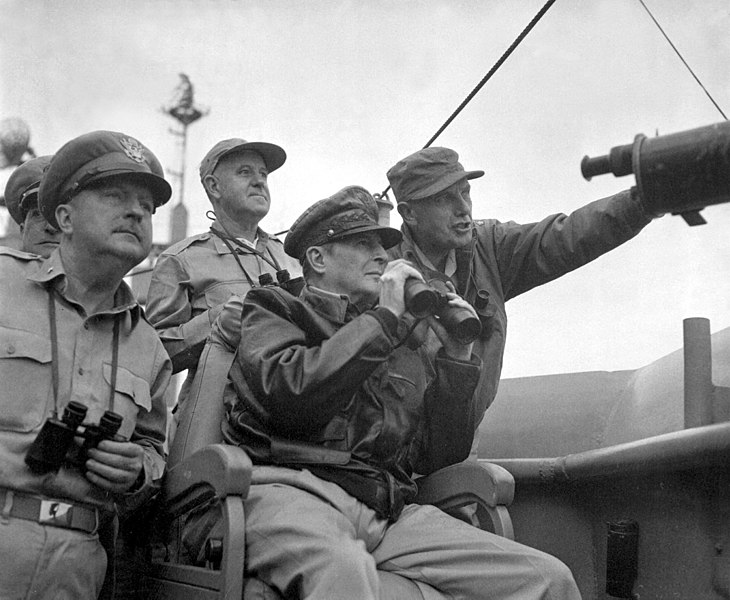
South Korean Marines reenact the historic amphibious landing operation in the Yellow Sea during the Korean War on Sept. 14, 2014, the eve of the anniversary of the Incheon Landing. The 1950 operation, commanded by U.S. Gen. Douglas MacArthur, turned the tide of the war against the invading North Korea. (Yonhap)
I wonder if they also complained about the display of the Chinese flag who is also responsible for the deaths of many Koreans during the Korean War and the key enabler of North Korea?:
Organizers of the upcoming Asian Games in Incheon pulled down all national flags that lined the streets of the port city after rightwing groups complained about the public display of the North Korean flag.
The flags of the 45 participating nations were hoisted along the streets of Incheon and the city of Goyang north of Seoul last week.
Under Olympic Council of Asia regulations, the flags of the council, host nation and participating countries are displayed around sports stadiums, accommodation and airports.
The North Korean flag was also hoisted during the 2002 Asian Games in Busan and Daegu Universiade in 2003.
But this time rightwing groups in Goyang protested, and the organizers took the drastic step of removing all national flags and replacing them with the OCA flag and Asian Games banner. [Chosun Ilbo]
Is there anyone out there suprised by the arrest of one of the leaders of the MacArthur protests as a North Korean spy? From the Chosun:
An activist who is on parole after serving time for spying for North Korea has been arrested for espionage again. Kang Soon-jeong, the former vice chairman of the South Korean chapter of the Pan-Korean Alliance for Reunification, an outlawed pro-Pyongyang group, was arrested on Tuesday for providing “national secrets†to Pyongyang, police said. Kang was also co-chairman of a civic group that led efforts to topple the statue of U.S. general Dougas MacArthur in Incheon last year.
Let’s remember the MacArthur protests of 2005 for a minute. The biggest protest happened on September 11, 2005 and was deliberately planned to occur on the same date of the worst terrorist attack in American history in order to rub it into Americans’ faces.
How can we ever forget images like this:
Or my personal favorite:
Something else to remember was that it wasn’t just the North Korean stooges calling for the removal of the MacArthur statue, but also the Korea Times newspaper:
As President Roh made it clear that it is the government’s position to keep the statue, U.S. lawmakers had better wait and see. Nor is this an issue for partisan wrangling domestically. Related officials can consider relocating it to a war memorial from the present public park someday. We have never heard of a statue of Dwight Eisenhower in Normandy to commemorate D-Day.
So keep that in mind the next time you read the Korea Times, that they advocated removing the MacArthur statue because a bunch of North Korean sponsored stooges demanded it. Plus their claims that Eisenhower’s statue is not on display at Normandy were proven to be utterly false as well. Ike’s statue stands proudly at Normandy just like MacArthur’s statue should continue to stand proudly at Inchon.
These ROK veterans at the time called the anti-MacArthur protesters North Korean spies and they were right.
The US Congress even got involved in the MacArthur controversy by sending this letter to the Blue House condemning the protests:
Members of the U.S. House Committee on International Relations on Thursday protested at calls in Korea to topple a statue of U.S. general Douglas MacArthur in Incheon. Their protest came in a letter to President Roh Moo-hyun signed by committee chairman Henry Hyde and others.
The letter said but for the 1950 Incheon landing led by MacArthur, the Korea of today would not exist. If attempts to damage the statue continued, it would be better to hand it over to the Americans, the signatories said.
(…)
Needless to say Mr. President the Congress of the United States and the American people would never subscribe to such a description of a hero who led the allied forces which liberated the Republic of Korea twice, first from the yoke of Japanese colonialism 60 years ago this summer and secondly through the brilliant execution of the Inchon landing 55 years ago this month. Our critical bilateral alliance was forged in the crucible of Inchon. The common sacrifices, goals, and achievements which sprang out of Inchon form, in our opinion, the continuing basis for our alliance. We presume that the government of the Republic of Korea shares this view of the critical importance fo the Inchon Landing and the leadership of General Douglas MacArthur.
(…)
In the chamber of the US House of Representatives, directly behind the speaker’s podium hang two portraits. On one side is that of a foreign friend, a soldier who came from a far to assist in the common cause of American independence. That portrait is of the Marquis de Lafayette. For more than 200 years his memory has been implanted deep in the hearts of the American people. We would hope that General MacArthur is so remembered in the hearts of the South Korean people.
“I have been saddened to read that a group of protestors attacked and called for the removal of the statue of the U.S. general MacArthur in Incheon. The statue was erected to commemorate the Incheon Landing, which he led, and which was one of the most decisive interventions of the Korean War. British naval vessels were among those involved. By attacking his statue and his memory, these protestors are also denigrating ALL those foreign soldiers under the UN command, who came to fight alongside South Korea in that war. There were men and women from more than 20 nations involved, including my own. Tens of thousands of them gave their lives so that South Korea should remain free and independent. Without the fierce allied fighting that followed there was a real chance that South Korea, by then pinned down to Busan, would have been overrun.
“None of us can change our country’s history. What happened, happened, and we should respect the right for people to demonstrate peacefully, but these protestors risk alienating more than just American friends. I am glad there have been some firmly-worded editorials, and that a number of leading figures, including Foreign Minister Ban Ki-moon, have spoken up. They need to, and strongly, if good friends of Korea and war veterans from many countries are not to feel insulted.â€
With North Korean agents leading protests to tear down the MacArthur statue and create a wedge in the US-ROK alliance what does the ruling Uri Party chairman do? Blame the conservative groups protecting the statue of course:
Ruling Uri Party chairman Moon Hee-sang said Sunday the dispute over a statue of U.S. general Douglas MacArthur in Incheon was “a clash between civic organizations,†but some media outlets and conservative forces blew it out of proportion for reasons of their own. They “sow distrust and friction between Korea and the United States on the pretext of being concerned about the Korea-U.S. alliance,†he said.
With this arrest of a North Korean spy it is also important to remember those in the Korean government and media that were complicit in this obvious North Korean sponsored attempt to create a wedge in the US-ROK alliance. The only thing I find surprising about the spy arrest is why it took so long to uncover it?
The Incheon Landing, code named “Operation Chromite” is quite possibly the most recognized action taken during the Korean War and what is most amazing about the operation is the fact that it happened at all. Just about every general in the Pentagon was against General MacArthur’s plan to invade Incheon because of the great danger involved in navigating Incheon’s infamous tidal flats. Everyone else was convinced that Kunsan or even Osan south of Incheon were better locations to launch an amphibious operation of this magnitude. MacArthur knew that this is where the North Koreans would expect the UN forces to land and the North Korean were in fact making preparations for landings in these areas because they believed no one was foolish enough to try and land at Incheon. Well no one accept General MacArthur.
MacArthur convinced the Secretary of Defense that his plan was the right course of action and eventually using has famous flare and prestige MacArthur was able to convince the Joint Chief’s of Staff and President Harry Truman to sign off on his plan. However, visions of landing crafts trapped in the Incheon mud which would be sitting ducks for the North Korean artillery raced through everyones minds.
Fortunately the successful “Operation Trudy Jackson” put those fears to rest. The operation allowed General MacArthur’s armada of ships containing the newly constituted X Corps and associated combat power to safely navigate the treacherous Incheon Bay the night of September 14, 1950. The bright light of the Palmi-do lighthouse proved to be a critical navigational aid for the sailors involved with the landing.
Lt. Eugene Clark’s successful intelligence gathering also allowed General MacArthur to gain much needed knowledge about the enemy’s strong points and weaknesses. However, General MacArthur had one weakness himself. The X Corps that would carry out the operation was highly inexperienced. The X Corps commanded by MacArthur’s close friend and advisor Major General Edmond Almond was created specifically for the invasion of Incheon and featured many troops with no combat experience.
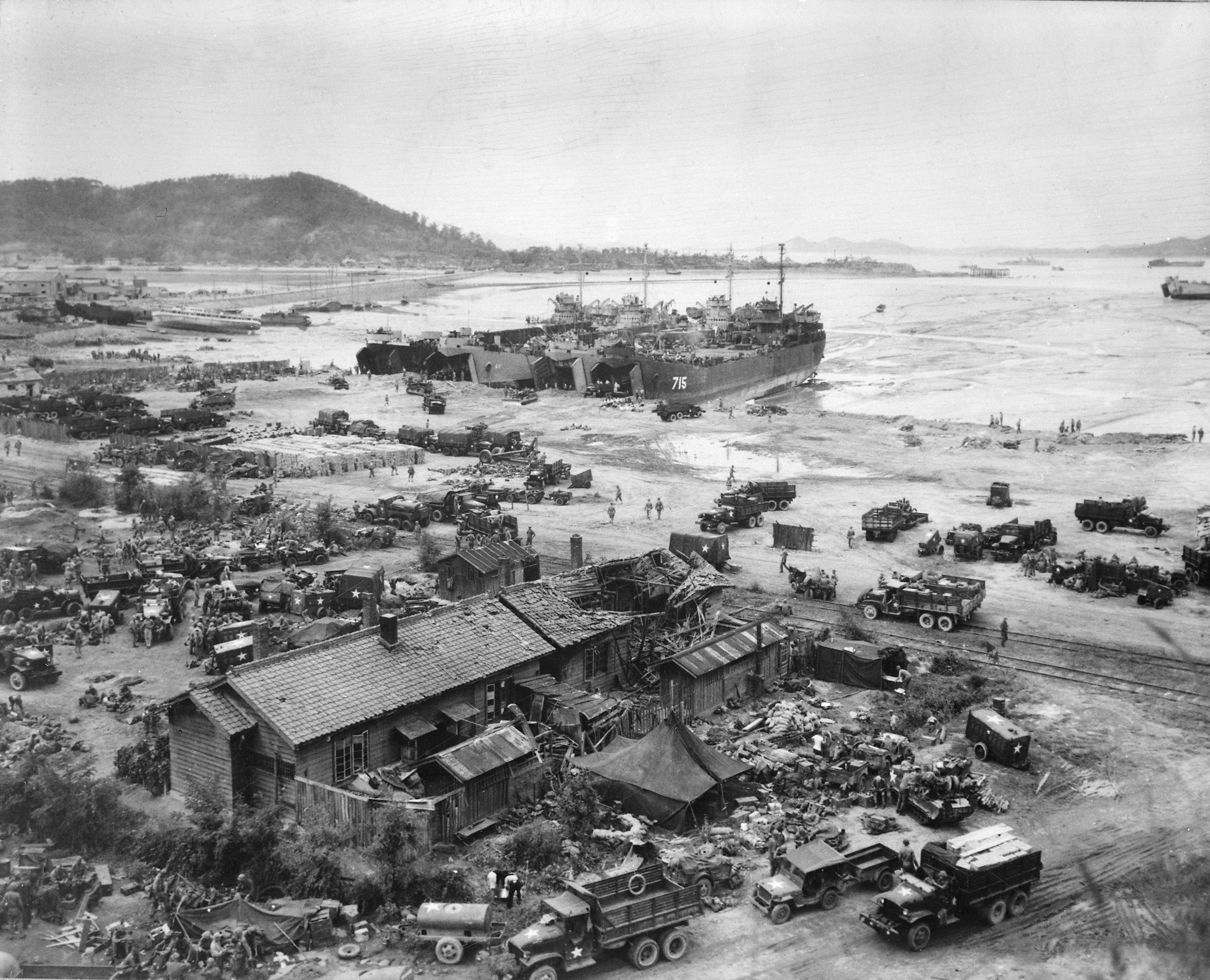
Picture of Ships Landing at Red Beach in Northern Incheon. Notice Radar Hill of Wolmi-do Island in the Background.
Two of the three Marine regiments that composed the 1st Marine Division involved in the operation had no combat experience. In fact the 1st Marine Regiment of the 1st Marine Division was activated in August and staged in Japan preparing for the invasion and the 7th Marine Regiment was activated on the 1st of September before deploying to fight at Incheon. Both of these regiments were filled with replacements from state side school houses, half of them were from the US Marine Reserve, and Marines transferred from the Mediterranean. The 5th Marine Regiment of the 1st Marine Division on the other hand were battle hardened Marines who fought in ferocious battles along the Naktong River Line during the Pusan Perimeter defense. They were the only unit in the X Corps with combat experience.
The 7th Infantry Division which was the Army’s contribution to the invasion was in worse shape than the Marines. They were the division responsible for occupation duty in Japan. However, as the war raged on in Korea the division was stripped for replacement soldiers in Korea. In August of 1950 the 7th Division was at approximately half strength. By channeling all infantry and artillery replacements into the 7th Division and transferring 8,000 ROK Army KATUSA trainees from Pusan to join the 7th Division in Japan, the division was able to near 100% strength by September.
However, these 8,000 KATUSA soldiers were merely nothing more than poor Korean boys taken from the refugee camps of Pusan for KATUSA training before being picked up for the Incheon invasion. They had not received any English or military training before leaving for Japan. Many of the KATUSAs in fact wore only shorts and sandals when they reported to their respective units in Japan.
To say the US invasion force lacked experience was an understatement but they did have numbers because X Corps when it was all said and done was composed of over 70,000 soldiers. MacArthur however, would rely heavily on the battle hardened 5th Marine Regiment to spearhead the landing at Incheon.
Incheon Landing Scheme of Maneuver
For two days prior to the landing the North Korean positions had been bombed repeatedly by US naval and air power. At 6:30AM on September 15, 1950 Marines from the battle hardened 5th Marine Regiment with nine Pershing tanks landed on Green Beach on Wolmi-do Island. The island sat in the middle of the harbor and had to be secured before the remaining invasion force could land at Incheon proper. The Marines secured the island in one and a half hours and killed or captured 400 North Korean soldiers while only suffering 17 wounded themselves.
However, the tide receded by 8:30AM and the invasion fleet had to retreat or risk being stuck in the mud flats. The Marines on Wolmi-do had to hold the island from an enemy counter attack along the tidal barrier connecting the island to the mainland until the tide rose again and more troops could land. The Marines held the island until 5:32PM when the tide rose again and the remaining Marines from the 1st Marine Division stormed Red Beach to the North and Blue Beach to the south of Wolmi-do, crushing the enemy resistance in the city of Incheon.
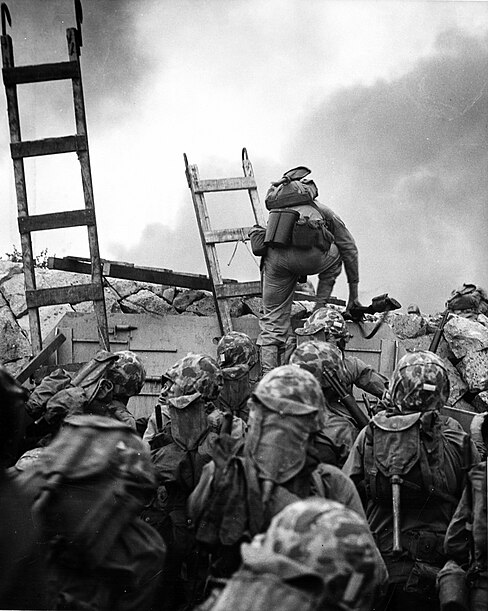
A picture of a Marine climbing a 15 foot high tidal barriers with a ladder while being shot at by North Koreans hiding in buildings over looking his position became the iconic image of the landing .
Lieutenant Baldomero Lopez of the Marine Corps is shown scaling a seawall after landing on Red Beach. Minutes after this photo was taken, Lopez was killed when smothering a live grenade with his body. He was posthumously awarded the Medal of Honor.
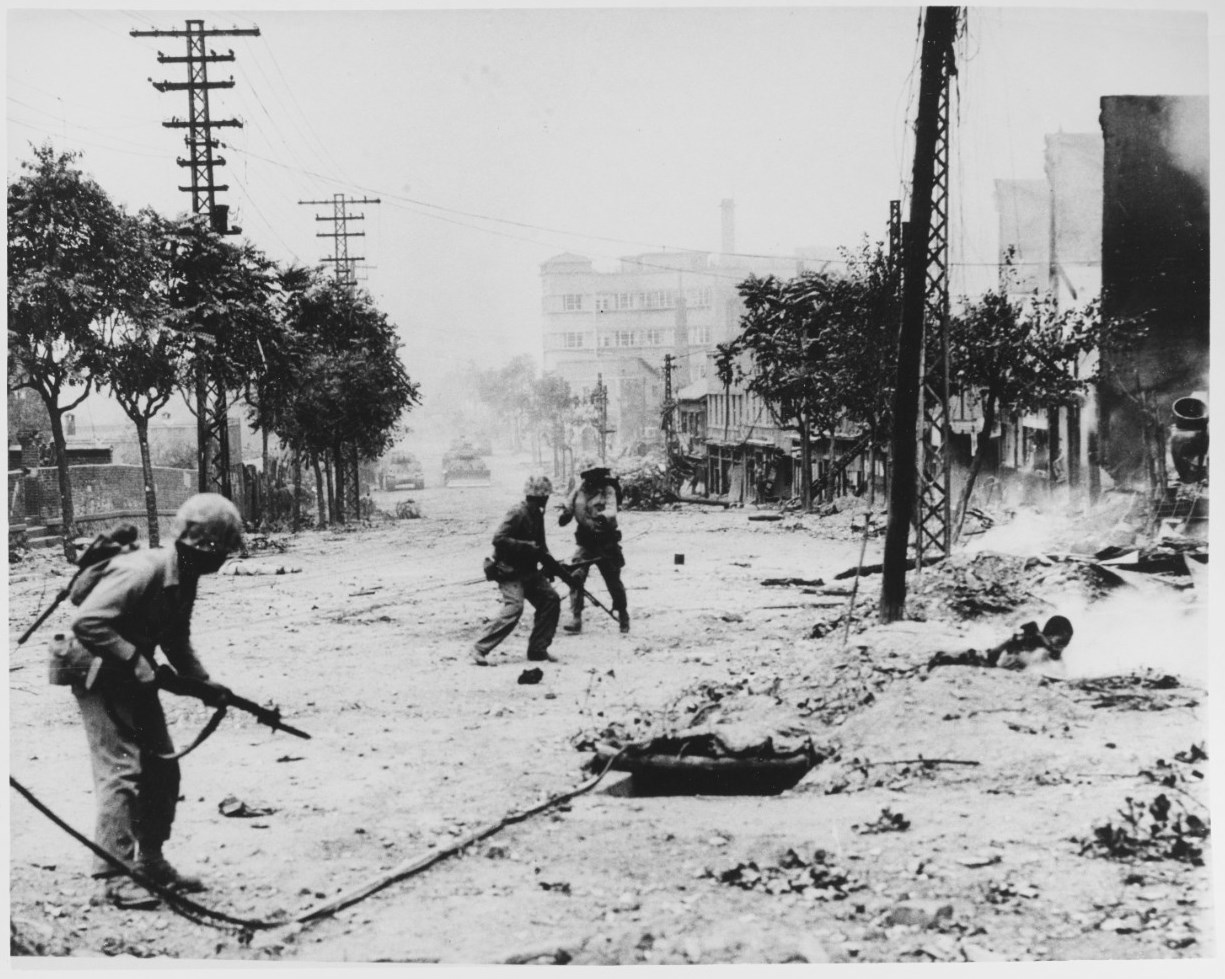
There had been no such amphibous landing during World War II into a city like what was being attempted now. Also during this time of combat in the streets of Incheon the Pershing tanks and Marines on Wolmi-do began to cross the tidal barrier to enter Incheon and also engage the overwhelmed North Koreans.
Heavy Fighting in the Streets of Incheon.
By 0130 on 16 September, 1950 the Marines had secured all their objectives in Incheon and allowed the ROK Special Marines to enter the city and mop up any remaining enemy forces, which they did with great brutality. Overall the X Corps had only 20 men killed, 174 wounded, and one MIA in taking Incheon. It was truly a brilliant amphibious operation constructed by General MacArthur.
The harbor was secured and the remainder of the X Corps, mostly the 7th Division, unloaded their equipment and men and began the march to capture Seoul. By September 26, 1950 Seoul was in UN forces hands and the North Korean supply lines had been effectively cut to their forces in the south. The 8th Army units at the Pusan perimeter mounted an offensive against the North Koreans and quickly the North Korean units were crushed by MacArthur’s hammer and anvil tactic. The North Koreans would never recover from this major defeat until the Chinese entered the war. But that is a story for another posting.
Information about the Incheon Landing was provided by the Kmike.com website and the book, This Kind of War by T.R. Fehrenbach.