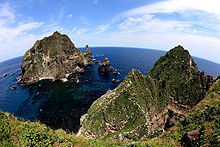
Picture of the Day: Dokdo Flash Mob
| July 31, 2014
Here is another example of a Dokdo idiot:
A 55-year-old man reportedly consumed poison Friday in an apparent suicide attempt with a note urging the need to “stand up against” Japan’s claim to Korea’s easternmost islets of Dokdo, police said.
The man, only identified by his surname Choi, was rushed to a nearby hospital after he was found lying unconscious in front of the National Cemetery in southern Seoul around noon after reportedly consuming a bottle of weed killer to take his own life, according to police officials.
A suicide note was found in a notebook inside Choi’s car that was parked in front of the cemetery, which reads, “The Japanese government, which had once colonized this country, is now trying to take away the Dokdo islets from us as well. We must not succumb to their claims but must stand up against them.”
Choi had written several letters in the notebook containing similar contents that were addressed to the president of Korea and members of the National Assembly, and he was also found to have been carrying a flag with the slogan “Dokdo belongs to us (South Korea),” police said.
Family members said Choi was an ordinary citizen who has never joined any activist groups or taken part in such protests, but added that he began telling friends that he was “so angered by Japan” through text messages since last month. [Korea Times]
Korea is looking to add their first natural heritage site recognized by the United Nations’ Educational, Scientific, and Cultural Organization:
On Jeju Island, there are many nominees up for world heritage recognition, like the nature reservations, caves, and tuff cones in Mt. Halla. Because of the fantastic geographical features created by breathtaking scenery and volcanic activity, the preservation value of its environment is high. Last October, the International Union for Conservation of Nature and National Resources (IUCN), the consultative body of the World Heritage Committee, visited Jeju and finished its research. Shim Mi-hwa of the Korean UNESCO committee says, We cannot say for 100 percent certain that it will be chosen, but last year the committee rated the place very highly and theres a good possibility.
I think it would be great if one of the natural features on Cheju Island receives World Heritage recognition, but in my opinion I find Soraksan National Park as being a better candidate for World Heritage recognition. I find Sorak Mountain more scenic than lets say Halla Mountain on Cheju plus their much more cultural sites surrounding Sorak Mountain than Halla Mountain. The Korean authorities have had Sorak Mountain on the tentative UNESCO list since 1994 and added Cheju Island sites in 2002. So it appears the Korean government has given up on listing Sorak Mountain because it has been pending for so long and focusing on getting Cheju listed instead.
Since Koreans like to compare themselves to Japan let me pose this comparison. In my opinion the Sorak Mountain wilderness is just as spectacular the Shirakami-sanchi Mountains in Japan that are listed as being a World Heritage area. Both areas are of nearly equal size (Sorak -163km2, Shirakami-170km2), both have important cultural history, and both protect an environment unique to their countries. So how come Sorak Mountain hasn’t been listed after all these years? In my opinion is probably because natural beauty is not the first thing that comes to mind when people working at the UN who make these decisions think of Korea when compared to Japan. That is why I hope Korea at least gets one natural feature cited to begin to shift this stereotype because the Korean mountains really are beautiful and under appreciated.
Now the really bold move that I would love to see the Korean government try, is to list Ulleongdo and Dokdo islands as World Heritage protected areas. Ulleongdo island is one of the most beautiful areas in Korea and Dokdo islets are not really beautiful, but are unusual. Additionally, a World Heritage nomination for Ulleongdo and Dokdo would be a way to resolve the whole Dokdo nonsense between Korean and Japan. A claim I have often heard from Koreans is that the UN is biased against Korea because Japan gives so much money to the UN. That claim is very weak when the UN is one of the most notable anti-American organizations out there and the US gives more money than any other country to the UN. Plus the new UN Secretary General Ban Ki-moon is a South Korean which totally debunks the biased UN claim. So now is the time to try to list Dokdo.
This wouldn’t be the first time an area has been given UNESCO recognition that was controversial. Look no further than the ancient Korean kingdom of Koguryo enshrined by China in 2004. The claiming of the Koguryo kingdom by China has been hotly contested by Korean scholars and UNESCO enshrined it anyway in the name of China. What better way than UNESCO recognition to settle the Dokdo dispute? No more talk about old, inaccurate maps, no more ex-pats losing their jobs over disputing Dokdo ownership, no more people chopping off their fingers, no more bee man, no more disrespecting Japanese flags by Korean politicians, just generally no more wackiness over Dokdo. However, I don’t see it happening because Korean politicians don’t want to settle the Dokdo issue just like they don’t want to settle the Yongsan Garrison issue either, because it provides them an issue that is easy to manipulate to promote nationalism within the general Korean population to their own political advantage.
I guess I no longer need to stalk up on rations, water, and batteries anymore since a global war over the Dokdo Isles has been officially adverted:
Two Japanese Coast Guard vessels that were to embark on a hydrographic survey near Korea¿s Dokdo returned to Tokyo on Sunday. It was the result of Korea and Japan reaching a compromise on Saturday to defuse tensions sparked by Japan¿s plan to send the ships into Korea¿s exclusive economic zone without permission from Seoul.
In a two-day meeting in Seoul, Vice Foreign Minister Yu Myung-hwan and his Japanese counterpart Shotaro Yachi reached a three-point agreement. Japan will stop the hydrographic survey in the East Sea it had planned to complete by June 30; Korea will temporarily put on hold a plan to register Korean names for seabed topography near the Dokdo islets with the International Hydrographic Organization until an ¿appropriate time¿; and the two neighbors will resume talks to demarcate the boundary between their EEZs as early as next month.
Though the Japanese appear to have gotten the better end of this deal, the Japanese Ambassador to Korea may not think so after having to withstand this verbal abuse. (Hat Tip: Nomad)
The Japanese Ambassador to Korea has got to be one of the world’s toughest and most thankless jobs.
How does doing this help Korea’s claim to the Dokdo Islands?:
An anti-Japan protester, Yang Bong-ho, stabs himself in the stomach with a kinfe to commite suicide demanding Japan abandon a plan to conduct a maritime survey near disputed islets, at a park in Seoul, Wednesday, April 19, 2006. Yang’s condition was unknown after being taken to hospital.
Actions like this only help Japan’s agenda of showing that Korea is an irrational society thus in turn aiding their claims to the Dokdo isles in regards to global public opinion, with the few people that actually give a crap about anything that has to do with Dokdo.
It is official now, I have now determined that the Dokdo Islets do in fact belong to Korea. I have been there and seen for myself that there are in fact Koreans on the island. Many of them were drunk, but never the less they were in fact Koreans.
My adventure to the Dokdo Islets began in the port town of Mukho just to the north of Donghae on the East Coast:
I arrived in the city the night before the departure of the boat that would take me to Dokdo. My wife and I found a cheap hotel to stay at and then we began to look for a place to eat. While looking for a place to eat I ran into a couple of young guys who I thought were maybe Americans. It turned out they were Russian sailors. I always figured Russian sailors would look well like scruffy sailors, but these young guys looked like they were ready to go to a Justin Timberlake concert with there clubbing clothes and died blonde hair. I think they mistook me for a Russian like I mistook them for Americans. As I walked by they asked me something in Russian. I know absolutely nothing in Russian, so I responded by telling them that I am an American in English and they seemed surprised by that. The two guys knew very little English and amazingly enough we began to talk a little in Korean. These guys told me that they have been to Korea many times on their boat and had learned some Korean. It was a little surreal talking to Russian guys in Korean. We talked for like only three minutes before we parted. They smell liked alcohol and looked like they were looking for their next bar to hit up. They wanted my wife and I to go with them, but we declined because we were tired and had plenty on our agenda for the next day.
The next morning we headed for the Mukho Harbor Station to get our tickets for the boat. To get tickets to Dokdo you need to make sure you reserve them in advance because they are hot items right now. At the station you could buy all the anti-Japanese shirts, hats, and Taeguki flags you needed to show your support for Dokdo and further enrich the marketers making a killing off the whole Dokdo craze. The shirt below says “Dokdo Bodyguard” and on the back of the shirt is says that “Daemado is ours too”:

This refers to the Japanese island of Tsushima just to the south of Pusan that many Koreans believe to be Korean territory taken from them by Japan hundreds of years ago.

Mukho ferry boat terminal.
At the station you need to be prepared to fight for every inch of space you have. The amount of pushy ajumas will force you to have to push and shove just to hold your spot in the ticket line and also the boarding line. If you are a foreigner a Customs Agent will check your passport and ask you questions about why you are going to Dokdo. I felt like telling them I was going to claim the isles for America to end the current controversy but I stuck with my story of being curious and wanting to see what the big fuss was all about with these islands. The custom agent must of felt I was up to something sinister because she then asked to see further ID. I then pulled out my military ID, which further surprised her. She asked why I wasn’t at work, so I told her I was on leave. She still must of thought something was fishy because she then asked to see my leave form. Anyway I eventually did get through Customs and boarded the boat. Be advised though that if you are Japanese you will not be allowed to board the boat. Matter of fact if you don’t have a passport they won’t let you board the boat.
The East Sea was remarkably calm that day and the boat cut through the ocean waves without any problems. I had taken some sea sickness medicine before I went on the boat but I really didn’t need it with the water so calm. The inside of the boat was like sitting in an airplane. The only difference was that there was more leg room and more drunks.

Inside seating on the ferry boat.
That is right, the boat was full of drunks. I would estimate 60% of the boat was older ajummas and 30% older ajushis while the other 10% was misc. people like my wife and I. Anyway these older ajummas and ajushis were having the time of their lives. They were dressed in their Dokdo / anti-Japanese finest and openly drank soju bottles on the boat. The boat employees didn’t care. So the boat was a raging party before we even reached Dokdo. Ajushis were singing and stumbling all over the place and grabbing other ajummas and dancing around. If you weren’t in a Dokdo mood after this the multiple TV’s played Dokdo videos over and over again proclaiming Korea’s ownership of the isles. The only time the boat employees tried to calm the party was when the partiers started stumbling into rooms and offices on the boat they weren’t supposed to go into. Overall it was a big Dokdo orgy of nationalism.
This made me wonder if all the bus tour groups of older ajushis and ajummas you see around the country at the different tourist areas are like this? Are they all just wild parties of older people making up for their lost party years of their youth due to war, famine, and hard work reconstructing the country?
Anyway after 5 hours of sailing and quick stop at Ullongdo Island, we reached Dokdo. Was it the beatiful unspoiled land I had envisioned and every Korean would lead you to believe? No it was nothing more than two unimpressive rocks:

My first view of the Dokdo Islets.

A closer view of the islets as the boat approached them.
They were both mostly brown rocks with no trees. There was occassional patches of green grass on the rocks. There was a lot of birds though. Dokto is supposed to be a bird migratory pit stop. There was lots of smaller rocks sticking up out of the crystal clear water. Overall, I wouldn’t call Dokto beautiful but is was definitely unusual. Especially for being so far out in the middle of no where.

Birds are the only thing more numerous then fishermen around the islets.

A close up look at the more unusual rock formations of the Dokdo Islets.
Even if you thought these rocks seemed pretty worthless you wouldn’t know it by the Koreans’ reactions. People broke out in the Korean national athemn and waved their Taegukis as we neared the islands. People were even crying at the sight of the islands. The ajummas stormed all over the deck of the boat and shifted their position to face the island every time the boat moved. It was like standing in a stampede of cattle as the ajummas raced across the deck to get a better view of the islets:

The people on the boat cheered the many fishing boats as we floated by. They looked back with indifference. In the distance you could even see the Korean naval destroyer that patrols Dokdo protecting it from any Japanese horde that may try to seize the islands such as research vessels filled with legions of hostile scientists.

Cable car used to transport supplies to the soldiers stationed on Dokdo.

On the islands there is actually quite a few buildings for the coast guard soldiers. There was more buildings than I expected. It must be boring being stuck on those islands all day though I imagine unless you like bird watching.

Islet garrisoned by Korean military personnel.
The importance of the islands for Korea’s fishermen was quite obvious with the number of fishing boats in the proximity of the islands. There was probably more fishermen than soldiers stationed on the island:

The real defenders of Dokdo, hordes of fishermen.
Overall, my trip to Dokto was at best interesting. If you got the time and patience to go through with this trip I say go for it. The price is not to expensive. A round trip ticket to Ulleongdo Island costs 93,200 won while the round trip ticket from Ullongdo to Dokdo cost 37,500 won for a grand total of 130,700 won for the total transportation costs. But keep in mind when traveling to Dokto that you will be more impressed by the experience than the actual sights. That is unless you are a bird watcher or you have a fetish for ajummas with big visors; Dokdo may then be your cup of tea.
According to the Asahi Shimbun Japan wants Korea’s Dokto island not because of nationalistic feelings but because of fishing rights.
A century ago, Shimane Prefecture claimed Takeshima island as part of its territory. The remote island is located in the Sea of Japan. On Thursday, a Shimane prefectural assembly committee approved a bill to designate Feb. 22 as “Takeshima Day.”
It aims to formally establish territoriality over the island, which is under de facto South Korean rule. The Shimane assembly’s plenary session is expected to adopt the bill next week.
It is not hard to see why Shimane wants this bill passed. An agreement between Japan and South Korea recognizes a wide area of the Sea of Japan as “provisional waters” under joint administration, where fishermen of both countries are allowed to operate unencumbered by the dispute over sovereignty. This area does not include the 12- nautical-mile zone around the island, which South Korea claims as part of its territorial waters.
Fishing communities in Shimane and other prefectures along the Sea of Japan coastline have been worried for some time that they are not getting a fair deal. They say South Korean ships are overfishing in the area.
It was these anxieties that fueled Shimane’s move to declare Takeshima Day on the centennial of its land-grab. In short, the bill reflects the concerns of local communities.
From what I have been told is that the waters around Dokdo are filled with fish. Apparently the Shimane prefecture just keeps bringing up the Tokto issue in an effort to put pressure on the South Korean government to open up the waters around the island to Japanese commercial fishing. I don’t see any chance of this happening though. The Koreans will never give up even the slightest bit of sovereignty over Tokto; even territorial waters.