A ceremony is under way to unveil a monument in the Chinese inland city of Xian on May 29, 2014. The monument is to honor the exiled Korean government army based in Xian to fight against Japan during Japan’s colonization of the Korean Peninsula from 1910-45. (Yonhap)
Korean War Service: 2-19 Infantry Regiment, 24th Infantry Division
Posthumously recognized with the Medal of Honor in 1951.
Picture of Mitchell Red Cloud Jr. in his US Army uniform. Picture via FreeRepublic.com.
Introduction
For soldiers that receive orders to the 2nd Infantry Division located near the Demilitarized Zone in South Korea one of the camps that all soldiers will eventually visit or at least hear about is Camp Red Cloud. This camp is located in the commuter city of Uijongbu just north of South Korea’s capitol of Seoul. Camp Red Cloud is home to 2ID’s division headquarters and other support units. Though every soldier in the 2nd Infantry Division knows of Camp Red Cloud very few actually know who the camp is named after. I can remember when I once had a lieutenant ask me if the camp was named after the sunsets seen from the camp over the mountains in the evenings. What many people do not realize is that Camp Red Cloud is actually named after a person and not for any red clouds seen in the air. The person the camp is named for is Mitchell Red Cloud Jr. who was recognized with the Medal of Honor for combat actions during the Korean War.
Mitchell Red Cloud Jr. was born on July 2, 1924 in Hatfield, Wisconsin on the traditional lands of the Winnebago Native-American tribe to Mitchell Red Cloud Sr. and Lillian Winneshiek. Mitchell Jr. was the oldest of three boys that the couple would have. As a boy Mitchell Jr. was well known for his outdoor skills that he perfected while going on hunting and fishing trips on the reservation. Mitchell Jr.’s schooling began at the Clay and Komensky Rural School before moving on to the Winnebago Indian School for a year. For high school he enrolled in the Black River Falls High School before deciding to drop out at the age of 16.
Red Cloud During World War II
Mitchell Jr. made the decision to drop out of high school because he wanted to pursue a career in the US military. Just one month after his 17th birthday he received permission from his dad to enlist in the Marine Corps. Red Cloud’s enlistment date into the Marines was on August 11, 1941. Due to his outdoors skills and physical conditioning honed from growing up on the Indian Reservation, Red Cloud excelled at boot camp and became an outstanding Marine. His first duty assignment was at Camp Elliot in San Diego when the Japanese bombed Pearl Harbor on December 7, 1941. After the bombing Red Cloud was assigned to the 2nd Marine Raider Battalion and deployed to the Pacific to fight in World War II. In November 1942, the then Private First Class Mitchell Red Cloud found himself in heavy combat on the island of Guadalcanal which was the scene of some of the most ferocious fighting of all of World War II.
Red Cloud spent a month in the jungle with the Raider Battalion fighting the Japanese on the island. After the US military was able to secure Guadalcanal from the Japanese, Red Cloud like many other personnel that served on the island became sick with the tropical diseases malaria and jaundice. He suffered extreme weight loss and was sent back to the US for medical evaluation in January 1943. The medical personnel recommended a discharge for Red Cloud but he refused. Red Cloud’s refusal to accept a discharge saw him redeployed to the Pacific theater again just in time to participate in another brutal fight against the Japanese; this time on the island of Okinawa. On May 17, 1945 while serving as a radio operator during the Battle of Okinawa PFC Red Cloud was shot in his left shoulder. He was medically evacuated to Guam for treatment before being shipped back to the US.
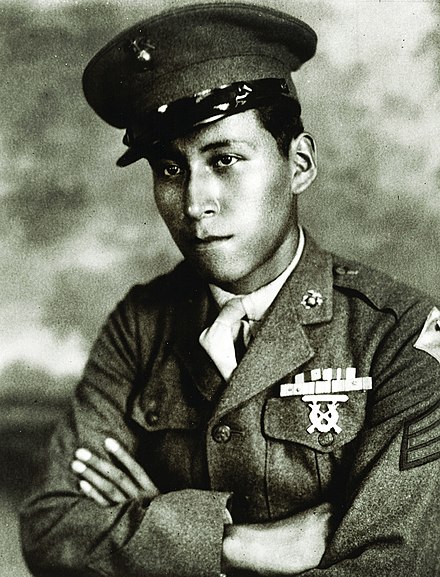
Picture of Mitchell Red Cloud in his Marine Corps uniform during World War II. Picture via Wikipedia.
With World War II over Red Cloud accepted his discharge from the Marines on November 9, 1945. The Marines gave him an honorable discharge and $56.70 before he returned to the Winnebago Indian Reservation in Wisconsin. While on the reservation Red Cloud got married and his wife gave birth to a daughter. Despite these personal developments in his life outside the military, Red Cloud decided after only two years on the reservation to reenlist in the US military. Red Cloud decided this time to not join the Marines, but instead the US Army in 1948. I wasn’t able to find anything definitive on why Red Cloud reenlisted in the military, but maybe he just grew restless after experiencing so much combat during World War II? Maybe it was just the more practical matter of providing for his family that caused him to reenlist in the military? His younger brother who had enlisted in the Army had just did in a peace time training accident; so maybe Mitchell enlisted in honor of his brother? Finally maybe he enlisted because after spending two years away from the Army he realized he is a true warrior and the military was his calling? For whatever the reasons were the US Army was getting an experienced soldier that was badly needed in the US military that had lost the vast majority of its combat veterans due to the post-World War II drawdown.
Red Cloud During the Korean War
The first unit Red Cloud was assign to was E company, 2 battalion, 19 Infantry Regiment of the 24th Infantry Division. The 24 ID at the time was responsible for conducting peacekeeping duties on the southern Japanese island of Kyushu. The assignment to Japan must have seemed like easy duty for Red Cloud compared to what he had been through during World War II. However, the relaxed time he spent in Japan didn’t last long when on July 3, 1950 the 24th ID was deployed to the Korean peninsula to stop the communist backed North Korean military that had invaded South Korea. The North Korean military crossed the DMZ that separates the two countries on June 25, 1950 and appeared to be on its way to reuniting the country that had been divided by US and Russian occupation forces after World War II. US President Harry Truman however decided to militarily intervene to stop the communist invasion of the Korean peninsula and the only troops immediately available to deploy to Korea were the peacekeeping troops located in Japan. Most of these troops were draftees that had not fought during World War II and had little combat training while stationed in Japan. Though these troops were eager to fight in what was being called a “police action” at the time; it would be up to hardened World War II vets like Mitchell Red Cloud to get these guys ready for battle. Red Cloud at the time of his deployment to Korea was a 25 year old Corporal who was respected by the men in his unit due to his prior combat experience. He had the nickname “Chief”, was easy going, and was quick to give advice to the younger troops that all looked up to him. They would soon learn to respect him even more.
Taskforce Smith soldiers arrive in Daejon during the Korean War, picture via Wikipedia.
Of the four US military divisions stationed in Japan, the 24ID was chosen to be the first to deploy to Korea. The first element of the 24th Infantry Division to arrive in Korea was the ill fated Taskforce Smith that first saw action against the North Korean military just south of Osan. The light infantry unit found themselves in battle against a foe with Soviet provided tanks and due to the superior firepower Taskforce Smith was soundly defeated. You can read more about Taskforce Smith at the below link:
Defeat would become a reoccurring theme for the other 24th ID units who were thrown into combat against the North Koreans with little to no weapons to combat the North Korean tanks. The battlefield chaos for the 24th ID reached its climax when the Division Commander Major General William Dean was captured during the Battle of Taejon. You can read more about General Dean at the below link:
This was the chaos that Corporal Red Cloud found himself in that most have been vastly different experience for him compared to his time in World War II. During that war he had fought in many successful battles against a much more dangerous enemy and now just a few years later he was part of one of the greatest military debacles in US history.
The 24th ID may have been soundly defeated by the North Koreans, but it and the other divisions from Japan that were thrown into battle, did enough to slow down the North Korean invasion until more troops from the US could arrive to help hold the Pusan Perimeter. Red Cloud and the rest of the men in the 2-19 Infantry Regiment saw combat soon after arriving in country on July 12, 1950. The unit saw combat during the defense of Daejon and then moved south towards Taegu and held part of the line along the Pusan Perimeter. Eventually General Douglas MacArthur would execute his famed Incheon Landing Operation that changed the course of the war and threw the North Koreans into a massive retreat. This allowed the 24th ID to reconstitute itself and soon enough Corporal Red Cloud and the rest of the personnel in the division were crossing the DMZ into North Korea to finish the war. In November 1950 the US military and its United Nations allies who had recently deployed troops to Korea, had advanced deep into North Korea when unbeknownst to them the Chinese military had decided to come to the aid of their communist ally North Korea. The unexpected attack by the Chinese caused the US and UN forces to a massive retreat that was quickly turning into yet another military debacle. This was the state of the war that Corporal Red Cloud now found himself in as he sat in a listening post on a hill north of the Chongchon River in North Korea on November 5, 1950.
The Chongchon River can be seen at the very bottom of the map which is located just north of the North Korean capitol city of Pyongyang. To the northwest of the river the positions of the 19th Infantry Regiment on November 1, 1950 can be seen. Map via Wikipedia.
The UN forces were in retreat and the bridge across the Chongchon River was a critical asset to support the southward movement of friendly forces. The 27th British Commonwealth Regiment which had just recently deployed to Korea and Red Cloud’s 19th Infantry Regiment were both positioned on the north side of the river to defend the bridge on November 2, 1950. Due to the shortage in personnel there was a five mile gap between the two units that was to be patrolled to prevent infiltration by the Chinese. However, the patrols ended up proving ineffective as the Chinese were able to successfully probe and discover this gap between the two units.
On the night of November 5, 1950 a 1,000 Chinese soldiers from the 355th Regiment were able to follow field telephone lines laid down in this gap to the positions of the 19th Infantry Regiment. Fortunately for E Company they had someone in a listening post that night that was awake and very attentive in looking for any Chinese infiltrating towards their position on Hill 123. That man was Corporal Red Cloud. A friend of Red Cloud’s in the company, Private First Class Ed Svach would later tell how Corporal Red Cloud had once told him that he could smell the Chinese coming. Red Cloud said, “It’s like hunting those Wisconsin deer. I can smell them coming.”
Red Cloud had been in a listening post that night with his assistant machine gunner on a ridge below the company command post. Red Cloud also knew how the Chinese liked to attack. The Chinese would launch a small frontal attack to draw attention that way but the main attack force would actually be infiltrating from the sides and rear. That is why Red Cloud set up his listening post to the side and rear of the company command post. At 3:20 AM in the morning Red Cloud let out a cry when he spotted Chinese infiltrating towards the E Company position who were following the communications wire leading to the command post. After being spotted the Chinese charged Red Cloud’s position from a 100 feet away and shot and killed his assistant machine gunner. Using his Browning Automatic Rifle (BAR), Red Cloud stood up out of his listening post and unleashed direct fire into the advancing Chinese. Red Cloud’s direct fire slowed the Chinese assault and bought time for the Company Commander, Captain Conway to wake everyone up and consolidate the defense of the E Company position. Unfortunately Red Cloud’s warning was not enough to alert everyone in the company in time because the Chinese were able to shoot some of the US soldiers in their sleeping bags. E Company was getting over run and one veteran of the battle is quoted in John McCain’s book, “Why Courage Matters” as saying:
“I wanted to bug out. I just couldn’t figure out how”
While Red Cloud was holding off the initial Chinese assault he was shot twice in the chest. One of the E company medics, Perry Woodley went to Red Cloud’s position and applied pressure bandages to his two chest wounds. Red Cloud seemed fine and continued to fire his BAR at the Chinese. Woodley left Red Cloud to go help other wounded soldiers. He returned a short time later to check up on Red Cloud again. He found Red Cloud surrounded by about a dozen Chinese bodies and more severely wounded than from when he last saw him.
Position of the 2-19 Infantry Regiment north of the Chongchon River where Corporal Mitchell Red Cloud Jr. was killed in action. Notice the area that the Chinese infiltrated through just west of the 2-19th’s position to get into their rear area. This was the gap between them and the British 27th Brigade which was mostly composed of Canadians that was supposed to be patrolled by both units to detect the Chinese. Map via Wikipedia.
Woodley told Red Cloud that he had to get off the mountain or he was going to die there. Red Cloud refused medical evacuation from his position and instead propped his wounded body up on a tree to continue firing at the advancing Chinese with the BAR. One soldier at the bottom Pete Salter said that he actually used a web belt to tie Red Cloud to the tree so he could stay up right to keep firing. Something not widely known about this battle is that another man, PFC Joseph Balboni stayed in a position near Red Cloud that created a crossfire that pinned the Chinese down enough for other men in the company to try and escape down a draw to the south.
After Woodley and Salter left the position they could hear the BARs from Red Cloud and Balboni continuing to fire on the advancing Chinese. The battle lasted for about an hour before Corporal Red Cloud and PFC Balboni would eventually be killed by the advancing Chinese. However by this time the men of E Company were well alert and retreating off the hill side from the massive Chinese assault to supplementary fighting positions a 1,000 yards to the south. From there the regiment was able to consolidate and make a defensive line to hold off any further Chinese attacks. There four quad 4′s with .50 cal machine guns were used to clear the hillsides of Chinese troops chasing the E Company survivors down the draw. Other units in the battalion would not be as lucky as E Company, if you can call E Company lucky. The nearby A Company would be nearly wiped out as many soldiers were killed while sleeping in their foxholes due to the surprise Chinese attack. E Company soldiers that survived that battle said that their unit likely would have been wiped out too if it wasn’t for Corporal Red Cloud holding off the Chinese attack.
The next morning with the sun out which provided air cover, the battalion was able to return to the old E company position to retrieve the bodies of the deceased. They found that the dead Americans soldiers had been stripped to include Mitchell Red Cloud. The only deceased soldier not stripped was 1st Lieutenant Leslie Kirkpatrick who had all of his clothes and gear on except for a missing West Point ring. Kirkpatrick had been killed while coming to the aid of a wounded soldier during the battle. His body was found with his head lying on his helmet as if he was sleeping. It is believed that one of the other lieutenants in his company placed his body like that after recovering his West Point ring to give to his wife. However, that lieutenant had been killed as well during the battle and the Chinese stripped his body and took the ring. Kirkpatrick was a 1949 graduate of West Point. Of the 670 cadets that graduated that year, 41 of them to include Kirkpatrick were killed in action during the Korean War.
Picture of Leslie Kirkpatrick as a cadet at West Point. Picture via SidneyLanier.org.
Red Cloud’s stripped down body was found lying near the tree where he died. He had been reportedly shot a total of eight times. All around Red Cloud were the bodies of Chinese soldiers. It was reported that over 30 Chinese bodies were found around Corporal Red Cloud’s position. Corporal Red Cloud’s recovered body would eventually be laid to rest in the United Nations Cemetery in Pusan. The other BAR gunner PFC Balboni would be credited with killing 17 enemy soldiers before being killed himself. PFC Balboni would posthumously be recognized with the nation’s second highest honor, the Distinguished Service Cross. In all the battalion estimated that about 500 enemy soldiers had been killed on the hill that day.
Post-Korean War Honors
A few months later in April 1951 the Congressional Medal of Honor was presented to Corporal Mitchell Red Cloud Jr.’s mother during a ceremony held at the Pentagon. She was presented the medal by General Omar Bradley. Here is what his Medal of Honor citation says:
At the Pentagon in April 1951, Lillian “Nellie” Red Cloud, mother of the late Cpl. Mitchell Red Cloud Jr., is handed the Medal of Honor awarded her son for his “dauntless courage and gallant self-sacrifice” against Chinese forces in North Korea the night of November 5, 1950. Gen. Omar N. Bradley, then-Chairman of the Joint Chiefs of Staff, is at left. ” – See more at: http://korea.stripes.com/base-info/cpl-mitchell-red-cloud-jr-annual-ceremony-planned#sthash.AZOcG1Oc.dpuf
Cpl. Red Cloud, Company E, distinguished himself by conspicuous gallantry and intrepidity above and beyond the call of duty in action against the enemy. From his position on the point of a ridge immediately in front of the company command post he was the first to detect the approach of the Chinese Communist forces and give the alarm as the enemy charged from a brush-covered area less than 100 feet from him. Springing up he delivered devastating pointblank automatic rifle fire into the advancing enemy. His accurate and intense fire checked this assault and gained time for the company to consolidate its defense. With utter fearlessness he maintained his firing position until severely wounded by enemy fire. Refusing assistance he pulled himself to his feet and wrapping his arm around a tree continued his deadly fire again, until he was fatally wounded. This heroic act stopped the enemy from overrunning his company’s position and gained time for reorganization and evacuation of the wounded. Cpl. Red Cloud’s dauntless courage and gallant self-sacrifice reflects the highest credit upon himself and upholds the esteemed traditions of the U.S. Army. for conspicuous gallantry and intrepidity in action at the risk of his life above and beyond the call of duty in Chonghyon, Korea, 5 November 1950.
At the Pentagon in April 1951, Lillian “Nellie” Red Cloud, mother of the late Cpl. Mitchell Red Cloud Jr., is handed the Medal of Honor awarded her son for his “dauntless courage and gallant self-sacrifice” against Chinese forces in North Korea the night of November 5, 1950. Gen. Omar N. Bradley, then-Chairman of the Joint Chiefs of Staff, is at left. ” Photograph via the Stars & Stripes
In 1955 his family was able to get his body moved from the UN Cemetery to the Ho-Chunk Cemetery on the Winnebago Indian Reservation back in Wisconsin so he could lay in rest with the rest of his tribe. His friend Ed Svach escorted the body back to the US where he remembered his friend being buried in the custom of the Winnebago people. The sides of his coffin were removed so his soul could escape, a bow and quiver of arrows was laid next to him so he could hunt in heaven, and bowl of fruit was laid next to him so head would have something to eat during the journey.
Mitchell Red Cloud Jr.’s grave in Wisconsin. Picture via FindaGrave.com.
In John McCain’s book, “Why Courage Matters: The Way to a Braver Life” he includes quotes from veterans from the battle that say they owe their lives to Mitchell Red Cloud. One of the survivors, Pete Salter said that during the battle he prayed to God in his foxhole to let him survive this fight and he would live a better life. He said his prayers were answered by Mitchell Red Cloud who sacrificed his life so many other men could survive. Salter in the mid-1960’s would take his kids to the Winnebago Indian Reservation to see the grave of Corporal Red Cloud. Salter broke down crying at the site of the grave of the man who had saved his life. Inscribed on Red Cloud’s grave are these words:
“The son of a Winnebago chief and warriors who believe that when a man goes into battle, he expects to kill, or be killed and if he dies he will live forever.”
Picture of marker above Mitchell Red Cloud’s grave site in Wisconsin. Picture via FindaGrave.com
Since Corporal Red Cloud’s death, the US military has made efforts to ensure that his memory does live forever by naming various military installations and equipment in his hnor. The first thing that I could find that was named after Red Cloud was when Camp Red Cloud in Uijongbu, South Korea was named after the Medal of Honor recipient.
Mitchell’s Club on Camp Red Cloud is named after him as well. There is also a rifle range on Ft. Benning, Georgia that is named after him. On August 7th, 1999 the newly commissioned strategic sealift ship, the USNS Red Cloud was launched from its dock in San Diego in honor of the fallen warrior. His daughter Annita Red Cloud, his granddaughter Tris Yellow Cloud, and other dignitaries from the Ho-Chunk tribe were there for the ceremony. Kenneth Kershaw, a veteran of E Company, 19th Infantry, who was able to survive the battle that night also attended the ceremony. He simply told the crowd that he attended the ceremony because “If it were not for the alarm sounded by Mitchell Red Cloud, I would not be here today.” The last commemoration I can find for Red Cloud was on the 50th anniversary of his death in 2000. The Korean War Commemoration Committee held a ceremony in honor of Red Cloud at his grave site in Black River Falls, Wisconsin. The committee presented Red Cloud’s daughter Annita with the Republic of Korea War Service Medal that had recently been authorized by Congress for Korean War veterans to wear.
Despite these attempts by the military to honor Corporal Red Cloud within the American public and even the US military his story is widely unknown. Red Cloud’s life story is why I have continued to advocate for Hollywood to explore using stories from the Korean War as movie material. A movie based around E Company with Mitchell Red Cloud as a main character and climaxing with the Battle of Hill 123 would make for a great movie. Red Cloud’s life is one to be remembered not just for his Korean War service, but for his service in World War II as well. There probably are not many US military servicemembers that fought at Guadalcanal and Okinawa during World War II and then the Busan Perimeter and then finally against the Chinese during their intervention into the Korean War. Clearly Mitchell Red Cloud Jr. is not only a Hero of the Korean War, but one of the nation’s most heroic military heroes that unfortunately few people know anything about.
Note #1: More stories about Heroes of the Korean War can be read at the below link:
Note #2:During my research I found only the two above photographs of Mitchell Red Cloud. If anyone knows of more photographs of Red Cloud please leave a link in the comments section.
Note #3:If anyone knows where to find a picture of PFC Joseph Balboni I would like to post his picture here as well.
Note #4: If anyone knows of any other buildings or site named after Mitchell Red Cloud Jr. please leave a comment and share it with everyone else.
Last month ROK Drop readers may remember that the Lowy Institute was offering to have reader provided questions answered by Chinese Professor Zhu Feng. I offered a number of questions and two of them were presented to Mr. Feng to answer. Here is the answer Professor Feng gave in regards to the repatriation of North Korean refugees:
What does Professor Zhu Feng think of the forced repatriation of refugees back to North Korea where they are either imprisoned or executed?
I think it’s a controversial issue, but the problem is that if China refuses to repatriate that would signal that Beijing wants to bring down the North Korean regime. So I know such repatriation is cold blooded, and it’s a big embarrassment for China’s policy on North Korea. I have to say, China’s policy implementation in this regard always keeps one eye open the other eye closed. Officially, we will repatriate, but in practice we keep the net quite loose. [The Interpreter]
You can read more at the link such as what Mr. Zhu thinks of the “Glans Plan” as well as current Chinese policies towards North Korea. By the way thank you to the Lowy Institute for hosting this as well as to Professor Zhu Feng for agreeing to answer questions from readers. I recommend ROK-Heads check out the Lowy Institute’s website The Interpreter which provides some good reads for those interested in Asia-Pacific issues.
Here is an update on the Chinese fishing boats that continue to violate South Korean waters that is getting worse every year:
Some 294 Chinese fishing boats and 2,905 Chinese fishermen have been caught so far this year illegally fishing in Korean territorial waters.
The number of Chinese trawlers caught illegally fishing in Korea’s Exclusive Economic Zone rose from 79 in 2007 to 91 last year, while the number of Chinese boats that trespassed into Korean territorial waters almost doubled from 27 to 53 over the same period.
Chinese fishermen are becoming increasingly brazen in their methods, and the scale of their activities is expanding. In the past, Chinese trawlers would only fish on foggy days or at night and slink away at daybreak. But these days they group together with ropes to create small armadas and resist arrest by using violence, or gang up against police wielding makeshift weapons. [Chosun Ilbo]
ROK-Heads may remember the violent incidents these Chinese fishermen have caused when the Korean Coast Guard tries to take them into custody to include murdering one Coast Guard officer. The violence has continued as recently 5 more Coast Guard personnel were injured by the Chinese fishermen:
Five Korea Coast Guard (KCG) officers sustained injuries while rounding up Chinese fishing boats illegally operating in South Korean waters Saturday, according to the KCG Sunday.
This is the latest in a series of recent incidents in which officers enforcing the law were injured by violent Chinese fishermen. There have been growing calls for the Korean government to take a tougher stance against these trawlers unlawfully fishing in the country’s Exclusive Economic Zone (EEZ).
According to the Jeju Coast Guard, a 1,500-ton patrol vessel seized a Chinese boat illegally fishing in the waters 12 kilometers northwest of the resort island at 4:25 a.m. Saturday. While towing the trawler to Jeju, about 25 Chinese boats illegally operating in nearby waters approached the ship and demanded the release of the captured trawler.
Soon after the patrol vessel called for reinforcements, 12 more Coast Guard vessels and two helicopters arrived at the scene and began rounding up the Chinese trawlers. Two more Chinese boats were captured but in the process, five officers were wounded by sailors resisting arrest with sharp objects. It is unknown how many Chinese fishermen were taken into custody. [Korea Times]
You can read the rest at the link but these Chinese fishermen are even being caught in the East Sea now and are active in sabotaging the nets and intimidating South Korean fishermen. Well now the Coast Guard has launched a new campaign to crackdown on the illegal fishing boats:
Stick-wielding Chinese fishermen illegally working in South Korean waters tried to evade arrest – by using rope to band their boats together.
The dramatic scenes unfurled on the Yellow Sea, off the South Korean coast near the south western city of Buan, during a three-day crackdown on illegal trawling in the area.
South Korea’s coastguard mobilised 12 ships, four helicopters and an elite team of armed soldiers to raid 10 boats. [Daily Mail]
When these Chinese fishermen are detained they are let go after paying a $27,000 fine. I still think they should confiscate their boats and send the fishermen back to China. They won’t be doing any illegal fishing any more if they don’t have a boat to fish with.
Here is a rare opportunity for those interested to ask questions to a noted North Korean expert Professor Zhu Feng from the University of Peking:
In the next part of our interview series, we’ll be speaking on 15 October to Zhu Feng, an internationally renowned expert on North Korea and nuclear disarmament. As before, we’ll be asking you to send your questions to blogeditor@lowyinstitute.org .
Zhu is the deputy director of Peking University’s Center for International and Strategic Studies and one of China’s leading scholars of international relations. He is a frequent guest on Chinese television and enjoys high-level policy access as an adviser to China’s leaders.
North Korea is a major diplomatic headache for Chinese leaders, and China is central to understanding the behavior of the reclusive state. As tensions have risen again in the Korean Peninsula over the sinking of a South Korean ship and an exchange of fire between the two countries, all eyes have been on China – as the source of 60% of the North’s foreign trade and the country’s only major ally, China is the only country that appears to have much influence.
However, China has consistently refused to censure North Korea’s leaders, keeping the country’s food and oil lifelines open despite hopes that it will use them to discipline the smaller nation. [The Interpreter]
You can read more at the link but this question and answer series is being hosted by the Australian think tank the Lowy Institute. If anyone has any questions they want asked to Professor Zhu Feng please e-mail them to blogeditor@lowyinstitute.org.
Anyway here are a few questions I can think of off the top of my head:
What does he think of the US military’s development of ballistic missile defenses and its BMD cooperation with Japan?
What would be China’s response if South Korea was to join the US BMD efforts?
Does Professor Feng believe space should be militarized? If not then why did China shoot down a satellite in 2007 that has led to massive space junk problems for the international community?
What does Professor Feng think of the forced repatriation of refugees back to North Korea where they are either imprisoned or executed?
Is it true that the Chinese government is continuing its Northeast Project in order to co-opt Korean history in case North Korea was to collapse and be absorbed into China like Tibet and East Turkestan?
If North Korea was to collapse does Professor Feng think that the Chinese should occupy North Korea or should it be left to the South Koreans to handle?
What would be China’s response if the US and South Korea in response to a North Korean attack were to launch their own offensive into North Korea?
Would China support a united Korean peninsula under democratic rule?
Why doesn’t the Chinese government stop the out of control Chinese fish boats that routinely violate South Korean waters and even murdered a South Korean Coast Guard officer?
China often claims it doesn’t interfere with country’s internal affairs. With that in mind does he think it is appropriate for the Chinese embassy in South Korea to organize violent protests against Koreans?
China is often accused of launching cyber attacks. What would the Chinese response be if the US was to launch a cyber attack against China in response?
I could go on and on, but I will let others discuss in the comments section what other questions should be asked of Professor Zhu Feng?
By the way thank you to the Lowy Institute for hosting this as well as to Professor Zhu Feng for agreeing to answer questions from readers.
– See more at: http://webcache.googleusercontent.com/search?q=cache:wPWOHNf5GqoJ:rokdrop.com/page/429/%3Fx%3D0%26y%3D0%252F+&cd=1&hl=en&ct=clnk&gl=us#sthash.5HnNNg3w.dpuf
Here is a rare opportunity for those interested to ask questions to a noted North Korean expert Professor Zhu Feng from the University of Peking:
In the next part of our interview series, we’ll be speaking on 15 October to Zhu Feng, an internationally renowned expert on North Korea and nuclear disarmament. As before, we’ll be asking you to send your questions to blogeditor@lowyinstitute.org .
Zhu is the deputy director of Peking University’s Center for International and Strategic Studies and one of China’s leading scholars of international relations. He is a frequent guest on Chinese television and enjoys high-level policy access as an adviser to China’s leaders.
North Korea is a major diplomatic headache for Chinese leaders, and China is central to understanding the behavior of the reclusive state. As tensions have risen again in the Korean Peninsula over the sinking of a South Korean ship and an exchange of fire between the two countries, all eyes have been on China – as the source of 60% of the North’s foreign trade and the country’s only major ally, China is the only country that appears to have much influence.
However, China has consistently refused to censure North Korea’s leaders, keeping the country’s food and oil lifelines open despite hopes that it will use them to discipline the smaller nation. [The Interpreter]
You can read more at the link but this question and answer series is being hosted by the Australian think tank the Lowy Institute. If anyone has any questions they want asked to Professor Zhu Feng please e-mail them to blogeditor@lowyinstitute.org.
Anyway here are a few questions I can think of off the top of my head:
What does he think of the US military’s development of ballistic missile defenses and its BMD cooperation with Japan?
What would be China’s response if South Korea was to join the US BMD efforts?
Does Professor Feng believe space should be militarized? If not then why did China shoot down a satellite in 2007 that has led to massive space junk problems for the international community?
What does Professor Feng think of the forced repatriation of refugees back to North Korea where they are either imprisoned or executed?
Is it true that the Chinese government is continuing its Northeast Project in order to co-opt Korean history in case North Korea was to collapse and be absorbed into China like Tibet and East Turkestan?
If North Korea was to collapse does Professor Feng think that the Chinese should occupy North Korea or should it be left to the South Koreans to handle?
What would be China’s response if the US and South Korea in response to a North Korean attack were to launch their own offensive into North Korea?
Would China support a united Korean peninsula under democratic rule?
Why doesn’t the Chinese government stop the out of control Chinese fish boats that routinely violate South Korean waters and even murdered a South Korean Coast Guard officer?
China often claims it doesn’t interfere with country’s internal affairs. With that in mind does he think it is appropriate for the Chinese embassy in South Korea to organize violent protests against Koreans?
China is often accused of launching cyber attacks. What would the Chinese response be if the US was to launch a cyber attack against China in response?
I could go on and on, but I will let others discuss in the comments section what other questions should be asked of Professor Zhu Feng?
By the way thank you to the Lowy Institute for hosting this as well as to Professor Zhu Feng for agreeing to answer questions from readers.
Sometimes heroism in warfare is not always won on the battlefield. Heroism can also occur in the rear ranks by strong leaders organizing and motivating logistical and support units to operate at full capacity to support the frontline units. Often in warfare the rear logistical units can become to complacent due to their distance from the frontline combat units. This complacency inevitably causes inefficiency that ultimately effects the frontline soldiers. This inefficiency and displacement from combat often causes tension between the frontline and rear echelon units that usually leads to colorful names for the rear troops. This has been a fact throughout the wars America has fought. Frontline soldiers today often call the rear echelon troops Foblins (FOB is a forward operating base). During the Korean War they were known as REMF’s (Rear End Motherfu****s). It was these REMF’s that would lead to one of the most embarrassing incidents of the entire Korean War.
Koje-do is a large island located in the southeast of Korea. It covers some 383 squared kilometers and is the second largest island in Korea only behind Cheju-do Island. The island has much historical significance with it’s links to the legendary Korean Admiral Yi Sun-shin. Today the island serves as a holiday destination for people from Pusan and as the home of the Daewoo ship building industry. However, probably the most infamous incident in the island’s history has to be the Koje Island communist prisoner of war (POW) camp constructed on the island during the Korean War. Long before there was Abu Graib there was Goje Island. What happened at Abu Graib totally and utterly fails in comparison to the incompetence and horror of Goje Island during the Korean War.
During the increasing combat on the Pusan Perimeter the US and allied forces found themselves with increasing numbers of North Korean POWs. It was decided that a camp had to be constructed to house the POWs. Goje Island was chosen as the site because of the fact that it was an island making it difficult to escape and it was far from the front making rescue attempts impossible. Additionally it was away from Pusan thus preventing the vital port in Pusan being clogged due to the amount of POWs held there, if the allies had to withdraw from Korea. The area chosen on the island to build the site a flat valley near the center of island that had access to a seaport to resupply the island from. Hap hazard housing and facilities were constructed on the site and very quickly POWs began to fill the camp. After the successful Inchon Landing Operation the amount of POWs increased greatly as even more North Korean troops were captured by the allies. With the entry of the Chinese into the war the camp continued to fill up well past it’s maximum capacity.
The following facts should give you some idea of how overcrowded the POW camp was. The facts are from March 1952, in the article “Prisoner’s Island: Tension and Tedium Rule Koje’s Barbed-Wire World”. This was an extensive story about life for the prisoners on Koje island off the east coast of South Korea. The story appeared in Vol. 32, Issue Number 13, pages 92 to 98 in the March 31, 1952 issue of LIFE magazine. Here are the facts:
Koje had 3,000 Prisoners of War under the age of 17
170,000 prisoners lived there
38,000 of the POWs were Korean civilians pressed into Red armies
21,000 were Chinese POW’s
111,000 were North Korean POWs of both sexes between the ages of 6 and 63
60% of the Chinese POWs were illiterate
24% of the Koreans were illiterate
Messages were sent from compound to compound via dragonflies
Each arriving prisoner received about $50 worth of GI uniform
Compound 66 had 2,600 North Korean officers who believed in communism
6,000 Koreans and 13,000 Chinese signed anti-Communist petitions, sometimes in blood
In February of 1952, 69 POWs in Compound 62 died in a riot
Prisoners of War on Koje studied language, history, manual crafts, modern farming, and the difference between democracy and totalitarianism.
To put the massiveness of these numbers into perspective, Abu Graib never held more than 4,000 prisoners at its peak in 2004.
Overcrowding and Incompetence
The overcrowding combined with an ideological battle within the camp made living conditions increasingly unbearable. The POWs segregated themselves into gangs that either believed in communism or capitalism and even further divided themselves by religion as Christianity was increasingly accepted by the prisoners. The gang like atmosphere in the prison bares a striking similarity to America’s prisons today by how prisoners segregate themselves into gangs based on ethnicity. The different gangs regularly fought for turf and influence in the prison camp.
The guards that secured the compound rarely if ever went inside the compound. Most of them were rear echelon troops bored and uninterested in duty on the island. The prisoners pretty much ran the prison themselves with the American soldiers standing guard outside the wire.
Due to the lax security within the compound the communist block was able to intimidate and crush opposition and when they had accumulated enough strength within the camp, they decided it was time to start waging war against the Americans from within inside the camp as well. They knew they couldn’t begin a conventional fight against the Americans because they would all just eventually be shot and killed. They decided the best way to open up another front against the Americans was to begin a propaganda war from inside the camp. This campaign would have better results than they ever could have imagined.
North Korean POW camp leader Colonel Lee Hak-ku.
On the morning of May 7th, 1952, the commander of the communist faction North Korean Colonel Lee Hak-ku requested that the commander of the prison, Brigadier General Francis Dodd urgently come and meet with him for an important reason. BG Dodd had met with COL Lee before and didn’t expect anything unusual from this request. In a well rehearsed and coordinated move COL Lee’s men surrounded the General and his guards and quickly subdued the guards and pushed them out of the compound and grabbed the general and moved him deep within the compound. The prisoners all pulled out their home made weapons and threatened to kill the general if any attempt to enter the compound was made. The seizure of the American general made instant headlines. Americans woke up to headlines of torture and abuse at Goje Island because the prisoners made demands that the US stop torturing, abusing, and starving them if they wanted their commander back. This was of course nonsense but to other nations around the world who didn’t know any better they of course began to wonder, “What the heck are the Americans doing on Goje Island?”
Additionally the communist block had a field day with the propaganda value of the Goje Island uprising. Here is what Pravda in Moscow wrote in response to the uprising:
Koje Island! Again the gloomy shadow of Maideneck (a Nazi extermination camp in Poland) has come upon the world, again the stench of corpses…… the groans of the tortured…… we learn that “civilized” Americans can be yet more inhuman, yet more infamous than the bloody Hitlerites. Dachau was a death camp, Maidenek was a death factory; Koje is a whole island of death. The American hangmen are torturing, tormenting, and killing unarmed people here. They are experimenting with their poisons on them….
This Kind of War
Page 398
To echo the communists claims the Red Cross condemned the treatment of prisoners on Goje Island as well. They condemned the over crowding, violence in the camp, and the lack of food reaching some prisoners because the communist leaders would store the food for themselves and only hand it out to prisoners loyal to their movement. The Red Cross also would not condone any force to put down the uprising and regain control of the camp in order to meet acceptable humanitarian standards. The Red Cross could provide no advice on how to meet acceptable standards, but was quick to criticize the Eighth Army forces guarding the prison for not meeting those standards.
COL Lee had scored a massive propaganda victory by claiming torture and abuse after capturing the general that was repeated and endorsed in newspapers across the globe. He even scored a bigger victory when another General, BG Charles Colson arrived to take charge of the camp and agreed to demands made by the prisoners to stop torture and abuse in exchange for General Dodd. Before releasing Dodd, the North Koreans put him on trial for war crimes and forced him to the statement that Colson had approved earlier.
After the release of General Dodd, General Colson retracted the signed statement made by Dodd, but by agreeing to the demands in the first place it had the effect of legitimizing the North Koreans’ claims of torture and abuse to the world’s media. The global media was having a feeding frenzy over the Goje Island story and it began to directly effect the truce negotiations being waged at Panmunjom. The US military brass was furious at what was going on at Goje Island and at General Colson for agreeing to the prisoner’s demands.
There were problems on Goje Island, but the prisoners were always fed and did what they wanted in the camp. The biggest problem on the camp was the overcrowding, because no one expanded the camp because everyone thought the war would end any day and all the prisoners would go home. The problems in the camp was not from torture or abuse, but from incompetence of the people running the camp. This incompetence would end once a man named Brigadier General Haydon Boatner.
The New Commander Takes Charge
Brigadier General Haydon Boatner was an old China hand for the US military. He served in China during World War II and spoke fluent Mandarin. He was serving as the assistant division commander of the Second Infantry Division on the frontlines of the Korean War when he went on leave for R&R in Japan. It was while on leave in Japan that he was notified that he was taking over the Geoje Island POW camp. The camp had been commanded by rear echelon troops and the Eighth Army commander General Mark Clark wanted a proven combat leader to fix the mess that the rear echelon commanders had created on Goje Island and General Boatner conveniently on leave in Japan was just the man he needed.
General Boatner soon arrived in Pusan and received a debriefing from General Colson on the situation on Goje Island. While in Pusan he even ran into the recently released General Dodd who was visibly a shaken man after being held hostage and was on his way to Tokyo to report to his superior there over the incident. Dodd would go on to be reduced one rank to colonel and forcibly retired from the military. While meeting with General Colson, Boatner was amazed how oblivious he was to the media frenzy over Goje Island. There was little access to the media in Korea, but in Tokyo the media frenzy in the newspapers could not be missed and Colson would soon find out about the frenzy after meeting with Boatner and returning to Japan where he was also disciplined for his part in the Goje Island mess.
Boatner found the lack of information reaching Korea to be even worse once he arrived on Goje Island. The first thing the command staff on Goje wanted to do once he arrived was to throw him a cocktail party. General Boatner couldn’t believe that the staff on Goje was more concerned about cocktail parties than ending the uprising and the subsequent propaganda beating the US was taking due to the mess on Goje Island. The priorities of the soldiers on Goje Island became only more evident as Boatner looked around the camp. He found soldiers in different uniforms and some soldiers carrying weapons and others not. The reason he found for the lack of weapons was the fear of accidental discharges. For a commander that had fought on Heartbreak Ridge, Boatner could not believe the attitude of the soldiers he found on Goje Island. General Boatner immediately ordered one standard uniform and put everyone under arms to the objection of the staff he inherited. They were an absolute disgrace and he was going to fix it.
Internationalizing the Problem
Boatner discovered that this attitude was allowed to manifest because many of the officers and soldiers that the Army found unfit for combat had been sent to this island instead of the frontlines. General Boatner decided it was time to start a purge to rid the camp of the unfit soldiers and leaders. He relieved over 400 soldiers from the island and now had to replace them. To replace them Eighth Army sent him combat team from the 187th Airborne from Japan, a Canadian company, a British company, a few Greek soldiers, and a Turkish company. The Eighth Army commander General Clark received a lot of criticism from the governments of the soldiers sent to Goje because these countries wanted nothing to do with what was going on with Goje Island. It was a political kryptonite that everyone wanted to steer clear of, but General Clark felt the problem on Goje was a UN problem and not solely a US problem and by sending foreign units there it internationalized the problem.
Expanding the Camp
After General Boatner had successfully conducted his purge and refocused the attention of the camp on regaining control of the prisoners and not holding cocktail parties, he then focused on expanding the camp in order to break up the organized groups of prisoners. Boatner know that he had to expand the compound quickly because the camp was not only making international headlines that were disgracing the country, but was also being used for political fodder during the negotiations at Panmunjom.
One of the most sensitive issues being discussed during the negotiations was the return of POWs at Goje Island. The allies wanted to give the prisoners an option of either staying in South Korea or returning to North Korea or China. The Chinese and North Korean negotiators wanted all the prisoners sent back to North Korea and China. When challenged that many of the prisoners wanted to stay in South Korea the communist negotiators would counter that the prisoners only say that because they are being inhumanely tortured on the island and would hold up western media reports that had sensationalized what was going on at Goje Island to prove it. Additionally images of the daily protests at the Goje camp complete with prisoners chanting communist slogans and holding up pictures of Marxist leaders were filling the daily newspapers across the globe feeding the perception of torture, abuse, and the fact that all the prisoners wanted to be returned to North Korea and China.
An engineer unit was sent to Goje to help expand the camp. Initially the engineer commander was more concerned about building a new PX for the soldiers than expanding the camp, but General Boatner set him straight and ordered his men to work 24 hours a day building the new barracks to house the prisoners. The PX could wait.
Breaking the Enemy’s Will
Along with Boatner’s efforts to restore discipline in his troops and expand the camp he also needed to break the will of the enemy. Boatner felt that since the prisoners’ commander North Korean Colonel Lee Hak-ku had successfully brought massive media attention on the island that at anytime he could order his men to attempt a massive prison break that would end in the deaths of many prisoners further causing disgrace to the US military and the condemnation of the world. Boatner had to work on breaking up the loyalty of the prisoners to Colonel Lee.
The prisoners would challenge General Boatner’s authority on just his second day on the job. A Chinese faction of soldiers loyal to Colonel Lee began to cause a commotion in the camp. General Boatner went to the camp to see what was going on. He was amazed to see 6,500 Chinese soldiers in perfect formation chanting slogans and holding propaganda signs. Outside the wire the American soldiers were gathered hooting and hollering back at the Chinese. It was a chaotic scene that Boatner was quick to get control of. He ordered his aid to bring the commander of the US soldiers to him and the Chinese commander. Boatner proceeded to scald the US commander to take control of his men. The commander, a lieutenant colonel had served under General Boatner on the frontlines of the war and quickly responded and got control of his men and stopped the hollering at the Chinese.
Boatner than turned his attention to the Chinese commander who was a colonel in the Chinese Army that spoke a northern Chinese accent that Boatner understood completely. The colonel not realizing Boatner could speak Chinese brought an interpreter with him that reiterated demands about the Geneva Convention, Panmunjom, and the usual communist talking points of the day. General Boatner, to the Chinese commander’s shock, responded in perfect Mandarin that he was full of crap and then proceeded to tell him the names of respected Chinese generals he had fought with during World War II. The fact that he could speak Mandarin combined with his association with prominent Chinese commanders impressed the Chinese commander. The Chinese commander agreed to end the protest and through small acts of Chinese cultural understanding over the proceeding days Boatner was able to win the respect of the Chinese commander. In just a few short days General Boatner had already eroded support for Colonel Lee Hak-ku’s uprising in the prison.
Next Boatner turned his attention to eliminating the communist propaganda such as signs and statues that had been erected around the camp. Boatner wanted to avoid one large operation that the prisoners could organize against and cause a massive incident that could turn into blood shed which would be reported around the world. Boatner decided instead to use well timed raids that featured tanks backed with soldiers trained in riot control. Boatner’s men raided one compound at a time over a series of days to slowly destroy all the propaganda around the camp thus avoiding one large operation. Slowly but surely General Boatner was able to eliminate the communist propaganda inside the camp. In the first week of Boatner’s command it was clear to all the prisoners that there was a new boss in town and it wasn’t Colonel Lee Hak-ku.
Isolating the Prisoners
It was long known that villagers outside of the Goje POW camp were helping the prisoners inside the camp with supplies and the sending of messages back to their masters in North Korea and in turn influencing the on going negotiations at Panmunjom. Many of the villagers on Goje were actually North Korean civilians relocated from Wonsan and Hangnum in North Korea. Among the evacuated civilians were many North Korean agents that were aiding the prisoners in the camp. General Boatner knew he had to stop this rat line running from Goje to Panmunjom and the only way to do that would be by forcibly moving thousands of villagers away from the camp.
The problem with doing that was that with the Red Cross and media hanging around would condemn such an act. However, the problem with the civilians supporting the prisoners got so bad that Boatner had to do something about them before he could move on fully ending the uprising in the prison. Boatner sent trucks to the village to move the villagers. The military in two days was able to move the entire village and burn the huts down. It brought some bad headlines in the short term, but in long term it totally isolated the North Korean leadership within the prison.
Ending the Revolt
It took 30 days for the engineers to complete the expansion of the prison and during this time General Boatner was able to restore discipline among his own troops, divide loyalties within the prison, and end the rat line of communications from and to the prison. The last thing that had to be done was to end the revolt and restore order.
With the new camp constructed the time was now here to begin moving prisoners into the new and more secure compound. There was tens of thousands of prisoners total on Goje divided in separate camps of 6,500 prisoners. General Boatner chose the most violent camp with the head communist leadership, including Colonel Lee Hak-ku in Camp 76 to begin the movement of the prisoners from. Boatner felt that by crushing opposition here first, it would set an example to the rest of the prisoners. Using crack paratroopers from the 187th Airborne Brigade, Boatner had his men completely surround Camp 76. The men were under very explicit orders to use non-lethal means to move the prisoners and could only shoot to kill with the permission of the commanding officer only. It was imperative that the operation didn’t turn into a blood bath for the world’s media to report. The paratroopers had trained for weeks for this operation and were ready to put down the uprising by chopping off it’s head at Camp 76.
Weapons found hidden within the Geoje Island POW camp.
All at once on June 10th, 1952, the soldiers cut down the wire around the camp and moved in. The paratroopers moved in slowly and deliberately subduing prisoners. As they moved further into the camp the prisoners set fire to the buildings creating a smoke screen to fight the paratroopers in. The paratroopers began throwing concussion grenades into the smoke which had the effect of breaking up the frontlines of the resistance. As prisoners fled the impact of the grenades they were quickly captured by the paratroopers. The last 150 holdouts made one last ditch effort to fight off the paratroopers by hunkering down in trenches they had dug. As the paratroopers closed in on the trenches some of the prisoners panicked and ran towards the paratroopers to give themselves up. However, as they ran from the trenches the hard core communist cadre chased after them and killed some of the defectors. The paratroopers quickly moved in to stop the slaughter and a melee ensued. You can watch historic video footage of the operation at this link.
Once the operation was over 43 POWs had been killed and 135 wounded with half these casualties coming from the communists attacking their own people. Only one paratrooper who had been speared to death was killed in the operation. The paratroopers searched through the compound and found corpses hanging from inside the buildings to serve as an example to anyone that did not resist the Americans. They also found detailed plans by the communist to conduct a mass prison break on June 20th and slaughter anyone in there path in order to make maximum headlines against the Americans.
Outside the paratroopers found Colonel Lee hiding in a ditch and dragged him to his new compound. The leader of the communist uprising had gone down without a fight. The 6,500 prisoners in the notorious Camp 76 had been broken down and moved to the new compound and divided into more secure compounds of 500 prisoners per camp. The smaller number of prisoners per camp made it harder for them to organize and easier for the guards to manage. After this operation the rest of Goje’s prisoners voluntarily moved without confrontation to the new camp. By June 12th all the prisoners had been moved and General Boatner was firmly in charge of Goje Island. Colonel Lee and the rest of the prisoners of the Goje POW camp would never give General Boatner and his successors anymore problems for the rest of the war
Lessons Learned from the Geoje Island Incident
The US forces during the Korean War had been completely unprepared for the detaining of massive amounts of enemy prisoners. During World War II the US military dealt with few prisoners because very few Japanese ever surrendered. In the European theatre the allies didn’t start taking massive amounts of German prisoners until the war was just about over and the Germans had lost their will to fight. During the Korean War the US had taken massive amounts of prisoners and the enemy was far from being vanquished. Additionally these prisoners came from an alien culture and ideology that US commanders understood little about. Enemy prisoners looked at using prison as just another front in their war against the US and its allies.
To compound the problem the US commanders were so consumed with fighting the immediate war little emphasis was put into the handling of prisoners and possible propaganda value to the enemy for any mistreatment. Additionally the assigning of poor soldiers and officers to manage the prisoners combined with the inadequate facilities to house the prisoners would lead to strategic consequences later in the war.
The mistakes made during the Korean War in the handling of prisoners would repeat itself to a much smaller degree during Operation Iraqi Freedom and the Abu Graib prison abuse controversy, but the propaganda value was just as valuable to not just the immediate enemy, but all the interests opposed to America in general as well.
Here are some of the big lessons learned I think the military can take away from these two very big historical blights on the image of the US military in the last 50 years. First of all, plans need to be made to house prisoners before going to war. Before the war even started there should have been an engineer unit designated to immediately begin building a compound to house prisoners. The Korean War was an unexpected war, but the Iraq War had plenty of prior planning and unfortunately the prior planning did little to plan for the amount of prisoners the US would end up holding. One engineer company during the Korean War built a camp to hold tens of thousands of prisoners in one month. What if the US military built a camp of similar size in the desert some where in Iraq to hold prisoners instead of Abu Graib? This would have easily prevented the overcrowding of the prison.
Secondly, Abu Graib should have never been chosen as a place to hold prisoners to begin with due to its notorious image from the Saddam Hussein era of power in Iraq. What if during the Korean War the US military started holding prisoners within Soedaemun Prison in Seoul? What kind of message would that have sent to the general Korean population during the war? During the Korean War Goeje Island was actually a well chosen location for a prison that planners during the Iraq War could have learned a lot from.
Next thing is that a mission as politically sensitive as handling prisoners of war at a detention facility should be handled by only highly professional soldiers. Who in the world thought it was a good idea to have people like Charles Graner and Lynndie England to have such authority over prisoners? Janice Karpinski was just a female version of Francis Dodd. Abu Graib was surrounded by just as much incompetence as Goje Island during the Korean War. It wasn’t until competent leadership backed by crack troops were conditions in the camp able to improve on Goje Island. The lesson learned is that highly professional units with excellent leadership that deal exclusively with handling prisoners of war should be formed before a war is even initiated. The adhoc nature of soldiers and agencies thrown together in Abu Graib caused an environment ripe for abuse.
Finally, internationalizing the Goje prison by General Boatner was a brilliant idea because it shares responsibility for anything that happens within the prison. The international media glee over Abu Graib would probably have been much more tempered if more countries were involved in the management of the prison. This is something that should become a standard practice in future conflicts.
These were all painful lessons learned in the aftermath of the Goje Island Incident that would unfortunately be forgotten 50 years later in Iraq. Military planning requires more than just maneuvering infantry and tanks and hopefully in future conflicts the US military properly plans to deal with the handling of prisoners of war. Especially when such an issue can have such strategic impact, which in the case of Abu Graib is still being felt today. The painful lessons learned from Abu Graib could have been avoided with a close study and appreciation of the experiences of General Haydon Boatner on Goeje Island.
Jeff Stith of the National Center for Atmospheric Research communicated with reporters via Web chat from a research jet flying 40,000 feet above the ocean as part of a mission to track dust and pollution particles blown from Asia to the United States.
“We have found enhancements in pollution levels in some of the upper regions of the storm clouds we studied, just yesterday for example,” Stith wrote.
Stith and his ground-based colleague, V. Ramanathan of the Scripps Institution of Oceanography, aimed to study the interaction between the pollution and dust with high-altitude clouds bearing ice crystals.
Ice crystals are found in extremely cold clouds, and when the crystals are composed entirely of frozen water, they reflect lots of sunlight — that’s why these clouds look so white, Ramanathan said by telephone after the Web chat.
However, if particles of dust and a dark pollutant known as black carbon managed to get inside the crystals, these clouds might absorb more solar energy rather than reflecting it all, Ramanathan said.
You can see interviews with the two scientists here and here, but they say the significance of this dust mixed with Asian pollution blowing across the Pacific, is that they believe it effects weather patterns by influencing precipitation levels once the clouds reach the US. They also believe the dust and pollution is possible for anywhere from 20%-80% of global warming.
Here is computer enhanced image of the dust and pollution crossing the ocean from the PACDEX website:
Â
It seems like the dust has been getting worse nearly every year, maybe some of you Korea old-timers can verify if the dust was as bad 20-30 years ago as it is now. It will be interesting to see what the scientists findings are once they complete their research.
China has been vigorously expanding their space program which includes such successes as recently launching astronauts into orbit. Korea has also recently begun expanding their space program including the announcement of the construction of a state of the art launch pad on the Korean island of Goheung. Now Japan is officially announced a significant expansion of their space program as well:
Japan is building upon its past successes in space to forge a range of initiatives, from disaster warning systems, probes to Mercury, Venus and Jupiter, as well as conduct an aggressive lunar exploration campaign.
Read the whole article, but the Japanese space agenda is definitely ambitious. All in all I’m glad to see this Northeast Asian space race because hopefully this increased competition will further push our own US space program and industries which have become increasingly stagnant in recent years. If it takes the Chinese landing on the moon to get the US space program moving again than I’m all for it.