What are the unique features of the Yusang-ni Missile Operating Base? Why is it important? @CSIS’s short video answers all of these questions: https://t.co/7gDXqqws58
— CSIS Korea Chair (@CSISKoreaChair) July 14, 2019
Want to learn more? Read @BeyondCSISKorea’s report: https://t.co/T2QwXbWnR3 pic.twitter.com/itQqITu43T
Latest
Picture of the Day: Ghost Boat

Report Claims Trump Administration Considering Allowing North Korea to Export Coal and Textiles for Nuclear Freeze
If this report is true it will allow the Kim regime to increase its foreign revenue for giving up nothing in return:

In return for the dismantlement of the Yongbyon Nuclear Research Reactor and a nuclear freeze, the United States would offer the Kim regime a 12-18 month suspension on some U.N. Security Council sanctions. The North Koreans would again be permitted to export coal and textiles, two commodities which have served as Kim’s biggest moneymakers. If Pyongyang agrees to keep its end of the deal, Washington would also consider an end of war declaration and the establishment of liaison offices in one another’s capitals. And if the North cheats or violates the agreement, the Security Council would reimpose the sanctions through a snap-back mechanism.
National Interest
You can read more at the link.
Japan May Be Planning to Add Additional Export Restrictions on South Korea
The trade dispute from South Korea and Japan may intensify by July 24th:

Trade tensions between South Korea and Japan are escalating as Tokyo seems to be preparing to expand the scope of its export controls beyond high-tech materials to a wide spectrum of areas, which could disrupt the global supply chain, industry watchers said Monday.
Japan began applying stricter export rules on South Korea for three key materials needed for making chips and displays on July 4 over a wartime forced labor issue and is pushing to remove South Korea from a list of trusted buyers, which could affect the supply of other key materials needed for making smartphones, televisions, chemicals and other industrial materials.
Tokyo’s move to exclude Seoul from its “whitelist” of countries on national security grounds would require Korean companies to seek export licenses for a wider range of technologies, which could result in additional costs and time.
South Korea is currently on the neighbor’s 27-nation whitelist, which includes the United States, Germany, Poland and Italy.
“If Japan removes South Korea from its whitelist, about 1,100 items are estimated to be affected by the new regulations,” a Seoul trade ministry official said, asking not to be named. “We are closely analyzing the potential impact from Japan’s move on the South Korean industry.”
The Japanese government is expected to announce the decision on July 24 after a review process, which goes into effect 21 days later. Seoul’s trade ministry proposed another meeting with its Japanese counterpart before the deadline to discuss the issue, after their first meeting Friday failed to mend the disputes.
Yonhap
You can read more at the link, but some observers believe the trade dispute will ease after upper house elections in Japan are complete on Sunday. The observers believe Prime Minister Shinzo Abe is using the trade dispute for political advantage in the election.

Timeline and Analysis of the Park Geun-hye Impeachment
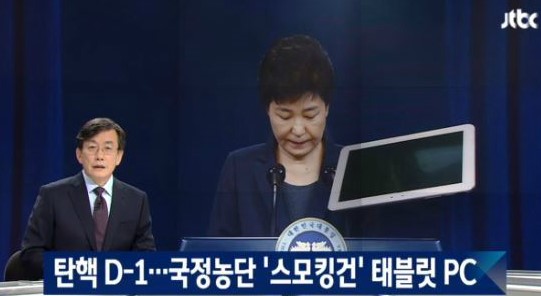
ROK Drop favorite Dr. Tara O has a good and very detailed article published about the impeachment of former President Park Geun-hye. The crux of Park’s impeachment has always been the tablet PC which many people don’t even realize was likely a fraud and not even submitted as evidence during President Park’s criminal trial:
JTBC’s claims about the tablet have not been verified. In fact, the government’s forensic report indicates many of the documents were put into the tablet after JTBC found the tablet. The forensic report also showed that there were multiple users of the tablet, so it could not determine to whom the tablet belonged. The forensic report did not surface until it was too late–a year later, which is a long time after Park was already impeached. Some continued to question the validity of JTBC and Sohn Suk-hee’s claims about the tablet, and the loudest were put in jail–journalists Byun Hee-jai, and later Hwang Ui-won, Byun’s journalist colleague at the same small media outlet called MediaWatch.
Despite what the forensic report shows, the prosecutor for Byun Hee-jai maintains that the tablet belongs to Choi, and the judges have refused, thus far, to grant Byun’s request for further discovery of the truths behind the tablet–a violation of the principle of self-defense. Many people do not even know that the tablet was not the “smoking gun” evidence for the impeachment that JTBC claimed it was.
In fact, the court never even admitted the tablet as evidence for either Park Geun-hye’s impeachment trial or the criminal trials that followed. JTBC later stated that “even if there was no such thing as the [insignificant] tablet PC…, [it wouldn’t have mattered]” after initially stating the tablet was the “smoking gun.”
East Asia Research Center
Here is the most suspicious part of Park’s impeachment, the rush to get rid of her:
The National Assembly impeached the nation’s president, Park Geun-hye, in a rush. There was no hearing, no investigation, and the voting occurred only six days after the introduction of the impeachment bill. This rushed and unreasonable, if not unconstitutional, impeachment process differs from the U.S. President Richard Nixon case, in which there existed two separate investigations totaling 1 year and 6 months.
I think it is arguable that the impeachment had to be rushed because a true investigation would have uncovered that the tablet PC was not the smoking gun the media made it out to be.
You can read much more about Park’s impeachment at the link.
Would North Korea Allow Unannounced International Inspections of Its Nuclear Weapons?
Retired Admiral James Stavridis has an opinion piece published in Bloomberg on how he believes North Korea’s denuclearization should be pursued:

While the ultimate shape of what might be termed “denuclearization lite” remains unclear, one can envision the general outline. For starters, the U.S. would likely demand a full, verifiable accounting of North Korea’s active nuclear and missile programs, with specific geographic positions identified. The U.S. could also push for a reduction in the total stockpile to a number that international inspectors could keep under permanent observation, say 50 warheads of a specified level of kilotons each. The warheads would be held in a small number of locations, three or so, each with a technical oversight system (cameras, electronic monitors) to alert inspectors if the facilities were breached. There could be a similar plan for the launcher systems, but they would be based different parts of the country than the warheads. All of this would be verified by international teams, which would have a mandate to inspect the facilities at any time.
In exchange, the North would receive sanctions relief and a large amount of development aid, although perhaps not of the kind Trump famously proposed for North Korea’s beaches in his first meeting with Kim: “Boy, look at that view. Wouldn’t that make a great condo?”
Bloomberg
You can read more at the link, but the international community could not get proper inspections of North Korean food aid, what makes anyone think the Kim regime will allow unannounced inspections of their nuclear weapons?
We have seen this movie before. It appears that North Korea is heading towards another deal where some sanctions are dropped in return for mostly future promises from the Kim regime to denuclearize. They will behave for a while and then once their cash reserves are restocked they will break the deal at a time of their choosing and blame the U.S. for its breakdown. Another provocation cycle will begin with more calls for talks and eventually another deal will be reached.
All the journalists and think tank types can then recycle all their old articles and opinion pieces. The only wild card with this issue is President Trump. Is he willing to watch this same old movie play out?
Picture of the Day: Lotte World’s 30th Anniversary

7 Tourists Injured in Seoul Tower Cable Car Accident
Anyone want to place a bet that this cable car operator was busy looking at his phone?:

The police investigating a cable car accident that took place at N Seoul Tower on Friday will book an employee who was in charge of the operations control at the time.
The Namdaemun Police Station said the individual will be taken into custody on charges of professional negligence resulting in injury.
In earlier police questioning, the employee is known to have said that he was late in putting the brakes on the cable car because he hadn’t been paying attention.
At around 7:15 p.m. Friday, the cable car carrying 20 passengers failed to slow down while entering the platform and crashed into the safety fence.
Seven passengers including two foreign tourists suffered minor injuries and were taken to a nearby hospital.
Cable car rides at the N Seoul Tower have since been suspended for mechanical inspections.
KBS World Radio via a reader tip
South Korea Cutting 118,000 Troops from Their Military By 2022
A cut of 118,000 servicemembers is going to be quite a reduction in the size of the ROK military by 2022:

Concerns are being raised over possible regional economic crises in cities near the inter-Korean border as they are seeing a considerable population outflow with military units in the region having been or set to be withdrawn or unified in the near future. This is in line with the country’s overall Defense Reform 2.0 troop drawdown plan.
Under the five-year plan announced by President Moon Jae-in last July, the military is seeking to be smaller but “smarter” to counter the demographic cliff the country is facing. The combined number of troops in the ROK Armed Forces ― the Army, Navy, Air Force and Marines ― is currently 618,000 but the government is planning to cut this by 118,000 by 2022.
Out of the eight corps currently being operated by the Republic of Korea Army, two ― VI Corps in Pocheon, Gyeonggi Province and VII Corps in Yangyang, Gangwon Province ― will be disbanded, while the number of Army divisions will also see a reduction from 39 to 33, according to military sources.
Korea Times
You can read the rest at the link, but the governments of the cities near the DMZ are concerned about the loss of population from the troop cuts and how it will effect regional economies. The governments are planning to turn towards DMZ eco-tourism to fill the economic gap the cuts in troops is going to cause.
ROK Drop Open Thready – July 14, 2019
Please leave anything you want to discuss in the comments section.