I am surprised someone hadn’t thought of doing this sooner:
The National Research Institute of Cultural Heritage (NRICH) introduced LiDAR, a new technology which made a debut scrutinizing the Dokdo islets last week, in commemoration of Dokdo Day, which falls on Oct. 25. The day marks King Gojong’s official proclamation of Dokdo as territory attached to Ulleung Island in 1900.
LiDAR, which stands for Light Detection and Ranging, is a technology using lasers to illuminate and measure the reflected light to estimate the distance to a target. This uses s distant red light to 3D scan the terrain.
The drone has become a popular means of cultural heritage management and preservation as it can reach places that people cannot to acquire photo and video data. A drone equipped with LiDAR can provide more meticulous information on the topography and ecology.
Support for anti-government movement in Hong KongProtesters hold banners supporting the anti-government movement in Hong Kong in the university district of Hongdae, western Seoul, on Oct. 27, 2019. (Yonhap)
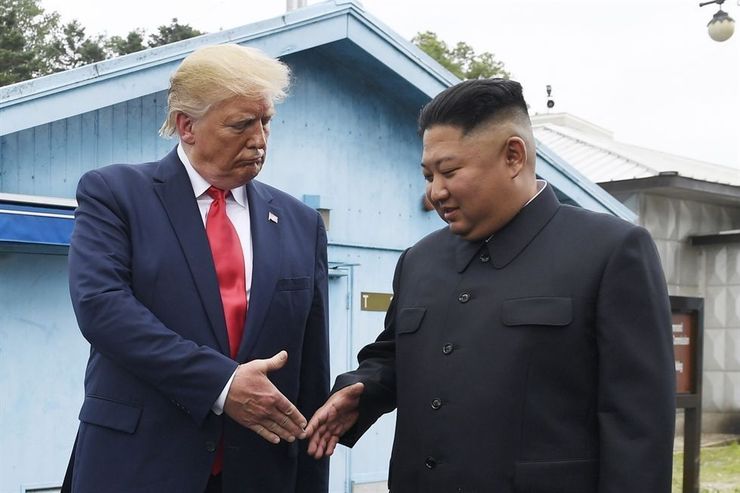
The North Koreans continue to put pressure on the Trump administration to cut the “pretend denuclearization” deal that want:
North Korea said on Sunday there has been no progress in the North Korea-United States relations, and hostilities that could lead to an exchange of fire have continued, according to North Korea’s state news agency KCNA.
In a statement under the name of Chairman of the Korea-Asia Pacific Peace Committee Kim Yong Chol, KCNA said that it would be mistaken for the United States to ignore a year-end deadline on U.S. President Donald Trump’s and North Korean leader Kim Jong Un’s “close personal relations.”
Kim Jong Un has set an end-of-the-year deadline for denuclearisation talks with Washington.
This flight may have more to do with recent Russian flights over the East Sea than just North Korea:
Two U.S. B-52 strategic bombers flew over the East Sea last week, an aviation tracker said, in a mission possibly designed to send a warning in response to North Korea’s recent series of missile launches.
The bombers, which took off from Guam’s Anderson Air Base, “conducted a mission” in the East Sea and “possibly the South China Sea” on Friday, Aircraft Spots said on a Twitter post. Three KC-135R aerial tankers provided support for their flight.
The B-52 is considered a representative strategic asset of the United States, along with intercontinental ballistic missiles (ICBMs) and ballistic missile submarines.
The plane had not appeared often near the Korean Peninsula since North Korea began its full-fledged diplomatic push with South Korea and the U.S. early last year.
Here is an editorial in the Korea Times about the USFK curfew issue written by someone named Andrea Plate who describes herself as a clinical social worker. There is a lot to break down in this editorial which I attempt to do:
“We are Ambassadors who represent our country on and off duty,” General Robert Abrams, commander of U.S. Forces Korea (USFK), tweeted over the summer about his decision to continue the curfew suspension for further review of troop behavior and morale, rather than permanently revoke it.
The good general was referring to a sordid news story ― one that was bad for Abrams’ reputation, for the 28,500 American troops stationed on the Korean Peninsula and for the South Korean citizenry. Just five weeks earlier, the 1 a.m. to 5 a.m. curfew had been lifted for a 90-day trial run.
But then an intoxicated soldier attempted to steal a taxi and assault a Korean police officer. He was tasered, turned over to the U.S. military and charged with assault. Procedurally, everything went as it should have, according to the Status of Forces Agreement (SOFA) between the host country and the U.S. military.
As I have always said to expect no crime out of a population of 28,500 people is not realistic. Crime is going to happen especially when you are dealing with a population of young males that statistically get in more trouble than other demographics. What matters is how they are dealt with and USFK handled the case as they should of.
“A majority of our service members do the right thing,” a seemingly defensive Gen. Abrams remarked. But the majority does not rule when it comes to the USFK. Why didn’t Abrams rescind the curfew for good, as the troops had hoped? “To ensure we are making the correct decision,” he demurred.
Provost Col. Marshall Fivian tried to further explain: The number of violent and disruptive crimes perpetrated by USFK troops had not changed significantly since the curfew had been lifted. Meaning, it hadn’t dropped.
General Abrams in my opinion is just being prudent to gather data before making a final decision one way or another on this issue.
Where there is hysteria, there is history. The curfew was imposed on the USFK, following the 2001 terrorist attacks on the World Trade Center. First billed as a “readiness recall, the message was clear: Attention, soldiers! Protect and defend! (plus, the unspoken, implied threat: Quit getting drunk! Leave the locals alone!).
It is not true that there wasn’t a curfew before the 9/11 attacks. There was a curfew in place for the 2nd Infantry Division before 9/11. However, each unit did have a limited number of Warrior Passes that could be given out to high performing soldiers. So there were still soldiers outside the gate passed curfew who had these passes.
No one likes a curfew. The word itself has a tortured etymological history, from Old French (“cuevrefeu” meant “to cover” and “fire”) to Middle English (“a regulation requiring people to extinguish fires at a fixed hour in the evening, or a bell rung at a particular hour”) to today’s troops’ interpretation: “Unfair,” and “Wish I’d been sent to Japan.”
Nevertheless, the initial curfew held for nine years, was suspended for one, then slapped back a year later in 2011, when news broke that two intoxicated soldiers had committed two high-profile rapes of two very young girls.
The public was enraged, of course. Attacked by their supposed protectors! By comparison, South Korean troops are more disciplined.
Of course she offers no evidence that ROK military troops commit less crime than USFK personnel. I hope she realizes that ROK military troops commit crimes as well. Once again there is going to be crime that occurs with a large population of personnel. How it is handled is what matters.
One might wonder whether the June announcement that the Combined Forces Command (CFC) would relocate to Camp Humphreys ― a safer 77.4 kilometers from the central city ― might temporarily calm some citizens’ nerves (although some U.S. military personnel have expressed concern regarding USFK military readiness and effectiveness).
In theory with more troops PCSing to Korea with their families instead of on one year unaccompanied tours this should further reduce incidents and is maybe why General Abrams is continuing to gather information before making a final curfew decision.
But the move would not happen overnight. Leave it to the U.S. military and the Department of Defense to come up with a quick interim fix: a four-hour curfew (1 a.m. to 5 a.m.). Leave it to the U.S. federal government to make an already slippery slope more slippery, even slipshod.
Curfew penalties can lead to verbal warnings at the very least ― if caught, of course. But while “courtesy patrols” ― duos of U.S. military and Korean National Police ― readily roam the streets of hotspot Itaewon, they do far less at less alluring locations. Is that fair to the troops, or to the hard-working businesspersons whose livelihoods depend on thrill-seeking military men?
In my experience I have never seen anyone picked up for a curfew violation by the military police get a simple verbal reprimand. It has always been an Article 15 action.
It was all so confusing! Can Korean-born spouses of American soldiers roam free? (Yes, although there’s no such written rule). Can individual commanders impose unit curfews at will? (Yes, despite the overall rule). Can exceptions be made? Yes, no and it depends on the case. What’s a Rubik’s cube compared to a giant ball of government red tape?
Truth is, American soldiers are unstoppable. They sneak past restrictions by hiding out in cars and bathrooms at 24-hour coffee shops.
Or, as an exasperated contributor wrote on Rally Point, the American online professional network dubbed “LinkedIn for the military,” some are “compulsive curfew violators,” like the private first class who was demoted for human trafficking but somehow kept his convoy going: “No amount of time spent with the military police deterred him.”
DoD civilian personnel are not subject to the curfew so what does it matter if the spouse is Korean or not? Also I don’t doubt some soldiers hideout after curfew but what evidence does she have this is a widespread practice?
Because you can fight crime, but you can’t fight military culture. Alcohol runs thicker than blood among the troops. Group binges breed feelings of brotherhood, manhood, machismo.
In time, military culture will change ― when more women step up to serve and are promoted; when more military occupation specialties (MOS) are opened to women; when substance abuse and military sexual trauma treatments are integrated into military training. But that will take decades.
The Army’s MOSs are already open to women and US troops receive repeated sexual assault and substance abuse training. Units have to track by name who has attended this training to ensure compliance.
In the meantime, our Armed Forces must remain strong and cannot afford further shrinkage. Fewer opportunities for fun could prompt fewer men to enlist (word gets around). A total 8.3 million served during World War II; roughly 1,055,600 (active duty and reserves) serve today.
During World War II the US military was fighting a global war against multiple enemies that required conscription. There is now no longer a need for such a large military or conscription.
What will happen Dec. 17, when the trial suspension period ends? Will the curfew be permanently levied, or lifted?
We know what the soldiers want. And their families. And the contract workers. And even some officers who take great pride in the troops, for all their human imperfections.
Maybe General Abrams will lift the curfew in time for Christmas or maybe he won’t. We will see, with that said is anyone else confused on what the overall point of this editorial is because it seems to ramble all over the place?
SKorea's economic growth will not hit the 2% mark. So are you telling me that government spending and boondoggle programs used to artificially inflate employment figures don't necessarily result in the expansion of the private economy? Who would have thunk? https://t.co/VcOCGUb2Pq
Douglas MacArthur UN flag The United Nations flag used by U.S. General Douglas MacArthur is shown to the public for the first time in 69 years, after undergoing restoration work in Busan, on Oct. 23, 2019. The UN Memorial Cemetery in Korea, which released the photo and where the flag is being displayed, said MacArthur used it while he was supreme commander of the United Nations Command during the early part of the Korean War (1950-53).
I have never heard of a park that can stop invading troops and tanks. Too bad Syngman Rhee did not know about this back in 1950:
Foreign Minister Kang Kyung-wha delivers a keynote speech during a luncheon ceremony marking the founding of the United Nations in Seoul on Oct. 24, 2019. (Yonhap)
Foreign Minister Kang Kyung-wha said Thursday that turning the Demilitarized Zone (DMZ) that bisects the two Koreas into a global peace zone will serve as a “physical guarantee of security” and solidify peace in the region.
She made the remark as Seoul was marking the 74th anniversary of the establishment of the United Nations, referring to President Moon Jae-in’s proposal to the U.N. General Assembly in New York last month.
“When the DMZ is turned into such a peace zone with the participation of the international community, it will surely serve as a physical guarantee of security of both Koreas, cement the foundation for lasting peace on the Korean Peninsula and contribute to greater peace and stability in Northeast Asia,” Kang told a U.N. Day ceremony held in Seoul.