Latest

A Profile of US Military Bases In Seoul

Introduction

The heart of United States Forces Korea is without a doubt Yongsan Garrison, which is appropriately located in the middle of the city that is at the heart of the entire nation of South Korea, Seoul.

Seoul is a vibrant and massive city with a population of over 10 million people. In the middle of this megalopolis is the expansive USFK camp Yongsan Garrison. To put the location of Yongsan Garrison into perspective imagine a 630 acre foreign military base in the middle of Manhattan in New York. That is what Yongsan Garrison is like.

The camp wasn’t always surrounded by such dense urban sprawl. It was originally constructed as an Army garrison during the Imperial Japanese colonial period of Korea between 1904-1945. In fact some of the older buildings that remain on Yongsan can be dated back to the Japanese colonial period. When the Japanese built the Garrison is was located south of Seoul which was mostly farmland at the time and close to the Han River. The Han River was where boats from the Yellow Sea would travel up to deliver goods to Seoul. This was also convenient for transporting military supplies and personnel as well to the garrison.


Old Japanese brick prison administration building picture via Army-Technology.com.

Interestingly enough the Yongsan area was actually used even prior to the arrival of the Japanese colonial forces as a military area for foreign armies due to its closeness to the Han River. In the 13th century the area was used as a garrison for the occupying Mongolian Army as well as in the 16th century by the invading Japanese samurai as part of the Hideyoshi invasion of Korea. Prior to the Japanese colonization of Korea in the 20th century the area had been used by the Chinese military as well who set up a headquarters in the Yongsan area in 1882. Due to its foreign military history it is easy to see why many Koreans have mixed feelings about the location of US troops at Yongsan Garrison.


Regimental Bachelor Officers’ Quarters; later Imperial Japanese Army Hospital; now JUSMAG-K Headquarters.

During the colonial period, Yongsan Garrison would remain under Japanese control until it was handed over to the United States military with the surrender of the Japanese Imperial Army at the end of World War II. The garrison was used by US military occupying forces until 1948 and after the withdrawal of the occupying force, the garrison was used by the US military’s Korean Military Advisory Group (KMAG) soldiers that advised and helped train the Republic of Korea (ROK) Army.

In June 1950 with the start of the Korean War, Yongsan Garrison was captured in less then a week by the invading North Korean forces. With the September 1950 Incheon Landing Operation led by General Douglas MacArthur, Yongsan would be recaptured by the US military to only be lost yet again a few months later with the Chinese entry into the war. By March 1951 the US military and their allies had recaptured Seoul and Yongsan Garrison once again from the Chinese. Considering the amount of warfare the garrison saw during the Korean War it is amazing how many of the old Imperial Japanese buildings actually survived the conflict.

Today most of the brick buildings seen on Yongsan Garrison date from the Japanese colonial period.

After the Korean War, Yongsan Garrison went on to become the home of United States Forces Korea (USFK), the United Nations Command (UNC), the Combined Forces Command (CFC), as well as the home of Eighth United States Army (EUSA). With such commands that are important both militarily as well as diplomatically, Yongsan Garrison is of extreme importance to both the United States and Korea.

Yongsan Garrison Today

Yongsan Garrison is currently home to over 25,000 US military servicemembers, DOD civilian contractors, and their families. In addition approximately 1,000 Korean Augmentees to the US Army (KATUSAs) serve on the compound along with 3,000 Korean civilian employees. Some of the major units stationed on Yongsan or its satellite camps are the USFK headquarters, 8th US Army headquarters, 18th Medical Command, 121 General Hospital, 175th Finance, Armed Forces Network Korea, Corps of Engineers Far East District, 1st Signal Brigade, and the 501st Military Intelligence to name a few.


8th Army Headquarters on Yongsan Garrison.


Combined Forces Command Headquarters on Yongsan Garrison.

Yongsan Garrison is currently considered one of the top installations in the entire US Army by recently receiving third place in the Army Communities of Excellence competition. The recognition is well deserved considering the excellent facilities on the post. The post is divided into North and South Posts which are divided by a wide Korean public road. In recent years an overpass was constructed over this road to allow vehicles to drive from each side of the garrison without having to exit on to the Korean road.


121 General Hospital image via Wikipedia.

As I said before the facilities on the post are excellent. Yongsan has a very big Post Exchange (PX) and a massive commissary stocked with every type of American food you can think of. The post has most of the popular fast food restaurants as well as fine dining at restaurants located at the four star hotel the Dragon Hill Lodge on south post. The post’s Navy Club also continues to be a popular attraction on the compound. (Update: Navy Club closed in 2015.)


The Post Exchange (PX) on Yongsan Garrison.

An important difference between Yongsan Garrison and most other USFK facilities in Korea is the amount of families that live on Yongsan. Due to the number of families living on the post the installation operates a number of schools and community programs to create a good family environment on the compound. For soldiers stationed in the 2nd Infantry Division without their families it is a strange experience to go to Yongsan and see junior NCOs driving privately owned vehicles and taking their families shopping at the commissary.


Yongsan Apartment Housing.

The majority of the command sponsored families live on South Post or over at Hannam Village. The majority of housing on South Post is in individual homes while Hannam Village is composed of a highrise apartment complex of 1162 apartments that vary between 2, 3, & 4 bedrooms that are a 20 minute walk from Yongsan Garrison. I have heard nothing but good things about the housing on South Post where the majority of senior leadership lives; however I have heard nothing, but bad things about the Hannam Village where mostly junior soldiers live. Not only have I heard and read bad things about the apartments from people who live there, but the Stars & Stripes has reported on it as well.  (Update: Hannam Village was closed in 2014.)

Those that are not housed on South Post or over at Hannam Village are authorized to live in an off post apartment. Off post apartments can be very hit and miss in quality and are notorious for landlord sharks defrauding the military and servicemembers out of money.

Dragon Hill Lodge

One of the key attractions of USFK is without a doubt the Dragon Hill Lodge hotel located on the south post of Yongsan Garrison. This massive hotel opened in May 1990 and was constructed using Morale Welfare & Recreation (MWR) funds raised through soldier programs such as the slot machines in operation on USFK camps in Korea. No Congressional funding was used to construct the hotel and to this day the hotel operates through an MWR program called the Armed Forces Recreational Centers. The Dragon Hill Lodge is one of four AFRC hotels across the globe with the others being in Hawaii, Germany, and Florida.

The hotel has 394 rooms and suites that come with queen size beds, sofas, private bathrooms, DVD players, etc. The hotel also has a number of western style restaurants to include fast food such as Subway and Pizza Hut. My personal favourite is the Oasis Mexican Restaurant that I believe serves the best Mexican food in Korea. The hotel also has a massive exercise and swimming facility for its guests. It is also popular for weddings and other large catered functions.

The Dragon Hill Lodge is rated as a four star hotel and for those staying there it definitely deserves its rating. I have only stayed at the Dragon Hill Lodge on TDY orders and have enjoyed every time I have stayed there. However, the one downside of the hotel is its price. Prices for rooms are based on rank and duty status and the average cost for a room is over $200. There are various reasons for the high prices at the hotel, but for soldiers on leave most can get a hotel room for less then a $100.


The Dragon Hill Lodge on Yongsan Garrison.

Even with the projected closing of Yongsan Garrison by 2012 the Dragon Hill Lodge is scheduled to remain a US military property which will mean that US servicemembers will be able to continue to use this great facility even after it closes.

Camp Kim

Located literally across the street from the main post of Yongsan Garrison is Camp Kim. Camp Kim is known to most GIs stationed in Korea as where the Seoul United Service Organization (USO) is located. Going to the USO is the only reason I have ever personally visited Camp Kim. The USO actually runs an excellent facility at Camp Kim and the best I have seen in USFK. Definitely worth checking out if you are a soldier stationed in Korea.

However, there is more to Camp Kim then just the USO. The camp is also home to the Special Operations Command – Korea (SOCKOR) which is the lone US special forces unit assigned to the Korean theatre of operations. The 1st Signal Brigade Project Support Directorate is also located at the camp. This directorate provides a number of technical and communications support capabilities for USFK.

Camp Kim also houses the Vehicle Processing Center for USFK which provides customer service for privately owned vehicles (POVs) of USFK servicemembers and their families. Finally the Korean Service Corps (KSC) is based out of Camp Kim which is a large organization of Korean civilian workers that provide direct peace time and combat support services to the US military in Korea.

Camp Coiner

On the northern part of the land that encompasses Yongsan Garrison is the small USFK installation of Camp Coiner. This camp was named after 2nd Lieutenant Randall Coiner assigned to the 3rd Battalion, 31st Infantry Regiment of the 7th Infantry Division who was posthumously awarded the Silver Star for actions taken in 1953 during the Korean War near the village of Sokkagae.

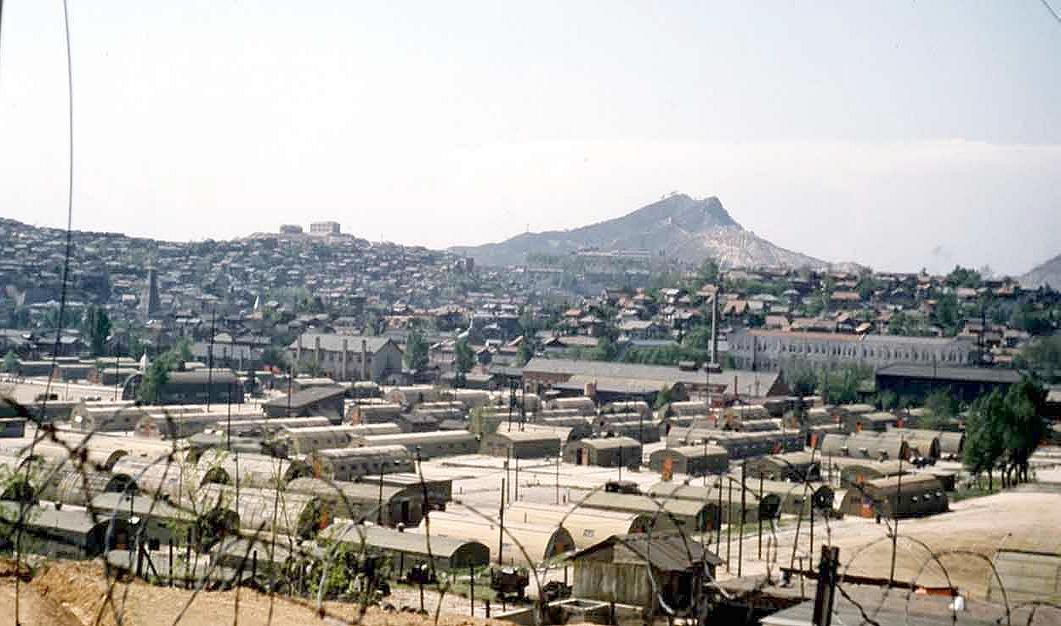
Quonset huts on Camp Coiner.  Picture from the Stars & Stripes.

Prior to the US military taking control of the camp from the Imperial Japanese Army, Camp Coiner was used as a garrison for a horse drawn artillery unit. Currently the camp is home to elements of 8th PERSCOM, the 8th MP Brigade, 17th Aviation Brigade, and the 1st Signal Brigade. The camp is relatively small and only encompasses a total of 55 acres.  (Update: In the future Camp Coiner will be tore down and become the location of a new US embassy compound.

Far East District Compound

The US Army’s Corps of Engineers Far East District has been based out of the extremely small Far East District Compound a block from Seoul’s massive Dongdaemun shopping district. The land that the compound was constructed on was originally owned by Seoul National University, but with the outbreak of the Korean War the South Korean government seized the land in order for the Corps of Engineers to start operations from the camp in 1951.

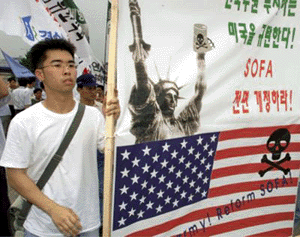
Since then with the economic development of Seoul, the surrounding community has swallowed up the small camp which some citizens of Seoul view as a eye sore. It also has been targeted by anti-US protesters from Hanchongryun that burned a hole in the US flag on the post. Recently the camp has been targeted by protesters angered by not being paid for services rendered while working on the project to expand Camp Humphreys.

The Far East District Compound is scheduled to be handed over back to the Korean government as part of the USFK transformation plan which has led to internal Korean fight between the ROK Ministry of Defense and Seoul National University over who really owns the land. Currently the compound is scheduled to close by 2012 and the land will be sold by the Ministry of Defense to the Korean National Housing Corporation. The camp is 142,000 square feet in size and is estimated that each 10.8 square feet in the compound is worth $85,000. The property is worth hundreds of millions of dollars thus making it quite clear why Seoul National University and the Ministry Defense are fighting over who controls the property.

Camp Jackson

Located in the far northern Dobong-gu suburb of Seoul is the small US military installation Camp Jackson. The camp was named after Private First Class George W. Jackson who was awarded the Silver Star during the Korean War. The camp is one of the smallest in Korea but probably has the prettiest back drop of any camp with the massive granite spires of beautiful Mt. Dobong soaring over the camp.
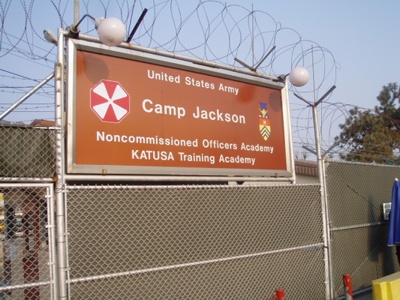
Camp Jackson used to be home to a field artillery Target Acquisition Battery that was assigned about 100 soldiers on the camp. In 1968 on the slopes of Mt. Dobong outside of the camp a continuing gun fight with Korean soldiers against North Korean infiltrators sent to kill Korean President Park Chung-hee erupted and could be heard from the camp.

Today there is no field artillery unit stationed on the installation and instead Camp Jackson is home to the Wightmen Non-commissioned Officer Academy that trains newly promoted US Army E-5 sergeants in basic NCO skills. Camp Jackson is also home to the very unique Korean Augmentee to the United States Army (KATUSA) training academy. Korea is the one US ally that has a sizable number of soldiers that serve side by side in US units. These Korean Army soldiers are called KATUSAs. The KATUSA program was first initiated in the early years of the Korean War to provide US units with translators and local cultural knowledge. KATUSAs continue to provide these important capabilities along with conducting clerical, driving, maintenance, etc. work within their respective units.

All ROK Army draftees that are selected for the KATUSA program after passing rigorous English language tests must attend the KATUSA academy at Camp Jackson. For all KATUSAs this is their first initiation into serving with US soldiers. The NCOs that train both the NCOs and KATUSAs at the academy are of high quality but unfortunately a sexual assault against a KATUSA trainee mired the school’s image a few years ago. Since then the academy has had a clean record and continues to produce great young NCOs and KATUSA soldiers for the United States Forces Korea.

Camp Jackson is scheduled to be handed back over to the Korean government as part of the USFK transformation plan by 2012.  (Update: The relocation plan to move the NCO Academy to Camp Humphreys has been delayed to 2017.)

K-16

The K-16 airbase is located just south of the Han River in the Seoul suburb of Soengnam. The airbase was actually the old Seoul City Airport which during the Korean War was converted into a full time military base. It received the name K-16 because airfields during the war were given code names. The original name of the base was Seoul Airbase but its codename of K-16 is what stuck and it continues to be identified as K-16 Airbase to this day.

The airbase today is 86 acres in size and controlled by the Korean Air Force 15th Composite Wing who plays host to the US Army’s 2-2 Aviation Battalion and its support units such as the 595th Maintenance Company. The 2-2 Aviation Battalion is equipped with Blackhawk helicopters and only moved to the base in 2005 from their former home at Camp Stanley in Uijongbu. The battalion was moved from Camp Stanley as part of the USFK transformation plan. K-16 also hosts a small security force that is responsible for defending Camp Post Tango located on the base. CP Tango is the primary warfighting center where any contingency on the Korean peninsula would be commanded and controlled from.

The airbase is also the entry and departure point for many VIPs flying to and from Seoul to include the South Korean president and American government officials. However, the thing that K-16 is probably most known for to USFK servicemembers is the nearby Sungnam golf course. The Sungnam golf course is not only popular with US servicemembers but with Koreans as well.

It is important to note that there are no plans to close the airfield as part of the USFK transformation plan to consolidate units around the hubs of Camp Humphreys and Osan Airbase. In fact money is actually flowing into K-16 now with major upgrades to the facilities taking place including brand new apartments for the servicemembers to be housed in.

Camp Market

Camp Market is yet another military installation that was originally constructed by the Imperial Japanese army in the 1930’s as a logistics base for supplies coming through the port of Incheon. Like with Yongsan Garrison, the Camp Market area was handed over to the US occupation troops after World War II. The area was captured by the North Koreans in the opening week of the Korean War and was recaptured in September 1950 with the Incheon Landing Operation. After the landing General McArthur used the area as a logistical base. The camp was lost again in December 1950 with the entry of the Chinese into the war. The camp was recaptured from the Chinese in March 1951.

After the Korean War the area became known as a logistical base for the US Marine Corps and in 1963 the area was given to the US Army which established the Army Support Command (ASCOM) in the area. ASCOM became the main logistical hub for the US military until most of the land and facilities for ASCOM was closed and turned over to the Korean government in 1973. Only the Camp Market area was not turned over and remains a small logistical base for USFK in Incheon.

Today Camp Market is composed of 34 warehouses that has a combined total of 852,495 square feet of storage space to store goods and supplies for USFK facilities. The Defense Reutilization and Marketing Office as well as the Army Air Force Exchange Service (AAFES) distribution and bakery is based out of Camp Market to provides products and baked goods to PXs and commissaries across USFK. Approximately 600 civilians work at Camp Market with the vast majority of them being Korean contract workers.

The Future of USFK Facilities in Seoul

As the decades passed in Seoul and the Korean economic miracle took hold of the city, it began to grow at a remarkable rate to where today Yongsan Garrison has been totally engulfed and surrounded by the city. A dense urban environment surrounds the garrison on all sides instead of the farmland that surrounded the garrison when it was first constructed by the Japanese.

This urban development has caused many problems for the US military in Korea because the 630 acres that composes the garrison causes both development and traffic problems for the city of Seoul. The location of the garrison also allows activists groups to easily use the garrison to conduct their anti-US protests at any time.

Recognizing the problems of the current location of Yongsan Garrison the United States military has tried for years to get the base relocated outside of Seoul and has been continually met with South Korean governmental delays to any proposed move. The first proposal to move the garrison was actually initiated back in 1987 with then Korean President Roh Tae-woo. By 1990 a Memorandum of Understanding was signed to relocate Yongsan Garrison.

However, in 1993 a new Korean president had come to power, Kim Young-sam who that year canceled the plan move, deeming it to expensive because Seoul was to pay for the cost of moving the garrison. However, it was probably no coincidence that the Korean government also killed the Yongsan move the same year the North Korean nuclear crisis was happening and the nation was on the brink of war with the North Koreans. After war was avoided with the signing of the Agreed Framework talks about relocating the garrison were effectively delayed even further with the onset of the Asian Financial Crisis in 1997.

Talks to relocate Yongsan did not seriously heat up again until 2003 when US President George Bush and Defense Secretary Donald Rumsfeld pushed the Korean government to relocate the garrison. On January 17, 2004 during the Sixth Future of the Alliance talks, an agreement was struck to relocate Yongsan Garrison to Camp Humphreys which is located about 50 kilometers south of Seoul. A small area of land would remain controlled by the US military at Yongsan to serve as the home for a new US embassy as well as keeping the Dragon Hill Lodge for the use of US servicemembers. The remainder of Yongsan was supposed to be turned into Seoul’s very own Central Park, but business interests and politics may sink this idea.

The original plan was to have the base relocated by 2008. However, technical problems and South Korean governmental delay games pushed the date of the relocation back to 2010, then 2013 and then finally back to 2012. Now there is even attempts by the South Korean government to push the relocation all the way back to 2015. With such governmental delay games being played out it is easy to see that Yongsan Garrison is probably going to be around for many more years to come and I can think of quite a few people who will be happy about that.  (Update: Most of Yongsan Garrison is hoped to be moved to Camp Humphreys by the end of 2017.)

Note: You can read more from the ROK Drop featured series “A Profile of USFK Bases” at the below link:

Comments


[…] TChahng: May 12th, 2008 at 10:55 pm […]

In my opinion the 2012 move date will never happen. Years ago I believed all the misinformation being put out by leadership about a 2008 move – not anymore!

Great work GI Korea, nicely written. And thanks for including the FED Compound. Most folks don’t even know we’re here.

Just one correction. The Google Earth image for Dragon Hill incorrectly identifies the building. The push pin identifies the First Replacement Company’s facility, Bldg. 4034 which is across the parking lot from DHL. DHL is actually the large “X” shaped gray roof at the bottom of the image (under the copyrights).

thanks again.

Fred, thanks and you are correct about mislabeling DHL. I was sloppy with the pin mark and have fixed the image. Thanks.

Pete I am at the point now that I won’t believe Yongsan will really move until I actually see it happen with my own two eyes.

Great post. How do you find the time to do these?

And I think you’re right on the final point, Yongsan will likely be a USFK base for the foreseeable future. Any ROK politico with half a brain knows that soon after the U.S. is gone from Seoul and then Korea, either the Chinese or the Japanese will want to establish a foothold. Stability in northeast Asia hinges on stability on the Korean peninsula.

Who can Korea depend upon to be the Hidden Dragon behind her Crouching Tiger? Someday that will be necessary, and I will say, Hell Yes!

These long posts like this one I actually type up as a Word file and leave it saved on my desktop and just slowly add to it over time. Once it is done I just cut and paste it into my blogging program. I have been slowly typing up this Yongsan post for probably about three months.

You forgot CP TANGO…

I too admire how you can keep a fairly steady stream of these posts coming week after week given your busy professional schedule.

I admire the consistency – which I sorely lack. I can only manage to work in heated spurts.

[…] Click here to read more. Click here to return to Korea Click here to return to MySpace News. […]

[…] main logistical support hub at the time and the only remnants of it that remains today is Camp Market.  The story initially develops by following Mike’s interactions with fellow soldiers in the […]

[…] … metacomm.co.kr/forum/USAG%20Humphreys%20Relocation… • Found on Google A Profile of USFK Camps in Seoul May 13, 2008 … The US Army?s Corps of Engineers Far East District has been based …. Camp […]

[…] expect to live in back in the states. Even families that are command sponsored find themselves in Yongsan for example living in the Hanam Apartments which I have often heard referred to as “The Ghetto”. This is a […]

I was in the 135th FST and i served in Korea from 1996 to 1997, i will never forget the team of people i met there, if anyone can read this please email me any jobs that can help our soldiers in the duty. I am a US Army Vet, and i am so proud of the work we did there, we took over Mash, i designed the coin for the 135th FST, I would love to hear from anyone there, it really brings back so many good memories. To all those in 121 GH i miss you all…….

Great stuff. I have a picture of Camp Coiner in my collection that will show how the area looked in 1960. I am sure you can not see any of that big hill now, since the area is all high rises now.

http://www.qsl.net/wd4ngb/cpcoiner1960.jpg

I spent 61-62 at Camp Coiner and going to all signal corps sites to set up our carrier communications deuce and a half. any pics of TV hill Uijongbu, Pyontec

I was with MILPERCEN-K at Coiner in 80-81 and USAGY in 84-85 (and even Camp Stanley in 73-74). If anyone has any photos of these locations during these periods, I’d appreciate the memories.

Station at Camp Coiner, 67-68, looking to conect with others, signal

Stationed at Camp Long Wonju 1973-1974 lookimg for buddie Robert Gambrell stationed Camp long 1972-1973

in 1973 K-16 was little more than the small Air Base and maybe 10 farm houses across the road does CXamp Long still exist where I set up communications van on a duce and a half with generator

I was station at Camp Market. It seems surreal that I spent two years there. I was only required one year, but within the first 6 months I extend my tour for the rest of my enlistment. What a weird place. You could run around the installation in less than half an hour and it was surrounded by large apartment buildings. At times it was a lonely place when everyone left home for the weekend. Once you step outside, it was a diffrent world. It seemed I was the only foreigner walking around on that part of the city. I use to get stared at all the time. Alot of shady deals went down at the commisary and at the “club” or casino. Korean women who were married to officers showed up in their BMWs and load their vehicles with beer and other items they would sell of post. The casino was closed for GI’s at 10pm during the weekend, but oddly you could see the Korean national patrons playing the slot machines with the doors locked. The club manager always kicked me out when I showed up with my camcorder!

I was 1SGT of an MI Co on Camp Coiner in 1987-88 (the Olympics). Great tour of duty, loved Itaewon.

What can you tell me about Camp Grey (not to be confused with Camp Grey Annex), located (previously) in Yongdungpo.

Greatest time of my life spent @ Seoul American High School,,71-74..Those who hated Korea, never really “saw” Korea, the culture shock of the far east and the pre concieved ideas blind some people.

Raul N Aguilar

I’m wondering why it never occurred to me to extend my stay in Korea at Camp Pelham in 1983. Had I known how boring stateside duty was (at least at Fort Ord)I would have spent my whole enlistment time in Korea. I clearly remember that moment on the runway..leaving the country..we all cheered when we heard and felt the rubber wheel lift off that runway when we departed. But deep down I felt sad..feeling like I had just scratched the surface of the experience and yet was leaving and would probably never be there again. I’m so grateful for sites such as this where I can check out the scene there a little bit and see the same sort of sentiments from others who served there. If ESL teaching paid a bit more..I’d probably be heading back now.

For anyone that served in the Seoul area in the 1950s or 1960s the below link may be of interest:

http://rokdrop.com/2012/06/28/filmmaker-looking-to-interview-us-rok-military-veterans-for-documentary/

I think there is a small error about Ascom City in your history. Ascom was indeed a Marine supply point during and for a short time (no pun intended) after the Korean War, but I think it became property of the US Army in early 1954. I went to Korea on my first tour in 1956 on the USS Freeman and we processed through Ascom and boarded unheated trains for Uijongbu. I spent a month in the 121 Evac hospital in 1961 on my second tour and it was indeed at Ascom and I didn’t see a Marine. The Marines withdrew from Korea in either 1954 or ’55 and the 24th Infantry Division took their place. I served with the 7th Div just south of Kumwha.

Richard Sullivan has it right. I went thru there in Feb 1960 also was assigned there July 1962 thru August 1964. It became ASCOM when the seven technical services were combined and consolidated I believe early 1963 to form a depot. I worked on the eventual movement of supplies to Waegwan Camp Carroll before I went to Japan.

Ascom was a supply depot before the Korean War as I was surprised to read on page 509 of Roy Appleman’s “From the Naktong to the Yalu” nearly 50 years ago in his account of the Inchon landing and subsequent liberation of Seoul.

“…During the night of 16-17 September, the 2d Battalion, 5th Marines, occupied a forward defensive position commanding the Seoul highway just west of Ascom City. Behind it the 1st Battalion held a high hill…”

Anyone as rabid about military history as me or someone with just a little curiosity of what happened where they were assigned would find the Army’s official history very interesting.

Ascom was a supply depot before the Korean War thats very true I believe the 24th Infantry Division had it prior to the war but not sure. I actually found a picture showing the Marines moving thru Bupyong Dong about three days ago sent it to my son who was a marine and a avid Korean War junkie. Him and his brother actually lived for a year on that same street while I was in Vietnam.

Sorry Richard your right 24th took it after the war from the Marines my mistake. Sometimes its had to keep it straight in my head. Ha Ha

Ron, I never made a MISTEAK! Where/when were you in Vietnam? I was there also.

1st time was 1965 at the Inventory Control Center down by the docks in Saigon. Then I was at Hq,USARV Long Binh 1968,1969. I was pretty lucky tour wise. Also spent two tours on Okinawa, Panama,Hawaii,Korea (two times) and one year at the Pentagon before I retired.

My 1st tour in Korea was 1960 7th Cav Camp Custer. I recall the 1st meal in Korea while at ASCOM was always a steak. Anytime of the day. Beat that junk on the ship.

I arrived in Korea on 5 January 1965 at Incheon aboard the USS Breckinridge bound for 7th Inf Div at Camp Casey. On Aug. 15, 1965, was transferred to Yongsan Garrison for assignment with the 199th Personnel Services Company. Separated from the US Army as SP5, at the 38th Replacement Co., then stationed at ASCOM/Camp Market on 23 Feb. 1966. Was hired as a temp GS3, Clerk-Typist with the ACofS, G5, Civil Affairs, 8th US Army on May 1, 1966. Thus began my civil service career. With the exception of nearly 3 years (Oct ’81-April ’82 and May 2007 – May 2009) I have lived in Korea and worked as a Public Affairs Specialist or Officer for about 35 years. Retired on 30 Sep 2008 at my last Public Affairs Officer position with the US Army Corps of Engineers, Sacramento District, California with 41 years of service (included 2 years of active duty). Worked on Yongsan Garrison for most of my life and living in numerous places in Seoul and now living in Yongin, near the Korean Folk Village.
I enjoy living in Korea and probably know more about this nation than I do about the US. I’ve traveled to almost all of the US military installations in Korea in the ’60s and ’70s and less travel in the ’80s, 90s and later.
Enjoy reading the comments and seeing the photos on the web related to our US military presence in the Republic of Korea. Appreciate the efforts of people like you who post these items of history.

I was never a military brat but I lived with my father in Seoul for many years. My dad worked for Dunham and Smith who supplied the military with food stuffs, electrical goods and you name it. So I was familiar with many of the bases. Especially Osan. I am looking forward to going back to Yongsan where I spent many of fond memories.

GI Flashbacks: The 2000 Yongsan Water Dumping Incident

A persistent GI myth perpetuated around Korea in the early 2000’s was the dumping of  formaldehyde down a drain on Yongsan Garrison in Seoul in February 2000 by a USFK mortician.  Spectacular headlines were splashed across Korea’s media outlets especially on the internet about how the mortician had exposed the millions of people in Seoul to cancer causing chemicals.  This incident reached such mythical proportions in Korea that the most popular monster movie in Korean history was based on it.

This incident all started when the so called environmental group Green Korea released reports over the internet about the dumping of formaldehyde on Yongsan followed by leading protests against USFK.  Green Korea, a group no one had heard of before, quickly became the darlings of the Korean media.

waterdump2

Here is a press release they released concerning the 2000 water dumping:

Nowadays the U.S army’s toxic fluid dumping to Han-river is main issue in Korea. On February 9th, in the US Eighth Army Mortuary Building, 480 bottles of formaldehyde, used for embalming were dumped in a drain without any detoxification.  It has been confirmed that the US Army has been releasing Formaldehyde for long periods of time into the Han-River.

Mr. Albert L. McFarland after issuing an order to pour these fluids down the drain, was refused by his subordinate on the basis that the drain led to the Han River, and that the chemicals are known to cause cancer and birth defects. Mr. McFarland swore at the soldier, and ordered him to execute the order. Do you know why Mr. McFarland ordered like that? The only reason is that the boxes were covered with dust.

This case was reported to the Headquarters of the Eighth Division in a statement made by the soldier who executed the order.  On July 10th, the Headquarters concluded that, ‘there was no problem if the chemicals were diluted with water’. Formaldehyde is a very toxic chemical. This is the label of the bottle. It was written like this Poison, Can not be made none poisonous.

This case serves as an exemplar for how the US and US military is deceiving, purposefully or not, Korea and its people. They asserted that the American bases in Korea caused no harm or damage to the environment, and that the US military is abiding by US EPA regulations, and that it is environmentally much safer than Korean bases or companies.  However, the fact that the US military is disposing of toxic fluids such as formaldehyde in the Han River, where 10 million people use it for household use, is in itself an outrage and mockery to the Korean people.  [Green Korea United]

These accusations by Green Korea were repeated over and over again in the Korean media with one editorial in the nation’s largest newspaper the Chosun Ilbo asking, “Would they dump toxic chemicals into the Potomac River?”:

These toxic chemicals are widely known to cause cancer and birth defects. The Han river supplies drinking water for over 10 million citizens residing in metropolitan Seoul and its satellite cities. Are Koreans disposable people?

The news is ethically repulsive. Environmentally, the act is destruction-friendly. In psychiatric terms, it comes close to an act of quasi-murder [oh my!].  For, what matters here is the sick mind and attitude that made possible the dumping of the cancer-causing substance. Whether or not the quantity of the discarded was enough to cause cancer is not the issue here.

Notice how this article sounds almost exactly like the Green Korea press release.  It makes you wonder if Green Korea wrote it for the Chosun Ilbo.  Green Korea and their media and political allies demanded the imprisonment of the USFK mortician and even the resignation of the USFK commander.  These sensational headlines also caused widespread public condemnation of USFK in Korea with no one in the media actually interested             in finding out what really happened.  Of course the truth of what really happened that day on Yongsan is of no concern to these people, establishing the mythology is.

Let’s look at what really happened that day.  There was formaldehyde dumped down the drain on Yongsan Garrison in February 2000, that fact is not in dispute.  However, a number of the myths surrounding this fact are in dispute.  The first myth is the amount of chemicals dumped.  Green Korea claims that 60 gallons of formaldehyde was dumped into the Han River when in fact only 20 gallons was dumped.  The next myth are the claims that the people of Seoul were exposed to cancer causing chemicals.  The formaldehyde was diluted first of all by running water, then was processed through the Seoul waste treatment system, and finally through the Nanjido central metropolitan treatment plant along with 1.9 million gallons of other sewage and waste that was processed through these facilities that day.

To further clarify this point let’s look at the man in the middle of this controversy Mr. Albert McFarland.  To this day, this man is the subject of widespread condemnation in Korea with no one reporting his side of the story.  The ROK Drop has come into possession of some documents from the investigation that clearly shows McFarland’s side of the story that further clarifies that the formaldehyde was no danger to the public.  Note that none of the excerpts from the documents I am showing here are FOUO or classified:

waterdump7

waterdump11

waterdump12

McFarland was taking over and trying to clean up the facility he inherited when the prior supervisor had to return to America due to an illness in his family.  Part of the clean up was to dispose of the old formaldehyde.  McFarland decided to dispose of the old formaldehyde the same way he was trained to do it in the United States and has always done it, including his prior assignment in Panama.  This was all done in accordance with prior established procedures.  I guess that answers the question the Chosun Ilbo had if Americans would dump formaldehyde in the Potomac River.  It makes you wonder why the Chosun Ilbo didn’t bother to investigate and find out how US morticians are trained before making such claims?

The rest of the excerpt of this document concerns another myth put out against McFarland that he recklessly put the people who worked under him in danger.  As can be seen in the document an Industrial Hygiene Survey was done prior that rated the mortuary as being of “normal limits” which classifies its workers as not needing protective equipment.  Here is another excerpt from a document that further shows how absurd this claim is:

waterdump8

waterdump9

The next myth is that McFarland made racial slurs towards the Korean workers, once again there is always another side to the story:

waterdump10

Reading through the documents and witness statements it is clear that McFarland does lose his temper and say unprofessional things.  The other Korean witness confirms that McFarland would often call Mr. Kim stupid and another soldier that worked at the mortuary said that McFarland used to call Kim stupid and that he acts like a child and would make off color comments to him.  McFarland was definitely unprofessional in how he spoke to Mr. Kim, but none of the documents supported any claims of racial slurs used by McFarland.

It is clear that Mr. Kim had plenty of reason to dislike McFarland.  Reading through to documents even more discloses that Mr. Kim had even more reason to dislike McFarland:

waterdump1

waterdump2

waterdump3

waterdump4

waterdump5

waterdump6

So McFarland is the new boss and he begins making the employees and soldiers actually do their jobs and not hang out in the commissary all day and is extremely critical of the work they are doing.  It makes you wonder what the two Korean workers were doing at the commissary in the first place, but I’m sure people can draw their own conclusions on that.  Also if we have learned anything from these documents, it is that you don’t want to die while stationed in USFK:

Yes, the hero of the Korean environmental movement is a guy that throws away people’s body parts because he too lazy to put them back in the person’s body.

Obviously Mr. Kim did not like McFarland and preferred the prior supervisor Mr. Pool because he let him hang out in the commissary all day.  It doesn’t take any stretch of the imagination that Mr. Kim saw an opportunity to get back at McFarland when he had him dispose of the formaldehyde down the drain that day.  After disposing of the fluid he contacted Green Korea and staged pictures in the mortuary and then Korean media sensationalized the story.

So why was Green Korea and the Korean media so interested in sensationalizing this incident?  Well let’s go back to that prior Chosun Ilbo article to answer this one:

 “Are they here to defend us? Thanks but from whom?” The answer to the question is in a sense becoming more and more ambiguous and ambivalent in the post inter-Korean summit detente.

Frankly, some Koreans are also scared of the idea of a defense by those who commanded to dump the toxic substance; who murdered many Korean hostesses, the poor souls, who had to sell sex to earn their subsistence; and, who care little about those Koreans suffering from constant bombing exercises like the one in Maehyang-ri. Why are they reluctant to fully disclose the facts about Nogun-ri massacres?  Is the SOFA really a fair arrangement?

This incident happened in February 2000, but didn’t make massive headlines until July 2000.  The first inter-Korean summit between Kim Dae-jung and Kim Jong-il happened in June 2000; the public in Korea was delirious with unification fever and perceptions of North Korea changed dramatically from one of animosity to one of a misunderstood uncle.  Today we know that the summit and the follow on Nobel Peace Prize to Kim Dae-jung was bought with a $500 million dollar bribe to Kim Jong-il by Kim Dae-jung.  We also know today that the bribe and follow on aid packages given to Kim Jong-il in the name of the Sunshine Policy went on to expand his military and advance his ballistic missile and nuclear programs to the point that North Korea now possesses a nuclear bomb.

The Sunshine Policy is now recognized as an utter failure, but back then the Korean people thought very differently and this led the anti-US movement in Korea to exploit this change in sentiment by trying to create a perception that the United States was the reason for the continued division of the country and not North Korea.  They also used this incident to demand changes to the US-ROK Status of Forces Agreement which they claim is unfair, which is of course another GI myth.  They used this incident to further their aims which to this day this incident continues to be demagogued in South Korea with continued hatred of Mr. McFarland and claims of US environmental crimes.

So what ended up happening to Mr. McFarland?  Well he was investigated by the military and was the focus of vicious protests against him by Koreans that wanted him tried and jailed.  The investigation found that he did nothing wrong and it was recommended no action be taken against him.  The commanding officer disagreed and ended up suspending McFarland for 30 days without pay probably to appease the Korean public’s anger.  Well as history has shown with the 2002 Armored Vehicle Accident, offering sacrificial lambs to appease public anger in Korea does not work.  The demagogues just whipped the masses into more of a fury and used the suspension of Mr. McFarland as evidence that USFK is committing great environmental crimes and don’t care about Koreans.  They continued to protest and make demands that the USFK commander resign.

Then the South Korean Ministry of Justice got involved even though they have no jurisdiction over McFarland since the incident happened on duty and on a US military base which the US-ROK SOFA agreement states is a case that is in US jurisdiction.  McFarland did not attend the trial but was fined $4000.  USFK paid the $4000 fine, probably once again in the hopes of appeasing public anger.  Of course this only encouraged the anti-US movement even more.

Unhappy with the results, the Seoul District court ordered a re-trial.  Yes you heard that right, McFarland was convicted once and since the anti-US groups didn’t like the verdict another trial was ordered.  That is how it works in Korea, it is “rule by law” instead of “rule of law”.  It is this manipulation of Korean law for clearly partisan political purposes, why a SOFA agreement with Korea exists in the first place.

The new trial sentenced McFarland to six months in jail, which was more jail time than a taxi driver that raped a newly arriving American Army private at Incheon airport ever saw because his original conviction was overturned because the US private did not show enough evidence of resisting the rape.

What else is so hypocritical about the protests, anger, and down right demagoguery of this issue is that when Korean companies contaminate the Han River, Green Korea could care less:

It is shocking news that 29 timber companies were found to have released 271 tons of formalin over the past three years into streams feeding the Han River, the main source of drinking water for Seoul and Kyonggi Province.

Formalin is basically a watered-down version of the highly toxic formaldehyde.

The discovery vividly testifies to the futility of the government’s campaigns to preserve water resources and protect the environment. […]

The timber companies have used the chemical to prevent the decay of their products to preserve the original patterns and the quality of wood used to make furniture or flooring.

Although the companies had the financial capability to install facilities for treating the polluted water, they simply did not bother.  [Korea Times]

Lumber companies dump 271 tons of chemicals directly into the Han River with no treatment at all and it is worthy of a brief mention in the Korea Times; a Yongsan mortician drains 20 gallons of formaldehyde mixed with water down a drain that is the established procedure for disposing of the fluid, which then gets processed through not one but two water treatment plants and months of protests occur, an entire nation is brainwashed to hate the mortician Mr. McFarland, he is tried twice and jail sentence give to him, and even a blockbuster monster movie is created to further exploit this myth.  Truly incredible, and yet people wonder why there is a SOFA Agreement in place?

In a bit of poetic justice, in October 2006 it was discovered that a number of anti-US groups including those in the Korean environmental movement like Green Korea were linked to the Il Shim Hoe North Korean spy scandal; not that the people invested in perpetuating this myth really care.

Further Reading:
The Mortician’s Tale – Asia Times
Great Dumping Scandal of 2000 – USinKorea

Note: You can read more GI Flashbacks articles by clicking on the below link: 

Comments:

Yo GI Korea… I am curious… Just how much money are you gettin paid from the Japs for all your hard work in slandering South Korea? And I am being real serious here.

Does it bother you that much that you cannot counter the facts I presented that you have to resort to unsubstantiated claims against me?

Instead of claiming slandering why don’t you point it out?

Dada need pacifier…..boo hoo hoo!

Hey…I saw it in the movies. If I saw it in the films, it must be true.

How dare you try to confuse me with facts!!!

But truthfully…nice to read the facts in this case. Long but interesting. Nice job…

Also very disturbing about what was done to the bodies. It does raise some legal questions about the appropriateness of the actions by the mortuary staff before Mr. MacFarland’s appearance and their suitability for their positions if they were disposing of body parts after the autopsy. It also says something for the former boss who allowed the practice. I wonder if family members in the states who had their loved ones undergo autopsies in Korea ever knew about this? We’re talking big time legal suits. I left my heart in Korea might take on new meanings.

One point though… Green Korea was quite active for many years before the Yongsan case. They were involved in the Saemangeum affair which I sided with their views — as well as the Kooni Range closure fight which I didn’t. However, as a whole, I agree that they seem to have an agenda that is slanted towards nailing the USFK.

If my memory is correct Mr. MacFarland was selected as USFK’s civilian employee of the year soon after the incident. But I don’t think he ever went to jail.

Is it also true that fans can’t suffocate you to death during your sleep?

Whatever happened to Mr. Kim? Is he still KGS in same job?

Kalani, I agree the treatment of the bodies is definitely disturbing and I can understand why McFarland was so pissed off about it. This may also provide additional motive on why Kim went to Green Korea and the media to have leverage to save his own skin for obvious incompetence of his official duties. If I was the parents of deceased soldiers processed through that mortuary I would be highly upset about what was going on there.

I looked around Green Korea’s webpage and they have been active with the Saemangeum affair since 1997 however they didn’t start making big headlines until 2000 along with their Kooni Range activities that also became big news in 2000. My opinion is the group is a anti-US front group which has to pick a few non-US environmental issues in order to keep the appearance of being an environmental group instead of the anti-US group that they really are. The fact that the Korean environmental movement was linked to the Ilshimhoe spy scandal only further validates this.

Pete, As far as I know McFarland is still working at the mortuary which I actually find to be a good thing because he obviously cares about the job he is doing and that mortuary is probably extremely squared away right now. As far as being employee of the year I do not know but judging by his efforts to fix the mortuary I wouldn’t be surprised.

He was sentenced to jail but the sentencing was all show because the Korean court system does not have the power to send him jail due to his SOFA status. So the whole conviction was a sham and was nothing more then legal theater for the anti-US groups to bash USFK with.

CPT Kim,

As far as Mr. Kim I do not know what his status is but judging by his documented incompetence in caring for the bodies processed through the morgue as well as his actions in allowing unauthorized pictures to be taken in the mortuary I wouldn’t be surprised if he was no longer working there.

Also just the fact that Mr. McFarland is still working there leads me to believe that Mr. Kim is probably gone because I can’t imagine those two still being able to work together, but like I said I do not know for sure and would appreciate anyone who knows to leave a comment.

Excellent post, GI Korea.

You Know I wonder if, “The Host 2” will be the revenge of Mr Kim?

I also wonder if “The Host 3” will be about the canal and Korea awaking a Soju Godzilla.

Could make for some interesting films.

One other bit of information that wasn’t presented anywhere (that I saw), the effluent from the wastewater treatment plant enters the Han River downstream from any water intake facilities. Yes, it flows into the ocean, not into the Seoul City (or any other city) domestic water distribution system. On the other hand, all the stuff from the lumber industry does in fact enter the river upstream of Seoul and then gets sucked into the Seoul City water distribution system (which supplies water all the way to Pyeongtaek, it’s a huge system).

Oops, not into the ocean, into the West Sea.

Great post, GI Korea. The only improvement would be to find out what Korean hospitals do with their excess formaldehyde, which I suspect is the same exact thing.

But hey, how did Dada ever find out you were on the Japanese payroll? You need better OPSEC.

[…] will go into an uproar about this chemical spill like it did when USFK mortician Albert McFarland poured 20 gallons of diluted embalming fluid down a drain at the Yongsan Garrison mortuary that was processed through two different water […]

USFK made a big mistake allowing the fine to be paid and not stone walling the Korean courts. This was clearly a line of duty infraction, and if don’t repect the SOFA, who the hell will? It set a bad precident and gave credence to the likes of Green Korea.

Also, back in 2000, and for some time after that, the Green Korea site had nothing but USFK-related material on it. I checked the site frequently for a long period of time, and in my memory, the notes about the reclamation project and other affairs not related to USFK or the US Embassy were not put up until months or a couple of years after the dumping incident.

The way it seemed to me based on watching the site and reading up on this years several years ago, Green Korea did as frequently happens in Korean civic groups as it gained in recognition thanks to the press championing it against USFK in 2000 —- it began taking onboard other environmental groups that were already operating before Green Korea became a national figure or were organized afterward. Either way, it seemed clear to me they had affilitated themselves with Green Korea in the typical umbrella fashion of Korean civic groups.

It wasn’t until this expansion that Green Korea really seemed to become a national movement, and from my looking at the site back then, unless I’ve gotten knocked in the head hard between now and then and dreamed all this up, none of the non-USFK, US Embassy stuff was on the site before the group mushroomed.

I do remember they had up one typical base waste oil page up that focused on a ROK installation, but I did not see the land reclamation or any other non-US related stuff in Korean or English when I was watching back then.

As for the new documents, they did clear up one big question I had never been able to satisfy before: how long had Mr. Kim been working for USFK?

When the images were staged of him dumping the chemicals came out from Green Korea, I wondered if he were a new employee and a plant.

The USFK documents seem to clearly show what GI Korea said: it was a classic case of a new boss coming in and taking charge and shaking things up and the old employees becoming disgruntled.

Mr Kim was fired shortly before he went to Green Korea. And yes Albert “Bones” Mcfarland is still around.

[…] How Things Get Stupid and Out of Control Remember back in 2000 when the US was accused of poisoning the water supply in Seoul with formaldehyde? The blog ROK Drop has a very accurate break down of what happened and how the local press was played like a fiddle by these radicals. Take a few mintues and ready this, very enlightening. […]

[…] March 27, 2008 the 2000 water dumpingGI KOREA TELLS IT LIKE IT IS…GREAT POST. I STILLED LIKED THE KOREAN MONSTER MOVIE THAT THIS SO […]

[…] you all haven’t caught on yet, I’m not only accepting bribes from the Japanese, but I am even linked to North Korean spies so says the Sports […]

[…] has decided to quit blogging. (2) If you all haven’t caught on yet, I’m not only accepting bribes from the Japanese, but I am even linked to North Korean spies so says the Sports Chosun. (2) […]

I was stationed at Yongsan from 97-00 and worked a few yards from the old main gate (pre-bridge days). While this was going on the protesters outside the gate (we would watch from the walkover bridge) were shooting rockets and water balloons filled with Han River water over the walls into the office complex area just east of the gate. It was quite a scene, 50 or so people and about 4x that number of “journalists”.

The bigger joke was the fact that every day on my walk to work from Bokwang-Dong (right on the river SE of Yongsan Garrison), I would pass auto repair shops that were draining used motor oil, coolant, and transmission fluid straight into the street or curbside drains – sewer and run-off drains that *did* run directly to the river without the benefit of waste treatment processing.

That’s the nice thing about living in Korea (6+ yrs as of this writing) – if there’s a way to blame your problems on someone else, the gov’t, press, and people will beat that horse until it’s WAAAAAAAY past dead.

[…] no further then the Yongsan Water Dumping Issue, the 2002 Armored Vehicle Accident, the GI Crime issue, or the US-ROK SOFA issues.  All these […]

[…] no further then the Yongsan Water Dumping Issue, the 2002 Armored Vehicle Accident, the GI Crime issue, or the US-ROK SOFA issues.  All these […]

[…] because demagoguery is the order of the day in Korea because it works. Look no further then the Yongsan Water Dumping Issue, the 2002 Armored Vehicle Accident, the GI Crime issue, or the US-ROK SOFA issues. All these issues […]

If Green Korea were a legitimate environmental group, wouldn’t they focus on the substandard environmental standards in Korea, instead of slandering the US Army?

[…] anti-US activity over a variety of issues — The Great Water Dump was the most memorable one (GI Korea’s Review). But, the Koon-ni/Maehyang-ri Bombing Range Saga was also finally picked up by average Koreans. […]

I don’t know why you folks like to downplay the FACT that formaldehyde was dumped down the drain on yongsan and it did make its way into the han river. Irregardless of the quantity, the fact remains the us army was responsible for this dumping. REMEMBER: the us army, air force, navy and marines are here as guests. Dumping chemicals, of any type, into the korean waste/water systems and/or the ground is wrong. Don’t bitch about how the koreans treat their country; it is their country – they can do as they see fit with it. But the us military is a guest here and must follow and OBEY their own rules for environmental issues – or is it just being a hypocrite? like always?

I agree with Huh, I dump lots of chemicals into the drain here in Korea and I mean a lot. Formaldehyde is nothing compared to what others dump. I saw a guy draining his motor oil into the open sewer system. I didn’t say anything because its his country. Again, formaldehyde is nothing and in fact check out the history of formaldehyde’s history used as a preservative in food and beverages.

It’s their country, what nonsense is that? ever hear of an ocean current or something called wind? How about the jet-stream?

Al Mcfarland was voted civilian of the year again.

[…] : http://rokdrop.com/2008/03/18/gi-myths-the-2000-yongsan-water-dumping-scandal/ […]

I’m an engineering student, who uses a lot of chemicals for research. Before saying that they were compliant to the regulations, you should check ‘safety precautions-Waste Disposal’ here. http://www.ehs.berkeley.edu/pubs/factsheets/49for…
They clearly limit the amount of formaldehyde you can dilute and drain one day.

You are citing a fact sheet from Berkley not USFK.

If you read the investigation documents McFarland followed the procedures that he was trained to follow as a mortician to dispose of the fluid because USFK had no established procedures to do so that he could find. So he just followed the disposal instructions on the USFK Material Safety Data Sheets as well as the procedures that he brought with him from his prior duty station in Panama.

What the hell! Are you kidding me? Formaldehyde? Have you seen the stuf f koreans put in the river? They dont care what goes in the river! I fish here in Korea all the time, especially in the HAN. Its absolutely ridiculous how dirty Koreans are. I also metal detect on the beaches and the sh1t I dig up is incredible. When on the beach Koreans just get up and walk away leaving all their trash laying exactly where they left it. Koreans pollute their waterways like crazy and care nothing for the environment. When I first read the article and seen that a organization was claiming to be a GREEN KOREA, I thought, hmm this has got to be some bullshit with some nice NORTH KOREAN funding. Thats all these organizations that are ANTI U.S are, North Korean funded.

Look at the leaders of all the Anti American Protest, Its always the same guys leading and antagonizing the situation. A great recent example was the FTA and the mad cow disease protest near city hall where the korean people beat their own country men and locked down the city hall street for a month, what kind of bullshit is this? Koreans need to get a grip of this media shit and realize when they are being fooled. Heres my solution, if you dont like the U.S in Korea and the fact the U.S has drastically boosted South Koreas economy to become one of the top ten in the world. If you dont like that we stopped the North Koreans from raping and killing your ancesters. If you dont like that Americans are in your country. Well then get the hell out, better yet lets box all the AntiAmerican Koreans up and ship them to North Korea you ungrateful little communist. So what the guy dumped some chemicals down the drain, KOREANS do worse every day, SO what the girls were killed up north by that tank a few years back, LET’S contact the families of all the vets KIA’s MIA’s and WIA’s in the Korea war and get them protesting! I hate these sympathetic waiting in the shadow bastards waiting to pounce or make someone elses life miserable because they want to seem important or got a different agenda! Wake up Koreans and kick the sh1t out of these people! They are giving us both a bad name!

B

Ok, here we go.

What the hell! Are you kidding me? Formaldehyde? Have you seen the stuf f koreans put in the river? They dont care what goes in the river! I fish here in Korea all the time, especially in the HAN. Its absolutely ridiculous how dirty Koreans are. I also metal detect on the beaches and the sh1t I dig up is incredible. When on the beach Koreans just get up and walk away leaving all their trash laying exactly where they left it. Koreans pollute their waterways like crazy and care nothing for the environment. When I first read the article and seen that a organization was claiming to be a GREEN KOREA, I thought, hmm this has got to be some bullshit with some nice NORTH KOREAN funding. Thats all these organizations that are ANTI U.S are, North Korean funded.

Look at the leaders of all the Anti American Protest, Its always the same guys leading and antagonizing the situation. A great recent example was the FTA and the mad cow disease protest near city hall where the korean people beat their own country men and locked down the city hall street for a month, what kind of bullshit is this? Koreans need to get a grip of this media shit and realize when they are being fooled. Heres my solution, if you dont like the U.S in Korea and the fact the U.S has drastically boosted South Koreas economy to become one of the top ten in the world. If you dont like that we stopped the North Koreans from raping and killing your ancesters. If you dont like that Americans are in your country. Well then get the hell out, better yet lets box all the AntiAmerican Koreans up and ship them to North Korea you ungrateful little communist. So what the guy dumped some chemicals down the drain, KOREANS do worse every day, SO what the girls were killed up north by that tank a few years back, LET’S contact the families of all the vets KIA’s MIA’s and WIA’s in the Korea war and get them protesting! I hate these sympathetic waiting in the shadow bastards waiting to pounce or make someone elses life miserable because they want to seem important or got a different agenda! Wake up Koreans and kick the sh1t out of these people! They are giving us both a bad name!

B

[…] degree.  GI Korea has frequently pointed out that Koreans pollute their own rivers, it is only when Americans do it, that it becomes […]

Well…im only 13. And Albert McFarland is my grandpa…its a very long story. And there is a great reason why i havnt met him before. Its great when you try to look up for biological grandpa and all this pops up on the internet. He is really a great guy from wat my mom tells me. And i dont really understand this whole thing but im sure he wasnt trying to harm anyone. All this is stupid. But if anyone happens to know were he is now that would be soo very much appreciated if you would please tell me. And if you knew a way to contact him…that would be greatly appreciated too. I would really like to meet him one day. Its hard growing up without a grandpa.

I know your grandfather, I need to know your email.

blondiechik2015@aim.com

Sorry! Thats my old one my new one is malloryolivia15@aim.com.

I served with Mcfarland. He is not an ethical person. For the record, he misused Army funds when he was stationed in the United States after his Korean assignment. The general at his location offered him the opportunity to retire immediately or face charges. He retired and eventually found his way to his job in Korea.

When I knew him in the Army, he was arrogant, dishonest, and self-serving. He took away from the morale of upright soldiers. This is ironic in light of his past service in much earlier years in Vietnam as a Green Beret.

David M. Color me skeptical.

I can not see Mr Mcfarlands hurt all things concidered he did abandon his own children during VET’Nam war and sighn off on someone adopting the out from under him to avoid child support this is not the actions of a MAN at all he should me tried for crimes against humans and stand a genivea trial.

James Meyer, you do realize your daughter is on here trying to locate a solid man in her life besides her Uncle. I would suggest you keep your dim witted comments to yourself. If you want we can discuss the “actions of a MAN” but I think a public forum is inappropriate.

I searched for instance completely unique, but discovered your web-site! And must say regards. Great study. Will occur back.

[…] the belief – as did his commenter – that Host was an anti-American military movie (covered here by ROK Drop) but I think Mike does an excellent job of explaining his view of why it […]

Life is too hard for GIs in Korea? Here’s an idea: pack up and go home!

Most Koreans want GI bases in the middle of Seoul about as much as Americans want a Korean army base in the middle of Washington D.C.

Seriously. You don’t have to keep blabbing on about harsh and unfair it is for you in Korea. Just go home. That will solve your problem.

Silly Mike…

Educated Koreans want Americans GIs in Korea. Average Koreans don’t really care unless it comes to their attention in a bad way. Agitators complain for other reasons. Korean leaders want to continue the great security deal they are getting. American leaders like to keep America’s influence in the region.

GI Joe would just rather be home with his family, dog and car… but no matter how much he babbles on about harshness or unfairness, nobody is going to allow him to pack up and go home.

You are whining about the wrong whiners.

Mike, guess what, Korea and it’s two seasons (one of which smells like kaka) kind a sucks, as far as being a “country” is concerned.

But the high quality of Korean Prostitutes really helps with the harshness of the winters and smell of the summers.

Let me know when your Men are able to protect Korea. What has it been, 60 years and you still can not defend yourselves.

RETIRED GI and Brandon, foad you wastes of space

A lot of these documents are missing, broken links.

Nevertheless, an argument is never helped by fallacies, such as well, it is harmful but not that harmful that we wouldn’t do it to our own rivers too; or yes it is harmful but Koreans themselves harm their rivers in a lot of ways too (2 wrongs make a right fallacy). And then there’s the boy are they stupid not to realize how lucky they are to have us there to protect them (attacking the source fallacy; also red herring). And finally, it wouldn’t have been a probem if the tree huggers had not needed an issue (unreliable source).

The fact is that harmful chemicals should not be dumped in other countries’ rivers under any curcumstances.

Hello…I was wondering if anyone has Mac’s current email/phone/address? I would really like to catch up with him. I was the US soldier that was working along Kim when this all happened. Mac was a great mentor to me and have nothing but great respect for him. Would love to say Hi. Thanks!

Erin he’s still here, look him up in the global. Don’t really see anyone posting his contact info here.

GI Myths: Is the US Military Crime Rate in Korea Out of Control?

Quiet possibly the most common complaint from Koreans about being host to thousands of American servicemembers is that they commit an inordinate amount of crime and then get away with it because of the “unfair” Status of Forces Agreement (SOFA). This belief is widespread and believed by many in the country with no one stopping to ask themselves is it true?

usfk logo

I have even heard from KATUSAs (Korean Augmentees to the US Army) that GIs commit crimes and get away with it because of the SOFA. When I challenge them and others that have made these statements to provide an example of a soldier committing a crime and getting away with it because of the SOFA, they always bring up the 2002 Armoured Vehicle Accident as evidence. I always appreciate them bring up that tragic accident because it is so easy to debunk and makes a great teaching point. The accident in question happened while the soldiers were on duty which clearly states in the US-ROK SOFA that it falls under the jurisdiction of the US military just like the SOFAs the Korean government has signed with nations that host Korean troops.

The American SOFA with Korea is actually better than the SOFAs that Korea has signed with other countries because it allows US soldiers to stand trial in Korean civilian courts for crimes committed while off duty while the Korean SOFAs do not. Some examples of the Korean SOFAs being activated to clear Korean soldiers from being tried in foreign courts include the 2005 shooting of an Iraqi soldier by a Korean servicemeber[i] as well as a 2006 traffic accident that killed a Kurdish political official in Irbil, Iraq[ii]. Each of these incidents were handled by Korean military courts because of the SOFA Korea signed with Iraq. Even more telling is that ROK military servicemembers in Korea do not stand trial for crimes committed while on or even off duty. This just begs the question of if Korean civilian courts are not good enough for their own servicemembers who speak Korean and understand the system, than why should Korean civilian courts be good enough to try US servicemembers who do not understand the system much less even speak the language?

Let me make clear before I move on that I am not advocating for any revision of the current SOFA to exempt American servicemembers from Korean courts. I am only pointing out the sheer hypocrisy of those in Korean society who do want to change the SOFA to be able to try US servicemembers for incidents that happen while on duty when it is something their own military will never agree to, even for crimes committed while off duty.

Despite Korean conventional wisdom that the SOFA allows GIs to literally get away with murder and fly back to America, the truth of the matter is that there is not one reason to blame for why GI incidents occur; GI incidents are a product of simple statistics, the environment in Korea, and leadership. Statistics of criminal activity show that the usual troublemakers are immature, young, male, junior enlisted soldiers. Guess what USFK is primarily filled with, young, male, junior enlisted soldiers. Then these soldiers are thrown into a sleazy “ville” (entertainment areas outside US camps) filled with alcohol and prostitutes; is it any wonder why these soldiers commit the most crimes in United States Force Korea (USFK)? Trouble from this pool of soldiers has happened long before now and will continue to happen in the future. It is a statistical certainty. What is important to determine is the measures taken by USFK to limit incidents from happening and how the USFK crime rate compares to the local population.

When looking at GI crime rates, people need to take a historical perspective on incidents in Korea. Just a decade ago the ville was a much more misbehaved place than what it is now. Back then I was appalled by the conditions in the entertainment districts located outside US military bases. I could not walk through the Dongducheon ville north of Seoul without being approached by multiple prostitutes or seeing a fight break out somewhere. Some of the older soldiers in my unit were stationed in Korea in the 80’s and they told me the ville was tame compared to what I saw then. With the environment that soldiers were thrown into in the ville it should come as no surprise that in prior decades there was much more serious crime occurring involving USFK servicemembers than there are now.

A Historical Look at GI Crime
The USinKorea website maintains an archive of GI Crimes in Korea through published American newspaper reports such as the New York Times and the Washington Post[iii]. The newspaper articles show that there were a number of violent incidents involving US servicemembers over the decades that are truly a disgrace to anyone wearing the uniform, however they also show that since the US-ROK SOFA was first signed in 1966 that US servicemembers have been regularly tried in Korean courts to include even receiving the death penalty. For example the first documented rape that was handled by Korean courts was in 1967, the first murder was handled by the Korean courts in 1968, and the first reported taxi cab related incident was in 1969. The rapes and murders continue through the years and this list is just what the site’s webmaster was able to dig up through published US newspaper reports, imagine how many more incidents happened that were never published. As appalling as all these incidents may be it is also instructive because it shows that the argument that US soldiers can literally get away with murder in Korea and fly home because of the SOFA is totally untrue and has been untrue for decades because all these American criminals that were tried and convicted in Korean courts.

Part of the reason that feeds this perception of GIs getting away with crimes is that in the past the Korean media which was controlled by authoritarian governments would not publish stories about GI crimes fearing that it would harm the alliance between the two countries. As democracy came to the country and the media received increased freedoms, stories about GI crimes began to appear in the news such as the 1992 murder of a Dongducheon bar worker Yoon Geu-mi by Private Kenneth Markle[iv]. Markle had brutally murdered the woman after he found out that she had been with another man the night before. Markle bashed her and then sexually assaulted her with an umbrella and Coke bottle before pouring laundry detergent over the body. The scene was horrific and photographs of the murder spread across Korea and the conventional wisdom soon became that US troops have been doing these types of crimes for a long time and had been getting away with it. However, as I have already demonstrated yes, horrible crimes have happened over the years involving USFK servicemembers, but they were tried and convicted in Korean courts for those crimes; it was just that the Korean public never heard about them. Markle went on to be tried and convicted in Korean court and sentenced to fifteen years in prison, just like the GIs criminals that came before him starting way back in 1967. The only thing that made his case different was that it was widely published.

Reporting GI Crime Today
In the past the Korean media may not have reported incidents of GI crime, but today the exact opposite has happened. Now the media reports the smallest incidents involving GIs. For example just last year a Korean newspaper ran an article about how an American GI brushed a Korean woman with the mirror of his car[v]. Would such an article have ever been published if the woman was brushed by the mirror of a vehicle driven by a Korean? Of course not, but the Korean media will report any incident involving a GI which further feeds the conventional wisdom of out of control GI crime.

Additionally, the proliferation of the Internet has only further added to the perception of surging GI crime. Often times the Internet will be the catalyst to publicize a perceived injustice by a USFK servicemember. For example the 2000 Yongsan Water Dumping Incident and the 2002 Armored Vehicle Accident were greatly amplified with an incredible amount of disinformation and outright lies on the Internet before the media picked up the story and reported the same disinformation to further inflame the Korean public.

To further add to the perception of out of control GI crime is the sensationalism that the Korean media often adds to the reporting to inflame public anger. The best example of this is the 1995 Seoul Subway Brawl involving four USFK soldiers[vi]. One of the soldiers on the subway patted the behind of a Korean woman with him. A group of Korean males than confronted the American soldier about patting the woman’s behind. The woman explained to the male Koreans that she was in fact the soldier’s wife. After hearing this, the Korean males began to spat on and slap the woman for being married to the soldier. Needless to say the husband and friends intervened to prevent the Koreans from beating the soldier’s wife. However, the story that was published in the Korean media was one of drunk, American GIs sexually assaulting a Korean woman on the subway until confronted by concerned local citizens.

Here is how the Korea Times reported the case[vii]:

“The four went on the rampage in the subway station in May and beat Cho who tried to stop them, causing him injuries requiring three weeks of treatment, the prosecution claimed. They were indicted without physical detention on May 19.”

With a dishonest media narrative such as this, the incident quickly became one that inflamed anti-US sentiment in the country. This belief was only reinforced when the four GIs and the Korean wife were arrested and convicted of assault. Three of the GIs received monetary fines while the GI husband was sentenced to six months in jail while his wife, the one spat on and slapped, received a fine. The Koreans that started the fight in the first place were never even indicted. This is justice in Korea, that I show later in the essay, continues to be practiced to this day.

A year later the GI husband was able to successfully appeal his case and quietly his jail term was reduced to a fine just like the others involved. If the US-ROK SOFA had not been in place at the time he would have been imprisoned in Korean jail the entire time his case was awaiting appeal for an obvious travesty of justice. This case is one of many examples of why the US needs a SOFA with a country like South Korea where a sensational media and rampant xenophobic nationalism often makes any fair trial of an alleged crime by a USFK servicemember difficult.

Another more recent example of an outrageous arrest of USFK servicemembers was in 2002 when three American GIs were assaulted and then kidnapped off a Seoul subway by known anti-US activists.[viii] One of the kidnapped soldiers was taken to a packed college sports stadium and forced to make a coerced statement to the crowd condemning USFK that was broadcast on national television. Then the soldiers were taken to a hospital and forced to apologize to the anti-US activist who attacked them on the subway in the first place. Despite being assaulted on the subway, kidnapped, and then forced to make coerced statements on national TV, the soldiers were then booked by the police for assault.

A travesty of justice doesn’t begin to describe how despicable this case is. Could you imagine what the Korean reaction would be if a mob of US soldiers assaulted three Koreans, kidnapped them on to a US military installation, and then forced them to make coerced anti-Korean statements on the Armed Forces Network? There would be nation wide outrage in Korea, yet when it happens to US soldiers they are the ones charged with a crime. It truly boggles the mind.

As evidence that the railroading of American soldiers in Korean courts continues to this day look no further than the case of PFC Mark Feldman. Feldman was convicted of attempted rape of an off duty Korean policewoman, along with another USFK servicemember SGT Anthony Basel. Basel confessed and was convicted for the crime, but Feldman told police that he was outside trying to catch a taxi while Basel was using the restroom where the attack occurred. The victim did not see Feldman in the bathroom and initially the restaurant owner that broke up the attack did not see Feldman either in his initial sworn statement to police. However, later the police were able to get the restaurant owner to change his statement and were able to arrest and convict Feldman. Additionally the police pressured Basel to write a statement implicating Feldman in order to reduce his own jail time. During Feldman’s trial he was not even given an adequate interpreter to understand what was going on.

When Feldman was convicted the senior judge presiding over the case encouraged Feldman to appeal the conviction because it was so dubious, which he did. After sitting in Korean jail for 113 days PFC Feldman’s conviction was reversed because of lack of evidence and changing witness statements[ix]. Under the pre-2001 US-ROK SOFA, Feldman would have never been in jail to begin with because the old SOFA only sent USFK servicemembers to Korean jail after their appeals process was complete. Since the 2001 revision soldiers are now handed over to Korean authorities before the completion of their appeals process. Yes the SOFA is unfair; it is unfair towards American soldiers not Koreans.

The Statistics of GI Crime
The Korean media and politicians like to play with statistics as well in order to feed the conventional wisdom of out of control GI crime. Often statistics will be released that shows a high USFK crime rate, however the media will inflate the statistics by including such minor offenses as parking tickets to support their claim of out of control GI crime. Left wing Korean politician Lee Young-soon in 2005 released statistics from the Seoul police department that USFK soldiers committed 780 criminal acts over a six-year period and were not held for trial[x]. To sensationalize this statistic even further, the newspaper headline read, “No US Soldiers Held in Hundreds of Crimes”. Of course this statistic was inflated with unpaid parking tickets but the article also made no distinction of whether the soldiers not tried in Korean court were found to have no involvement in the crime by the police or were handed over to the US military for trial for minor crimes. From personal experience I have seen Korean police hand over soldiers for minor crimes such as urinating on a building to be handled by the military justice system so they do not have to prepare all the necessary paperwork to handle a US servicemember case in the Korean justice system. It should come as no surprise that this politician was later linked to a North Korean spy scandal[xi].

So what do the real criminal statistics say about GI crimes in Korea? For example let’s start with the statistics for SOFA status persons convicted of crimes in Korean court in 2007. These statistics are compiled from the ROK criminal court records involving USFK members published every month on the USFK website:

  • Crime Soldier Dependent Contractor
  • Rape 2
  • Sexual Assault 1
  • Assault 11 2              1
  • Bodily Injury 5
  • Larceny 3
  • Robbery 1
  • Drugs 2
  • DUI 10
  • Prostitution 1
  • T.M. Violation           2
  • Totals: 36 4 1

USFK currently has approximately 27,500 soldiers stationed in Korea. This means that .00131% of the population of USFK servicemembers in Korea are the ones causing trouble while the other 27,464 soldiers are minding their own business and respecting Korean law. Further more if the number of USFK servicemembers is divided by the number of incidents the ratio comes out to 1 criminal incident for every 764 soldiers.

This ratio is even further improved when just serious crimes are considered. The Korean National Policy Agency considers Murder, Robbery, Rape, Violence, & Larceny as major crimes when compiling Korean crime statistics. Of these five major categories USFK soldiers committed 23 cases of serious crime. When the USFK population is divided by this number, the ratio comes out to 1 serious crime for 1196 soldiers.

So how does this compare to Korean crime rates? The Korean National Police Agency has 2007 statistics for serious crimes committed by Koreans on their website. The KNPA has arrested 385,704 Koreans for serious crimes out of a population of 49 million Koreans[xii]. Here is how the statistics break down:

  • Crime Number
  • Murder – 1,062
  • Burglary – 3,731
  • Rape – 7,795
  • Theft – 102,688
  • Assault – 270,428
  • Total – 385,704

Korea has a conviction rate of 99% which means that of the 385,704 people arrested that comes out to roughly 381,847 people convicted.  If the total Korean population of 49 million is divided by the number of serious criminal convictions, the ratio comes out to 1 serious crime for every 128 Koreans. As I have just demonstrated the USFK crime rate isn’t just lower than the Korean crime rate, but is significantly lower.

These statistics are even more interesting when compared by individual crime. For example by using the same equation as above, for assaults 1 in every 183 Koreans are arrested for assault compared to 1 in every 1,718 USFK servicemembers. The Korean statistic for rape is much high then the USFK number with 1 in every 6,350 Koreans are arrested for rape compared to 1 in every 9,166 USFK servicemembers. For combined burglary and theft 1 person is arrested for every 181 Koreans compared to 1 person arrested for every 6875 USFK servicemembers. Finally, for murder 1 in every 45,623 Koreans are arrested for murder compared to zero arrests for murder for USFK servicemembers.

These numbers are truly stunning and show how hard USFK has worked in recent years to lower what was already a low crime rate to begin with. The most stunning statistic the last few years has been that no USFK servicemember has been involved with murdering a Korean.

If you look at murders from 1990-2000 there was the infamous 1993 Kenneth Markle murder[xiii] of a Korean prostitute in Dongducheon, followed by another murder in Dongducheon in 1996 of another prostitute by Steven Munique[xiv], then a 1998 murder by Jerome Henrix[xv] of a prostitute in Itaewon, and then the 2000 murder of yet another Itaewon prostitute by Christopher McCarthy[xvi]. Additionally a USFK dependent murdered a Korean man at the Itaewon Burger King in 1997[xvii].

Now compare these murders to the time period between 2001 through 2008 where not one murder of a Korean civilian was perpetrated by a USFK servicemember. In fact a USFK servicemember was more recently murdered by a Korean than vice versa when in 2000 Major David Berry was murdered in broad daylight in Itaewon by a deranged Korean man[xviii].

The Spread of Disinformation
What else is interesting is that the most notorious Korean anti-US group USA Crime has launched a campaign claiming that USFK is releasing mentally deranged soldiers into Korea due to their service in the wars in Iraq and Afghanistan and that they are committing increasing crime in Korea[xix]. The statistics above prove that this is nonsense especially the murder statistics. How does USA Crime explain that during the peace time military before 9/11 that USFK servicemembers were responsible for murdering four Korean civilians, but after 9/11 not one Korean civilian has been murdered by these so called mentally deranged soldiers? They can’t explain it and they won’t explain it either because their sole purpose is to spread anti-US disinformation to the Korean public, which they are very effective at doing. They could care less about the actual truth of USFK crime rates.

It is because of the blatant smears, disinformation campaigns, and subsequent publicity that the Korean public continues to believe that USFK is responsible for an inordinate amount of crime in Korea. This perception problem has caused a command environment within USFK where commanders are trying to prevent every incident when preventing all incidents is statistically impossible. There is approximately 40,000 USFK servicemembers, contractors, and family members in Korea. Is there a town of 40,000 people in either the US or Korea with no crime?

Conclusion
The USFK attempt to create a crime free utopia is statistically impossible. In order to create this utopia, a curfew is implemented, the battle buddy policy exists, the loss of driving privileges for most of USFK service members was enacted, blood alcohol content (BAC) regulations in the 2nd Infantry Division were implemented, certain areas of Korean cities are put off limits, along with a host of other regulations to limit the amount of incidents involving USFK servicemembers.

All these regulations greatly effect soldier life in Korea which effects morale and has the side effect of creating a negative perception of Koreans because everyone knows these restrictions are enacted on them because of a general Korean public that believes GIs are out of control criminals. This perception will not change until the Korean media stops reporting every Korean brushed by a USFK servicemember’s car mirror as well as the media stopping the sensationalizing of major USFK crimes without providing context of how the USFK crime rate is significantly lower then the Korean crime rate.

The Korean media is only going to change the way they report when USFK and the American government begins to vigorously defend the rights and reputations of American servicemembers stationed in Korea. Korea has a long pattern of arrests of GIs, such as the 1995 subway incident that are driven solely by xenophobic nationalism. When these incidents happen why are American politicians and media silent while US soldiers are being railroaded through Korean courts? As long as America’s political leaders and media continues to be ignorant of the treatment of USFK servicemembers on the peninsula, cases of nationalistic xenophobic prosecutions will continue for little regard of whether the soldier is guilty or not simply to appease the masses in Korea that desperately want to believe GIs are out of control criminals despite all evidence that says otherwise. Just because Korean authorities are more concerned with appeasing the masses instead of rendering justice doesn’t mean our political leaders should be as well. USFK servicemembers deserve better than this.

________________________________________________

Note #1: I would appreciate if everyone DIGG this story by clicking here and if you have a blog to link to this posting. The internet is filled with disinformation about USFK GI crimes and I want to get this posting pushed up the Google page rankings as much as possible to combat the high level lies and propaganda on the Internet that only continues to feed the perception of out of control GI crime in Korea. Thanks.

Note #2: This posting has been updated with the latest 2007 KNPA criminal statistics and adjusted to reflect a 99% ROK criminal conviction rate.


[i] “Korean Soldier Accidentally Killed Iraqi”, Chosun Ilbo, 13 April 2005, http://english.chosun.com/w21data/html/news/200504/200504130032.html

[ii] Jung Sung-ki, “Kurd Official Killed in Traffic in Erbil”, The Korea Times, 02 February 2006, http://www.ekurd.net/mismas/articles/misc2006/2/kurdlocal98.htm

[iii] USinKorea Site, http://www.usinkorea.org/crimes/, accessed 14 February 2008-02-14

[iv] “Former GI Convicted of Murder Released from South Korean Prison Early”, Stars & Stripes, 29 October 2006, http://www.stripes.com/article.asp?section=104&article=40120&archive=true

[v] “Woman Demands Justice for Hit & Run Accident”, The Hankyoreh, 27 June 2007, http://english.hani.co.kr/arti/english_edition/e_national/218697.html

[vi] Nicholas Kristof, “Subway Brawl Inflames Issue of GI’s in Korea”, New York Times, 24 August 1995, http://query.nytimes.com/gst/fullpage.html?res=990CEED81430F937A1575BC0A963958260

[vii] “US Sergeant Involved in Subway Brawl in May Given 6 Month Jail Sentence”, Korea Times, 22 December 1995

[viii] UsinKorea Site, http://usinkorea.org/issues/subway/, accessed 07 February 2008

[ix] Jimmy Norris & Hwang Hae-rym, “Soldiers Jailed in Attempted Rape of South Korean Policewoman Freed”, Stars & Stripes, 16 January 2008, http://www.stripes.com/article.asp?section=104&article=59127&archive=true

[x] “No US Soldiers Held in Hundreds of Crimes”, Chosun Ilbo, 26 September 2005, http://english.chosun.com/w21data/html/news/200509/200509260010.html

[xi] “Prosecutors Accuse 5, Including American of Spying for North Korea”, USA Today, 08 December 2006, http://www.usatoday.com/news/world/2006-12-08-korea-espionage_x.htm

[xii] Korean National Police Agency, http://www.police.go.kr/eng/index.jsp, accessed 14 February 2008

[xiii] “Former GI Convicted of Murder Released from South Korean Prison Early”, Stars & Stripes, 29 October 2006, http://www.stripes.com/article.asp?section=104&article=40120&archive=true

[xiv] USinKorea Site, http://www.usinkorea.org/crimes/1996_murder/, accessed 14 February 2008

[xv] USinKorea Site, http://www.usinkorea.org/crimes/1998_murder/, accessed 14 February 2008

[xvi] “US Soldier Guilty of Sex Killing”, BBC, 16 June 2000, http://news.bbc.co.uk/1/hi/world/asia-pacific/793426.stm

[xvii] Terri Weaver & Hwang Hae-rym, “South Korean Murder Victim’s Family Wins Settlement”, Stars & Stripes, 21 January 2006, http://www.stripes.com/article.asp?section=104&article=33581&archive=true

[xviii] “US Strengthens Safety for Its Troops in South Korea”, CNN, 19 July 2000, http://edition.cnn.com/2000/ASIANOW/east/07/18/skorea.us.military.ap/

GI Myths: The Unfair US-ROK SOFA Agreement

Introduction

A myth in Korea that is persistently held by many in Korean society no matter how discredited it is, is the belief that Korea has signed an unfair Status of Forces Agreement (SOFA) with the United States. A SOFA is a document signed between the US and the host country of US military personnel in order to clarify each side’s rights and responsibilities in regards to a variety of issues that arise with the stationing of US troops in a foreign country.

korea us flag image

A SOFA between different nations is never the same because each nation has different legal and political systems that influence the way in which a SOFA is written. For example in the United States people expect that someone accused of a crime should have the right to remain silent and have access to lawyer. It is important to realize with Status of Forces Agreements, that unlike civilians, troops are ordered to go overseas. Since troops are under orders they are owed the legal protections they would find in the United States. Ambassador Thomas Hubbard summarizes this best, “we sent them under our system, and we owe them those protections.”[i]

Not all countries the United States has troops in respect these rights. For example the SOFA between the US and Japan allows the military to hold servicemembers accused of crimes until they are indicted by a Japanese court, to which then they are handed over to Japanese authorities[ii]. The holding of a servicemember prior to indictment is to protect their rights to remain silent, not to have coercive interrogation tactics used against them[iii], and have access to a proper lawyer, which is not something readily available to them if held by local Japanese authorities[iv]. It is legal differences such as this that make detailed status of forces agreements necessary.

The US-ROK SOFA

Like all other nations that hosts US troops, Korea has its own SOFA in regards to the stationing of United States Force Korea (USFK) personnel in the country[v]. Here is how USFK summarizes it responsibilities under the US-ROK Status of Forces Agreement:

The SOFA sets forth each nation’s responsibilities with respect to many subjects, including facilities and areas used by U.S. forces, entry and exit of U.S. personnel, customs, taxation, criminal jurisdiction, claims procedures, health and sanitation, use of utilities and USFK’s employment of Korean citizens.

The SOFA applies to members of the U.S. armed forces, civilian employees, invited contractors, technical representatives and their dependents. Civilian and military personnel of the U.S. Embassy and JUSMAG-K enjoy privileges under the SOFA, but are covered by separate agreements with the ROK government.

SOFA-status personnel are obliged to respect the laws of the ROK and abstain from any activity inconsistent with the spirit of the agreement and, in particular, from any political activity. In some cases the SOFA supersedes or abridges Korean law. For example, active-duty military personnel are exempt from passport and visa requirements and SOFA-status personnel are exempt from Korean taxes on wages and salaries paid by the U.S. government. […]

The SOFA also fully acknowledges the ROK government’s right to exercise criminal jurisdiction over USFK personnel accused of violating Korean laws. Accused military personnel may be placed in ROK custody upon indictment in serious cases, and the ROK may retain custody upon arrest in some of the most serious murder or rape cases. Civilians may be placed into ROK custody if the charges are serious and their presence for trial cannot be guaranteed.[vi]

The original SOFA was established in 1966 and has numerous revisions over the years with the most recent revision coming in 2001 that take into account the maturation of the Korean legal and political systems, which leads to the transfer of more rights and responsibilities to the Korean government.

However in Korea the SOFA has become a very convenient issue for the anti-US movement in the country to demagogue in order to create anti-US sentiment within the general Korean population. Like many of their other misinformation operations in Korea, the anti-US groups have succeeded in creating a widely held belief in the country that US servicembers can literally get away with murder and there is nothing the Korean government can do to stop them.

The 2000 Yongsan Water Dumping Scandal

One of the more recent and well known attempts to pass off this disinformation to the general Korea public was with the 2000 Yongsan Water Dumping Scandal where a USFK mortician ordered 20 gallons of formaldehyde to be disposed of down a sink in the mortuary. The formaldehyde was of no threat to the public because it was diluted with water and passed through two different water treatment plants before the wastewater was discharged into the Han River[vii]. Despite these facts the anti-US groups in coordination with their media allies were able to launch ferocious anti-US protests over this issue claiming that USFK was intentionally poisoning the Seoul city water supply and exposing everyone in the city to cancer. These groups distorted the amount of chemicals poured as well as the fact that they could not cause any cancer because they passed through two different water treatment plants.

waterdump2
Korean activists protest the dumping of formaldehyde by a USFK mortician.

These were inconvenient facts that were simply ignored. The anti-US groups also demanded that the USFK mortician be tried in a Korean court even though under the SOFA he was legally not eligible to fall under Korean jurisdiction since his alleged crime happened on duty. According to the US-ROK SOFA, all crimes committed on post or while on duty anywhere in the peninsula fall under USFK jurisdiction. Any crimes committed off a US military facility while the servicemember was off duty falls under Korean jurisdiction. The case of the mortician did not meet either criteria. Despite this the mortician was tried in absentee in a Korean court and fined. USFK actually paid the fine, but the anti-US groups were not happy with the fine and demanded a re-trial. Thus the Korean courts re-tried the case even though they had already reached a verdict. In the re-trial the mortician was sentenced to six months in jail, which was a longer sentence than what a child molester in Korea would receive[viii]. This was all because of the Korean court’s attempt to appease public sentiment instead of holding a fair trial to render justice.

This issue gave the anti-US groups a platform to bash the US-ROK SOFA, but if anything this issue only demonstrated to the United States why the nation needs a SOFA with Korea in the first place, to protect US servicemembers from politically charged trials. Even more telling is that Korean logging companies that were caught dumping 271 tons of lethal chemicals directly into the Han River without passing through any water treatment plant were simply fined with no one receiving jail time yet the USFK mortician is sentenced to jail[ix]. Such hypocrisy in the Korean courts and subsequent bashing of the US-ROK SOFA is not uncommon in Korea and the greatest example of this is the aftermath of the 2002 armoured vehicle accident.

2002 Armoured Vehicle Accident

On June 13, 2002 a USFK armoured vehicle struck and killed two thirteen-year-old Korean schoolgirls walking to a friend’s birthday party. The incident was clearly a tragic accident that led to apologies from every commanding general in USFK, the US Ambassador to Korea, and even President George Bush himself. In accordance with Korean law USFK payed over $150,000 to each of the effected families in compensation for their loss. Additionally $22,000 was raised for the two families through a candle light vigil fundraiser held by US soldiers after the accident and another $30,000 was eventually raised by US soldiers to fund a memorial for the two girls.[x]

Despite all of this, the anti-US groups were able to very successfully portray this accident as an act intentionally committed by US soldiers and that they were exempt from Korean justice because of an unfair SOFA. This perception only grew when the two soldiers were acquitted of negligent homicide charge after the conclusion of a military court martial. The USFK Commanding General Leon LaPorte felt that a military court martial could be used to disclose all the facts in an open setting to show the Korean public that this was simply a tragic accident. General LaPorte however unintentionally fed the frenzy because the perception of a court trial in Korea is very different from what Americans perceive trials to be in the US.

In the US defendants are presumed innocent and trials are held to have an open debate about the facts of the case with a verdict rendered by either an impartial judge or jury. In Korea when someone goes to trial, they are already presumed guilty; the only question to be found out during the trial is how guilty that person is. So when the two soldiers were acquitted, the Korean public took it to mean a cover up by the US military because if they were not guilty to begin with than why put them on trial? This belief of a cover up by USFK validated many people’s feelings of why the SOFA with the US must be changed so Korean courts can try soldiers who commit crimes while on duty.

After the not guilty verdict, anti-US groups and their media allies were able to feed this perception of a cover up and injustice by making claims that US soldiers regularly avoid Korean courts by claiming on duty status. Others even claimed US soldiers were never tried in Korean courts at all because of the unfair SOFA. However, US soldiers have actually been regularly tried in Korea courts since the 1960’s with some even receiving the death penalty[xi]. With such information easily available to those willing to look for it, it was incredible to see how the Korean media would simply avoid such inconvenient facts in their reporting.

Legal Status of ROK Military Servicemembers

The most hypocritical aspects of the anti-US groups and the Korean media’s claims of an unfair SOFA is that servicemembers in the Korean military are not subject to civilian courts whether they commit a crime on or off duty. For example, four young Korean males attacked and stole two K2 assault rifles from two on duty Korean soldiers. The gang was not able to get any ammunition for the rifles until one member of the gang stole ammunition from his ROK Army unit while conducting his annual reserve training. The gang used the weapons to execute a bank robbery in 2002 where they stole over $11,000[xii]. When the gang was apprehended by authorities, all four of the gang not just the reserve soldier who committed a crime while on duty were tried in a ROK Army court martial.

Another more recent example is when in 2007 a South Korean man struck two patrolling South Korean Marines with his truck and then assaulted them with a knife, killing one of them and then fleeing with their weapons and grenades. A manhunt ensured for the killer and he was eventually apprehended a week later. However, even though he was a civilian he was handed over to the Korean military to be tried by a military court martial[xiii]. The fact that ROK military personnel never stand trial in Korean courts and the fact that civilians can be forced to stand trial in a military court martial is an inconvenient fact that many Koreans would rather not acknowledge. A USFK servicemember on the other hand is subject to Korean civilian court for any crime committed while off duty. With the differences in jurisdiction between the Korean and American militaries, it makes you wonder if the Korean civilian judicial system is not good enough for the Korean military than why should it be good enough to try American soldiers in? This is an inconvenient fact that is left unaddressed by the anti-US groups and their media allies

Korean Media Disinformation

This avoidance of inconvenient facts would continue long after the 2002 accident. A year after the tragic 2002 accident, a USFK servicemember was involved in a DUI hit and run that killed a Korean woman. The servicemember was handed over to Korean authorities and put on trial in Korean court. A Korea Times headline about the trial of the USFK servicemember read, “First US Soldier to be Tried in Korean Court”[xiv]. What is quite ironic about this article is that the first GIs tried in Korean court was in 1967 when an airman was tried for arson and assault [xv]. In the article covering the rape convictions the newspaper said, “This is the first case which the Republic of Korea has exercised criminal jurisdiction over an American serviceman”.  Nearly 40 years later and the media is making the same claims.

Later on other incidents that happened between GIs and Koreans that were ultimately handled by Korean courts would be covered in the Korean media with passages that would say, “However, many U.S. soldiers have evaded the South Korean jurisdiction by citing their exemption from the SOFA clause by claiming on-duty status.”[xvi] This claim in the years after the 2002 accident was made repeatedly in Korean newspapers in regards to incidents with GIs. I e-mailed the newspapers that made these proclamations to substantiate their claim by providing one example of when a soldier was off duty and claimed to be on duty to avoid prosecution in Korean court, I did not receive one reply back.

Probably the most stunning hypocrisy of the SOFA criticism is the fact that the Korean military has status of forces agreements with every nation that is host to South Korean military personnel. In every one of these SOFAs, the ROK Army has primary jurisdiction of crimes committed by their soldiers both on and off duty. A couple of recent examples of when the ROK military’s SOFA was activated were both in Iraq and involved the deployment of the ROK Army’s Zaytun Division outside the Kurdish capitol city of Irbil. In the first case a South Korean soldier was playing with his rifle when an accidental discharge killed a nearby Kurdish soldier[xvii].

The SOFA was activated and the Korean soldier was handled by a ROK military court martial. In 2006 a Korean soldier driving a military truck was involved in a traffic accident where he caused the death of a 53 year old Kurdish politician. Once again the South Korean military activated their SOFA. This is what Colonel Ha Du-cheol told reporters after the accident, “The traffic accident occurred in the line of duty, so we are seeking ways to compensate the victim’s family.”[xviii] Sound familiar? It should because it is the same thing the US military did after the 2002 armored vehicle accident, which everyone demanded SOFA revisions for, however when a nearly identical situation happens with a Korean soldier it receives a small passage in the newspaper and no righteous indignation from anyone complaining about an unequal SOFA between Korea and Iraq.

The Korean military has never allowed one of their soldiers to be tried in a foreign host nation’s civilian courts, which shouldn’t be surprising considering that Korean soldiers do not even stand trial in civilian courts in their own country. Despite all of these inconvenient facts the anti-US groups and their media allies have the nerve to condemn USFK for an unfair status of forces agreement. The hypocrisy is really quite stunning.

US Camp Pollution Claims

In recent years the claims of GIs getting away with crimes in Korea because of the SOFA have become more muted probably because of the sheer hypocrisy of it has become too evident as I noted. Instead the anti-US groups and their media allies have decided to shift their focus back on to so called USFK environmental crimes. This logic is a recycle of the anti-US tactic used in 2000 in regards to the Yongsan Water Dumping Scandal. However, this time the anti-US groups were not making claims that USFK is poisoning the Seoul water supply, but rather that the bases USFK was closing down and handing back to the Korean government were grossly polluted and a threat to their surrounding communities. USFK was handing back the bases as part of a USFK transformation plan made between the United States and the Republic of Korea that would see all 2nd Infantry Division bases in the north of the country and Yongsan Garrison in Seoul closed down and consolidated on an expanded Camp Humphreys base south of Seoul.

This agreement was made in compliance with the SOFA, and the ROK government stated that the Korean government would receive all the USFK land “as is”.[xix] This is because in the SOFA it states that USFK is “not obliged … to restore the facilities and areas to the condition they were at the time they became available to the U.S. armed forces, or to compensate the government of the ROK in lieu of such restoration.”[xx] The reason for this is because the ROK government is receiving 33,000 acres of prime real estate with many modern buildings and amenities already constructed on them. For example when Yongsan Garrison in the heart of Seoul is closed out, the Korean government will be receiving 615 acres of land, nearly the size of New York City’s Central Park, right in the middle of a city with some of the world’s highest real estate prices. Plus the Korean government will be receiving at no costs modern facilities on the camps such as the brand newly refurbished hospital on Yongsan Garrison[xxi]. Any costs in regards to cleaning any pollution on handed over USFK camps can easily be covered with the profits the Korean government is sure to make from the sale of the acquired USFK land.

hump4
Korean activists protest the expansion of Camp Humphreys.

Once again the claims that the environmental clauses in the US-ROK SOFA are unequal compared to SOFAs the US has with Japan and Germany are totally unfounded as well. For example when the US closed camps in Germany the US was responsible for cleaning any environmental damage on the closed camps. This is a fact that the anti-US groups like to trumpet to claim that the US-ROK SOFA is unfair, however what they don’t tell people is that the German government was responsible for buying back all the facilities built on the camps. The money the US government received from the German government to buy back the facilities was more than enough to cover the environmental clean up associated with closing the camps[xxii]. In the US-ROK SOFA the Korean government receives all the facilities on the camp free of charge. For example the renovation and added wing to the Yongsan 121 General Hospital that the Korean government will receive free of charge cost USFK $39 million dollars. The cost savings the Korean government will receive from conducting an environmental clean up compared to paying to receive all the USFK facilities will be enormous.

Likewise the anti-US groups will also not mention the environmental provision in the US-Japan SOFA. In this SOFA the US has no responsibility to clean any environmental damage when handing over closed out bases. The Japanese government bears all the costs in cleaning the returned land[xxiii].

Unequal SOFA Claims

Finally another common claim is that Korea has an unequal SOFA with the United States compared to the one the US currently has with Japan or Germany. As I have already shown in regards to environmental regulations, this claim is totally bogus, however the rhetoric does have a grain of truth to it, but the vast majority of the people making the claims have no idea what they are talking about[xxiv]. Both SOFAs with Japan and Germany are reciprocal meaning that German and Japanese servicemembers have the same rights granted to them while in the United States as American servicemembers have while stationed in their respective countries.

The US-ROK SOFA however is not reciprocal and this is because Korea does not have permanently stationed troops in the United States while Japan and Germany do. The Germans and the Japanese have air defense soldiers stationed on Ft. Bliss, Texas for example. The Germans even have their Luftwaffe flight-training center located just outside of Alamogordo, New Mexico. South Korea on the other hand does not have permanently stationed units in the US and ROK military soldiers that do travel to the United States are usually soldiers there to attend training. International soldiers who attend US military training schools fall under a separate status of forces agreement.

This is the only reason how the SOFAs between these nations are unequal, but the common people who make the unequal SOFA claims think that Japan and Germany have greater rights over American servicemembers than Korea does when in fact the opposite is true. The latest SOFA revision in 2001, before the armored vehicle accident, gave Korean authorities the right to hold US servicemembers before their trials. In comparison to the US-Japan SOFA there is nothing written that says that the US has to hand over servicemembers to Japanese authorities before being indicted. However, the perception in Korea exists that the agreement does allow Japan to take custody of US servicemembers before a trial because the US military often hands over servicemembers suspected of serious crimes to the Japanese authorities as part of a gentleman’s agreement. When one views the US-ROK SOFA without an agenda, it is quite clear that it is not unfair compared to the over 80 other SOFAs the US has signed with other nations that host US troops[xxv].

Conclusions

If people in Korea want to complain about unfair status of forces agreements they can start with the agreements their own military has signed with foreign nations. As I have clearly demonstrated the US-ROK status of forces agreement is much more fair than agreements Korea has with other nations that host Korean troops. I have also demonstrated that the US-ROK SOFA is just as, if not more fair to the Republic of Korea than similar agreements signed between the US and with Japan and Germany.

The fact of the matter is that the anti-US groups and their media allies could care less about how fair the US-ROK SOFA really is. The anti-US groups find an issue that will appeal to the wider Korean public and then the groups demagogue the issue by only presenting facts that support their side of the story while ignoring all the other evidence that says otherwise. Their media allies than spread this disinformation around the country without challenging the veracity of the claims. These anti-US groups manipulate issues such as the US-ROK SOFA in order to create increased anti-US sentiment in the country as well as drive a wedge in the US-ROK alliance.

Past political leaders in Korea would not show any leadership in exposing the untruthfulness these groups’ claims and often time were complicit in their activities. With all this misinformation being passed to the public is it any wonder why the average Korean has such a skewed view of the US-ROK SOFA when all they are fed by the Korean media is one-sided propaganda?


 Endnotes

[i] Ambassador Thomas C. Hubbard’s KBS-TV “Sunday Analysis”, http://seoul.usembassy.gov/19_jan_03.html, accessed 07 February 2008

[ii] US-Japan Status of Force Agreement, http://www.niraikanai.wwma.net/pages/archive/sofa.html, accessed 07 February 2008

[iii] Manabu Kimura and Yuichiro Nakamura, “Interrogation Methods Questioned”, Daily Yomiuri, 26 January 2008, http://www.yomiuri.co.jp/dy/national/20080126TDY03304.htm

[iv] David T. Johnson, The Japanese Way of Justice, (Oxford University Press – 2002), pg 83

95% of lawyers in Japan never bothered to attend their client’s interrogation , 2/3rd of lawyers in Japan never recommended that their clients remain silent, and 3/4th of Japanese lawyers never asked a judge to have the prosecutors release evidence. The book’s list of Japanese defense lawyers colluding with the prosecution is extensive.

[v] US-ROK Status of Forces Agreement, http://www.shaps.hawaii.edu/security/us/sofa1966_1991.html, accessed 07 February 2008

[vi] United States Force Korea Website, http://www.usfk.mil/usfk/welcome/sofa.html, accessed 07 February 2008

[vii] David Scofield, “The Mortician’s Tale”, Asia Times, 28 January 2004, http://www.atimes.com/atimes/Korea/FA28Dg02.html

[viii] David Scofield, “The Mortician’s Tale”, Asia Times, 28 January 2004, http://www.atimes.com/atimes/Korea/FA28Dg02.html

[ix] “Dumping of Toxic Chemicals into Streams”, Korea Times, 03 November 2003, http://search.hankooki.com/times/times_view.php?term=han+timber++&path=hankooki3/times/lpage/opinion/200311/kt2003110317083811300.htm&media=kt

[x] US Embassy Seoul, http://seoul.usembassy.gov/june13acc.html, accessed 07 February 2008

[xi] “South Korea, Sentences to US Soldiers to Death”, New York Times, 04 December 1970, http://usinkorea.org/crimes/5_dec_1970_1.JPG

[xii] Robert Neff, “Gun Toting Robbers Set Sights on Korean Banks”, Oh My News, 17 November 2006, http://english.ohmynews.com/articleview/article_view.asp?menu=c10400&no=327489&rel_no=1

[xiii] T.D. Flack & Hwang Hae-rym, “South Korean Indicted in Murder of Marine”, Stars & Stripes, 12 January 2008, http://www.stripes.com/article.asp?section=104&article=59037&archive=true

[xiv] Byun Duk-kun, “First US Soldier to be Tried in Korean Court”, Korea Times, 15 December 2003

[xv] USinKorea Site, http://usinkorea.org/crimes/12_22_1967.JPG, accessed 07 February 2008

[xvi] Korea Herald, http://www.koreaherald.co.kr/SITE/data/html_dir/2005/07/18/200507180024.asp, accessed 07 February 2008-02-07

[xvii] “Korean Soldier Accidentally Killed Iraqi”, Chosun Ilbo, 13 April 2005, http://english.chosun.com/w21data/html/news/200504/200504130032.html

[xviii] Jung Sung-ki, “Kurd Official Killed in Traffic in Erbil”, The Korea Times, 02 February 2006, http://www.ekurd.net/mismas/articles/misc2006/2/kurdlocal98.htm

[xix] Teri Weaver, “97 Percent of Yongsan Garrison will be Turned Over to South Korea As Is”, Stars & Stripes, 21 December 2004, http://www.stripes.com/article.asp?section=104&article=25240&archive=true

[xx] T.D. Flack, “USFK: Total of 33,000 Acres to be Returned to South Korea”, Stars & Stripes, 16 July 2006, http://www.stripes.com/article.asp?section=104&article=37742&archive=true

[xxi] Teri Weaver, “USFK Opens New Wing at Yongsan’s 121 General Hospital”, Stars & Stripes, 23 January 2005, http://www.stripes.com/article.asp?section=104&article=25790&archive=true

[xxii] LTC Park Kwang-ok, “Misunderstandings and Truths on Return of US Bases”, Defense Daily, 21 July 2006, http://www.usfk.mil/org/fkpa/News/newsArchive.asp?id=120

[xxiii] LTC Park Kwang-ok, “Misunderstandings and Truths on Return of US Bases”, Defense Daily, 21 July 2006, http://www.usfk.mil/org/fkpa/News/newsArchive.asp?id=120

[xxiv] David Steinberg, Korean Attitudes Toward the United States (M.E. Sharpe, 2005), pg 201

[xxv] US Embassy Korea Webpage, http://seoul.usembassy.gov/june13acc.html, accessed 07 February 2008

Soldiers Rescue Passengers from Vehicle Accident

The Korean netizens and anti-US groups will assuredly keep talking about these two soldiers, but I can guarantee you won’t hear them talking about these soldiers:

Two 2nd Aviation Regiment soldiers traveling on a snowy highway last Friday said they reacted automatically when they spotted a car wrapped around a telephone pole with one bloody passenger hanging out a window.

“We have to stop, was the first thing Staff Sgt. Kimberly Veal, of the regiment’s Headquarters Company, 1st Battalion (Attack), told the driver, Pfc. Bradley Herron, of the same unit.

They found three others in the car: one dead, another injured and another who appeared unhurt.

During a phone interview Monday, both Herron and Veal said they were shocked to see people driving past the crumpled car without stopping to offer help. [Stars & Stripes]

No one stopping to offer help at the scene of an accident?  I’m shocked I tell you.  Anyway make sure to read the whole thing because these soldiers did go above and beyond the call of duty trying to aid the people trapped in the vehicle. Great job by these two soldiers.

Anti-Whaling Fight Heats Up In the South Sea

UPDATE #2: Japan Probe has news and pictures that the Sea Shepherd eco-loons attacked the Japanese whalers with an acid attack. That may explain why the whalers are so pissed off and holding the two eco-loons.

________________________________

UPDATE #1: The Japanese reversed their decision and are not going to release the two eco-loons now:

Sea Shepherd founder and Steve Irwin captain Paul Watson said today he had received an email from the Japan’s Institute of Cetacean Research (ICR) which said a halt to protests by the ship was a condition of returning his crew.

“They are saying that we have to agree to not take any action against their whaling activities, not to video or photo their whaling activities and want us to send a boat – a small zodiac – 10 miles over the horizon to pick up my crew, which I am not going to do,” Mr Watson said.

“It endangers the life of the crew, to put them out in these waters in a small boat, 10 miles out of view. So I am not going to meet these demands.

“When you hold hostages and make demands, that is the definition of a terrorist organisation, and that is the way they are acting.” [News.com]

Paul Watson would know a thing or two about being a terrorist organization considering his own bombing campaigns and arrest warrants for him in multiple countries. This could turn into a very interesting diplomatic battle if the Japanese take the detained intruders back to Japan. I doubt it would get that far but who knows if these Sea Sheppard loons keep causing trouble.

______________________________________________

Things are heating up in the high seas of the southern ocean as the eco-terrorists from the Sea Shepherd Society are claiming the Japanese have taken two of their members hostage:

TWO anti-whaling activists from a protest ship, an Australian and a Briton, are being held hostage aboard a Japanese whaling vessel in an escalation of the whaling wars in the Southern Ocean.

Benjamin Potts, 28, of Sydney, and Giles Lane, 35, from Britain, crew members of the Sea Shepherd Conservation Society vessel Steve Irwin, boarded the Japanese whaling vessel Yushin Maru No 2 about 5pm (AEDT) yesterday to deliver a plea to stop killing whales.

Sea Shepherd Conservation Society international director Jonny Vasic said the two men were tied to a radar mast in freezing conditions for up to three hours after their capture, a claim denied by Japan’s Institute of Cetacean Research (ICR), which is running the whale hunt. [AFP]

These eco-terrorists must have read the handbook of fellow terrorist group Al Qaeda and claim torture when you are captured because the media will echo it enough that people will eventually believe it. The Japanese had every right to restrain them and lock them in an office because remember these are the same people who rammed their ship and threw acid at the Japanese whalers last year and lied about it. Plus the boarding of the ship is can be construed as piracy especially when the ship they are on flies a pirate flag.

It is interesting that Sea Shepherd even found the Japanese whalers because they were having a little inter-anti-whaling war with the Greenpeace that would not help them with the location of the Japanese fleet. Fortunately a whale decided to show them the way:

Greenpeace declined to comment on Esperanza’s position, but the western location confirmed Sea Shepherd president Paul Watson’s belief that the whalers were likely to be working north of Prydz Bay, in the Co-operation Sea, where he was headed.

He also said a whale showed him the way. Yesterday a large humpback whale surfaced beside the Steve Irwin and seven times raised his long flipper into the air, and seven times brought it down pointing in a direction due west, as if to say go this way.” [The Age]

Folks, I can’t make this stuff up. So the next time you see a whale raise his flipper in the air you know he must be pointing at a Japanese whaler somewhere. The Sea Shepherd crew isn’t the only ones providing high seas eco-loon comedy:

The only smell that turns me on is the smell of diesel. This is why, especially at night, I used to go down to the Engine Room, stroke my engines, then dip my hands into the diesel. Unfortunately, I was caught in action one night, so I had to think of other ways to make it look more natural. This is why every now and again, I start breaking engines into pieces, only to reassemble them again. Not that there is anything wrong with our propulsion system on board, or because of lack of maintenance, but this is the only way for me to get my hands dirty in diesel oil.

This is a personal blog entry from a member of the crew of the Greenpeace ship named Bent. If his picture isn’t the definition of a eco-loon I don’t know what is:

Australian blogger Tim Blair says, maybe the whale was really trying to warn the Sea Shepherd crew to stay away from Greenpeace’s Bent. That might be a good idea. Anyway the two Sea Shepherd members detained by the Japanese are going to be released. After a call from the Australian Foreign Minister to Japan the Japanese have agreed to release the two and hopefully not to Bent.

Some more interesting information coming out of Australia is that they passed a law banning Japanese whaling in the Australian Antarctic Territory. There is only one problem next to no one recognizes the Australian Antarctic Territory. Australia claims 42% of Antarctic territory, yes I said 42% they are claiming! Only Britain, New Zealand, Norway, and France recognizes Australia’s claim because they have big claims themselves:

Is it any wonder why the vast majority of the world does not take their claim seriously? It is also why the Australian government will not send the Royal Australian Navy to arrest the whalers because they know that in an international court they will lose. So the court decision by the Australian court is nothing more then empty rhetoric.

Some more empty rhetoric from the Australian government is the customs ship they were going to send to monitor Japanese whaling and make a case at an international court against the Japanese. Like I said before they won’t take a case to international court because they would lose and that might explain why the custom ship has not even arrived yet in Antarctic waters and the Japanese are about ready to head back home. Like I said empty rhetoric, but the press and the public continue to buy it.

Another blow to the eco-loons is that the leading environmentalist and Australian of the Year Tim Flannery has come out and said Japanese whaling is not a environmental conservation issue and that the hunted whale populations are sustainable:

ENVIRONMENTALIST and 2007 Australian of the Year Tim Flannery has declared his support for the hugely unpopular Japanese whaling program.

As Australia prepares to monitor the whaling fleet in Antarctica amid rising diplomatic tensions with Japan, Professor Flannery says there is nothing unsustainable about its annual cull of up to 1000 whales – particularly the common minke whale.

“In terms of sustainability, you can’t be sure that the Japanese whaling is entirely unsustainable,” Professor Flannery told The Daily Telegraph. “It’s hard to imagine that the whaling would lead to a new decline in population.” [The Daily Telegraph]

The next time anyone brings up whaling as an environmental conservation issue I will direct them to this quote from Flannery even though I have repeatedly linked to whale populations compared to the numbers hunted as evidence. So since it is not a territorial issue and it is not an environmental conservation issue than what is the remaining reason for attacking Japanese whaling?

The only reason left is that the whales are smart and cute which is what the anti-whaling people believe. They literally think whales are the people of the sea and it is cannabalism to eat them. However, such reasoning does not motivate the public at large to come out and support the anti-whaling campaign. The anti-whaling groups know this and thus have to rely on spreading disinformation that the Japanese are hunting the last whales into extinction and violating Australian territorial rights.

I have long said that negotiations with the Japanese that would allow them to catch a quota of whales every year commercially at numbers probably lower than what they are whaling now through the IWC could be reached. However, when one side is against whaling period and sends ships to attack the Japanese it has caused the Japanese to make this issue one of nationalism that they will not back down from which is making any agreement impossible. This is an issue in need of statesmanship but when your statesman is someone like Bent expect only more comedy and idiocy to continue.

Policewoman Rape Case GIs Released By Korean Authorities

By on January 16th, 2008 at at 2:42 am

Policewoman Rape Case GIs Released

UPDATE: ZenKimchi has more K-blog reaction to the verdict and you can read Marmot’s reaction in the comments section, but both are critical that he got off because he was drunk.  Not only was he drunk but there was plenty of other mitigating circumstances as well, but this is a separate issue from these two GIs receiving equal treatment in Korean courts.

We all know Korean courts give jacked up sentences for sex crimes, but I’m thinking about this case setting a precedence so GIs don’t get screwed over in Korean courts like we have seen repeatedly in the past.  So that is why I find the outrage that GIs received treatment in Korean courts similar to what a Korean would receive, from the anti-US groups and netizens quite ironic.

_____________________________

I am quite amazed by this, but the two GIs involved in the policewoman rape case have been released:

The Seoul High Court on Monday freed two U.S. soldiers who were serving prison terms after being convicted of attempting to rape an off-duty South Korean policewoman last April.

Sgt. Anthony Basel and Pfc. Mark Feldman, both 61st Maintenance Company, were convicted July 27 of attempting to rape the woman in a public restroom in the Gangnam district of Seoul after a night of heavy drinking.

Basel, who admitted attempting to rape the woman, was sentenced to 3½ years and Feldman, who maintained his innocence, was sentenced to 3 years in prison.

On Monday, the court overturned Feldman’s conviction, citing a lack of evidence and changing witness testimony during the investigation.

“At the time of the incident, right before the incident there was misconduct and [Feldman was seen] running away with defendant Basel,†head judge Cho Hee-dae said through an interpreter. “This might create the suspicion that he is guilty. However, there is no concrete evidence.â€

Cho reduced Basel’s sentence to 18 months, minus the 113 days he had served, but suspended the sentence for two years.

Cho said he reduced and suspended Basel’s sentence because it was a “failed attempt†at rape; Basel was highly intoxicated at the time of the attack; he’d suffered trauma during a deployment to Iraq; and the 10 million won (about $10,905) settlement paid the woman after the first trial. [Stars & Stripes]

This is an amazing announcement and the first time I can personally remember a GI being found not guilty in a major case like this. After all the dubious convictions of GIs in the past maybe the Korean legal system is actually starting to mature.

Over at the Marmot’s Hole Robert has translated Korean reactions to the announcement and they are of course not pleased:

The Herald Gyeongje, meanwhile, reports that controversy has already started. Women’s groups and left-wing civic groups are “shocked†by the decision, despite it “being clear that the crime was premeditated.†Netizens, meanwhile, are ashamed.

Jeong Yong-jun, the director of the Peace Alliance of JinboCorea, called the decision a “typical political judgment.†He said, “One can only see it as a political decision made in consideration of the United States and negotiations between Korea and the United States. She might have been in plain clothes, but one cannot reduce sentences and acquit [criminals] for the serious crime of premeditatedly attempting to rape a police officer.â€

Netizens, meanwhile, are ashamed… or so says the Herald Gyeongje. Said one, “Many people call our country, ‘Small but Strong Korea,’ but to America, we must seem like nothing.†Another, meanwhile, said it appears nothing has changed since the time two middles school girls were killed after being struck by a US military vehicle in 2002.

Not surprising the netizens bringing up another dubious case like the 2002 armored vehicle accident to justify their rage at another dubious case such as this. How do these netizens explain all the GIs convicted over the years and sentence in Korean court before and after 2002? It still amazes me how Koreans still think GIs get off in Korean courts when this is the first major incident I can remember a soldier being acquitted.

Robert calls the decision to release Basel “outrageous” and commenters seem to agree, but lets look at the facts instead of emotional reactions. I have followed this case very closely from the beginning because it was dubious. I knew the evidence of this case had to be weak because of how long it took to file the charges. Usually charges against GIs in high profile crime cases are filed rather quickly.

PFC Feldman was clearly innocent when he was originally convicted. Feldman claimed he was trying to hail a taxi while SGT Basel went to use the restroom. This alibi is highly likely since the victim did not remember seeing Feldman in the restroom. Also the Korean restaurant owner who heard the woman yell in the bathroom originally wrote on a sworn statement after the incident that he saw only one man in the restroom. Then days later after the police got a hold of him he changed his statement to say he saw Feldman in the restroom. Additionally the Korean prosecutors were linked to trying to coerce Basel into writing a statement saying that Feldman was in the restroom for a lighter sentence.

The evidence against Feldmann was so dubious that when he was convicted the chief judge encouraged Feldmann to appeal the sentence which is what he did. Finally, on appeal Feldmann was found not guilty and when look at the evidence he should have never had any charges brought against him in the first place.

Now let’s look at Basel’s case. The restroom was a unisex restroom and Basel had 20 beers that day and was highly intoxicated. He goes into the restroom and walks in on the woman there. Basel says he only remembers going into the restroom and after some confrontation with the woman pushing her on the ground while his pants were down. Remember she was not raped by Basel and he was in a restroom he had every right to go into since it was unisex. He could argue his pants were down because he taking a piss before the confrontation for all we know. From the media reports we don’t know if he attempted to take clothes off of her. It would be hard to rape somebody if you don’t take their clothes off.

The only thing we know is that he was highly intoxicated, went to take a piss, got into a confrontation, pushed the woman to the ground while having his pants down. He definitely committed a crime but if he made no attempt to take the victim’s clothes off I would consider this more a drunken sexual assault than a rape. However, the evidence itself shows there is no way this incident was premeditated as the Korean feminist and left wing groups claim.

To complicate things further is the changing witness statements and the fact that the prosecutors were linked to trying to coerce Basel into implicating Feldman. It is times like this it is important to remember these important words of every expat’s favorite lawyer in Korea.

So the appeal judges when looking at Basel’s case had to take into consideration the police and prosecutors incompetence in the case, the courtroom was originally not providing accurate translation services for the trial, the fact that the incident was what the Korean judges call a “failed attempt at rape”, as well as the fact Basel according to Korean custom paid over $10,000 in compensation money to the victim. Additionally you have to take into consideration Korea’s own lack of stiff penalties with rape cases. When you combine all these things that is how you get Basel receiving a suspended sentence after serving 113 days in jail.

If you don’t agree with this sentence ask yourself what would a Korean in similar circumstances have received? I can tell you very well what they would have received:

The Seoul High Court yesterday overturned the conviction by a lower court of a 49-year old taxi driver who had been charged with the rape of a 19-year old U.S. female soldier.
The man had received a 10-month prison term in the original trial after being convicted of luring the newly-arrived servicewoman from Incheon International Airport to a hotel near there where the woman said he raped her.

The woman reported the incident to U.S. military authorities, who asked for assistance from Korean prosecutors. The appeals court ruled that the woman had shown no evidence of having refused the man’s advances, and that he used “not enough violence to constitute rape.â€

This taxi cab driver committed what was obviously a premeditated rape of a 19 year old soldier who had just arrived in country and originally received a 10 month sentence for it before the case was overturned. This guy wasn’t even drunk, premeditated the attack, and actually raped her and received no jail time. You want outrageous this case is outrageous. I can also point to the case of the ROK Army soldier who sexually assaulted a female US soldier on Camp Casey while she was sleeping and he to received no jail time. If you look at past precedents SGT Basel has already been punished more harshly than other Korean rapists and sexual assaulters.

SGT Basel is only going to be further punished because his career is over and will probably face an other than honorable discharge of some sort that will follow him around the rest of his life. I’m not sure if being convicted of a sex crime in a Korean court would cause him to have to register as a sex offender in the US, but if he did, that would be something else that would follow him around the rest of his life. He probably deserved more jail time which if he was tried in a US military court he would have assuredly received, but the mitigating circumstances in the Korean court were overwhelming and I overall look at this case as a step forward for the Korean legal system and maybe one day justice for GIs in Korea will not be so hard to find.

– See more at: http://webcache.googleusercontent.com/search?q=cache:2X0KOqSSjLIJ:rokdrop.com/page/1034/%3Fq%3DSave%2520Us%2520From%2520Berlusconi+&cd=6&hl=en&ct=clnk&gl=us#sthash.0AB4ytcm.dpuf

 UPDATE: ZenKimchi has more K-blog reaction to the verdict and you can read Marmot’s reaction in the comments section, but both are critical that he got off because he was drunk.  Not only was he drunk but there was plenty of other mitigating circumstances as well, but this is a separate issue from these two GIs receiving equal treatment in Korean courts.

We all know Korean courts give jacked up sentences for sex crimes, but I’m thinking about this case setting a precedence so GIs don’t get screwed over in Korean courts like we have seen repeatedly in the past.  So that is why I find the outrage that GIs received treatment in Korean courts similar to what a Korean would receive, from the anti-US groups and netizens quite ironic.

_____________________________

I am quite amazed by this, but the two GIs involved in the policewoman rape case have been released:

The Seoul High Court on Monday freed two U.S. soldiers who were serving prison terms after being convicted of attempting to rape an off-duty South Korean policewoman last April.

Sgt. Anthony Basel and Pfc. Mark Feldman, both 61st Maintenance Company, were convicted July 27 of attempting to rape the woman in a public restroom in the Gangnam district of Seoul after a night of heavy drinking.

Basel, who admitted attempting to rape the woman, was sentenced to 3½ years and Feldman, who maintained his innocence, was sentenced to 3 years in prison.

On Monday, the court overturned Feldman’s conviction, citing a lack of evidence and changing witness testimony during the investigation.

“At the time of the incident, right before the incident there was misconduct and [Feldman was seen] running away with defendant Basel,†head judge Cho Hee-dae said through an interpreter. This might create the suspicion that he is guilty. However, there is no concrete evidence.

Cho reduced Basel’s sentence to 18 months, minus the 113 days he had served, but suspended the sentence for two years.

Cho said he reduced and suspended Basel’s sentence because it was a failed attempt at rape; Basel was highly intoxicated at the time of the attack; he’d suffered trauma during a deployment to Iraq; and the 10 million won (about $10,905) settlement paid the woman after the first trial. [Stars & Stripes]

This is an amazing announcement and the first time I can personally remember a GI being found not guilty in a major case like this. After all the dubious convictions of GIs in the past maybe the Korean legal system is actually starting to mature.

Over at the Marmot’s Hole Robert has translated Korean reactions to the announcement and they are of course not pleased:

The Herald Gyeongje, meanwhile, reports that controversy has already started. Women’s groups and left-wing civic groups are “shocked†by the decision, despite it “being clear that the crime was premeditated.†Netizens, meanwhile, are ashamed.

Jeong Yong-jun, the director of the Peace Alliance of JinboCorea, called the decision a “typical political judgment.†He said, “One can only see it as a political decision made in consideration of the United States and negotiations between Korea and the United States. She might have been in plain clothes, but one cannot reduce sentences and acquit [criminals] for the serious crime of premeditatedly attempting to rape a police officer.â€

Netizens, meanwhile, are ashamed… or so says the Herald Gyeongje. Said one, “Many people call our country, ‘Small but Strong Korea,’ but to America, we must seem like nothing.†Another, meanwhile, said it appears nothing has changed since the time two middles school girls were killed after being struck by a US military vehicle in 2002.

Not surprising the netizens bringing up another dubious case like the 2002 armored vehicle accident to justify their rage at another dubious case such as this. How do these netizens explain all the GIs convicted over the years and sentence in Korean court before and after 2002? It still amazes me how Koreans still think GIs get off in Korean courts when this is the first major incident I can remember a soldier being acquitted.

Robert calls the decision to release Basel “outrageous” and commenters seem to agree, but lets look at the facts instead of emotional reactions. I have followed this case very closely from the beginning because it was dubious. I knew the evidence of this case had to be weak because of how long it took to file the charges. Usually charges against GIs in high profile crime cases are filed rather quickly.

PFC Feldman was clearly innocent when he was originally convicted. Feldman claimed he was trying to hail a taxi while SGT Basel went to use the restroom. This alibi is highly likely since the victim did not remember seeing Feldman in the restroom. Also the Korean restaurant owner who heard the woman yell in the bathroom originally wrote on a sworn statement after the incident that he saw only one man in the restroom. Then days later after the police got a hold of him he changed his statement to say he saw Feldman in the restroom. Additionally the Korean prosecutors were linked to trying to coerce Basel into writing a statement saying that Feldman was in the restroom for a lighter sentence.

The evidence against Feldmann was so dubious that when he was convicted the chief judge encouraged Feldmann to appeal the sentence which is what he did. Finally, on appeal Feldmann was found not guilty and when look at the evidence he should have never had any charges brought against him in the first place.

Now let’s look at Basel’s case. The restroom was a unisex restroom and Basel had 20 beers that day and was highly intoxicated. He goes into the restroom and walks in on the woman there. Basel says he only remembers going into the restroom and after some confrontation with the woman pushing her on the ground while his pants were down. Remember she was not raped by Basel and he was in a restroom he had every right to go into since it was unisex. He could argue his pants were down because he taking a piss before the confrontation for all we know. From the media reports we don’t know if he attempted to take clothes off of her. It would be hard to rape somebody if you don’t take their clothes off.

The only thing we know is that he was highly intoxicated, went to take a piss, got into a confrontation, pushed the woman to the ground while having his pants down. He definitely committed a crime but if he made no attempt to take the victim’s clothes off I would consider this more a drunken sexual assault than a rape. However, the evidence itself shows there is no way this incident was premeditated as the Korean feminist and left wing groups claim.

To complicate things further is the changing witness statements and the fact that the prosecutors were linked to trying to coerce Basel into implicating Feldman. It is times like this it is important to remember these important words of every expat’s favorite lawyer in Korea.

So the appeal judges when looking at Basel’s case had to take into consideration the police and prosecutors incompetence in the case, the courtroom was originally not providing accurate translation services for the trial, the fact that the incident was what the Korean judges call a “failed attempt at rape”, as well as the fact Basel according to Korean custom paid over $10,000 in compensation money to the victim. Additionally you have to take into consideration Korea’s own lack of stiff penalties with rape cases. When you combine all these things that is how you get Basel receiving a suspended sentence after serving 113 days in jail.

If you don’t agree with this sentence ask yourself what would a Korean in similar circumstances have received? I can tell you very well what they would have received:

The Seoul High Court yesterday overturned the conviction by a lower court of a 49-year old taxi driver who had been charged with the rape of a 19-year old U.S. female soldier.
The man had received a 10-month prison term in the original trial after being convicted of luring the newly-arrived servicewoman from Incheon International Airport to a hotel near there where the woman said he raped her.

The woman reported the incident to U.S. military authorities, who asked for assistance from Korean prosecutors. The appeals court ruled that the woman had shown no evidence of having refused the man’s advances, and that he used “not enough violence to constitute rape.

This taxi cab driver committed what was obviously a premeditated rape of a 19 year old soldier who had just arrived in country and originally received a 10 month sentence for it before the case was overturned. This guy wasn’t even drunk, premeditated the attack, and actually raped her and received no jail time. You want outrageous this case is outrageous. I can also point to the case of the ROK Army soldier who sexually assaulted a female US soldier on Camp Casey while she was sleeping and he to received no jail time. If you look at past precedents SGT Basel has already been punished more harshly than other Korean rapists and sexual assaulters.

SGT Basel is only going to be further punished because his career is over and will probably face an other than honorable discharge of some sort that will follow him around the rest of his life. I’m not sure if being convicted of a sex crime in a Korean court would cause him to have to register as a sex offender in the US, but if he did, that would be something else that would follow him around the rest of his life. He probably deserved more jail time which if he was tried in a US military court he would have assuredly received, but the mitigating circumstances in the Korean court were overwhelming and I overall look at this case as a step forward for the Korean legal system and maybe one day justice for GIs in Korea will not be so hard to find.

North Korea Backing Down from Complete Nuclear Declaration

Fresh after being caught with highly enriched uranium, the North Koreans are now announcing that they are going to have a hard time making a “complete declaration” of their nuclear activities:

A Japanese daily says North Korea’s top nuclear negotiator has hinted that uranium is not subject to its nuclear program disclosure.

The Tokyo Shimbun quoted Chinese officials as saying North Korean Vice Foreign Minister Kim Kye-gwan told his Beijing counterpart Wu Dawei that plutonium is the key to the disclosure.

The report said the comment reflects Pyongyang’s intent to limit its disclosure to the production and use of plutonium.

The paper also predicted considerable difficulty in the “complete declaration” of North Korea’s nuclear program as requested by the parties to the six-way nuclear talks. [KBS]

Would anyone be surprised if North Korea misses the year end deadline to declare all their nuclear activities all together? I sure wouldn’t. The North Koreans are already saying the US should be “flexible” with the deadline. No matter what happens the Six Party Charade will continue and everyone knows it.

Is Camp Kyle: “A No Use Area”?

Or so claims the ever trustworthy Korean media:

Handed back to South Korea several months ago, a former American military base, Camp Kyle, remains a no-use area.

Only a small group of South Korean soldiers wearing anti-contamination suits and jackboots can be seen as they work to curb the spread of pollution in the vast land in the heart of this city, just north of Seoul. [Yonhap]

The ignorance of this Yonhap reporter Lee Chi-dong who wrote this article is quite evident if you have ever been to Camp Kyle, which judging by Lee’s article, he probably has not. First of all Camp Kyle is not a “vast land” in the heart of Uijongbu. Camp Kyle was one of the smallest camps in USFK which housed only two company sized units. You can see for yourself with pictures of the camp I took earlier this year, which I posted right here on the ROK Drop:

This is not a “vast land” as the Yonhap reporter claims. Uijongbu has park land bigger than Camp Kyle. If the reporter wants to see a military camp that covers a “vast land” then he needs to go to Camp Casey because Camp Kyle is far from it. The camp is also on the outskirts of Uijongbu, located along the southern slopes of Cheonbo Mountain which I took the above picture from, not in the heart of Uijongbu as the reporter claims. The closed out Camp Falling Water, which is even smaller than Camp Kyle, is the USFK camp located in the heart of Uijongbu:

The most absurd aspect of the article is that the camp is so contaminated that South Korean soldiers are wearing “anti-contamination suits and jackboots”. I actually spoke to Korean soldiers manning the front gate of Camp Kyle because I wanted to go in and take some pictures of the camp. The soldiers would only tell me that no one was allowed in because the camp was now “top secret”. Since I couldn’t go in I walked over to the near by pedestrian overpass to take pictures. From the overpass you can see right into the camp:

So can anyone tell me what is wrong with this picture?:

If you guessed that the Koreans in the picture are not wearing their supposed “anti-contamination suits and jackboots” you would be correct. I did not see one person on the camp wearing any protective gear. If I would have known that the Yonhap reporter would write such a ridiculous article I would have taken more photographs complete with video footage.

The pollution claims are just as false as this article because US soldiers have been serving on these camps for decades without the need of “anti-contamination suits and jackboots” with no ill side effects. A Korean government representative from the Agriculture and Foresty Ministry actually praised the US military for cleaning the camps to a much higher standard than a comparable Korean military camp.

However, since USFK does not vigorously defend itself against blatant propaganda such as this from Yonhap, the conventional wisdom will now become that Camp Kyle is a “no use area” with people walking around in “anti-contamination suits and jackboots” even though I have shown this to be totally absurd.

North Korea Caught With Enriched Uranium

It will be interesting to see how the North Korea apologists will respond to this latest finding supporting a covert North Korean highly enriched uranium nuclear program:

U.S. scientists have discovered traces of enriched uranium on smelted aluminum tubing provided by North Korea, apparently contradicting Pyongyang’s denial that it had a clandestine nuclear program, according to U.S. and diplomatic sources.

The United States has long pointed to North Korea’s acquisition of thousands of aluminum tubes as evidence of such a program, saying the tubes could be used as the outer casing for centrifuges needed to spin hot uranium gas into the fuel for nuclear weapons. North Korea has denied that contention and, as part of a declaration on its nuclear programs due by the end of the year, recently provided the United States with a small sample to demonstrate that the tubes were used for conventional purposes. [Glenn Kessler – Washington Post]

The discovery of the high enriched uranium is going to make it very difficult for the State Department to continue to make excuses for Pyongyang all in the name of diplomacy especially with increased Congressional pressure on the State Department to get North Korea to come clean on their nuclear proliferation activities with Syria.Â

However, at least one of the usual North Korea apologists has come out to defend Pyongyang:

David Albright, a former U.N. weapons inspector and president of the Institute for Science and International Security, said the equipment did not need to be in the same room but could have picked up the uranium traces from a person who was exposed to both sets of equipment. He said that several Energy Department laboratories have highly sophisticated methods of detecting the nuclear material from items that had been thoroughly decontaminated.

“There is a real art in extracting enriched uranium from samples,” Albright said. The labs can detect micrograms of enriched uranium, which he said is “way beyond what any normal radiation detector would pick up.” However, he said, such minute quantities could easily have come from other sources.

One Free Korea finds Albright’s claims unlikely:

Of course, that assumption — that the enriched uranium traces got onto the tubes in Pakistan, seems unlikely. Presumably, a shadowy axis-of-evil nuclear scientist of above-average intelligence would look for a less suspicious, uranium-trace-free source for its tubes. For obvious reasons, Khan’s own procurement network was decentralized and relied on a global network of suppliers for itself and its clients. The Iranians, for example, were smart enough to get their aluminum tubes through Russian suppliers. So why would any North Korean procurer buy aluminum tubes from the world’s most suspicious source, especially if its purpose was peaceful?

If the fact that North Korea admitted to Assistant Secretary of State James Kelly that they had a covert HEU program and the additional fact that Pakistan nuclear scientist A.Q. Khan confessed to selling HEU technology to North Korea was not enough evidence to convince North Korea apologists of Kim Jong-il’s untrustworthiness; don’t expect this latest finding too either.

Other views on this:
You can read more from One Free Korea here.
Ampontan see similarities with North Korea’s lies with the HEU issue and their lies over kidnapped Japanese citizens.
DPRK Forum sees another Team America moment in all of this.