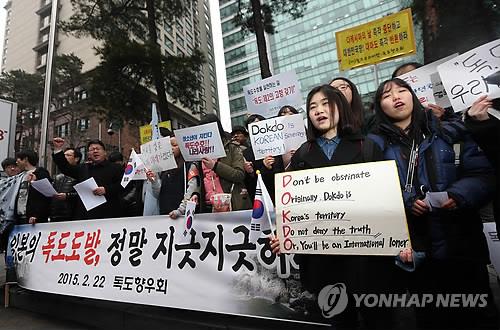
South Korean activists give an anti-Japanese performance in front of the Japanese Embassy in downtown Seoul on Feb. 22, 2015, to condemn Japan’s territorial claim to South Korea’s easternmost islets of Dokdo. (Yonhap)
South Korean activists give an anti-Japanese performance in front of the Japanese Embassy in downtown Seoul on Feb. 22, 2015, to condemn Japan’s territorial claim to South Korea’s easternmost islets of Dokdo. (Yonhap)
There is a lot of things to like about living in South Korea, but the yellow dust has to be one of the worst aspects of living on the peninsula:
Image from the Korea Herald.
The worst winter seasonal yellow dust in five years blanketed the Korean Peninsula on Monday, prompting the authorities to issue health warnings against the sandy, chemical-laden wind from China.
According to the Korea Meteorological Administration (KMA), yellow dust warnings were issued at 10 a.m. in Incheon, Seoul, Gyeonggi Province and part of Gangwon Province with dust advisories in place for most other parts of the peninsula except some southeastern cities, including Busan and Ulsan.
The dust warnings in the capital area were to be lowered to advisories at 4 p.m. as the number of fine dust particles gradually decreased.
A yellow dust advisory is issued when an hourly average dust concentration of more than 400 micrograms per cubic meter is expected to last for more than two hours. More than 800 micrograms leads to a yellow dust warning.
People are advised to stay indoors when yellow dust advisories or warnings are in place. When going outside, they are advised to wear protective glasses and yellow-dust masks.
As of 4 a.m., Seoul’s atmospheric concentration levels of “particulate matter (PM)-10” pollutants soared to 1,044 micrograms per cubic meter. This marks the worst yellow dust that has hit the peninsula during a winter season since Dec. 25, 2009, when the level recorded 963 micrograms. [Yonhap]
I have always wondered how much of an effect on weather patterns that the yellow dust has in the region and there are actually scientists trying to figure that out. In fact these scientists think the increase in yellow dust could be responsible for up to 80% of global warming. Here is a map with satellite measurements of the yellow dust reaching the US:

For those that don’t know the yellow dust gets blown in from the Gobi desert where overgrazing of grassland is turning large areas of it into desert. To make matters worse a lot of industrial pollutants from China’s factories are dumped in the desert and contribute to the amount of air pollutants that get blown over neighboring countries. This is a provable man-made environmental catastrophe which little is done about.
Here is the latest ban on a US food import to Korea:
The government’s import ban on U.S. chicken is feared to raise poultry prices.
U.S. poultry accounts for half of Korea’s chicken imports, or over 10 percent of consumption here.
In particular, prices of chicken legs could soar if the ban continues because Korea imports tens of thousands of chicken legs each year.
According to the Ministry of Agriculture, Food and Rural Affairs, Sunday, Korea has banned the import of U.S.-bred chicken since Dec. 20, two days after a highly-pathogenic avian influenza virus was found in chickens on an Oregon farm.
Since then, no U.S. poultry has been brought into Korea unless they were killed before Dec. 20, or were heat-treated at over 70 degrees Celsius. [Korea Times]
You can read more at the link.
You would think these people would have something better to do than protest at the Japanese embassy:
http://img.yonhapnews.co.kr/etc/inner/EN/2015/02/22/AEN20150222001900315_01_i.jpg
Scores of South Koreans assembled in central Seoul on Sunday to denounce Japan for holding a ceremony that promotes Tokyo’s territorial claim over South Korea’s easternmost islets of Dokdo.
In 2005, Japan’s Shimane Prefecture, which claims administrative sovereignty over the islets, designated Feb. 22 as a day to promote Takeshima, the Japanese name for Dokdo. Since then, Shimane has hosted various programs to strengthen its territorial claims to the islets on this day.
Tokyo sent a vice-minister-level official to this year’s ceremony as a government representative, marking the third year in a row that it has sent a ranking official to the controversial event.
Some 150 South Koreans, who belong to a civic group promoting South Korea’s sovereignty over Dokdo, gathered in front of the Japanese embassy here to call for Tokyo to cancel the designation. [Yonhap]
You can read the rest at the link, but Shimane prefecture is basically the Mississippi of Japan. It is a poor province and in the case of Shimane it is depended on fishing and the Dokdo Islets have good fishing grounds and thus why the government in Shimane continues to promote Takeshima Day.

#ParkShinHye is Ceci magazine's March beauty http://t.co/0Ti7pQPl8X @PSH_Philippines pic.twitter.com/y7tLCDxBmG
— DramaFever (@dramafever) February 21, 2015

Shirtless South Korean soldiers conducted an exercise in heavy snow in Pyeongchang, about 180km east of Seoul, in temperatures below -20°C.
More than 150 Chunma Special Force Army members stripped off their shirts and shouted army slogans during a physical strength training exercise. [International Business Times]
You can read and see more pictures at the link, but this picture is just asking for a caption contest.
The war on cigarettes in Korea continues:
Lawmakers will start debating Tuesday whether to make it mandatory for cigarette makers to print photos on cigarette packs showing the dangers of smoking.
The National Assembly Health and Welfare Committee will review the government’s proposal to revise laws so they require warning photos such as damaged lungs or rotten teeth. Currently, tobacco makers are required only to print a health warning.
Observers said there is a good chance the revisions will take place. The government has made 11 unsuccessful attempts to have warning photos on cigarette packs since 2002. [Korea Times]
You can read more at the link.
I always wonder if these tests are just highly choreographed deception operations to make us think the North Koreans have more capability then they really do?
North Korea appears to have conducted a test of a missile ejection launcher that helps fire missiles from submarines, South Korean military sources said Friday.
The communist North “tested the ejection launcher from the seashore near the Sinpo South Shipyard on Jan. 23 for missiles that can be fired from submarines,” one military source here said, requesting anonymity.
The ejection test last month from the North’s northeast coast simulated the initial stage of boosting a missile out of a submarine launch tube, the source said.
According to South Korean and U.S. intelligence officials, the North has been developing a submarine-launched ballistic missile (SLBM) in a move to boost its underwater missile strike capabilities after launching a new 2,500-ton submarine last year.
The North’s move appears to be part of its efforts to equip its missiles with miniaturized nuclear bombs, raising further concerns over the North’s evolving missile and nuclear threats, say North Korean watchers. [Korea Times]
You can read more at the link.
The US may want an interoperable BMD architecture with the ROK, but they continue to maintain they are going to develop their own BMD system:
Building an interoperable missile defense system is a key focus the United States places on trilateral cooperation with its two key Asian allies, South Korea and Japan, a senior American diplomat said.
Principal Deputy Assistant Secretary of State Anita Friedt made the remark at the Japan Institute of International Affairs in Tokyo earlier Friday, echoing what Assistant Secretary Frank Rose said during a recent trip to Seoul, according to the State Department.
“With regards to trilateral cooperation among the United States, Japan, and the ROK … Developing an interoperable regional missile defense architecture is an important future area of focus in light of the increasing nuclear and missile threats posed by North Korea,” she said.
“We believe that future trilateral cooperation between the United States, the ROK, and Japan can positively impact our deterrence efforts against North Korean aggression and send a powerful message of deterrence to the DPRK (North Korea),” she added.
The U.S. wants to build a regional missile defense with South Korea and Japan in a move that critics say is aimed not only at countering North Korean threats, but also keeping China in check. Seoul has said it will build its own Korean Air and Missile Defense System (KAMD) in a way that is interoperable with the U.S. system. [Yonhap]
You can read more at the link, but the ROK is trying to take the middle road on this to balance their relationship with China and the US. China doesn’t want an interoperable architecture so the ROK has maintained they will build their own missile defense system. However, as the article states the ROK’s KAMD system can be developed to be interoperable with the US if needed.
Does China Really Know How to Wage Cyber War? http://t.co/hUQ5Wipvjt
— The Diplomat (@Diplomat_APAC) February 21, 2015