Here is a pretty cool story about how a USFK civilian was able to save a co-workers life using CPR:
Robert Lamoureux, left, and colleague Jerry Giefer look at the spot where Giefer fell after suffering a heart attack in December. Lamoureux was honored in March by Seoul fire officials for helping save Giefer’s life with CPR. Erik Slavin/Stars and Stripes
As heart attacks go, Jerry Giefer’s timing was impeccable.
Giefer, 64, doesn’t recall much about what happened Dec. 30 at his office at the Army Corps of Engineers compound in Seoul.
One moment he was working and the next, everything went black.
It was 11:30 a.m., and co-worker Robert Lamoureux walked in after his lunch break tofind Giefer on the floor, his head bleeding from the fall.
Lamoureux, who first learned CPR as an 11-year-old Boy Scout, was about to use his training for the first time.
Lamoureux felt a pulse and then turned Giefer over. He asked a co-worker to call for an ambulance and returned his attention to his fallen friend.
Giefer’s face had turned purple, indicating an airway obstruction. Lamoureux cleared Giefer’s mouth and gave him a breath, but Giefer’s chest didn’t rise. He showed no sign of a pulse.
Lamoureux knew that his friend might not survive.
“If I’d have been here a minute later, that would’ve been it,” he said. [Stars & Stripes]
You can read the rest at the link, but great job Mr. Lamoureux.
YONGSAN, South Korea – A USFK service member at Camp Humphreys self-reported a potential exposure to the Middle Eastern Respiratory Syndrome virus and is experiencing some symptoms associated with MERS. The service member previously received treatment at an affected Korean hospital before the hospital was identified as having a MERS patient. USFK is continuing to monitor the service member’s health and the individual has been isolated to on-post quarters, pending test results to assess infection. If test results establish that the service member has been infected, the individual will be placed into a special-care facility for MERS treatment and isolation.
For the most current MERS information, please go to USFK.mil and listen to AFN radio and television. [Camp Humphreys Facebook page via a reader tip]
I checked the USFK webpage for any updates and it is currently down. The USFK Facebook page however has a message on there from U.S. Forces Korea commander, Gen. Curtis M. Scaparrotti directing service members, civilians, and their families to contact their chain of command and healthcare providers prior to completing any off-installation hospital referrals within the Republic of Korea. Let’s all hope that if this USFK servicemember does in fact have MERS that he has a speedy recovery.
This could just be China cracking down on North Korean soldiers coming across the border and murdering Chinese citizens:
Chinese border guards shot and killed one person who was allegedly trying to illegally cross from North Korea on Thursday, authorities said.
The incident took place shortly before 4:00 p.m. (0800 GMT) after the suspect attempted to evade arrest by border guards, according to a brief statement from the Helong city government in Jilin province. It said the shooting is under investigation.
China’s 1,416-kilometer (880-mile) border with North Korea is a key crossing point for refugees from the impoverished hard-line communist state.[Stars & Stripes]
This Council on Foreign Relations article makes the case that North Korea is preventing South Korea from being an affective middle power nation in regards to cyber security issues:
US Secretary of State John Kerry shakes hands with Jaeho Yeom, President of Korea University, as he arrives to speak about cyber security and Internet freedom at Korea University in Seoul, Korea on May 18, 2015. (Saul Loeb/Reuters).
South Korea is one of the world’s most wired countries, which demonstrates the country’s embrace of cyber technologies. However, this commitment renders South Korea vulnerable to malicious cyber activities. As has happened in many countries, South Korea has scaled up its domestic cybersecurity efforts to address cyber threats, including the appointment in 2015 of a presidential adviser on cybersecurity. Despite increased attention on cyber defense and resilience, South Korea has not developed approaches that obviously stand out from equivalent efforts by other countries. South Korea struggles with the same problems as other nations, which means its domestic cybersecurity activities do not necessarily boost its middle power ambitions.
These ambitions also suffer because South Korea faces threats from North Korea that dominate South Korea’s cybersecurity agenda. Although North Korea is a cyber menace beyond the Korean peninsula, no other country bears the cyber burden Pyongyang imposes on South Korea. Indeed, in no other country is cybersecurity so interwoven as part of an existential security threat. This burden damages South Korea’s middle power aspirations in cyber affairs by highlighting South Korea’s vulnerabilities, forcing Seoul to prioritize North Korean cyber threats, and undermining the idea South Korea has effective strategies other countries can use.
South Korea’s close political, economic, and security relationship with the United States also affects its desire to be a middle power on cyber issues. A function of middle powers is to find ways to navigate international cooperation through the shoals of great-power competition. Middle powers should be—or perceived to be—sufficiently independent to be able to broker such cooperation. South Korea remains dependent on the United States in defending against North Korea, which colors perceptions of how autonomous South Korea can be on security issues. [Council on Foreign Relations]
You can read more at the link, but you would think that South Korea would be a great nation to learn from in regards to cyber security if they are constantly being probed and attacked by the North Koreans.
Here is an interesting read from a doctor who survived being infected with MERS by the 68 year old Korean man who initially brought the virus to South Korea after traveling in the Middle East:
Q. What were your symptoms?
A. In terms of my personal symptoms, there really isn’t much [to talk about]: a bit of muscle pain, indigestion, some coughing and a meager fever just high enough to fall after taking a few pills. The muscle pain wasn’t severe enough to take any painkillers. It hurt a little for about three to four days, but I got a lot better from the fifth. After a week, I started reading.
What was the most difficult pain to endure?
I don’t know whether my case can be comparable with that of other MERS patients. I was pretty healthy before the disease and also diagnosed pretty early, so it wasn’t as tough [as people assume]. I didn’t have trouble breathing. I’ve had the flu before, and if I were to grade the pain that ensued up to a 7, I’d say MERS was a 3 or a 4.
What was your daily schedule?
I had no sense of life during the first several days of treatment, but when I settled down later on I felt like my world was in tragedy. The television was one of my very few tools of connection with the outer world. I saw endless false rumors about MERS on the Internet, and being unable to speak up about the truth was what suffocated me the most. I was also worried about my own patients, and the false rumors that I treated them even after hearing the news I had MERS.
How are you feeling now?
I’m completely fine. I have a small cough, but I feel the same as I did before I had MERS.
As a doctor and former MERS patient, do you have anything to say about the current spread of the virus in Korea?
Fundamentally, I think doctors generally have to reflect upon their [lack of professionalism], because they were ignorant of MERS to begin with. In that sense, I think the outbreak may have been our [Korean doctors’] fault. [Joong Ang Ilbo]
A South Korean couple’s special day has become an unexpected symbol of the country’s MERS health scare, after a joke wedding photo with their guests wearing surgical face masks went viral.
The picture that flooded South Korean social networking sites showed the young couple formally posing with dozens of family and friends — with nearly everyone’s face obscured by the white masks.
It was taken at their wedding in Seoul on Saturday, as the outbreak of Middle East Respiratory Syndrome (MERS) gathered pace.
As of Tuesday, nearly 100 people had been infected by the virus, of whom seven have died.
“This is so scary and sad,” one Facebook user commented on the photo which was apparently taken by a guest.
But the couple’s wedding planner said the picture was not meant to be taken seriously and added that the couple — currently on honeymoon — had been taken aback by the publicity.
The wedding was held “normally” in Seoul, the planner, Hwang Myung-Hwan, told AFP.
“They had already taken normal group photos without masks when they decided to do something fun,” he said. [AFP]
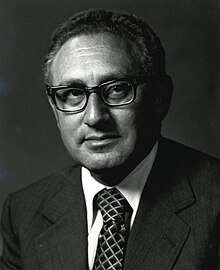
Via a reader tip comes a link to this State Department document from the minutes of the Washington Special Actions Group Meeting on August 18, 1976 after Washington policy makers became aware of the DMZ Axe Murder Incident. The document show the internal deliberations that Secretary State Henry Kissinger had with his staff, the Department of Defense, and the CIA in regards to formulating a response to the murders of two US Army officers by the North Koreans. Here is an excerpt from the document:
Secretary Kissinger: Well there are two problems as I see it. The first problem is that two American officers have been beaten to death. The second problem is to review the procedures we are following in the DMZ. Now, regarding the first issue, I agree with the CIA analysis. My impression is that it was a premeditated attack. There were some fifty other things they could have done to stop us from pruning the tree.
Now this letter Stilwell wants to send to Kim. Why should he send a letter to Kim? What standing does he have?
Mr. Habib: Well Stilwell is the Commander of the UN Forces and Kim is the Commander of the North Korean Army. Kim also signed the original peace agreement.
Secretary Kissinger: There have already been White House and State Department statements deploring these murders. Why do we now also need a Stilwell statement? Does he have the authority to make a statement?
Mr. Abramowitz: No. He needs Washington approval.
Secretary Kissinger: Well lets put that in abeyance. I have talked to the President today about this. He feels that some sort of strong action is necessary but does not know precisely what it should be. Now there are two things that come to my mind. A few weeks ago we turned off a B-52 exercise because it would be provocative to the Chinese. We might resurrect that exercise. The second possibility would be to alert all forces in Korea.
Adm. Holloway: We could go from DEFCON 4 to DEFCON 3.
Secretary Kissinger: What would that do?
Adm. Holloway: Unless we had a specific plan in mind or the North Koreans felt we had a specific plan in mind they probably would not react at all.
Secretary Kissinger: Well on that basis you could not threaten anything.
Mr. Abramowitz: Stilwell recommends that we finish pruning the tree.
Mr. Clements: I am in complete accord with that and think we should cut the God damn thing down.
Secretary Kissinger: I am in favor of that too but I don’t think we should do anything about the tree until after we do something with our forces. What is the meaning of the DEFCON alert stages?
Adm. Holloway: 5 is normal and 1 is war. Stage 2 means that war is inevitable and stage 1 is when the shooting starts.
Mrs. Colbert: If the alert were moved up to 3 how would the media and the U.S. people react to that in this campaign year.
Secretary Kissinger: That has nothing to do with it. The important thing is that they beat two Americans to death and must pay the price.
Mrs. Colbert: The North Koreans are looking for indications that they can create another Vietnam type mentality in this country. Therefore to disabuse them of this it is important to have the right kinds of expressions of support from the media and opinion makers.
Secretary Kissinger: What about resurrecting the B-52 exercise? The State Department hereby withdraws its objections to it. This is tow the best time in the world to run it.
Mr. Habib: It was a training exercise.
Mr. Abramowitz: Would it scare the Americans or the Koreans?
Mr. Gleysteen: There is another exercise planned.
Secretary Kissinger: But everybody already knows about that one.
Mr. Clements: Is it true that in the exercise we would fly the B-52s over Korea and then go back?
Adm. Holloway: Yes.
Secretary Kissinger: How long would it take?
Lt. Gen. Smith: We could get it going in 72 hours possibly less.
You can read much more at the link, but all these deliberations led to Operation Paul Bunyan where the tree was cut down backed by massive US firepower in case the North Koreans tried to retaliate. What else is interesting is that deploying B-52’s and other bombers is still something the US government does to this day to send a message to the North Koreans.