Kim Jong-un is taking a play out of his father’s denuclearization playbook with his announcement that he will seal the shafts at this nuclear test site:
North Korean leader Kim Jong-un has promised to dismantle a “northern” nuclear test site in May in full view of experts and journalists from South Korea and the United States, Cheong Wa Dae said on Sunday.
Kim made the promise during talks with South Korean President Moon Jae-in on Friday, the president’s top press secretary Yoon Young-chan said.
Kim said the site is still “usable” and “there are two more shafts that are bigger than the one (to be dismantled) which are sturdy,” according to Yoon.
Kim did not specify the location of the site to be dismantled, but given the North’s past announcement, it is believed to be in Gilju, North Hamgyong Province. On April 21, Kim declared the shutdown of the Gilju site, along with a freeze on missile and nuclear tests. [Korea Times]
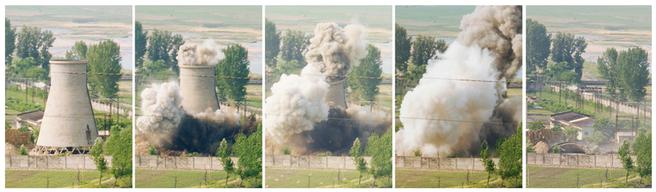
You can read more at the link, but when I read this I though immediately back to 2008 when Kim Jong-il blew up a cooling tower at it Yongbyon nuclear plant:
In a gesture demonstrating its commitment to halt its nuclear weapons program, North Korea blew up the most prominent symbol of its plutonium production Friday.
The 60 foot, or 18meter, cooling tower at North Korea’s main nuclear power plant collapsed in a heap of shattered concrete and twisted steel, filmed by international and regional television broadcasters invited to witness the event.
The destruction of the tower, the most visible element of the nuclear complex at Yongbyon, about 100 kilometers, or 60 miles north of Pyongyang, bore witness to the incremental progress that has been made in U.S.-led multilateral efforts to end North Korea’s nuclear weapons programs. [NY Times, June 27, 2008]
The North Koreans eventually rebuilt the cooling tower and reopened the Yongbyon nuclear facility in 2013. As little as two months ago satellite imagery showed the plant producing plutonium. Much like with the destruction of the cooling tower, the sealing of shafts at their Punggye-ri nuclear test site is easily reversible at a time of the Kim regime’s choosing. However, when this event happens most of the international media and Korean leftists will once again seize on the dramatic images this is sure to bring as evidence that the Kim regime really means to denuclearize this time.
I will know Kim Jong-un means to denuclearize when the entire Yongbyon plant is demolished and his nuclear weapons and material are removed from the country. Until this happens everyone is just continuing to play along with this great facade which the closure of the nuclear test site will be another part of.
Here is already possibly billions in investment dollars to upgrade North Korea’s infrastructure for the little to nothing the Kim regime has tangibly offered in return:
In this photo taken on April 27, 2018, a man takes a photo of a bulletin that reads “The Steelhorse Wants to Run!” at a train stop no longer in use in a city of Gangwon Province near the border with North Korea. (Yonhap)
The historic inter-Korean summit is raising hopes for cooperation on social overhead capital (SOC) projects as the leaders of South and North Korea agreed on Friday to link cross-border roads and railways.
In the joint statement released by South Korean President Moon Jae-in and North Korean leader Kim Jong-un after their summit, the two Koreas agreed to push forward the SOC projects agreed upon by late South Korean President Roh Moo-hyun and late North Korean leader Kim Jong-il in 2007 for balanced growth and joint prosperity on the Korean Peninsula.
As part of the first step, Seoul and Pyongyang agreed to connect cross-border roads and railways and upgrade the existing infrastructure, the two sides said.
The plan includes taking practical steps to utilize the Gyeongui railway, which links Shinuiju, a city on the Korean Peninsula’s border with China, and Seoul.
During the summit talks, Moon said if the railroad is connected with the North, both South and North Korea can make use of trains in the future. Kim praised the quality of the railway that connects Seoul and PyeongChang, the site of the 2018 Winter Olympic Games in February. [Yonhap]
The faces of these "objective," "skeptical" journalists, watching a guy who keeps kids in gulags, makes poison gas for Assad, and killed his half-brother with VX. Stupidity so luminescent, it's almost a strange beauty in a way.https://t.co/f3krX76YFQ We are so screwed.
It looks like the Moon administration is about to surrender sovereignty of their side of the NLL to the Kim regime:
This map shows the West Sea peace-cooperation special zones proposed by South Korea at the 2007 inter-Korean summit. (Yonhap)
The leaders of South and North Korea agreed Friday to establish a peace and cooperation zone on their disputed western sea border, a move that could prevent future clashes.
The disputed sea demarcation line, which Seoul has enforced, has been the scene of two deadly naval clashes between the two Koreas since 1999.
On Friday, South Korean President Moon Jae-in and North Korean leader Kim Jong-un held a historic summit at the border village of Panmunjom and agreed to turn the area into a special region that can be used safety by both sides.
The agreement could also potentially allow South and North Korean fishermen to jointly operate their boats in the area while allowing maritime authorities crack down on illegal Chinese fishing. [Yonhap]
You can read more at the link, but this is the same area where repeated attacks by the North Koreans have been executed against the ROK. In effort to appease North Korean aggression, the Moon administration is proposing giving up sovereignty of South Korean territory to the North Koreans to fish.
So why do the North Koreans want the NLL changed? Well this map shows why:
The current NLL is depicted with the Blue line and North Korea’s claimed NLL is depicted with the Red line.
The prior proposed joint fishing areas on the NLL nearly mirror what North Korea claims to be their ocean waters. The giving up of sovereignty of this maritime territory will make it harder to defend the South Korean islands along the NLL. Such an agreement would also set a precedent that the Kim regime’s claim against the legitimacy of the NLL is valid. The last time a South Korean leftist government tried to give away the NLL the ROK Defense Ministry was furious. It will be interesting to see how they respond this time to this news.
South Korean President Moon Jae-in’s televised summit with North Korean leader Kim Jong Un on Friday was spectacularly effective as pageantry aimed at South Koreans fearful of a U.S. attack on North Korea — and spectacularly empty in terms of meaningful commitment by the North to denuclearization. In fact, everything Kim put on the table was designed to reaffirm North Korea’s status as a nuclear weapons state and dilute Chinese and South Korean support for sanctions. Many veterans of negotiations with North Korea worry that Kim is now getting ready to play the United States. While the Trump administration’s tough sanctions no doubt had some role in pushing the North toward this summitry, one can also imagine exactly how this was a scenario the North itself sought from the beginning. [Foreign Policy]
Green then goes on to write a satire email from Vice Marshall Kim Jong Gak, director of the Political Bureau, Korean People’s Army to Kim Jong-un on their peace strategy. Here is an excerpt from the email:
You will pledge seemingly historic commitments that are all unverifiable and easily reversed, many of which we have deployed successfully in past negotiations. These include your commitment (like your father’s and grandfather’s) to the denuclearization of the Korean Peninsula, your pledge to join the global quest for denuclearization as the other nuclear weapons states have pledged to do under the Treaty on the Non-Proliferation of Nuclear Weapons, a promise not to transfer nuclear weapons to third parties, a no-first use pledge, and a promise to halt testing and to shut down our nuclear test site at Punggye-ri (for added drama, you might invite inspectors to the facility).
These commitments all parrot the aspirations of the current members of the nuclear weapons club and will thus confirm our membership in that club as we negotiate arms control with the Americans as a fellow nuclear weapons state. We, of course, made no commitment to cease production and deployment of our deterrent. We can easily reverse all these steps later, at the time of our choosing, yet already many in the imperialist and puppet media are proclaiming these meaningless declarations on your part to be a historic breakthrough.
I recommend reading the whole thing at the link, but as I have been saying since this whole peace initiative began, the Kim regime was conducting a facade. The North Koreans are very good at executing facades and Kim Jong-un has shown a particularly great talent for it, so much so that he has most in the international media believing every word he is saying.
The short term goal of this facade is to create a perception of progress towards peace and denuclearization on the peninsula to justify South Korea reopening the Kaesong Industrial Park, restarting joint tourism projects, and other inter-Korean cooperation initiatives that will be huge cash cows for the Kim regime. In return the Kim regime will pretend to denuclearize and make other commitments that can easily be reversed at a time of their choosing.
The Kim regime’s long term goal backed by China is to get the United States out of South Korea. That is why there has been such a strategic messaging emphasis on a peace treaty to end the Korean War. If there is a peace treaty South Korean leftists could argue why US forces are still needed in South Korea? The Kim regime’s even longer term goal is to separate the US from Japan as well with their surrogates in the media already pushing ideas of removing the US nuclear umbrella for Japan as part of any denuclearization agreement.
The wild card in all of this is President Donald Trump. South Korea, China, Russia, and most in the international community are willing to pretend denuclearization and a lasting peace is happening. Will the United States? For all we know President Trump could be conducting his own facade. For the US to get international consensus to conduct any strike against North Korea all options will have to be exhausted. Since this supposed peace process has began President Trump has been saying all the right things and being very reasonable even agreeing to meet with Kim Jong-un.
Going into the negotiations President Trump could be very solid about stringent inspections to ensure denuclearization compliance. If the Kim regime does not agree to stringent inspections or agrees and then plays their old tricks against inspectors than President Trump could have his rationale to strike North Korea. Or maybe President Trump is willing to go along with the facade to get a Nobel Peace Prize like his rival Barack Obama did and then let some other future US president deal with the consequences when Pyongyang ultimately reneges on the deal. Time will tell but the next 1-2 years should continue to be interesting times on the peninsula as everyone involved continues to play their role in this great facade.
There is a need for a country to register a protest about stuff like this. I’ve been with Korean diplomats trying to get American school districts to stop calling a body of water the “Sea of Japan.” But at some point you’re just embarrassing yourself. https://t.co/0lk78sYcv6
This photo captured from North Korea’s Central TV on April 26, 2018, shows North Korean leader Kim Jong-un (R) talking with Chinese Ambassador to Pyongyang Li Jinjun while seeing off a special train carrying the bodies of Chinese killed in a deadly bus crash and those wounded at a station in Pyongyang the previous day. The April 22 accident left 32 Chinese tourists dead and two seriously injured. Four North Koreans also died. (Yonhap)
In March of 1951 United States Forces Korea (USFK) was executing their annual Team Spirit exercise. Team Spirit was the major joint exercise held annually with the Republic of Korea (ROK) military from 1976 to 1993. Team Spirit ended in 1993 as part of the efforts to end the nuclear crisis with North Korea that began that year. Team Spirit exercised the logistics of supporting US warfighting units on the peninsula and joint operations between the US and ROK militaries.
In 1981 USFK held its largest ever Team Spirit exercise up to that point that featured 27,000 US military personnel stationed in Korea and 33,000 US military personnel from outside the peninsula. In addition to the US military personnel, over 100,000 ROK military servicemembers participated in the exercise as well. The April 8, 1981 Stars and Stripes called that year’s Team Spirit “the largest ground field maneuver exercise in the Free World”. This was the first Team Spirit exercise held during the Ronald Reagan administration where US and ROK ties had noticeable improved after much deterioration during the prior Carter administration.
The 1981 Team Spirit exercise featured a scenario where North Korea attacked southwest across the Han River which caused US and ROK forces to fight a delaying action southeast of the river. After completing the delaying action, US and ROK forces would then launch a counterattack to push the North Koreans north of the Han River again.
The Deadly Accident
On March 15, 1981 soldiers from Charlie Company, 1st Battalion, 31st Mechanized Infantry (C/1-31IN) from the 2nd Infantry Division stationed in South Korea found themselves participating in the counterattack portion of the exercise. Their unit was participating in a river crossing exercise where their armored personnel carriers would cross a pontoon bridge constructed on the Namhan River outside of the city of Yeoju, 35 miles southeast of Seoul.
City of Yeoju located on the far bottom right and Seoul on the upper left. The Namhan River can be seen flowing north from Yeouju and connecting with the Han River that flows through Seoul.
Due to the many large rivers in South Korea, river crossing exercises are an extremely important skill to master. To this day river crossing exercises are conducted on major rivers in South Korea to include the Namhan River:
However, for the soldiers of C/1-31IN, the river crossing exercise executed during the 1981 Team Spirit exercise quickly turned deadly. 12 soldiers found themselves fighting for their lives when two armored personnel carriers fell into the frigid water when the pontoon bridge broke apart. Eight of the soldiers were rescued, but the accident ultimately cost the lives of four USFK soldiers. Sergeant Harry Pickins, age 26 of West Memphis, Arkansas was the first body recovered on the same day of the accident. He was assigned to the 17th Field Artillery battalion:
Stars & Stripes newspaper, March 21, 1981
The Stars & Stripes newspaper reported five days later that the body of 18-year old, Private First Class Philip Pidgeon from Carbondale, Pennsylvania had been recovered about one mile downstream from the accident site:
Stars & Stripes newspaper, March 26, 1981
Two weeks later the Stars & Stripes then reported that the body of 21-year old Sergeant Vernon Cude was recovered from the river:
Stars & Stripes newspaper, April 12, 1981
Sergeant Cude reportedly helped others to find their life vests before the cold water and fast current washed him away. The only other body that had not been recovered was of 22-year old Sergeant Gary Schlecht. Much like Sergeant Cude, he attempted to help save soldiers without life vests before the swift current washed him away. I could not find any additional articles in the Stars & Stripes archive reporting on whether Sergeant Schlecht’s body was eventually recovered. However, the Find A Grave website does have a memorial marker for Sergeant Schlecht in Dayton, Ohio.
Stars & Stripes newspaper, April 8, 1981
River Crossing Accidents in Korea
Unfortunately this accident would not be the last deadly river crossing accident in South Korea. The May 10th, 1985 Stars & Stripes newspaper reported that a US soldier lost his life when an armored personnel carrier fell off a pontoon bridge on the Imjim River. In 1998 four US soldiers and a Korean Augmentee to the US Army (KATUSA) lost their lives when once again an armored personnel carrier fell off a pontoon bridge on the Imjim River. It was this accident I remember being briefed to my unit when we conducted my first river crossing exercise on the Imjim River back in 2000. Safety was of the up most concern during every river crossing exercise I have ever done in Korea since then and fortunately there has been no other deadly accidents since 1998.
Remembering the tragic deaths during the 1981 Team Spirit exercise serves as a reminder of the importance of safety during potentially dangerous training and making sure all efforts are made to mitigate risk. I don’t know if everything was done to mitigate risk before this tragic accident in 1981, but leaders today owe it to the memories of those killed in tragic accidents like this to take all measures to prevent future accidents.



 City of Yeoju located on the far bottom right and Seoul on the upper left. The Namhan River can be seen flowing north from Yeouju and connecting with the Han River that flows through Seoul.
 Stars & Stripes newspaper, March 21, 1981
 Stars & Stripes newspaper, March 26, 1981
 Stars & Stripes newspaper, April 12, 1981
 Stars & Stripes newspaper, April 8, 1981