It appears that the Trump administration is settling for the lowest sum they are willing to take which is $1 billion for the upkeep of the US-ROK alliance:
The United States has demanded South Korea pay $1 billion (1.12 trillion won) in annual defense costs sharing, as its final proposal to months of negotiations on the issue, according to officials, Wednesday.
South Korea flatly rejected the demand, maintaining its position that it cannot pay more than 1 trillion won.
“U.S. Ambassador to South Korea Harry Harris met with South Korea’s National Security Adviser Chung Eui-yong last month to deliver the final proposal,” a government official said, asking for anonymity.
On top of that, Washington also urged Seoul to renew the cost-sharing contract each year from the current five year, according to the official.
You can read more at the link, but I have been saying that I don’t think this issue will be resolved until after the Trump-Kim2 summit. If Seoul gets what they want from the US during the summit then they may be more flexible on paying more for the upkeep of the US-ROK alliance.
I have been saying that the Trump administration must be offering something the Kim regime wants in order to agree to a second summit, sanctions relief or a Korean War peace treaty would do it:
Sung Yoon-lee
U.S. President Donald Trump will most likely offer North Korea some kind of relief from international sanctions or a peace treaty in the near future, a prominent DPRK watcher and legal scholar told NK News last week. Speaking in Washington DC ahead of a conference hosted by NK News’s parent organization the Korea Risk Group, Tufts University’s Sung-Yoon Lee said the international community’s growing lack of political will to enforce sanctions will likely allow the U.S. to reward Pyongyang for what he described as its “fake concessions” on the nuclear issue. “Trump will be willing to lift sanctions formally, I believe, not all sanctions, but he might say, ‘okay the poor starving North Korean people, they are suffering, so let’s lift sanctions on the ban of export of seafood and textiles,’” Lee, Kim Koo-Korea Foundation Professor in Korean Studies and Assistant Professor at the Fletcher School of Law and Diplomacy, said. “If the U.S. takes the lead in bending the rules – U.S. rules as well as UN Security Council resolutions – who will object? China? No. South Korea? No. Russia? No. Britain and France which really don’t have a bone in this fight? No,” he added. “So it’s all up to Trump and I think Trump is more than willing to offer premature sanctions relaxation.” In a wide-ranging interview, Lee also discussed why he believes it’s “too late” to bridge the gap between the U.S. and North Korea on denuclearization definitions, ROK President Moon Jae-in’s role in promoting dialogue with the DPRK, and what he sees as Pyongyang’s long-term goal: forcing U.S. withdrawal from the peninsula and the region.
You can read the whole interview at the link, but Professor Lee believes that sanctions relief and a peace treaty will in the near future be offered by the US.
However, squabbles over the definition of denuclearization could cause North Korea in the next few years to detonate a hydrogen bomb in the atmosphere over the Pacific to make the point their nuclear program is now complete. I don’t see them doing that due to the affect such a detonation would have on satellites. Taking out satellites with an EMP blast I think would lead to a call for regime removal; just imagine the global financial and economic impacts of losing satellites in low Earth orbit. The outrage I believe would be huge.
I don’t think the Kim regime would risk the blowback which would leave them with an above ground test option. If they were going to do an above ground test they would have to do it over the surface of a remote part of the Pacific Ocean. Seems pretty challenging logistically for the North Koreans to pull off such a test, but if they get billions of dollars in cash from the South Koreans and sanctions relief may be they can pull it off.
NK premier inspects fertilizer factoryNorth Korean Premier Pak Pong-ju (C) inspects a fertilizer factory in Hungnam, the North’s South Hamgyong Province, in this photo provided by the North’s official Korean Central News Agency on Jan. 22, 2019. (For Use Only in the Republic of Korea. No Redistribution) (Yonhap)
The stupidity between Japan and South Korea has gotten worse:
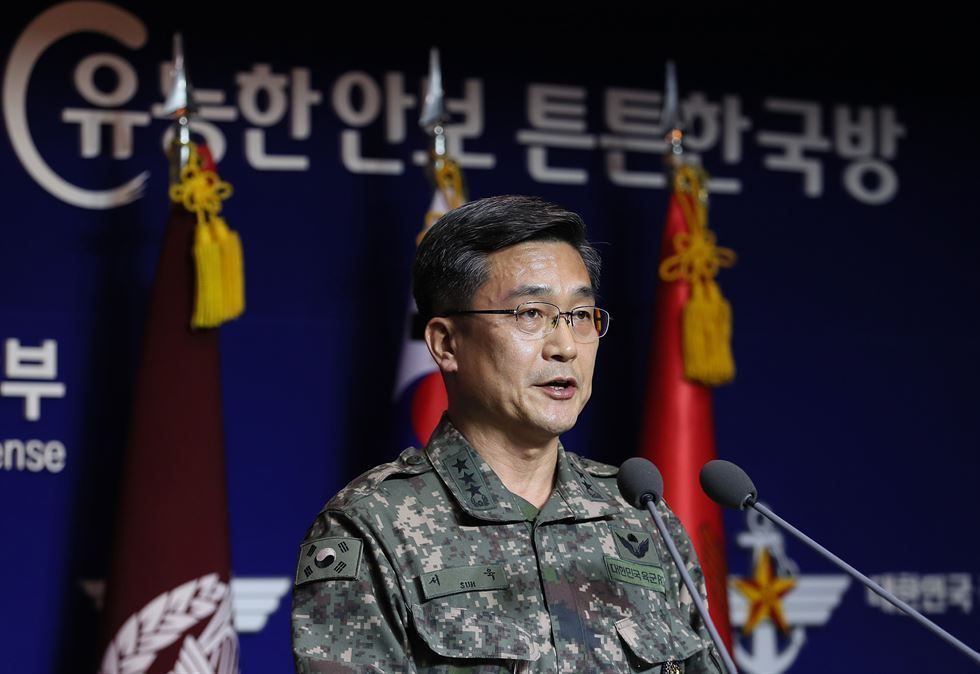
Suh Wook, chief director of operations at the Joint Chiefs of Staff, reads a statement from the Ministry of National Defense over the “provocative” low-altitude flight of a Japanese patrol aircraft close to a South Korean warship, Wednesday. / Yonhap
A Japanese maritime patrol aircraft carried out a low-altitude flight close to a South Korean warship Wednesday afternoon, in an apparent threatening and provocative action, according to the Ministry of National Defense.
“The P3 maritime patrol airplane flew at an altitude of 60 to 70 meters and about 540 meters away from the South Korean Navy’s destroyer in waters near Ieodo, [a rock southwest of the southern island of Jeju] at around 2:03 p.m., Wednesday,” the ministry said.
In response, the South Korean Navy lodged a strong complaint about the incident through a hot line, urging Japan to stop the recurrence of such acts. The Navy also said it will take steps for self-defense if Japan repeats such an “obvious provocation.”
The Navy said that the destroyer perceived the move as a security threat, adding that Japan should make it clear the exact reason for the low-level flight.
According to the ministry, Japan replied that it was “very inappropriate” for South Korea to threaten to take self-defense measures, as Japan is an ally and the Navy must have been able to discern that the aircraft belonged to the allied country.
You can read more at the link, but some how I doubt the ROK sailors on the ship were in a panic from a propellor driven P-3 flying 540 meters from their ship.
Remember the 100th anniversary of the March 1st Independence Movement is occurring soon. I would not be surprised if the Moon administration tries to get anti-Japanese sentiment to an all-time high, especially if he is able to get Kim Jong-un to visit Seoul that day.
The owner of a Ford Explorer smashes his car with a baseball bat in Jeonju, North Jeolla Province, Jan. 20. Yonhap
A Korean man has destroyed his new car worth more than 50 million won ($45,000) in a fury, claiming he was given a Ford Explorer that “wasn’t actually new.”
Jang Dong-min smashed his vehicle with a baseball bat in front of a Ford sales shop in Jeonju on Jan. 20, accusing Ford Motor Company of giving him a car with “traces of repair.”
“It was the last and only thing I could do after no one had believed me,” Jang told The Korea Times Tuesday. “Every time I looked at my car, I felt my heart swelling with anger … I couldn’t just let it go.”
Jang bought his first Ford Explorer in May 2017, but within a few weeks, a serious engine problem occurred, he said. So the company exchanged that car for a new one in August that year.
But he later found some traces, which he believes indicate that his car was not brand new.
After receiving an experts’ technical evaluation report that supports his claims, Jang eventually brought the issue to the court. But the judges did not accept his claims.
It looks like the Trump administration is falling for the freeze deal that both the Moon administration and the Chinese have been pushing for:
U.S. Secretary of State Mike Pompeo said his administration wants to reduce North Korea’s capacity to build its nuclear and missile development programs and that discussions on that are an “important component” for making sure that both countries deliver on commitments made in Singapore last year.
During an interview with the Sinclair Broadcast Group, transcripts of which were released by the State Department last Friday, Pompeo said that U.S. President Donald Trump has made enormous strides in working with the North to get their commitment to denuclearize and that now was the time “to execute” and “to implement.”
Pompeo didn’t elaborate on how precisely Washington wants to “reduce” the North’s capacity, but the remarks came on the same day The New York Times reported that officials from both countries were currently negotiating a “freeze” of the North’s nuclear fuel and weapons production so that the country’s arsenal doesn’t grow while denuclearization talks drag on.
This could mean that a freeze, which could be interpreted as a short-term goal in getting Pyongyang to denuclearize, would also be discussed when Trump meets North Korean leader Kim Jong-un late next month for their second summit. In their first summit last June in Singapore, both leaders agreed to commit “to work toward complete denuclearization of the Korean Peninsula,” but very little progress – if any – has been made since.
You can read more at the link, but if they are playing for a freeze deal they could have done this all the way back in 2017 when the Moon administration and just about every North Korea expert was pushing this idea.
Freeze Deal framework from back in 2017 shown on CNN.
A freeze deal falls right in line with North Korea’s “pretend denuclearization” strategy. A freeze deal means that the Kim regime will get concessions from the US for little to nothing in return. The big concession they will likely push is a peace treaty to end the Korean War.
Getting the peace treaty in return for a freeze deal would then allow surrogates to question the continued existence of the US troop presence in South Korea. If there is peace then why are US troops stationed in Korea?
The ultimate goal of the North’s nuclear weapons program is to co-opt the ROK into a confederation on North Korean terms. A freeze deal followed by a peace treaty plays right into the Kim regime’s hands. Additionally the freeze deal for treaty plays into China’s hands who have also long wanted to separate the ROK from the US in a bid to increase their hegemony over the region.
Exactly. Trump is so desperate for the perception of a policy victory to change his presidency’s domestic image as a corrupt, incompetent mess, that who knows what he’ll give away. Fairly amazed the S Korean gov’t wants yet another T-Kim summit where T goes in blind & unprepared https://t.co/pzzw6duqWv
‘Otto Warmbier Way’ street name sought near N.K. officeThis Jan. 17, 2019, photo shows the building in Manhattan, New York, where North Korea has its mission to the United Nations. U.S. broadcaster Fox News reported that Joe Borelli, a New York City Council member, is seeking to rename the street in front of the building “Otto Warmbier Way” after a U.S. university student who was detained in the North for 17 months and died in 2017 soon after he was sent back home in a coma. (Yonhap)
Here is a lawyer who thinks that North Korea is a great place to invest:
Michael Hay, a foreign legal counsel qualified in New York, talks about his 12-year judicial experience in North Korea in an interview with The Korea Times at his office at HMP Law in central Seoul, Monday. / Korea Times photo by Shim Hyun-chul
North Korea has an advanced arbitration system even compared to developed countries, and foreign companies face an even playing field in dispute resolution, according to Michael Hay, the founder of North Korea’s only foreign law firm Hay, Kalb & Associates.
“From start to finish, (an arbitration case) could be done in six months… which is much faster than most other countries I have worked in,” Hay said in an interview with The Korea Times at his office in Seoul, Monday.
He has been a foreign legal counsel at HMP Law since December, after 12 years of operating his law firm in the North.
Hay emphasized that the North Korean regime has no choice but to maintain an advanced dispute resolution system in order to continue reeling in foreign investment and companies.
“One thing North Koreans are very conscious of: If they don’t have a dispute resolution system, people will not come and invest in the country. In my experience they are very supportive (of foreign firms),” he said.
You can read the rest at the link, but Mr. Hay says that the businesses that lost money in North Korea did so because they grandstanded about doing business in North Korea. He says businesses that kept their dealings quiet with the regime were more successful.