South Korea and the United States have agreed to make the Combined Forces Command (CFC) exempt from their plan to relocate U.S. troops until Seoul retakes wartime command of its forces from Washington, sources here said Thursday.
Seoul and Washington had been at odds over whether to move the CFC headquarters and its affiliated forces to Pyeongtaek, some 70 kilometers south of the capital, in accordance with their 2004 agreement to move the Yongsan Garrison, the sprawling U.S. military headquarters in central Seoul, and the 2nd Infantry Division stationed north of Seoul to the southern town by the end of 2016.
“The two sides have agreed to maintain the CFC in Yongsan, where it is currently located, until we regain the operational control (OPCON) from the U.S.,” a senior Seoul government source said, requesting anonymity.
The CFC, which has the command over South Korean and U.S. troops stationed here, was to be disbanded upon Seoul’s OPCON transfer in December 2015, but a bilateral agreement to delay the transfer has led the CFC to remain intact.
“Albeit temporarily, we, in fact, accepted the U.S. request to stay them in Seoul. The U.S. has proposed the CFC be an exception for the relocation plan, citing smooth policy coordination between the allies,” the source said.
“Though the U.S. wants to have most of its forces under the CFC stay in Yongsan, we have conveyed our position that it would not be possible. Discussions are under way about the size of the remaining forces,” he added. [Yonhap]
You can read more at the link, but the ROK Defense Ministry are denying the report. If true it will be interesting to see how large of a footprint will remain on Yongsan and will the commissary, PX, and other facilities remain open as well?
The Chinese have been complaining about the deployment of THAAD to Korea and it looks like the Korean government is going to try and alleviate their concerns:
The government is moving to ease China’s concerns about the possible deployment of U.S. missile interceptors on Korean soil.
National Security Office (NSC) chief Kim Kwan-jin is expected to undertake this hard mission on a visit to Beijing to meet with State Councilor Yang Jiechi in October.
Government officials have recently dropped hints that they would not object to the U.S. Forces Korea (USFK) plan to bring in a Terminal High Altitude Area Defense (THAAD) system.
The advanced missile-defense system that has a range of up to lometers is regarded as an indispensable element of the U.S. missile defense system.
“The NSC chief will try and acquire China’s understanding on THAAD,” a government official said. The resumption of six-party talks aimed at stopping North Korea’s nuclear programs would also be on the agenda, he said. [Korea Times]
I have always liked this idea of a combined division and it appears it will become a reality:
Headquarters of the 2nd Infantry Division in Uijongbu.
South Korea and the United States have agreed to establish a combined division of their troops next year that will be tasked with carrying out wartime operations, Seoul’s defense ministry said Thursday.
The unit, slated to be organized in the first half of next year, will be comprised of the U.S. 2nd Infantry Division and a South Korean brigade-level unit, according to the ministry.
The 2nd Division commander plans to head the newly-made joint staff of the combined unit, with South Korea’s brigadier general-level officer to be its vice chief, the ministry said, adding that an equal number of dozens of service personnel from the two sides will form the leadership.
“While being operated in a separate fashion in peacetime, the 2nd Division and the Korean brigade will carry out joint exercises when necessary,” a ministry official said, asking not to be named.
In time of war, the two entities will get together to carry out diverse “strategic operations” such as eliminating weapons of mass destruction as well as civil missions against North Korea, he noted, without elaborating further. [Yonhap]
You can read more at the link, but the article says this will not impact the relocation of the 2ID to Camp Humphreys. However, I wonder how it is going to impact the residual combat power in Area 1 that has long been discussed.
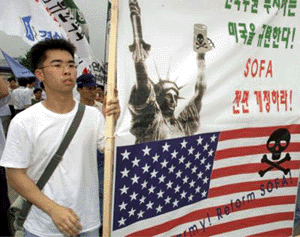
Here we go again with the Korean media claiming that the Status of Forces Agreement allows US soldiers to commit crimes and not be held accountable in Korean courts:
South Korea and the United States are set to revise their joint guidelines on U.S. Forces Korea’s patrol activities, sources said Monday, following a controversial incident last year in which a group of American military officers handcuffed three local civilians using force.
South Korea’s prosecution is seeking to indict seven U.S. military police officers on charges of violence for handcuffing three South Korean citizens last July in Pyeongtaek, a provincial city 70 kilometers south of Seoul. (……….)
Despite continuing crimes by U.S. soldiers here, South Korean authorities have often fallen short of taking proper legal actions due to the SOFA regulation that helps the accused soldiers end up in the hands of U.S. authorities. [Yonhap via reader tip]
Many ROK Heads may remember the incident the article is referring to which is the Osan Handcuff Scandal. There is no doubt that those SP’s acted unprofessionally and handled the incident very poorly. However, they were clearly on duty which falls under USFK jurisdiction which gives them the authority on whether to hand them over for Korean criminal prosecution. USFK handled the incident themselves by punishing two of the town patrol members.
Anyway the Yonhap article pushes many of the myths about the US-ROK SOFA. First of all in the article it claims this is the first change to the SOFA which is not true. The SOFA has been updated many times over the years. Also the article claims that the SOFA is preventing ROK authorities from taking legal action against criminal GIs. I have challenged people over and over again on this topic to name one GI that committed a crime while off duty and USFK hid behind the SOFA to allow him to get away with the crime? Maybe someone should first provide an answer to this question before bashing the SOFA.
Anyway with all that said I do agree with this effort to change the SOFA to better specify what the town patrols should be doing in order to prevent another Osan Handcuff Scandal like incident from happening.
Amid escalating threats from North Korea, U.S. and South Korean defense officials will meet over the next few days and discuss whether to extend America’s wartime control over the South’s armed forces, 60 years after a truce ended the Korean War.
Defense Secretary Chuck Hagel flew to Seoul on Sunday, and said there will be conversations about the possible extension of the 2015 deadline, but likely no decisions will be made.
“We’re constantly re-evaluating each of our roles,” Hagel told reporters traveling with him. “That does not at all subtract from, or in any way weaken, our commitment – the United States’ commitment – to the treaty obligations that we have and continue to have with the South Koreans.”
U.S. officials have acknowledged that the South Koreans have informally expressed an interest in delaying the deadline when Seoul is supposed to assume wartime control of the forces that would defend the country in the event of an attack by North Korea.
The target date initially was in 2012, and was pushed back to 2015.
Defense officials said they expect to have discussions about it with the South Koreans that will help map out the way ahead. [Stars & Stripes]
The Koreans were supposed to take over Operational Control back in 2012 but it was delayed to 2015 reportedly as a quid pro quo by the Koreans deploying troops to Afghanistan. I support the transfer of Operational Control for the reasons you can read about at this link, but I am skeptical it is going to happen any time soon due to the Korean delay games and so far the unwillingness of the US government to force the Koreans to stick to the timeline. I guess we will see what happens.
This is pretty much just something to appease the masses in Korea who believe all the lies put out by the media and anti-US activists that claim that the Korean police are unable to investigate crimes due to the big, bad SOFA:
South Korea and the U.S. will discuss introducing new guidelines on investigating American soldiers suspected of crimes in a meeting of the South Korea-U.S. Status of Forces Agreement Joint Committee.
In the meeting slated for Wednesday, Seoul will ask Washington to “positively consider” South Korean investigative authorities’ request to transfer American suspects accused of crimes into the custody of the South before indictment.
The new guidelines will be similar to those that the U.S. and Japan agreed to after a rape case involving a U.S. soldier in Okinawa in 1995. After the rape case, the U.S. agreed to “favorably consider” handing over suspects accused of heinous crimes to Japan before they have been indicted. [KBS Global]
I long ago showed the problems with the anti-US activists complaints about the US-ROK SOFA and I am still awaiting for one person to point out an example of a crime committed by a GI off duty and the USFK refused to hand him over? The anti-US activists keep complaining about GI’s getting away with crimes and can’t point out a specific example of when this happened.
Due to the on going US beef protests, the long chain of anti-US protests, as well as the underlying anti-Americanism prevalent in Korean society, many people have advocated for the immediate withdrawal of USFK.
The immediate withdrawal of USFK is something easier said then done. Listed below is my list of reasons why I believe an immediate pull out of USFK is not practical and thus will not happen anytime soon.
Take note that my list is no particular order of importance. Also this is my own personal opinion so do not take it as any indication of what the USFK command thinks on this issue. Take it for what it is worth and feel free to debate it in the comments section.
Korean Economic Impact – First of all you have all the jobs that Korean workers hold on USFK bases which would be lost if USFK pulled out. You also have all the businesses outside the camps that are another example of ways money is made from USFK. Blackmarketing, illegal gambling, golf course scams, gate scams, housing scams, shady contracts, etc. are examples of ways that Koreans are making millions off the USFK presence in Korea. So much money would be lost that Korean politicians would feel enormous pressure to keep USFK in Korea.
Impact on Foreign Investment – With Korea already hurting for foreign investment the loss of USFK would create another major shock to Korean attempts to draw international investors. Think about if you were going to invest your money in Korea, wouldn’t you feel better if your investment was insured by the US military presence in the country?
Korean Defense Spending – Currently the Korean government gets state of the art military capabilities courtesy of the USFK presence in their country for the small USFK upkeep fee that they pay every year that mostly goes to pay the salaries of Korean workers anyway. The Korean government has been able to put off paying the full amount to pay for their own defense for decades and are eager to keep things that way. This allows the ROKs to take advantage of superior US technology such as command & control, intelligence, and missile defense systems that would normally be too cost prohibitive for them to pursue.
Loss of Korean Political Influence in Washington – For a country considered a middle power around the world Korea’s has an inflated importance within Washington for a nation of its size and stature should have because of the US-ROK alliance. Korea has one of the few four star commands in the US military with the USFK commander having direct access to senior policy makers in the United States. Losing USFK would also mean a huge loss in political influence in Washington which the Korean government does not want.
Moderating American Reactions to North Korea – The Korean government knows that as long as American troops are exposed to an attack by North Korea that this moderates a US response to a North Korean provocation. The 2ID and even soldiers on Yongsan are easy targets for a North Korean response and this tends to moderate American reactions to North Korean brinkmanship. This was one of the main reasons why the ROK government has reservations about the USFK transformation plan. By consolidating troops on Camp Humphreys which is outside the North Korean artillery range, an American military response to North Korean brinkmanship is a greater possibility.
Lack of Unit Space in the US – Related to logistics is the fact that 27,500 soldiers that are currently in USFK plus their families would need a post back in the US that has room for them to redeploy to. When 2BCT redeployed to Iraq I knew guys that were living in rented college dorm rooms because Ft. Carson didn’t physically have room for them yet. The post hadn’t anticipated the soldiers being posted at the facility in order to build enough barracks for them. In the US you have units coming back from overseas that are living in squalor, ghetto like conditions because they are a waiting for units to deploy overseas in order to take their barracks space. This is caused by the growth of the military, base closings, as well as the prior force cut backs in Korea and the major force cut backs in Germany.
Camp Closeout Procedures – If USFK were to pull out all the camps currently occupied, all the camps would need to be cleaned and inspected before redeployment. Having personally been involved in the closeouts of smaller camps in Uijongbu I can tell you this process took about 4-6 months for smaller camps to get done. I can only imagine how long it will take to get a huge installation like Yongsan inspected and handed over.
Political Apathy in Washington – The fact of the matter is that very few politicians back in the US know much of anything about Korea. Much of their perceptions of Korea is based off the US-ROK alliance that was forged in blood during the Korean War. There have been few politicians in Washington that “get it” in regards to Korean affairs and Congressmen Henry Hyde was one of them before he past away.
Despite all the other issues with Donald Rumsfeld, in regards to Korean affairs he was another guy that understood Korea very well. When the Korean government balked at the relocation plan Rumsfeld pulled 2nd Brigade, 2ID from Korea with little forewarning to let the Korean government know he was serious about the transformation. The removal of 2nd Brigade is what began the USFK transformation. However, once Rumsfeld resigned from office the Korean government a week later reneged on the deal and the delay games preventing the USFK transformation began.
Power of the Status Quo – For anyone to tackle all the issues I have listed above it would take extraordinary dedication and effort to do so that would need to be maintained over a number of years until the pull out of forces from Korea is complete. For many political leaders, putting forth the multi-year effort necessary to withdraw USFK is simply too much work with little political payoff, so why bother? In regards to USFK you have a military unit comprised mostly of people there for one year and then going home. They to have little incentive to undertake a long term project in regards to the withdrawal of USFK.
The ones who have spent a long time in USFK and work to change things are often offset by those who have been in Korea a long time themselves and actually benefit from keeping the status quo the way it is. It is not impossible, but it is difficult to create change in USFK. There are a few other smaller issues I can think of in regards to pulling USFK out of Korea but these are the main ones that would need to be addressed that clearly show that withdrawing USFK would require a multi-year long term effort. Since such a thing isn’t going to happen anytime soon that is why I think the US government should continue to strongly push for the USFK consolidation on Camp Humphreys. The consolidation is an opportunity for USFK to cut troop numbers along with reducing the force footprint in the nation along with being in a better strategic position in regards to North Korea.
The ROK government is going to continue to do everything possible to delay the relocation. President Bush announced in April a delay in troop cuts that were anticipated as part of the Camp Humphreys relocation and he should use that as a bargaining chip in regards to the Camp Humphrey relocation. In due time those troop cuts should be restarted anyway and get the USFK force strength down to 25,000 servicemembers as planned.
Additionally I believe USFK should move units piece meal to Camp Humphreys. USFK should focus on building one unit area at a time on the expanded Camp Humphreys and fill it with soldiers currently stationed on Yongsan. Build another unit area and fill it with more soldiers from Yongsan. Physically moving people from the most visible US military presence in Korea will send a signal to Korea at large that the US is serious about the move.
If the Korean government continues to play delay games (ie- the cost sharing and camp pollution issues) then serious consideration should given in regards to removing 2ID completely from the peninsula. This would be a shock to Korean society even greater then when 2nd brigade was withdrawn that should be enough to get the Korean government moving on the relocation of US forces to Camp Humphreys.
On the morning of June 13th, 2002 it was just another hard day of training for the soldiers of Bravo Company, 44th Engineer Battalion, who were part of the US military’s premier combat unit in Korea, the Second Infantry Division (2ID). The 2ID is the lone US combat division stationed on the Korean Demilitarized Zone (DMZ) and is responsible for maintaining a credible combat deterrent to any possible North Korean aggression. A major part of maintaining a credible combat deterrent is to make sure soldiers are properly trained in both individual and collective soldier skills and that they have confidence in the equipment they use. In order to develop these skills and confidence much of a soldiers’ time while stationed in Korea is comprised of field training exercises that can last for weeks at a time.
The soldiers of Bravo Company were participating in one of the routinely scheduled brigade level exercise that are conducted to evaluate a unit’s combat readiness that is so critical to ensuring a credible combat deterrent is being kept by the Second Infantry Division. Bravo Company had been in the field for two weeks conducting continuous operations and that morning the engineers were under orders to travel to the Twin Bridges Training Area (TBTA) to link up with a mechanized infantry unit in order to participate in an expected training event there. Twin Bridges is one of the most heavily used training areas in the Second Infantry Division and most soldiers in the division are quite familiar with it. The engineers that morning prepared their equipment and began their move down Highway 56 to the training area.
Google Earth image of convoy route to Twin Bridges from accident site.
Much like the soldiers of Bravo Company, Shim Mi-son and Shin Hyo-sun, both 13 year-old middle school students, were also beginning a typical day. They had both agreed to meet up and walk to a nearby restaurant in order to attend a friend’s birthday party being held there. As the girls were walking down the road and the engineers moved west down Highway 56, none of them had any idea that the events of this day would become one of the defining moments of the US-ROK alliance that is still causing ripple effects to this day.
Tragedy Strikes
Highway 56, like most of the highways in the 2ID area of operations north of Seoul, is a very narrow road with many blind corners and no shoulders. This highway is heavily used by both the American and Korean militaries to access training areas located adjacent to the highway. Bravo Company and other units had been travelling down the road all week due to the major training exercise. The engineers’ were organized themselves in a convoy with the company commander CPT Mason in a HMMWV (High Mobility Multi-Wheeled Vehicle) leading the convoy, followed by a M113 tracked vehicle and then the five largest vehicles in the convoy, M60A1 AVLB (Armored Vehicle Launched Bridge) who were followed by another HMMWV bringing up the rear of the convoy.
The AVLB driver is on the left side of the vehicle. Notice the blind spot caused by the bridge laying aparatus.
All was fine until about 20 minutes into the movement when the convoy reached a particularly narrow portion of the highway that featured a turn that sloped up a hill. As the Bravo Company convoy travelled up the hill another convoy of M2 Bradley Fighting Vehicles was moving towards the Bravo Company convoy from the other direction. The engineers would find out later that this convoy of Bradleys were in fact the very ones they were travelling to meet up with. The appearance of this convoy would ultimately lead to a perfect storm of events that would that end with deadly consequences.
The lead HMMWV with CPT Mason in it saw the Bradleys coming down the opposite lane of the highway as well as seeing two young Korean girls walking along the white line on the shoulder of the road. The actions of CPT Mason at this critical moment would come under much scrutiny later on. The commander of the M113, Staff Sergeant (SSG) Murray, was directly behind Mason’s HMMWV and he saw the on coming convoy and the two girls as well. He immediately turned around and signalled to the AVLB behind him with his arms crossed to warn the vehicle commander of the impending danger.
The driver of the AVLB Sergeant (SGT) Mark Walker saw the Bradleys coming down the left side of the road, but could not see the two girls walking on the right side of the road due to the shape and design of the AVLB that blocked the driver’s vision to his right. The commander of the AVLB, SGT Fernando Nino who was seated above Walker was overall responsible for directing the movement of the vehicle. He did see someone with a red shirt walking along the side of the road and tried to radio to SGT Walker to stop the vehicle. Due to the noise made by a large tracked vehicle like an AVLB, the vehicle’s driver and commander can only communicate through radio head-sets that are wired to each other in the vehicle. When SGT Nino tried to communicate his warning to Walker, there was a failure with the internal radio and Walker could not hear Nino’s warning because of cross talk on the radio[ii].
Example communications microphone system used by US military.
The AVLB has a width of 3.67 meters and the right lane of the highway they were travelling on was 3.7 meters wide. Walker moved the AVLB slightly to the right in order to give his AVLB more room between him and the on coming convoy of Bradleys. This simple reaction would become something that both men in the AVLB and everybody involved in the convoy that day would regret for the rest of their lives.
Reacting to Tragedy
SSG Murray sitting on top of the M113 in front of the AVLB was unfortunate enough to have a perfect view of the tragedy that had unfolded. As Walker maneuvered the AVLB to the right hand shoulder of the road he had inadvertently struck and ran over Shim Mi-son and Shin Hyo-sun who had very nearly made it to the restaurant to attend their friend’s birthday party when tragedy struck. Murray told his driver Specialist (SPC) Joshua Ray to immediately radio CPT Mason in the lead HMMWV. CPT Mason did not respond and SPC Ray increased the speed of the M113 in order to stop the lead HMMWV and report what happened to CPT Mason.
CPT Mason’s HMMWV and SSG Murray’s M113 pulled over in the parking lot of a near by restaurant. A tearful Murray told Mason what he had saw happen. Ray wanted to rush to the scene with a first aid kit, but Murray told him it was no use, he knew nothing could be done to aid the two girls.
School pictures of Shim Mi-son and Shin Hyo-sun.
As ambulances and local police arrived on the scene the busy highway became snarled with traffic and the accompanying sounds of angry motorists thinking that the road was blocked by yet another broken down army vehicle, which is not a uncommon sight in the 2ID area, instead of being the scene of a great tragedy that it was.
As the scene continued to grow a woman from the restaurant came out to see what the commotion was all about. When she found out what was happening she was shocked because her daughter had been waiting for two of her friends to come to her birthday party at the restaurant. She went back into the restaurant and the father of one of the girls then rushed out to the scene of the accident. He like everyone else at the scene was devastated by what had happened. There was no Americans or Koreans that day, just people saddened and at a loss of words at the tragedy that unfolded. It is too bad that such a unity in grief and sorrow would not last.
The Initial US Military Response
The day after the tragedy the commander of the Eighth United States Army at the time General Daniel Zanini, which is the higher headquarters for the Second Infantry Division, immediately apologized the day of the incident and vowed to conduct a thorough investigation in conjunction with Korean authorities of what happened[iii]. In the coming days the families of the two victims would be visited by the commander of the 2ID, Major General Russel Honore.
Former 2ID commander General Honore
General Honore would a few years later become more famously known for being the tough, talking General that commanded the military relief operation in the aftermath of Hurricane Katrina. Long before his hurricane fame, General Honore was dealing with a tragedy in Korea that may not have done the physical destruction of a Hurricane Katrina, but threatened to cause far more political destruction than even the fall out after the botched hurricane response.
General Honore apologized, accepted full responsibility for the accident, and offered the families an initial solation payment of one million won (about US $1,000) which is a normal Korean custom in response to such an accident. General Honore also vowed that an agreement would be reached according to Korean law to determine the overall sum of compensation payment to be given to the family since clearly 2ID was at fault for the accident.
Other efforts organized by 2ID in the wake of the accident, was a candle light vigil by the soldiers to express the grief of the division over the accident that was also used as a charity event to raise money for the victim’s families. The soldiers raised $22,000 from this effort that went to the families. Future fundraising drives would total another $30,000 that would be used to build a memorial in memory of the lives of the two girls[iv]. To this day I have never met a Korean yet that knows about these fundraising efforts immediately after the accident by the soldiers of the 2nd Infantry Division.
Korean NGO’s Mobilize
For years Korean non-governmental organizations (NGO’s) have been chipping away at the fabric of the US-ROK alliance by finding issues to demagogue and then using effective media coverage to influence public perceptions about USFK. Many of the leaders of these groups were from the pro-Democracy movement of the 1980’s and many of them have spent time in South Korean jails at various times. These leaders blamed the US for the country’s tacit support of various military dictators that ruled the country in the past. It was illegal in South Korea to openly protest against the United States thus these pro-Democracy activists used the concept of creating NGO’s in order to mask their true anti-US intentions. A perfect example of this is a group named Green Korea, which was formed to advocate for environmental protection in Korea. However, the group very rarely advocates for any environmental causes outside of protesting US military camps for alleged environmental abuses.
Koreans protest outside US military base. Involving children is a common protest tactic.
These groups had been looking for a cause that they could rally the majority of the Korean general public around for years. The causes they had advocated before were effective to a degree but none of them truly mobilized the general public against USFK. This all changed on June 13, 2002. These anti-US groups could not have asked for a better issue to demagogue than the accident on Highway 56. Just days after the accident the anti-US groups were protesting outside of US military installations and demanding that the soldiers involved in the accident be tried in Korean courts.
On June 27, 2002 the anti-US activist groups waged a medium size protest of an estimated 200 people outside the Second Infantry Division headquarters at Camp Red Cloud in the city of Uijongbu. The protesters launched a well-planned assault on the camp in the hopes of creating effective propaganda images of US soldiers beating Korean civilians.
The protest organizers had set up a tent along the camp’s fence line that was supposed to serve as a place for people to sign a petition. However, the tent’s real purpose was to serve as cover for a group of activists who were at the back of the tent cutting a hole in the fence line. Once the hole was cut a pre-selected group of activists flooded through the hole and into Camp Red Cloud. The students marched through the main street of the camp chanting anti-US slogans and holding banners. They marched to the front gate where they confronted the US force protection guards there manning the gate. As the guards confronted the protesters to remove them from the camp the protesters chained themselves together to make the mass of protesters harder to move.
Additionally many of the protesters that had infiltrated into the camp were women. The anti-US group organizers had hoped to capture film of US soldiers striking over reacting and striking the protesters to remove them from the camp. The groups had cameramen positioned on rooftops of high apartments overlooking the camp and with bird’s eye views of the front gate. If any of these cameramen could get footage of a US soldier striking one of these protesters, preferably a female they would have won a massive propaganda victory for their efforts.
To further provoke the Camp Red Cloud guards a second group of protesters infiltrated along the heavily forested western fence line of the camp and cut another hole to enter the camp through. Now the camp’s guards faced infiltrators on two fronts. US soldiers rushed to apprehend the protesters and seal the hole in the fence line. It is at this hole that the protest turned particularly violent.
The US soldiers who responded to the hole in the western fence line used shields and baton to stop the flow of protesters into the camp. As they sealed the hole with their shields the protesters continued to try and push themselves through the shields. As they did this, another group of protesters threw rocks and chunks of concrete over the fence at the US soldiers in order to get them to raise their shields to protect themselves thus exposing their bodies to attack from the mob trying to get through the fence. Due to this violent stand off on the western fence line, nine US soldiers had to be hospitalized for serious injuries after the protest.
With the help of the Korean National Police the US force protection personnel were able to remove all the protesters from the camp without the anti-US groups winning a large propaganda victory. However, this didn’t stop the Korean media from sympathizing and sensationalizing what happened at Camp Red Cloud that day.
The Korea Times newspaper on June 27th reported:
“Two reporters affiliated with an Internet news firm have been under arrest since Wednesday evening on charges of trespassing on territory occupied by US military facilities, local police in Uijongbu said yesterday. Police officers are also examining the claims by some witnesses that the two reporters were beaten with clubs and dragged in chains as they were being taken into US military police custody.”
The “reporters” in question are in fact simply administrators of anti-US websites who helped cut down the fences and infiltrated into the camp. Notice how the Korea Times makes no mention that the protesters in fact chained themselves and instead leaves the reader to believe the US military chained and beat the people including these “reporters” who infiltrated into the camp. Unsurprisingly absent from the Korean media reporting of the Camp Red Cloud protest was that nine US soldiers had to be treated in a hospital due to injuries sustained from the anti-US protesters throwing concrete blocks at them.
The absurdity of these claims reached a crescendo when on July 8th the Korean Human Right’s Commission demanded to interrogate the US military policemen who arrested the protesters for breaking into the camp. When USFK would not turn over the military policemen the Human Rights Commission fined USFK.
However, overall these groups at the time were receiving very little media and public attention in the days after the accident because Korea was co-hosting the 2002 World Cup with Japan. The World Cup had the full attention of the Korean media and public due to the fact that the Korean team was in the midst of a stunning winning streak that ended in the World Cup semi-finals. The Korean soccer team’s amazing performance had brought nationalism in the country to an all time high that may never be surpassed. The anti-US groups may have failed to draw attention to their cause in June, but by July these groups were well prepared to capitalize on this rise in nationalism that would ultimately change the course of US-ROK relations forever.
Influence of the New Internet Media
In July the anti-US groups began to launch larger and more violent protests against USFK. The most heated protests were outside the two main camps of the Second Infantry Division, the largest installation, Camp Casey in Dongducheon and the division headquarters on Camp Red Cloud in Uijongbu.
In July, the anti-US groups began to launch an effective propaganda campaign on college campuses across the nation in order to swell their ranks during planned protests that month. They were able to do this through not only the common means of word of mouth and flyers, but through the use of internet message boards and text messaging as well. Korea is considered the world’s “most wired” country and internet cafes filled with youths spending hours at a time on the internet can be found in even the smallest towns. Nearly every South Korean walks around with cell phone, even children as young as seven years old can be seen walking and talking on a cell phone. Harnessing modern technology to spread the NGOs’ anti-US message would be easy the part, but creating a message that would mobilize the masses would prove to be the hard part.
Wanted posters distributed for capture of “US killers” involved in the accident.
Simply telling the truth about what happened on that road side that fateful June morning along Highway 56 would not be enough to cause the general public to join the anti-US groups’ cause to expel USFK from Korea. Instead of the truth to mobilize the masses, the NGOs had to create a perception, and the perception they chose to create was one of a great injustice against the Korean people that everyone could identify with. The NGOs launched a propaganda campaign centered around creating an image of evil, non-apologetic American GI’s mercilessly running over two angelic school girls on their way to a birthday party and getting away with it. This image is so powerful because Koreans love their children just like any culture, but it was also equating the US military with the Japanese Imperial Army that colonized the Korean peninsula prior to the country’s liberation after World War II. Due to this sometime extremely brutal colonial period, many Koreans today still hold a very bitter grudge against the Japanese. The fact that the Eighth United States Army headquarters is based out of Yongsan Garrison in Seoul, which used to be the headquarters of the old Imperial Japanese military only helped to feed this perception. It would be an easy leap of logic for someone in Korea to conclude that the Japanese had disrespected and brutalized Korea than and the US military is doing it now.
Additionally Korea is a homogeneous society that instinctively groups together against any slight made against the country by foreigners. A perfect example of this is when American late night comedian Jay Leno made a joke about how Koreans like to eat dogs. This simple joke was taken by many in Korea to be a racist attack against the nation by America and the fall out from this joke lasted for weeks with demands for apologies from the comedian[v]. The NGOs knew the attitudes of the general Korean public very well and they had a strategy to take advantage of the attitudes of their Korean audience. They had already decided on a perception they wanted to create about the accident and how they were going to spread it; the only thing they needed to do was figure out how to present this message so it seemed plausible to the general public.
The NGOs decided by spreading simple disinformation through the Internet about what happened would be the most plausible way to implement their strategy. Stories on internet message boards spread about how the American soldiers had intentionally ran over the two girls[vi]. The most famous story that made its way around all the Korean internet message boards was how the US soldiers in the convoy that day were laughing at the fact that they had ran over the two girls. The laughing so angered KATUSA (Korean Augmentee to the US Army) soldiers serving with the unit that they started a fight with the laughing soldiers. This story is not supported by any of the witnesses that were at the scene that day and additionally no one can produce the KATUSA soldiers that were allegedly involved in the fight. Despite the lack of evidence to support the claim that KATUSA soldiers fought with laughing GIs that day, it is still a common belief among many Koreans that this story is in fact true[vii].
As the misinformation spread, almost over night hundreds of websites dedicated to Shim Mi-son and Shin Hyo-sun were set up by Koreans who felt legitimate grief over what happened and demanded justice against the evil, unapologetic GIs who they felt had murdered these two girls.
Response of Major Korean Media Outlets
The initial response of the major Korean news outlets after the accident, had at first been marginal with newspapers publishing short articles about what happened and was largely ignored by the major television broadcasters[viii]. However, by July the major media could join the anti-US feeding frenzy that was already raging on-line because the thousands of foreign visitors and media representatives to Korea who had attended the World Cup had already departed. With the world’s attention away from Korea the major media outlets were poised to take advantage of this tragedy just like the on-line media had in the weeks right after the accident.
One of the common themes in the media was that even though the US military apologized for the accident, the apology was not “sincere”[ix]. After the accident every commanding US general in USFK issued an apology after the accident happened, the US Ambassador apologized[x], an initial solation payment was made to the family, a candle light vigil by US soldiers was held, and a fundraising drive was initiated that raised $22,000 for the girl’s families and another $30,000 for a memorial in their honor. Despite all this, the Korean media declares the US military’s response insincere. Incredibly even President Bush would later go on and apologize for the accident[xi].
Before long the misinformation being put out was not limited to internet message boards and print newspapers, but was on the average Korean’s television screen as well. The networks repeated much of what was already available on-line and is wasn’t too long before the networks produced sensational misinformation of their own making. The most infamous example of misinformation was when the major news network MBC aired footage of someone claiming to be a former Korean Army tank driver who was able to “prove” in an interview that the American soldiers in the AVLB intentionally ran over the girls and then ground guided the vehicle back over the bodies again to make sure they were dead. This interview entered into the common mythology of what happened that even to this day, much like the KATUSA story, many Koreans believe this story to be true.
The print media as well repeated much of what was on-line, but also focused repeatedly on the “one-sided” SOFA Agreement[xii]. The Status of Forces Agreement (SOFA) between the US and South Korea lays out the legal framework of how US soldiers handled when crimes are committed in South Korea. Under the SOFA American military personnel in Korea can be charged, tried, and imprisoned under Korean law for crimes committed off duty. For crimes committed on duty these crimes would be handled by US military authorities. Since the accident on Highway 56 happened while SGT Walker and SGT Nino were on duty they do not fall under Korean law.
The Korean newspapers focused their disinformation on claiming repeatedly that no US soldiers have ever been tried in Korean courts because of the “unfair SOFA Agreement”. The newspapers continued to hype how US soldiers were allowed to commit all these crimes against Koreans and then fly back home due to the big, bad SOFA. The facts of the matter is that US soldiers that have committed crimes while off duty have in fact been tried in Korean courts and imprisoned in Korean jails since the 1960s, yet none of this information ever made it into the Korean media. To this day there are people in Korea who think that US soldiers are tried presently in Korean courts due only to the fall out from the 2002 armoured vehicle accident, when in fact they have been tried in Korean courts for decades.
Those newspapers that were at least intellectually honest enough to distinguish between crimes committed on duty and off, tried to use a 1957 decision by the United States military to allow the prosecution of a soldier who had shot and killed a Japanese woman while on duty in Japanese courts. However, what the media would not point out is that the soldier intentionally murdered the Japanese female and was rightfully handed over to the Japanese authorities for prosecution compared to the two USFK soldiers who were involved in a traffic accident.
Such sensationalism by the Korean media over this accident really should not have been unexpected. Korean journalists do not report the news in the sense that people in West expect. Citizens from western countries expect their news outlets to serve as a check and balance on the government and big business and provide factually based news. In Korea the media often reports what the government and big business want reported as well as what British journalist Michael Breen calls, “speculation, trial balloons, rumour, and deliberate distortions”[xiii] in the name of ratings.
Signs went up around Korea banning Americans from entering into restaurants and businesses.
The sensationalism by the Korean media of the armoured vehicle accident was made quite clear when on June 29, 2002 North Korean patrol boats deliberately ambushed a South Korean Naval vessel patrolling the maritime border between the two countries. Six South Korean sailors died in the attack and the South Korean government, NGOs, and media did everything possible to minimize the deliberate murder of six South Korean sailors while continuing to sensationalize the accidental death of the two school girls[xiv]. The hypocrisy is quite stunning but when it comes to the Korean media they could care less about hypocrisy and more about ratings and sensationalism of the Highway 56 traffic accident was bringing in those ratings. There would be plenty more sensationalism to come.
The slander and accusations against USFK continued to fly both on the web and through the television networks. The tragic accident had taken on a life of its own as the major media outlets competed with the new start up internet media sites in their rush to condemn these soldiers for murder. The propaganda against USFK would become so effective that US soldiers were being assaulted and spat upon on the streets of Seoul with waiting Korean news cameramen recording it all for the nation to see[xv]. Signs went up all around Seoul refusing service to Americans in restaurants, hotels, and businesses. Massive rallies were held where demonstrators burned and tore American flags.
US soldiers kidnapped, beaten, and forced to make false statements denouncing the US government on Korean TV.
Probably the most blatant example of anti-US hate was when three US soldiers on a Seoul subway were assaulted by Korean protesters travelling to a rally on university campus. The protesters beat the soldiers and then abducted them from the subway car and began dragging them towards the anti-US demonstration. Korean policemen were able to free two of the soldiers but the third soldier was dragged into the demonstration held at the university’s sports stadium. He was threatened and forced to make coerce statements against the US by the demonstrators and make forced apologies. Despite everything that happened to them, the soldiers were charged with assault by the Korean police[xvi].
It wouldn’t be long before such irrational behaviour and actions would influence the South Korean political climate as well.
Politicizing the Tragedy
In the summer of 2002, Korea was in the middle of a heated presidential election that year. With the NGOs and the major media taking advantage of the accident it was only natural that the politicians running for president would do so as well. Instead of responsible leadership from the Korean government mediating between the media, the public, and USFK to stop the exploitation of this tragedy; the Korean politicians in fact encouraged it and made it even worse. None of the politicians wanted to be accused by their opponents of being a lap dog of the US, so it quickly became a political race to see who could bash the US more.
A little known human rights lawyer, Roh Moo-hyun began to attract popular attention with his populist anti-American rants and slogans that began to strike a cord with the general Korean people. Roh who had little political experience and did not even graduate from college became a serious contender for the highest office in the country simply because he ran on a platform of being more anti-American than all the other contenders.
Example of narrow roads that remain near military training areas today.
The Korean politicians had more than just political agendas to advance with their demagoguery of the 2002 armored vehicle accident. The politicians also had to deflect blame as well.Much of the infrastructure in the northern Kyongi Province where 2ID is located had not kept up with South Korea’s rapid economic progress. Massive highways, bridges, and tunnels can be found all over South Korea to the south of Seoul however, few of these infrastructure improvements can be found in the 2ID area. Most of the roads in the 2ID are extremely small, not well maintained, and heavily used by both the American and Korean militaries as well as many civilian vehicles and pedestrians. Despite the heavy use of these roads very few of them even have a shoulder for a broken down vehicle to park on or even a sidewalk for civilians to walk on. Accidents involving the US military as well as the Korean military are not uncommon due to the conditions and do lead to fatalities[xvii].
The Court Martial
Probably the most significant and biggest mistake made in the handling of the 2002 armoured vehicle accident was that the USFK commanding General Leon LaPorte decided to court martial both SGT Nino and SGT Walker. Since the accident happened while the two sergeants were on duty they were not subject to Korean law due to the US-ROK Status of Forces Agreement, and thus the investigation of the accident along with any potential charges against them would be handled by the US military. All though the Korean authorities had no jurisdiction over the case, USFK had the Korean police investigate the scene with them and kept the Korean authorities and media fully briefed on what was going on. Five months after the accident the Korean National Police concurred with USFK investigators that the deaths of the two girls was an accident[xviii].
Out of the 30 nations that compose the Organization for Economic Cooperation and Development (OECD) Korea ranked as the most dangerous place to drive[xix]. The data gathered from 2003 just one year after the armoured vehicle accident showed that Korea had 137 car accidents per 10,000 vehicles on the road. Additionally for every 100,000 people involved in a traffic accident, 15 people died. Each statistic topped the OECD’s rankings. Probably the most dubious statistic is that Korea ranked first in the OECD in traffic related child deaths. 82 children died every day in Korea with 70 percent of those accident involving children walking alongside a road[xx].
Perfect example of how a narrow road is made even more dangerous due to civilian activity.
As the statistics show, a tragic accident like what happened in June 2002 is not uncommon in Korea and the reasons for these accidents happening has nothing to do with the US military and the Korean police who helped investigate the tragedy realized this. That is why the police concluded with the USFK investigators that this was a tragic accident like many other tragic accidents involving children in Korea; the only difference was that this one involved the US military.
The NGO’s involved in the protests against USFK after the accident could care less about promoting traffic safety in Korea to prevent accidents like what happened in June 2002 from happening anywhere else in Korea. All these groups were interested in was promoting their anti-US agendas. These people have little concern about the welfare of Korean children killed every year on Korean roads and if Shim Mi-son and Shin Hyo-sun were killed by a Korean vehicle these groups would be shedding no tears and could care less.
After the results of the initial investigation were released these anti-US groups immediately started declaring it was a cover up. The claims of a cover up in Korea is very easy for the general public to believe because for decades the ruling Korean dictators had often covered up many crimes and scandals caused by the government. Even though democracy has come to Korea the old beliefs of government cover ups, especially involving USFK are easy to believe.
Korean NGOs demanded that USFK hand over the two soldiers to be tried in Korean courts despite their SOFA status. This demand was especially hypocritical considering that due to Article 2 of the Korean Military Court Act, the Korean military has jurisdiction over all crimes committed by their servicemembers whether they were off duty or not[xxi]. The fact that ROK military personnel never stand trial in Korean courts is an inconvenient fact that many Koreans would rather not acknowledge. A USFK servicemember on the other hand is subject to Korean civilian court for any crime committed while off duty. With the differences in jurisdiction between the Korean and American militaries, it makes you wonder that if the Korean civilian judicial system is not good enough for the Korean military than why should it be good enough to try American soldiers in? This is an inconvenient fact that is left unaddressed by the anti-US groups and their media allies. The hypocrisy is stunning, but like I said before hypocrisy is of little significance in Korea.
SGT Walker and his defense lawyer ambushed by the Korean media.
Probably the most stunning hypocrisy of the SOFA criticism is the fact that the Korean military has status of forces agreements with every nation that is host to deployed South Korean military personnel. In these SOFAs, the ROK Army has primary jurisdiction of crimes committed by their soldiers both on and off duty. A couple of recent examples of when the ROK military’s SOFA was activated were both in Iraq and involved the deployment of the ROK Army’s Zaytun Division outside the Kurdish capitol city of Irbil. In the first case a South Korean soldier was playing with his rifle when an accidental discharge killed a nearby Kurdish soldier[xxii].
The SOFA was activated and the Korean soldier was handled by a ROK military court martial. In 2006 a Korean soldier driving a military truck was involved in a traffic accident where he caused the death of a 53 year old Kurdish politician. Once again the South Korean military activated their SOFA. This is what Colonel Ha Du-cheol told reporters after the accident, “The traffic accident occurred in the line of duty, so we are seeking ways to compensate the victim’s family.”[xxiii] Sound familiar? It should because it is the same thing the US military did after the 2002 armoured vehicle accident, which these groups were demanding SOFA revisions for. However, when a nearly identical situation happens with a Korean soldier it receives a small passage in the newspaper and no righteous indignation from anyone complaining about an unequal SOFA between Korea and Kurdistan.
The Korean military has never allowed one of their soldiers to be tried in a foreign host nation’s civilian courts, which shouldn’t be surprising considering that Korean soldiers do not even stand trial in civilian courts in their own country. Despite all of these inconvenient facts the anti-US groups and their media allies have the nerve to condemn USFK for an unfair status of forces agreement.
Despite the sheer hypocrisy of the demands, USFK Commander General LaPorte in an attempt to placate these groups and appease Korean public sentiment, ordered the two US soldiers court martialled for negligent homicide in the hope that if all the facts were laid out during the trial; everyone would see that USFK was not conducting a cover up. General LaPorte was new to the job and probably did not understand Korean customs very well. In Korea when a traffic accident happens that involves a fatality a solation payment is made to the family of the deceased. In accordance with Korean customs and in coordination with the Korean Justice Ministry, before the court martial was announced, USFK issued a compensation payment of $147,820 American dollars to each of the victim’s families[xxiv]. In a typical traffic accident in Korea the compensation payment and apologies would have been enough to settle the dispute.
When General LaPorte made the decision to court martial the two sergeants, it only aggravated the situation because court trials in Korea are not perceived like trials in the US are. Korea is not a “rule of law” country and is instead a “rule by law” country[xxv]. So when someone goes on trial in Korea the expectation is that the person is guilty to begin with; the trial is just a determination of how guilty the person really is. This sentiment is best expressed in a Chosun Ilbo editorial that declared: “Although we had not expected much, we had hoped that the US martial court might reach a verdict that showed a little understanding of Korean sentiment. That hope turned out to be misplaced.”[xxvi] As shown by this article what mattered most to the general Korean population was “Korean sentiment” that the soldiers were guilty, not any concerns of an open and fair trial to determine the facts of what happened that day.
50,000 Korean protesters tear up American flags before 2002 Korean presidential election.
By putting the two sergeants on trial General LaPorte had already declared to the general Korean public that the two sergeants were guilty. When the two sergeants were acquitted of all charges it played right into the anti-US group’s claims of a cover up. The acquittals just led to more protests, bad publicity, political demagoguery, and violence against American military personnel stationed in Korea.
Aftermath
Following the court martial, both SGT Walker and SGT Nino were flown back to the United States and both eventually left the Army[xxvii]. Four leaders within the engineering unit involved in the accident were disciplined by the US military. The commander CPT Mason, the first sergeant, platoon sergeant, and platoon leader all received written letters of reprimand from General Honore for not following traffic safety procedures, which effectively ended their careers[xxviii].
In a letter to the editor of the Stars & Stripes SPC Joshua Ray who was the driver of the AVLB in front of the one involved in accident stated that their commander CPT Mason has ignored safety measures by driving the large vehicle on the road where the accident happened as well as not giving soldiers in the unit enough sleep before departing on the convoy[xxix]. The points Ray brings up in the article are not unique to this engineer unit. During this timeframe 2nd Infantry Division trained heavily in the field and conducted “tactical movements” on civilian roads from one training area to the next. As Ray brings up in his article such “tactical movements” in civilian areas would never happen in the United States.
However, in the United States, military units usually do not have to travel through civilian areas to get to a training area because the training areas are often located adjacent to the military base. In Korea long convoys of both wheeled and tracked vehicles have to be conducted on civilian roads to get to training areas, with many of these roads being quite narrow and passing through small towns[xxx]. In the United States a tracked vehicle would never travel on a civilian road for any reason, in Korea it was common.
A 2001 image of one of my unit’s bradleys traveling through a densely populated Korean village.
From my own personal experience I know how dangerous these convoys can be. I have led multiple convoys of Bradleys before during my time in Korea around the timeframe and even on the very road in question that the accident happened. Korean civilians in the 2nd Infantry Division area grow up around the large military equipment and have lost respect for how dangerous the equipment can be. It was a common sight back then to see Korean civilians walking on the white line on the side of the road despite heavy armoured vehicles and tanks coming down the road behind them. They would simply continue to walk on the white line with the hands over their ears to muffle the sounds of the passing tanks.
My unit had plenty of close calls with one incident I especially remember when my Bradley was driving through the densely populated city of Pocheon and a lady talking on a cell phone walked in front of my Bradley. I yelled at my driver to stop over the intercom and fortunately he stopped in time to not hit the woman who simply looked up in surprise to see a Bradley coming at her when we were barely able to stop in time from hitting her. How she remained oblivious to a 25 ton hulk of metal driving down Highway 43 is beyond me?
Unlike the SGT Nino and SGT Walker’s AVLB, my internal communications in the Bradley worked. However, it is not uncommon for these radios to go out during a convoy. 25 tons of metal bumping around on a road has the tendency to cause things to shake things out of place. That is why my unit had an SOP of at least every minute saying something over the radio to the driver to ensure communications are still working. There was a time my internal communications went out during a convoy and I started throwing candies from the turret at the open hatch of my driver to get his attention. This was our standard operating procedure to stop because it meant our communications went out and it worked the one time we had to use it.
Pedestrians and communications failures weren’t the only danger on these convoys, impatient civilian drivers were also a source of much concern. A convoy of Bradleys on a civilian road is a long, slow movement. The convoy is usually travelling around 20 miles per hour. Civilian vehicles would try to pass our convoys on blind turns and other areas where they cannot see oncoming traffic. The most dangerous civilian vehicles were the buses because they would try and pass a Bradley and then have an on coming car coming and then the bus would then merge right sometimes forcing Bradleys on to the shoulder of the road to avoid an accident. Many of my peers and I felt that it was only a matter of time before a tragic accident happens and were actually surprised it hadn’t happened already.
Highway 56 Accident Memorial built with funds raised by the soldiers of the 2nd Infantry Division.
A closer look at the memorial.
Another thing to keep in mind is that the US military was not the only ones to use tracked vehicles on these roads. The Korean Army actually used these roads much more than the US military due to their much larger force footprint in the area. I have personally seen for myself tracked Korean Army vehicles in accidents with civilian vehicles[xxxi]. The dangers of driving on Korean roads in the 2ID area of operations was danger faced by both militaries.
To make matters worse is that many of these roads with heavy civilian traffic and pedestrians in the 2ID area are small and narrow and should not have tracked vehicles on them in the first place. The stretch of road on Highway 56 where the accident occurred is a perfect example of one of these poorly built roads, because there was no shoulder or sidewalk for the girls to walk on to avoid traffic. It is clear that USFK bears responsibility for what happened that day, but the US military shouldn’t be the only ones held accountable for what happened that day.
With such poor road conditions in the 2ID area that were posing a risk to civilians, why had the Korean government not done anything to expand the roads or even add sidewalks along roads with heavy military traffic? This is a question Korean politicians do not want to answer. A simple sidewalk along that road would have saved those two girls lives that day. Because of this fact it was in the interest of the Korean government to deflect any responsibility for what happened solely on the US military.
Site of the accident today. Notice how the government has since widened the road and added a sidewalk.
Also since the accident the Korean government has quietly begun expanding roads and adding sidewalks in the 2ID area in order to prevent future accidents. However, this is all too little to late for Shim Mi-son and Shin Hyo-sun. These two girls tragically became the victims of something that could have been easily prevented. If Korean societal attitudes were different (pedestrians not giving way for military vehicles), if the Korean government expanded roads and sidewalks, if the breakdown in basic safety measures within the unit did not happen, and finally if the internal communications systems of the AVLB worked properly these two girls would be alive today. It is a shame that everyone involved with this accident will have to live with for the rest of their lives.
Another shame from the aftermath of the tragedy is the wilful demagoguery and manipulation of this accident by Korean NGOs and politicians to advance their own agendas. The US military had sacrificed over 37,000 lives during the Korean War and had been helping maintain security on the Korean peninsula for over 50 years which was directly responsible for setting conditions for the economic miracle that took place in Korea. Despite all the US military has done for the Republic of Korea, not one person in the Korean government had the moral courage to mediate what happened and instead they all competed to see who can demagogue the accident the most for their own domestic political purposes. With his anti-US platform and the aid of the media, Roh Moo-hyun would prove he was the biggest demagogue of them all, by going on to win a narrow victory in the 2002 presidential election[xxxii]. Incredibly the aftermath of the June 2002 armoured vehicle accident had been enough to elect a political nobody to the presidency of South Korea.
Note:I am trying to make this posting as accurate as possible a depiction of what really happened on June 13, 2002 in order to disspell the number of Internet rumors and urban myths surrounding this accident. If you were a member of the unit involved in the accident please leave a comment to further clarify exactly what happened that day. Likewise if people have any more information about the Korean and USFK reactions to the accident please feel free to leave a comment as well. Please save any comments for USFK recommendations for the upcoming posting. Thanks.
Joshua Ray was a member of the unit involved in the accident and he recounts the convoy and what happened that day on both his blog and a follow up Stars & Stripes article he wrote.
Lee Hoi-chang and Roh Moo-hyun were promising to renegotiate the SOFA if elected. Only now Lee Hoi-chang of the LFP has helped bring the National Assembly to a standstill — and Roh is making commentary on the Candlelight vigils and LMBs problems from the sidelines. Our favorite radical priest Fr. Moon moved from Kunsan to Seoul to head up the anti-hate movement in 2002…but now is too weak after his last ditch fight at Daechu-ri in Pyeongtaek. The cast of other anti-American activists have all shown up at the latest Candlelight vigils.
Things haven’t changed that much. I just hope the teeny-bopper Korean kids with their signs of “F_CK USA” back then have now matured into reasonable college kids of today and don’t bring up all that vomit from the past.
The photos of the masses of people filling Seoul Plaza up to Dec 2002 look the same as the latest Candlelight vigil. I wonder how many of those folks from back then want to relive the wonderful days of hating Americans. I hope not many.
What a vile experience it would be to live through it all over again…
I don’t think the beef issue will match the 2002 hatefest but I do expect the anti-US elements behind the beef protests to try and mobilize these people to take up their anti-USFK causes such as with the funding or pollution issues in the coming months.
God forbid if another traffic accident should happen in the coming months as well because the anti-US groups will jump all over it just like they did in 2002.
The beef protests is just the prelude to get the masses riled up in order to mobilize them to take on the anti-US groups real agenda which is bashing USFK.
[…] clearly-discernible facts for what it was. THE POINT OF THIS POST Yet, I suggest that you read this very concise and useful post from the ROKDrop, with which I concur on the major factual matters of the case, because I did a lot of research of […]
I am looking forward to the next posting’s list of lessons learned.
Somehow, I seriously doubt that any lessons learned would be institutionalized by the Korean government, media, NGOs, and population. They all would do the exact same thing again.
[…] and I never use that term lightly. Y’all need to make some time and read GI Korea’s post “GI Myths: The 2002 Armored Vehicle Accident.” He recaps in great detail the events surrounding the deaths of two middle school girls six years […]
You covered everything with this post and absolutely nailed the hipocrisy of it all!
Just sickens me how so many Koreans will believe the most absurd anti-American propaganda lies:
In 2002, I had some of my university students (and this is a good university) swear that it was totally true that the vehicle drivers “laughed and celebrated their kill” and the backed up and ran over the girls again for fun.
I was absolutely stunned that someone could believe something so absurd and implausible.
I asked where they got that information and the answers were either “I read it on the Internet” or “My senior told me”.
I tell you, it’s scary how well the anti-American propaganda groups know how to manipulate their audience and get them to believe all the lies without question.
They’re accomplishing so much with the anti-beef thing- very cleverly disguising it as anti-Lee Myung Bak and a “health concern”.
Why can’t the Lee government, the American interests, and the pro-American groups understand how to really get the truth to the people and help them to believe it?
Or, at least properly let the people know they are being lied to and manipulated?
Seems we are fighting a losing battle against the anti-American groups who have the majority of the Korean public and a few Quislings wrapped around their finger!
Must Read: GI Korea on The 2002 Armored Vehicle Accident…
GI Korea has an excellent and lengthy post on the background, events, and aftermath of the 2002 accident where a U.S. armored vehicle killed to schoolgirls. I arrived in Korea a few days after the accident, but things didn’t start to heat up unti…
When I heard about this tragic news of two teenaged girls, I saw it on Korean-American news in California. I am Korean myself so I know bits of current events going on in Korea when my mom watches news every night.
When I saw this news, I thought it was just tragic and sad. Then I went on my merry ways at high school. What I didn’t realize that this tragedy had turned into political mass campaign of anti-American sentiment there. I learned about it just now and I began to wonder why my mom failed to tell me that it was going on.
The act of hatred toward a country is very brutal and evil because they turn the individual’s responsibility into nation’s but Korea is not the only country that have done that. (Examples would be prior and during WWI & WWII, Red Scare) But considering today is today even back then was fairly modern and Korea is “democratic”, I am really ashamed.
I’m not apologizing for Korea because I, myself, was a victim of its racial discrimination (I don’t look like a typical Korean which is why I was mistreated while living in Korea).
I also didn’t know how Korea reacted to Virgina Tech tragedy. Again, I didn’t really pay attention (but I do now, thanks to beef issue). When I read about it, I was touched that Korea was showing its condolences but when I knew its intention, I was upset.
Thanks for writing about it. It really opened my eyes how strong the nationalism that Korea now have. America doesn’t even show its nationalism as strongly as several decades ago. When it does, it’s about troops overseas with concerns and hope.
I want to talk with Korean students on my campus (Upstate New York) and ask them how they feel about it. I wonder if they share the same sentiment after living here for few years. But there aren’t many Koreans around here during the summer…
Great post, and a important record of that history.
As you pointed out, it was US soldiers honoring the memories of Shim Mi-son and Shin Hyo-sun who introduced Koreans to candlelight vigils, which was not mentioned in a Korean Herald article HERE, which credited the idea for candlelight vigils to some anonymous Korean “netizen”.
[…] have taken. Anyway, the article you really ought to read is from the blogger GI Korea: “GI Myths:The 2002 Armored Vehicle Accident.” I also recommend checking out the information on USinKorea.org, as well as a small […]
[…] it is absolutely disgusting what these groups are doing once again demagouging and hijacking the memories of Shim Mi-son and Shin Hyo-sun for their own partisan political purposes. Then again these are the same people that would […]
[…] are plenty of lessons to be learned from the 2002 Armored Vehicle Accident from all sides of this issue to include the Korean public, government, and media, but I am going to […]
[…] deaths of two girls who were run over by a U.S. Armoured vehicle near an army base north of Seoul. ROK Drop has a really amazingly excellent write-up on what happens when misinformation, lack of crit…(re: that 2002 armoured car incident) that shows just how far you can go on anti-american emotion […]
[…] to paralyze or seize the reigns of national power. The reaction to the 2002 traffic accident certainly seemed irrational enough (must-read link), but two girls did die; the tragedy was at least real. This year, lacking a […]
[…] a great blog for US Forces in Korea, recently did a fantastic job of uncovering the facts of the case. Koreans still believe a lot of the lies surrounding this incident and it is an emotional issue for […]
[…] girls run over by a US military vehicle on June 13, 2002 (for more background on the incident, this post at ROK Drop is well worth reading, and the Metropolitician offers his analysis of those that used […]
[…] the report done last week by the blogger “ROK Drop” on the incident and the aftermath: http://rokdrop.com/2008/06/13/gi-myt…icle-accident/ Reading that put me in the state of mind to write this latest KT piece. While I know Koreans will […]
[…] It will be interesting to see if Brian Deutsch the K-blogger who raised the ire of Korean netizens due to his objection to the Crazy Cow Madness, with his latest article in the Korea Times taking a stab at the myth making of the 2002 Armored Vehicle Accident. […]
I think that maybe sometimes Korean civilian courts are too lenient. For example, there was a U.S. soldier in his early 20’s who raped and beat an elderly Korean woman, but he only got something like 3-4 years in prison (he was tried by an ROK civilian court, as he was off duty at the time).
That said however, it is despicable how some South Koreans are dishonouring the memory of the two schoolgirls by trying to pursue an anti-American agenda at any cost. Of course, Korea activated its own SOFA with Kurdistan in Iraq, when an ROK soldier accidentally killed a 53-year-old politician in a traffic accident. Why were there virtually no articles or comments in the Korean press about that? Aren’t Kurdish people important?
A well-written post from a GI’s point of view, although I, as a Korean citizen, have to disagree with you on several points which I would rather not elaborate. BTW I agree with you that it was a very unfortunate “accident” and some of Korean NGOs grossly distorted the truth. But it also has to be true that somebody in that convoy made a fatal mistake (or a few mistakes) and got away. I believe it’s what angered most Koreans, because there had long been a perception in Korea (which may partly be true) that Americans can do whatever in Korea and get away with it.
A few factual errors: ex-president Roh was from Gyeongsang province, not Cholla. Maybe you were mistaken because Cholla province is his party’s stronghold. And he was not a little-known lawyer at that time, he had been a widely respected politician (a rarity in Korea). You may also be surprised that he refused to participate in the anti-US rally, saying that it would be imprudent for a presidential candidate to do so. All the other major presidential candidate did participate, including the leading conservative candidate Lee Hoi-chang. That he was elected in the midst of anti-americanism does not mean he was anti-american; it just is not logical.
Korean court martial sentence is generally harsher, that’s why Korean soldiers are not allowed to be tried in civilian courts. Not because of hypocrisy.
[…] it is absolutely disgusting what these groups are doing once again demagouging and hijacking the memories of Shim Mi-son and Shin Hyo-sun for their own partisan political purposes. Then again these are the same people that would […]
As far as Roh yes point taken and correction made he was not from Cholla but his base of support was there. As far as Roh being anti-American the fact that he played up how he wouldn’t “kowtow to the Americans” or how he had never traveled to America and my all time favorite “is going anti-American a big deal?” all are pretty indicative of him trying to shore up the anti-American vote.
The fact that Korean soldiers are not tried in civilian courts is hypocritical if Korean citizens do not want to hold their own soldiers to the standards they expect of USFK. Also using your logic that Korean court martials are harsher then civilian courts that means that all US soldiers should be tried in court martials as well since they are harsher then Korean civilian courts.
Case in point in 2003 when a KATUSA was sexually assaulted at Camp Jackson. Since the crime happened off duty Korean courts had jurisdiction however the family of the KATUSA wanted the US to court martial him because they knew the punishment would be greater. They US soldier was sentenced to 30 years in jail. Such a sentence would have never been handed down in a Korean court.
As far as the accident you need to provide specific criticisms in order to properly respond because CID investigated the unit and no criminal intent was found on the leaders of the unit and the charges brought against the two soldiers in the vehicle were politically motivated as I have shown. Also as I have shown safety infraction violations led the unit leadership to all be reprimanded and their careers ended.
Also as a Korean you should know full well how traffic accidents are handled in Korea. As long as the person shows proper remorse and pays the blood money that the family accepts they don’t have a lynch mob coming after them like what the two soldiers involved in this tragic accident had coming after them.
Interesting report, how our vaulted left wing media didn’t run this into the ground is beyond belief.
My heart goes out to the familys of those 2 girls.
To the commander of that movement, he should of had a lead vechile out there to watch out for traffic and pedestrians. That’s the guy who should be punished.
The commander was in a HMMWV leading the convoy. Also remember the girls were hit by the fourth vehicle in the convoy which shows they knew they were standing in the midst of a military convoy and continued to walk on the road any way.
Soldiers in the convoy including the TC of the vehicle of that hit the girls saw them but the radio issue prevented the driver from being aware that they were walking on the road.
The fact that civilians walk on the road and do not move is not unusual in the 2ID area because the people are so used to the ROK and US military equipment and have thus lost respect for how dangerous the equipment can be. Likewise many military units got used to the civilians as well and slacked on safety procedures like this unit did by having tired drivers and no proper convoy rehearsal. I would also like to reemphasize that the commander and the other leaders in the unit were punished with General reprimands which are career killers.
It was a tragic accident that was preventable from many angles, but in no way was it worthy of the xenophobic hate that followed it.
“The most infamous example of misinformation was when the major news network MBC aired footage of someone claiming to be a former Korean Army tank driver …”
Was this “PD Notebook”? I cannot be 100% sure and the page from where that video is sourced doesn’t say what program it was from. I seem to recall kimsoft had it on his site, but no more. Can anyone confirm the name of the program? (If the owner of this site knows, could you email me at the address provided please?)
[…] Oh has been behind anti-US-ROK FTA protests as well as anti-US protests in 2002 in regards to the USFK armored vehicle accident. He was also involved in protests to shut down the USFK bombing range at Maehyang-ri in […]
That’s not a picture of Walker and Nino at their court-martial. They were tried separately, and acquitted separately. That’s a picture of Walker’s military defense counsel, with Walker behind him. They are at the Uijongbu courthouse, months before the court-martial.
We were supposed to meet with Korean prosecutors as a bona-fide SOFA/international law requirement that the defendants be made “available” for questioning. It ended up being a set-up: Korean prosecutors never met with us, the Korean press “infiltrated” the courthouse (when someone opened the front door and led them to us), and our U.S. security detail got us out of there in a hurry.
I know because I was Walker’s military defense counsel. I’m holding up my black University of Akron Law binder in that picture. I still own it.
Jag D, thanks for commenting and clarifying the picture. Is there anything else in the posting that needs additional clarification because I am trying to make this posting as accurate as possible in regards to what happened.
Your posting is excellent, thank you for providing it. Your sources are spot-on, and your opinions are very accurate. Only other thing I would add is there were no photographers or reporters allowed in or around the courtroom at Camp Casey, except for one from Stars and Stripes I believe (T.D. Flack).
That is because the entire trial was televised closed-circuit to a Korean VIP/family/press room located a few buildings away, complete with translator services, all paid for by (who else?) the USG. Everyone in that VIP room seemed fine with the arrangements and the proceedings themselves until the consecutive not guilty verdicts were returned. Then of course the cries of kangaroo court, bad SOFA, etc. etc. began anew.
[…] I think the most disgusting example of the political nature of these protests is when the anti-US groups set up a memorial tent outside City Hall in Seoul that has blatantly linked the US beef protests with the 2002 USFK armored vehicle accident: […]
[…] as a reminder that military driver’s safety is not something that came about because of the 2002 armored vehicle accident but in fact something that has been emphasized for […]
Totally disagree with you korean bashers here. The driver of the military vehicle that KILLED Ms. Shin and Ms. Shim was a professionally trained driver of that vehicle. If he wasn’t then why was he driving it?? While he may not have intentionally killed these young ladies, he did, in fact, kill them. Therefore he is at fault and should have received a korean prison sentence. If you drive an automobile and you hit someone and kill them, because you are considered a professional driver because you have a driver’s license, you will face a prison sentence – seen it done in another province. So don’t try to shift blame onto Ms. Shin and Ms. Shim, the solder was at fault! BTW: Ms. Shin is a distant cousin of my family’s so I do take this very personally when you bash her.
Just to second what USinKorea said, Huh? is using the same old, tired arguments.
In just the last two years there were two GIs killed by taxi cab drivers and those drivers were never sent to jail for killing the GIs. The second incident was an accident but the first innocent was definitely shady with the cab driver committing a hit and run.
I’m not even an American, but, because I’m visibly foreign, I experienced some of that anti-American (and later generally anti-Western, anti-foreigner) horsesh** as well.
I understand that in 2006 (correct me if I’m wrong), a Korean soldier accidentally ran over a Kurdish man in Iraq and killed him. The Korean army then activated its own SOFA they had with Kurdistan, so that the soldier wouldn’t be tried in a Kurdish court.
I also understand that Korean soldiers in the ROK are never tried in civilian courts for crimes they may commit, whether they’re on duty or off.
Finally, weren’t there a number of South Korean sailors who were deliberately killed by North Korean forces at about the same time in 2002? Not to mention the many young Koreans killed in traffic accidents by their fellow countrymen that year…yet, because U.S. troops were involved in that one particular, accidental tragedy, the xenophobic fit hit the shan.
On the ROK soldier, I remember hearing something like that. The one that comes to mind more is of an ROK soldier who accidently shot a Kurd, I think it was, by being careless with his rifle.
The story on how ROK soldier crimes are handled I like best is one in the late 1990s when a guy robbed a bank with a machine gun and stun grenade. He wounded at least one person with the gun. That is highly unusual in Korea. It was a shocker. When they caught the guy several days later and heard he was a soldier – it was stunning but then the news accounts dried up. —- He was handled in Korean military court – even though the bank was off base and civilian.
In the water dumping case this guy also commented on on another thread, a month or two after that case, a Korean logging company was finally dragged into court and fined for having pumped, was it thousands??, of gallons of fromaldehyde into the Han River directly – well, through run-off due to how close to the river they were treating the wood.
That case got a fine after the practice had been ongoing. But, the USFK case gets months of protests and an ever-lasting story/justification.
Everyone can read about US-ROK SOFA as well as the SOFA’s Korea has signed with other countries to include the Kurdish incident and the ROK soldiers who held up the bank at the below link:
[…] a soldier committing a crime and getting away with it because of the SOFA, they always bring up the 2002 Armoured Vehicle Accident as evidence. I always appreciate them bring up that tragic accident because it is so easy to […]
[…] Ruin Everything Popular Gusts “Protests, public space in Seoul, and cyberspace” ROK Drop – GI Myths – The 2002 Armored Vehicle Accident Samedi: Korean Temples Series Gord Sellar, Roboseyo, The Korean, et. al.: Why Do Expats Complain So […]
[…] Ruin Everything Popular Gusts “Protests, public space in Seoul, and cyberspace” ROK Drop – GI Myths – The 2002 Armored Vehicle Accident Samedi: Korean Temples Series Gord Sellar, Roboseyo, The Korean, et. al.: Why Do Expats Complain So […]
Is this post available in Korean? A Korean co-worker mentioned this accident to me at lunch this week, claiming that there was no apology. I told her she was misinformed, and sent her a link to this post. Her English is pretty good, but if this is available in Korean, I’d like to send her that as well. And if it isn’t available in Korean, I think this and all of your “GI myth” posts should be translated. I think there are many fair-minded Koreans out there who simply have never been told the truth. Maybe the “Korea Beat” guys could do it?
I have had offers to have the posting translated for my site but I do not have the Korean language skills to answer comments that may begin to come in from Korean commenters to answer questions and criticisms of the posting.
If someone wanted to post it in Korean on their site to where they could respond intelligently to questions from Korean commenters I would be all for it.
I will be showing this to my Korean girlfriend today, along with some of your other postings. She is under the impression that U.S. military personnel are never brought to trial in Korean courts and that there are no U.S. military personnel in Korean jails. Her evidence is “everybody says so”.
Oh, and she brought up this incident (the 2002 death of these schoolgirls) as evidence that GIs are never brought to justice. She claims that they were sent back to the U.S. to avoid prosecution in the Korean court system. I asked for her evidence…”well everybody says it’s true…”
I haven’t been in Korea teaching Korean adults since 2000, but that was what everybody knew as the truth back then.
Even after a couple of major cases came up in the late 1990s, and we had gone over news articles that showed the GIs were tried and convicted in a Korean court, some of my long-term students would still end up saying some weeks later that “no” GIs are ever held to Korean justice.
Just wanted to add. Since that accident, every soldier that comes to Korea is briefed on the accident as part of the inprocessing procedure. The soldiers are taken to the site of the accident and briefed the 5Ws (and How). Also, no longer are tracked vehicles allowed to move during the day time, and I would say that 95% of tracked convoys are moved by Heavy Equipment Truck Transport run by the Korean Service Corps. So very rarely are trackes even on the ground anymore.
Was doing some fact checking today on the incident I was part of nearly 8 years ago today. Great blog post that tackles the topic from the angle I typically view the events and the aftermath from. I may be reading wrong, but one part of your article seemed to suggest that our unit (B Co, 44th Engineer Bn) left a staging area to go TO Twin Bridges.
In fact, we were staged on the outskirts of the training area awaiting Bradleys to reach us so that we could continue into the training area. Instead, CPT Mason informed us that we would leave the training area and travel a few miles down the road to the Bradleys, THEN travel back over the same road back to our staging area. We would effectively be traveling miles over the same small road twice, when we only needed to wait in place.
I personally mentioned something to CPT Mason about it during staging. So did my squad leader. I can’t quote him directly due to years of separation from the conversation, but he said something very very close to “it’s my company and I’ll do what I want”.
I was interviewed by PD Notebook in 2005 (2006?) about the incident while in Korean language school in Monterey, CA, and have been trying to get a copy of that show since then. I am very worried that they did not represent my words correctly, since Korean media has been very spotty as you have addressed well in this blog.
Currently I am back in school continuing toward my goal of intelligence/PR work in Korea while working full time for the government. I have matured since then, but there is still a lot to learn. In those days, I had a very small piece of the responsibility. That being said, I still feel three things very strongly:
1) Korean media did a great disservice to both U.S. servicemembers and the Korean people.
2) CPT Mason made a horrendously poor decision that was indicative of his and 1SG Williams’ leadership at the time.
3) I still feel like I owe a debt to the families of Shim Mi Son and Shin Hyo Soon that I am trying to repay further down the road by continuing my studies of Korean history and culture.
I am subscribing to this comment thread and would enjoy chatting with you about Korea.
heard from my korean coworker today about this event. we joke sometimes about how koreans get offended when any foreigners ‘diss’ korea. today it came up at lunch and she asked how i would feel if someone insulted the US. i told her many americans hate the US, so i people’s negative opinions don’t bother me.
she’s pretty fair about discussing cultural issues, so i was surprised at how somber she got later in the afternoon when explaining america’s injustice toward korea in the armored vehicle incident. i’m glad there is some thorough, fact-grounded information in this post to help me process her expression of korea’s disdain toward the US. i’ve heard so much about japan’s atrocities since being here (and about the dokdo conflict, etc), and have therefore come to somewhat resent korea’s ‘everyone says so’ mentality.
thank you for working to bring this incident into a new light…i do hope the tolerance and investigatory skills of korean society soon catch up to their amazing technological and economical development.
For all your citations, you got the Girard situation completely wrong (the US military who killed a Japanese woman). You say he “deliberately” killed her but that’s not what he was sentenced for, he was sentenced to 3 years for causing her death. Also strictly speaking the US shouldn’t have handed him over as he was on duty while the incident happened – in the end, mounting Japanese antagonism made sure he was handed over, which was widely protested in the states at the time.
So the Korean media def. had a point when they mentioned this case. You got it all wrong.
Marcus, here’s a link from Time magazine, 1957. The Girard case involved a soldier actually firing an empty cartridge from a GRENADE LAUNCHER — AT a group of Japanese scavengers. The cartridge stuck and killed a woman.
The Sec Def at the time (1957) decided that Girard’s actions were not authorized. Well, no kidding. Firing anything from a grenade launcher at a group of civilians is pretty “unauthorized.”
The Korean media, true to form, sensationalized and hyped the Walker incident to actually compare Walker’s actions to those of Girard. Sorry, but a soldier following his commander’s orders to drive an AVLB during a training exercise, was totally authorized. The fact that Walker got in a vehicle accident — which was admittedly a horrible accident — is in no way the same act.
Unless of course you’re trying to sell papers and get Koreans enraged. Mission accompished, obviously.
One more thing I wanted to clarify is that the 2002 SOFA contained something called a “first right of jurisdiction” for on-duty incidents. In other words, once an on-duty determination was made (driving an AVLB during training was definitely on-duty), then the second question was whether the U.S. would exercise or waive its “first right” to retain jurisdiction of the soldiers. The U.S. could have waived jurisdiction and handed the soldiers over to the Korean government. Even though the incident occurred on-duty.
So when the U.S. execrcised its “first right” and announced in a press release it would retain jurisdiction, Korea went crazy for a third time (the first time being immediately after the incident, the second when Camp Red Cloud was assaulted two days after Korea’s World Cup elimination). As the article points out, this was particularly hypocritical in light of Korea’s military jurisdiction at home, and existing Korean SOFAs for its own troops abroad.
Shortly after the announcement a U.S. soldier was kidnapped by a mob under the guise of having committed an assault. He was forced to read a prepared statement saying the SOFA was bad and needed to be changed. That’s why I say “went crazy.”
So when the U.S. exercised its “first right” and announced in a press release it would retain jurisdiction, Korea went crazy for a third time (the first time being immediately after the incident
There was very little reaction for several days after the accident – as Korea was completely wrapped up in the World Cup.
Maybe I was too close to the event, or “crazy” is too strong to describe the initial reaction — but the protestors and stories on the Korean press wire — especially the myth about the Katusa fighting Walker — were nearly instantaneous / contemporaneous with the accident itself.
I’ll grant that because of the WC, a lot of the initial incendiary reaction was overshadowed. But it’s not like people just all of a sudden decided to show up at CRC and breach the Main Gate after the WC loss. The propaganda machine, and leaks of gruesome photos on protest placards (being held by citizens and kids), mobilized by the weekend of the incident, esp in Dongducheon, Uijongbu, and Yongsan. After the WC, the full movement of “crazy” found a nationwide audience, to be sure.
the comanding general should walk into the korean parliment ask them if they want us to leave them to mercy of north korea.then if they don’t respond to the ngos we walk see how they like that.
As an American-raised Korean, I have an admittedly unique perception on the surrounding attitudes of the incident. While certainly I acknowledge that there was quite a large departure from rationality on the part of the protesters, I hesitate at your willingness to paint the entire country with the same brush. Surely there has been (and still is, to some extent) similar expressions by Americans and American media, if only against themselves.
Take, for example, the Vietnam War. Surely you are familiar with the photo of the public execution that was spread across the nation that demonized your presence there. What wasn’t told to the public was that the executed prisoner was guilty of espionage and that the legal penalty for such was indeed death. And yet had you told anyone who had seen that picture on TV, can you really say that the response you would have gotten would have been too different from “everybody says so?” Perhaps it may have been closer to disbelief that you could be so “stupid” as that is closer to the American Way, but even so, the basic tenet would have been the same.
The media (and by extension, liberals) are quite dangerous, and if they feed on the public’s more basic instincts (such as preservation of children and women), it becomes easy to see why the nation may have become so incited. Also keep in mind that the entire country is about the size of Delaware. Organizing the entire country is not so far-fetched, especially with the support of the media (which is already traditionally left-leaning).
And, sadly, I am sure there are those who simply went along with it because the vocal majority was so forceful with it.
Regardless, I can tell you now that while there is a faint lingering of those emotions, they are by and large gone. There are new liberals spreading new reasons to hate America, but at least they are tempered by somewhat cooler minds. The fact that there is a conservative in the Blue House helps. The fact that North Korea recently showed its true colors twice in one year helps even more, although I’m afraid that the liberals are again making the nation weak in leaning on the president to become softer.
Korea is indeed quite homogeneous, and while there are some bad points (perhaps too many), certainly there are still yet some good parts of it. America is a nation that is no longer proud of itself, a nation that is beginning to self-destruct because not only does it not defend itself but it also openly attacks itself with words, a stronger weapon than bullets or bombs could ever be. It even goes to the extent of demonizing those who *are* proud of their American culture and heritage, how can such a thing strengthen a union?
And, if the result of your multi-culturism is unending terrorism and submitting to Islam, I would then feel quite safe in our xenophobia.
But I do grant you that our country has yet a long way to go regarding certain crimes. We do not have an exemplary record in our government. That said, barely a century ago, we did not have widespread electrical power or railroads and lived under a monarchy (soon to be annexed by Japan). Today we are on the cutting-edge of technology. Sadly, our societal advances have been lagging behind, but we will catch up. America began its industrial revolution in the early 1800s, had it in full swing by 1860, and passed the 19th Amendment in 1920. And even then, it took some time before women were considered equal, as even as late as the 1950s, women were seen as little more than kitchen adornments. I’ll be generous, however, and say that from the beginning of America’s advance into the future and the social recognition of women was roughly 120 years. Given that Korea has had but sixty with which to catapult from a war-torn nation to one of the strongest economic, technological, and communication powers of the world, I believe I can safely wager that they will soon catch up socially, and faster than America has.
America has had the luxury of time and (perhaps more importantly) democracy, something I would remind readers that the Republic of Korea has not truly enjoyed until the early 1990s. We are still adjusting, and there is quite the sore spot for any perceived injustice, as there has been quite a few valid injustices already committed. I’m afraid it is a case of the victim seeing muggers everywhere they go. That, and comparatively, America has an atrociously short memory. Most of Asia (Korea included) have histories that are decidedly longer, and the memory of committed wrongdoings done by outsiders will unfortunately taint our perceptions of any further mistakes.
For the record, “outsiders” haven’t had the greatest record, and that goes all the way back to the French Catholic missionaries that spat on our culture. And while you may not be French, I am afraid that you all do indeed look quite alike. So it is not too hard to understand why we are not overly fond of foreigners.
68, So it all boils down to (we look different). Check. Quite good of you to admit your country of Korea is a racist country. (Not like I didn’t know that already)
More justification for the black, white and brown people to leave korea to the Chinese.
Have you ever actually been to France? Paris in particular is home to several millions of blacks, Arabs, Viets, Chinese, Latin Americans, etc. “You all look alike”?….spare me.
Why do so many Korean people condemn Japan for colonial crimes committed by Imperial Japanese over 65 years ago, but totally overlook North Korea starving 1.5 million Koreans to death, gang-raping female inmates, doing medical experiments on prisoners, administering forced abortions, torturing inmates, kidnapping foreigners (not just Koreans and Japanese, but also Filipinos, Thais, Romanians and Lebanese, amongst others), counterfeiting U.S. currency, and illegally building nuclear weapons and selling arms to terrorists? By the way, the late Kim Dae-Jung and Roh Mu-Hyeon facilitated the latter by giving so much bribe money to Kim Jong-Il.
Some Koreans will say, “That’s different, because we’re the same race/ethnic group as North Koreans.” So that makes North Korea’s current injustices accepatble, but Japan’s past ones unacceptable? Alrighty then…are you saying that it’s all right for some Koreans to disrepect foreigners and their cultures (without whom and which South Korea wouldn’t even exist today), but only vice-versa is wrong?
BTW, in the litany of North Korean crimes I have listed, I forgot to mention extensive narcotics production and trafficking (eg. heroin, methamphetamines (“meth”), cocaine, etc.). Let’s not forget to touch on that as well.
I was a MP that responded to the accident scene where Shin and Shim were killed. Forget what you heard from people who dont know, i can tell you first hand no one was laughing, no one thought it was funny! The driver of the tank was so upset I had to physically help pull him out of the tank.The images of those girls haunt me to this day and i cant sleep at night from what i saw there that day. I pray that they will never be forgoten, god knows i will remember them for the rest of my life. may they RIP and my heart goes out to their family. and for the record every soldier i know feels the way i do. some one dieing is never funny and is a sad loss.
I drove the Bradley that was coming up the other direction.
The way that this story was told is inaccurate. This has caused me alof of nightmares
Over the years.
*sigh* this is y u Yankee bastards have to leave. maybe more kids won’t be turned into roadkill if there werent as many huge ass vehicles rolling around
Kor-Amer: and how many South Korean kids get killed by reckless and/or aggressive Korean drivers each year, including in 2002? Except the anti-U.S., anti-Western, ugly xenophobic and racist bigotry was in full force that year, so that particular incident was used by radical civic groups to blame everyone who looked foreign.
The South Korean government pays the U.S. to stay, and most South Koreans just about puddinged their pants when Donald Rumsfeld threatened to pull out all the U.S. troops in response to the bigoted violence against them at the time. Of course, if that happened, then North Korea would be very tempted to reinvade, and they’d stand a fair chance of winning the second time round.
Then, instead of having a handful of South Korean kids getting killed or injured by U.S. army vehicles in tragic accidents over a period of many years, millions of them would starve to death like their counterparts in the wonderful, foreigner-free paradise of North Korea, while the magnamimous elite there gorges on gourmet food and Hennessay whiskey, drives Mercedes-Benzes, goes to Singapore, China and Switzerland for shopping, etc.
[…] a military vehicle accidentally killed two teenage girls in what would later be deemed the “Yangju Highway Incident.” The tragedy sparked a greater wave of anti-American sentiment along with Apolo Ohno 2002 […]
rus858582, you talk big on the interwebs; but you’re just a racist, cowardly troll that is acting in support of the butchers in Pyongyang… like so many others here…
The girls killed themselves by walking where it was not safe and they should have known it was not safe…
It’s still tragic; but it’s not the GI’s fault. No matter how many banners someone makes. No matter how many curses one utters. No matter how many protest vigils one attends.
And nothing we do will bring them back. So let’s try to make fewer wars and spread less hatred and BS so eventually all the soldiers can go home.
[…] and killed them. It was also a period of heart-rending tragedy that saw an American military vehicle kill 13-year-old middle school girls Shim Mi-son and Shin Hyo-sun, who were walking along the roadside just outside of Seoul on the […]
I talked to a Korean a few months ago about this and he too still believes that the soldiers took it as a joke. I was dumbfounded, I simply said “You understand soldiers have daughters, and sons, and mothers, and farther, and a heart as well”
I then pointed out several ROK Military accidents, to which he hushed up.
I sometimes find the Korean attitude towards foreigners a little disheartening.
We had several people presumably Americans here who were joking about it for the last few days right here in this forum. I also heard many American soldiers in clubs, joking about it, and making lots of disparaging remarks about the dead kids and Koreans in general whom the Americans had nothing but contempt for, right after the killings happened. I would say very few if any American soldiers at that time cared for those girls. The ones who claimed otherwise, were all bull sh1tters.
[…] At an progressing concert, in 2002, PSY crushed a indication of an American tank, Korean media sources say, protesting a exculpation of dual U.S. troops group who were concerned in an collision that killed dual South Korean teenagers. […]
Everything is very open with a really clear clarification of the challenges.
It was definitely informative. Your site is useful. Many thanks for sharing!
I want to tell you about The Yangju highway incident as korean.
Please.. understand my grammar is not perfect.
At first, you should know, we always thank for people who fought for freedom and democracy. Korea government set up memorial monument which be carved veteran names of the Korean war. so you should know it different with ani-america that be caused by The Yangju highway incident. (in korea called 효순이 미선이 사건)
Most important is that American soldiers did not deserve punishment.
After the Yangju highway incident, we just want to deserve punishment for death. So, we suppressed a demonstration with holding candlelight to US army for giving jurisdiction.
but they did not …and…. say “not guilty”. then, ani-american wave was spreaded in korea. ( I can’t sure… perhaps…that time, psy sang ani-american)
it’s wrong!!! whoever, anyone if they make someone death, they should pay their guilty.
what would you do if korean army kill two american girls(age 12) by tank, then korea court judge “oh. not guilty.”
To tell you the true, before we had an illusion that USA is always righteous. Because… they fought with us against north korea…. we love them.. I think that time, may be.. korean felt sense of betrayal to USA.
well…. now… korean still love USA but we never forget Hyo-sun and Mi-seon.
*if you search ‘효순이 미선이 사건’ on the internet, you can watch girls body picture which was not blotted out by a camera. then you can understand korean angry and sad.
What you’re not considering is why that traffic accident remained unnoticed until months later. Don’t you think that’s odd?
Tell me, how do you feel about South Koreans who cause traffic accident deaths in South Korea? Do you burn your passport in protest? Of course not.
And, face it, the reaction was not limited to ‘candlelight vigils’. In my hometown, for example, some idiot spray-painted “USA F@cking” (his grammar mistake, not mine) on a building downtown for all people to see, even kids who probably asked their parents what that obscene word meant. There aren’t any US bases anywhere near my town, which confounded me. The only Americans that I knew of were a handful of hagwon teachers and the kids of a few of my US-educated Korean colleagues.
Moreover, some American soldiers were attacked (one was killed) in the months following this.
And, to make matters worse, it wasn’t just Americans who were targeted, but anyone who seemed American to the xenophobes and the racists.
No American soldiers have been killed by South Korean since 2000. And that was done by an insane homeless man who heard voices. So puhleessee..don’t spread more unfounded rumors about what happened years ago.
Actually, if korean kill korean by traffic accident, they have to deserve punishment: may be go to jail. but not judge no guilty.
Important is if you make crime or not, it’s no matter where come.
i’m so sorry to hear that. may be.. I think, that time which you suffered hardship was after US soldiers was declared not guilty.
That time I was young, so I can’t remember exactly. but after that judgement, korean was angry. we think it’s not fair.
Like many american can’t distinguish asian nation, we was same.
if your skin is white, then some people consider as american. because korea most have been effected US than other country. we just see as american sight.
I don’t know that ->some American soldiers were attacked (one was killed) in the months following this.
but whoever, they have to pay their guilty for victim right and social justice
I never heard a soldier or civilian “joke” about the 2 girls getting run over, everyone thought it was a tragedy.
But, I do know of one older Korean man(Mr. Hwang) who laughed giddely about the people jumping off of the World Trade Center on 9/11, so funny to see those flaying arms and legs.
The same guy cried when relating about North Koreans eating their own children.
I could never figure out how this guy could find the 9/11 incident amusing.
In the American justice system, if no intent or negligence can be proven, it’s possible to be found to be an accident where no one is at fault. I understand that that perception is different in the Korean justice system where there is an expectation that someone is at at fault and must be found guilty. Some Americans here who are not covered under the US military’s in-the-line-of-duty protection have been shocked to find out that even if someone runs out in front of their car and is hit, they (the driver) will always be found to be at fault.
In the situation of this accident, was there negligence? Reading through the whole article there seems to have been many places where there was negligence. However, in the public rush to fix blame on the vehicle operators, much of the negligence that existed elsewhere went unnoticed.
It’s like a plane with faulty parts that is directed to fly a mission near a populated area. If the plane fails, the crew has to eject and the plane hits an occupied home, are the plane’s crew members guilty of a crime?
well I think. military troop have negligence , not to driver.
In korea, because of small country, sometimes, military troop be built near small town. so if they go out for training with tank, they have to charge that inform people for prevention using road during training. but by driver statement, they did not.
After accident, we also try to investigate accident, for confirmation a statement, prosecution called driver, but US troop did not to send..
So government asked to giving jurisdiction, (because of SOFA, if US troop did not agree, korea government can’t investigate US soldier crime.)
but they rejected our asking, and judged ‘not guilty’ without our opinion. there was only US troop judge.
yes. your right. korea justice system different with america justice system. our system is similar Germany justice system.
if driver take judge in our court, they might judge accidental homicide, even though they did not go to jail.
well maybe.. korean just angered that we couldn’t do anything even our little girls death. (that make us more sad)
anyway. I want to tell you Mi-seon father words after 10 year (2012)
“at first I was so sad but I didn’t think, they make dead intentionally. I hope diver become free from guilt.”
Tom: you make some good points. Also, after the Apolo Ohno incident in Salt Lake City, there were some Koreans putting up pro-bin Laden websites and praising the 9/11 terrorist attacks against the U.S.
As others have pointed out, the so-called “Sunshine Policy” was an abject failure, as North Korea didn’t reciprocate and start to reform itself. The billions of dollars given to the DPRK has simply made it more dangerous, as witnessed by torpedo attacks which have killed many South Korean sailors, or the shelling of the Yeon-Pyeon Island.
It also has made Iran more dangerous, since North Korea has conducted extensive trade in nuclear and missile technology with that country, which wouldn’t have been as great if South Korea hadn’t been funneling money to the North. Israel and Saudi Arabia would not be wrong in expressing some anger against South Korea for that, as Iranian leader Mahmoud Ahmadinejad has threatened both of those countries (Saudi abd Israel) before.
[…] was also a period of heart-rending tragedy that saw an American military vehicle kill 13-year-old middle school girls Shim Mi-son and Shin Hyo-sun, who were walking along the roadside just outside of Seoul on the […]
As a Korean American, the facts posted on this site regarding the above referenced incident angers me. I am angry at the Korean media and its leaders for portraying American soldiers as evil doers who murdered with intent or were “laughing” at having created “roadkill”.
1> Anti-American leaders (including educators) have taken over the system in Korea and are maintaining an ideology of hatred towards America.
2> The U.S. military may have had issues with their radio system BUT the GIRLS WERE NOT SUPPOSED TO HAVE BEEN THERE!!!
Death is always tragic, no matter the circumstances. However, the media was also tasteless in posting pictures of the disfigured girls’ bodies online and in papers. The pictures just incited more negative reaction.
Lastly, to all the idiotic people protesting against the U.S., GET YOUR FRIENDS AND FAMILY MEMBERS OUT OF THE STATES BEFORE PROTESTING!
The hypocrisy behind the anti-American protesters never cease to amaze me – almost every single one of them have relatives or friends who are in the U.S. Most are here legally, some are not. Some came to chase after the American dream, others came to give birth to anchor babies. Bottom line: they are all in the States to “receive” and not “give”.
A message to native Koreans: It is okay for you, native Koreans, to hate on the U.S. It is your right. However, please stay out of the U.S. If you have friends or family members, please have them leave the U.S. We don’t want you/them here, either! Don’t bother learning English, if you hate the U.S. so much. Learn anything other than American style English and please don’t feel that your entitled ar$e is OWED anything by Americans.
I love my Korean identity but the way native Koreans have been behaving on the political platform regarding military and anti-American issues really makes me consider otherwise. I love the culture but hate the idiot anti-Americans.
-Angry Korean American (or should I write, American of Korean descent)-
#89,
Someone was attacked, stabbed. So, I might have confused two different attacks. Remains that someone tried to kill that soldier.
#94,
I was disgusted by the way certain people used the death of these two girls to further their political agenda. I’m happy Koreans nowadays aren’t going to allow themselves to be so easily fooled by these pro-North Korean groups.
[…] GI Flashback: The 2002 Armored Vehicle Accident (ROK Drop) — A detailed viewpoint from the U.S. military side on what happened with the 2002 tank accident. […]
[…] was also a period of heart-rending tragedy that saw an American military vehicle kill 13-year-old middle school girls Shim Mi-son and Shin Hyo-sun, who were walking along the roadside just outside of Seoul on the […]
I remember this incident. I was in Korea then. The thing that stuck out in my mind – but was too insensitive and politically incorrect to say – was that the girls bear a little of the blame themselves. In typical Korean style, they kept walking even though a loudass group of tracks were coming up behind them. Now my unit in the States used to share a motor pool with Abrahms tanks, and when you were walking down the vehicle rows and heard them behind you…you got out of the way.
Same with this. There’s no way those girls didn’t hear or feel the vibrations from the tracks. They should have got off the road or ran ahead to cross the bridge instead of trying to walk along the bridge letting the tracks pass just a few feet from them.
It was a sad loss of life, but it could have been avoided with a little common sense.
I will always remember this day. I was in the convoy right behind the bridge layers. I was riding along with my CPT in a hummer with a group of LMTVs behind us. We where taking parts to a different part of Twin Bridges. I remember seeing the other convoy approaching and every one in the convoys trying to make room by inching the vehicles closer to the edge of the pavement. Then everything came to a stand still and my CPT dismounted to see if there was a problem. He came running back to grab poncho liners / blankets to cover the bodies and had us set up a Traffic Control Point (TCP) to turn around the vehicles behind us. I remember walking up to inform him that the TCP was set and saw a dozen or so Soldiers standing around the girls, silent, most had tears in their eyes. I had never seen a senior leader cry before. I’m glad you have this page outlining the facts of the situation. I was a young Soldier then and didn’t understand what was going on in the media. I was stationed at Casey and only knew that certain days we couldn’t leave the base or could only leave by going out through Camp Hovey (sp?). We pulled guard at the gates and set up vehicle check points after the Red Cloud incident but I never really understood why. I knew it had been a terrible accident but had never heard that the media was portraying the accident as a blatant murder. Those streets where narrow and dangerous but what was worse was how they had us drive for hours on end with little to no sleep. I will never forget this day and continue to use it as a reminder when ever I give a Convoy Safety Brief.
Stumbled upon this while looking for news on that 2ID accident. Having read the stories and seen all the arguments and sensationalism I had never actually seen visuals from the time of the accident. I think it really gives better context to the whole thing:
You can see based on the driver’s position and that there’s machinery blocking his view to the front-right that there’s no way he’d of seen them actually getting hit. The right tread’s touching grass and the left is touching the median line so there was literally no more room. Of course this isn’t to say the driver is free of any repsonsbility.
There’s blame enough for all in this event:
* Why’d the convoy try to pass knowing those kids were to the right? It should’ve stopped and forced them to get to the other side before passing.
* Why’d the Korean government find it acceptable to keep roads in such conditions despite the massive buildup in vehicular traffic, why did it also agree to allow immensly wide, slow to control vechicles travel these roads? They are responsible for providing safe lanes of travel.
* Why’d USFK continue to drive super heavy track vehicles while fully knowing how Koreans aren’t the most aware travellers and that traffic density added to poor road conditions meant sooner or later something real bad was going to happen.
* Why didn’t the girls get over to the right? You surely could hear that beast coming up the road and I know if it were me I’d of gotten the hell out of there, I’m not one to put my life into the hands of another.
You can see now via Daum that there’s a sidewalk but as all too often with government, too little too late. There’s still roads in Korea on and off base with heavy traffic and moderate pedestrian traffic with no sidewalks (yeah I’m looking at you USAG Yongsan, you’ve been there like 70 years what the F were you waiting for? :evil:).
In any case if you’re going to be one of those people who like to use this event to bolster some other argument pro or anti US(FK) that really has nothing to do with this event then I suggest right before you do so to look at those photos and get it deep in your head that you’re using those dead girls, you should be ashamed.
On the whole look at how complex it was by the time everything had setlled down. What started as an accident turned into a huge mess staring misinformation, ignorance, subversion, ____ism, etc…
Social poisoning was at its highest in Korea I’d say, thanks to the dubious Roh’s and incompetent LaPorte’s actions. Wouldn’t be surprised if LTG “Grandstand” Honore excaerbated things but haven’t seen anything to indicate as such.
Makes me wonder why it takes things like this and the Osan Hundcuff’ing to get the RoK and USFK talking to ensure the relationship stays a good one?
[…] background of the story is the 2002 World Cup in South Korea, and the accident in which a US tank killed two Korean girls. There are three main characters and there are chapters for every one of […]
Thanks for this post. It’s hard to find detailed information on what actually happened. I know someone who was a KATUSA soldier stationed there during that time, and he has talked about how he was asked to go talk to protestors, but he was afraid of them. It made me very curious about the full story – thanks again.
I do want to mention one thing after reading all the comments. I don’t think this was the drivers’ fault, but I also disagree with the folks blaming the girls. They were not adults, they were 14, an age where you have really developed a sense of bravado and invincibility, and are much less likely to be careful, especially in the presence of a peer. If it had been two adults walking, it probably would have turned out differently, because they would have had a better sense of danger and not care about following what the other was doing. I’m not saying that better common sense on their part wouldn’t have helped – just that there’s a reason we don’t charge kids with making life and death decisions or send them into dangerous situations. They can’t be expected to be developmentally equipped at that age to handle situations with proper caution.
Based on comments from those who were there, this seems to be a tragic accident, with the only fault factor being a systemic lack of sufficient caution by command. Several other commenters have mentioned this incident’s use in training, now. It’s very sad that a lack of caution had to be remedied by the death of two kids… but then, that is the case for many major accidents and disasters.
I served in Korea Feb 1978-Feb 1979 HHB 2/17FA and luckily we had wheeled vehicles, no tracks and also operated in much rural areas. I looked at the site of former Camp Pelham and was surprised at how built up Sunyu-ri is now. I do remember taking my Gama goat M561 on a mail run to Seoul during the winter and that was harrowing enough.
A myth in Korea that is persistently held by many in Korean society no matter how discredited it is, is the belief that Korea has signed an unfair Status of Forces Agreement (SOFA) with the United States. A SOFA is a document signed between the US and the host country of US military personnel in order to clarify each side’s rights and responsibilities in regards to a variety of issues that arise with the stationing of US troops in a foreign country.
A SOFA between different nations is never the same because each nation has different legal and political systems that influence the way in which a SOFA is written. For example in the United States people expect that someone accused of a crime should have the right to remain silent and have access to lawyer. It is important to realize with Status of Forces Agreements, that unlike civilians, troops are ordered to go overseas. Since troops are under orders they are owed the legal protections they would find in the United States. Ambassador Thomas Hubbard summarizes this best, “we sent them under our system, and we owe them those protections.”[i]
Not all countries the United States has troops in respect these rights. For example the SOFA between the US and Japan allows the military to hold servicemembers accused of crimes until they are indicted by a Japanese court, to which then they are handed over to Japanese authorities[ii]. The holding of a servicemember prior to indictment is to protect their rights to remain silent, not to have coercive interrogation tactics used against them[iii], and have access to a proper lawyer, which is not something readily available to them if held by local Japanese authorities[iv]. It is legal differences such as this that make detailed status of forces agreements necessary.
The US-ROK SOFA
Like all other nations that hosts US troops, Korea has its own SOFA in regards to the stationing of United States Force Korea (USFK) personnel in the country[v]. Here is how USFK summarizes it responsibilities under the US-ROK Status of Forces Agreement:
The SOFA sets forth each nation’s responsibilities with respect to many subjects, including facilities and areas used by U.S. forces, entry and exit of U.S. personnel, customs, taxation, criminal jurisdiction, claims procedures, health and sanitation, use of utilities and USFK’s employment of Korean citizens.
The SOFA applies to members of the U.S. armed forces, civilian employees, invited contractors, technical representatives and their dependents. Civilian and military personnel of the U.S. Embassy and JUSMAG-K enjoy privileges under the SOFA, but are covered by separate agreements with the ROK government.
SOFA-status personnel are obliged to respect the laws of the ROK and abstain from any activity inconsistent with the spirit of the agreement and, in particular, from any political activity. In some cases the SOFA supersedes or abridges Korean law. For example, active-duty military personnel are exempt from passport and visa requirements and SOFA-status personnel are exempt from Korean taxes on wages and salaries paid by the U.S. government. […]
The SOFA also fully acknowledges the ROK government’s right to exercise criminal jurisdiction over USFK personnel accused of violating Korean laws. Accused military personnel may be placed in ROK custody upon indictment in serious cases, and the ROK may retain custody upon arrest in some of the most serious murder or rape cases. Civilians may be placed into ROK custody if the charges are serious and their presence for trial cannot be guaranteed.[vi]
The original SOFA was established in 1966 and has numerous revisions over the years with the most recent revision coming in 2001 that take into account the maturation of the Korean legal and political systems, which leads to the transfer of more rights and responsibilities to the Korean government.
However in Korea the SOFA has become a very convenient issue for the anti-US movement in the country to demagogue in order to create anti-US sentiment within the general Korean population. Like many of their other misinformation operations in Korea, the anti-US groups have succeeded in creating a widely held belief in the country that US servicembers can literally get away with murder and there is nothing the Korean government can do to stop them.
The 2000 Yongsan Water Dumping Scandal
One of the more recent and well known attempts to pass off this disinformation to the general Korea public was with the 2000 Yongsan Water Dumping Scandal where a USFK mortician ordered 20 gallons of formaldehyde to be disposed of down a sink in the mortuary. The formaldehyde was of no threat to the public because it was diluted with water and passed through two different water treatment plants before the wastewater was discharged into the Han River[vii]. Despite these facts the anti-US groups in coordination with their media allies were able to launch ferocious anti-US protests over this issue claiming that USFK was intentionally poisoning the Seoul city water supply and exposing everyone in the city to cancer. These groups distorted the amount of chemicals poured as well as the fact that they could not cause any cancer because they passed through two different water treatment plants.
Korean activists protest the dumping of formaldehyde by a USFK mortician.
These were inconvenient facts that were simply ignored. The anti-US groups also demanded that the USFK mortician be tried in a Korean court even though under the SOFA he was legally not eligible to fall under Korean jurisdiction since his alleged crime happened on duty. According to the US-ROK SOFA, all crimes committed on post or while on duty anywhere in the peninsula fall under USFK jurisdiction. Any crimes committed off a US military facility while the servicemember was off duty falls under Korean jurisdiction. The case of the mortician did not meet either criteria. Despite this the mortician was tried in absentee in a Korean court and fined. USFK actually paid the fine, but the anti-US groups were not happy with the fine and demanded a re-trial. Thus the Korean courts re-tried the case even though they had already reached a verdict. In the re-trial the mortician was sentenced to six months in jail, which was a longer sentence than what a child molester in Korea would receive[viii]. This was all because of the Korean court’s attempt to appease public sentiment instead of holding a fair trial to render justice.
This issue gave the anti-US groups a platform to bash the US-ROK SOFA, but if anything this issue only demonstrated to the United States why the nation needs a SOFA with Korea in the first place, to protect US servicemembers from politically charged trials. Even more telling is that Korean logging companies that were caught dumping 271 tons of lethal chemicals directly into the Han River without passing through any water treatment plant were simply fined with no one receiving jail time yet the USFK mortician is sentenced to jail[ix]. Such hypocrisy in the Korean courts and subsequent bashing of the US-ROK SOFA is not uncommon in Korea and the greatest example of this is the aftermath of the 2002 armoured vehicle accident.
2002 Armoured Vehicle Accident
On June 13, 2002 a USFK armoured vehicle struck and killed two thirteen-year-old Korean schoolgirls walking to a friend’s birthday party. The incident was clearly a tragic accident that led to apologies from every commanding general in USFK, the US Ambassador to Korea, and even President George Bush himself. In accordance with Korean law USFK payed over $150,000 to each of the effected families in compensation for their loss. Additionally $22,000 was raised for the two families through a candle light vigil fundraiser held by US soldiers after the accident and another $30,000 was eventually raised by US soldiers to fund a memorial for the two girls.[x]
Despite all of this, the anti-US groups were able to very successfully portray this accident as an act intentionally committed by US soldiers and that they were exempt from Korean justice because of an unfair SOFA. This perception only grew when the two soldiers were acquitted of negligent homicide charge after the conclusion of a military court martial. The USFK Commanding General Leon LaPorte felt that a military court martial could be used to disclose all the facts in an open setting to show the Korean public that this was simply a tragic accident. General LaPorte however unintentionally fed the frenzy because the perception of a court trial in Korea is very different from what Americans perceive trials to be in the US.
In the US defendants are presumed innocent and trials are held to have an open debate about the facts of the case with a verdict rendered by either an impartial judge or jury. In Korea when someone goes to trial, they are already presumed guilty; the only question to be found out during the trial is how guilty that person is. So when the two soldiers were acquitted, the Korean public took it to mean a cover up by the US military because if they were not guilty to begin with than why put them on trial? This belief of a cover up by USFK validated many people’s feelings of why the SOFA with the US must be changed so Korean courts can try soldiers who commit crimes while on duty.
After the not guilty verdict, anti-US groups and their media allies were able to feed this perception of a cover up and injustice by making claims that US soldiers regularly avoid Korean courts by claiming on duty status. Others even claimed US soldiers were never tried in Korean courts at all because of the unfair SOFA. However, US soldiers have actually been regularly tried in Korea courts since the 1960’s with some even receiving the death penalty[xi]. With such information easily available to those willing to look for it, it was incredible to see how the Korean media would simply avoid such inconvenient facts in their reporting.
Legal Status of ROK Military Servicemembers
The most hypocritical aspects of the anti-US groups and the Korean media’s claims of an unfair SOFA is that servicemembers in the Korean military are not subject to civilian courts whether they commit a crime on or off duty. For example, four young Korean males attacked and stole two K2 assault rifles from two on duty Korean soldiers. The gang was not able to get any ammunition for the rifles until one member of the gang stole ammunition from his ROK Army unit while conducting his annual reserve training. The gang used the weapons to execute a bank robbery in 2002 where they stole over $11,000[xii]. When the gang was apprehended by authorities, all four of the gang not just the reserve soldier who committed a crime while on duty were tried in a ROK Army court martial.
Another more recent example is when in 2007 a South Korean man struck two patrolling South Korean Marines with his truck and then assaulted them with a knife, killing one of them and then fleeing with their weapons and grenades. A manhunt ensured for the killer and he was eventually apprehended a week later. However, even though he was a civilian he was handed over to the Korean military to be tried by a military court martial[xiii]. The fact that ROK military personnel never stand trial in Korean courts and the fact that civilians can be forced to stand trial in a military court martial is an inconvenient fact that many Koreans would rather not acknowledge. A USFK servicemember on the other hand is subject to Korean civilian court for any crime committed while off duty. With the differences in jurisdiction between the Korean and American militaries, it makes you wonder if the Korean civilian judicial system is not good enough for the Korean military than why should it be good enough to try American soldiers in? This is an inconvenient fact that is left unaddressed by the anti-US groups and their media allies
Korean Media Disinformation
This avoidance of inconvenient facts would continue long after the 2002 accident. A year after the tragic 2002 accident, a USFK servicemember was involved in a DUI hit and run that killed a Korean woman. The servicemember was handed over to Korean authorities and put on trial in Korean court. A Korea Times headline about the trial of the USFK servicemember read, “First US Soldier to be Tried in Korean Court”[xiv]. What is quite ironic about this article is that the first GIs tried in Korean court was in 1967 when an airman was tried for arson and assault [xv]. In the article covering the rape convictions the newspaper said, “This is the first case which the Republic of Korea has exercised criminal jurisdiction over an American serviceman”. Nearly 40 years later and the media is making the same claims.
Later on other incidents that happened between GIs and Koreans that were ultimately handled by Korean courts would be covered in the Korean media with passages that would say, “However, many U.S. soldiers have evaded the South Korean jurisdiction by citing their exemption from the SOFA clause by claiming on-duty status.”[xvi] This claim in the years after the 2002 accident was made repeatedly in Korean newspapers in regards to incidents with GIs. I e-mailed the newspapers that made these proclamations to substantiate their claim by providing one example of when a soldier was off duty and claimed to be on duty to avoid prosecution in Korean court, I did not receive one reply back.
Probably the most stunning hypocrisy of the SOFA criticism is the fact that the Korean military has status of forces agreements with every nation that is host to South Korean military personnel. In every one of these SOFAs, the ROK Army has primary jurisdiction of crimes committed by their soldiers both on and off duty. A couple of recent examples of when the ROK military’s SOFA was activated were both in Iraq and involved the deployment of the ROK Army’s Zaytun Division outside the Kurdish capitol city of Irbil. In the first case a South Korean soldier was playing with his rifle when an accidental discharge killed a nearby Kurdish soldier[xvii].
The SOFA was activated and the Korean soldier was handled by a ROK military court martial. In 2006 a Korean soldier driving a military truck was involved in a traffic accident where he caused the death of a 53 year old Kurdish politician. Once again the South Korean military activated their SOFA. This is what Colonel Ha Du-cheol told reporters after the accident,“The traffic accident occurred in the line of duty, so we are seeking ways to compensate the victim’s family.”[xviii] Sound familiar? It should because it is the same thing the US military did after the 2002 armored vehicle accident, which everyone demanded SOFA revisions for, however when a nearly identical situation happens with a Korean soldier it receives a small passage in the newspaper and no righteous indignation from anyone complaining about an unequal SOFA between Korea and Iraq.
The Korean military has never allowed one of their soldiers to be tried in a foreign host nation’s civilian courts, which shouldn’t be surprising considering that Korean soldiers do not even stand trial in civilian courts in their own country. Despite all of these inconvenient facts the anti-US groups and their media allies have the nerve to condemn USFK for an unfair status of forces agreement. The hypocrisy is really quite stunning.
US Camp Pollution Claims
In recent years the claims of GIs getting away with crimes in Korea because of the SOFA have become more muted probably because of the sheer hypocrisy of it has become too evident as I noted. Instead the anti-US groups and their media allies have decided to shift their focus back on to so called USFK environmental crimes. This logic is a recycle of the anti-US tactic used in 2000 in regards to the Yongsan Water Dumping Scandal. However, this time the anti-US groups were not making claims that USFK is poisoning the Seoul water supply, but rather that the bases USFK was closing down and handing back to the Korean government were grossly polluted and a threat to their surrounding communities. USFK was handing back the bases as part of a USFK transformation plan made between the United States and the Republic of Korea that would see all 2nd Infantry Division bases in the north of the country and Yongsan Garrison in Seoul closed down and consolidated on an expanded Camp Humphreys base south of Seoul.
This agreement was made in compliance with the SOFA, and the ROK government stated that the Korean government would receive all the USFK land “as is”.[xix] This is because in the SOFA it states that USFK is “not obliged … to restore the facilities and areas to the condition they were at the time they became available to the U.S. armed forces, or to compensate the government of the ROK in lieu of such restoration.”[xx] The reason for this is because the ROK government is receiving 33,000 acres of prime real estate with many modern buildings and amenities already constructed on them. For example when Yongsan Garrison in the heart of Seoul is closed out, the Korean government will be receiving 615 acres of land, nearly the size of New York City’s Central Park, right in the middle of a city with some of the world’s highest real estate prices. Plus the Korean government will be receiving at no costs modern facilities on the camps such as the brand newly refurbished hospital on Yongsan Garrison[xxi]. Any costs in regards to cleaning any pollution on handed over USFK camps can easily be covered with the profits the Korean government is sure to make from the sale of the acquired USFK land.
Korean activists protest the expansion of Camp Humphreys.
Once again the claims that the environmental clauses in the US-ROK SOFA are unequal compared to SOFAs the US has with Japan and Germany are totally unfounded as well. For example when the US closed camps in Germany the US was responsible for cleaning any environmental damage on the closed camps. This is a fact that the anti-US groups like to trumpet to claim that the US-ROK SOFA is unfair, however what they don’t tell people is that the German government was responsible for buying back all the facilities built on the camps. The money the US government received from the German government to buy back the facilities was more than enough to cover the environmental clean up associated with closing the camps[xxii]. In the US-ROK SOFA the Korean government receives all the facilities on the camp free of charge. For example the renovation and added wing to the Yongsan 121 General Hospital that the Korean government will receive free of charge cost USFK $39 million dollars. The cost savings the Korean government will receive from conducting an environmental clean up compared to paying to receive all the USFK facilities will be enormous.
Likewise the anti-US groups will also not mention the environmental provision in the US-Japan SOFA. In this SOFA the US has no responsibility to clean any environmental damage when handing over closed out bases. The Japanese government bears all the costs in cleaning the returned land[xxiii].
Unequal SOFA Claims
Finally another common claim is that Korea has an unequal SOFA with the United States compared to the one the US currently has with Japan or Germany. As I have already shown in regards to environmental regulations, this claim is totally bogus, however the rhetoric does have a grain of truth to it, but the vast majority of the people making the claims have no idea what they are talking about[xxiv]. Both SOFAs with Japan and Germany are reciprocal meaning that German and Japanese servicemembers have the same rights granted to them while in the United States as American servicemembers have while stationed in their respective countries.
The US-ROK SOFA however is not reciprocal and this is because Korea does not have permanently stationed troops in the United States while Japan and Germany do. The Germans and the Japanese have air defense soldiers stationed on Ft. Bliss, Texas for example. The Germans even have their Luftwaffe flight-training center located just outside of Alamogordo, New Mexico. South Korea on the other hand does not have permanently stationed units in the US and ROK military soldiers that do travel to the United States are usually soldiers there to attend training. International soldiers who attend US military training schools fall under a separate status of forces agreement.
This is the only reason how the SOFAs between these nations are unequal, but the common people who make the unequal SOFA claims think that Japan and Germany have greater rights over American servicemembers than Korea does when in fact the opposite is true. The latest SOFA revision in 2001, before the armored vehicle accident, gave Korean authorities the right to hold US servicemembers before their trials. In comparison to the US-Japan SOFA there is nothing written that says that the US has to hand over servicemembers to Japanese authorities before being indicted. However, the perception in Korea exists that the agreement does allow Japan to take custody of US servicemembers before a trial because the US military often hands over servicemembers suspected of serious crimes to the Japanese authorities as part of a gentleman’s agreement. When one views the US-ROK SOFA without an agenda, it is quite clear that it is not unfair compared to the over 80 other SOFAs the US has signed with other nations that host US troops[xxv].
Conclusions
If people in Korea want to complain about unfair status of forces agreements they can start with the agreements their own military has signed with foreign nations. As I have clearly demonstrated the US-ROK status of forces agreement is much more fair than agreements Korea has with other nations that host Korean troops. I have also demonstrated that the US-ROK SOFA is just as, if not more fair to the Republic of Korea than similar agreements signed between the US and with Japan and Germany.
The fact of the matter is that the anti-US groups and their media allies could care less about how fair the US-ROK SOFA really is. The anti-US groups find an issue that will appeal to the wider Korean public and then the groups demagogue the issue by only presenting facts that support their side of the story while ignoring all the other evidence that says otherwise. Their media allies than spread this disinformation around the country without challenging the veracity of the claims. These anti-US groups manipulate issues such as the US-ROK SOFA in order to create increased anti-US sentiment in the country as well as drive a wedge in the US-ROK alliance.
Past political leaders in Korea would not show any leadership in exposing the untruthfulness these groups’ claims and often time were complicit in their activities. With all this misinformation being passed to the public is it any wonder why the average Korean has such a skewed view of the US-ROK SOFA when all they are fed by the Korean media is one-sided propaganda?
[iv]David T. Johnson, The Japanese Way of Justice, (Oxford University Press – 2002), pg 83
95% of lawyers in Japan never bothered to attend their client’s interrogation , 2/3rd of lawyers in Japan never recommended that their clients remain silent, and 3/4th of Japanese lawyers never asked a judge to have the prosecutors release evidence. The book’s list of Japanese defense lawyers colluding with the prosecution is extensive.
UPDATE #4: Thanks to commenter extraordinaire Sonagi, what Roh actually said is a whole lot "clearer" to me now and DPRK Studies has an updated posting on Roh’s actual comments that sums things up very well.
UPDATE #3:DPRK Studies believes Roh is just stupid while OFK believes this was planned attack on Bush before the Korean presidential election to show how Roh will stand up to the hated Yankees. I don’t think Roh is stupid, he is just incompetent.
Also everyone seems to be picking up on the Korean media cover up of this exchange as well. The only Korean media source I have seen bring up the exchange was the Joong Ang Ilbo which briefly mentioned a "testy exchange" between the two leaders.
UPDATE #2: This story is definitely getting around. It is currently on the front page of the Drudge Report now. The Marmot and Nomad have a postings up on this as well. KU Studies looks at the current US-ROK relationship as defined by this exchange in the context of what it means towards the possible unification of the two Koreas. More over at DPRK Forum.
UPDATE #1: Video of the exchange is now available on CNN (HT: Jack). Unfortunately you cannot hear what President Roh says in Korean or more importantly what the interpreter says in Korean.
In what is probably the last meeting between President Bush and South Korean President Roh Moo-hyun it ended in what is the perfect analogy of the current relationship between the US and Korea, an incoherent argument over North Korea:
In a testy public exchange Friday with South Korean President Roh Moo-hyun, President Bush said the United States would formally end the Korean War only when North Korea halts its nuclear weapons program.
The two leaders met on the sidelines of a 21-nation Pacific Rim summit here, spending much of their roughly one-hour session discussing the international standoff over the communist North’s pursuit of atomic arms.
They agreed there had been progress. But then they had a before-the-cameras back-and-forth that was remarkable in the diplomatic world of understatement and subtlety.
Roh pushed Bush to be "clearer" about his position on an official end to the 1950-53 Korean War. The two Koreas were divided by the conflict, which ended in a truce, not a peace treaty, meaning they still remain technically at war.
The leaders’ tone remained light, but Bush responded firmly: "I can’t make it any more clear, Mr. President. We look forward to the day when we can end the Korean War. That will happen when Kim Jong Il verifiably gets rid of his weapons programs and his weapons." […]
The tense moments with Roh came as the leaders each made statements to reporters after their meeting. Roh concluded his by questioning why Bush hadn’t mention the issue of the war’s end.
"I might be wrong. I think I did not hear President Bush mention a declaration to end the Korean War just now," Roh said through an interpreter. "Did you say so, President Bush?"
"It’s up to Kim Jong Il," Bush said.
Roh pressed on. "If you could be a little bit clearer," he said, prompting nervous laughter from the U.S. delegation and a look of annoyance from Bush. [Tom Raum, AP]
I have to wonder if the delegation was laughing at the situation or laughing at Roh. I have been looking for video of this exchange, but could not find any yet. Interestingly enough Yonhap mentioned nothing about the exchange between Roh and Bush and actually put a positive spin on the meeting.
Friday’s Roh-Bush meeting, the eighth South Korea-U.S. summit during Roh’s term, lasted over 70 minutes in a "very friendly and warm atmosphere," presidential spokesman Cheon Ho-seon said, noting Bush called Roh his friend during the talks.
Roh and Bush have said that the settlement of the North Korean nuclear issue would lead to multilateral negotiations on the establishment of a permanent peace regime on the Korean Peninsula. [Yonhap]
"Very friendly and warm atmosphere"? If you say so Yonhap.
Over at KBS there wasn’t much said about the exchange either:
U.S. President George W. Bush says that if North Korea abandons its nuclear ambitions, Washington is willing to sign a formal peace treaty with the communist state.
He made the remarks during talks with President Roh Moo-hyun Friday in Sydney, where the Asia-Pacific Economic Cooperation summit is under way.
When Mr. Roh asked Bush to elaborate, the U.S. leader said the treaty will replace the inter-Korean armistice that ended the Korean War in 1953.
Bush said that whether the U.S. makes the peace offer is not important but that all depends on North Korean leader Kim Jong-il, urging him to get rid of his nukes and complete verification procedures. He added that progress is being made but that the ultimate decision lies with Pyongyang. [KBS]
I have to wonder if Roh had a poor interpreter or is he really that incompetent? What does he not understand about the Korean War officially ending once Kim Jong-il ends all of his illicit weapons programs?
This argument with Roh has made international headlines and is currently on the front page of Yahoo, CNN, and Fox News. I have to think that Roh has high hopes of having the US and North Korea end the Korean War during his term and wants to use the upcoming inter-Korean summit to announce it. He is desperation mode for some kind of legacy, but Bush isn’t going to give him any kind of legacy unless Kim Jong-il verifiably disarms his nuclear weapons programs which he has no intent to do for reasons I have listed before.
First the ransom payment to the Taliban and now this. It hasn’t been a good week for US-Korea relations. Bush’s expression in the above photograph says it all about the current state of the US-Korea relationship.