The big upgrade for the Aegis destroyers is the ability to shoot down incoming ballistic missiles. The Moon administration must have some doubts then that North Korea has peaceful intentions:
South Korea on Tuesday approved plans to build next-generation Aegis-equipped destroyers and upgraded submarines to enhance the military’s operational capabilities, the arms procurement agency said. The Defense Project Promotion Committee passed the plans to construct the second batch of three destroyers, called Gwanggaeto the Great Ⅲ, by 2028 with a budget of around 3.9 trillion won (US$3.3 billion), according to the Defense Acquisition Program Administration (DAPA). The new Aegis destroyers will be outfitted with an upgraded missile launch system which will allow them to intercept ballistic missiles. They will also represent a marked upgrade in detection and tracking abilities, the agency noted. The committee also approved a plan to build the next-generation indigenous submarine, the Jangbogo Ⅲ. The project calls for building three 3,450-ton submarines that will be equipped with ballistic missile launchers with its own technology, using a budget of 3.4 billion won by 2028, according to the DAPA.
There will be some naval action going in the waters off of Busan this week:
A large-scale multinational maritime exercise will begin in the country’s southern port city of Busan this week.
The Navy said on Sunday that South Korea, the ten-member Association of Southeast Asian Nations (ASEAN) and other partner countries will kick off a combined maritime security exercise in Busan from Monday to Thursday and in Singapore from May 9th to 13th.
The exercise involves 18 member countries of the maritime security expert working group of the ASEAN Defense Ministers’ Meeting-Plus (ADMM-Plus), a defense dialogue mechanism involving ASEAN and other countries, including the United States.
The Navy said 12 countries will send 16 warships and six aircraft for the exercise, while six other countries will send only military personnel.
I guess besides people becoming Jehovah’s Witnesses they can now eat their way out of their mandatory military service:
A man accused of putting on weight by eating fried chicken to avoid mandatory military service was acquitted of breaking the law on conscription, Incheon District Court said Sunday.
The 22-year-old college student reportedly underwent a physical examination for military service in August 2016. The test showed that the man, who weighed 106 kilograms and was 169.6 centimeters tall at the time, had Body Mass Index of 36.8.
People with BMI of 33 and higher can be exempted from full-time military service and work as a public service worker.
The prosecutors indicted the man for violating the military service law, arguing that he deliberately gained weight by eating fried chicken and drinking alcohol ahead of the physical exam to avoid the conscription. They also accused the man of stooping when getting his height measured so as to increase his BMI.
Here is an example of a unique ROK Air Force unit:
A fleet of FA-50 light-attack fighters on a flight mission in an Air Force photo. [YONHAP]
The Air Force’s 8th Fighter Wing is emerging as a symbol of South Korea’s growing independent military capabilities, with its combat fleet consisting only of domestically developed warplanes, officials said Sunday.
The unit in Wonju, Gangwon, has two operators of the FA-50 fighter – the 103rd Fighter Squadron and the 203rd Fighter Squadron – and the 237th Tactical Control Squadron running the KA-1 airfield control aircraft.
The FA-50 is a light-attack fighter based on the design of the T-50 trainer jet manufactured by the Korea Aerospace Industries (KAI), the country’s sole aircraft maker.
Armed with AIM-9, AGM-65G and other missiles, the plane can conduct air-to-air and air-to-ground operations.
Fortunately no one was killed from this accidental firing of a Cheolmae-2 missile which is South Korea’s equivalent of a Patriot missile:
Cheolmae-2 Launcher
The inadvertent launch of an anti-aircraft missile at a military base in Chuncheon, Gangwon, on Monday was the result of maintenance accident, the South Korean Air Force said on Thursday.
After it was launched from a vehicle during a routine maintenance check, the Cheongung medium-range surface-to-air (SAM) missile exploded mid-air at around 10:38 p.m. on Monday. There were no casualties, nor was there property damage, but the accident spurred an investigation by the Air Force.
Following an on-site inspection and testimonies from witnesses, investigators concluded that the launch was unintentionally triggered by human error during a routine maintenance check.
“During regular check-ups, mechanics are supposed to disconnect a cable plugged into the missile used in real operations and plug in a testing cable, but the communication between the mechanics was unclear and the check-up was performed without disconnecting the operational cable,” said an Air Force spokesman. “This caused the test launch signal transmitted by the mechanics’ laptop to trigger a launch, and the missile exploded mid-air around 3.5 seconds after launch due to its automatic self-destruction system.”
The missile is equipped with a mechanism that causes it to explode in the event of guidance system failures after launch, according to the Air Force’s briefing on the accident on Monday.
Also known as the Cheolmae-2, the Cheongung SAM system was developed by the domestic arms producer Agency for Defense Development (ADD) based on the Russian 50R6 Vityaz and S-400 Triumf systems. Each missile costs around 1.5 billion won ($1.3 million) to produce, and a total budget of 1.2 trillion won has been allocated toward the project as a whole.
Moon admin plan to dismantle the strongest Mechanized Forces in S.Korea.This particular Force is Korean War Legend which known to demolished 3 N.K divisions during Korean War. Soldiers in this group even salute each other "Strike North!"to boost morale.https://t.co/youmwnafqi
Silly season between the ROK and Japan continues. I expect the ROK government will continue to push anti-Japanese issues to their domestic audience up to the March 1st Independence Movement Day holiday:
Defense Minister Jeong Kyeong-doo leaves the ministry headquarters in Seoul on Jan. 23, 2019. (Yonhap)
South Korean Defense Minister Jeong Kyeong-doo has instructed the Navy to sternly deal with the repeated low-altitude flybys by Japanese warplanes, describing them as “a serious provocation by an ally,” his ministry said Saturday. He made the remarks during his unscheduled visit to the Fleet Command in the southern port city of Busan, the ministry said later in a release. The minister was briefed on the details regarding multiple close-range flights by Japanese maritime patrol planes toward South Korean destroyers in recent weeks.
South Korea’s military on Thursday released five photos captured from two videos of a Japanese warplane’s “threatening” low-altitude flyby close to its destroyer a day earlier. The disclosure came as Tokyo rejected Seoul’s claim that its P-3 maritime patrol plane buzzed by South Korea’s 4,500-ton destroyer Daejoyeong at an altitude of 60 to 70 meters and just 540 meters away in international waters south of the peninsula on Wednesday. The Korean Navy filmed what it called Japan’s “provocative” flight with an infrared camera and handheld camcorder on the destroyer during the incident that sharply heightened tensions between the neighbors. Seoul initially mulled releasing the videos but decided later to disclose just still photos, apparently in line with its stance to “act with restraint.”
You can read more at the link, but notice how the ROK uses the term “buzzed”. I don’t think they quite understand that when the term is used in English people generally think of an aircraft flying right over the observer. In this case the Japanese plane was over half a kilometer away from the ship.
The stupidity between Japan and South Korea has gotten worse:
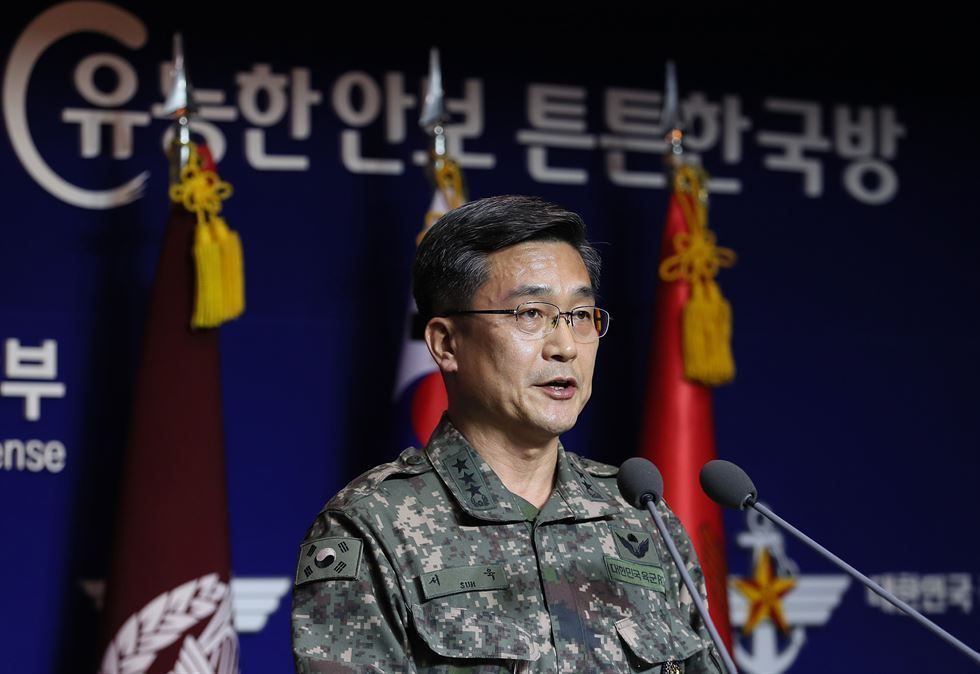
Suh Wook, chief director of operations at the Joint Chiefs of Staff, reads a statement from the Ministry of National Defense over the “provocative” low-altitude flight of a Japanese patrol aircraft close to a South Korean warship, Wednesday. / Yonhap
A Japanese maritime patrol aircraft carried out a low-altitude flight close to a South Korean warship Wednesday afternoon, in an apparent threatening and provocative action, according to the Ministry of National Defense.
“The P3 maritime patrol airplane flew at an altitude of 60 to 70 meters and about 540 meters away from the South Korean Navy’s destroyer in waters near Ieodo, [a rock southwest of the southern island of Jeju] at around 2:03 p.m., Wednesday,” the ministry said.
In response, the South Korean Navy lodged a strong complaint about the incident through a hot line, urging Japan to stop the recurrence of such acts. The Navy also said it will take steps for self-defense if Japan repeats such an “obvious provocation.”
The Navy said that the destroyer perceived the move as a security threat, adding that Japan should make it clear the exact reason for the low-level flight.
According to the ministry, Japan replied that it was “very inappropriate” for South Korea to threaten to take self-defense measures, as Japan is an ally and the Navy must have been able to discern that the aircraft belonged to the allied country.
You can read more at the link, but some how I doubt the ROK sailors on the ship were in a panic from a propellor driven P-3 flying 540 meters from their ship.
Remember the 100th anniversary of the March 1st Independence Movement is occurring soon. I would not be surprised if the Moon administration tries to get anti-Japanese sentiment to an all-time high, especially if he is able to get Kim Jong-un to visit Seoul that day.
I wonder how long it will be before these F-35’s are in a photo op flying over Dokdo?:
South Korea will acquire two stealth fighters from the United States in late March, allowing the country to fly the latest fifth-generation aircraft in the world, sources said Sunday.
The two F-35A jets will arrive in Seoul, and they will likely be assigned to combat units that defend the country starting in April or May, several insiders familiar with the matter said.
South Korea has agreed to purchase 40 F-35As in a 2014 contract. The jets are designed to evade detection and have the latest electronics suite that can allow them to be effective even in well defended airspace. A single plane is reportedly priced at around 120 billion won (US$107.5 million). Korea may buy 20 additional F-35s as the Air Force has requested more assets.