Category: North Korea

ISIS Report States North Korea Building New Facility to Manufacture Hydrogen Bomb Ingredients

It would not be surprising if this facility is in fact being built to manufacture hydrogen bomb ingredients considering the Kim regime’s state goal of building a hydrogen bomb.  With that said I think the Institute for Science and International Security (ISIS) may want to get a different acronym to describe themselves with:

north korea nuke

North Korea is forging ahead with construction of a new nuclear facility believed to be designed to separate isotopes from spent fuel, such as tritium, a key ingredient for hydrogen bombs, a U.S. research institute said.

The Institute for Science and International Security said in a report released Monday that satellite imagery taken on Jan. 25 of the North’s Yongbyon nuclear complex shows “external construction signatures” at the new facility site, such as vehicles, construction material, and earth displacement activities.

“The precise purpose of this site remains unknown. However, it is of interest because the signatures visible through a historical analysis of satellite imagery are consistent with an isotope separation facility, including tritium separation,” ISIS said.

“This assessment is shared not only by an expert ISIS consulted but also by a government expert we consulted who has long experience in assessing activities at the Yongbyon site,” it said.

In September, ISIS first raised the possibility that the new facility could be an isotope separation plant.

If confirmed as such, the facility would separate isotopes from spent nuclear fuel rods from the 5-megawatt reactor, the North’s main plutonium-producing reactor, the institute said at the time. Though the reactor is not an ideal producer of isotopes, it can be used in that way, it added.  [Yonhap]

You can read more at the link.

Tweet of the Day: Birthday Blast

North Korea Launches Propaganda Balloons With Used Toilet Paper In Them

Leave it to the North Koreans to come up with propaganda balloons this crude:

north korea balloon image

North Korea has been floating balloons over the border with a cargo of propaganda leaflets denouncing the United States as well as South Korean leader Park Geun-hye, calling her “political filth.”

Recently, the leaflets have been accompanied by genuine filth: cigarette butts and used toilet paper.

According to military and police sources Monday, Pyongyang began sending the balloons carrying leaflets starting from Jan. 12 to retaliate for South Korea’s resumption of propaganda broadcasts at the border earlier that week.  [Joong Ang Ilbo]

You can read the rest at the link.

How Can the US Defend Itself From A North Korean ICBM Attack?

That is what the National Interest answers for its readers:

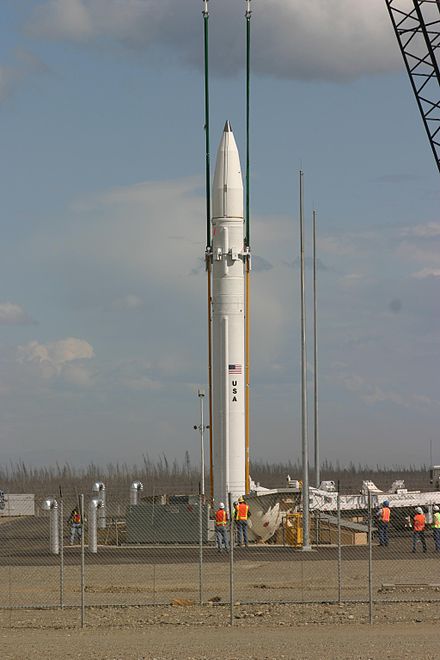
Ground Based Interceptor at Ft. Greeley, Alaska via Wikipedia.

But as with almost all North Korean developments and proclamations from the exalted “supreme leader” Kim Jong-un, it’s hard to say what’s real and what’s a delusional fantasy. Nonetheless, Washington has to take the possibility of a nuclear-tipped North Korean ICBM seriously. What, then, can the United States do to stop a North Korean ICBM that’s headed towards the American homeland?

To a large extent the United States has prepared from this eventuality. The best way to stop a North Korean ICBM would be to eliminate the target before it’s launched. But if the regime in Pyongyang—in a move that would guarantee a devastating U.S. nuclear retaliation—manages to launch a missile towards an American city, Washington has an operational missile defense system in place.

The Missile Defense Agency’s Ground-based Midcourse Defense (GMD) element provides Washington the ability to destroy a limited number of incoming intermediate and long-range ballistic missiles threats in space to defend the United States. There are interceptors already in place at Fort Greely, Alaska, and at Vandenberg Air Force Base, California. Right now there are a total of thirty interceptors deployed, but there are plans to add fourteen more missiles.   [National Interest]

You can read more at the link about other missile defenses the US has, but first of all launching an ICBM at the US would be a weapon of last resort since the US response would be so devastating against the North Koreans.  Additionally the rocket they are threatening to fire now would be easy to destroy left of launch since it takes days to prepare it for launch.  That is why the North Koreans have fielded the KN-08 ICBM that is road mobile and much more easier to launch.  However, it has never been tested and many have claimed they are mock ups.

For all we know the Kim regime could be playing the same games that Saddam Hussein did with exaggerating his military capability.  However, military leaders have to prepare for the worst case a threat poses and thus why the Kim regime’s threats are taken so seriously.

Picture of the Day: Kim Jong-un Visits Textile Mill

N. Korea's Kim visits textile mill

North Korean leader Kim Jong-un (C) is featured being heartily greeted by women workers of the Kim Jong Suk Pyongyang Textile Mill that he visited in this photo carried by the country’s official media, the Korean Central News Agency, on Jan. 28, 2016. The news report said Kim expressed deep satisfaction “picturing to himself students going to and from school with cheerful laughter, carrying with them locally produced fashionable bags” manufactured at the facility. (Yonhap)

North Korea May Have Tested Hydrogen Bomb Components

The data inconclusive, but I would not be surprised if the North Koreans did in fact test some hydrogen bomb components:

north korea nuke

The U.S. now believes North Korea might have attempted to test components of a hydrogen bomb on January 6, after further review and analysis of the latest intelligence information.A U.S. official directly familiar with the latest U.S. assessment said there may have been a partial, failed test of some type of components associated with a hydrogen bomb. The assessment comes after careful examination of the latest intelligence analysis of the test data.

But the official emphasized there is no final conclusion.Immediately following the test earlier this month, White House Press Secretary Josh Earnest said the initial analysis that have been conducted was “not consistent” with a successful hydrogen bomb test.The U.S. still does not accept North Korea’s claim that it tested a hydrogen bomb, but air sampling conducted after the test has proved inconclusive, the official said. That prompted another look at the seismic data.

That analysis shows the test was conducted more than two times deeper underground than originally assessed — at a depth consistent with what might be needed for a hydrogen bomb.However, the size of the seismic event and other intelligence indicates it was not likely a fully functioning device. The official said it’s possible the North Koreans believe they conducted a full hydrogen bomb test, but the U.S. believes it was likely only some components, perhaps a detonator, that exploded.  [CNN]

Are the North Koreans Planning A Rocket Launch In Response to Possible UN Sanctions?

It appears that the North Koreans are preparing for a response to any United Nations sanctions the US may be trying to get implemented in response to their recent nuclear test.  In fact US Secretary of State John Kerry is in China trying to get the Chinese government to agree to a sanctions deal.  A rocket test would be a fitting way to thumb their noses at any UN sanctions that may be passed:

Speculation mounted Friday that North Korea is preparing a rocket or long-range missile launch to follow its recent nuclear test, with Japan reportedly ordering its military to shoot down any projectile that threatened its territory.

With existing UN Security Council resolutions banning North Korea from the use of ballistic missile technology, any launch would be a further slap in the face of the international community which is struggling to find a united response to the January 6 nuclear test.

Following a Japanese report that cited government sources as saying a rocket launch could come as early as next week, two US defence officials confirmed ongoing activity at the North’s Sohae satellite complex.

“The indications are that they are preparing for some kind of launch,” one US official told AFP, speaking on condition of anonymity.

“Could be for a satellite or a space vehicle — there are a lot of guesses. North Korea does this periodically — they move things back and forth,” the official said.

The United States regularly monitors North Korea from space, while Japan began satellite monitoring of the country in 2003.

North Korea successfully put a satellite into orbit with its Unha-3 carrier in December 2012.  [AFP]

You can read more at the link, but the best report I have read about any possible launch is over at 38 North which has a lot of good commercial imagery of the test site and have settled on this conclusion of what the North Koreans are doing:

The level of activity throughout the Sohae facility at the launch pad, covered rail station, VIP housing area, launch control bunker and NADA facilities (particularly the helipad) raise justifiable concerns that North Korea may be preparing for the launch of a space launch vehicle. Moreover, the level of activity throughout the site is unlikely to be justified by what appears to be an imminent rocket engine test. If Pyongyang is preparing for a rocket launch, available imagery indicates that a launch is not imminent and that the North may be at an early stage of preparation.

However, there is a high level of uncertainty about this judgment for a number of reasons. First, the gantry tower work platforms are covered by an environmental cover and are folded forward, obscuring any view of whether a rocket is inside or not. Second, the movable transfer structure could easily allow for stages to be assembled and transferred to the gantry tower during periods of darkness or heavy cloud cover. In the earlier image the structure did not appear to have moved since the snowfall observed in a December 4 image as its tracks remained snow covered. Since the entire launch pad area is now clear of snow, any movement by the structure cannot be determined. Third, commercial satellite imagery coverage of the test site is not continuous and therefore observers only have snapshots of activity at the launch pad.

If North Korea follows previous pre-launch preparation practices, we would expect to see in the coming days increased site-wide activity, traffic at the fuel/oxidizer storage bunkers, activity at the launch pad and the presence of tracking equipment.  [38 North]

I recommend reading the rest at the link.

Should American Citizens Be Banned from Visiting North Korea?

Considering the political fall out every time an American is arrested it is amazing that a travel ban has not been instituted on North Korea a long time ago.  If a travel ban is not instituted then the US government should at least make it very clear that it will not negotiate to get detainees released:

Passengers board an Air Koryo plane bound for Beijing at the Pyongyang International Airport in Pyongyang, North Korea, in June 2015. The U.S. State Department has long warned against travel to North Korea, but it is now reportedly seeking a ban on tourism.

Without banning it outright, the U.S. State Department has long warned against travel to North Korea. But, post nuclear test, the U.S. is now reportedly seeking a ban on tourism and restrictions to keep the North’s flagship airline, Air Koryo, from flying into and out of airports abroad. Most tourists board their flights to Pyongyang from Beijing.

As yet, none of the major North Korea travel agencies are canceling upcoming trips. One of the year’s biggest tourist draws, the Pyongyang marathon, is just months away.

They are, however, concerned about the fallout from Warmbier’s arrest.

China-based Young Pioneer stressed in a news release that Warmbier was the first of the 7,000 people it has taken to North Korea over the past eight years to face arrest. Uri Tours, based in New Jersey, told AP that it has also had only one such case — American Matthew Miller, who ripped up his tourist visa on arrival in what he has said was a deliberate attempt to get arrested.  (……….)

“Critics claim that tourism is an avenue for the DPRK government to arrest Americans as political hostages. However, this has not been our experience,” she said. “We’ve taken many American tourists and with the exception of Matthew Miller, they’ve all returned safely with positive feedback.”  [Stars & Stripes]

You can read more the link.

Tweet of the Day: Should Davos Have Included North Korea?

Can Targeted Financial Sanctions Against North Korea Work?

38 North has an op-ed in response to the recent article that a ROK Drop favorite Joshua Stanton contributed to on CNN.  The author Joseph DeThomas doesn’t believe that the targeted sanctions that Stanton advocates for will work:

A recent op-ed by Sung-Yoon Lee and Joshua Stanton highlights what should happen in dealing with North Korea. Unfortunately, for this long-time practitioner in the field of nonproliferation sanctions, it also highlights what cannot happen—or at least what cannot happen at an acceptable level of risk with the limited knowledge and the complex agendas that policymakers face.

At the highest level of analysis, Lee and Stanton get some key points right. The effort of multiple US administrations to negotiate away the threat of North Korean nuclear weapons has been a truly bipartisan failure. Four US presidents—two of each party—have tried and yet it seems the story of failure repeats itself in very familiar ways. However, the authors certainly over-simplify the story of those efforts. It is worthy of note that the four administrations came at the problem from very different perspectives and initially tried tactics that ranged from highly confrontational to being predisposed to engagement. Yet, all ended up more or less in the same policy dead-end. This might lead one to suspect that the problem with North Korean policy might not rest primarily with naiveté in Washington but rather with a single-minded Pyongyang that has a very limited diplomatic repertoire.

Lee and Stanton are correct that it is extremely unlikely that any set of negotiated incentives will ever induce the DPRK to give up its nuclear weapons. They are probably also correct that—if North Korea were to be coerced into giving up its weapons—it would require regime-threatening measures to be put into play. But, that does not mean that such measures can be created at this time. Moreover, it does not mean they should be implemented unless a careful calculation of the costs and benefits can be made.  [38 North]

You can read the rest at the link.