I think President Trump couldn’t care less what the Kim regime thinks of what he says:
This file photo released by the Korean Central News Agency on Sept. 24, 2017, shows North Koreans holding a mass anti-U.S. rally in Pyongyang on Sept. 23, 2017. (Yonhap)
North Korea threatened “merciless punishment” on U.S. President Donald Trump over “foolish remarks” on Sunday, two days before his state visit to South Korea.
The Rodong Sinmun, the main newspaper and organ of the ruling Workers’ Party of Korea (WPK), published a commentary accusing Trump of “seriously stimulating” North Korea with his words.
Trump kicked off his Asia tour in Japan earlier Sunday. He’s scheduled to land in South Korea on Tuesday for a summit with President Moon Jae-in during his two-day visit.
Trump has engaged in a war of words with North Korean leader Kim Jong-un, referring to Kim as “Little Rocket Man” and threatening to “totally destroy” North Korea.
In the report carried by the Korean Central News Agency (KCNA), Rodong Sinmun argued Trump must heed assertions from other U.S. experts that he must “halt the reckless blackmail and take hands off the Korean affairs.”
“Nobody can predict when Trump does a reckless act. The only and one way for checking his rash act is to tame him with absolute physical power,” the report said in English. “If the U.S. misjudges (North Korea’s) toughest will and dares to act recklessly, the latter will be compelled to deal a resolute and merciless punishment upon the former with the mobilisation of all forces. The U.S. has no energy to prevent it. Then its regret is too late.” [Yonhap]
You can read more at the link, but I am really curious to see if President Trump will use this trip to South Korea to make a “tear down this wall” type of speech towards North Korea?
This sounds more like business as usual in North Korea than an actual purge:
North Korean leader Kim Jong-un has resumed his purges, the National Intelligence Service here said Thursday.
In an audit by the National Assembly Intelligence Committee, NIS officials said Kim has stepped up surveillance of senior officials and resumed purges and executions to create a climate of fear.
Lawmakers quoted officials as saying Kim sent several senior editors of the Rodong Sinmun daily to a reeducatiom camp for failing to celebrate a missile launch on the front page, and executed a senior officer of an anti-aircraft battery in Pyongyang for corruption. [Chosun Ilbo]
Former North Korean diplomat turned defector, Thae Yong-ho is calling for the US to increase its efforts to fight the information war within North Korea:
Thae Yong-ho speaks at the Center for Strategic and International Studies in Washington on Oct. 31, 2017. (Yonhap)
The North Korean leader does not have a full grasp of the strength and might of U.S. military power, Thae said, leading him to believe that if he can get Washington to accept Pyongyang’s possession of ballistic missiles capable of reaching the U.S., all sanctions against his regime will be lifted.
The former diplomat is in Washington at a time of heightened tension over Pyongyang’s nuclear and missile testing. U.S. President Donald Trump is set to travel to Asia on Friday in part to rally further support behind his administration’s sanctions and pressure campaign.
But Thae appeared to question the U.S. policy.
“We can educate the North Korean population to stand up by disseminating outside information,” he said. “However, is the United States really doing enough in this regard? The U.S. is spending billions of dollars to cope with the military threat. Yet how much does the U.S. spend each year on information activities involving North Korea in a year? Unfortunately, it may be a tiny fraction.” [Yonhap]
You can read more at the link, but this is something I have been saying for years is that fighting the information campaign inside of North Korea should be aggressively pursued. Something else Thae discussed was the world coming together against the Kim regime like it did to end Apartheid in South Africa. This is another viewpoint I have advocated for is that why is North Korea welcomed at international venues like the Olympics when Apartheid South Africa was shunned? Apartheid South Africa had no where near the human rights abuses or was a threat to world peace as the Kim regime currently is.
Over at One Free Korea he has videos of Thae’s speech available which should be required viewing for those interested in this topic. OFK also has some great analysis I recommend everyone read as well.
Here is what another so called North Korea expert says should be done to resolve the ongoing nuclear crisis which is basically more of the same that has led to the slow motion acquisition of North Korean nuclear weapons and ballistic missiles:
Kelsey Davenport
Diplomacy is the only way to achieve a peaceful resolution of the North Korea nuclear crisis, according to Kelsey Davenport, director for nonproliferation policy at the Arms Control Association.
She said that in order to bring North Korea back to negotiations, U.S.President Donald Trump and his administration should send a sincere, consistent message that the offer of engagement is real.
“Diplomacy is the only path forward to resolve the North Korean nuclear crisis,” Davenport said in a recent interview.
“The Trump administration purports to advance a strategy of maximum pressure and engagement but U.S.actions and rhetoric expose a serious diplomacy deficit,” she added.
She pointed out that mixed messages from Trump and top administration officials about U.S.intentions to engage in talks further complicate the environment.
“The Trump administration can and must signal to North Korea that it is willing to engage in talks without preconditions,” she said.
“Direct talks would give the U.S.an opportunity to discuss a path forward with North Korea to reduce tension.”
Davenport stressed that the U.S.Congress should also refrain from activities that heighten tension and muddy the waters regarding the prospects of diplomacy.
“That may require putting denuclearization on the back burner, voicing support for shorter-term, more manageable goals, and giving existing sanctions time to work before pushing new measures,” she said. [Korea Times]
You can read more at the link, but all I read was more of the same strategy used for the past 25 years that has led to where we are at today.
Ms. Davenport’s strategy is to once again reward the North Koreans for their bad behavior by limiting US-ROK military drills. She says it would not impact military readiness, how would she know that? In my opinion cancelling a UFG or Key Resolve exercise would impact readiness considering the constant change over of personnel in Korea and the amount of off-Pen augmentees that participate in the training.
Ms. Davenport believes offering up a military exercise will lead to the “freeze deal” that many in the academic world are calling for. I think if any freeze deal is pursued it should include robust inspections and the risk of a retaliatory bombing strike if it is not complied with. However, I am doubtful the Kim regime will ever sign up for vigorous inspections when they know the so called experts are more interested in making a deal than actually denuclearizing North Korea.
This is not surprising to people who have been following this issue, but stopping the foreign parts supply to North Korea is hopefully a major effort being taken by the US government:
Debris from a 2016 North Korean rocket launch
So far this year, North Korea has conducted 16 test launches of missiles, virtually each one personally approved by the country’s young dictator, Kim Jong-un. With every test, North Korea takes a step toward its ultimate goal: an intercontinental ballistic missile capable of hitting the United states with a thermonuclear warhead.
This week on 60 Minutes, correspondent David Martin and producer Mary Walsh report just how close the North Koreans are to that goal — and how they get their hands on the parts to do it.
Martin and Walsh interviewed Hugh Griffiths, head of the team that monitors the North Korean missile program and their compliance with sanctions for the U.N. Security Council. During the interview, Griffiths showed the 60 Minutes team a series of stunning photos of rocket debris, which revealed the the inner workings of a North Korean missile.
“What makes this rocket fly was in those photos,” Walsh tells 60 Minutes Overtime in the video above. “And that’s what made them so valuable to the U.N. inspectors, but also to 60 Minutes.”
The recovery of North Korean rocket debris is highly unusual, says Griffiths. In February 2016, North Korea launched a satellite into orbit, and while the satellite wasn’t very serious, the rocket that launched it was. “I think most people around the world agree, the point of this test was not to put a satellite into orbit,” Martin says. “The point of this test was to try out technologies for an intercontinental ballistic missile.”
Before launch, North Korea filed a Notice to Airmen and Mariners, warning them that debris may fall from the sky in a designated area. The South Koreans, in turn, knew exactly where to go in an attempt to recover the debris for intelligence purposes.
To block the South Koreans from collecting their debris, the North Koreans rigged the rocket with explosives that were supposed to detonate after boosting the satellite into orbit, Griffiths says. The rocket was meant to self-destruct, rendering its parts unrecognizable. But that system failed, says Griffiths, leaving the South Koreans with a debris field to collect and analyze.
“This was a gold mine,” correspondent David Martin says. “You just get this in-depth, excruciatingly detailed understanding of how these missiles work.” [60 Minutes]
You can read more at the link, but considering the North Koreans may be planning to launch another ICBM disguised as a space launch it will be interesting to see if they put out a notice beforehand again? Considering the intelligence value the ROK received from the recovered debris from the last launch it will be interesting to see what the regime decides to do.
If this report is true, the fact these workers were tunneling shows that the Kim regime has future plans for more nuclear tests:
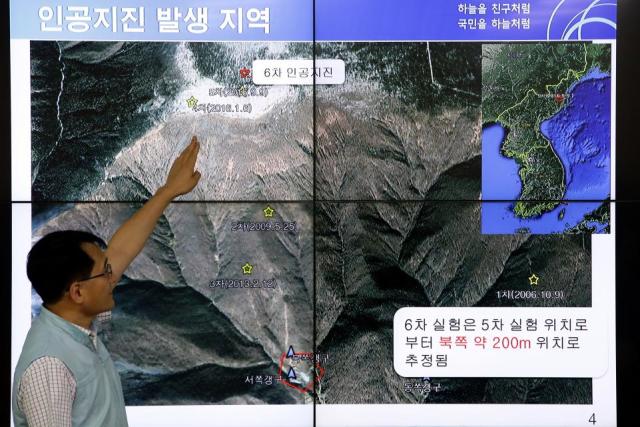
A South Korean scientist shows seismic waves taking place in North Korea on a screen at the Korea Meteorological Administration center on September 3, 2017 in Seoul. More than 200 people are believed to have died in underground tunnels after a collapse at North Korea’s Punggye-ri nuclear facility.
More than 200 people are believed to have died in underground tunnels after a collapse at North Korea’s Punggye-ri nuclear facility.
The test site was reportedly badly shaken by the aftermath of the country’s sixth nuclear test, a 100-kiloton hydrogen bomb roughly seven times more powerful than the atomic bomb the U.S. dropped on Hiroshima in 1945.
North Korean sources told Japanese television channel Asahi TV that the collapse occurred in October during the construction of an underground tunnel at the facility.
Around 100 workers were stuck underground and a group that was sent to their rescue were also buried after another collapse, causing a total death toll of around 200.
A series of small-scale earthquakes that followed the September 3 test indicated the facility, built south of the Mantapsan mountain, may no longer be stable enough to conduct further tests. [Newsweek]
You can read more at the link, but I wonder how many of the workers killed were just forced laborers from the regime’s system of gulags?
This photo, released by the North’s Korean Central TV Broadcasting Station on Feb. 7, 2016, shows North Korea’s “Kwangmyongsong-4” satellite being fired from the Dongchang-ri launch site in Cholsan, North Pyongan Province. The North launched the rocket in a move widely viewed as a disguised ballistic missile test in defiance of United Nations Security Council resolutions. (Yonhap)
North Korea said Monday it will launch more satellites as any sovereign country has the right to develop a space program amid speculation that it is preparing more provocative acts.
North Korea will place into space more satellites, including a stationary one, in accordance with its five-year space development program as it seeks to improve its economy and people’s livelihood, according to the Rodong Sinmun, the main newspaper.
“Some countries have manipulated U.N. sanctions resolutions against us and hindered the sovereign country’s space development. It is not a tolerable act,” the newspaper said. “It is a global trend that a country seeks the economic growth with the space program.” [Yonhap]
You can read more at the link, but the last time North Korea did a space launch they announced it and invited foreign journalists to the launch site. It will be interesting to see if they try and take this same approach to fire their next rocket.