A nurse with protective gear makes preparations at Dongsan Hospital in the virus-hit city of Daegu on April 6, 2020.
South Korea’s new coronavirus cases hovered around 50 for the third straight day Wednesday, but the nation marked the grim milestone of 200 virus deaths.
Health authorities renewed calls for people to maintain social distancing to curb the spread of the virus, as cluster infections at churches and hospitals, as well as new cases coming from overseas, are still rising steadily.
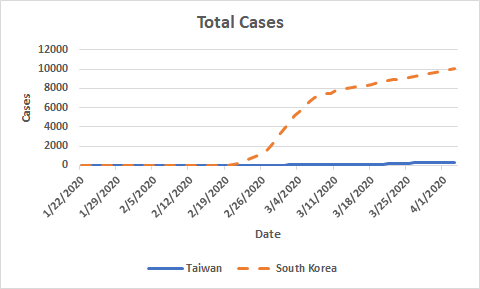
The 53 new cases, detected Tuesday and up from 47 new cases a day ago, brought the nation’s total number of infections to 10,384, according to the Korea Centers for Disease Control and Prevention (KCDC).
Dr. Tara O makes a very compelling case that the international media should be looking at Taiwan as a great example of what to do to combat COVID-19 instead of South Korea:
Taiwan recognized the threat early on and rapidly began to take measures. It inspected and screened travelers from Wuhan, the epicenter of the SARS CoV-2, as early as December 31, 2019. It also actively monitored travelers from Wuhan who had already entered Taiwan on December 20, 2019 and onwards. It had developed screening, testing, and quarantine protocols early based on lessons from the SARS 2003 outbreak. It also engaged in aggressive contact tracing to ensure everyone that came into contact with an infected person was quarantined and tested. On February 6, 2020, Taiwan banned travel from China.
Unlike Taiwan, South Korea never banned travel from China, although the Korean Medical Association (KMA) and the public called for such measures multiple times. South Korea eventually restricted travel from Wuhan on February 2, 2020, but it was not until after China had already quarantined the City of Wuhan on January 23, 2020. KMA, on February 3, made its fifth request to the government to ban entry from China, saying South Korea is losing its “golden time” of prevention, and it will become “regional spreads.” KMA also highlighted inadequate tracking of visitors from China. KMA’s concerns and the government’s inadequate tracing are not reflected in foreign reports that praise South Korea’s tracing.
On January 31, 2020, 11,345 people traveled from China to South Korea. Multiplying by 30 days, that would be more than 340,350 people in one month. If 1% were infected with the coronavirus, that would be 3,403 infected people entering South Korea.
What I think Dr. O is getting after is that the international media has been heaping great praise on President Moon’s response to COVID-19 without mentioning his administration’s previous missteps which also included lack of masks and testing. Even the testing today there is misinformation in the international media about free testing in South Korea, but don’t mention that a sick person needs to have a CT Scan or an X-ray done before a coronavirus test can be conducted. The cost of the CT scan and X-ray could dissuade people from getting tested.
The only reason why I can think of that the international media isn’t instead lavishing praise on Taiwan is because they don’t want to deal with the backlash from China. So the Moon administration has become a better example to damage the Trump administration with. Pointing out the Moon administration’s failings does not help with that goal and thus why they only focus on things that the Moon administration has done right.
Anyone else have any alternate theories on why the international media is not focusing on what the Moon administration has done wrong?
This is going to be tough for parents to stomach that try to limit the amount of time kids spend in front of a television:
In this file photo from March 31, 2020, a boy looks through closed gates at an elementary school in the Yongsan district of central Seoul. (Yonhap)
In a new learning environment in South Korea created by the coronavirus outbreak, getting glued to the television screen won’t be such a bad thing for young students.
The education ministry announced on Sunday that, starting on April 20, first and second graders in elementary school will be following instructions offered in TV programs and handout materials, rather than through live online classes like older students. Those programs will air on the state-run Educational Broadcasting System (EBS).
You can read more at the link, but I find just the general educational programming on EBS is pretty good so it will be interesting to see what they come up with for general educational instruction.
For any foreigner that wants to get easily tested for COVID-19 head on over to the Seoul Sports Complex. The article says it takes about 15 minutes to get tested:
This photo shows a walkthrough screening center set up at Seoul Sports Complex in southeastern Seoul on April 3, 2020. (Yonhap)
A walkthrough virus screening center for overseas entrants opened at a major sports complex in southeastern Seoul on Friday amid a continued increase in imported cases.
The screening center, which Seoul Mayor Park Won-soon claimed could test up to 1,000 people per day, was set up at Seoul Sports Complex, the site of the 1986 Asian Games and 1988 Summer Olympics.
On the first day of operation, the screening venue appeared mostly quiet, with around 10 people visiting during a two-hour slot.
Visitors said they came to the walkthrough to be tested promptly.
“I arrived (in South Korea) on Thursday and have been taking a language course in San Diego,” said a 23-year-old who lives in the northeastern ward of Nowon. “I was told that it would take some time for me to be tested at the Nowon health center, which is why I came here.”
You can read more at the link, but with 10,156 infections and 177 deaths that means the mortality rate is at 1.7%, but is probably at least half that with all the people infected that don’t know about it.
South Korea will begin the new school year with online classes on April 9 following repeated delays due to the novel coronavirus, the prime minister said Tuesday.
The unprecedented move to introduce online classes will be applied step by step at schools, Prime Minister Chung Sye-kyun said, without elaborating.
Here is another article about foreigners spreading the coronavirus:
Another foreigner has been caught ignoring the self-isolation rules that are being implemented to prevent the spread of coronavirus.
Busan City said Sunday a German student, 25, had ignored the instruction after entering the country on March 20. The student, enrolled at Pusan National University, is being treated at the school’s hospital after testing positive for coronavirus on March 28.
The student, whose identity was withheld, entered the country through Gimhae International Airport on March 20, without symptoms of coronavirus infection. Before coming to Korea, he briefly visited the United States and Japan, according to the city.
Despite being devoid of suspicious symptoms, he was subject to mandatory two-week self-isolation in his dorm room. But he ignored this.
It looks like soon Americans will begin getting tested with Korean made coronavirus test kits though there appears to be some confusion of when the approval will officially be given:
The foreign ministry reconfirmed Monday that three South Korean coronavirus test kits can be exported to the United States as they were given pre-emergency use authorization numbers from the U.S. Food and Drug Administration (FDA).
On Saturday, the foreign ministry issued a press release that the three unidentified companies have gained preapproval in the FDA’s emergency use authorization (EUA) process and that their diagnostic devices can be sold in the U.S. market.
But the announcement created confusion as it turned out that none of the test kit manufacturers that applied for EUA approval knew about the authorization. Some newspapers accused the ministry of making the announcement in a hurried manner to show it is the result of President Moon Jae-in’s diplomacy toward the U.S.
The articles blaming foreigners for spreading coronavirus in South Korea has expanded to include the United States now:
Travelers from London wait in line at Incheon International Airport, west of Seoul, to take a bus heading to virus testing clinics on March 23, 2020. (Yonhap)
As of Monday, the number of COVID-19 cases in the U.S. surpassed 33,400, according to the U.S. Centers for Disease Control and Prevention, the third largest in the world after China and Italy.
“As the number of virus patients increases quickly in the United States, health authorities should conduct virus tests on all arrivals from North America,” said Kim Woo-joo, a professor of infectious medicine at Korea University Guro Hospital.
Experts warned that the number of imported cases involving U.S. travelers could increase. Of the 14 new imported cases reported on Monday, eight of them were from the United States.
Doctors said that arrivals from the United States should also be quarantined for two weeks even if they test negative for the virus because of the virus’ incubation period and possible asymptomatic carriers.
On top of the coronavirus test they will also be held in quarantine for 14 days:
Passengers who arrived at Incheon International Airport, west of Seoul, aboard a flight from Frankfurt, Germany, head to where they can be tested for the new coronavirus on March 22, 2020, as the South Korean government tightened its quarantine procedures for inbound travelers from Europe to prevent any inflow of the virus from outside. (Yonhap)
South Korea on Sunday began conducting new coronavirus tests on all arrivals from Europe and requiring even those with negative results to undergo a 14-day self-quarantine as part of efforts to prevent any inflow of the virus from outside.
Starting at midnight, the government set in motion the screening measure for both its citizens and foreigners, amid growing concerns over a steady rise in the number of imported COVID-19 cases.
On Sunday, more than 8,510 people are to arrive in Korea from overseas. Of them, about 1,000 are from Europe, which has become a new front line in the global fight against the virus, with Italy having clocked more than 4,820 deaths.