You would think that with an issue as sensitive as the comfort women issue, that there would be checks to make sure the non-profit supporting those affected were credible and honest. Well that appears to have not been the case:
The gates are shut Sunday at a house in Sangjung-ri, Geumgwang-myeon, in the city of Anseong in Gyeonggi, that was supposed to be used as a facility for “comfort women” victims. The house was purchased by a civic group in 2013 reportedly at much higher price than the market value . [YONHAP]
A civic group supporting victims of Japanese wartime sexual slavery reportedly purchased a house in Anseong, Gyeonggi, for 400 million won ($324,000) over market value.
The Korean Council for Justice and Remembrance for the Issues of Military Sexual Slavery by Japan has been under fire for recently selling this facility, which was supposed to serve as a center for victims of the Japanese military’s sexual slavery during World War II. The facility, the House of Peace and Healing, was sold for 420 million won on April 24 at a reported loss.
The Korean Council bought the two-story house in a residential area in Sangjung-ri, Geumgwang-myeon, in the city of Anseong in September 2013 for 750 million won — much more than the price of comparable properties in the area. Hyundai Heavy Industries at the time donated 1 billion won designated to building a healing center for “comfort women” victims.
Yoon Mee-hyang, a lawmaker-elect and former head of the civic group, has faced various accusations of mishandling of the civic group’s donations. She put her father in charge of maintaining this facility, which had reportedly been used for church functions, workshops and retreats rather than for its original purpose.
Lee Yong-soo, a 91-year-old comfort woman survivor and longtime rights activist, questioned Yoon’s integrity in a press conference earlier this month, which has led to a string of accusations against the Korean Council and Yoon on financial transparency. Yoon was elected as a proportional representative of the Citizen Party last month and had rebutted the various accusations.
This is likely going to be the new normal in South Korea, dealing with periodic cluster infections:
This file photo, taken on May 19, 2020, shows Samsung Medical Center in southern Seoul, where four nurses tested positive for the new coronavirus. (Yonhap)
South Korean health authorities were put on edge again on Tuesday as yet another cluster case looms, at a major hospital in Seoul, following mass infections tied to nightclubs and bars in the nightlife district of Itaewon.
Four nurses working at Samsung Medical Center, one of the country’s five major general hospitals, were confirmed to have been infected with COVID-19, and more related cases are likely to come as transmission routes are unknown, according to the Korea Centers for Disease Control and Prevention (KCDC).
The Moon administration has been doing a really good job flexing South Korea’s soft power during the coronavirus pandemic. Here is the latest example:
Navajo code talker troops photographed during World War II. [UNITED STATES MARINE CORPS]
South Korea will provide thousands of face masks and other medical supplies to the Navajo Nation of the United States as gratitude for their participation in the 1950-53 Korean War.
According to the Ministry of Patriots and Veterans Affairs, 10,000 face masks and goods like hand sanitizers will be shipped to the United States to aid surviving Navajo veterans of the war.
Around 800 Native Americans of the Navajo Nation fought in the war as part of the U.S. Armed Forces, around 130 of whom are still alive today.
The Korean Consulate in Los Angeles, in consort with the Korean community in Arizona and Korean Christian missions in the United States, will deliver the medical supplies to the Navajo Nation.
Sex dolls fill an empty football stadium in western Seoul during Seoul’s game with Gwangju, Sunday. Yonhap
Seoul’s K League football team apologized Monday over filling its stadium in western Seoul with sex dolls during its Sunday game with Gwangju FC but placed the blame on its supplier.
“We tried to make sure the mannequins weren’t sex dolls multiple times,” FC Seoul said in an apology posted on Instagram, adding that it happened because of a mix-up by the suppliers. “We take the blame on this point. We should have paid attention to details (when communicating with the supplier).”
Here is some good news about people who relapse after recovering from the coronavirus:
Citizens take tests for the new coronavirus at a clinic in Yongsan, central Seoul, on May 18, 2020. (Yonhap)
– South Korean health authorities said Monday they will lift quarantine measures for patients who retested positive for the new coronavirus, as they did not find any evidence that such cases pose the risk of infecting others.
Coronavirus relapse cases have been a headache for public health authorities here in their battle against the pandemic. So far, the country has reported 447 such cases, or 4.5 percent of the country’s total caseload of 11,065.
You can read more at the link, but medical professionals have not found one person that has been infected by someone who has relapsed. This suggests the virus is no longer contagious at this point and why quarantine restrictions on these patients have been lifted.
It is probably only a matter of time before a cluster infection happens at a church, if one does happen, it makes me wonder if the government will use that as an excuse to close all the churches again?:
An image of a Christian church service where worshippers keep a distance from each other (Yonhap)
Churches and temples remained on their toes Sunday, taking strict precautionary anti-virus measures, in the second week since the resumption of their public services following COVID-19 outbreaks.
South Korea eased strict social distancing guidelines on May 6, allowing churches, state-run museums and libraries to resume operations.
But following a recent resurgence of virus infections, traced to clubs in Seoul’s nightlife district of Itaewon, reopening churches and temples remained highly vigilant. Some religious groups reported fewer on-site worshippers this weekend, compared with a week earlier.
You can read more at the link, but according to the article church attendance is way down and congregations are using social distancing during services and having their temperatures checked before entering.
The staff sergeant who is believed to be the main spreader of the Itaewon infection cluster has also reportedly infected a number of personnel he worked with the at the ROK Cyber Command as well:
Service members walk outside Seoul Station on May 8, 2020, after they were allowed to go on vacation after more than two months of restrictions amid fears about the spread of the new coronavirus. The military began to lift the restrictions on vacationing the same day in line with the government’s decision to end a weekslong, strict social distancing campaign amid signs of a slowdown in virus infections. (Yonhap)
An officer at the South Korean military’s cyber command has tested positive for the new coronavirus in the latest in a series of cases traced to a member of the command infected following a visit to clubs in Seoul’s Itaewon district, the defense ministry said Friday.
The new case raised the total number of infections in the military to 51.
The infected officer is one of the Cyber Operations Command personnel put into quarantine at a military facility in Goesan, some 160 kilometers southeast of Seoul, after having contact with a staff sergeant who contracted the virus following a visit to clubs and bars in Itaewon early this month.
Nine of the staff sergeant’s colleagues have been infected so far.
It doesn’t appear the Itaewon cluster infection is going to delay the reopening of Korean schools any more:
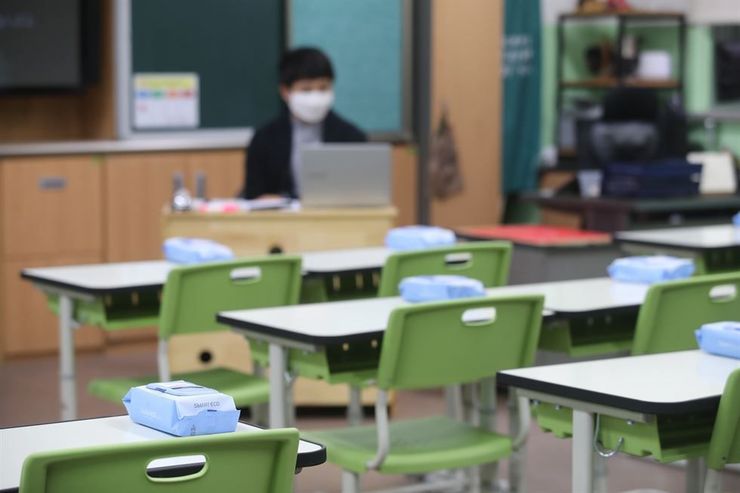
A teacher of a sixth-grade class, teaches an online class from an empty classroom in Borame Elementary School in Seoul, Friday. South Korea has introduced online classes for elementary, middle and high schools to ensure the safety of teachers and students during the coronavirus pandemic. /Yonhap
The education and health authorities will forge ahead with their plan to reopen schools for high school seniors next week, despite a recent spike in COVID-19 infections involving teachers and students, officials said Friday.
High school seniors are expected to return to school May 20, while those in other grades will return to school gradually over the following weeks.
“The Ministry of Education (MOE) is expected to proceed with its plan to reopen schools for high school seniors next week. The health authorities have been conducting strict disinfection of school facilities in preparation for their return,” said Vice Health Minister Kim Gang-lip in a regular briefing at the Government Complex in Sejong.
You can read more at the link, but the reopening of schools will likely be closely watched by the Trump administration. If South Korea can successfully do this, the Trump administration can point to this as a success story and that U.S. schools should reopen in the Fall as well.
Sung Sang-hoon (성상훈), a journalist who runs the Global Defense News (글로벌디펜스뉴스) YouTube channel and website, was arrested and jailed on May 13, 2020.
His “crime” was saying the Chinese man, who fell over and died in early February in front of a public health clinic, may have died of Coronavirus. The suppression of YouTubers and journalists already began under the Moon administration, including demonetizing many of them, but some expect it will get worse, especially since the ruling party has won by a landslide in the April 2020 general election, which is itself a huge controversy in South Korea. While many YouTubers are covering the election fraud issue extensively, the mainstream media hardly prints or broadcasts this issue.
I recommend reading the whole article at the link, but essentially Sung was jailed because he questioned whether a Korean-Chinese man who fell over and died in front of a clinic had coronavirus. He was trying to make the point that the Chinese brought the coronavirus to South Korea which the Moon administration has made efforts to deny.
Because of his statement he was sued for libel by the Pyeongtaek mayor who is part of the ruling Democratic Party of Korea. So like other journalists sued with libel laws he was arrested and jailed.
Could you imagine what the reaction in the media around the world would be if President Trump started jailing journalists, yet the international media has had zero interest in journalists being jailed in South Korea.
It was only a matter of time before the Korean media jumped on foreign English teachers for visiting Itaewon:
Foreigners wait to take COVID-19 tests at a clinic set up at Soonchunhyang University Hospital in Seoul, Monday.
Concerns are growing at schools as nearly 90 foreign English teachers were found to have recently visited Itaewon in Seoul, a new COVID-19 hot spot connected to more than 90 confirmed coronavirus cases, education officials said Tuesday.
The South Jeolla Office of Education said 36 foreign teachers and 15 Korean teaching staff visited Itaewon and the Hongdae area sometime between April 24 and May 6. Among them two visited nightclubs. The office said 20 tested negative for the virus and 31 are currently undergoing testing.
According to the South Jeolla provincial government, five residents including one foreign teacher were confirmed to have visited Itaewon during the period when a 29-year-old Korean “superspreader” visited a number of nightclubs there from May 1 to May 2, but all tested negative.
The Gangwon Provincial Office of Education also said 55 foreign teachers and substitute teachers visited Itaewon from April 24 to May 6. They didn’t visit clubs or bars, just a number of restaurants and coffee shops.
You can read more at the link, but the Korea Times writes an article about how schools are supposedly concerned about foreign born English teachers even though none of them have tested positive yet for the virus.
Does anyone think there were no ethnic Korean teachers that visited Itaewon during this timeframe?

![The gates are shut Sunday at a house in Sangjung-ri, Geumgwang-myeon, in the city of Anseong in Gyeonggi, that was supposed to be used as a facility for "comfort women" victims. The house was purchased by a civic group in 2013 reportedly at much higher price than the market value . [YONHAP]](https://i0.wp.com/koreajoongangdaily.joins.com/data/photo/2020/05/17/56b12f6b-984b-40da-ad0e-684218a1f0cc.jpg?w=640&ssl=1)

![Navajo code talker troops photographed during World War II. [UNITED STATES MARINE CORPS]](https://i0.wp.com/koreajoongangdaily.joins.com/data/photo/2020/05/18/48e6813b-6c75-4a85-92a4-7fcdc5afde89.jpg?w=640&ssl=1)