President Lee maybe talking nice about the Japanese now, but we all know how this is going to end. When Lee inevitably begins to slide in the polls or some scandal pops up, be prepared for the latest Dokdo or comfort women crisis to happen:
President Lee Jae-myung on Monday called for South Korea and Japan to join hands for a better future, casting the two neighbors as important partners bound to work together amid a rapidly changing global environment.
Lee made the remark in a congratulatory video message at the start of an event hosted by the Japanese Embassy in Seoul to mark the 60th anniversary of the establishment of diplomatic relations, which falls on this Sunday.
“South Korea and Japan are key partners who must cooperate closely in responding to a rapidly changing global landscape. Let’s join hands and move toward a better future,” Lee said.
The phrase “join hands and move toward a better future” is the official slogan for the 60th anniversary of the normalization of the ties. Korea was under Japan’s colonial rule from 1910-45
Tokyo station under capitalism, now featuring clean accessible restrooms. Let’s just turn the whole nyc subway over to JR (and give the company extraterritoriality) https://t.co/qXAVpyT3f5pic.twitter.com/EzS2rlcaji
I had no idea that the Japanese road tax sticker was designed by a USFJ civilian employee. This is a pretty cool story:
Tomoko Hyatt has no formal art training, but her designs are in high demand across Japan, displayed by tens of thousands of people and growing in popularity. Hyatt, a civilian employee at this U.S. airlift hub in western Tokyo, creates the colorful sticker that anyone under the status of forces agreement must display each spring on their personal vehicle to prove they have paid the annual Japanese road tax. (………)
Her husband, Matthew Hyatt, a meteorological technician with the 374th Operations Support Squadron, has a background in graphic design and introduced her to Adobe Illustrator. Her work has sparked a following. She recently launched a Facebook page — Tomoko’s Tokyo Treasures — where she sells items featuring her designs, including patches, ceramic ornaments and stickers.
At some point the Japanese have got to give the Senkaku Islands the Dokdo treatment and just put a small military garrison on it in order to show the island is and always will be Japanese:
Japan and China are accusing each other of violating the airspace around the Japanese-controlled East China Sea islands that Beijing also claims. Japan’s Foreign Ministry issued a statement saying that it has protested to Beijing after a Chinese helicopter that took off from one of China’s four coast guard boats had entered Japan’s territorial waters around the Senkaku island, violating the Japanese airspace around them for about 15 minutes on Saturday.
In response to the airspace intrusion, Japan’s Self-Defense Force scrambled fighter jets, the Defense Ministry said. China routinely sends coast guard vessels and aircraft into waters and airspace surrounding the islands, which China calls the Diaoyu, to harass Japanese vessels in the area and force Japan to scramble jets in response.
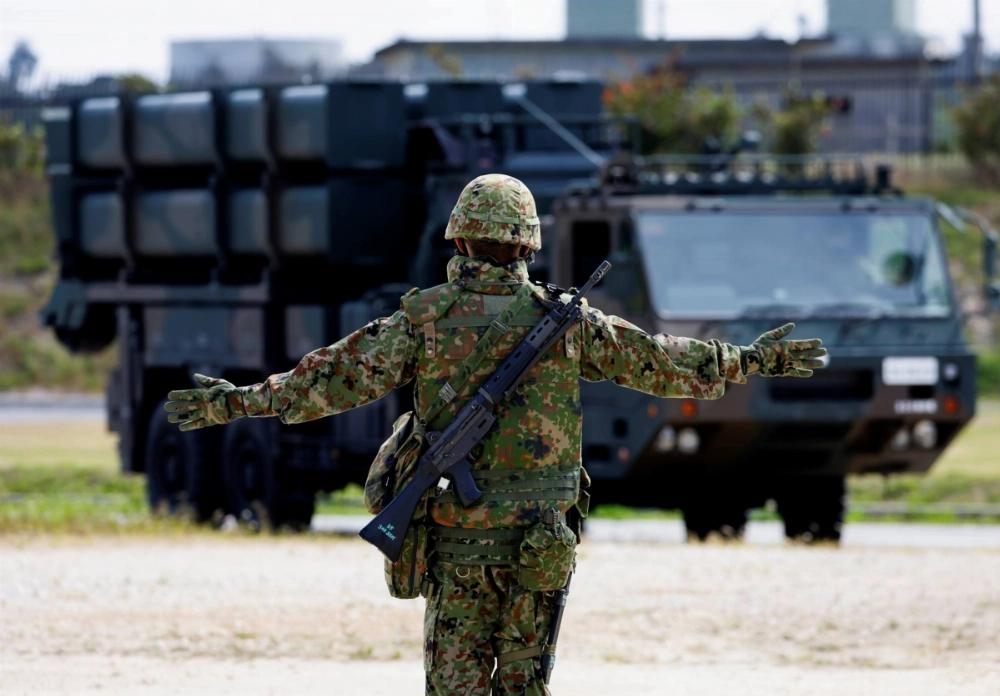
It the coming years USFJ is going to turn into a warfighting headquarters much like USFK in Korea:
U.S. Forces Japan has begun reorganizing into a “warfighting headquarters,” U.S. Defense Secretary Pete Hegseth said Sunday during his first trip to the Indo-Pacific since taking office. Hegseth that day discussed restructuring USFJ amid regional security challenges with Japanese Minister of Defense Gen Nakatani at Camp Ichigaya, the Ministry of Defense headquarters in central Tokyo.
The Defense Department has begun the first phase of upgrading USFJ into a joint force command better equipped to coordinate with its Japanese counterpart, Hegseth told reporters after the meeting. “This also means reorganizing U.S. Forces Japan into a warfighting headquarters, increasing its staff and giving its commander the authorities needed to accomplish new missions,” he said
You can read more at the link, but a difference I see between the future USFJ and USFK is that the USFK commander has operational control of US and ROK forces during a conflict. The future USFJ will instead coordinate with Japanese Joint opeational command during conflict.