Author: GIKorea

U.S. Removes Visa Waiver Status For People Who Visited North Korea

This is a good idea to not only discourage travel to North Korea, but also put a process in place to detect a intelligence collection threat that could be coming to the U.S.:

Any South Korean who visited North Korea after March 2011 will no longer be able to visit the United States visa-free, according to the Ministry of Foreign Affairs.

The U.S. government said it is putting new restrictions on its Visa Waiver Program, or VWP, for citizens of 38 countries including South Korea who have visited Iran, Iraq, Sudan, Syria, Libya, Yemen, Somalia or North Korea. 

Under the VWP, South Korean citizens are eligible to visit the United States visa-free for up to 90 days as long as they register through the Electronic System for Travel Authorization at least three days in advance. 

This is no longer an option for South Koreans – or citizens of the other 37 countries – who have visited the North. While they will be allowed to visit the U.S., they will have to obtain a visa from a U.S. consular office.

Joong Ang Ilbo

You can read more at the link.

Prime Minister Abe Says Trade Dispute with Korea Linked to National Security Concerns

Prime Minister Abe claiming the current trade dispute with South Korea is only about national security concerns is about as believable as Japanese whaling for scientific research:

Prime Minister Shinzo Abe

Japanese Prime Minister Shinzo Abe said Tuesday that the main cause of escalating tensions between Japan and South Korea is a loss of trust over court rulings ordering Japanese companies to compensate South Koreans for forced labor during World War II.

Japan has imposed export controls on key materials for South Korea’s semiconductor industry and moved to downgrade the country’s trade status. It has insisted that the measures were related to national security concerns and were not in retaliation for the court rulings, which allowed the freezing of assets of three Japanese companies in South Korea to provide the compensation money.

Japan ruled the Korean Peninsula as a colony until the end of the war, and insists that all compensation issues were settled under a 1965 agreement normalizing ties.

Stars & Stripes

Prime Minister Abe probably has to say this is about national security concerns for legal reasons, but his is how Abe is rationalizing it:

Abe said last month that it is natural to assume that South Korea would fail export control promises because it already has broken the wartime compensation agreement.

You can read more at the link.

U.S. Defense Secretary Says US Looking to Deploy Ballistic Missiles In Pacific Region

This only makes sense that the U.S. should start deploying ballistic missiles when the North Koreans, Russians, and Chinese are doing the same thing:

With the new Pentagon chief’s signal that Washington plans to consult with its allies on the placement of intermediate-range missiles in Asia, Seoul is again put in a difficult position, concerned that its relations with Beijing and Pyongyang could be complicated if South Korea is chosen as the deployment site.  

However, the Korean Ministry of National Defense said on Monday that it has not yet held any official discussions with the United States on the placement of intermediate-range missiles in Korea, nor is it considering such deployment at the moment.  

Ahead of a visit to Seoul this week, U.S. Defense Secretary Mark Esper was asked by reporters Saturday if the Pentagon was considering deploying ground-based intermediate-range missiles in Asia, to which he responded, “Yes. I would like to. But let’s be clear, I’m talking about conventional weapons.”  

Washington was previously unable to pursue ground-based missiles with a range of 500 to 5,500 kilometers because of the Intermediate-Range Nuclear Forces (INF) Treaty, an arms control pact with Russia dating back to 1987, which the United States withdrew from last Friday.  

“Right now, we don’t have plans to build nuclear-tipped INF-range weapons,” said Esper. As to the timeline, he said, “I would prefer months … But these things tend to take longer than you expect.”  

The move is expected to prompt protests by Russia, China and North Korea, and analysts fear the start of a new arms race. Experts have pointed out that the first U.S. intermediate missile deployments are likely to counter China, rather than Russia.

Joong Ang Ilbo

You can read more at the link, but I would be surprised if South Korea is chosen as a location unless the peace talks with North Korea collapse and lead to another provocation cycle. Deploying ballistic missiles to South Korea would be a great deterrent option to execute in response to a future provocation cycle.

Tweet of the Day: China Builds Cool Stuff?

North Korea Conducts 4th Missile Test in Two Weeks

North Korea is still using the US-ROK joint exercise as an excuse to continue test their short range missile systems:

North Korea conducted its fourth weapons test in two weeks early Tuesday morning with a pair of unidentified projectiles launched into the East Sea, justifying the act as an “essential and powerful physical means” in a statement from its foreign ministry. 

The projectiles, which South Korea’s Joint Chiefs of Staff (JCS) said appeared to be short-range ballistic missiles, were fired at 5:24 a.m. and 5:36 a.m. from an area around Kwail County in South Hwanghae Province. They each flew a distance of around 450 kilometers (280 miles) with peak altitudes of 37 kilometers at Mach 6.9, according to a JCS spokesman. 

South Korean and U.S. intelligence officials believe the rockets displayed a flight pattern similar to the short-range ballistic missiles launched on July 25, the first in a series of four tests that all involved projectiles launched into the East Sea. The North’s state media followed up each of the previous three tests – on July 25, July 31 and last Friday – with reports saying the country had tested new types of ballistic missiles and rocket artillery, all under the personal direction of its leader, Kim Jong-un. (…..)

“Despite our repeated warnings, the United States and South Korean authorities have finally started the joint military exercise targeting the DPRK,” read the English-language release, using the acronym for North Korea’s official name, the Democratic People’s Republic of Korea. “This is an undisguised denial and a flagrant violation of June 12 DPRK-U.S. Joint Statement, Panmunjom Declaration and September Pyongyang Joint Declaration, all of which are agreements to establish new DPRK-U.S. relations and build a lasting and stable peace regime on the Korean Peninsula.”

Saying the North had no reason to keep its promises while the United States and South Korea ignored theirs, the statement stressed the regime was “compelled to develop, test and deploy the powerful physical means essential for national defense.”North Korea conducted its fourth weapons test in two weeks early Tuesday morning with a pair of unidentified projectiles launched into the East Sea, justifying the act as an “essential and powerful physical means” in a statement from its foreign ministry. 

The projectiles, which South Korea’s Joint Chiefs of Staff (JCS) said appeared to be short-range ballistic missiles, were fired at 5:24 a.m. and 5:36 a.m. from an area around Kwail County in South Hwanghae Province. They each flew a distance of around 450 kilometers (280 miles) with peak altitudes of 37 kilometers at Mach 6.9, according to a JCS spokesman. 

South Korean and U.S. intelligence officials believe the rockets displayed a flight pattern similar to the short-range ballistic missiles launched on July 25, the first in a series of four tests that all involved projectiles launched into the East Sea. The North’s state media followed up each of the previous three tests – on July 25, July 31 and last Friday – with reports saying the country had tested new types of ballistic missiles and rocket artillery, all under the personal direction of its leader, Kim Jong-un. (…..)

Joong Ang Ilbo

You can read more at the link.

Picture of the Day: US-ROK Joint Exercise Begins

Korea-U.S. joint military drill
Korea-U.S. joint military drillAn Apache chopper takes off at U.S. base Camp Humphreys in Pyeongtaek, 70 kilometers south of Seoul, on Aug. 5, 2019, as South Korea and the United States kicked off their joint military exercise. (Yonhap) 

South Korean Lawmaker Wants to Implement A Travel Ban to Japan

It is not surprising that Korean lawmakers are all rushing to out do each other on their anti-Japan ideas:

A top ruling party lawmaker said Monday that the government must impose travel bans on large areas in Japan, including Tokyo, citing health risks from high radioactive levels, as a means to counter Japan’s economic retaliations.  

“We need to impose travel bans,” said Rep. Choi Jae-sung of the Democratic Party (DP), chairman of the in-house special committee on countermeasures against Japan’s economic retaliations. “We need to consider [imposing travel bans on] areas including Tokyo.” 

Choi made the recommendation during an interview with MBC radio as he discussed Korea’s possible countermeasures against Japan. In July, Tokyo tightened export restrictions on three materials crucial for Korea’s semiconductor and display productions. 

Last Friday, Tokyo escalated the row further by taking Korea off of its so-called white list of 27 trusted trade partners. 

“I cannot say the specifics of the countermeasures we are currently considering, but there are various options,” Choi said. “And we have non-economic options. Japan is making economic and industrial [attacks], but we can take non-economic measures.” 

Joong Ang Ilbo

You can read more at the link, but I wish someone in the media would ask these politicians why they did not advocate for a travel ban against China which continues its economic retaliation against Korea over the THAAD dispute.

Four Out Five Koreans Say Their Job Creates Negative Health Effects

Despite the news of a rising life expectancy rate in South Korea, many believe they have bad health and stress is one of the main reasons:

Four out of every five Korean office workers say their job has a negative effect on their health.

According to a survey conducted by job search website Incruit, 83.9 percent of 671 respondents said that working has a negative effect on their health. 

By age, people in their 40s believe they suffer the most – 87.7 percent of this age group said they were suffering from health problems.

The most common work-related issues were stress-related symptoms like depression and sleeping disorders, with 18.9 percent of respondents complaining of these health problems. Sixteen percent of respondents experienced digestive disorders like stomach ulcers, chronic constipation and diarrhea. 

Burnout was offered as a separate option from stress-related symptoms, receiving 12.6 percent of the vote.

Joong Ang Ilbo

You can read more at the link.

South Korea’s Life Expectancy Continues to Rise Despite Most People Thinking They are Unhealthy

This does not surprise me at all:

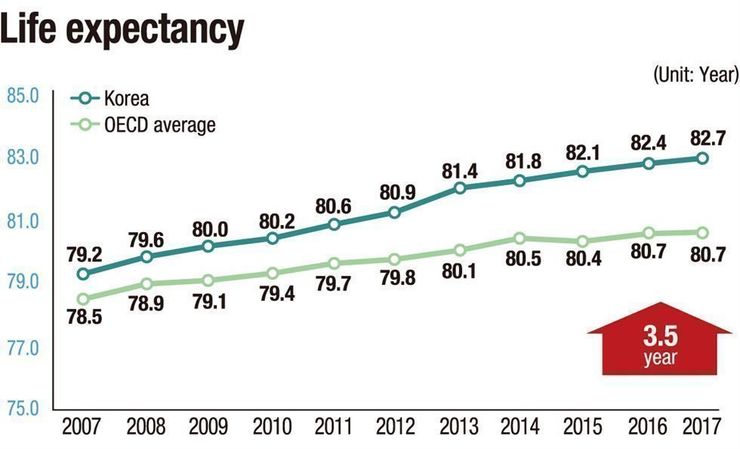
Koreans have the fifth-highest life expectancy among Organization for Economic Cooperation and Development (OECD) member countries, but few of them think they are healthy, according to a government report. 

The report released by the Ministry of Health and Welfare, based on data from the OECD, said babies born in 2017 are expected to live 82.7 years, up by 3.5 years from 2007. This is the fifth-highest in OECD countries, with its average at 80.7. Girls born in 2017 were expected to live 85.7 years, six years longer than boys. (…..)

Despite better health, Koreans don’t think they are in good health, as only 29.5 percent think they are healthy. The ratio was the lowest of OECD countries. Contrary to Korea, 88.5 percent of people in Canada and 87.9 percent in the United States think thought they were healthy.

Korea’s suicide rate ranked second, with 24.6 out of every 100,000 people in 2016, after Lithuania with 26.7.Koreans have the fifth-highest life expectancy among Organization for Economic Cooperation and Development (OECD) member countries, but few of them think they are healthy, according to a government report. 

The report released by the Ministry of Health and Welfare, based on data from the OECD, said babies born in 2017 are expected to live 82.7 years, up by 3.5 years from 2007. This is the fifth-highest in OECD countries, with its average at 80.7. Girls born in 2017 were expected to live 85.7 years, six years longer than boys. (…..)

Korea Times

You can read more at the link, but I think the bad environmental conditions in South Korea combined with constant stress and the wellness craze is what causes Koreans to think they are not healthy despite their ever growing life expectancy.

Tweet of the Day: Anti-Japanese Protesters Storm into Fuji TV’s Seoul Office