

Picture of the Day: Cheongsong Forest Fire
| April 10, 2020
Here is the latest on South Korea’s acquisition of the Global Hawk surveillance aircraft:

Two more units of the Global Hawk high-altitude unmanned aircraft are expected to arrive in South Korea this month, sources said Thursday, a move expected to further boost the country’s surveillance capabilities against North Korea and beyond.
Their planned arrival comes after South Korea brought in its first RQ-4 Block 30 Global Hawk remotely piloted aircraft in December last year. Under a 2011 deal, Seoul purchased four from the United States.
Air Force officers and the manufacturer, Northrop Grumman, have been working to bring in two additional units within this month, though the exact schedule is subject to change, according to the government sources. One remaining unit is also expected within the first half, they added.
Joong Ang Ilbo
You can read more at the link, but this sale has been in the works since 2003 because of the delays caused by concerns that technology and information would be leaked to North Korea. Now with the US wanting the ROK to take on more of their defense responsibilities the sale was approved and hopefully whatever concerns of technology leaks has been mitigated as well.
Another sign of improving conditions in South Korea in their fight against the coronavirus:

New infections of the coronavirus dropped to 39 Wednesday, the lowest daily figure since cases began to soar in mid-February after a major cluster was traced to a church in Daegu.
As local health officials try to push the number down by imposing strict penalties on violators of government quarantine orders, the Ministry of Justice announced that a 40-year-old Indonesian man was slapped with a 500,000 won ($411) fine and deported from Korea Wednesday afternoon after leaving a residence and lying to officials about it.
Joong Ang Ilbo
You can read more at the link.
Online classes for South Korean students began this week:

The government had postponed the new school year, which usually starts in March, by five weeks to Monday. But the plan changed as unexpected cluster infections broke out in various parts of the country.
Last week, the government announced plans to first resume online classes for seniors at middle and high schools before expanding the remote learning program to other grades.
Grades one and two at middle schools and high schools, as well as grades four to six at elementary schools, will begin the new semester next Thursday. Grades one to three at elementary schools will start taking online classes from April 20. The national college entrance exam has been pushed back by two weeks to Dec. 3.
Classes at kindergartens and child care centers have been indefinitely postponed.
Yonhap
You can read more at the link.

For Americans this news will not apply because the U.S. does not have a travel ban in place on South Korea. It will apply to a total of 88 countries which include Canada and Australia:

The government plans to bring into force a decision to temporarily suspend visa exemptions for countries imposing entry bans on South Koreans at an early date, a foreign ministry official said Wednesday.
South Korea announced earlier that it will halt visa-free entry and visa waiver programs for countries that have barred the entry of South Koreans over coronavirus concerns, a move aimed at curbing the rise in imported cases that has emerged as a key factor behind the continuing virus outbreak.
Yonhap
You can read more at the link.
Here is some good news from South Korea:

South Korea’s new coronavirus cases hovered around 50 for the third straight day Wednesday, but the nation marked the grim milestone of 200 virus deaths.
Health authorities renewed calls for people to maintain social distancing to curb the spread of the virus, as cluster infections at churches and hospitals, as well as new cases coming from overseas, are still rising steadily.
The 53 new cases, detected Tuesday and up from 47 new cases a day ago, brought the nation’s total number of infections to 10,384, according to the Korea Centers for Disease Control and Prevention (KCDC).
Yonhap
You can read more at the link, but lets hope this a sign of an improving infection trend for South Korea.
Dr. Tara O makes a very compelling case that the international media should be looking at Taiwan as a great example of what to do to combat COVID-19 instead of South Korea:
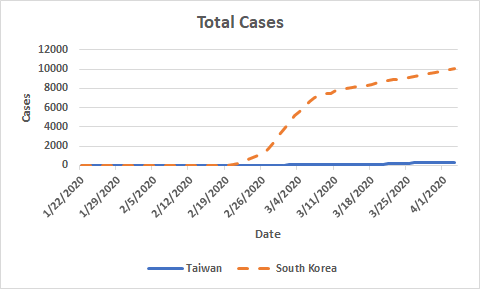
Taiwan recognized the threat early on and rapidly began to take measures. It inspected and screened travelers from Wuhan, the epicenter of the SARS CoV-2, as early as December 31, 2019. It also actively monitored travelers from Wuhan who had already entered Taiwan on December 20, 2019 and onwards. It had developed screening, testing, and quarantine protocols early based on lessons from the SARS 2003 outbreak. It also engaged in aggressive contact tracing to ensure everyone that came into contact with an infected person was quarantined and tested. On February 6, 2020, Taiwan banned travel from China.
Unlike Taiwan, South Korea never banned travel from China, although the Korean Medical Association (KMA) and the public called for such measures multiple times. South Korea eventually restricted travel from Wuhan on February 2, 2020, but it was not until after China had already quarantined the City of Wuhan on January 23, 2020. KMA, on February 3, made its fifth request to the government to ban entry from China, saying South Korea is losing its “golden time” of prevention, and it will become “regional spreads.” KMA also highlighted inadequate tracking of visitors from China. KMA’s concerns and the government’s inadequate tracing are not reflected in foreign reports that praise South Korea’s tracing.
On January 31, 2020, 11,345 people traveled from China to South Korea. Multiplying by 30 days, that would be more than 340,350 people in one month. If 1% were infected with the coronavirus, that would be 3,403 infected people entering South Korea.
East Asia Research Center
I highly recommend reading the rest at the link.
What I think Dr. O is getting after is that the international media has been heaping great praise on President Moon’s response to COVID-19 without mentioning his administration’s previous missteps which also included lack of masks and testing. Even the testing today there is misinformation in the international media about free testing in South Korea, but don’t mention that a sick person needs to have a CT Scan or an X-ray done before a coronavirus test can be conducted. The cost of the CT scan and X-ray could dissuade people from getting tested.
The only reason why I can think of that the international media isn’t instead lavishing praise on Taiwan is because they don’t want to deal with the backlash from China. So the Moon administration has become a better example to damage the Trump administration with. Pointing out the Moon administration’s failings does not help with that goal and thus why they only focus on things that the Moon administration has done right.
Anyone else have any alternate theories on why the international media is not focusing on what the Moon administration has done wrong?
