I think it is arguable that the government is trying to blame younger people for the current COVID surge instead of themselves for the slow vaccine rollout:
People in their 20s and 30s are complaining of being stigmatized as the main culprits of the fourth wave of the COVID-19 pandemic, in which the number of infections among people in this age group is significantly higher compared to during previous waves.
Many young people point out that the government is trying to leave the responsibility for controlling the fourth wave to them while they have been pushed to the back of the line in the country’s vaccination plans. In recent weeks, public health authorities have urged people in their 20s and 30s to abide by the social distancing guidelines, all the while suggesting that they are the most responsible for the spreading of the virus. (……..)
In response, young people have said that they are unable to understand the government’s message because they are the last group planned to be vaccinated according to the government’s vaccination schedule, and thus have lower vaccination rates than other age groups, making them more vulnerable to infection.
I guess we will see if the South Korean government tries to cancel the upcoming vacation season for South Koreans:
Local governments in charge of antivirus measures at popular summer vacation destinations are on high alert for a massive influx of vacationers from the greater Seoul area and other regions hit by a surge of COVID-19 cases.
South Korea’s daily new coronavirus cases have been in excess of 1,500 in recent days, with the capital area accounting for approximately three-fourths of the total.
Fearing that increased tourist arrivals at famous beaches and mountains nationwide will further fuel the spread of the coronavirus, local governments are moving to beef up their quarantine efforts.
Here is the latest on the COVID situation for USFK:
Thirty-one U.S. service members from a single Army base in South Korea tested positive for the coronavirus last week as the country reached a new record for daily infections.
The 31 new patients, who tested positive between July 5 and 11, are from Camp Casey, a military outpost near the Demilitarized Zone on the border with North Korea.
They are among 58 people from U.S. Forces Korea who tested positive last week, marking the most infections reported by the command during the pandemic. The previous record from early this year was 42 cases recorded over a 12-day span.
LG Electronics’ South African plant looted Looters attack a plant of South Korea’s LG Electronics Inc. in Durban, South Africa, on July 12, 2021, as rioting triggered by the imprisonment of the country’s former leader, Jacob Zuma, continues to spread, in this provided photo. (Yonhap)
Our last education session prior to the rise of ROK SD level was an outdoor affair. Our team was in the #DMZ near Cheorwon to discuss the terms of #Armistice & principles of deescalation with frontline units–all in support of consistency, clarity & transparency on the Peninsula. pic.twitter.com/9AqQZv1wWf
— United Nations Command 유엔군사령부/유엔사 (@UN_Command) July 14, 2021
This reads like a story you would read on a news satire site, but it is actually happening in South Korea:
Gyms in the capital area may need a new instrument in the fight against COVID-19 — a metronome.
As of Monday, the government has banned gyms in the greater Seoul area from playing music faster than 120 beats per minute (bpm) during group exercises.
That’s to prevent people from breathing heavily and accidentally getting saliva on each other — an extra precaution amid a record-breaking surge in COVID-19 cases in the country.
No matter what the combined US-ROK exercise is called North Korea is still going to complain about it:
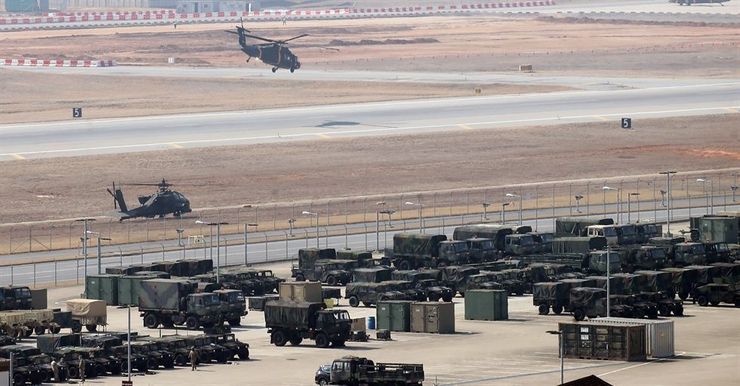
Hellicopters and vehicles are deployed at U.S. Army Garrison Humphreys in Pyeongtaek, Gyeonggi Province, during this year’s first Combined Command Post Training between South Korea and the U.S. in this March 8 photo. The two sides are yet to reveal the scale of the drill, which is anticipated to take place next month. Yonhap
North Korea has resumed its belligerent rhetoric against a combined summertime military exercise between Seoul and Washington, raising questions about whether the Kim Jong-un regime will escalate the situation with a military provocation.
Uriminzokkiri, a North Korean propaganda website, issued a warning Tuesday to South Korea and the U.S. with regard to the drill expected to be held in August, saying that “war exercises” and peace cannot exist simultaneously.
“The current instability on the Korean Peninsula is fully attributable to the warmongers among the South Korean military colluding with an outside power, and engaging in reckless, confrontational machinations,” the website commented.
Citing previous exercises including the Combined Command Post Training in March and Seoul’s participation in the cooperative maritime exercise Pacific Vanguard, it alleged “(South Korea) showed its craze for war exercises.”
N.K. leader meets awarded artists North Korean leader Kim Jong-un (C) poses with a group of state-honored writers and artists in Pyongyang on July 11, 2021, in this photo provided by the Korean Central News Agency. (For Use Only in the Republic of Korea. No Redistribution) (Yonhap)
Both business and the labor unions are unhappy with the rise:
Park Jun-sik, head of the Minimum Wage Commission, leaves the commission’s final meeting held at Government Complex Sejong, Tuesday, during which the minimum hourly wage for 2022 was set at 9,160 won. Yonhap
The country’s hourly minimum wage for 2022 has been set at 9,160 won ($7.98), a 5.1 percent increase from the current 8,720 won, which did not satisfy either the union or business sectors.
Unions expressed anger over President Moon Jae-in’s unfulfilled campaign pledge to hike the minimum wage to 10,000 won per hour during his five-year-term, as this year’s negotiations were the last to be held during his term.
Representatives from business were equally unsatisfied, as they had been calling for a virtual freeze of the minimum wage considering the problems facing small- and medium-sized enterprises due to the COVID-19 pandemic.
Around midnight, Monday, the 27-member Minimum Wage Commission, a trilateral panel composed of nine members each from the union, business and public sectors, voted on the new wage during its final plenary session held at the Government Complex Sejong.
Only 14 members participated in the vote as all nine members from the business sector and four union representatives left the room in protest against the proposed wage hike.