Taxi falls off parking facility A taxi (in red circle) falls about 20 meters to the ground from a parking facility on the fifth floor of a discount store in the southeastern port city of Busan on Dec. 30, 2021, in this provided photo. It broke through a wall and hit a passenger car waiting for the traffic lights to change. The accident, which took place around 12:30 p.m., left the taxi’s driver dead and seven people, including five people in the passenger car, injured. (Yonhap)
The resilience that Australia has shown against China’s economic retaliation has likely been a major surprise for the CCP. Instead of weakening Australia it has actually strengthened and embolden the country to stand up even more against CCP human rights violations, economic coercion, and territorial expansion:
Australian Prime Minister Scott Morrison speaks at a press conference in Canberra on Aug. 17; Chinese President Xi Jinping speaks at Macau’s international airport on Dec. 18, 2019.
If the scale of China’s trade coercion against Australia is unprecedented, it also offers an intriguing experiment: What does a sudden economic decoupling from China look like? With China accounting for nearly 40 percent of Australian exports, one might assume the costs of Canberra’s defiance would be grave.
But in fact, the effects have been surprisingly mild. The reason is trade diversion: When a trade barrier is erected, businesses seek alternate outlets for their products. In open international markets, the outcome is rarely the destruction of export industries. Most of the time, trade flows adjust around the barrier.
Coal provides an illustrative example. Once China banned imports of Australian coal in mid-2020, Chinese utilities had to turn to Russian and Indonesian suppliers instead. This, in turn, took Russian and Indonesian coal off the market, creating demand gaps in India, Japan, and South Korea—which Australia’s stranded coal was able to fill. What’s more, the global energy crunch has pushed up the price of coal, leading Australian coal producers’ export earnings to rise this year—not exactly the effect China had in mind.
You can read more at the link, but for a commodity based economy like Australia has, it is easier to decouple from China. However, for countries that have tech and manufacturing relationships with China it will be harder to decouple because new factories have to be built and new skilled workers have to be trained elsewhere. This would likely be a multi-year process. However, if countries don’t start this process now they could find their economies compromised if China threatens to close them as part of economic pressure to coerce governments to side with them during any future conflict over the South China Sea for example.
He may have lost weight, but he is still morbidly obese by weighing approximately 120 kilograms (264 pounds):
In this photo released by North Korea’s official Korean Central News Agency, Dec. 29, North Korean leader Kim Jong-un attends a plenary session of the Workers’ Party in Pyongyang, Dec. 28. Yonhap
North Korea’s leader, Kim Jong-un, seems to be have reached his lowest weight in at least the past few years.
In a photo released by North Korea’s official Korean Central News Agency, Dec. 29, Kim was wearing a black suit with a white button-down shirt and silver tie, while attending a plenary session of the Workers’ Party.
The photo immediately drew attention, as there was some space between his neck and the shirt. Previously, he has rarely worn button-down shirts and even if he has, they looked very tight around the neck.
Seoul’s National Intelligence Service (NIS) reported in a parliamentary audit in October that Kim had shed around 20 kilograms compared to 2019, when he weighed 140 kilograms (308 pounds).
It seems to me a fairway to handle this is that any information about the site include the fact that Korean forced laborers were used her during the Imperial era. However, this makes too much sense and likely won’t happen:
Sado Gold Mine
A government panel proposed Tuesday that a gold mine site on the island of Sado, Niigata Prefecture, be a candidate for the 2023 UNESCO World Heritage designation.
But in a rare move, the Cultural Affairs Agency released a statement saying that the candidate selection by the Council for Cultural Affairs does not mean that the government has decided to recommend the site to UNESCO.
The agency said that the government will consider the matter comprehensively.
Under ordinary circumstances, the Japanese government would submit a recommendation to UNESCO by Feb. 1 next year after obtaining approval from related ministries and agencies and the Cabinet.
As South Korea claims that workers from the Korean Peninsula were forced to work at the Sado mines, however, it is unclear whether the Japanese government will recommend the site for World Heritage listing.
Ceremony for fallen police officers during Korean War National Police Agency chief Kim Chang-ryong (R) burns incense in front of the remains of two police officers killed in the 1950-53 Korean War during a ceremony at the National Cemetery in the central city of Daejeon on Dec. 28, 2021, to lay them to rest. (Yonhap)
I have said for years that China would not just be a bystander during any conflict on the Korean peninsula and retired USFK General Robert Abrams believes in this viewpoint now as well:
South Korea’s Ministry of National Defense on Monday pushed back against remarks by a former commander of U.S. Forces Korea who said wartime plans against North Korea must account for China’s militaristic influence in the region.
North Korea’s weapons testing demonstrates that it persists as a threat, but the Chinese military also has “to be accounted for in the war plan,” retired Gen. Robert Abrams, who led USFK and U.N. Command until July, said on Voice of America on Saturday.
“It’s not a secret that they have increased their presence in and around the Korean Peninsula since 2010,” Abrams said, referring to China’s military.
“These are indications of things that have to be accounted for in the war plan that the current [guidance] does not contain,” he said.
I guess we will see if NASA’s budget will continue to be supported to actually put a person on the Moon this decade:
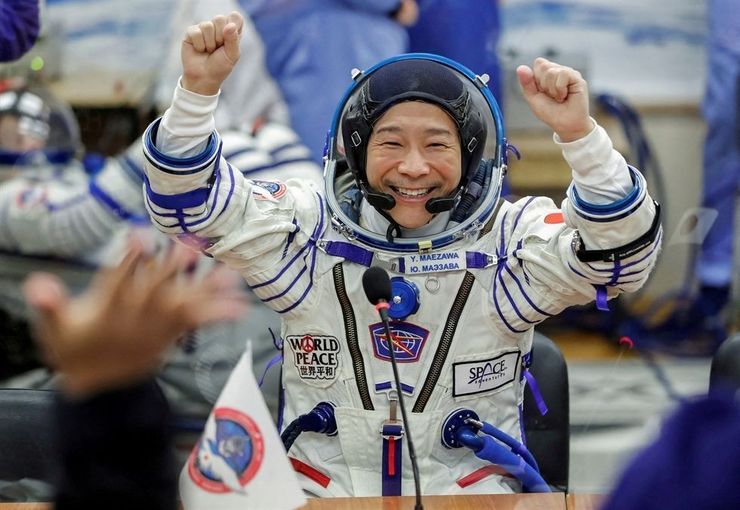
Japanese entrepreneur Yusaku Maezawa reacts as he speaks with his family after donning space suits shortly before the launch to the International Space Station at the Baikonur Cosmodrome, Kazakhstan, Dec. 8. Reuters-Yonhap
Japan revised the schedule of its space exploration plans on Tuesday, aiming to put a Japanese person on the moon by the latter half of the 2020s.
“Not only is space a frontier that gives people hopes and dreams but it also provides a crucial foundation to our economic society with respect to our economic security,” Prime Minister Fumio Kishida told a meeting to finalize the plan.
According to the draft schedule of the plan, Japan aims to put the first non-American on the moon as part of the Artemis program, a U.S.-led initiative that aims to return astronauts to the moon.
Walmart is the latest U.S. company caught in the middle over Xinjiang, with Chinese citizens saying they canceled Sam's Club memberships after Walmart appeared to stop stocking some products from Xinjiang in their China stores.@lizalinwsj@SarahNassauerhttps://t.co/S4MYIosdPd