Commanders will be allowed to keep their authority:
In a dramatic hearing Wednesday focused on sexual assault in the military, the Senate Armed Services Committee knocked down an effort to strip military commanders of oversight in the prosecution of serious crimes by their subordinates.
The 17-9 committee vote to leave prosecutions within the chain of command cut across party lines, and represented a victory for the Pentagon. Leaders including Secretary of Defense Chuck Hagel and each of the service chiefs have argued that military commanders are best able stem a tide of sexual assaults that Defense Department statistics indicate has been rising in recent years.
But a senator who voted to maintain the status quo, Maine independent Sen. Angus King, warned that legislators would have little choice but to reduce the authority of commanders in criminal cases if the Pentagon doesn’t quickly reverse the trend.
“In a sense, I see this as a last chance for the chain of command to get it right,” King said. [Stars & Stripes]
You can read much more at the link, but I respectfully disagree with Senator King’s statement. As I have already shown the statistics for military sexual assaults last year were inflated due to adding assaults from prior years to the 2012 statistics along with other reasons such as an increase in baseless claims. The military has made a big effort in recent years to get people to report sexual assaults and her statement runs counter to this. So instead of trying to count every report there is, the military for the 2013 statistics can show improvement by just recalculating their statistics. They can do this by just including reports from 2013 and reports from prior years would be counted to the year’s that they happened. This would show instant progress and not bring attention to reports people filed from prior years.
Something that has changed is this:
Levin’s amendment would set up an appeals system that would give service secretaries the final say on commanders’ prosecution decisions, and makes it a crime to retaliate against those who report sexual assault.
Gillibrand said the time to let the military solve its own sexual assault problem had passed.
“The chain of command has told us for decades that they would solve this problem, and they have failed,” she said.
Gillibrand argued that the amendment does not address the main problem — a climate of fear faced by sexual assault victims when considering whether to report a crime to a commander who may be biased in favor of a higher-ranking perpetrator.
I do not have a problem with Levin’s amendment though I would like to see how retaliate is defined. For example if someone files a report that is considered baseless can they not be prosecuted for filing a false report? As far Congresswoman Gillibrand’s complaint it runs counter to the facts that show commanders are overwhelming prosecuting servicemembers under their command for sexual assault even when the evidence does not support a prosecution. There are servicemembers that had to be released from jail by the US Court of Appeals due to having their Constitutional rights to a fair trial trampled on by the witch hunt against anyone accused of sexual assault. In the article even Congresswoman McCaskill had to cede this point. Anyway this issue is not over, expect the special interests to try and bring it up again next year, but hopefully the Pentagon gets their act together on how they compile the statistics so they do not give the special interests ammunition to bash them with.
When people think of provocations from North Korea most people today think that the deadliest incidents from the rogue regime have been targeted against South Korea. The largest loss of life from one provocation by North Korea was the sinking of the ROK Navy ship the Cheonan in 2010 that killed 46 personnel on the ship and wounded 56 more. What many people don’t realize is that the US military historically has been subject to many provocations from North Korea as well to include the 2nd deadliest attack, the shoot down of an EC-121 reconnaissance plane that killed all 31 men on board.
This deadly attack occurred on April 15, 1969 when the EC-121 which used the call sign “Deep Sea 129” was shot down in international waters 167 kilometers off the coast of North Korea. The EC-121 is an intelligence gathering platform that picks up radio transmissions in the area that it is conducting surveillance of. The mission of the Deep Sea 129 would not only be to pick up radio transmissions from North Korea, but from China and Russia as well. The military has conducted these flights on behalf of the National Security Agency (NSA) for many years.
The routine flight of the Deep Sea 129 began at 0700 local time when it took off from Atsugi, Japan. On board were 8 officers and 23 enlisted men under the command of LCDR James Overstreet. The plane first flew over Japan and then over the Sea of Japan. Once over the Sea of Japan the EC-121 flew in a clockwise ellipse as it collected signal intelligence from the region. LCDR Overstreet was given orders that his flight pattern would not go any further than 90 kilometers from North Korea. Radars at Osan Airbase in South Korea as well as back in Yokota Airbase in Japan tracked the missions progress as well as looking for any aircraft being dispatched from North Korea. At 12:34 local time radars at Osan Airbase detected that two MIG-17s had been launched by North Korea. At 13:00 Deep Sea 129 issued a routine report and everything seemed normal. At 13:22 the radars as Osan lost track of the two MIG-17s and reacquired them at 13:37. When the aircraft were reacquired it became obvious that the MIGs were dispatched to intercept the EC-121. At 13:44 Deep Sea 129 was alerted that they were being intercepted. At 13:47 the MIGs had reached the vicinity of Deep Sea 129 and then at 13:49 the EC-121 disappeared from the radar screen.
After the EC-121 disappeared from the radar screen the operators originally thought that it may have followed normal procedures and dropped to an altitude below radar coverage. This thought prevailed because the operators figured that if the MIGs were acting hostile to the EC-121 than LCDR Overstreet would have radioed something back to Japan. However, after 10 minutes had past and no radio transmission had been received from LCDR Overstreet, people began to fear the worst. Two US jets were dispatched from Japan to conduct a Combat Air Patrol of the area where the EC-121 had last been tracked. By 14:44 almost an hour after Deep Sea 129 was last tracked, the CAP planes could not find the EC-121 and the command in Japan decided to send an urgent message back to the Pentagon and the White House that they feared the EC-121 had been shot down.
The reactions from political leaders in Washington once the news was heard was initially very harsh. On Capitol Hill, Mendel Rivers, chairman of the House Armed Services Committee, proclaimed: ‘There can be only one answer for America-retaliation, retaliation, retaliation!’ Chairman of the House Armed Services Committee, Rep. L Mendel Rivers, called for military retaliation against North Korea with “whatever is necessary. If nuclear weapons are required, let them have it. It’s time to give them what they ask for.”
As the political leadership back at the US reacted to the shoot down the military command back in Japan prepared a massive search and rescue effort to recover the plane and any survivors. The plane had life rafts the crew could have used if the plane crashed intact. The seas were not too rough and temperatures were in the 40s. So if the crew survived the crash they had a high chance of survival in the conditions if found quickly. The search was conducted by C-130s from Japan that were supported by a K-135 Stratotanker to provide fuel support. These search and rescue aircraft were further supported by CAP aircraft. In total 26 aircraft were used during the search and rescue operation. Besides the aircraft two American destroyers, the USS Dale and the USS Tucker reached the suspected crash site around 9PM. The Soviet Union would also dispatch two destroyers to search for survivors as well. The Soviets were probably eager to show the US they did not support the North Koreans actions by assisting with the search and rescue. The Soviet destroyer the Vdokhnovenie recovered pieces of the downed aircraft as well as the only two bodies found during the entire search effort. The bodies of LTJG Joseph R. Ribar and AT1 Richard E. Sweeney were turned over to the USS Tucker on April 17th. This ended the search and rescue operation and the bodies of the other 29 crew members were never recovered.
With the end of the search and rescue operation, US President Richard Nixon had to decide on what to do in response to North Korea’s deadly provocation. During this time period North Korea had even taken the rare step of bragging on their state radio station of shooting down the aircraft that they said was flying over their territorial waters. Despite calls for retaliation from various political figures Nixon decided to go with most other officials were recommending which was essentially to do nothing. With the war raging in Vietnam many US officials thought it was unwise to open up a possible second front war on the Korean peninsula. So he decided not to do anything provocative against the North Koreans such as bombing the airfield where the MIGs that shot down the EC-121 flew from. Instead he conducted a show of force by continuing the reconnaissance flights while backed with appropriate naval and Air Force support to protect them. This showed American resolve to the North Koreans while not creating a second war in Asia.
What I cannot understand is why the EC-121 was left without escort of some kind in the first place? The mission of the EC-121 was very similar to what the USS Pueblo ship was doing when it was fired upon and captured by the North Koreans in 1968. Considering that North Korea had shown previously an intent to target US reconnaissance efforts it seems surprising to me that the Pentagon was allowing the EC-121 flights off the coast of North Korea to continue with out a fighter escort or at least ships in the Sea of Japan that could provide better early warning of any potential North Korean fighters trying to intercept them.
Below is a list of all the lives that were lost by this act of North Korean aggression. Like all the other lives brought to an early end by the thugs and killers of the Kim regime in North Korea these men should not be forgotten:
Petty Officer 1st Class Eli Redstone rings the bell twice for each of the 31 U.S. troops killed on April 15, 1969, when North Korean fighters downed their EC-121 reconnaissance plane over the Sea of Japan. Wednesday’s ceremony marked the 40th anniversary of the attack. Matthew M. Bradley/Courtesy of the U.S. Navy
(Note:This is a guest posting from ROK Drop reader Steve McGee that served in Korea when the below incident happened.)
It was a normal day on March 6th 1970 and in the evening one of our guys had to pull guard duty at the motor pool at Camp Red Cloud. The camp is located in the city of Uijongbu, South Korea. The slicky boys would try to steal parts from the trucks if not the whole truck. It was fenced with barb wire at the top but they would still try. Earl Harms checked out his M-16 and two clips of live ammo that night and headed to the motor pool. Around 10:00pm he came through the barracks and I waved at him as he passed back by on his way out. The next morning we got up and headed for chow. After chow we went to work at the motor pool.
Camp Red Cloud’s main gate in 1966. Picture from Flickr user Ottmar.
When I got there some people who had arrived early were already talking about not being able to find Earl. The motor pool was the old wood style with bays on one end and offices at the other with an OVM equipment room loft above the offices. The bays were high for the trucks which made the offices and OVM room two story. There were three offices, an outer office, a middle generator office and the tool room and a desk. The loft OVM room is where we stored extra equipment. The tool room had a ladder on the wall that went up to the OVM room. You could also access the OVM room from the bays. In the outer office we had file cabinets and desk. His M-16 was leaning up against the file cabinets and the clips were laid on top. We started a search for him and some went out to check the grounds. I had a key to the tool room and went back and keyed the door. I sat down for a minute at the desk and picked up a comic book.
When I sat down I looked up and noticed the sliding wood door to the tool room was slightly open and the light was on. I figured maybe he went up there and was sleeping. I went up the wall mounted ladder and slid the door open. There I found Earl hanging from the end of a rope stark naked. Why he was naked I don’t know. There was a five gallon gas can that was tipped over beside him. His clothes were all piled neatly just a couple of feet from him. His hand behind his back. I have tried over the years to zero in on my memory to see if his hands were tied. I froze in shock. I fell backwards off the ladder and landed smack on my ass. I jumped up and went running out screaming he’s dead, he’s dead. SGT Corey caught me outside and shook and slapped me. I had run by everyone one else as they thought I was nuts.
They took me next door to the other office and left. I remember sitting there watching an ambulance and MP’s rolling into the motor pool. After awhile the ambulance left. The MP’s and people still all over the place when they realized where they left me. They took me to the dispensary where I don’t remember a whole lot of. I remember seeing a doctor then I left with two guys with me. As we walked out the back door there was the ambulance with the back doors open and a black body bag inside. I did not find out until years later when I got my records that they had drugged me up pretty good. I do remember that I had two guys that went with me no matter where I went. To the bathroom even. I called them my shadows. I don’t know how many days after it happened my shadows told me the brass wanted me down at the motor pool. I told them No. They almost carried me down there.
Picture of Camp Red Cloud in 1966. Picture via Flickr user Ottmar.
When we got there we went in the outer office and they sat me in a chair. I remember there were MP’s, some officers and the CID. I should say here that he had just re-enlisted and was married to a Korean national, thus the CID. They started asking me questions and then opened a brief case and took out 8×10 glossy black and white pictures of what I already had burned in my mind. It was him hanging and where they had cut him down. I flipped out again and ran out of the motor pool with my shadows running after me. I never went back there again. I transferred to another unit until I left Korea. Earl was a friend and he drove the 5 ton wrecker and we use to make runs to the different units. I still have pictures of him in our year book. No one ever talked to me about it nor did I get any counseling. I was never told the end results of any investigation. I went on to spend 18 months in Germany with the 8th infantry division motor pool.
Since I got out I never talked to anyone about it. I have had PTSD and back problems from the fall off the ladder for which I am now totally disabled from. back in the early 80′s after joining the VVA and through the first councilor I ever talked to about it, we got my medical records. By chance I found a friend that served with me there. His name was Gerald. He lives just a short way from me. I had to have my wife call him and afterwards she says that he doesn’t know much more than me. He was the second one up the ladder after me and I did not know that. He said that he thought that it had to do with something sexual. I started posting in the web site, Korean Tour of Duty and ROK Drop about the incident to see if anyone I served with at that time could tell me more than what I knew.
This last year out of the clear blue I get an e-mail from Earl’s niece. She lives in Nebraska where the family is from and she had read my post as she was looking for answers to. After several e-mails I told her what I knew. Earl’s mother is still alive and in a nursing home. The family does not believe what the Army report says. The funeral was held and Earl’s Korean wife came over for it. The funeral home director told the family that there were bruises on his body around his shoulders. Debbie ask if it would be alright if her uncle (Earl’s brother) could call me and I said sure. He did and after I told him he just said thanks and hung up. The mother must have a report from the military but she is not sharing it and Debbie is not wanting to ask her for it yet. Only family can get the official report until 60 years after the incident then it opens to anyone. I was never told if it was suicide, a sexual thing or it was murder. Sure would like to know.
Note:You can read more GI Flashbacks articles by clicking on the below link:
During the period of 2000-2004 USFK servicemembers were subject to a number of anti-American incidents especially after the 2002 Armored Vehicle Accident where an environment was created that encouraged altercations with US military members. Arguably the worst anti-American incident during this time period was the 2002 Seoul Subway Kidnapping. In September 2002 three USFK servicemembers, Private John Murphy, Private Eric Owens, and Private Shane Tucker were traveling back to Camp Red Cloud in Uijongbu from Seoul on the subway system that runs between the two cities.
The three soldiers were sitting in a subway car when approached by a group of South Koreans led by the the 65 year old Suh Kyung-won. Suh was a long time anti-US activist and former member of parliament in South Korea that had been convicted in 1989 for spying for North Korea. Suh’s group was handing out flyers critical of the US military and the armored vehicle accident that happened 3 months prior. They were handing out the flyers to people on the subway as their group traveled to a major anti-US rally at Kyunghee University.
Suh approached the three soldiers and tried to give them a leaflet. One of the soldiers Private John Murphy refused the leaflet and Suh slapped him in the face and was accosted by the other members of the group. Suh said he slapped Murphy in the face because he cursed at him. Suh however does not speak English so how he would know for sure that Murphy cursed at him or not is open to debate. Murphy said he responded to the assault by Suh and other group members by swinging wildly to defend himself which included punching Suh in the face. The three soldiers moved to a different subway car and then got off the subway to wait for another train to get away from Suh’s group. However, the stop they got off on was the one where the anti-US protest was being held. The three soldiers now found themselves being ”pulled, punched, kicked and spat upon by demonstrators” as they tried to get away from them. As the soldiers were being beaten and pulled towards the Kyunghee University stadium by the growing mob the Korean riot police who had been stationed near the university for an unrelated event were able to intervene and rescue two of the soldiers from the mob.
The video opens with a one-minute statement by Suh recounting the evening’s events. The next 100 seconds show a chaotic street scene, with squadrons of riot-geared police and protesters running and cursing. Police are running while escorting Owens and Tucker from the mob.
An alarmed Owens and Tucker are seen running to police behind barricades at the hospital entrance.
“We have three friends. We have three,” shouts one of the soldiers.
“One more,” says the other. “Yellow. Yellow shirt. Yellow,” he said, tugging on his own shirt in an apparent reference to Murphy, who wore a school-bus-yellow shirt that day.
The video cuts to a vivid scene between South Korean protesters and riot police. One policeman bashes a protester with his shield, wounding the protester’s face. Other protesters throw items at police and kick them.
“How come you guys hit us to protect Americans?” the protesters scream. [Stars & Stripes]
Unfortunately the anti-US Voice of People website that published video of the incident has since removed the video from their website, but fortunately the Stars & Stripes published what was said. I find it interesting how the xenophobia of the protesters by thinking the police would just give up the soldiers who are being beaten simply because of their nationality. Their friend Private Murphy remained detained by the mob and brought to the stadium to witness the anti-US rally. There according to the US military he ”was photographed, videotaped and allegedly forced to make a public statement about the incident on the train.” The US military also criticized the Korean police for allegedly letting the demonstrators take Murphy with them.
Private John Murphy during his detainment at a anti-US rally at Kyunghee University.
At the rally one of the key statements that Murphy was forced to say was that the US military should give up legal jurisdiction of the two soldiers involved in the 2002 Armored Vehicle Incident back to Korean authorities. For those that do not know the US-ROK Status of Forces Agreement (SOFA) allows the US military to keep legal jurisdiction over servicemembers involved in incidents while on duty. Since the armored vehicle accident happened while on duty the US military kept jurisdiction over the case. If the accident had happened off duty while driving a civilian car the soldiers would have been tried in a South Korean court. USFK keeps jurisdiction for on duty incidents which is a central tenant of all US SOFAs and is one that is included in SOFAs that the Korean military has signed with other countries that ROK Army troops are deployed in. The 2002 Armored Vehicle Accident is a perfect example of why a SOFA is needed in order to prevent politically motivated mob justice against US servicemembers serving in a foreign country. The kidnappers of Murphy would later go on to claim that they kidnapped Murphy because they thought the US-ROK SOFA would prevent the police from arresting him. Even if this was true, this shows how effective the misinformation about the US-ROK SOFA in Korea has been over the years.
The demonstrators that had kidnapped Murphy were from the pro-North Korean group Hanchongryun. Hanchongryun were some of the most violent protesters duriring the 2008 US beef riots and have a long track record of anti-US and pro-North Korean activity. This group was actually considered an illegal pro-North Korean collaborator group until Korean President Roh Moo-hyun came to power in 2003 and allowed them operate openly again. The Hanchongryun members next took Murphy from the stadium to Kyunghee University Hospital where he was forced to apologize to Suh Kyung-won who was sitting in a hospital bed there with a black eye. Murphy’s time at the hospital was also videotaped. Here is what Murphy said in the video:
“I’m sorry. I’m very sorry. I’m very sorry. I’m sorry,” says Pvt. John Murphy to Suh Kyung-won, a former South Korean assemblyman who has accused Murphy of throwing the first punch in a melee that spread from a train car to a sports stadium. Murphy, his palms pressed together and taking cues from a South Korean policeman, tells Suh, “I was swinging. I was not looking … I was scared because everybody was hitting me … I’m very, very sorry.” [Stars & Stripes]
I have seen this video before and clearly Murphy was under duress and even then he clearly states that he was assaulted by the mob first. After being forcibly brought to the hospital and videotaped Murphy was then released by the mob to Korean police who were actually in the hospital letting the mob use Murphy as a anti-US propaganda prop. Ultimately despite being assaulted, beaten, kidnapped, and forced to make coerced statements, Murphy was charged by the Korean police for assault.
Three USFK servicemembers at the police station after being beaten and abducted by members of the anti-US group Hanchongryun.
After this incident the US embassy and military in South Korea was furious and demanded action by the Korean government against Suh and the Hanchongryun members that were responsible for the beating and kidnapping. They also demanded that the charges be dropped against Murphy which later they were by the Korean police. Despite a mob beating and kidnapping of these soldiers, only one person ever received any punishment. 24 year old Yongin University student Koh Min-soo was fined $8,500 and given three years probation for the assault and kidnapping of the US soldiers. However, the judge presiding over the case said during sentencing that the fight was provoked by Murphy and that Koh was responding to help an older Korean. This is of course ridiculous when later Korean prosecutors admitted they dropped charges against Murphy because they determined that Suh struck Murphy first and then abducted him. However, defenders of Suh would later say that this was just a cultural misunderstanding:
Reminds me of the subway incident with some USFK soldiers in 2002. In my view the incident was a series of cross-cultural misunderstandings. I’ve met Suh Kyung Won personally on a few occasions and his public behavior over the years does make me believe that he probably touched one of the three US soldiers in one way or another, as he is accused of doing. No responsible public figure wants to be seen with him anymore, and he likes to make a scene and make himself a victim at demonstrations. But a man of his age can physically push a young man around in Korea, or at least do it and not then get a violent response, which appears to be what he got from the soldiers.
Americans think that once someone touches you you are authorized to unleash more than is necessary to merely get out of the situation. Angered by that, the students accompanying Suh dragged one of the soldiers on to the campus of nearby Kyunghee University to make him “apologize.” Well knowing that a US soldier had been taken by Korean students somewhere against his will, the riot police outside the school still chose not to raid the campus and rescue the guy. Like I’m saying, Koreans just don’t think “detaining” someone to make a point is full-fledged kidnapping or hostage taking, and the police, being Korean, knew instinctively that the soldier would be coming back soon enough. It was not worth breaching the unwritten rules of engagement that exists between students and riot police.
I do not think this was a cultural misunderstanding. Suh and his goons clearly saw an opportunity to provoke an incident when they saw the GIs on the subway. They took advantage of this opportunity and ultimately got away with assault and kidnapping. Does anyone think that if the situation was reversed and an elder American man struck a younger Korean and then a mob of GIs pounded on the younger Koreans that people would defend the GIs for this behavior? Better yet what if the GIs then went and took the younger Koreans as hostages, brought them on to a US military installation and then forced them to make coerced anti-Korean statements to air on the Armed Forces Network? That is basically what happened and if GIs ever did such a thing it would lead to huge protests and outrage. Yet when the same thing happens to GIs it is hushed up and quickly forgotten. Here on the ROK Drop these incidents are not forgotten and hopefully shining a light on these incidents can help other people from becoming provoked into an incident like the one these soldiers unfortunately found themselves in.
Note:You can read more GI Flashbacks articles by clicking on the below link:
Korean War Service: 2-19 Infantry Regiment, 24th Infantry Division
Posthumously recognized with the Medal of Honor in 1951.
Picture of Mitchell Red Cloud Jr. in his US Army uniform. Picture via FreeRepublic.com.
Introduction
For soldiers that receive orders to the 2nd Infantry Division located near the Demilitarized Zone in South Korea one of the camps that all soldiers will eventually visit or at least hear about is Camp Red Cloud. This camp is located in the commuter city of Uijongbu just north of South Korea’s capitol of Seoul. Camp Red Cloud is home to 2ID’s division headquarters and other support units. Though every soldier in the 2nd Infantry Division knows of Camp Red Cloud very few actually know who the camp is named after. I can remember when I once had a lieutenant ask me if the camp was named after the sunsets seen from the camp over the mountains in the evenings. What many people do not realize is that Camp Red Cloud is actually named after a person and not for any red clouds seen in the air. The person the camp is named for is Mitchell Red Cloud Jr. who was recognized with the Medal of Honor for combat actions during the Korean War.
Mitchell Red Cloud Jr. was born on July 2, 1924 in Hatfield, Wisconsin on the traditional lands of the Winnebago Native-American tribe to Mitchell Red Cloud Sr. and Lillian Winneshiek. Mitchell Jr. was the oldest of three boys that the couple would have. As a boy Mitchell Jr. was well known for his outdoor skills that he perfected while going on hunting and fishing trips on the reservation. Mitchell Jr.’s schooling began at the Clay and Komensky Rural School before moving on to the Winnebago Indian School for a year. For high school he enrolled in the Black River Falls High School before deciding to drop out at the age of 16.
Red Cloud During World War II
Mitchell Jr. made the decision to drop out of high school because he wanted to pursue a career in the US military. Just one month after his 17th birthday he received permission from his dad to enlist in the Marine Corps. Red Cloud’s enlistment date into the Marines was on August 11, 1941. Due to his outdoors skills and physical conditioning honed from growing up on the Indian Reservation, Red Cloud excelled at boot camp and became an outstanding Marine. His first duty assignment was at Camp Elliot in San Diego when the Japanese bombed Pearl Harbor on December 7, 1941. After the bombing Red Cloud was assigned to the 2nd Marine Raider Battalion and deployed to the Pacific to fight in World War II. In November 1942, the then Private First Class Mitchell Red Cloud found himself in heavy combat on the island of Guadalcanal which was the scene of some of the most ferocious fighting of all of World War II.
Red Cloud spent a month in the jungle with the Raider Battalion fighting the Japanese on the island. After the US military was able to secure Guadalcanal from the Japanese, Red Cloud like many other personnel that served on the island became sick with the tropical diseases malaria and jaundice. He suffered extreme weight loss and was sent back to the US for medical evaluation in January 1943. The medical personnel recommended a discharge for Red Cloud but he refused. Red Cloud’s refusal to accept a discharge saw him redeployed to the Pacific theater again just in time to participate in another brutal fight against the Japanese; this time on the island of Okinawa. On May 17, 1945 while serving as a radio operator during the Battle of Okinawa PFC Red Cloud was shot in his left shoulder. He was medically evacuated to Guam for treatment before being shipped back to the US.
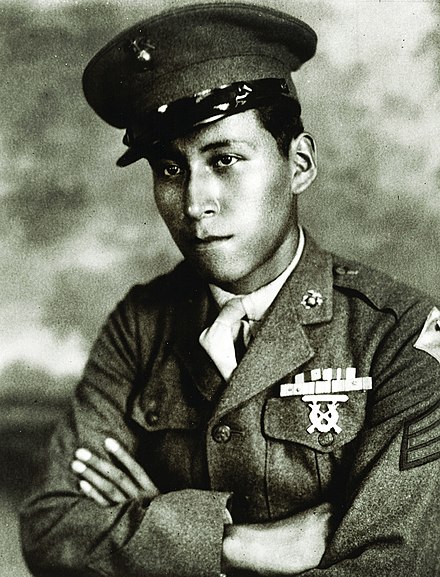
Picture of Mitchell Red Cloud in his Marine Corps uniform during World War II. Picture via Wikipedia.
With World War II over Red Cloud accepted his discharge from the Marines on November 9, 1945. The Marines gave him an honorable discharge and $56.70 before he returned to the Winnebago Indian Reservation in Wisconsin. While on the reservation Red Cloud got married and his wife gave birth to a daughter. Despite these personal developments in his life outside the military, Red Cloud decided after only two years on the reservation to reenlist in the US military. Red Cloud decided this time to not join the Marines, but instead the US Army in 1948. I wasn’t able to find anything definitive on why Red Cloud reenlisted in the military, but maybe he just grew restless after experiencing so much combat during World War II? Maybe it was just the more practical matter of providing for his family that caused him to reenlist in the military? His younger brother who had enlisted in the Army had just did in a peace time training accident; so maybe Mitchell enlisted in honor of his brother? Finally maybe he enlisted because after spending two years away from the Army he realized he is a true warrior and the military was his calling? For whatever the reasons were the US Army was getting an experienced soldier that was badly needed in the US military that had lost the vast majority of its combat veterans due to the post-World War II drawdown.
Red Cloud During the Korean War
The first unit Red Cloud was assign to was E company, 2 battalion, 19 Infantry Regiment of the 24th Infantry Division. The 24 ID at the time was responsible for conducting peacekeeping duties on the southern Japanese island of Kyushu. The assignment to Japan must have seemed like easy duty for Red Cloud compared to what he had been through during World War II. However, the relaxed time he spent in Japan didn’t last long when on July 3, 1950 the 24th ID was deployed to the Korean peninsula to stop the communist backed North Korean military that had invaded South Korea. The North Korean military crossed the DMZ that separates the two countries on June 25, 1950 and appeared to be on its way to reuniting the country that had been divided by US and Russian occupation forces after World War II. US President Harry Truman however decided to militarily intervene to stop the communist invasion of the Korean peninsula and the only troops immediately available to deploy to Korea were the peacekeeping troops located in Japan. Most of these troops were draftees that had not fought during World War II and had little combat training while stationed in Japan. Though these troops were eager to fight in what was being called a “police action” at the time; it would be up to hardened World War II vets like Mitchell Red Cloud to get these guys ready for battle. Red Cloud at the time of his deployment to Korea was a 25 year old Corporal who was respected by the men in his unit due to his prior combat experience. He had the nickname “Chief”, was easy going, and was quick to give advice to the younger troops that all looked up to him. They would soon learn to respect him even more.
Taskforce Smith soldiers arrive in Daejon during the Korean War, picture via Wikipedia.
Of the four US military divisions stationed in Japan, the 24ID was chosen to be the first to deploy to Korea. The first element of the 24th Infantry Division to arrive in Korea was the ill fated Taskforce Smith that first saw action against the North Korean military just south of Osan. The light infantry unit found themselves in battle against a foe with Soviet provided tanks and due to the superior firepower Taskforce Smith was soundly defeated. You can read more about Taskforce Smith at the below link:
Defeat would become a reoccurring theme for the other 24th ID units who were thrown into combat against the North Koreans with little to no weapons to combat the North Korean tanks. The battlefield chaos for the 24th ID reached its climax when the Division Commander Major General William Dean was captured during the Battle of Taejon. You can read more about General Dean at the below link:
This was the chaos that Corporal Red Cloud found himself in that most have been vastly different experience for him compared to his time in World War II. During that war he had fought in many successful battles against a much more dangerous enemy and now just a few years later he was part of one of the greatest military debacles in US history.
The 24th ID may have been soundly defeated by the North Koreans, but it and the other divisions from Japan that were thrown into battle, did enough to slow down the North Korean invasion until more troops from the US could arrive to help hold the Pusan Perimeter. Red Cloud and the rest of the men in the 2-19 Infantry Regiment saw combat soon after arriving in country on July 12, 1950. The unit saw combat during the defense of Daejon and then moved south towards Taegu and held part of the line along the Pusan Perimeter. Eventually General Douglas MacArthur would execute his famed Incheon Landing Operation that changed the course of the war and threw the North Koreans into a massive retreat. This allowed the 24th ID to reconstitute itself and soon enough Corporal Red Cloud and the rest of the personnel in the division were crossing the DMZ into North Korea to finish the war. In November 1950 the US military and its United Nations allies who had recently deployed troops to Korea, had advanced deep into North Korea when unbeknownst to them the Chinese military had decided to come to the aid of their communist ally North Korea. The unexpected attack by the Chinese caused the US and UN forces to a massive retreat that was quickly turning into yet another military debacle. This was the state of the war that Corporal Red Cloud now found himself in as he sat in a listening post on a hill north of the Chongchon River in North Korea on November 5, 1950.
The Chongchon River can be seen at the very bottom of the map which is located just north of the North Korean capitol city of Pyongyang. To the northwest of the river the positions of the 19th Infantry Regiment on November 1, 1950 can be seen. Map via Wikipedia.
The UN forces were in retreat and the bridge across the Chongchon River was a critical asset to support the southward movement of friendly forces. The 27th British Commonwealth Regiment which had just recently deployed to Korea and Red Cloud’s 19th Infantry Regiment were both positioned on the north side of the river to defend the bridge on November 2, 1950. Due to the shortage in personnel there was a five mile gap between the two units that was to be patrolled to prevent infiltration by the Chinese. However, the patrols ended up proving ineffective as the Chinese were able to successfully probe and discover this gap between the two units.
On the night of November 5, 1950 a 1,000 Chinese soldiers from the 355th Regiment were able to follow field telephone lines laid down in this gap to the positions of the 19th Infantry Regiment. Fortunately for E Company they had someone in a listening post that night that was awake and very attentive in looking for any Chinese infiltrating towards their position on Hill 123. That man was Corporal Red Cloud. A friend of Red Cloud’s in the company, Private First Class Ed Svach would later tell how Corporal Red Cloud had once told him that he could smell the Chinese coming. Red Cloud said, “It’s like hunting those Wisconsin deer. I can smell them coming.”
Red Cloud had been in a listening post that night with his assistant machine gunner on a ridge below the company command post. Red Cloud also knew how the Chinese liked to attack. The Chinese would launch a small frontal attack to draw attention that way but the main attack force would actually be infiltrating from the sides and rear. That is why Red Cloud set up his listening post to the side and rear of the company command post. At 3:20 AM in the morning Red Cloud let out a cry when he spotted Chinese infiltrating towards the E Company position who were following the communications wire leading to the command post. After being spotted the Chinese charged Red Cloud’s position from a 100 feet away and shot and killed his assistant machine gunner. Using his Browning Automatic Rifle (BAR), Red Cloud stood up out of his listening post and unleashed direct fire into the advancing Chinese. Red Cloud’s direct fire slowed the Chinese assault and bought time for the Company Commander, Captain Conway to wake everyone up and consolidate the defense of the E Company position. Unfortunately Red Cloud’s warning was not enough to alert everyone in the company in time because the Chinese were able to shoot some of the US soldiers in their sleeping bags. E Company was getting over run and one veteran of the battle is quoted in John McCain’s book, “Why Courage Matters” as saying:
“I wanted to bug out. I just couldn’t figure out how”
While Red Cloud was holding off the initial Chinese assault he was shot twice in the chest. One of the E company medics, Perry Woodley went to Red Cloud’s position and applied pressure bandages to his two chest wounds. Red Cloud seemed fine and continued to fire his BAR at the Chinese. Woodley left Red Cloud to go help other wounded soldiers. He returned a short time later to check up on Red Cloud again. He found Red Cloud surrounded by about a dozen Chinese bodies and more severely wounded than from when he last saw him.
Position of the 2-19 Infantry Regiment north of the Chongchon River where Corporal Mitchell Red Cloud Jr. was killed in action. Notice the area that the Chinese infiltrated through just west of the 2-19th’s position to get into their rear area. This was the gap between them and the British 27th Brigade which was mostly composed of Canadians that was supposed to be patrolled by both units to detect the Chinese. Map via Wikipedia.
Woodley told Red Cloud that he had to get off the mountain or he was going to die there. Red Cloud refused medical evacuation from his position and instead propped his wounded body up on a tree to continue firing at the advancing Chinese with the BAR. One soldier at the bottom Pete Salter said that he actually used a web belt to tie Red Cloud to the tree so he could stay up right to keep firing. Something not widely known about this battle is that another man, PFC Joseph Balboni stayed in a position near Red Cloud that created a crossfire that pinned the Chinese down enough for other men in the company to try and escape down a draw to the south.
After Woodley and Salter left the position they could hear the BARs from Red Cloud and Balboni continuing to fire on the advancing Chinese. The battle lasted for about an hour before Corporal Red Cloud and PFC Balboni would eventually be killed by the advancing Chinese. However by this time the men of E Company were well alert and retreating off the hill side from the massive Chinese assault to supplementary fighting positions a 1,000 yards to the south. From there the regiment was able to consolidate and make a defensive line to hold off any further Chinese attacks. There four quad 4′s with .50 cal machine guns were used to clear the hillsides of Chinese troops chasing the E Company survivors down the draw. Other units in the battalion would not be as lucky as E Company, if you can call E Company lucky. The nearby A Company would be nearly wiped out as many soldiers were killed while sleeping in their foxholes due to the surprise Chinese attack. E Company soldiers that survived that battle said that their unit likely would have been wiped out too if it wasn’t for Corporal Red Cloud holding off the Chinese attack.
The next morning with the sun out which provided air cover, the battalion was able to return to the old E company position to retrieve the bodies of the deceased. They found that the dead Americans soldiers had been stripped to include Mitchell Red Cloud. The only deceased soldier not stripped was 1st Lieutenant Leslie Kirkpatrick who had all of his clothes and gear on except for a missing West Point ring. Kirkpatrick had been killed while coming to the aid of a wounded soldier during the battle. His body was found with his head lying on his helmet as if he was sleeping. It is believed that one of the other lieutenants in his company placed his body like that after recovering his West Point ring to give to his wife. However, that lieutenant had been killed as well during the battle and the Chinese stripped his body and took the ring. Kirkpatrick was a 1949 graduate of West Point. Of the 670 cadets that graduated that year, 41 of them to include Kirkpatrick were killed in action during the Korean War.
Picture of Leslie Kirkpatrick as a cadet at West Point. Picture via SidneyLanier.org.
Red Cloud’s stripped down body was found lying near the tree where he died. He had been reportedly shot a total of eight times. All around Red Cloud were the bodies of Chinese soldiers. It was reported that over 30 Chinese bodies were found around Corporal Red Cloud’s position. Corporal Red Cloud’s recovered body would eventually be laid to rest in the United Nations Cemetery in Pusan. The other BAR gunner PFC Balboni would be credited with killing 17 enemy soldiers before being killed himself. PFC Balboni would posthumously be recognized with the nation’s second highest honor, the Distinguished Service Cross. In all the battalion estimated that about 500 enemy soldiers had been killed on the hill that day.
Post-Korean War Honors
A few months later in April 1951 the Congressional Medal of Honor was presented to Corporal Mitchell Red Cloud Jr.’s mother during a ceremony held at the Pentagon. She was presented the medal by General Omar Bradley. Here is what his Medal of Honor citation says:
At the Pentagon in April 1951, Lillian “Nellie” Red Cloud, mother of the late Cpl. Mitchell Red Cloud Jr., is handed the Medal of Honor awarded her son for his “dauntless courage and gallant self-sacrifice” against Chinese forces in North Korea the night of November 5, 1950. Gen. Omar N. Bradley, then-Chairman of the Joint Chiefs of Staff, is at left. ” – See more at: http://korea.stripes.com/base-info/cpl-mitchell-red-cloud-jr-annual-ceremony-planned#sthash.AZOcG1Oc.dpuf
Cpl. Red Cloud, Company E, distinguished himself by conspicuous gallantry and intrepidity above and beyond the call of duty in action against the enemy. From his position on the point of a ridge immediately in front of the company command post he was the first to detect the approach of the Chinese Communist forces and give the alarm as the enemy charged from a brush-covered area less than 100 feet from him. Springing up he delivered devastating pointblank automatic rifle fire into the advancing enemy. His accurate and intense fire checked this assault and gained time for the company to consolidate its defense. With utter fearlessness he maintained his firing position until severely wounded by enemy fire. Refusing assistance he pulled himself to his feet and wrapping his arm around a tree continued his deadly fire again, until he was fatally wounded. This heroic act stopped the enemy from overrunning his company’s position and gained time for reorganization and evacuation of the wounded. Cpl. Red Cloud’s dauntless courage and gallant self-sacrifice reflects the highest credit upon himself and upholds the esteemed traditions of the U.S. Army. for conspicuous gallantry and intrepidity in action at the risk of his life above and beyond the call of duty in Chonghyon, Korea, 5 November 1950.
At the Pentagon in April 1951, Lillian “Nellie” Red Cloud, mother of the late Cpl. Mitchell Red Cloud Jr., is handed the Medal of Honor awarded her son for his “dauntless courage and gallant self-sacrifice” against Chinese forces in North Korea the night of November 5, 1950. Gen. Omar N. Bradley, then-Chairman of the Joint Chiefs of Staff, is at left. ” Photograph via the Stars & Stripes
In 1955 his family was able to get his body moved from the UN Cemetery to the Ho-Chunk Cemetery on the Winnebago Indian Reservation back in Wisconsin so he could lay in rest with the rest of his tribe. His friend Ed Svach escorted the body back to the US where he remembered his friend being buried in the custom of the Winnebago people. The sides of his coffin were removed so his soul could escape, a bow and quiver of arrows was laid next to him so he could hunt in heaven, and bowl of fruit was laid next to him so head would have something to eat during the journey.
Mitchell Red Cloud Jr.’s grave in Wisconsin. Picture via FindaGrave.com.
In John McCain’s book, “Why Courage Matters: The Way to a Braver Life” he includes quotes from veterans from the battle that say they owe their lives to Mitchell Red Cloud. One of the survivors, Pete Salter said that during the battle he prayed to God in his foxhole to let him survive this fight and he would live a better life. He said his prayers were answered by Mitchell Red Cloud who sacrificed his life so many other men could survive. Salter in the mid-1960’s would take his kids to the Winnebago Indian Reservation to see the grave of Corporal Red Cloud. Salter broke down crying at the site of the grave of the man who had saved his life. Inscribed on Red Cloud’s grave are these words:
“The son of a Winnebago chief and warriors who believe that when a man goes into battle, he expects to kill, or be killed and if he dies he will live forever.”
Picture of marker above Mitchell Red Cloud’s grave site in Wisconsin. Picture via FindaGrave.com
Since Corporal Red Cloud’s death, the US military has made efforts to ensure that his memory does live forever by naming various military installations and equipment in his hnor. The first thing that I could find that was named after Red Cloud was when Camp Red Cloud in Uijongbu, South Korea was named after the Medal of Honor recipient.
Mitchell’s Club on Camp Red Cloud is named after him as well. There is also a rifle range on Ft. Benning, Georgia that is named after him. On August 7th, 1999 the newly commissioned strategic sealift ship, the USNS Red Cloud was launched from its dock in San Diego in honor of the fallen warrior. His daughter Annita Red Cloud, his granddaughter Tris Yellow Cloud, and other dignitaries from the Ho-Chunk tribe were there for the ceremony. Kenneth Kershaw, a veteran of E Company, 19th Infantry, who was able to survive the battle that night also attended the ceremony. He simply told the crowd that he attended the ceremony because “If it were not for the alarm sounded by Mitchell Red Cloud, I would not be here today.” The last commemoration I can find for Red Cloud was on the 50th anniversary of his death in 2000. The Korean War Commemoration Committee held a ceremony in honor of Red Cloud at his grave site in Black River Falls, Wisconsin. The committee presented Red Cloud’s daughter Annita with the Republic of Korea War Service Medal that had recently been authorized by Congress for Korean War veterans to wear.
Despite these attempts by the military to honor Corporal Red Cloud within the American public and even the US military his story is widely unknown. Red Cloud’s life story is why I have continued to advocate for Hollywood to explore using stories from the Korean War as movie material. A movie based around E Company with Mitchell Red Cloud as a main character and climaxing with the Battle of Hill 123 would make for a great movie. Red Cloud’s life is one to be remembered not just for his Korean War service, but for his service in World War II as well. There probably are not many US military servicemembers that fought at Guadalcanal and Okinawa during World War II and then the Busan Perimeter and then finally against the Chinese during their intervention into the Korean War. Clearly Mitchell Red Cloud Jr. is not only a Hero of the Korean War, but one of the nation’s most heroic military heroes that unfortunately few people know anything about.
Note #1: More stories about Heroes of the Korean War can be read at the below link:
Note #2:During my research I found only the two above photographs of Mitchell Red Cloud. If anyone knows of more photographs of Red Cloud please leave a link in the comments section.
Note #3:If anyone knows where to find a picture of PFC Joseph Balboni I would like to post his picture here as well.
Note #4: If anyone knows of any other buildings or site named after Mitchell Red Cloud Jr. please leave a comment and share it with everyone else.
While reading through his memoirs about his time in Korea he provides an extensive and very interesting history of how the naming of Camp Red Cloud in Uijongbu came to be:
Did I tell you the story about the naming of Camp Red Cloud? Well, I think this is worth telling. My compound there, the corps headquarters, had always been called Jackson Six, which was our telephone exchange. That seemed to me a rather inadequate name. I told somebody — my G-1, I guess, or PR officer, whoever it was — to start digging and find some people in this corps who got a Congressional Medal of Honor during combat and let’s name our compound here, our headquarters, for the most worthy. They came up with several names, and they had a couple of lieutenants. One of them was the Lieutenant Shea that I mentioned, who had just reported to my division and was killed on Pork Chop Hill. She was sort of a favorite of mine, because he held the two-mile record at West Point, about 30 seconds faster than I had held it 30 years before. I had a great feeling for Shea and when I went back home had a review and presented the decoration to his mother. Shea was one of the names, and there were two or three other lieutenants. I finally looked this list over and spotted the name of Corporal Mitchell Red Cloud. I thought that was interesting; what did he do. I got the citation, and Mitchell Red Cloud had done about everything a soldier could do; he charged a bunker and knocked off about 20 of the enemy and finally — even after he was badly wounded, tossed a grenade in a bunker before he died. So what about Mitchell Red Cloud? Well, Mitchell Red Cloud’s mother was the daughter of a chief of the Winnebago Indian Tribe. I said, “Now let’s get hold of all the records we can, and we’ll put in and get this camp named Camp Red Cloud.” I was thinking of the relationship between a native American and a native Asian. We did this, and I had a brass plaque made. I put the brass plaque on a tremendous rock on the more or less flat sloping side in front of I Corps (Group) headquarters, where it is today. We put it in front, right at our flagpole. On Armed Forces Day, 1957, I decided that we had the authority to redesignate and announce it at the Armed Forces Day meeting.
It was a lovely May day; I had all the Diplomatic Corps, President Rhee and his wife, Ambassador Dowling and his wife, General Decker, I believe, or White — all the Americans. We had about 150 people that were there for the ceremony and then for lunch at my club, which I had built or greatly extended across the street. They were sitting there. General Lemnitzer came over; he was always great because my wife had remained in Tokyo, so he brought her over. She was sitting in the front row of seats next to Mrs. Rhee. The President was standing there on one side of this curtain. I was going to say something about Camp Red Cloud, draw the curtain, and expose this plaque, and then the President was to make some remarks. This all happened; we pulled the cord and it worked, fortunately, and the brass was there, so I read what the brass plaque said. Then I said, “How wonderful it is that an American, a native American, an Indian whose ancestors lost their country to us, came over here to fight for the freedom of the native men of Asia.” I went on and built this one up for a little bit, and emphasized that he gave his life for the freedom of Asian people. I then turned it over to President Lee. Well, he said excitedly what a great thing this was. Mrs. Rhee was getting itchier by the moment because she knew that he frequently went of on tangents, and my wife was keeping her calm, saying, “Never mind everything is going to be alright.”
The President launched into this one. He said, “Yes American Indians are exactly like Asian people. I think American Indians came from Asia.” But then he said, “Why is it that all the time you have American movies over here, you show soldiers and cowboys killing American Indians? Asian people don’t like to see white men killing American Indians.” The he said, “Never again will a motion picture be shown in Korea that has the American soldiers or cowboys killing American Indians.” And they never have, but this doesn’t mean that our compound cannot. There was quite a “to-do,” Mrs. Rhee was so upset. I said, “This is nothing. What he said is true, but this happened more than a hundred years ago.” Of course to them this could be happening today. The dates aren’t shown frequently, and they think this is still going on out in the West. It is bad psychology.
Before I left there to come back to the United States at the end of that year, the end of 1957, I wrote back to G-2 and I said, “Listen, you have got to go out and get me tow of the finest pictures, portraits, grand portraits of American Indian chiefs that you can get for me to present to President Rhee.” Mrs. Trudeau and I were invited there for dinner at Chung Mu Dae, now the Blue House, with President and Mrs. Rhee. He presented me with another Korean decoration and then I said, “Your Excellency (or Mr. President), I have a presentation I would like to make to you.” He said, “Certainly.” So we went into the next room. The portraits were on the wall. I had this all planned with his people bringing him in and then we were going to flip the covers back. I said, “Mr. President, you remember the day we named the I Corps Headquarters Camp Red Cloud for Mitchell Red Cloud, the American Indian who came to fight for your freedom in Asia?” He said, “Oh, yes, I remember”. “Well,” I said, “I want to show you, I want to present to you a pair of portraits of other famous American Indians who are high in our esteem in our country also.” I’ve forgotten which ones they were, but I presented them to him; he thought it was tremendous. Goddam it, they looked more like him than he did himself, if he had a headdress on. It was terrific!
This was a very interesting read and I have to wonder what ever happened to those two portraits? I wonder if they are still on display in Cheongwadae?
Note:You can read more GI Flashbacks articles by clicking on the below link:
Private First Class Anthony T. Kaho’ohanohano via Army.mil.
Introduction
The Korean War saw people from many countries come to the peninsula and fight and die to protect the Republic of Korea from communist aggression. Some of those people who came to Korea to fight were Americans from the Hawaiian Islands. In downtown Honolulu the Hawaii Korean War Memorial can be seen that lists the names of all 456 residents of Hawaii who died fighting in the Korean War. The memorial is about a 100 feet in length, 6 feet high and made of polished granite and black lava rock. On each of the rock squares is the name of each Hawaii resident that died during the war.
Early Life
One of the names on these blocks is Anthony T. Kaho’ohanohano from the Hawaiian Island of Maui. Kaho’ohanohano was born in 1930 to a family with 5 other brothers and a sister. This large family lived in a two bedroom house in the village of Wailuku in Maui. Anthony graduated in 1949 from St. Anthony High School where he played both football and basketball and was known as the “humble giant”. After high school he like all of his other 5 brothers joined the military; three of his other brothers joined the active Army, one other brother served in the Marines, and the last brother served in the National Guard. Anthony initially enlisted in the Hawaii National Guard, but later joined the active Army on February 5, 1951 to fight in the Korean War.
Picture of Kaho’ohanohano as a high school football player via Wikipedia.
Korean War Service
Anthony Kaho’ohanohano was later that year deployed to South Korea where UN forces were battling communist aggression against the Republic of Korea. By 1951 the war had changed dramatically from what appeared was going to be a rout of the North Korean military by the UN forces after the successful Incheon Landing Operation. With the North Korean forces largely defeated the Chinese military secretly infiltrated across the Yalu River into North Korea where they launched a massive surprise attack against the UN forces. The effectiveness of the Chinese surprise attack caused a full scale UN forces retreat back across the 38th parallel into South Korea. The retreat was only halted in February 1951 when soldiers from the 2nd Infantry Division and their attached French Battalion under the command of two Heroes of the Korean War, Colonel Paul Freeman and Lieutenant Colonel Ralph Monclar stopped the Chinese advance at the Battle of Chipyong-ni.
The Chinese would attempt to regain their battle field momentum when they launched the “Chinese Spring Offensive” in April 1951. However, United Nations units such as the British Gloucestershire Regiment commanded by Lieutenant Colonel James P. Carne, the Philippines Expeditionary Force To Korea (PEFTOK) commanded by Lieutenant Colonel Dionisio Ojeda, and the Princess Patricia’s Canadian Light Infantry commanded by Lieutenant Colonel J.R. Stone were able to stop the Chinese advance. After the failed “Chinese Spring Offensive” the Korean War had largely turned into a stalemate near the 38th parallel where the opposing Army’s battled over hilltops that gave each side increased leverage during the Armistice Negotiations that had begun July 10, 1951 at Kaesong.
This is the war that Private First Class Anthony Kaho’ohanohano found himself entering in 1951when he was assigned to Company H, 17th Infantry Regiment, 7th Infantry Division. In August, 1951 the 7th Infantry Division was deployed along the frontlines in the area north of Hwacheon which is an extremely mountainous region in the central area of the Korean peninsula.
This mountainous area made the control of high points extremely important in order to call for indirect fire and to better control the few roads in the area. The 7th Infantry Division launched an operation on August 26, 1951 that would come to be known as the Battle of Chup’a-ri. The small village of Chup’a-ri was located in one of the main valleys in the area and the 7th Infantry was attempting to seize five key hills to the east of the village that would allow them to better control the valley and the road that ran through it. Additionally the control of these hills would put the UN forces in a better position tactically to reclaim the Kumsong River located two miles north of Chup’a-ri.
The 17th Infantry Regiment of the 7th Division that PFC Kaho’ohanohano was assigned to was tasked to secure three of these hills. On August 26th the regiment began combat operations to secure Hill 461 that overlooked the valley and its access road, Hill 682 that was a mile to the east of 461, and Hill 851, which was one more mile east of 682. For the next five days the regiment battled the Chinese 81st Division for control of these hills. PFC Kaho’ohanohano’s company was part of the 2nd Battalion which was tasked to assault Hill 682. By this point in the war, Anthony had found himself as the leader of a machine gun squad within his company. On August 31, the unit was able to secure the hill, but the Chinese launched a massive counterattack against the 2nd battalion. The fighting was ferocious with the Chinese blowing whistles to signal the next human wave attack against the American positions. The overwhelming Chinese attacks eventually caused the 2nd Battalion soldiers to begin to withdraw off of Hill 682 the next day.
During the initial Chinese assault Kaho’ohanohano was wounded in the shoulder, but continued to fight on. When his company began their withdrawal PFC Kaho’ohanohano ordered his squad to take up better positions lower down the hill while he provided covering fire for them. Kaho’ohanohano gathered a satchel of grenades and extra ammunition to use against the on coming enemy. His last words were reported to be “I’ve got your back” as he headed back to a position to hold off the Chinese attack. The extra ammunition would not be enough though as Anthony eventually ran out of ammo and had to turn to his entrenching tool to fight off the enemy until he was killed. He had fired so many rounds from his rifle that it had actually melted and was found bent. Seeing his final stand against the Chinese, Kaho’ohanohano’s comrades charged back up the hill and defeated the Chinese onslaught. When his unit re-secured the hill they found 11 dead Chinese bodies around Kaho’ohanohano’s position and two more found dead inside his position apparently killed by blunt force trauma to the head from Kaho’ohanohano’s entrenching tool.
By September 4th, the 7th Infantry Division had captured all 5 hills in the vicinity of Chup’a-ri, but PFC Kaho’ohanohano was far from being the only person killed during the battle. In just his unit 17 other soldiers died defending Hill 682. In total the 7th Infantry Division lost 175 soldiers with 594 more wounded in the Battle of Chup’a-ri. What did the lives of all the soldiers gain the UN forces? Well if you look at a map of South Korea it ultimately helped the UN forces consolidate about 10 square miles worth of territory. Think how many more lives the Chinese lost trying to defend that territory? Life was definitely cheap back then.
Kaho’ohanohano for his actions received the Army’s second highest decoration for combat, the Distinguished Service Cross in 1952. However, his family believed that he deserved the nation’s highest honor, the Medal of Honor for his heroism during the Battle of Chup’a-ri. Considering that another soldier in his battalion Corporal William F. Lyell was awarded the Medal of Honor for doing nearly the same thing as Kaho’ohanohano did during the battle, it would seem his family had a strong case. However, it would take 60 years before the Kaho’ohanohano family would see Anthony be recognized with the Medal of Honor. US Senator from Hawaii Daniel Akaka requested in 2004 that the Pentagon review Kaho’ohanohano Distinguished Service Cross documentation to see if it should be upgraded to a Medal of Honor. Senator Akaka has long been an advocate for veterans from Hawaii. In 2000, he was able to get 22 veterans of Asian and Pacific ancestry to include 20 of them from the famed 442 Regimental Combat Team the Medal of Honor for combat actions during World War II. Many advocates for these veterans believed that these minorities may have been overlooked for the Medal of Honor by commanders that were prejudice against minorities.
President Obama presents George Kaho`ohanohano, the nephew of Army Pfc. Anthony T. Kaho`ohanohano, a posthumous Medal of Honor during a White House ceremony.
The President of the United States Barack Obama, who was born in Hawaii himself, must have agreed as he upgraded Kaho’ohanohano’s Distinguished Service Cross to the Medal of Honor. On May 3rd, 2011 at a White House ceremony President Obama presented PFC Kaho’ohanohano’s family with the Medal of Honor.
George Kaho’ohanohano, a retired Maui Police Department captain, also said it was a relief that their hard work had come to fruition. He added that he had a “lump” in his throat when he received the medal from Obama.
“When I looked at the family when I got it from the president, I saw couple of the family members crying; I saw a couple of family members with a broad smile. It was a wide range of what the family was going through,” he said. [Maui News]
Here is Private First Class Anthony Kaho’ohanohano’s Medal of Honor citation:
The President of the United States of America, in the name of Congress, takes pleasure in presenting the Medal of Honor to (Posthumously) to Private First Class Anthony T. Kahoohanohano (ASN: RA-29040479), United States Army, for extraordinary heroism in connection with military operations against an armed enemy of the United Nations while serving with Company H, 2d Battalion, 17th Infantry Regiment, 7th Infantry Division. Private First Class Kahoohanohano distinguished himself by extraordinary heroism in action against enemy aggressor forces in the vicinity of Chup’a-ri, Korea, on 1 September 1951. On that date, Private Kahoohanohano was in charge of a machine-gun squad supporting the defensive positions of Company F when a numerically superior enemy force launched a fierce attack. Because of the overwhelming numbers of the enemy, it was necessary for the friendly troops to execute a limited withdrawal. As the men fell back, he ordered his squad to take up more tenable positions and provide covering fire for the friendly force. Then, although painfully wounded in the shoulder during the initial enemy assault, he gathered a supply of grenades and ammunition and returned to his original position to face the enemy alone. As the hostile troops concentrated their strength against his emplacement in an effort to overrun it, Private Kahoohanohano fought fiercely and courageously, delivering deadly accurate fire into the ranks of the onrushing enemy. When his ammunition was depleted, he engaged the enemy in hand-to-hand combat until he was killed. His heroic stand so inspired his comrades that they launched a counterattack that completely repulse the enemy. Coming upon Private Kahoohanohano’s position, the friendly troops found eleven enemy soldiers lying dead before it and two in the emplacement itself, beaten to death with an entrenching shovel.
Pfc. Anthony T. Kaho’ohanohano [KA ho OH hano hano]
– Killed in Action Sept. 1, 1951 in Chupa-ri, Korea
– Age: 21 years, 2 months
– Unit: Company H, 17th Infantry Regiment, 7th Infantry Division
– Years of Service: 3 years, 3 months, prior service with Hawaii National Guard. Enlisted with the U.S. Army Feb. 5, 1951
– Awards: Purple Heart (posthumously), Army Good Conduct Medal (posthumously), National Defense Service Medal, Korean Service Medal with one Bronze Service Star, United Nations Service Medal, Republic of Korean-Korean War Service Medal, The Republic of Korea’s Wharang Distinguished Military Service Medal with Silver Star (posthumously), Combat Infantryman Badge, Republic of Korea-Presidential Unit Citation
Anthony Kaho’ohanohano is buried at the Makawao Veterans Cemetery on the slopes of Maui’s gigantic volcano called Haleakala. In February 2012 the US military replaced his headstone to signify that he is a Medal of Honor recipient. This replacing the headstone was the ultimate closure for Private First Class Kaho’ohanohano’s family who had fought for so long to see that he received the recognition he deserved as a Hero of the Korean War.
Note: You can read more of the ROK Drop featured series Heroes of the Korean War at the below link:
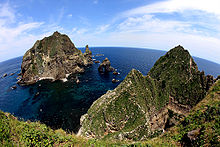
A 55-year-old man reportedly consumed poison Friday in an apparent suicide attempt with a note urging the need to “stand up against” Japan’s claim to Korea’s easternmost islets of Dokdo, police said.
The man, only identified by his surname Choi, was rushed to a nearby hospital after he was found lying unconscious in front of the National Cemetery in southern Seoul around noon after reportedly consuming a bottle of weed killer to take his own life, according to police officials.
A suicide note was found in a notebook inside Choi’s car that was parked in front of the cemetery, which reads, “The Japanese government, which had once colonized this country, is now trying to take away the Dokdo islets from us as well. We must not succumb to their claims but must stand up against them.”
Choi had written several letters in the notebook containing similar contents that were addressed to the president of Korea and members of the National Assembly, and he was also found to have been carrying a flag with the slogan “Dokdo belongs to us (South Korea),” police said.
Family members said Choi was an ordinary citizen who has never joined any activist groups or taken part in such protests, but added that he began telling friends that he was “so angered by Japan” through text messages since last month. [Korea Times]
Players from Spain and Japan compete in a preliminary match at the three-day 2012 Federation Internationale de Volleyball Ulsan Women’s Beach Volleyball Exhibition which kicked off yesterday at Jinha Beach, southern Ulsan. Ten teams from nine countries, including Austria, the U.S. and the Netherlands are participating. [NEWSIS]



 Camp Red Cloud’s main gate in 1966. Picture from Flickr user Ottmar.