That is what the National Interest answers for its readers:
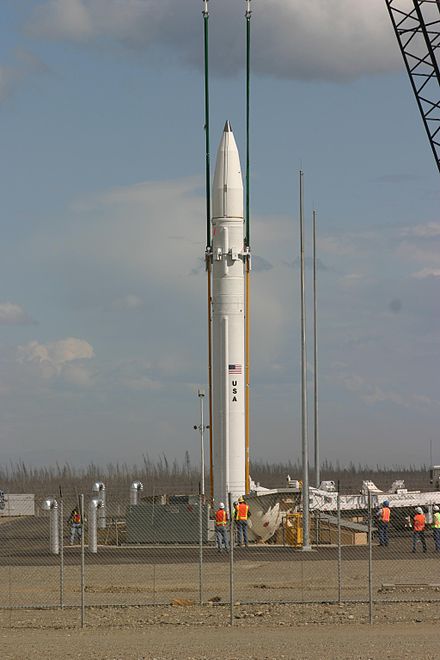
Ground Based Interceptor at Ft. Greeley, Alaska via Wikipedia.
But as with almost all North Korean developments and proclamations from the exalted “supreme leader” Kim Jong-un, it’s hard to say what’s real and what’s a delusional fantasy. Nonetheless, Washington has to take the possibility of a nuclear-tipped North Korean ICBM seriously. What, then, can the United States do to stop a North Korean ICBM that’s headed towards the American homeland?
To a large extent the United States has prepared from this eventuality. The best way to stop a North Korean ICBM would be to eliminate the target before it’s launched. But if the regime in Pyongyang—in a move that would guarantee a devastating U.S. nuclear retaliation—manages to launch a missile towards an American city, Washington has an operational missile defense system in place.
The Missile Defense Agency’sGround-based Midcourse Defense (GMD) element provides Washington the ability to destroy a limited number of incoming intermediate and long-range ballistic missiles threats in space to defend the United States. There are interceptors already in place at Fort Greely, Alaska, and at Vandenberg Air Force Base, California. Right now there are a total of thirty interceptors deployed, but there are plans to add fourteen more missiles. [National Interest]
You can read more at the link about other missile defenses the US has, but first of all launching an ICBM at the US would be a weapon of last resort since the US response would be so devastating against the North Koreans. Additionally the rocket they are threatening to fire now would be easy to destroy left of launch since it takes days to prepare it for launch. That is why the North Koreans have fielded the KN-08 ICBM that is road mobile and much more easier to launch. However, it has never been tested and many have claimed they are mock ups.
For all we know the Kim regime could be playing the same games that Saddam Hussein did with exaggerating his military capability. However, military leaders have to prepare for the worst case a threat poses and thus why the Kim regime’s threats are taken so seriously.
North Korean leader Kim Jong-un (C) is featured being heartily greeted by women workers of the Kim Jong Suk Pyongyang Textile Mill that he visited in this photo carried by the country’s official media, the Korean Central News Agency, on Jan. 28, 2016. The news report said Kim expressed deep satisfaction “picturing to himself students going to and from school with cheerful laughter, carrying with them locally produced fashionable bags” manufactured at the facility. (Yonhap)
The data inconclusive, but I would not be surprised if the North Koreans did in fact test some hydrogen bomb components:
The U.S. now believes North Korea might have attempted to test components of a hydrogen bomb on January 6, after further review and analysis of the latest intelligence information.A U.S. official directly familiar with the latest U.S. assessment said there may have been a partial, failed test of some type of components associated with a hydrogen bomb. The assessment comes after careful examination of the latest intelligence analysis of the test data.
But the official emphasized there is no final conclusion.Immediately following the test earlier this month, White House Press Secretary Josh Earnest said the initial analysis that have been conducted was “not consistent” with a successful hydrogen bomb test.The U.S. still does not accept North Korea’s claim that it tested a hydrogen bomb, but air sampling conducted after the test has proved inconclusive, the official said. That prompted another look at the seismic data.
That analysis shows the test was conducted more than two times deeper underground than originally assessed — at a depth consistent with what might be needed for a hydrogen bomb.However, the size of the seismic event and other intelligence indicates it was not likely a fully functioning device. The official said it’s possible the North Koreans believe they conducted a full hydrogen bomb test, but the U.S. believes it was likely only some components, perhaps a detonator, that exploded. [CNN]
I never had the chance to see the K-2 cross a river before, but having this capability is needed in South Korea with its many deep rivers:
A South Korean K-2 “Black Panther” tank sports an unusual-looking piece of equipment in this YouTube video. The tank, crossing a 13 foot deep river during a military exercise, is using a so-called fording kit to allow it to drive across the river bottom.
Bridges are often destroyed in wartime, and the pace of operations may mean only a limited number of portable bridges may be available. The solution to a potentially deadly traffic bottleneck: unlike many military vehicles, tanks are usually waterproof and their tracks still work underwater-so why not drive them underwater? (………….)
Modern fording kits typically consist of a single smokestack-like pipe that connects to the tank commander’s hatch. This allows the tank commander to sit at the top, where he can keep an eye on the tank’s progress. The stack also serves as an escape hatch for the crew in case of emergencies. [Popular Mechanics]
South Korean and U.S. marines run through a snow-covered field carrying each other over their shoulders at a mountain training center in Pyeongchang, east of Seoul, on Jan. 28, 2016. The marines from the two countries conducted the joint drill, set in extreme cold winter conditions, to enhance their combined military capability. The U.S. maintains about 28,500 troops in South Korea as a deterrent against North Korea after the 1950-53 Korean War ended in a truce, not a peace treaty. (Yonhap)
The house shown in the photo, owned by Lee Myung-hee, chief of the Shinsegae Group, is the most expensive “standard” private home in the country, according to the appraisal released by the land ministry on Jan. 28, 2016. Standard houses are selected samples whose prices serve as the basis against which other houses are appraised. The official price of Lee’s house, with 2,861.83-square-meter floor space that sits on 1,758.9 square meters of land in central Seoul, was valued at 12.9 bilion won (US$10.7 million). Lee is the daughter of Lee Byung-chull, the founder of Samsung Group, and the younger sister of Samsung Group chairman Lee Kun-hee. (Yonhap)
Reading the details of this bomb found at Incheon International Airport makes it sound like this may have been more of a hoax then some warning from a Islamic extremist group. I am sure the ROK authorities are scouring over video footage to try and pin point who left the device and hopefully we will get answer soon:
Police said Saturday that they have found a warning message written in Arabic inside a box recently discovered at South Korea’s main airport that raised terror alarms in the country.
The message, which was written in Arabic on a sheet of paper half the size of A4, reads, “This is the last warning to you. God will punish.”
It was not a handwritten but a printed sentence with some grammatical errors, according to the police, who suspected that it could have been translated by a computer program or by a person whose Arabic skill is not that good.
The discovery was announced a day after the police found a box suspected to contain explosive devices in a men’s bathroom in Incheon International Airport.
The area was cordoned off, but no explosives or detonators were found, just with two butane canisters and one bottled water taped to it.
Also found inside the box, along with the warning message, were guitar strings, electric cords, batteries and some pieces of vegetables, the police said. [Yonhap]